Self Serving Future Generation
E-Famulus
Anju Sebastian1, Shahaziya Parvez M.2
UG Student, Dept. of AEI, IES College of Engineering, Chittilappilly, Thrissur, Kerala, India1
Assistant Professor, Dept. of AEI, IES College of Engineering, Chittilappilly, Thrissur, Kerala, India2
ABSTRACT: The scope of this paper is to implement the transparency and importance in famulus facility function in a firm. We, in this method intend to make their organisation to reduce the salary part which is given to a permanent human famulus. The main objective of this study was to design and implement fully automated attender functions using system. This system can be replacing the human attender in large number to a single automated system. This system can be implementing on colleges, hospitals, industries etc in any firm where famulus function is done. The system was designed with the micro processor Atmega 8, using the development board of Atmel board. We made this E-famulus system more secure by introducing the RFID technology. When the system get ready to used, thus just show your RFID card on the reader module and after at a particular range card reads and code matches, corresponding box will open and the item to be delivered can be transferred or if any circulars are released by Head of the firm placed in the system can received by in-charge. By this paper we can ensure that heavy burden loaded to human famulus is reduced, only system maintenance is needed and therefore one embedded developer is needed to that firm. Salary can be reduced which is given to the attenders. E - Famulus is a relevant solution to all these above existing system.
KEYWORDS: E-famulus, famulus, E - Famulus, RFID, automated system
I.INTRODUCTION
In the modern and fast growing world we are having a boom in all sectors with administrative departments and their own wings with many sub departments. So whatever the decisions which are taken in the administrative departments those have to be transferred to the down floor in big firms .so to carry all information to the down floor an attender is needed .Here an famulus plays a vital role in transferring the information and also to give the things which are needed by the authorities in sub departments with higher integrity in transferring information. For the prototype we are using Atmel Board.. The AVR was one of the first microcontroller families to use on-chip flash memory for program storage, as opposed to one-time programmable ROM, EPROM, or EEPROM used by other microcontrollers at the time. The hardware consists of open-source board designs based on various 8-bit Atmel AVR micro controllers or 32-bit Atmel ARM processors. In this paper we use RFID module. RFID tags are used to identify.
In recent scenarios all public and private sectors need a large number of attenders for departments to sub departments and the number may vary according to the number of persons working in the firm for doing the famulus work. Now a firm should annually separate some amount, for giving salary to the attender department. Instead the firm administrative can spend this money in terms of some other productive purpose to increase their profit ratio. So we the students thought of this problem and we formulate some ideas regarding this and we thought to implement this in a practical way by making a small prototype and is explained in brief. So we made a prototype and for doing the work as attender by replacing a human famulus in our department and the work which is assigned for it is as follows.
system. This paper is designed to minimize the large number of attenders for departments to sub departments and the number may vary according to the number of persons working in the firm for doing the attender work.
II.EXISTING METHODS
Existing system are now a day’s presently are line following robots .The simple robot is designed to be able to follow a black line on the ground without getting off the line too much. The robot has two sensors installed underneath the front part of the body, and two DC motors drive wheels moving forward. A circuit inside takes and input signal from two sensors and controls the speed of wheels’ rotation. The control is done in such a way that when a sensor senses a black line, the motor slows down or even stops. Then the difference of rotation speed makes it possible to make turns. For instance, in the figure on the right, if the sensor somehow senses a black line, the wheel on that side slows down and the robot will make a right turn.
Line follower is a system that can follow a path. The path can be visible like a black line on a white surface (or vice-versa) or it can be invisible like a magnetic field. Sensing a line and manoeuvring the robot to stay on course, while constantly correcting wrong moves using feedback mechanism forms a simple yet effective closed loop system. As a programmer you get an opportunity to ‘teach’ the robot howto follow the line thus giving it a human-like property of responding to stimuli. Practical applications of a line follower: Automated cars running on roads with embedded magnets; guidance system for industrial robots moving on shop floor etc.
III. E-FAMULUS (ELECTRONIC –ATTENDER)
E-Famulus (Electronic -Attender) is a robotics based technology extended to the attender functioning. The first uses of modern robots were in factories as industrial robots-simple fixed systems capable of manufacturing tasks which allowed production without the need human assistance. Digitally controlled industrial robots and robots making use of artificial intelligence have been built since the 1960s.And the attender functioning system point outs the functions of an attender in a firm. Attender is responsible to work with human resource department, general office administrative and executive support.
In coverage, all public and private sectors need a large number of attenders for departments to sub departments and the number may vary according to the number of persons working in the firm for doing the attender work. Now a firm should annually separate some amount, for giving salary to the attender department. Instead the firm administrative can spend this money in terms of some other productive purpose to increase their profit ratio. So we the students thought of this problem and we formulate some ideas regarding this and we thought to implement this in a practical way by making a small prototype and are explained in brief.
To overcome above mentioned problems, so we the students thought of this problem and we formulate some ideas regarding this and we thought to implement this in a practical way by making a small prototype and are explained in brief. Mainly we focussed on colleges -Basically here we presenting a line follower robot –prototype replacing the human attended. By detecting the required path according to programme, it reach infront of the room. Each faculty is provided with specific RFID tag. When it shows and it matches the reader corresponding box will open, As in the college campus mobile phones are prohibited, If any student uses mobiles in class room the concerned faculty can take the mobile from them and can be handed over to HOD by using our proposed attender system . At the starting of our class the concerned staff need s chalk piece so it is designed as such that it will carry chalk to all classes. And dusters are also transferred to various classes. The circulars from the head of the department to various staff rooms are also transferred.
IV. SOFTWARE DESCRIPTION
AVR microcontrollers.AVR studio runs under Microsoft windows95 and Microsoft Windows.NT. AVR studio enables execution of AVR programs on an AVR in-charge emulator or the built-in AVR instruction set simulator.Inorder to execute a program using AVR studio, it must first be complied with IAR system’s C complier or assembled with Atmel’s AVR assembler in Fig. 1 to generate an object file which can be read by AVR studio as given below.
Fig. 1 AVR studio
Proteus is software for microprocessor simulation, schematic capture, and printed circuit board (PCB) design. It is developed by Lab centre Electronics. The Proteus Design Suite is wholly unique in offering the ability to co-simulate both high and low-level micro-controller code in the context of a mixed-mode SPICE circuit simulation. With this Virtual System Modelling facility, you can transform your product design cycle, reaping huge rewards in terms of reduced time to market and lower costs of development.
Proteus Virtual System Modelling (VSM) combines mixed mode SPICE circuit simulation, animated components and microprocessor models to facilitate co-simulation of complete microcontroller based designs. For the first time ever, it is possible to develop and test such designs before a physical prototype is constructed.
The Fig 2 shows Proteus simulation of the proposed system as per the E –Famulus functions and objectives. The whole system confined to software and implemented.
V. DESIGN OF FLOWCHART
The proposed system E- Famulus flowchart is given below. Each and every directions predefined to the system are clearly executed in this flowchart. From this, it easy to access the commands given to the system for its betterment of function.
VI .RESULT
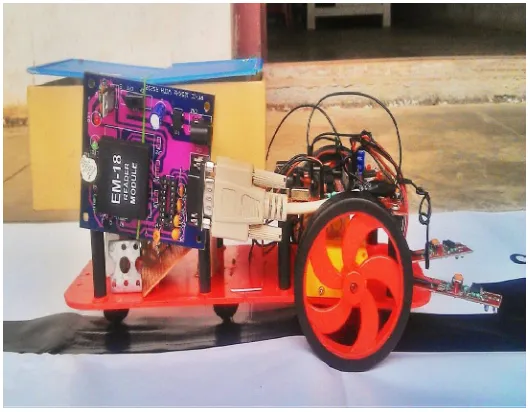
Proto type of the proposed system was designed and implemented using Atmel AVR development board, and the expected result was obtained. The Fig.4 given below shows the implemented proto type. By this paper we can ensure that heavy burden loaded to human famulus are reduced .Only system maintenance is needed for this system and therefore one embedded developer is to be recruited for that firm. Salary can be reduced which are given to the attenders. E – Famulus is a relevant solution to all these above existing system.
Fig.3 E- Famulus Logic Table
LEFT MOTOR RIGHT MOTOR E – FAMULUS MOVEMENT
STRAIGHT STRAIGHT STRAIGHT
STOP STRAIGHT LEFT TURN
REVERSE STRAIGHT SHARP LEFT
STRAIGHT STOP RIGHT
STRAIGHT REVERSE SHARP RIGHT
Fig. 3 shows the basic E- Famulus systems logic table. From this we can access the motion of the system and the further development can be modified using this logic table.
Fig. 4 Two box prototype E- Famulus
The above Fig. 4 represents small prototype with two box service. We can also stack the number of boxes according to the increase of number of users which the message is intended for the purpose. It represents is with open circuit for easy demonstration purpose. As per the firm they can decide enclose over the prototype. And also if they require they can also have mechanical design for the boxes.
VII.CONCLUSION
Our paper focuses design and implementation of .E - Famulus. In recent scenario, all the public and private sectors go for automation in their process. But, in the case of attender it is still manual. In many places, there is only one attender for all the work..Thus workload will be greater and it will be inefficient. Through our paper, it will be easier and efficient. We can allot this system for each department and for all these systems; we need only one manual operator. Thus workload and salary expenses can be reduced and saved money can be use to the growth of the firm.
Here, we using microcontroller based system. The Atmel AVR consist processor of Atmega8. It is very powerful processor and very easy to programming. The program is written in AVR Studio4 software, is based upon embedded C language. We interfaced different I/O modules for the system like RFID module, IR sensors etc.Simulation of the system E-Famulus was completed successfully on proteus. This system will make a new step in the public and private sectors in India and all over the world.
REFERENCES
[1] .Bajestani, S.E.M, Vosoughinia.A,”Technical report of building a line following robot”. International conference on electronics and information engineering (ICEIE 2010) vol 1,pp v1-1, v1-5,2010.
[2] .Deepak Punetha, NeerajKumar, VarthikaMehta,”Development and applications of line following robot based health care management system” ISSN: 2278-1323 International journal of advanced research in computer engineering and technology (IJARCET) volume 2,issue 8,(August 2013).
[3]. M.ZafriBaharuddin, Izham.Z.Abidin, S.SulaimanKajaMohideen, YapkeemSiah, Seffray Tan Too Chuan,”Analysis of line sensor configuration for the advanced line follower robot”, UniversityTenegaNasional.
[4]. Nov Maniha Abdul Ghani,FaradilaNaim,TanPiowYon,”Two wheels balancing robot with line following capability”. World academy of science, engineering and technology,pp-634-638,2011.