Speed Control Induction Motor with
Feedback
Amal V C1, Anusree Anilkumar2, Thasni V M3, Divya Haridas4
B.Tech Student, Dept. of EEE, Ilahia College of Engineering and Technology, Ernakulam, Kerala, India1
B.Tech Student, Dept. of EEE, Ilahia College of Engineering and Technology, Ernakulam, Kerala, India2
B.Tech Student, Dept. of EEE, Ilahia College of Engineering and Technology, Ernakulam, Kerala, India3
Assistant professor, Dept. of EEE, Ilahia College of Engineering and Technology, Ernakulam, Kerala, India4
ABSTRACT: The project is proposed to control the speed of induction motor with feedback.Speed is controlled by varying the volltage across the motor.It is established by a triac.voltage is varied by changing the firing angle of triac.Firing angle control is obtained by a microcontroller Atmega 328.While controlling the speed of motor a speed sensor will give feedback to the microcontroller so that optimal monitoring of the system is established. For feed backing, the speed is measured using microcontroller.A display unit is also provided so that real time speed can be viewed.Any variation in the speed is regulated.power supply consists of a step down transformer 230/12V, which steps down thevoltage to 12V AC. This is converted to DC using a Bridge rectifier. The ripples are removed using a capacitive filter and it is then regulated to +5V using a voltage regulator 7805 which is required for the operation of the microcontroller and other components
KEYWORDS: Flow chart and Softwares,Working
I.INTRODUCTION
Now a days control systems are widely used to minimize human effort and increase the production rate with good quality so most of the machine used in the production stream uses induction motor with variable speed. The main aim of this project is to control the speed of induction motor by varying voltages to the motor by using thyristor .Based on the principle of firing angle control of thyristors one can control ac power A display unit the full or any percentage and one can enter the desired percentage to reduce power to load. The firing angle would automatically adjust to maintain the load power .The above operation is carried out by using TRIAC in series load.It uses micro controller ATmega8.The power system consist of step down transformer 230/12v which step the voltage to 12v.This is converted to dc using bridge converter .The ripples generated are removed using a capactive filter and it is then regulated to +5v using a voltage regulator which is used for the operation of microcontroller and other components. The controller is interfaced with LCD display to continuously monitor the speed.A zero crossing detector circuit is used here to interrupt ATmega8 . After getting an interrupt micro controller will fire after some delay this will cut the supply to motor and so the speed will reduce.A proximity sensor is added to detect the speed of motor.here a feed back circuit is used . The PID controller continuously calculate the error value .According to the error value firing angle of triac is varied so that voltage supply changes and speed is controlled.An octo coupler is provided for circuit protection.If the Triac is damaged there is a chance to enter the fault current in Atmega 8 to avoid the accident.By this project we are introducing a new method to control the speed of induction method by simple and economical way.
II.LITEARTURE SURVEY
III.BLOCK DIAGRAM
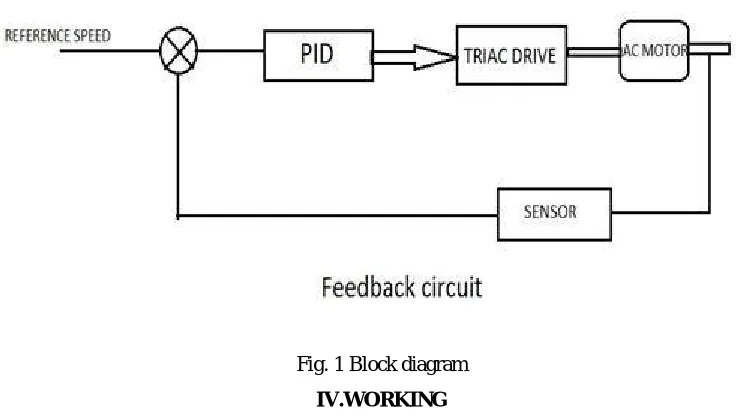
PID CONTROLLER: Proportional-Integral-Derivative (PID) control is the most common control algorithm used in industry and has been universally accepted in industrial control. The popularity of PID controllers can be attributed partly to their robust performance in a wide range of operating conditions and partly to their functional simplicity, which allows engineers to operate them in a simple, straightforward manner.Here it continuously calculates the error value as the difference between reference speed (that is the speed which is given) and actual speed of the induction motor.this value will given to triac drive.
TRIAC DRIVE: According to error value produced by the PID the triac drive fires the triac .Firing angle will be proptional to the error value is produced.Voltage supply is controls by the triac drive.
PROXIMITY SENSOR: Proximity sensor measures the actual speed of induction motor and value will gives to PID.
Fig. 1 Block diagram
IV.WORKING
V. FLOW CHART
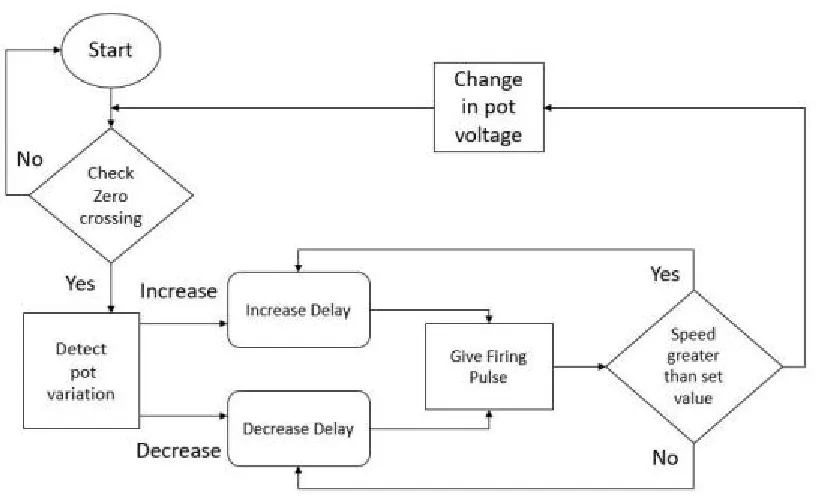
Fig 2 Flow chart
VI. SOFTWARE USED
Kiel: Support every level of software developer from the professional applications engineer to student in learning about embedded software development. When starting a new project, simply select the microcontroller and µvision IDE sets all compiler, assembler, linker, and memory options.
Proteus 8 professional: It has been used to simulate the result in software. It is software used for simulation of electronic circuits as well as PCB designing.
VII .SIMULATION & RESULTS
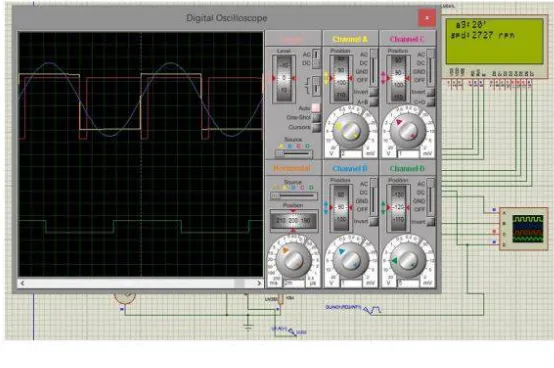
Fig 5,Firing Pulse Waveform 2
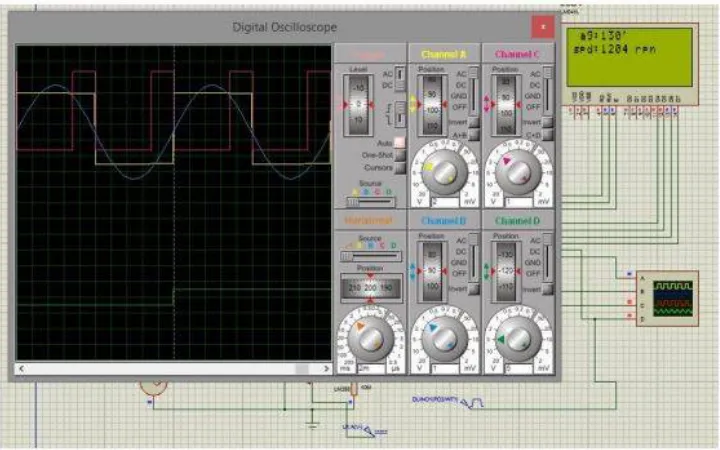
The result from the simulation was satisfactory.While setting up the feedback zero crossing pulse and proximity sensor output were given to the interrupt ports of the microcontroller.
VII.CONCLUSION
The project attempts a new speed control technique for induction motor. It present a design of low cost; high efficiency drive capable of supplying induction motor with variable ac voltage. The same as in Triac control, the voltage applied to the load can be varied from zero to maximum value. here the device attempted here take advantage of both the low price of phase control and low harmonic content and high efficiency that we can get with standard converter topology.
This kind of setup provide a complete user interface unit. Hence the system is completely stand alone and user friendly. Microcontroller provide less requirement of hardware. The system is user friendly so anybody can operate. After knowing the different condition by changing firing angle the speed can be controlled.
VIII.ACKNOWLEDGEMENT
First i would like to thank all those whose valuable contributions and suggestions have helped me in the completion of this project .I extent my sincere gratitude to Mrs Divya Haridas our project guide for their valuable guidance as well as timely advice which helped me a lot in the completion of this project.I also express my thanks to all other faculty members of EEE department for their support and encouragement.I would also like to acknowledge all the help and support provided by my friends parents and above all almighty,without whom this endeavor would not have been a success.
REFERENCES
[1] Shepherd W “Thyristor Control of AC circuits”,Book,Lockwood staples Ltd,1st ed.England 1975
[2] Dubey G K , Doradla, S R Hoshi,A and Sinha, R M,”Thyristorized power Controllers”,Book,john Wiley & Sons, India, 1986.
[3] Hamed, S- and Chalmers, B-, “Analysis of variable-voltage thyristor controlled induction motors” IEEE proc-, Vol-137(3),Pt, B,pp 184-193,May 1990.