ISSN 2348 – 7968
Microalgae biofuel can be easy available source of energy
Vivek P. Pankaj and Mamta Awasthi
Centre for Energy and Environmental Engineering, National Institute of Technology, Hamirpur, H.P-177005, India.
Abstract
Microalgae biofuels may provide a viable alternative to fossil fuels; however, this technology must overcome a number of hurdles before it can compete in the fuel market and be broadly deployed. These challenges include native strain identification and improvement, both in terms of oil productivity and crop protection, nutrient and resource allocation and use, and the production of co-products to improve the economics of the entire system. Although there is much excitement about the potential of microalgae biofuels, much work is still required in this field. In this paper, we are discussed about the importance of native microalgae strain and the potential of lipid extraction in respect of other biomolecules in standard lab condition i.e. 12L/12D period of light, 7 W/m2 light intensity, pH 7 and temperature 25±2oC in culture room, for a sustainable source of energy.
Keywords: biofuels; biodiesel; lipids; microalgae; oil production.
1. Introduction
The global economy requires fossil hydrocarbons to providing the energy required for lighting, heating and transportation. With our increasing population and expanding economy, there will be increased fossil fuel use. As countries improve their gross domestic product per capita, data suggest that their fossil fuel use will increase, and competition for these limited resources will increase. In addition, there comes increasing atmospheric CO2 concentration, and the potential for significant greenhouse gas-mediated climate change [1], which now seems likely to affect all parts of the world. Finally, petroleum, which is partially derived from ancient algae deposits, is a limited resource that will eventually run out or become too expensive to recover [2–3]. These factors are driving the development of renewable energy sources that can replace fossil fuels, and allow greater access to fuel resources for all nations, while greatly reducing carbon emissions into the atmosphere. A number of technologies have been examined as renewable energy sources and, although no single strategy is likely to provide a total solution, it seems possible that a combination of strategies can be employed that will substantially decrease our dependence on fossil fuels [3].
A number of technologies have been examined as renewable energy sources and, although no single strategy is likely to provide a total solution, it seems possible that a combination of strategies can be employed that will substantially decrease our dependence on fossil fuels [3]. The challenge that remains is to develop renewable energy industries that operate sustainably and can be cost competitive with existing energy options.
Fossil fuels are used for the generation of electrical power, as well as liquid fuels. There are a variety of renewable or low atmospheric pollution technologies that can generate electrical power, including solar, wind, hydroelectric, geothermal and nuclear. However, renewable technologies to supplement or replace liquid fossil fuels are still in their early developmental stages. The most promising sustainable alternatives are almost exclusively categorized under the moniker ‘biofuels’. This term describes a diverse range of technologies that generate fuel with at least one component based on a biological system. A number of hybrid strategies have been discussed or are currently being deployed. Examples of such strategies include conversion of cellulose to sugars for fermentation into fuel, and gasification of residual biomass into syngas that can then be used to produce liquid fuels [8]. Although each of these strategies is being used to produce fuels, they are insufficient to accommodate the global demand for liquid fuels.
ISSN 2348 – 7968
species have been found to naturally accumulate high oil levels in total dry biomass [8].
Microalgae have additional advantages over terrestrial plants. Since they are single-celled organisms that duplicate by division, high-throughput technologies can be used to rapidly evolve strains. This can reduce processes that take years in crop plants, down to a few months in algae. Algae have a reduced impact on the environment compared with terrestrial sources of biomass used for biofuels [9]. They can be grown on land that would not be used for traditional agricultural, and are very efficient at removing nutrients from water. Thus, not only would production of algae biofuels minimize land use compared with biofuels produced from terrestrial plants but, in the process of culturing these microalgae, waste streams can be remediated. Potential waste streams include municipal wastewater to remove nitrates and phosphates before discharge, and flue gas of coal or other combustible-based power plants to capture sulfates and CO2 [10–11]. Algae production strains also have the potential to be bioengineered, allowing improvement of specific traits [12, 13] and production of valuable co-products, which may allow algal biofuels to compete economically with petroleum. These characteristics make algae a platform with a high potential to produce cost-competitive biofuels.
In this paper, we are discussed about the importance of native microalgae strain and the potential of lipid extraction in respect of biofuel with other biomolecules in standard lab condition for a sustainable source of energy.
2. Benefits
Algae are emerging to be one of the most promising long-term, sustainable sources of biomass and oils for fuel, food, feed, and other co-products. Nearly all these benefits stem from the fact that these plants have evolved over billions of years to produce and store energy in the form of oil, and they do this more efficiently than any other known natural or engineered process. Microalgae are a promising new source of fuel and other products:
• Algae Grow Fast: Algae can double their numbers every few hours, can be harvested daily, and have the potential to produce a volume of biomass and biofuel many times greater than that of our most productive crops.
• Algae Can Have High Biofuel Yields: Algae store energy in the form of oils and carbohydrates, which, combined with their high productivity,
means they can produce from 2,000 to as many as 5,000 gallons of biofuels per acre per year.
• Algae Consume CO2: Like any other plant, algae, when grown using sunlight, consume (or absorb) carbon dioxide (CO2) as they grow, releasing oxygen (O2) for the rest of us to breathe. For high productivity, algae require more CO2, which can be supplied by emissions sources such as power plants, ethanol facilities, and other sources.
• Algae Do Not Compete With Agriculture: Algae cultivation uses both land that in many cases is unsuitable for traditional agriculture, as well as water sources that are not useable for other crops, such as sea-, brackish- and wastewater. As such, algae-based fuels complement biofuels made from traditional agricultural processes.
• Microalgal Biomass Can Be Used for Fuel, Feed and Food: Microalgae can be cultivated to have a high protein and oil content, for example, which can be used to produce either biofuels or animal feeds, or both. In addition, microalgal biomass, which is rich in micronutrients, is already used for dietary supplements to advance human health.
• Microalgae Can Purify Wastewaters: Algae thrive in nutrient-rich waters like municipal waste waters (sewage), animal wastes and some industrial effluents, at the same time purifying these wastes while producing a biomass suitable for biofuels production.
• Microalgal Biomass Can Be Used as an Energy Source: After oil extraction, the remaining algal biomass can be dried and “pelletized” and used as fuel that is burned in industrial boilers and other power generation sources.
3. Material and Methods
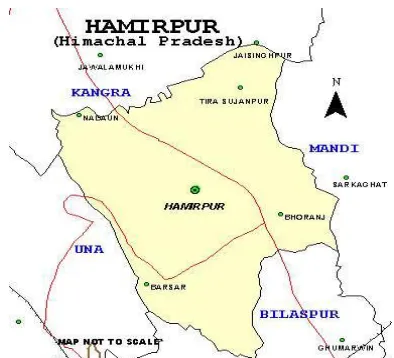
This study was carried out in Hamirpur district as shown in Fig. 1. This is one of the 12 districts of the state of Himachal Pradesh, India. This district occupies an area of 1,118 km². It is situated between 31°25′ N and 31°52′N and between 76°18′E and 76° 44′E. These microalgae were collected and isolated from different location of Hamirpur (from fresh water, wastewater and etc.).
ISSN 2348 – 7968
Fig. 1 Hamirpur district of Himachal Pradesh in India.
3.1 Microalgae collection techniques
Microalgae and the attached microalgae can be collected by hand or with a knife, including part or all of the substrate (rock, plant, wood etc.) if possible. Search all habitats in the water body, including the edge of stones in fast-flowing water, aquatic plants, dam walls, and any floating debris. In running or slightly turbid waters, a simple viewing box made from transparent perspex enables attached algae to be more easily observed. The Spectroscopic technique was selected as a testing tool and validated with dry mass measurements in this research. The percentage transmission, concentration, optical density. After substantial growth was determined during the period, this growth a portion of the algae biomass was separated. Then the biomass were filtered and dried to find out its weight and it is preserved in isolation.
3.2 Isolation
The isolation process can be done by the micromanipulation and some other conventional techniques; such as;
o Streaking plate technique o Serial dilution
o Pour plate technique o Spreading plate technique
Around more than 50 samples were collected and around 13 samples were isolated by repetitions of plate techniques. These techniques are very use full to isolate single cell of microalgae as shown in Fig. 2. And the isolated microalgae shown in Fig. 3.
Fig. 2. Isolation of microalgae
These microalgae sp. are grown in its respected medium (BBM and CHU#10) which was examined earlier for microalgae growth. The growth is examined by UV spectrophotometer and the total time of growth was taken out 21 day in case of microalgae. In this experiments we took three parameters as reported in published paper as a standard lab condition i.e. 12L/12D period of light, 7 W/m2 light intensity, pH 7 and temperature 25±2oC in culture room. After 21 days all samples were used for further experiments of extraction process of biomolecules such as Lipid, Protein, Carbohydrate, Chl ‘a’, Total Chl and Carotenoid in respect of lipid.
3.3 Lipid Estimation
Lipid estimation is done by Bligh & Dyer method, in this procedure 10 ml of samples were taken in centrifuge tubes and centrifuged at 5000rpm. The pellet was washed 2-3 times with distilled water. CHCl3: MeOH were added in the ratio 2:1 (Total 6ml), shaken and left for 20min at room temperature and then it centrifuged at 10000rpm for 15min. Supernatant was discarded. 5ml water added to the pallet and centrifuged at 7000rpm for 5min at room temperature to give a two-phase system. Bottom phase recovered in test tubes with the help of pipette without disturbing upper phase. Test tubes were allowed to hot water bath at 30-40oC till samples get dry and then % of lipid estimated by (1) equation.
% of lipid = X 100 % (1)
ISSN 2348 – 7968
4. Statistical Analysis
A statistical analysis of the data based on growth of microalgae was monitored and analysis was done using ANOVA for Response Surface Reduced Quadratic Model Analysis of variance table [Partial sum of squares - Type III] by Design of Experiments (DOE).
5. Result and Discussion
Microalgae sp. were taken from Centre for energy and environmental Engineering, NIT Hamirpur, (H.P), India. Microalgae were CEE-2 Bracteacoccus sp., CEE-4 Oedogonium sp., CEE-6 Oscillatoria sp., CEE-7 Chlorella vulgaris, CEE-8 Microcystis sp., CEE-9 Schroederia sp., CEE-10 Selenastrum sp., CEE-11 Urospora sp.
Fig. 3. Microalgae sp. isolated by streaking and other plate technique ((a) Urospora, (b) Oscillator, (c) Oedogonium, (d) Microcystis, (e) Bracteacoccus, (f)
Chlorella, (g) Selenastrum, (h) Sehroederia).
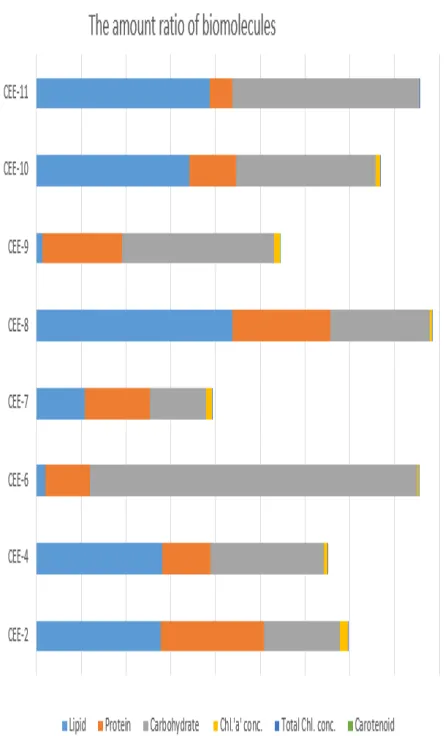
Fig. 4 The amount ratio of biomolecules (in graphical form)
ISSN 2348 – 7968
Table1:
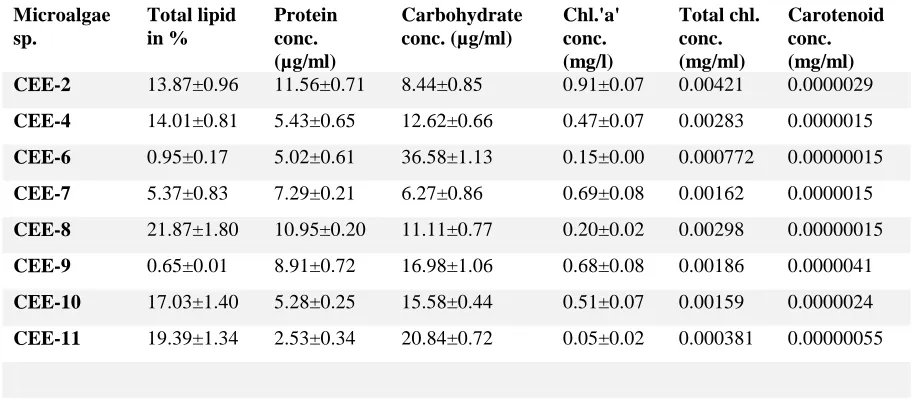
Table. 1. Total lipid in % of different microalgae sp with other biomolecules (in values)
Microalgae sp.
Total lipid in %
Protein conc. (µg/ml)
Carbohydrate conc. (µg/ml)
Chl.'a' conc. (mg/l)
Total chl. conc. (mg/ml)
Carotenoid conc. (mg/ml)
CEE-2 13.87±0.96 11.56±0.71 8.44±0.85 0.91±0.07 0.00421 0.0000029
CEE-4 14.01±0.81 5.43±0.65 12.62±0.66 0.47±0.07 0.00283 0.0000015
CEE-6 0.95±0.17 5.02±0.61 36.58±1.13 0.15±0.00 0.000772 0.00000015
CEE-7 5.37±0.83 7.29±0.21 6.27±0.86 0.69±0.08 0.00162 0.0000015
CEE-8 21.87±1.80 10.95±0.20 11.11±0.77 0.20±0.02 0.00298 0.00000015
CEE-9 0.65±0.01 8.91±0.72 16.98±1.06 0.68±0.08 0.00186 0.0000041
CEE-10 17.03±1.40 5.28±0.25 15.58±0.44 0.51±0.07 0.00159 0.0000024
CEE-11 19.39±1.34 2.53±0.34 20.84±0.72 0.05±0.02 0.000381 0.00000055
6. Conclusion
Biodiesel produced from microalgae is a new sustainable energy source substituted for petroleum diesel. Microalgal biodiesel is technically feasible because of the possibility of using the same engines and equipment’s used for petroleum diesel. Large scale microalgal production is needed for microalgal biodiesel to be used instead of petroleum diesel.
This study shows, the amount or potential of lipid extracted from different native microalgae with other biomolecules in standard lab condition. In this experiment we examined that CEE- 2, 4, 8, 10, 11 microalgae sp. produces high amount of total lipid (%) 13.87±0.96, 14.01±0.81, 21.87±1.80, 17.03±1.40, 19.39±1.34 respectively. CEE- 2 and CEE-8 produces high amount of protein 11.56±0.71 and 10.95±0.20 respectively. And in case of carbohydrate microalgae sp. CEE- 6, 9, 10, 11 produces 36.58±1.13, 16.98±1.06, 15.58±0.44, 20.84±0.72 amount of carbohydrate respectively. The main purpose of this study is that if this amount of biomolecule present in native microalgae sp. in standard lab condition then we can easily improve or increase the amount of biomolecules in respect of lipid for biofuel production by optimizing of environmental condition such as light period, pH and temperature and other modification in the native microalgae.
Microalgae with their high doubling time and photosynthetic activity, could be the only quick solution for solving oil crises problem in short term.
Acknowledgement
Authors would like to thank their organization, Centre for Energy and Environmental Engineering, National Institute of Technology, Hamirpur, Himachal Pradesh-177005 for their support in this study.
Reference
[1].Parry, ML.; Intergovernmental Panel on Climate Change, Working Group II, World Meteorological Organization, United Nations Environment Programme. Summary for Policymakers. In: Parry, ML.; Canziani, OF.; Palutikof, JP.; van der Linden, PJ.; Hanson, CE., editors. Climate Change 2007: Impacts, Adaptation and Vulnerability Contribution of Working Group II to the Fourth Assessment Report of the Intergovernmental Panel on Climate Change. Cambridge University Press; Cambridge, UK: 2007.
[2].Dyni, JR. Scientific Investigations Report 2005-5294. US Geological Survey; VA, USA: 2006. Geology and resources of some world oil-shale deposits.
[3].Energy Information Administration. International Energy Outlook. Vol. 284. EIA; DC, USA: 2009.
[4].Falkowski PG, Barber RT, Smetacek VV. Biogeochemical controls and feedbacks on ocean primary production. Science. 1998; 281(5374):200– 207.
ISSN 2348 – 7968
[6].Sheehan, J.; Dunahay, T.; Benemann, J.; Roessler, P. A Look Back at the U S Department of Energy's Aquatic Species Program – Biodiesel from Algae. Vol. 328. National Renewable Energy Laboratory; CO, USA: 1998.
[7].Huesemann MH, Hausmann TS, Bartha R, Aksoy M, Weissman JC, Benemann JR. Biomass productivities in wild type and pigment mutant of Cyclotella sp. (diatom). Appl Biochem Biotechnol. 2009; 157(3):507–526. [PubMed: 18597048]
[8].Rodolfi L, Chini Zittelli G, Bassi N, et al. Microalgae for oil: strain selection, induction of lipid synthesis and outdoor mass cultivation in a low-cost photobioreactor. Biotechnol Bioeng. 2009; 102(1):100–112.
[9].Dismukes GC, Carrieri D, Bennette N, Ananyev GM, Posewitz MC. Aquatic phototrophs: efficient alternatives to land-based crops for biofuels. Curr Opin Biotechnol. 2008; 19(3):235–240.
[10].He P, Xu S, Zhang H, et al. Bioremediation efficiency in the removal of dissolved inorganic nutrients by the red seaweed, Porphyra yezoensis, cultivated in the open sea. Water Res. 2008; 42(4–5):1281–1289.
[11].Douskova I, Doucha J, Livansky K, et al. Simultaneous flue gas bioremediation and reduction of microalgal biomass production costs. Appl Microbiol Biotechnol. 2009; 82(1):179–185.
[12].Rosenberg JN, Oyler GA, Wilkinson L, Betenbaugh MJ. A green light for engineered algae: redirecting metabolism to fuel a biotechnology revolution. Curr Opin Biotechnol. 2008; 19(5): 430–436.