ISSN (Print) : 2320 – 3765 ISSN (Online): 2278 – 8875
I
nternational
J
ournal of
A
dvanced
R
esearch in
E
lectrical,
E
lectronics and
I
nstrumentation
E
ngineering
(An ISO 3297: 2007 Certified Organization)
Vol. 5, Issue 7, July 2016
Development of Double Hexagonal UWB
Monopole Fractal Microstrip Patch Antenna
Vijaykumar Patil ¹, Tejal Nilakhe²
AssistantProfessor, Dept. of Electronics Engineering, K.I.T. Kolhapur, Maharashtra, India1
P.G. Student, Dept. of E.&T.C.Engineering, K.I.T. Kolhapur, Maharashtra, India2
ABSTRACT:A Development of Double Hexagonal UWB Monopole Fractal Microstrip Patch Antenna is presented.
In this letter, by inserting a modified small fractal elements at the corners of a polygon patch, standard UWB bandwidth can be covered while antenna dimensions are only 25 x25 mm. Parametric studies is performed, and different shapes are added to the antenna as the fractal element in order to realize the multiresonance behavior To validate the simulation results, prototypes of the proposed antenna are fabricated and tested.
KEYWORDS: Fractal monopole antenna, ultra wideband (UWB).
I.
INTRODUCTION
U
LTRAWIDEBAND antennas are of great interest because of the merits such as high data rate, immunity against electromagnetic interference, robustness to fading, and capability of transmitting ultra-short pulses. These antennas are utilized in many applications such as mobile systems, wireless LANs, radars, biomedical imaging, tracking, and location finding.[1-3]. A very long length or a wide surface in a limited area can be produced by using fractal geometries. This provides a possibility to design miniaturized wideband antennas having radiation patterns and input impedance characteristics similar to larger antennas. Different antennas have been designed by using self-similarity and space-filling concepts of fractals to achievd wideband characteristics[4-6].UWB technologies have become very attractive due to the numerous advantages such as gigabit/second-level data rate, high security, and low cost. However, over the released UWB operation bandwidth (3.1~10.6 GHz), there are some narrow bands occupied by the existing wireless systems—for example, WLAN at 5.15~5.825 GHz ,monopole antennas have been widely used in wireless ultrawideband (UWB) communication systems because of their simple structure, low costs, and omnidirectional radiation pattern. The[8-9].In this letter, a technique for enhancing the impedance bandwidth is studied. Small polygon elements are added to the corners of an antenna radiator to achieve a multiresonance operation in a small area. Closely spaced resonant frequencies of the antenna lead to bandwidth enhancement.Surface current density on the proposed radiator is given for further insight. In addition, analysis of the effectiveparameters of the impedance bandwidth is presented. The simulated results are validated with measurement results.
II
.
STRUCTURE OF AN ANTENNAISSN (Print) : 2320 – 3765 ISSN (Online): 2278 – 8875
I
nternational
J
ournal of
A
dvanced
R
esearch in
E
lectrical,
E
lectronics and
I
nstrumentation
E
ngineering
(An ISO 3297: 2007 Certified Organization)
Vol. 5, Issue 7, July 2016
Fig. 1. Structure of the proposed Hexagonal With Side Element. L= 29mm W=25mm hf=8.86mm hg=7mm
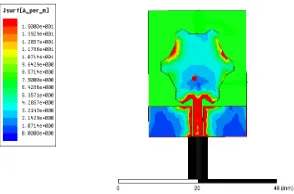
In Fig1.on rectangular FR4 substrate of size 25mm x 25mm. Height of the substrate is 1.53 mm with relative permittivity 4.3 and radius of the radiating patch is optimized to 9.2 mm with feed-line width of 3.95mm Fig. 2 presents the surface electric current density on the antenna radiator and ground planes at frequencies 4.8693Ghz in this Fig that the electric current distribution at 4.8693 GHz is concentrated on the lower edge of the radiator and upper edge of half part. This means the antenna lower edge and upper edge of half part affects impedance characteristic at low frequencies. Fig. 3 shows the electric current distribution at 6.8040GHz.Current distribution is mainly concentrated on the four lower fractal elements and side edges. It is seen that the current distribution is more complicated than the first resonance frequency current distribution. The currents excited by the four lower fractal elements have strongly affected. It is observed in Fig.4 that the electric current distribution at 9.6784GHz is concentrated on the lower edge of the radiator. This means the antenna lower edge affects impedance characteristic at low frequencies
Fig 2: Current distribution at frequency 4.8693 GHz Fig 3: Current distribution at frequency6.8040 GHz
Fig 4: Current distribution at frequency9.6784GHz
ISSN (Print) : 2320 – 3765 ISSN (Online): 2278 – 8875
I
nternational
J
ournal of
A
dvanced
R
esearch in
E
lectrical,
E
lectronics and
I
nstrumentation
E
ngineering
(An ISO 3297: 2007 Certified Organization)
Vol. 5, Issue 7, July 2016
III.SIMULATED RESULTS
In Figure 5 Simulation results for the proposed antenna,S11 with and without hexagonal elements at its corners. Blue part is a with hexagonal elements at its corners and red part is a without hexagonal elements at its corners. S11 without hexagonal elements at its corners in a two resonant frequency is shifted from 1.6548GHz to7.3955GHz. Simulation results for the proposed antenna, S11 with hexagonal elements at its corners in a three resonant frequency is shifted from 1.6080GHz to6.8040GHz to9.6231GHz. In Figure 6: Simulation results for the proposed antenna VSWR with and without hexagonal elements at its corners. The proposed antenna is optimized first for each design parameters two achieve the required ultra wide bandwidth. In this, ground width, ground length, feed width, gap between feed and ground optimized.
Fig 5: Simulation results for the proposed antenna ,S11 with and without hexagonal elements at its corners.
Fig 6: Simulation results for the proposed antenna VSWR with and without hexagonal elements at its corners.
IV. RADIATION PATTERNS
ISSN (Print) : 2320 – 3765 ISSN (Online): 2278 – 8875
I
nternational
J
ournal of
A
dvanced
R
esearch in
E
lectrical,
E
lectronics and
I
nstrumentation
E
ngineering
(An ISO 3297: 2007 Certified Organization)
Vol. 5, Issue 7, July 2016
(b)
(a)
(c)
(d)
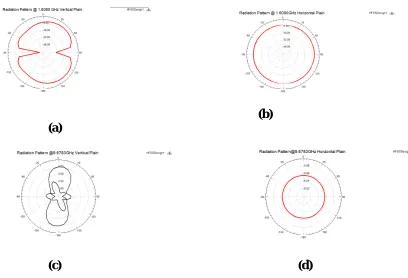
Fig 7: Radiation pattern of proposed antenna at fig a)&b) 1.6080GHz (Vertical and Horizontal Plain), fig c)&d) 9.6783GHz(Vertical and Horizontal Plain)
Fig 8:3D Polar Plot
V
.
CONCLUSIONSISSN (Print) : 2320 – 3765 ISSN (Online): 2278 – 8875
I
nternational
J
ournal of
A
dvanced
R
esearch in
E
lectrical,
E
lectronics and
I
nstrumentation
E
ngineering
(An ISO 3297: 2007 Certified Organization)
Vol. 5, Issue 7, July 2016
REFERENCES
[1] Wei-Chung Weng, Chia-Liang Hung,’’An H-Fractal Antenna for Multiband Applications,’’ IEEE Antennas and wireless propagation letters vol.13, pp. 1705-1708, 2014.
[2] Hojjatollah Fallahi and Zahra Atlasbaf, “Study of a Class of UWB CPW-Fed Monopole Antenna with Fractal Element, ”IEEE Antennas and wireless propagation letters vol.12, pp.1484-1487, 2013.
[3] Abolfazl Azari, Alyani Ismail,’’ A New Super Wideband Fractal Monopole-Dielectric Resonator Antenna,’’IEEE Antennas and wireless propagation letters vol.12 , pp. 1014-1016, 2013.
[4] Changiz Ghobadi, Javad Nourinia,’’ Novel Modified Pythagorean Tree Fractal Monopole Antennas for UWB Applications,’’ IEEE Antennas and wireless propagation letters, vol.10, pp. 484-487, 2011.
[5] Reza Zaker, Abdolali Abdipour,’’ Bandwidth Enhancement and Miniaturization of Fork-Shaped Monopole Antenna,’’ IEEE
Antennas and wireless propagation letters, vol.10, pp.697-700, 2011
[6] Homayoon Oraizi, Shahram Hedayati’’ Miniaturized UWB Monopole Microstrip Antenna Design by the Combination of Giusepe Peano and Sierpinski Carpet Fractals,’’ IEEE Antennas and wireless propagation letters, vol.10, pp.67-70, 2011.
[7] Mahdi Naghshvarian Jahromi, Abolfazl Falahati,’’ Bandwidth and Impedance-Matching Enhancement of Fractal Monopole Antennas
Using Compact Grounded Coplanar Waveguide,’’IEEE Transctionson antenna and propogation letters, vol.59, no. 7, pp.2480-2487,
July 2011.
[8] Hossein Eskandari, Mahmood Rafaei Booket, Manouchehr Kamyab’’ Investigations on a Class of Wideband Printed Slot Antenna,’’ IEEE Antennas and wireless propagation letters, vol.9,pp.1221-1224, 2010.
[9] Ke Zhang, Yuanxin Li, Member,’’ Band-Notched UWB Printed Monopole Antenna With a Novel Segmented Circular Patch,’’ IEEE
Antennas and wireless propagation letters, vol.9, pp.1209-1212, 2010.
[10] Ahmed Khidre, Kai Fang Lee,’’ Wideband Circularly Polarized E-Shaped Patch Antenna for Wireless Applications,’’ IEEE Antennas and Propagation Magazine, Vol. 52, no.5, pp.219-229, October 2010.