ISSN (Online) : 2319 - 8753 ISSN (Print) : 2347 - 6710
International Journal of Innovative Research in Science, Engineering and Technology
An ISO 3297: 2007 Certified Organization Volume 7, Special Issue 5, April 2018 1st International Conference on Recent Innovation in Civil Engineering and Management (ICRICEM '18)
22nd March 2018
Organized by
Department of Civil Engineering & MBA, Loyola Institute of Technology, Chennai, Tamilnadu, India
Experimental Study on Concrete with
Manufactured Sand and Partial Replacement
of Cement by Brick Dust
S.Monisha
PG Student, Department of Civil Engineering, Tamilnadu College of Engineering, Coimbatore, Tamil Nadu, India
ABSTRACT: In this study, effects of Brick dust on strength were experimentally investigated. The Study focus on partial replacement of cement by Brick dust in M30 grade concrete . They were incorporated into concrete at the levels
of 10%, 20% and 30%. This paper presents a detailed experimental study on compressive strength, split tensile strength and flexural strength at an age of 7,14 and 28 days. Test results shows that use of Brick dust in concrete has improved the performance of concrete in strength at a 20% replacement. Although the highest compressive strength of concrete was observed was 20% Brick dust replacement for ordinary Portland cement and were reduced as the increase in the replacement ratios.
KEYWORDS: Brick dust, M-sand, Compressive strength,Split tensile strength, Flexural strength
I.INTRODUCTION
Concrete is one of the most used material, which required large quantities of Portland cement. Ordinary Portland cement production is the second only to the automobile as the major generator of Carbon di-oxide, which pollute the atmosphere. In addition to that large amount of energy was also consumed for the cement production. Hence, it is inevitable to find an alternative material to the existing most expensive, most resource consuming Portland cement. Brick dust is the potential material to be used as FA & also help in protecting the environment surrounding. Due to rapid growth in construction activity, the available sources of natural sand are getting exhausted & also, good quality sand may have to be transported from long distance, which adds to the cost of construction. Therefore, it is necessary to replace natural sand in concrete by alternate material, without compromising the quality of concrete. The artificial sand produced by proper machines can be a better substitute to river sand. The strength, durability and other characteristic of concrete depends on the properties of its ingredients, proportion of mix, method of compaction and other controls during placing and curing.
II.MATERIAL PROPERTIES
2.1 Materials
In concrete, the selection of proper ingredients evaluating their properties and understanding the interaction between different materials plays a major role in performance of the concrete. The ingredients used are cement, Brick dust, natural sand, manufacture sand, coarse aggregate. The performance requirements of concrete enhancements of the following
1. Ease of placement and compaction by no segregation. 2. Long term mechanical properties.
ISSN (Online) : 2319 - 8753 ISSN (Print) : 2347 - 6710
International Journal of Innovative Research in Science, Engineering and Technology
An ISO 3297: 2007 Certified Organization Volume 7, Special Issue 5, April 2018 1st International Conference on Recent Innovation in Civil Engineering and Management (ICRICEM '18)
22nd March 2018
Organized by
Department of Civil Engineering & MBA, Loyola Institute of Technology, Chennai, Tamilnadu, India
2.2 Brick dust
Brick dust is a waste product obtained from different brick kilns and tile factories. There are numerous brick kiln which have grown over the decades in an unplanned way in different part of the country. Tons of waste products like brick dust come from these kilns and factories. So far, such materials have been used just for filling low lying areas or dumped as waste material. is a waste product obtained from different brick kilns and tile factories. There are numerous brick kiln which have grown over the decades in an unplanned way in different part of the country. Tons of waste products like brick dust come from these kilns and factories. So far, such materials have been used just for filling low lying areas or dumped as waste material.
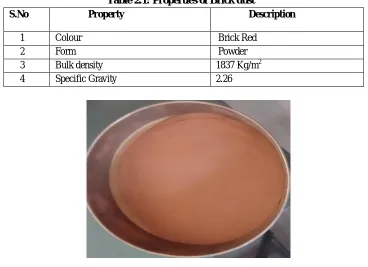
The properties of Brick dust as shown in Table 2.1
Table 2.1: Properties of Brick dust
S.No Property Description
1 Colour Brick Red
2 Form Powder
3 Bulk density 1837 Kg/m2
4 Specific Gravity 2.26
Figure 2.1Brick dust
2.3 M-sand
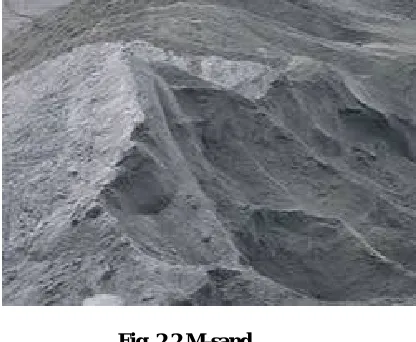
Manufactured sand / M- sand is an fine aggregate, which is an eco friendly and economical alternative to river sand. It is manufactured by crushing suitable stones and are finely graded to match the IS standard requirements. Otherwise, M-sand is crushed aggregates produced from hard granite stone which is cubically shaped with grounded edges, washed and graded with consistency to be used as a substitute of river sand.
The properties of Concrete M-sand are shown in below, Specific Density : 15.1 kN/m3
ISSN (Online) : 2319 - 8753 ISSN (Print) : 2347 - 6710
International Journal of Innovative Research in Science, Engineering and Technology
An ISO 3297: 2007 Certified Organization Volume 7, Special Issue 5, April 2018 1st International Conference on Recent Innovation in Civil Engineering and Management (ICRICEM '18)
22nd March 2018
Organized by
Department of Civil Engineering & MBA, Loyola Institute of Technology, Chennai, Tamilnadu, India
Fig. 2.2 M-sand
III. MIX DESIGN
3.1 GENERAL
The process of selection suitable ingredients of concrete and determining their relative amounts with the objective of producing a concrete of the required strength and workability as economically as possible, is termed the concrete mix design. The proportioning of ingredient of concrete is governed by the required performance of concrete in two states, namely the plastic and the hardened states. If the plastic concrete is not workable, it cannot be properly placed and compacted. The property of workability therefore becomes of vital importance.
3.2MIX PROPORTIONS
Cement = 379 Kg/ m3
Brick dust = 163 Kg/m3
Water = 197 Kg/m3
Fine aggregate = 645 Kg/m3 Coarse aggregate = 941 Kg/m3 Water –cement ratio = 0.51
The table 3.1 shows the mix proportion of concrete.
Table 3.1 Mix proportion.
Mix proportions
Cement kg/m3
Fine Aggregate
kg/m3
Coarse Aggregate
kg/m3
Water kg/m3
Brick dust kg/m3
Mix 1 (0%) 542 645 941 197 0
Mix 2(10%) 487.8 645 941 197 54.2
ISSN (Online) : 2319 - 8753 ISSN (Print) : 2347 - 6710
International Journal of Innovative Research in Science, Engineering and Technology
An ISO 3297: 2007 Certified Organization Volume 7, Special Issue 5, April 2018 1st International Conference on Recent Innovation in Civil Engineering and Management (ICRICEM '18)
22nd March 2018
Organized by
Department of Civil Engineering & MBA, Loyola Institute of Technology, Chennai, Tamilnadu, India
IV. EXPERIMENTAL PROGRAM
4.1 MECHANICAL PROPERTIES
4.1.1 Compression Test (Ref: IS: 516-1959)
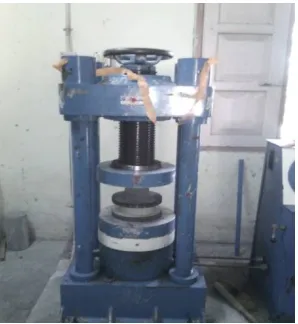
Compression test is the most common test conducted on hardened concrete, partly because it is an easy test to perform, and partly because most of the desirable characteristics properties of concrete are qualitatively related to its compressive strength. Compressive strengths were attained as a result of the compressive tests conducted on the cube specimens of size 150mm x 150mm x 150mm . Cube was placed on the platform of the compression testing machine. The load was applied gradually till the concrete cubes get failed. The specimens are subjected to compressive loads in compression testing machine as per IS: 516-1969 and the crushing load is noted which gives the compressive strength of that cube. The compressive strength is the ratio of crushing load to the surface area of the specimens expressed in N/mm2. Similarly the compression strength values of all the cubes are found.
Fig 4.1 Test Set up for Compressive Strength Test
4.1.2 Flexure Test (Ref: IS: 516-1959)
The flexural strength represents the highest stress experienced within the material at its moment of rupture. It is measured in terms of stress, here given the symbol fcr. . The flexural strengths of the respective specimens have been
ISSN (Online) : 2319 - 8753 ISSN (Print) : 2347 - 6710
International Journal of Innovative Research in Science, Engineering and Technology
An ISO 3297: 2007 Certified Organization Volume 7, Special Issue 5, April 2018 1st International Conference on Recent Innovation in Civil Engineering and Management (ICRICEM '18)
22nd March 2018
Organized by
Department of Civil Engineering & MBA, Loyola Institute of Technology, Chennai, Tamilnadu, India
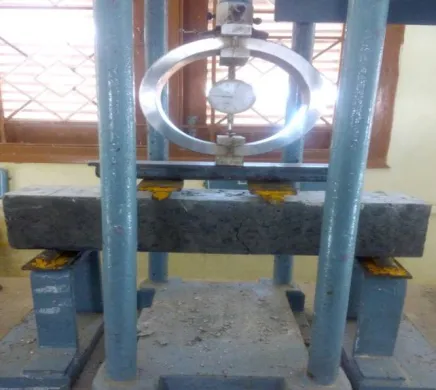
Fig 4.2 Test Set Up for Flexural Strength
The modulus of rupture can be determined by using the formula given below fcr = (Pmax x l)/bh2 where,
fcr = Flexural strength Pmax = Maximum load in (N) kg.
b = Width of the prism in mm h = Depth of the prism in mm l = Span of the prism in mm
The loading must be applied centrally and without subjecting the specimen to any tensional stresses and restraints. The axis of the specimen shall be carefully aligned with the axis of the loading device. The load shall be applied without any shock and increasing continuously at specified rate.
4.1.3 Split tensile strength Test (Ref: IS: 5816-1999)
Split tensile strength of concrete is usually found by testing plain concrete cylinders. Cylinders of size 150mm x 300 mm were casting using M30 grade concrete. Specimens with Conventional Concrete and SCC of two different
percentages were casted. During casting the conventional concrete cubes were manually compacted using tamping rods. After 24hours, the specimens were removed from the mould and subjected to water curing for 7, 14, 28 days. After curing, the specimens were tested for compressive strength as per IS: 5816-1999 using a calibrated compression testing machine of 2000KN capacity.
ISSN (Online) : 2319 - 8753 ISSN (Print) : 2347 - 6710
International Journal of Innovative Research in Science, Engineering and Technology
An ISO 3297: 2007 Certified Organization Volume 7, Special Issue 5, April 2018 1st International Conference on Recent Innovation in Civil Engineering and Management (ICRICEM '18)
22nd March 2018
Organized by
Department of Civil Engineering & MBA, Loyola Institute of Technology, Chennai, Tamilnadu, India
continuously until the resistances of the specimen to the increasing load broke down and no greater load can be sustained.
Tensile strength of concrete ft =
Where ,
P = Maximum load in N applied to the specimen L = Measured length in cm of the specimen D = Measured diameter in cm of the specimen
V.RESULTS AND DISCUSSION
5.1 GENERAL
This chapter deals with the results obtained from the various experiments conducted to access mechanical properties. The aim of the study is to determine the compressive strength, flexural strength and spilt tensile strength. So the results of test specimens are presented. The discussion on the results also presented in this chapter.
5.2 MECHANICAL PROPERTIES
The mechanical properties of concrete such as compressive strength, flexural strength and split tensile strength are determined from the standard experiments. They are as follows.
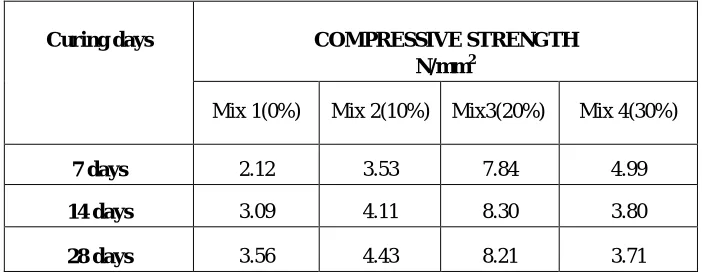
5.2.1 Compressive Strength
The compressive strength of replacement of Brick dust is arrived. The compressive strength value for replacement of Brick dust Table 5.1Shows compression test results.
Table 5.1: Compressive Strength of Cubes with Partial Replacement of Brick dust
Curing days COMPRESSIVE STRENGTH N/mm2
Mix 1(0%) Mix 2(10%) Mix3(20%) Mix 4(30%)
7 days 2.12 3.53 7.84 4.99
14 days 3.09 4.11 8.30 3.80
ISSN (Online) : 2319 - 8753 ISSN (Print) : 2347 - 6710
International Journal of Innovative Research in Science, Engineering and Technology
An ISO 3297: 2007 Certified Organization Volume 7, Special Issue 5, April 2018 1st International Conference on Recent Innovation in Civil Engineering and Management (ICRICEM '18)
22nd March 2018
Organized by
Department of Civil Engineering & MBA, Loyola Institute of Technology, Chennai, Tamilnadu, India
5.2.2 FLEXURAL STRENGTH
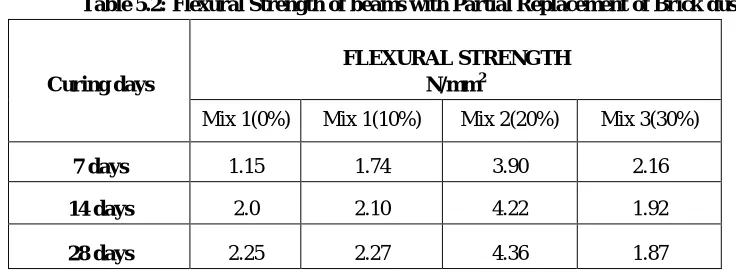
The flexural strength of replacement of Brick dust is arrived.. Table 5.2 shows flexural strength test results
Table 5.2: Flexural Strength of beams with Partial Replacement of Brick dust
Curing days
FLEXURAL STRENGTH N/mm2
Mix 1(0%) Mix 1(10%) Mix 2(20%) Mix 3(30%)
7 days 1.15 1.74 3.90 2.16
14 days 2.0 2.10 4.22 1.92
28 days 2.25 2.27 4.36 1.87
5.2.3 SPLIT TENSILE STRENGTH
The variation of split tensile strength at the age of 28 days with different percentage of Brick dust. From the test results, it was observed that the maximum split tensile strength was obtained for mix of 20% replacement of cement by Brick dust. Table 5.3 flexural strength test results
Table 5.3: split tensile strength of Cylinder with Partial Replacement of Brick dust
VI. CONCLUSION
The compressive strength of concrete increased when cement is replaced by Brick dust for M30 grade of
concrete at 20% replacement of cement by Brick dust the concrete attained maximum compressive strength for M30
grade of concrete. The split tensile strength of concrete is also increased when cement is replaced by Brick dust. The split tensile strength is maximum at 20% of replacement. The flexural strength of the concrete is also increased when the cement is replaced by brick dust. At 20% replacement, the flexural strength is maximum.
`
REFERENCES
1. Shetty M.S,(2010) “concrete technology” S.Chand and company Ltd, Delhi
Curing days SPLIT TENSILE STRENGTH N/mm2
Mix 1(0%) Mix 2(10%) Mix 3(20%) Mix 4(30%)
7 days 1.78 1.82 1.23 2.12
14 days 2.21 2.07 4.24 1.87
ISSN (Online) : 2319 - 8753 ISSN (Print) : 2347 - 6710
International Journal of Innovative Research in Science, Engineering and Technology
An ISO 3297: 2007 Certified Organization Volume 7, Special Issue 5, April 2018 1st International Conference on Recent Innovation in Civil Engineering and Management (ICRICEM '18)
22nd March 2018
Organized by
Department of Civil Engineering & MBA, Loyola Institute of Technology, Chennai, Tamilnadu, India
absorption and bulking (Feb-97)
6.IS: 8112-1981, Specifications for 53 grade Portland cement, Bureau of Indian Standards, New Delhi 7.IS: 383-1970, Specifications for Coarse and Fine aggregates from Natural sources for Concrete, Bureau of Indian Standards, New Delhi, Indian.
8. Kamal Uddin.M (2004) “ Use of brick dust in concrete as mineral admixture and partial replacement of cement”. Journal of Civil Engineering (IEB), 32(1), Faculty of Engineering, Bangladesh University of Engineering and Technology, Dhaka 1000, Bangladesh.
9. Priyanka A. Jadhav and Dilip K. Kulkarni(2012) “ An experimental investigation on the properties of concrete containing manufactured sand’. IJAET/ Vol. III/ Issue II, Civil Engineering department, Indian Institute of Technology, Bombay, Maharashtra.
10. A.A.Aliabdo, Abd –Elmoaty.M and Hani H. Hassan (2013) “Utilization of crushed clay brick in cellular concrete production”. Alexandria Engineering Journal 53, Faculty of Civil Engineering, Alexandria University, Egypt.
11. Er.Ranjoth Singh, Er. Rohin kaushik and Er.Gurniwaz Singh (2013) “Study of Self compacting concrete using brick dust and marble powder”. IJERA, ISSN: 2248-9622, Vol -3, Department of Civil Engineering, IIU(HP).
12. Salman siddique, Mohd. Shadab siddique, Shariq masood khan (2015) “Assessing the scope of utilizing waste from brick production for building materials”. IJATES/ Volume No.3/ Special Issue No 01, Department of Civil Engineering, Integral University, Lucknow.