Analysis of Economic Load Dispatch & Unit
Commitment Using Dynamic Programming
Gaurav1, Dr. Jyoti Shrivastava2
PG Student [PS], Dept. of EE, SHIATS, Allahabad, UP, India1 Assistant professor, Dept. of EE, SHIATS, Allahabad, UP, India2
ABSTRACT: The modern power system around the world has grown in complexity of interconnection and power demand. The focus has shifted towards enhanced performance, increased customer focus, low cost, reliable and clean power. In this changed perspective, scarcity of energy resources, increasing power generation cost, environmental concern necessitates optimal economic dispatch. In reality power stations neither are at equal distances from load nor have similar fuel cost functions. Hence for providing cheaper power, load has to be distributed among various power stations in a way which results in lowest cost for generation. Practical economic dispatch (ED) problems have highly non-linear objective function with rigid equality and inequality constraints. In this paper, a unit commitment problem is being described & its solution using dynamic programming for multi unit system over 24 hour time horizon is being presented. This also means that it is desirable to find the optimal generating unit commitment (UC) in the power system for the next H hours. The main objective of this paper is to reduce the total production cost includes fuel cost, maintenance cost etc.
KEYWORDS: Economic Load Dispatch, Unit Commitment, Power System, Production Cost.
I.INTRODUCTION
Many utilities have daily load patterns which exhibit extreme variation between peak and off peak hours because people use less electricity on Saturday than on weekdays, less on Sundays than on Saturdays, and at a lower rate between midnight and early morning than during the day. If sufficient generation to meet the peak is kept on line throughout the day, it is possible that some of the units will be operating near their minimum generating limit during the off peak period. The problem confronting the system operator is to determine which units should be taken offline and for how long. In most of the interconnected power systems, the power requirement is principally met by thermal power generation. Several operating strategies are possible to meet the required power demand, which varies from hour to hour over the day. It is preferable to use an optimum or suboptimum operating strategy based on economic criteria. In other words, an important criterion in power system operation is to meet the power demand at minimum fuel cost using an optimal mix of different power plants. Moreover, in order to supply high-quality electric power to customers in a secured and economic manner, thermal unit commitment (UC) is considered to be one of best available options. It is thus recognized that the optimal UC of thermal systems, which is the problem of determining the schedule of generating units within a power system, subject to device and operating constraints results in a great saving for electric utilities. So the general objective of the UC problem is to minimize system total operating cost while satisfying all of the constraints.
Various approaches have been developed to solve the optimal UC problem. These approaches have ranged from highly complex and theoretically complicated methods to simple rule-of thumb methods. The scope of operations scheduling problem will vary strongly from utility to utility depending on their mix of units and particular operating constraints. The economic consequences of operation scheduling are very important. Since fuel cost is a major cost component, reducing the fuel cost by little as 0.5% can result in savings of millions of dollars per year for large utilities. A very important task in the operation of a power system concerns the optimal UC considering technical and economical constraints over a long planning horizon up to one year.
There may be a tendency to think that maximizing the profit is essentially the same as minimizing the cost. This is not necessarily the case. We have to remember that since we no longer have the obligation to serve the demand, the GENCOs may choose to generate less than the demand. This allows a little more flexibility and makes the problem complex in the UC schedules under the deregulated environment. Finally, the profit depends, not only on the cost, but also on revenue. If revenue increases more than the cost does, the profit will increase. So for the next-generation UC problem, researchers have to still play an important role. If the bid functions are non convex or non differentiable in nature, which is commonly seen in both regulated and deregulated power industry, then the above problem becomes complex. Further, the complexity increases if the competition is encouraged in both suppliers and buyers side including emission constraints. So it has been observed that the hybrid models, which are the combination of both classical and non classical methods, can handle the present day complex UC problem commonly seen within developed countries. With the available standard software products, electric utilities have to enhance, evolve, and upgrade or add new applications such as UC solutions for modern deregulated power industry in conjunction with energy management systems.
II.UNIT COMMITMENT
The scope of the operations scheduling problem will vary strongly from utility to utility depending on their mix of units and particular operating constraints. The economic consequences of operations scheduling are very important. Since fuel cost is a major cost component, reducing the fuel cost by as little as 0.5 percent can result in savings of millions of dollar per year for large utilities. The time horizon of operations scheduling depends on a number of factors. Large steam units take several hours to start up and bring on-line. They also have minimum up and down-time constraints and start up costs which require that they be scheduled over a period of several days. The Schedule of the thermal units is also influenced by preventative maintenance schedules, nuclear refuelling schedules, or long-term fuel contracts which involve making decisions on a yearly or multi-year timeframe. Hydro scheduling also, in general, involves a yearly or multi-year time frame due to the large capacity of many hydro reservoirs. Many hydro or pumped hydro reservoirs have daily or weekly cycles. Typically the commitment and generating schedule is output on an hourly basis.
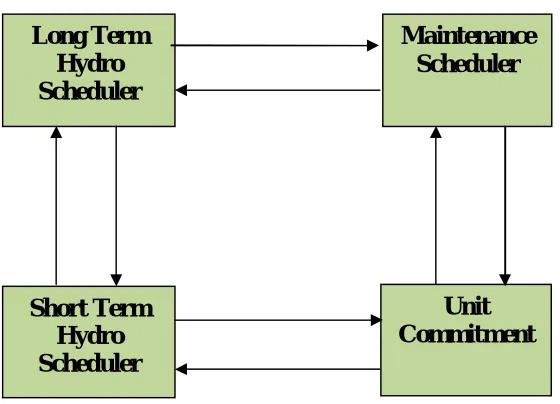
Although yearly or multi-year factors influence operations scheduling, the schedules actually produced are often useful for just several hours. This is because the scheduling requires forecast of many stochastic quantities such as loads, hydro inflows, and unit availabilities. If the actual values of these quantities differ greatly from the forecasts, then it is economical to resolve the operations scheduling problem. Since the determination of hourly hydro and thermal schedules over a period of several years is unrealistic and, As described above, unnecessary, past approach have developed a hierarchical approach to the overall operations scheduling problem .A typical hierarchy is shown in Fig 2.1 The Maintenance Scheduler solves for the time for preventive maintenance of the generating units. Typically, weekly schedules are generated over a period of one to three years. The Maintenance Scheduler coordinates with the long-Term Hydro Scheduler which produces hydro schedules over the same timeframe .This insures that the hydro energy is available, as needed, to replace units down for maintenance. The long-term maintenance and hydro schedules are inputs to the Unit Commitment and Short-Term Hydro Schedulers. Unit Commitment produces commitment and generation schedules or the thermal units while the Short-Term Hydro Scheduler produces generation schedules for the hydro units. The combined Unit Commitment and Short-Term Hydro scheduling problem often referred to as the Short-term hydro-thermal scheduling problem, produces hourly schedules over a period of several days.
Fig 2.1. The typical hierarchy for overall operation of scheduling problem.
III. FORMULATION OF UNIT COMMITMENT
The objective of the UC problem is to minimize the total operating costs subjected to a set of system and unit constraints over the scheduling horizon. It is assumed that the production cost, PCi for unit ‘i’ at any given time interval is a quadratic function of the generator power output, pi.
PCi = ai + bi
ρ
i + ciρ
i2 (1)Where ai, bi, ci are the unit cost coefficients. The generator start-up cost depends on the time the unit has been switched off prior to the start up, Toff. The start-up cost SCi at any given time is assumed to be an exponential cost curve.
(2)
Where σi is the hot start-up cost, δi the cold start-up cost and τi is the cooling time constant.
The total operating costs, OCT for the scheduling period T is the sum of the production costs and the start-up costs.
(3)
Where Ui,t is the binary variable to indicate the on/off state of the unit i at time t. Ui,t =1 if unit i is committed at time t, otherwise Ui,t=0.
The overall objective is to minimize OCT subject to a number of system and unit constraints. All the generators are assumed to be connected to the same bus supplying the total system demand. Therefore, the networks constraints are studied above are as follows briefly.
Long Term
Hydro
Scheduler
Maintenance
Scheduler
Unit
Commitment
Short Term
3.1 Power Balance Constraint
The total generated power at each hour must be equal to the Load of the corresponding hour, Dt.
(4)
3.2 Power Generation Limits
The generation of the unit is under its minimum and maximum limit
(5)
3.3 Minimum Up Time
This constraint signifies the minimum time for which a committed unit should be turned off and removed from online.
T
i,ton≥ MUT
i(6)
3.4 Minimum Down Time
This constraint signifies the minimum time for which a de-committed unit should be turned on and brought on-line.
T
i,toff≥ MUT
i (7)3.5 Spinning Reserve Constraints
Spinning reserve is the term used to describe the total amount of generation available from all the units synchronized on the system minus the present load plus losses being incurred. Spinning reserve must be carried so that the loss of one or more units does not cause too far a drop in system frequency
(8).
IV.UNIT COMMITMENT ALGORITHM
i) Make the required combination of n no of generators, Combination = 2n-1
ii) Select the feasible combination according to the given load.
iii) Calculate the combination having least production cost.
iv) Compute total cost, and do for all states.
v) Save lowest cost strategies.
vi) Trace optimal schedule
Yes
Input, load, Start up cost, no of units
Form unit selection list and unit
Combination list
Calculation the production cost of each feasible combination
Choose the least cost combination
Compute unit commitment scheduling
End
Last Hour
Discard the
combination
If
The combination
is feasible
No
Start
No
Yes
V. RESULT AND DISCUSSION
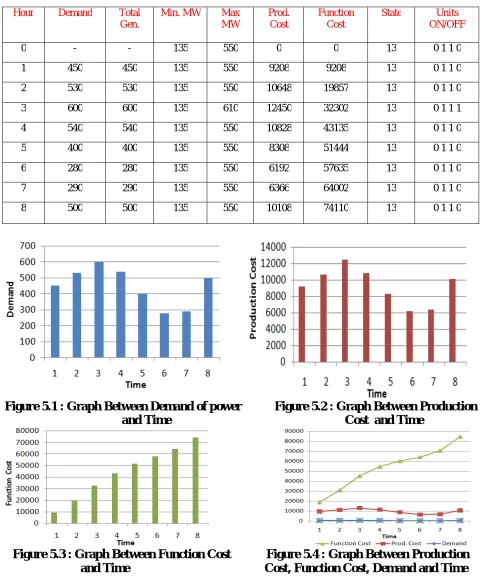
In this paper the committed generators are designated with "1" and non-committed generators are designated with "0".For each hour, program finds the potentially feasible states. Potentially feasible states are the states where demand (and reserve) can be supplied by the committed generators. If there are no potentially feasible states, program displays the error message and terminates. For each potentially feasible state, program takes all feasible states from the previous hour and checks if the transition to the current state (in current hour) is possible. If it is not possible, the corresponding transition (start-up) cost is set to Inf. However, if the transition is possible, calculated is the transition cost. Production for the current hour is calculated based on demand taking into account production at previous hour (ramp-up and down constraints). Finally, total cost is the sum of the transition cost, production cost, and the total cost at the state in previous hour. This procedure is repeated for all the states in previous hour. Total costs are then sorted and MN of them are saved (this is enhancement comparing to the classical dynamic program where only 1 previous state is saved). If the transition to a state in current hour is not possible from any of the states in previous hour, then current state is regarded as infeasible and is not considered anymore. If all the states in an hour are infeasible, program displays the error message and terminates.
The results obtained for the system using dynamic programming are summarized below in Table. I & II.
Table I
State No MW min MW max Units
1 0.0 0.0 0 0 0 0
2 20.0 60.0 0 0 0 1
3 25.0 80.0 1 0 0 0
4 45.0 140.0 1 0 0 1
5 65.0 250.0 0 1 0 0
6 75.0 300.0 0 0 1 0
7 80.0 310.0 0 1 0 1
8 85.0 330.0 1 1 0 0
9 95.0 360.0 0 0 1 1
10 100.0 380.0 1 0 1 0
11 105.0 390.0 1 1 0 1
12 120.0 440.0 1 0 1 1
13 135.0 550.0 0 1 1 0
14 155.0 610.0 0 1 1 1
15 160.0 630.0 1 1 1 0
Table II
Hour Demand Total
Gen.
Min. MW Max
MW
Prod. Cost
Function Cost
State Units
ON/OFF
0 - - 135 550 0 0 13 0 1 1 0
1 450 450 135 550 9208 9208 13 0 1 1 0
2 530 530 135 550 10648 19857 13 0 1 1 0
3 600 600 135 610 12450 32302 13 0 1 1 1
4 540 540 135 550 10828 43135 13 0 1 1 0
5 400 400 135 550 8308 51444 13 0 1 1 0
6 280 280 135 550 6192 57635 13 0 1 1 0
7 290 290 135 550 6366 64002 13 0 1 1 0
8 500 500 135 550 10108 74110 13 0 1 1 0
Figure 5.1 : Graph Between Demand of power Figure 5.2 : Graph Between Production
.
and Time Cost and Time
Figure 5.3 : Graph Between Function Cost Figure 5.4 : Graph Between Production
VI.CONCLUSION
It is recognized that the optimal unit commitment and economic load dispatch of power system results in a great saving for electric utilities. Unit Commitment is the problem of determining the schedule of generating units subject to device and operating constraints. The formulation of unit commitment has been discussed and the solution is obtained by dynamic programming method. The effectiveness of this algorithm has been tested on systems and analyses the behaviour of demand, production cost and function cost of the system with respect to time. It is found that the result obtained for the unit commitment and economic load dispatch using dynamic programming is minimum.
REFERENCES
[1]. A. J. Wood, B. F. Wollenberg, “Power generation, operation and control”, John Wiley & Sons, New York, 1984.
[2]. Abido MA. Multiobjective particle swarm optimization for environmental/economic dispatch problem. Elec Power Syst Res. 2009; 79(7):1105–13.
[3]. Amjady N, Nasiri-Rad H. Security constrained unit commitment by a new adaptive hybrid stochastic search technique. Int J Energy Conversion and Management. 2011; 52(2):1097–106.
[4]. Ch. Yang, D. Simon, “A New Particle Swarm Optimization Technique”, Cleveland State University, Ohio, USA, 2005.
[5]. Chusanapiputt S, Nualhong D, Jantarang S, Phoomvuthisarn S. Relative velocity updating in parallel particle swarm optimization based lagrangian relaxation for large-scale unit commitment problem. IEEE Telecon. 2005 Nov; 1–6.
[6]. E.W. Weisstein, http://mathworld.wolfram.com . Engg.(OJEEE) vol.2,No.2 W09-0043.
[7]. H. Shayeghi, A. Ghasemi, “Application of MOPSO for Economic Load Dispatch Solution with Transmission”
[8]. H.A. Shayanfar, A. Ghasemi, N. Amjady, O. Abedinia, “PSO-IIW for Combined Heat and Power Economic Dispatch”, International Journal on Technical and Physical Problems of Engineering (IJTPE), Issue 11,
[9]. Hiroyuki Mori, Takuya Horiguchi, “Genetic algorithm based approach to economic load dispatching”, IEEE journal of Electrical and Computer Engg.vol.8,No.1,winter- spring 2009.
[10]. K.Chandram, N. Subrahmanyam, and M.Sydulu, “ Brent method for dynamic dispatch with Transmission losses”,Iranian Losses”, International Journal on Technical and Physical Problems of Engineering (IJTPE), Issue 10, Vol. 4, No. 1, pp. 27-34, March 2012.
[11]. M. Dorigo, M.A. Montes de Oca, A. Engelbrecht, “Particle Swarm Optimization”, Scholorpedia, Vol. 3, No. 11, p. 1486, 2008. [12]. Michalewicz Z. GeneticAlgorithm+data structurs = Evolutionprograms. Berlin: Springer; 1992.
[13]. Nidul Sinha, Chakrabarthi R. and P. K. Chattopadhyay, “Evolutionary programming techniques for economic load” IEEE
[14]. Nidul Sinha, Chakrabarti, P. K. Chatopadhyay, “Improved fast evolutionary program for economic load dispatch” IEEE vol. 16, no.1, pp. 22-28, Feb. 2001.
[15]. Palanichamy C, Sundar Babu N. Analytical solution for combined economic and emissions dispatch. Elec Power Syst Res. 2008; 78(7):1129– 37.
[16]. Reneses J, Centeno E, Barquin J. Coordination Between Medium-Term Generation Planning and Short-Term Operation in Electricity Markets. IEEE Transactions on Power Systems. 2006 Feb; 21(1):43–52.
[17]. S.Ganesan and S.Subramanian, “Dynamic Economic dispatch based on simple algorithm”, International journal on Swarm Intelligence, www.swarmintelligence.org . Transactions on power systems, Vol. 1, pp. 145-150, 1993. Vol. 4, No. 2, pp. 51-55, June 2012.
BIOGRAPHY
Gaurav Belongs to Bihar Received his Bachelor of Technology degree from Allahabad Agriculture Deemed University, Allahabad in 2008. He is pursuing his M.Tech in Electrical Engg. (Power System) from SHIATS, Allahabad, UP-India.