Implementation of Optical Reversible Multiplexer Using
Mach-Zehnder Interferometer
*A.VENNELA **Md.ASIM IQBAL
*M.TECH Dept Of ECE, KAKATHIYA UNIVERSITY OF ENGINEERING AND
TECHNOLOGY
**Asst. prof Dept of ECE, KAKATHIYA UNIVERSITY OF ENGINEERING AND
TECHNOLOGY
Abstract:
With the advancements in semiconductor
technology, there has been an increased
emphasis in low-power design techniques
over the last few decades. Now-a-days,
semiconductor optical amplifier (SOA)-
based Mach–Zehnder interferometer (MZI)
plays a vital role in the field of ultra-fast
all-optical signal processing. Reversible
computing has been proposed by several
researchers as a possible alternative to
address the energy dissipation problem.
Several implementation alternatives for
reversible logic circuits have also been
explored in recent years, like adiabatic logic,
nuclear magnetic resonance, optical
computing, etc. Recently researchers have
proposed implementations of various
reversible logic circuits in the all-optical
computing domain. Most of these works are
based on semiconductor optical amplifier
(SOA) based Mach-Zehnder interferometer
(MZI), which provides desirable features
like low power, fast switching and ease of
fabrication.
In this paper we present an all-optical
implementation of a digital multiplexer
using MZI switches.we exploring this
project with MZI based Carry lookahead
Adder(CLA). Both non-reversible and
reversible versions of multiplexer design are
proposed, along with analytical evaluation
of the design complexities both in terms of
delay and resource requirements. The final
optical netlists obtained have been compared
against traditional reversible synthesis
approaches, by using an available synthesis
tool and then mapping the reversible gates to
techniques for optimizing the final optical
netlists have also been proposed.
Keywords: Reversible logic, optical
computing, MZI switch, low- power design
I.INTRODUCTION:
Reversible logic is becoming a popular
emerging paradigm because of its
applications in various emerging
technologies like quantum computing, DNA
computing, optical computing, etc. [3], [11],
[15], [16], [19]. It is also considered as an
alternate low-power design methodology. A
reversible circuit consists of a cascade of
reversible gates without any fanout or
feedback connections, and the number of
inputs and outputs must be equal. There
exists various ways by which reversible
circuits can be implemented like NMR
technology, optical technology, etc. [4], [7],
[12], [14]. In the optical domain, a photon
can store information in a signal having zero
rest mass and provide very high speed.
These properties of photon have motivated
researchers to study and implement
reversible circuits in optical domain.
Theoretically from the decade old principles
of Landauer [10] and Bennett [2], reversible
logic is considered as a potential alternative
to low-power computing. Optical
implementation of reversible gates can be
one possible alternative to overcome the
power dissipation problem in conventional
computing. In recent times researchers have
investigated various reversible logic gates
and their all-optical implementations using
micro- resonator [18] and semiconductor
optical amplifier (SOA) based
Mach-Zehnder interferometer (MZI) switch [4],
[8], [9], [12], [13], [14], [19].
Also MZI-based implementation of
reversible logic gates offer significant
advantages like ease of fabrication, high
speed, low power, and fast switching time
[4], [14]. In this paper, an all-optical
implementation methodology of reversible
multiplexers has been proposed. Cost and
delay analysis in implementing arbitrary
functions using such multiplexers have also
been discussed.
The rest of the paper is organized as follows.
Section II provides a brief summary of
MZI-based switch, reversible logic circuits, and
implementing reversible logic gates using
MZI-based switches. Section III describes
methodology, followed by discussions on
implementing arbitrary functions in Section
IV. Section V, followed by discussions on
implementing carry lookahead adder(CLA),
summarizes the results of experimental
studies, followed by concluding remarks in
Section VI.
II. LITERATURE SURVEY:
In this section we briefly discuss some
relevant background about MZI-based
optical switch, various reversible gates, and
their all-optical implementations.
A.MZI-BASED ALL-OPTICAL
SWITCH:
Mach-Zehnder interferometer (MZI) is one
of the efficient configurable building blocks
in optical computing [19]. Some of the main
advantages for using MZI switches in
various circuit design methodologies are
their compact size, ease of fabrication,
thermal stability and fast switching time [3],
[14]. Recently optical switches based on
MZI have attracted many researchers in the
area of all-optical reversible logic
implementations [3], [8], [9], [12]. An
all-optical MZI switch can be constructed using
two SOA and two couplers. SOA amplifies
an optical signal with- out converting it to
electric signal and uses a semiconductor to
administer the gain medium.
A coupler is a passive optical component
which can either combine or split a signal
based on application requirement. Figure
1(a) shows the schematic diagram of a MZI
switch. It consists of two input ports and two
output ports. At the input port, the optical
signal entering at port A is called the
incoming signal (λ1) and the optical signal
coming from port B is termed as control
signal (λ2). The output ports are termed as
bar port and cross port. The switch works as
follows.
• When both incoming signal (λ1) at A and
control signal (λ2) at B are present, there
will be a presence of light at bar port and no
light at cross port.
• When there is incoming signal (λ1) at A
and no control signal (λ2) at B, then there is
absence of light at bar port and presence of
light at cross port.
If we represent presence of light as Boolean
1, and absence of light as Boolean 0, the
working principle of the MZI switch can be
expressed in terms of the following Boolean
B. REVERSIBLE LOGIC CIRCUITS:
A Boolean function f :Bn → Bn is said to be
reversible if it is one-to-one and bijective. In
other words, for every input vector, there
must be a unique output vector, and vice
versa. A reversible logic circuit consists of a
cascade of reversible gates, with several
constraints. Specifically, the number of
input and output lines must be equal, and
there cannot be any fanouts or feedback
connections [16]. Various reversible gates
have been used by researchers for
synthesizing reversible gate netlists, like
NOT, CNOT [5], Toffoli [20], Fredkin [6],
Peres [17], etc.
In a reversible gate netlist, extra inputs are
often added to make a function reversible,
which are called constant input or ancilla
input. The outputs that are not used in the
circuit but required to maintain reversibility
are called garbage outputs. In the proposed
reversible multiplexer design, we have used
one ancilla input line.
C. IMPLEMENTING REVERSIBLE
GATES USING MZI SWITCH:
Several researchers have studied and
proposed all-optical implementations of
reversible and non-reversible gates like
Toffoli, Fredkin, Peres, XOR, NOR, etc. [3],
[4], [13], [19], [22], and some function
implementations like adder [9] and signed
adder [1]. In all the works, the optical cost
of imple- mentation has been estimated as
the number of MZI switches required, since
the costs of beam splitters and beam
combiners are relatively small. And the
delay has been calculated as the number of
stages of MZI switches multiplied by a unit
Δ. Only one work exists in the literature that
discusses about all-optical realization of
multiplexer [12]; however, the pro- posed
implementation using Feynman and Toffoli
gates is costly both in terms of optical cost
in the present work, both the optical cost and
delay are much smaller as compared to that
in [12]. Figures 2 and 3 respectively show
the all-optical realizations of a CNOT gate
and a 3-input Toffoli gate. For the CNOT
gate realization, the optical cost is 2, while
the delay is 1Δ. Similarly, for the Toffoli
gate realization, the optical cost is 3, while
the delay is 2Δ. For a multiple-control
Toffoli gate with n inputs, the optical cost is
n, and the delay is [log2(n− 1)+ 1]Δ .
III. PROPOSED ALL-OPTICAL
MULTIPLEXER DESIGN:
In this section, we present the all-optical
implementation of a digital multiplexer
using MZI switches, beam splitters and
beam couplers. In the following subsections,
we discuss the design of a (2×1)
non-reversible all-optical multiplexer, followed
by its generalization to (2n×1) multiplexer.
Then a design extension to make the
multiplexer design reversible is suggested,
that requires one additional ancilla line.
A.DESIGN OF (2×1) MULTIPLEXER :
The schematic diagram of a (2×1)
multiplexer is shown in Figure 4(a), where
I0 and I1 are the two inputs, and S is the
select line. The function implemented at the
output is also shown. The all-optical
implementation of the multiplexer is shown
in Figure 4(b), which consists of a beam
splitter (BS) for splitting the select input S,
two MZI switches which generates the
subfunctions I0.S, I0.S, S.I1 and S.I 1
respectively, and finally a beam coupler
(BC) that combines two of the MZI outputs
to realize the desired functionality at the
final output F. The BC essentially performs
the logical OR function in the digital
domain. In the earlier reported works on
implementing logic func- tions using MZI
switches, BS and BC [8], [9], the cost of
implementation (referred to as optical cost)
has been estimated as the number of MZI
and BC are small. Similarly, the delay is
measured as the length of the longest
cascade of MZI switches. Denoting the units
of cost and delay by MZI and Δ, for the
implementation as shown in Figure 4(b),
B. DESIGN OF (2N ×1)
MULTIPLEXER: We now show how a
multiplexer of any larger size can be
constructed using smaller multiplexers as
basic building blocks. This is a standard
approach followed in conventional logic
design; however, in the context of the
present work, we shall be analyzing the
costs and delays with respect to the
all-optical implementations. A (4×1)
multiplexer can be constructed using three
(2×1) multiplexers, as shown in Figure 5(a),
where I0, I1, I2, I3 are the inputs, S0, S1 are
the select lines, and F is the output. Each of
the three multiplexers can be replaced by
their corresponding all-optical netlists, to get
the final netlist as shown in Figure 5(b). For
this implementation, M(2) = 6 MZI D(2) = 2
Δ
Similarly, an (8 × 1) multiplexer can be built
using two(4 ×1) and one (2×1) multiplexers,
for which M(3) = 6∗2 + 2 = 14MZI D(3) = 3
Generalizing, an (2n × 1) multiplexer can
be built using two (2n−1 × 1) and one (2 ×
1) multiplexers, as shown in Figure 6. We
have seen earlier that M(1) = 2, M(2) = 6,
and M(3) = 14. We can express the optical
cost M(n) as a recurrence relation and solve
it as follows
Since the number of MZI stages is equal to
the number of multiplexer select lines in the
final netlist, we can write the delay for an
(2n × 1) multiplexer as D(n) = n Δ
C. REVERSIBLE IMPLEMENTATION
OF THE MULTIPLEXER The all-optical
implementations of multiplexer as
dis-cussed in the previous subsection are not
reversible. One possible approach to have a
reversible implemen-tation of a multiplexer
is to define a suitable reversible embedding
for a (2 × 1) multiplexer, and use it to build
larger multiplexers. As an alternative, we
can add an extra ancilla line and have a
reversible implementation, as shown in
Figure 7.
IV. IMPLEMENTING ARBITRARY
FUNCTIONS USING MZI-BASED
MULTIPLEXERS:
It is a well-known design practice to
implement arbitrary logic functions using
multiplexers. Any function of n variables
can be implemented using an (2n−1 × 1)
multiplexer, with an additional inverter if
required. Figure 8(a) shows the truth table of
an example 3-variable function, and Figure
using a (4×1) multiplexer. An all-optical
im-plementation of the function is shown in
Figure 8(c), which requires 6 MZI switches,
5 beam splitters, and 3 beam couplers.
A. Optimization rules:
It may be observed that in the all-optical
multiplexer-based realization of functions,
some of the MZI switches have constant
inputs (0 or 1). Some of these MZI switches
may be eliminated from the final netlist.
These may be summarized in terms of the
following four optimization rules.
a) If the upper input of a MZI switch is 0,
both the outputs will be 0’s and the switch
can be deleted from the netlist. This is
illustrated in Figure 9(a).
b) If the lower input of a MZI switch is 0,
the upper output will also be 0, and the
upper input will get copied to the lower
output. In this case also, the MZI switch can
be deleted (see Figure 9(b)).
c) If the upper input of a MZI switch is 1,
the two outputs will be respectively the
lower input and its complement. A MZI
switch in this configuration can be used as
an inverter (Figure 9(c)).
d) If the lower input of a MZI switch is 1,
the upper input gets copied to the upper
output, and the lower output becomes 0.
Here again the switch can be deleted (see
To compare the proposed approach with
conventional reversible circuit synthesis,
experiments have been carried out on some
standard reversible logic benchmarks from
RevLib [21]. A summary of the results has
been tabulated in Table I. The first three
columns of the table show the benchmark,
number of inputs, and number of outputs,
respectively.
The next two columns show the gate count
(GC) and quantum cost (QC) of the
reversible gate netlist avail-able in [21]. The
next two columns show the number of MZI
switches (Optical Cost) and the
corresponding number of stages required
(Delay) when each of the Toffoli gates in the
netlist is converted into its equiva-lent
all-optical realization. An n-input multiple-
control Toffoli gate can be realized using n
MZI switches, with [log2(n−1) + 1]number
of stages. The last two columns show the
corresponding values using the proposed
multiplexer based approach. It may be noted
that the optical cost and the delay as
reported in Table I for the proposed
approach uses a straight- forward
multiplexer based realization without using
the opti- mization rules as discussed in the
previ-ous section. If the rules are used,
significant reductions in the number of MZI
switches are expected. The table shows that
the optical costs for some of the benchmarks
are less in the proposed approach, while for
some others it is more. However, the delays
are significantly less for all the benchmarks
in the multi-plexer based approach. It is
known that all 256 possible Boolean
functions of three variables can be expressed
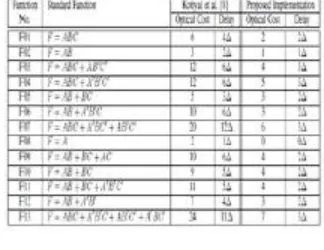
in terms of 13 standard functions [23]. Table
II compares the optical costs and the delays
for these 13 standard functions, for the
proposed method against the corresponding
costs reported by Kotiyal et al. [8]. The
optical cost reported for the proposed
method incorporates the optimization rules
discussed in the previous section. It can be
seen that the proposed implementations
re-quire significantly less number of MZI
switches and also less delay as compared to
[8]. The all-optical imple-mentations of two
of the functions (F09 and F13) after
optimization using the rules are shown in
TABLEI:SYNTHESIS RESULTS ON
BENCH-MARKS:
TABLE II: OPTICAL COST AND
DELAY ANALY-SIS COMPARISON
FOR 13 STANDARD 3-VARI-ABLE
BOOLEAN FUNCTIONS:
V.MZI BASED CLA:
In this section, we present all optical
reversible imple-mentation of Carry
Lookahead Adder (CLA) with the property
of functional reversibility using
Mach-Zehnder Interferometer (MZI) switches.
We have proposed two design techniques of
CLA: - one is hierarchical implementation
and another is nonmodular staircase
structured implementation. In hierarchical
implementation, a generalized design of all
optical reversible CLA using SOA-based
MZI switches is presented. The design of
reversible CLA is improved by
introducingstaircase structure. These
techniques are discussed in details.
A.HIERARCHICAL DESIGN OF 2N
-BIT CLA:
This design is divided in two phases. In
initial phase, we design an optimized 4-bit
CLA circuit and consider this 4-bit design as
small 4-bit CLA blocks in a hierarchical
way, a 2n-bit CLA circuit is constructed.
A.1. OPTIMIZED 4-BIT CLA DESIGN
WITH MZI:
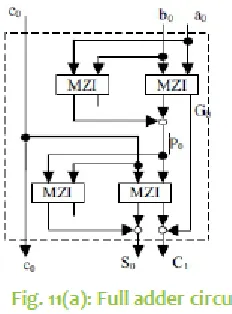
A reversible full adder circuit implemented
with 4 MZI switches, 4 beam splitters (BS)
and 3 beam combiners (BC) as shown in
Fig. 11(a). Here, apart from sum (Si) and
carry (Ci), we define two extra variables: -
carry generator (Gi) and carry propagator
(Pi), where Gi = ai.bi and Pi =abi. The carry
generate (Gi) generates output carry when
the bit values of both the input namely,aiand
bi are set to one, where the carry propagate
(Pi) helps to propagate the carry from Cito
Ci+1. The output sum (Si) and carry (Ci) are
expressed as Si = Pi CiandCi+1 = Gi + PiCi.
The optimized design of 4-bit CLA circuit
using MZI switches is shown in Fig. 11(b).
This circuit consists of four full adder
circuits as shown by the dotted box [Fig.
3(b)]. In CLA, there are two blocks: - one is
carry generate block, and another is carry
propagate block. The inputs to the 4 bit CLA
are A(a3a2a1a0), B (b3b2b1b0) and c0.
The c0 acts as input carry. This 4-bit CLA
performs addition of two four bit binary
numbers. The outputs from the CLA are sum
(S) and carry (C). We deduce the following
relations from Fig. 11(b).
A.2. 2N-BIT CLA DESIGN:
We integrate several 4-bit CLA in a
hierarchical fashion to design a 2n-bit CLA
circuit. In this hierarchical structure, we use
two parameters namely, group generate and
group 4-bit CLA modules and one additional
4-bit ahead block. The additional
look-ahead block computes carry bits based on
received group generate and group
propagate values. Among the five 4-bit CLA
the sense that they compute group generate
and group propagate values but the fifth one
does not. For a 4-bit CLA block, the group
generate and group propagate functions are
labelled as G0-3 and P0-3, respectively. The
group generate and group propagate
functions are defined as follows.
The group generate and group propagate
functions are defined as follows.In this way,
we can construct higher order 2n-bit CLA
circuit using multiple 4-bit look-ahead
blocks. For example, a 64-bit CLA is
constructed by four 16-bit CLA and a 4-bit
ahead block i.e. twenty-one 4-bit
look-ahead block is required.
VI.CONCLUSION: In this paper
all-optical implementation of multiplex-ers us-
ing Mach-Zehnder Interferometer (MZI)
based switches have been presented, along
with analysis of the corresponding costs and
delays. Using one ancilla line, a reversible
implementation of multiplexer is also
proposed. A method for reversible
implementation of functions using MZI
switches and some optimization rules have
also been presented. Experimental results for
some of the benchmarks reveal that the
proposed all-optical implementation results
in significantly less delay as compared to the
one based on conventional reversible gate
implementations. Comparison with a recent
work for the 13 standard 3-variable
demonstrates significant im-provements
both in terms of optical cost and delay.
REFERENCES:
[1] A. Al-Zayed and A. Cherri. Improved
all-optical modified signed- digit adders
using semiconductor op-tical amplifier and
Mach-Zehnder interferometer. Op-tics and
Laser Technology, 42(5):810–818, 2010.
[2] C. Bennett. Logical reversibility of
computation. Journal of IBM Research and
Development, 17:525–532, 1973.
[3] T. Chattopadhyay. All-optical symmetric
ternary log-ic gate. Optics and Laser
Technology, 42(6):1014–1021, 2010.
[4] T. Chattopadhyay. All-optical modified
Fredkin gate. IEEE Journal of Selected
Topics in Quantum Electron-ics, 18(2):585–
592, 2012.
[5] R. Feynman. Quantum mechanical
computers. Op-tic News, 11:11–20, 1985.
AUTHOR 1:-
*A.VENNELA completed
her B.Tech in PULIPATI PRASAD
INSTITUTE OF TECHNOLOGY AND
SCIENCE in 2014 and M.Tech completed
in KAKATHIYA UNIVERSITY OF
ENGINEERING AND TECHNOLOGY
AUTHOR 2:-
**Md.ASIM IQBAL working
as Asst. prof in Dept of ECE, KAKATHIYA
UNIVERSITY OF ENGINEERING AND