Development and Evaluation of Alginate Microspheres
Paracetamol: Effect of Different Concentrations of
Crosslinking Agent and Coating(Scmc &Sodium Alginate)
Anup Kabade*,,Sumit Gaikwad ,Vipul Pulli,Ashwini Pachrane
Department of Pharmaceutics, D.S.T.S College of Pharmacy, Solapur, Solapur, Maharashtra, India.
Email:[email protected]* Abstract
The objective of the present study was to design the alginate microspheres of paracetamol (modeldrug) using calcium chloride as a crosslinking agent by inotropic gelation method. The study focused on the effect of different concentrations of crosslinking agent and coating on the dissolution profile of microspheres using sodium carboxymethylcellulose (SCMC) as coating agent. Microspheres were prepared by using 2% sodium alginate aqueous solution with three different concentrations (5%, 10%, 15% w/v) of crosslinking agent (CaCl2), followed by coating with 2%
sodium carboxymethylcellulose (low
viscosity grade). Uncoated microspheres were evaluated for micromeritic properties like angle of repose, bulk density, tapped density, Carr’s index, Hausner’s ratio and for drug content. The in vitro drug release study was done for both uncoated and coated microspheres. The bulk density values were found in between 0.78 to 1.45 and tapped density values were found in between 0.82 to 1.48. Angle of repose was found to be less than 200, which shows excellent flow properties. The values of Carr’s index were in between 5.05 to 6.22 and Hausner’s ratio was in between 1.01 to
1.05 for uncoated microspheres. It was concluded that microspheres formulated with lower concentration of crosslinking agent showed the higher drug release while
the coated microspheres showed
prolongedor extended release drug release.
Key words: Paracetamol, Microspheres,
Sodium alginate, Calcium chloride, Sodium carboxymethylcellulose.
INTRODUCTION
Microspheres are free flowing polymeric micro particles loaded with biologically active drugs intended for providing constant and prolonged therapeutic effect thus reducing the dosing frequency and thereby improving the patient compliance [1]. They not only used for prolonged release but also for targeting drug to specific site for minimizing the side effects [2-4] Coating of microspheres with a suitable coating material is an additional important technique in microsphere formulation taken for
modification of characteristics of
microspheres especially in-vitro release
profile. Paracetamol is a mild
inhibiting activity. It is used primarily as antipyretic and analgesic drug. It has a short biological half life (2.5h) and about 98% of the drug gets eliminated after a single dose thus requiring a high dosing frequency [5, 6]. Therefore, the present study aims to develop the alginate microspheres of paracetamol prepared with three different concentrations of crosslinking agent (CaCl2) followed by their coating with sodium carboxymethylcellulose (coating agent) for modifying the dissolution profile and providing a sustained release of drug leading to reduce dosing frequency. The prepared microspheres (uncoated and coated) were subjected to evaluation. The uncoated microspheres were subjected to evaluation for various micrometric properties along with the drug content and in vitro drug release. On the other hand the coated microspheres were subjected to in vitro drug release study.
MATERIALS AND METHODS
Paracetamol was obtained as a gift sample from Wings Pharm. Ltd. Mumbai. Sodium alginate, sodium carboxymethylcellulose and calcium chloride were purchased from Himedia Ltd. Mumbai. All other chemicals were of analytical grade.
Method of preparation of alginate microspheres and its coating
The microspheres of paracetamol were prepared by ionotropic gelation method using sodium alginate as polymer and calcium chloride as crosslinking agent (Table 1). A 2% sodium alginate solution was prepared by dissolving weighed amount of sodium alginate in 100 mL distilled water with stirring on a
magnetic stirrer (Remi 5MLH, India).
Table 1: Composition of uncoated microspheres of paracetamol Formulation PARACETAMOL(mg) Sodium alginate
%( w/v) Calcum chloride %(w/v)
A1 500 2% 5%
A2 500 2% !0%
A3 500 2% 15%
Weighed amount of paracetamol was dispersed in the sodium alginate solution.
Crosslinking solutions of various
concentrations (5, 10, 15 %w/v) were prepared by dissolving calcium chloride in distilled water. Sodium alginate solution was filled in the syringe and dropped into the solutions of crosslinking agent from a height of 6 inches with speed of about 50 drops per minute. Microspheres were prepared due to the crosslinking of the polymer by the calcium ions. The prepared microspheres
were collected by decantation followed by centrifugation of the solutions, air dried overnight and then stored in vacuum desiccator. For the coating of prepared microspheres a fraction of uncoated microspheres were subjected to the process
of coating with 2% sodium
dried for overnight and then stored in
vacuum desiccators until the
characterization. The coated microspheres prepared with different concentrations (5, 10 and 15%) of crosslinking agent were coded as formulations CA1, CA2 and CA3.
EVALUATION
Drug content
An amount of microspheres containing a quantity equivalent to 100 mg paracetamol were weighed, crushed and dissolved into 100mL of distilled water using magnetic stirrer for 24 h. Sample was withdrawn after 24h, diluted appropriately and analyzed spectrophotometrically (Double beam UV-Vis spectrophotometer, AU2701, Systronics Ltd. India) at 257nm for determination of the drug content.
Density determination
Bulk density: A weighed amount of microspheres were filled into a measuring
cylinder and the volume (V0) occupied by the microspheres was noted and the bulk density was calculated as followed [7], Bulk Density =Mass of the microspheres (W)/Initial volume of the microspheres (V0). Tapped density: A weighed quantity of microspheres were filled in a measuring cylinder and the cylinder was tapped against a wooden surface at regular interval for 100 times, then the volume occupied by the microspheres was noted down and tapped density was calculated as followed [7], Tapped Density = Mass of the microspheres (W)/Tapped volume of the microspheres (Vf).
Flow properties
Carr’s compressibility index and Hausner’s ratio were calculated for the uncoated microspheres using the following equations [7] Carr’s index = Tapped density- Bulk density/
Tapped density
Table 2 : Evaluation of uncoated microspheres of paracetamol
Hausner’s ratio = Tapped density/ Bulk Density
Angle of repose: It is a measure of resistance to flow and calculated by funnel method. A weighed quantity of microspheres was passed through the funnel and the heap was formed on the paper. The area of the heap was encircled and diameter of the circle and the height of the heap were measured and the angle of repose was calculated as followed [7], TanФ = 2H/D H = Height, D =
diameter of heap formed, 2H/D = surface area of the heap formed.
In Vitro drug release studies
In Vitro release studies was carried out in USP type II dissolution apparatus (Veego, 8DR, India) using 900mL of acid buffer pH 1.2 (upto 3h) and phosphate buffer pH 6.8
(after 3h) as dissolution mediums
dissolution study. Samples (5mL) were withdrawn at different intervals and an equal volume of the fresh dissolution medium was introduced into the apparatus. Each sample was diluted suitably with dissolution
medium and analyzed with UV
spectrophotometer at 257nm for determining the drug release.
RESULTS AND DISCUSSION
In the present study the alginate
microspheres prepared by ionotropic
gelation technique using three different concentrations (5, 10, 15 %) of crosslinking agent (CaCl2) leading to three different
formulations (A1, A2, A3). These
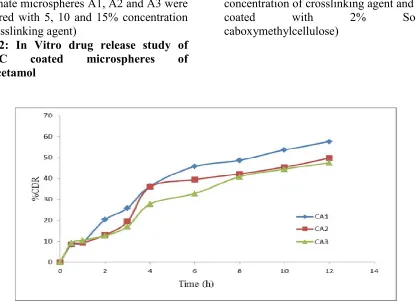
microspheres were subjected to the evaluation for drug content, micrometric properties (like bulk density, tapped density, compressibility index and Hausner’s ratio) and in vitro drug release studies. A1, A2, and A3 formulations were coated with 2% SCMC (low viscosity grade) and the effect of coating on in vitro drug release were also studied. Drug content for different microsphere formulation was in the range of 96.06 to 96.78 %. Microsphere formulation A1 (5% CaCl2 as crosslinking agent) showed highest drug content of 96.78%. The rank order of drug content for all formulation was as follows A1> A2>A3. The micromeritic properties such as bulk density, tapped density, angle of repose, Carr’s index and Hausner’s ratio were determined for uncoated microspheres (Table 2). The various microsphere formulations showed angle of repose less than 200 indicating good flow properties
Fig. 1: In Vitro drug release study of uncoated microspheres of Paracetamol (Alginate microspheres A1, A2 and A3 were prepared with 5, 10 and 15% concentration of crosslinking agent)
Fig. 2: In Vitro drug release study of
SCMC coated microspheres of
paracetamol
(Alginate microspheres CA1, CA2 and CA3 were prepared with 5, 10 and 15% concentration of crosslinking agent and were
coated with 2% Sodium
caboxymethylcellulose)
CONCLUSION
The alginate microspheres were prepared by ionotropic gelation technique using three different concentrations (5, 10, 15%) of crosslinking agent (CaCl2) and these three different formulations were coated with
sodium carboxymethylcellulose. It can be
concluded that all the uncoated
prepared with lower concentration of crosslinking agent showed the higher drug
release therefore, modulating the
concentration of crosslinking agent may be a critical factor for modulating the drug release. The coated microspheres prolonged and extended the drug release. Therefore, these coated microspheres can be used to control and prolong the drug release effectively and reducing the dosing frequency of Paracetamol.
ACKNOWLEDMET
The authors sincerely thanks to D.S.T.S college of pharmacy solapur Maharashtra, India for providing experimental facilities to carry out this work
REFERENCES
[1] Kumar V, Banker GS. Target
oriented drug delivery systems. In; Modern Pharmaceutics. Banker GS, Rhodes CT. Eds. 4th edition, Marcel Dekker, New York, 2005: pp. 529-586. [2] Khar RK, Vyas SP, Ahmad FJ, Jain GK. Lachman/Lieberman’s The Theory and Practice of Industrial Pharmacy, 4th edn. CBS publishers & distributers 2013; pp. 888
[3] Vyas SP. Khar RK. Targetted and controlled drug delivery novel carrier systems. Ist edn. CBS publishers and distributers 2002,
[4] Kataria S. Middha A. Sandhu P. Bilandi A. Kapoor B. Microsphere: a review, IJRPC 2011; 1(4):1184-1198. [5] Jamil. S. Kohli. K. Khar. R.K. Talegaonkar. S. Sustained release sodium alginate microspheres formulation of aceclofenac and paracetamol as potential combination therapy in arthritis. J Pharm Pharmacol.2007; 59(1), 117.
[6] Aslani P, Kennedy RA. Effect of gelation conditions and dissolution media on the release of paracetamol from
alginate gel beads 1996; J
Microencapsul;13(5):601- 14.
[7] Semalty M. Verma D. Semalty A.
Development and evaluation of
microcapsules of verapamil
hydrochloride.indian Drugs 2011; 48 (08):34-38.S
[8] Soni ML. Kumar M. Namdeo KP.
Sodiumbalginate microspheres for
extending drug
[9] release: formulation and in
vitrobevaluation. Int J Drug deliv 2010; 2:64-68.
[10] Mukhopadhyay D. Reid M. Saville D.vTucker IG. Cross-linking ofvdried paracetamol alginate granules Part 1.vThe effect of the cross-linking process variables. Int J Pharm. 2005; 299(1- 2):134-45.
[11] Deasy PB. Microencapsulation and related drug processes. Marcel Dekker Inc., New York, 1984. Pp9-10.
[12] Varde NK, Pack DW. Microspheres for controlled release drug delivery. Expert opinion on biological therapy. 2004;4(1):35-51.
[13] Dhakar RC, Maurya SD, Sagar PS, Bhagat S, Prajapati SK, Jain CP.
Variables influencing the drug
entrapment efficiency of microspheres: A pharmaceutical Review. Der Pharmacia Lett. 2010;2(5):102-116
[14] Dash S. Murthy P.N. Nath L.