Evaluating language understanding accuracy with respect to objective
outcomes in a dialogue system
Myroslava O. Dzikovska and Peter Bell and Amy Isard and Johanna D. Moore Institute for Language, Cognition and Computation
School of Informatics, University of Edinburgh, United Kingdom {m.dzikovska,peter.bell,amy.isard,j.moore}@ed.ac.uk
Abstract
It is not always clear how the differences in intrinsic evaluation metrics for a parser or classifier will affect the performance of the system that uses it. We investigate the relationship between the intrinsic evalua-tion scores of an interpretaevalua-tion component in a tutorial dialogue system and the learn-ing outcomes in an experiment with human users. Following the PARADISE method-ology, we use multiple linear regression to build predictive models of learning gain, an important objective outcome metric in tutorial dialogue. We show that standard intrinsic metrics such as F-score alone do not predict the outcomes well. However, we can build predictive performance func-tions that account for up to 50% of the vari-ance in learning gain by combining fea-tures based on standard evaluation scores and on the confusion matrix entries. We argue that building such predictive mod-els can help us better evaluate performance of NLP components that cannot be distin-guished based on F-score alone, and illus-trate our approach by comparing the cur-rent interpretation component in the system to a new classifier trained on the evaluation data.
1 Introduction
Much of the work in natural language processing relies on intrinsic evaluation: computing standard evaluation metrics such as precision, recall and F-score on the same data set to compare the perfor-mance of different approaches to the same NLP problem. However, once a component, such as a parser, is included in a larger system, it is not always clear that improvements in intrinsic eval-uation scores will translate into improved over-all system performance. Therefore, extrinsic or
task-based evaluation can be used to complement intrinsic evaluations. For example, NLP com-ponents such as parsers and co-reference resolu-tion algorithms could be compared in terms of how much they contribute to the performance of a textual entailment (RTE) system (Sammons et al., 2010; Yuret et al., 2010); parser performance could be evaluated by how well it contributes to an information retrieval task (Miyao et al., 2008). However, task-based evaluation can be difficult and expensive for interactive applications. Specif-ically, task-based evaluation for dialogue systems typically involves collecting data from a number of people interacting with the system, which is time-consuming and labor-intensive. Thus, it is desirable to develop an off-line evaluation pro-cedure that relates intrinsic evaluation metrics to predicted interaction outcomes, reducing the need to conduct experiments with human participants.
This problem can be addressed via the use of the PARADISE evaluation methodology for spo-ken dialogue systems (Walker et al., 2000). In a PARADISE study, after an initial data collection with users, a performance function is created to predict an outcome metric (e.g., user satisfaction) which can normally only be measured through user surveys. Typically, a multiple linear regres-sion is used to fit a predictive model of the desired metric based on the values of interaction param-eters that can be derived from system logs with-out additional user studies (e.g., dialogue length, word error rate, number of misunderstandings).
PARADISE models have been used extensively in task-oriented spoken dialogue systems to estab-lish which components of the system most need improvement, with user satisfaction as the out-come metric (M¨oller et al., 2007; M¨oller et al., 2008; Walker et al., 2000; Larsen, 2003). In tu-torial dialogue, PARADISE studies investigated
which manually annotated features predict learn-ing outcomes, to justify new features needed in the system (Forbes-Riley et al., 2007; Rotaru and Litman, 2006; Forbes-Riley and Litman, 2006).
We adapt the PARADISE methodology to eval-uating individual NLP components, linking com-monly used intrinsic evaluation scores with ex-trinsic outcome metrics. We describe an evalua-tion of an interpretaevalua-tion component of a tutorial dialogue system, with student learning gain as the target outcome measure. We first describe the evaluation setup, which uses standard classifica-tion accuracy metrics for system evaluaclassifica-tion (Sec-tion 2). We discuss the results of the intrinsic sys-tem evaluation in Section 3. We then show that standard evaluation metrics do not serve as good predictors of system performance for the system we evaluated. However, adding confusion matrix features improves the predictive model (Section 4). We argue that in practical applications such predictive metrics should be used alongside stan-dard metrics for component evaluations, to bet-ter predict how different components will perform in the context of a specific task. We demonstrate how this technique can help differentiate the out-put quality between a majority class baseline, the system’s output, and the output of a new classifier we trained on our data (Section 5). Finally, we discuss some limitations and possible extensions to this approach (Section 6).
2 Evaluation Procedure
2.1 Data Collection
We collected transcripts of students interacting with BEETLE II (Dzikovska et al., 2010b), a tu-torial dialogue system for teaching conceptual knowledge in the basic electricity and electron-ics domain. The system is a learning environment with a self-contained curriculum targeted at stu-dents with no knowledge of high school physics. When interacting with the system, students spend 3-5 hours going through pre-prepared reading ma-terial, building and observing circuits in a simula-tor, and talking with a dialogue-based computer tutor via a text-based chat interface.
During the interaction, students can be asked two types of questions. Factual questions require them to name a set of objects or a simple prop-erty, e.g., “Which components in circuit 1 are in a closed path?” or “Are bulbs A and B wired
in series or in parallel”. Explanation and defi-nition questions require longer answers that con-sist of 1-2 sentences, e.g., “Why was bulb A on when switch Z was open?” (expected answer “Be-cause it was still in a closed path with the bat-tery”) or “What is voltage?” (expected answer “Voltage is the difference in states between two terminals”). We focus on the performance of the system on these long-answer questions, since re-acting to them appropriately requires processing more complex input than factual questions.
We collected a corpus of 35 dialogues from paid undergraduate volunteers interacting with the system as part of a formative system evaluation. Each student completed a multiple-choice test as-sessing their knowledge of the material before and after the session. In addition, system logs con-tained information about how each student’s utter-ance was interpreted. The resulting data set con-tains 3426 student answers grouped into 35 sub-sets, paired with test results. The answers were then manually annotated to create a gold standard evaluation corpus.
2.2 BEETLEIIInterpretation Output
The interpretation component of BEETLE II uses a syntactic parser and a set of hand-authored rules to extract the domain-specific semantic represen-tations of student utterances from the text. The student answer is first classified with respect to its domain-specific speech act, as follows:
• Answer: a contentful expression to which the system responds with a tutoring action, either accepting it as correct or remediating the problems as discussed in (Dzikovska et al., 2010a).
• Help request: any expression indicating that the student does not know the answer and without domain content.
• Social: any expression such as “sorry” which appears to relate to social interaction and has no recognizable domain content.
If the student utterance was determined to be an answer, it is further diagnosed for correctness as discussed in (Dzikovska et al., 2010b), using a do-main reasoner together with semantic representa-tions of expected correct answers supplied by hu-man tutors. The resulting diagnosis contains the following information:
• Consistency: whether the student statement correctly describes the facts mentioned in the question and the simulation environment: e.g., student saying “Switch X is closed” is labeled inconsistent if the question stipulated that this switch is open.
• Diagnosis: an analysis of how well the stu-dent’s explanation matches the expected an-swer. It consists of 4 parts
– Matched: parts of the student utterance that matched the expected answer
– Contradictory: parts of the student ut-terance that contradict the expected an-swer
– Extra: parts of the student utterance that do not appear in the expected answer
– Not-mentioned: parts of the expected answer missing from the student utter-ance.
The speech act and the diagnosis are passed to the tutorial planner which makes decisions about feedback. They constitute the output of the inter-pretation component, and its quality is likely to affect the learning outcomes, therefore we need an effective way to evaluate it. In future work, performance of individual pipeline components could also be evaluated in a similar fashion.
2.3 Data Annotation
The general idea of breaking down the student an-swer into correct, incorrect and missing parts is common in tutorial dialogue systems (Nielsen et al., 2008; Dzikovska et al., 2010b; Jordan et al., 2006). However, representation details are highly system specific, and difficult and time-consuming to annotate. Therefore we implemented a simpli-fied annotation scheme which classifies whole an-swers as correct, partially correct but incomplete, or contradictory, without explicitly identifying the correct and incorrect parts. This makes it easier to create the gold standard and still retains useful in-formation, because tutoring systems often choose
the tutoring strategy based on the general answer class (correct, incomplete, or contradictory). In addition, this allows us to cast the problem in terms of classifier evaluation, and to use standard classifier evaluation metrics. If more detailed an-notations were available, this approach could eas-ily be extended, as discussed in Section 6.
We employed a hierarchical annotation scheme shown in Figure 1, which is a simplification of the DeMAND coding scheme (Campbell et al., 2009). Student utterances were first annotated as either related to domain content, or not con-taining any domain content, but expressing the student’s metacognitive state or attitudes. Utter-ances expressing domain content were then coded with respect to their correctness, as being fully correct, partially correct but incomplete, contain-ing some errors (rather than just omissions) or irrelevant1. The “irrelevant” category was used for utterances which were correct in general but which did not directly answer the question. Inter-annotator agreement for this annotation scheme on the corpus wasκ= 0.69.
The speech acts and diagnoses logged by the system can be automatically mapped into our an-notation labels. Help requests and social acts are assigned the “non-content” label; answers are assigned a label based on which diagnosis fields were filled: “contradictory” for those an-swers labeled as either inconsistent, or contain-ing somethcontain-ing in the contradictory field; “incom-plete” if there is something not mentioned, but something matched as well, and “irrelevant” if nothing matched (i.e., the entire expected answer is in not-mentioned). Finally, uninterpretable ut-terances are treated as unclassified, analogous to a situation where a statistical classifier does not out-put a label for an inout-put because the classification probability is below its confidence threshold.
This mapping was then compared against the manually annotated labels to compute the intrin-sic evaluation scores for the BEETLEII interpreter described in Section 3.
3 Intrinsic Evaluation Results
The interpretation component of BEETLE II was developed based on the transcripts of 8 sessions
1Several different subcategories of non-content
Category Subcategory Description
Non-content Metacognitive and social expressions without domain content, e.g., “I don’t know”, “I need help”, “you are stupid”
Content The utterance includes domain content. correct The student answer is fully correct
pc incomplete The student said something correct, but incomplete, with some parts of the expected answer missing
contradictory The student’s answer contains something incorrect or contradicting the expected answer, rather than just an omission
[image:4.595.72.542.73.223.2]irrelevant The student’s statement is correct in general, but it does not answer the question.
Figure 1: Annotation scheme used in creating the gold standard
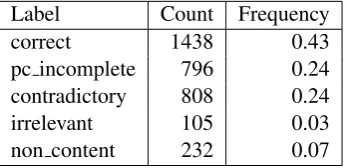
Label Count Frequency correct 1438 0.43 pc incomplete 796 0.24 contradictory 808 0.24 irrelevant 105 0.03 non content 232 0.07
Table 1: Distribution of annotated labels in the evalu-ation corpus
of students interacting with earlier versions of the system. These sessions were completed prior to the beginning of the experiment during which our evaluation corpus was collected, and are not in-cluded in the corpus. Thus, the corpus constitutes unseen testing data for the BEETLEII interpreter. Table 1 shows the distribution of codes in the annotated data. The distribution is unbal-anced, and therefore in our evaluation results we use two different ways to average over per-class evaluation scores. Macro-average combines per-class scores disregarding the per-class sizes; micro-average weighs the per-class scores by class size. The overall classification accuracy (defined as the number of correctly classified instances out of all instances) is mathematically equivalent to micro-averaged recall; however, macro-averaging better reflects performance on small classes, and is com-monly used for unbalanced classification prob-lems (see, e.g., (Lewis, 1991)).
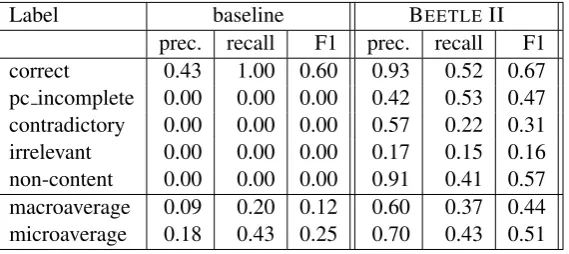
The detailed evaluation results are presented in Table 2. We will focus on two metrics: the overall classification accuracy (listed as “micro-averaged recall” as discussed above), and the macro-averaged F score.
The majority class baseline is to assign “cor-rect” to every instance. Its overall accuracy is
43%, the same as BEETLE II. However, this is obviously not a good choice for a tutoring sys-tem, since students who make mistakes will never get tutoring feedback. This is reflected in a much lower value of the F score (0.12 macroaverage F score for baseline vs. 0.44 for BEETLEII). Note also that there is a large difference in the micro-and macro- averaged scores. It is not immediately clear which of these metrics is the most important, and how they relate to actual system performance. We discuss machine learning models to help an-swer this question in the next section.
4 Linking Evaluation Measures to Outcome Measures
Although the intrinsic evaluation shows that the BEETLE II interpreter performs better than the baseline on the F score, ultimately system devel-opers are not interested in improving interpreta-tion for its own sake: they want to know whether the time spent on improvements, and the compli-cations in system design which may accompany them, are worth the effort. Specifically, do such changes translate into improvement in overall sys-tem performance?
[image:4.595.73.247.262.346.2]Label baseline BEETLE II prec. recall F1 prec. recall F1 correct 0.43 1.00 0.60 0.93 0.52 0.67 pc incomplete 0.00 0.00 0.00 0.42 0.53 0.47 contradictory 0.00 0.00 0.00 0.57 0.22 0.31 irrelevant 0.00 0.00 0.00 0.17 0.15 0.16 non-content 0.00 0.00 0.00 0.91 0.41 0.57 macroaverage 0.09 0.20 0.12 0.60 0.37 0.44 microaverage 0.18 0.43 0.25 0.70 0.43 0.51
Table 2: Intrinsic Evaluation Results for the BEETLEII and a majority class baseline
the most improvement, we focus on finding a bet-ter performance metric for a single component (interpretation), using standard evaluation scores as features.
Recall from Section 2.1 that each participant in our data collection was given a pre-test and a post-test, measuring their knowledge of course material. The test score was equal to the propor-tion of correctly answered quespropor-tions. The normal-ized learning gain, post1−−prepre is a metric typically used to assess system quality in intelligent tutor-ing, and this is the metric we are trying to model. Thus, the training data for our model consists of 35 instances, each corresponding to a single dia-logue and the learning gain associated with it. We can compute intrinsic evaluation scores for each dialogue, in order to build a model that predicts that student’s learning gain based on these scores. If the model’s predictions are sufficiently reliable, we can also use them for predicting the learning gain that a student could achieve when interacting with a new version of the interpretation compo-nent for the system, not yet tested with users. We can then use the predicted score to compare dif-ferent implementations and choose the one with the highest predicted learning gain.
4.1 Features
Table 4 lists the feature sets we used. We tried two basic types of features. First, we used the eval-uation scores reported in the previous section as features. Second, we hypothesized that some er-rors that the system makes are likely to be worse than others from a tutoring perspective. For ex-ample, if the student gives a contradictory answer, accepting it as correct may lead to student miscon-ceptions; on the other hand, calling an irrelevant answer “partially correct but incomplete” may be less of a problem. Therefore, we computed
sepa-rate confusion matrices for each student. We nor-malized each confusion matrix cell by the total number of incorrect classifications for that stu-dent. We then added features based on confusion frequencies to our feature set.2
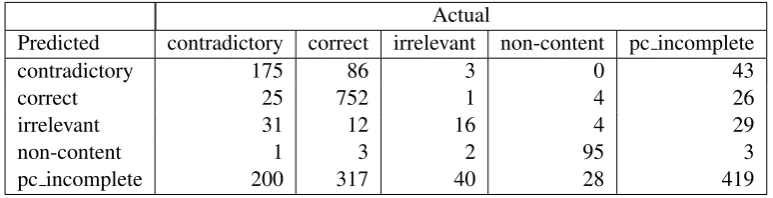
Ideally, we should add 20 different features to our model, corresponding to every possible con-fusion. However, we are facing a sparse data problem, illustrated by the overall confusion ma-trix for the corpus in Table 3. For example, we only observed 25 instances where a contra-dictory utterance was miscategorized as correct (compared to 200 “contradictory–pc incomplete” confusions), and so for many students this mis-classification was never observed, and predictions based on this feature are not likely to be reliable. Therefore, we limited our features to those mis-classifications that occurred at least twice for each student (i.e., at least 70 times in the entire cor-pus). The list of resulting features is shown in the “conf” row of Table 4. Since only a small num-ber of features was included, this limits the appli-cability of the model we derived from this data set to the systems which make similar types of confusions. However, it is still interesting to in-vestigate whether confusion probabilities provide additional information compared to standard eval-uation metrics. We discuss how better coverage could be obtained in Section 6.
4.2 Regression Models
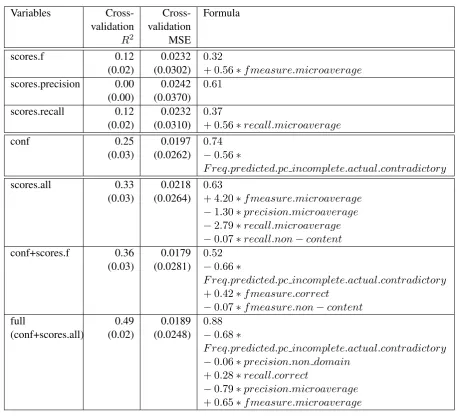
Table 5 shows the regression models we obtained using different feature sets. All models were ob-tained using stepwise linear regression, using the Akaike information criterion (AIC) for variable
2We also experimented with using % unclassified as an
Actual
Predicted contradictory correct irrelevant non-content pc incomplete
contradictory 175 86 3 0 43
correct 25 752 1 4 26
irrelevant 31 12 16 4 29
non-content 1 3 2 95 3
[image:6.595.102.489.71.170.2]pc incomplete 200 317 40 28 419
Table 3: Confusion matrix for BEETLEII. System predicted values are in rows; actual values in columns.
selection implemented in the R stepwise regres-sion library. As measures of model quality, we re-portR2, the percentage of variance accounted for by the models (a typical measure of fit in regres-sion modeling), and mean squared error (MSE). These were estimated using leave-one-out cross-validation, since our data set is small.
We used feature ablation to evaluate the contri-bution of different features. First, we investigated models using precision, recall or F-score alone. As can be seen from the table, precision is not pre-dictive of learning gain, while F-score and recall perform similarly to one another, withR2 = 0.12. In comparison, the model using only confusion frequencies has substantially higher estimatedR2
and a lower MSE.3 In addition, out of the 3 con-fusion features, only one is selected as predictive. This supports our hypothesis that different types of errors may have different importance within a practical system.
The confusion frequency feature chosen by the stepwise model (“predicted-pc incomplete-actual-contradictory”) has a reasonable theoret-ical justification. Previous research shows that students who give more correct or partially cor-rect answers, either in human or human-computer dialogue, exhibit higher learning gains, and this has been established for different sys-tems and tutoring domains (Litman et al., 2009). Consequently, % of contradictory answers is neg-atively predictive of learning gain. It is reasonable to suppose, as predicted by our model, that sys-tems that do not identify such answers well, and therefore do not remediate them correctly, will do worse in terms of learning outcomes.
Based on this initial finding, we investigated the models that combined either F scores or the
3The decrease in MSE is not statistically significant,
pos-sibly because of the small data set. However, since we ob-serve the same pattern of results across our models, it is still useful to examine.
full set of intrinsic evaluation scores with confu-sion frequencies. Note that if the full set of met-rics (precision, recall, F score) is used, the model derives a more complex formula which covers about 33% of the variance. Our best models, however, combine the averaged scores with con-fusion frequencies, resulting in a higherR2 and
a lower MSE (22% relative decrease between the “scores.f” and “conf+scores.f” models in the ta-ble). This shows that these features have comple-mentary information, and that combining them in an application-specific way may help to predict how the components will behave in practice.
5 Using prediction models in evaluation
The models from Table 5 can be used to compare different possible implementations of the inter-pretation component, under the assumption that the component with a higher predicted learning gain score is more appropriate to use in an ITS. To show how our predictive models can be used in making implementation decisions, we compare three possible choices for an interpretation com-ponent: the original BEETLE II interpreter, the baseline classifier described earlier, and a new de-cision tree classifier trained on our data.
We built a decision tree classifier using the Weka implementation of C4.5 pruned decision trees, with default parameters. As features, we used lexical similarity scores computed by the
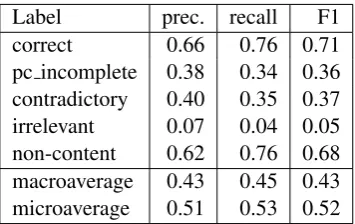
Text::Similaritypackage4. We computed 8 features: the similarity between student answer and either the expected answer text or the question text, using 4 different scores: raw number of over-lapping words, F1 score, lesk score and cosine score. Its intrinsic evaluation scores are shown in Table 6, estimated using 10-fold cross-validation. We can compare BEETLEII and baseline clas-sifier using the “scores.all” model. The predicted
4
Name Variables
scores.fm fmeasure.microaverage, fmeasure.macroaverage, fmeasure.correct, fmeasure.contradictory, fmeasure.pc incomplete,fmeasure.non-content, fmeasure.irrelevant
scores.precision precision.microaverage, precision.macroaverage, precision.correct, precision.contradictory, precision.pc incomplete,precision.non-content, precision.irrelevant
scores.recall recall.microaverage, recall.macroaverage, recall.correct, recall.contradictory, recall.pc incomplete,recall.non-content, recall.irrelevant
[image:7.595.70.525.83.262.2]scores.all scores.fm + scores.precision + scores.recall conf Freq.predicted.contradictory.actual.correct, Freq.predicted.pc incomplete.actual.correct, Freq.predicted.pc incomplete.actual.contradictory
Table 4: Feature sets for regression models
Variables Cross-validation
R2
Cross-validation MSE
Formula
scores.f 0.12 (0.02)
0.0232 (0.0302)
0.32
+ 0.56∗f measure.microaverage
scores.precision 0.00 (0.00)
0.0242 (0.0370)
0.61
scores.recall 0.12 (0.02)
0.0232 (0.0310)
0.37
+ 0.56∗recall.microaverage
conf 0.25
(0.03)
0.0197 (0.0262)
0.74 −0.56∗
F req.predicted.pc incomplete.actual.contradictory
scores.all 0.33 (0.03)
0.0218 (0.0264)
0.63
+ 4.20∗f measure.microaverage
−1.30∗precision.microaverage
−2.79∗recall.microaverage
−0.07∗recall.non−content
conf+scores.f 0.36 (0.03)
0.0179 (0.0281)
0.52 −0.66∗
F req.predicted.pc incomplete.actual.contradictory
+ 0.42∗f measure.correct
−0.07∗f measure.non−content
full
(conf+scores.all)
0.49 (0.02)
0.0189 (0.0248)
0.88 −0.68∗
F req.predicted.pc incomplete.actual.contradictory
−0.06∗precision.non domain
+ 0.28∗recall.correct
−0.79∗precision.microaverage
+ 0.65∗f measure.microaverage
Table 5: Regression models for learning gain. R2 and MSE estimated with leave-one-out cross-validation.
[image:7.595.68.526.308.725.2]score for BEETLE II is 0.66. The predicted
score for the baseline is 0.28. We cannot use the models based on confusion scores (“conf”, “conf+scores.f” or “full”) for evaluating the base-line, because the confusions it makes are always to predict that the answer is correct when the actual label is “incomplete” or “contradictory”. Such situations were too rare in our training data, and therefore were not included in the models (as discussed in Section 4.1). Additional data will need to be collected before this model can rea-sonably predict baseline behavior.
Compared to our new classifier, BEETLEII has lower overall accuracy (0.43 vs. 0.53), but per-forms micro- and macro- averaged scores. BEE
-TLE II precision is higher than that of the classi-fier. This is not unexpected given how the system was designed: since misunderstandings caused dialogue breakdown in pilot tests, the interpreter was built to prefer rejecting utterances as uninter-pretable rather than assigning them to an incorrect class, leading to high precision but lower recall.
However, we can use all our predictive models to evaluate the classifier. We checked the the con-fusion matrix (not shown here due to space lim-itations), and saw that the classifier made some of the same types of confusions that BEETLE II interpreter made. On the “scores.all” model, the predicted learning gain score for the classifier is
0.63, also very close to BEETLE II. But with the “conf+scores.all” model, the predicted score is
0.89, compared to0.59for BEETLEII, indicating
that we should prefer the newly built classifier. Looking at individual class performance, the classifier performs better than the BEETLE II
in-terpreter on identifying “correct” and “contradic-tory” answers, but does not do as well for par-tially correct but incomplete, and for irrelevant an-swers. Using our predictive performance metric highlights the differences between the classifiers and effectively helps determine which confusion types are the most important.
One limitation of this prediction, however, is that the original system’s output is considerably more complex: the BEETLE II interpreter explic-itly identifies correct, incorrect and missing parts of the student answer which are then used by the system to formulate adaptive feedback. This is an important feature of the system because it al-lows for implementation of strategies such as ac-knowledging and restating correct parts of the
[image:8.595.322.500.70.182.2]an-Label prec. recall F1 correct 0.66 0.76 0.71 pc incomplete 0.38 0.34 0.36 contradictory 0.40 0.35 0.37 irrelevant 0.07 0.04 0.05 non-content 0.62 0.76 0.68 macroaverage 0.43 0.45 0.43 microaverage 0.51 0.53 0.52
Table 6: Intrinsic evaluation scores for our newly built classifier.
swer. However, we could still use a classifier to “double-check” the interpreter’s output. If the predictions made by the original interpreter and the classifier differ, and in particular when the classifier assigns the “contradictory” label to an answer, BEETLE II may choose to use a generic strategy for contradictory utterances, e.g. telling the student that their answer is incorrect without specifying the exact problem, or asking them to re-read portions of the material.
6 Discussion and Future Work
In this paper, we proposed an approach for cost-sensitive evaluation of language interpretation within practical applications. Our approach is based on the PARADISE methodology for dia-logue system evaluation (Walker et al., 2000). We followed the typical pattern of a PARADISE study, but instead of relying on a variety of fea-tures that characterize the interaction, we used scores that reflect only the performance of the interpretation component. For BEETLE II we could build regression models that account for nearly 50% variance in the desired outcomes, on par with models reported in earlier PARADISE studies (M¨oller et al., 2007; M¨oller et al., 2008; Walker et al., 2000; Larsen, 2003). More impor-tantly, we demonstrated that combining averaged scores with features based on confusion frequen-cies improves prediction quality and allows us to see differences between systems which are not ob-vious from the scores alone.
expen-sive, and building a predictive model of system performance can simplify system development.
Our evaluation data limited the set of features that we could use in our models. For most con-fusion features, there were not enough instances in the data to build a model that would reliably predict learning gain for those cases. One way to solve this problem would be to conduct a user study in which the system simulates random er-rors appearing some of the time. This could pro-vide the data needed for more accurate models.
The general pattern we observed in our data is that a model based on F-scores alone predicts only a small proportion of the variance. If a full set of metrics (including F-score, precision and recall) is used, linear regression derives a more complex equation, with different weights for pre-cision and recall. Instead of the linear model, we may consider using a model based on Fβ score, Fβ = (1 +β2)β2P RP+R, and fitting it to the data to
derive theβweight rather than using the standard
F1score. We plan to investigate this in the future.
Our method would apply to a wide range of systems. It can be used straightforwardly with many current spoken dialogue systems which rely on classifiers to support language understanding in domains such as call routing and technical sup-port (Gupta et al., 2006; Acomb et al., 2007). We applied it to a system that outputs more com-plex logical forms, but we showed that we could simplify its output to a set of labels which still allowed us to make informed decisions. Simi-lar simplifications could be derived for other sys-tems based on domain-specific dialogue acts typ-ically used in dialogue management. For slot-based systems, it may be useful to consider con-cept accuracy for recognizing individual slot val-ues. Finally, for tutoring systems it is possible to annotate the answers on a more fine-grained level. Nielsen et al. (2008) proposed an annota-tion scheme based on the output of a dependency parser, and trained a classifier to identify individ-ual dependencies as “expressed”, “contradicted” or “unaddressed”. Their system could be evalu-ated using the same approach.
The specific formulas we derived are not likely to be highly generalizable. It is a well-known limitation of PARADISE evaluations that models built based on one system often do not perform well when applied to different systems (M¨oller et al., 2008). But using them to compare
implemen-tation variants during the system development, without re-running user evaluations, can provide important information, as we illustrated with an example of evaluating a new classifier we built for our interpretation task. Moreover, the confusion frequency feature that our models picked is con-sistent with earlier results from a different tutor-ing domain (see Section 4.2). Thus, these models could provide a starting point when making sys-tem development choices, which can then be con-firmed by user evaluations in new domains.
The models we built do not fully account for the variance in the training data. This is expected, since interpretation performance is not the only factor influencing the objective outcome: other factors, such choosing the the appropriate tutor-ing strategy, are also important. Similar models could be built for other system components to ac-count for their contribution to the variance. Fi-nally, we could consider using different learning algorithms. M¨oller et al. (2008) examined deci-sion trees and neural networks in addition to mul-tiple linear regression for predicting user satisfac-tion in spoken dialogue. They found that neural networks had the best prediction performance for their task. We plan to explore other learning algo-rithms for this task as part of our future work.
7 Conclusion
In this paper, we described an evaluation of an interpretation component of a tutorial dialogue system using predictive models that link intrin-sic evaluation scores with learning outcomes. We showed that adding features based on confusion frequencies for individual classes significantly improves the prediction. This approach can be used to compare different implementations of lan-guage interpretation components, and to decide which option to use, based on the predicted im-provement in a task-specific target outcome met-ric trained on previous evaluation data.
Acknowledgments
References
Kate Acomb, Jonathan Bloom, Krishna Dayanidhi, Phillip Hunter, Peter Krogh, Esther Levin, and Roberto Pieraccini. 2007. Technical support dia-log systems: Issues, problems, and solutions. In Proceedings of the Workshop on Bridging the Gap: Academic and Industrial Research in Dialog Tech-nologies, pages 25–31, Rochester, NY, April. Gwendolyn C. Campbell, Natalie B. Steinhauser,
Myroslava O. Dzikovska, Johanna D. Moore, Charles B. Callaway, and Elaine Farrow. 2009. The DeMAND coding scheme: A “common language” for representing and analyzing student discourse. In Proceedings of 14th International Conference on Artificial Intelligence in Education (AIED), poster session, Brighton, UK, July.
Myroslava O. Dzikovska, Charles B. Callaway, Elaine Farrow, Johanna D. Moore, Natalie B. Steinhauser, and Gwendolyn E. Campbell. 2009. Dealing with interpretation errors in tutorial dialogue. In Pro-ceedings of the SIGDIAL 2009 Conference, pages 38–45, London, UK, September.
Myroslava Dzikovska, Diana Bental, Johanna D. Moore, Natalie B. Steinhauser, Gwendolyn E. Campbell, Elaine Farrow, and Charles B. Callaway. 2010a. Intelligent tutoring with natural language support in the Beetle II system. InSustaining TEL: From Innovation to Learning and Practice - 5th Eu-ropean Conference on Technology Enhanced Learn-ing, (EC-TEL 2010), Barcelona, Spain, October. Myroslava O. Dzikovska, Johanna D. Moore, Natalie
Steinhauser, Gwendolyn Campbell, Elaine Farrow, and Charles B. Callaway. 2010b. Beetle II: a sys-tem for tutoring and computational linguistics ex-perimentation. InProceedings of the 48th Annual Meeting of the Association for Computational Lin-guistics (ACL-2010) demo session, Uppsala, Swe-den, July.
Kate Forbes-Riley and Diane J. Litman. 2006. Mod-elling user satisfaction and student learning in a spoken dialogue tutoring system with generic, tu-toring, and user affect parameters. In Proceed-ings of the Human Language Technology Confer-ence of the North American Chapter of the Asso-ciation of Computational Linguistics (HLT-NAACL ’06), pages 264–271, Stroudsburg, PA, USA. Kate Forbes-Riley, Diane Litman, Amruta Purandare,
Mihai Rotaru, and Joel Tetreault. 2007. Compar-ing lCompar-inguistic features for modelCompar-ing learnCompar-ing in com-puter tutoring. InProceedings of the 2007 confer-ence on Artificial Intelligconfer-ence in Education: Build-ing Technology Rich LearnBuild-ing Contexts That Work, pages 270–277, Amsterdam, The Netherlands. IOS Press.
Narendra K. Gupta, G¨okhan T¨ur, Dilek Hakkani-T¨ur, Srinivas Bangalore, Giuseppe Riccardi, and Mazin
Gilbert. 2006. The AT&T spoken language un-derstanding system. IEEE Transactions on Audio, Speech & Language Processing, 14(1):213–222. Pamela W. Jordan, Maxim Makatchev, and Umarani
Pappuswamy. 2006. Understanding complex nat-ural language explanations in tutorial applications. InProceedings of the Third Workshop on Scalable Natural Language Understanding, ScaNaLU ’06, pages 17–24.
Lars Bo Larsen. 2003. Issues in the evaluation of spo-ken dialogue systems using objective and subjective measures. InProceedings of the 2003 IEEE Work-shop on Automatic Speech Recognition and Under-standing, pages 209–214.
David D. Lewis. 1991. Evaluating text categorization. InProceedings of the workshop on Speech and Nat-ural Language, HLT ’91, pages 312–318, Strouds-burg, PA, USA.
Diane Litman, Johanna Moore, Myroslava Dzikovska, and Elaine Farrow. 2009. Using natural lan-guage processing to analyze tutorial dialogue cor-pora across domains and modalities. In Proceed-ings of 14th International Conference on Artificial Intelligence in Education (AIED), Brighton, UK, July.
Yusuke Miyao, Rune Sætre, Kenji Sagae, Takuya Mat-suzaki, and Jun’ichi Tsujii. 2008. Task-oriented evaluation of syntactic parsers and their representa-tions. InProceedings of ACL-08: HLT, pages 46– 54, Columbus, Ohio, June.
Sebastian M¨oller, Paula Smeele, Heleen Boland, and Jan Krebber. 2007. Evaluating spoken dialogue systems according to de-facto standards: A case study. Computer Speech & Language, 21(1):26 – 53.
Sebastian M¨oller, Klaus-Peter Engelbrecht, and Robert Schleicher. 2008. Predicting the quality and usability of spoken dialogue services. Speech Com-munication, pages 730–744.
Rodney D. Nielsen, Wayne Ward, and James H. Mar-tin. 2008. Learning to assess low-level conceptual understanding. InProceedings 21st International FLAIRS Conference, Coconut Grove, Florida, May. Mihai Rotaru and Diane J. Litman. 2006. Exploit-ing discourse structure for spoken dialogue perfor-mance analysis. InProceedings of the 2006 Con-ference on Empirical Methods in Natural Language Processing, EMNLP ’06, pages 85–93, Strouds-burg, PA, USA.
Mark Sammons, V.G.Vinod Vydiswaran, and Dan Roth. 2010. “Ask not what textual entailment can do for you...”. InProceedings of the 48th Annual Meeting of the Association for Computational Lin-guistics, pages 1199–1208, Uppsala, Sweden, July. Marilyn A. Walker, Candace A. Kamm, and Diane J.