The Self-Concept Life Cycle and Brand Perceptions: An Interdisciplinary
Perspective
Abstract Consumer research has paid scant attention to the full spectrum of a consumer’s self-concept life cycle and its subsequent impact on brand attitude. This article presents a
conceptual framework that provides the foundation for future research on how the
self-concept, across its full life cycle, impacts brand attitude. The article considers the
development of the self-concept from childhood to late adulthood, and integrates findings
from various disciplines into a comprehensive framework. The factors in the framework
affecting the self-concept are global culture, life events, as well as cognitive and desired age.
The article offers six propositions to guide future research and encourage more
interdisciplinary work, as well as guiding the application of a broader perspective in terms of
the self-concept’s full life-span. Moreover, the article also presents methodological and
managerial implications on how to use branding approaches that target specific consumer
segments according to their self-concepts’ life cycle.
Introduction
Research investigating how the self-concept impacts a consumer’s brand perceptions and the
underlying decision-making processes has flourished over the last few decades (Chaplin and
John 2005; Mittal 2006; Reed II 2002; Sirgy 1982; Sirgy et al. 2008; Sirgy et al. 1991; Sung
et al. 2012). Recognizing that the self-concept is dynamic over a person’s lifespan, a
sub-domain in this field has evolved to investigate how a person’s chronological age (herein
actual age) impacts his or her self-concept and, subsequently, their brand perceptions (e.g.,
Chaplin and John 2005; Loroz 2004; Yoon et al. 2009). More than two decades ago,
however, Demo (1992) indicated that the focus of self-concept related research had been too
narrow (i.e., student samples of young adults), thus limiting the applicability of the outcomes
to individuals in other life-stages. The field of psychology responded through a growing body
of knowledge that considers a wider range of respondents, such as adolescents and other
groups from early to late adulthood (e.g., Green et al. 2012; Lodi-Smith and Roberts 2010).
Nevertheless, applications to consumer research focusing on the full spectrum of a
consumer’s self-concept life cycle and, subsequently, its impact on brand perceptions, such as
brand attitude, have been sparse. Focusing mainly on one phase of the life cycle, these studies
have shown that differences in cognitive development, as well as neural structures, are
responsible for variations in the decision-making processes pertaining to brands among
children (Chaplin and John 2007) and individuals in late adulthood when compared to young
adults (Yoon et al. 2009). Recent work by Moschis (2012) offers a theoretically rich and
broad review of consumer behavior among older consumers, including implications of the
self-concept, but it does not delve into the other life-stages of a consumer’s self-concept.
Furthermore, the self-concept is shaped by numerous factors (e.g., global culture and
Abrams 2012; Zhu and Han 2008). Consequently, consumer researchers should also use
multiple theoretical lenses to explore consumer phenomena (Pham 2013) and adopt an
interdisciplinary perspective to study the self-concept across its full life cycle (McConnell
2011). Adopting a wide variety of perspectives might potentially reveal new insights into
how the self-concept impacts brand attitude. The narrow focus of self-concept research in the
consumer domain is particularly surprising, as it was established decades ago that consumers
use brands as a means of self-expression (Belk 1988); this marks the self-concept as a key
construct in consumer research (Aguirre-Rodriguez et al. 2012). Moreover, the number of
potential consumers in various age groups (e.g., older adults) continues to grow across the
globe (Hurd and Rohwedder 2010; Schwarz 2003; Szmigin and Carrigan 2001). This notion
further amplifies the need for a more comprehensive understanding of how the self-concept
affects brand attitude during its full life cycle. Apart from benefiting consumer researchers
from a theoretical perspective, such knowledge also offers marketing practitioners insights
into how to position their brands when targeting consumers from specific age segments.
This article contributes to the growing body of literature on how consumers use
brands as a means of self-expression during various life-stages (Chaplin and John 2005;
Loroz 2004; Yoon et al. 2009). This is accomplished through the following two objectives:
First, it offers a synthesis of the previous literature on various factors that have been shown to
impact the self-concept at different life-stages. The three factors considered in the framework
are: (1) global culture, (2) life events, (3) and cognitive as well as desired age. Subsequently,
these factors are integrated into a conceptual framework, which offers a “big picture” that
considers an interdisciplinary perspective on the full self-concept life cycle (from childhood
to late adulthood) and how it impacts brand attitude. Second, the article provides six research
propositions that consider how these factors interact to influence, through the mediating
consider how actual age potentially moderates these relationships. These propositions serve
as a foundation for future consumer research that might investigate how the self-concept,
through its full life cycle, impacts brand attitude.
The remainder of this article is structured as follows; first, it offers a background on
the conceptualization of the concept and how brands are used as a means of
self-expression, subsequently impacting brand perceptions such as brand attitude; second, it
discusses the conceptual framework; third, the article presents the six research propositions.
This is followed by directions for future research, and methodological and managerial
implications, and the article’s overall conclusions.
Background
The self-concept
Since William James offered a rich account of the self-concept in his seminal text Principles
of Psychology at the end of the 19th century, scholars have debated extensively about an
adequate conceptualization of the self. A definition, widely used nowadays, was brought
forward by Rosenberg (1979, p. 7), conceptualizing the self-concept as “the totality of an
individual‘s thoughts and feelings having reference to himself as an object”. This definition
encompasses the various views of previous scholars (e.g., Cooley 1964; James 1890; Mead
1934) as it describes how an individual processes internalized (private) aspects of the
self-concept, as well as the importance placed on social interaction as part of the self-concept
formation process.
From the 1970s onwards, research on the self-concept has registered a continued and
publications (Swann and Seyle 2005). Important contributions considering the self-concept
have been made in the domain of theory, such as the theory of self-perception (Bem 1972),
the self-efficacy theory (Bandura 1977), and theories of attitude and value formation
(Rokeach 1973). There has also been an evolution in terms of the conceptualization of the
self-concept in the last decades. Rather than a static and mono-dimensional entity, there is a
general consensus among self-scholars that the self-concept is not static but, rather, a
dynamic multi-dimensional entity composed of private and public selves that include actual
and desired (ideal) selves that have the potential to be modified over time (Markus and Wurf
1987; Reed II 2002; Swann Jr. et al. 2007). Epstein (1973, p. 4) highlights that the
self-concept is a dynamic entity that changes with experience and, in particular, develops out of
experiences rooted in social interaction with others. For instance, while infants tend to lack
the ability to differentiate themselves from their environment, as they age and gain
experience their self-concept becomes increasingly differentiated (Shavelson et al. 1976). In a
similar vein, Demo (1992, p. 305) states that “the self-concept […] is a function of interacting
biological, developmental, and social processes across the life course, it is acquired through
patterns of interaction with others and is modified as children and adults develop new
cognitive and intellectual capabilities and confront new social demands and processes”;
hence, this also suggests that various factors influence the self.
There are two key conclusions that can be drawn from the conceptualizations of the
self-concept outlined by previous scholars. First, due to the dynamic nature of the self,
researchers need to consider an age perspective, i.e., how actual age influences the
development of an individual’s self-concept and resulting attitude and behavior. However, as
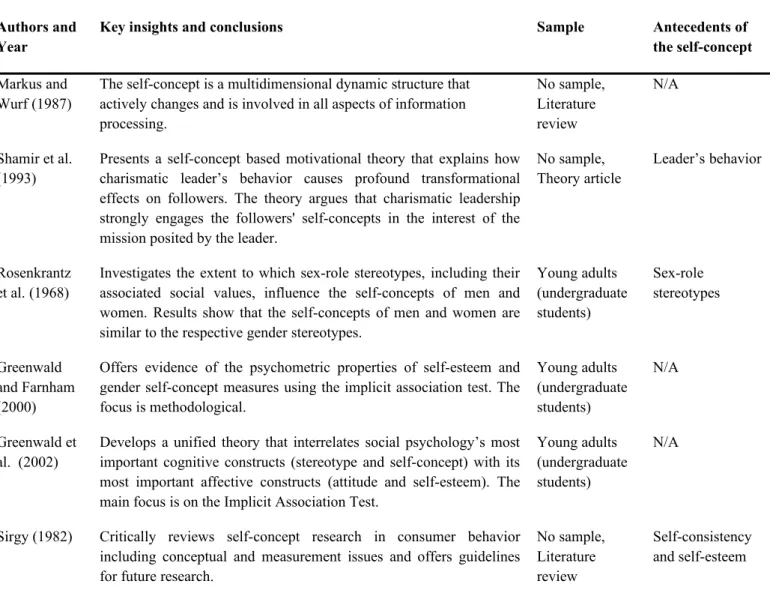
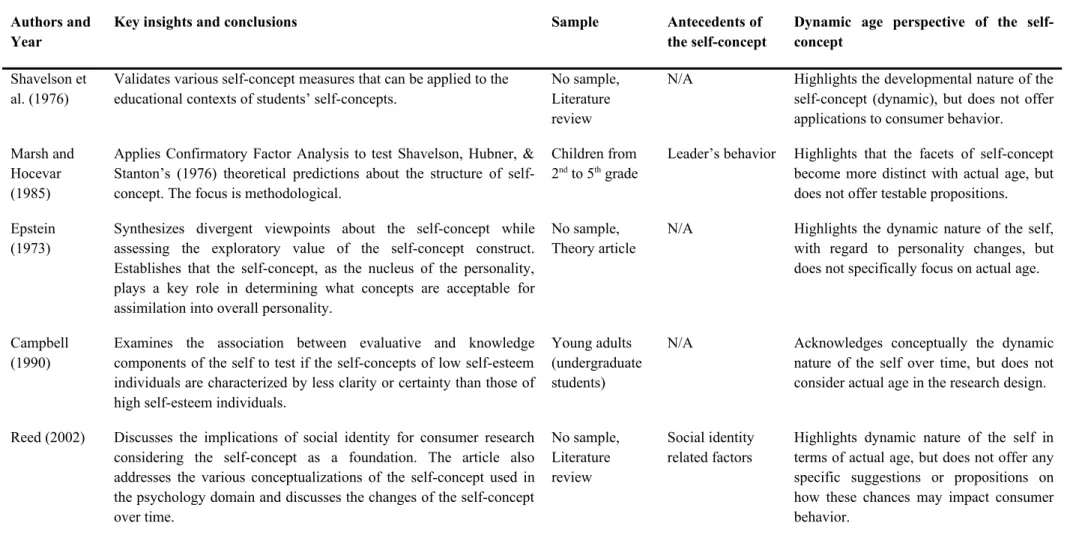
shown in Tables 1 and 2 (see Appendix), prior research largely just acknowledges the
dynamic nature of the self-concept in their discussion of the self-concept (e.g., Campbell
adolescence or young adulthood (e.g., Briñol et al. 2006; Marsh et al. 2006), or outlines that
the role of actual age needs to be considered in future research (Marsh et al. 2005). While
these studies offer a foundation for future self-concept research, they do not provide
theoretically grounded and testable propositions that account for all phases of the self-concept
life cycle and its subsequent impact on attitude and behavior.
Second, drawing further from Demo’s (1992) view, different lenses need to be applied
in order to study the self-concept, as the self is influenced by various factors that are
generally studied in disciplines such as cognitive psychology, developmental psychology,
social psychology or sociology. The literature from various research domains supports this
interdisciplinary notion, while documenting that the self-concept mediates the effect of
various factors on individuals’ attitude and behavior. Specifically, as illustrated in Tables 1
and 2 (see Appendix), evidence suggests that factors such as a leader’s behavior (Marsh and
Hocevar 1985), academic achievement (Marsh and Craven 2006; Trautwein et al. 2006),
evaluations of significant others (O'Mara et al. 2006), global culture (Arnett 2002; Erez and
Gati 2004), life events (Cantor et al. 1987; Park 2010), as well as cognitive and desired age
(Barak 2009; Loroz 2004; Stephens 1991) influence the self-concept, which in turn
influences an individual’s attitude and behavior. Furthermore, the self-concept has also been
a topic of extensive debate in the consumer research domain, as outlined in the next section.
The self-concept and consumption
The self-concept is of particular interest to consumer researchers because consumers use the
symbolic properties of brands as a means of defining and expressing their self-concept
(Ahuvia 2005; Belk 1988; Harmon-Kizer et al. 2013; Levy 1959). The image of a brand
at large (Richins 1994). Therefore, brands offer consumers an outlet to project socially
attributed meanings of their self. The knowledge of how brands are used as a means of
self-expression has led to the theoretical development of self-congruity theory (Sirgy 1982),
which posits that congruity between a brand’s image and a consumer’s self-concept produces
positive consumer responses. A vast body of empirical research supports self-congruity
theory, showing that the self-congruity effect leads to positive brand perceptions (e.g., brand
attitudes, purchase intentions; Aaker 1997; Kressmann et al. 2006; Sirgy 1982; Sung and
Choi 2012). Moreover, research in the consumer research domain continues to evolve
alongside related research streams such as self-brand connections (Escalas and Bettman
2003). Specifically, when consumers form connections between their self-concept and a
brand’s image, this leads to positive brand evaluations and attitude strength (Chaplin and
John 2005; Moore and Homer 2008). Studies in this research domain also emphasize the
mediating role of the self-concept. For instance, Paharia et al. (2011) show that the self
positively mediates the underdog brand effect on purchase intentions. Further examples also
suggest that the self mediates the effect of value congruence on brand commitment (Tuškej et
al. 2013), as well as the interaction of in-group identification and reference group labels on
product evaluations (White and Dahl 2007), and the effect of a holiday destination
personality on intent to return and recommend (Usakli and Baloglu 2011).
Taking into account that various factors influence the self-concept, consumer
researchers have also emphasized the importance of interdisciplinary research that uses
multiple theoretical lenses to study consumer phenomena based on the self (McConnell 2011;
Pham 2013; Reed II 2002). In line with studies from the field of psychology, numerous
marketing studies have also adopted an interdisciplinary approach that considers the
influence of various factors on the self-concept (for details see Appendix Table 1). As
self-concept (e.g., academic achievement, leadership, global culture, cognitive function);
however, it should be noted that the current article is rooted in the consumer research domain
and aims to account for the dynamic nature of the self-concept life cycle. Therefore, this
article focuses on a select few antecedents of the self-concept that (a) are expected to be
influenced by actual age and (b) are likely to have an effect on consumer phenomena.
Specifically, the marketing literature suggests that global culture (Zhang and Khare 2009),
life events (Mathur, Moschis, and Lee 2008), as well as cognitive and desired age (Van
Auken et al. 2006) influence consumer phenomena through changes to the self-concept, while
also being affected by an individual’s actual age (Appendix Table 2).
Interestingly, similarly to the psychology domain, the aforementioned studies either
simply acknowledge in their discussion that actual age may influence how the self-concept
affects consumer phenomena such as brand perceptions, or their research design only focuses
on one phase of the self-concept life cycle. However, none of these studies accounts for the
full life cycle of the self-concept. To bridge this knowledge gap, the current article considers
the role of actual age in order to offer a foundation to improve the understanding of how each
of these factors potentially influence the self-concept and, perhaps more importantly for
consumer researchers, the subsequent impact on a consumer’s brand perceptions.
Recent reviews show that the self-concept is a key construct that influences consumer
brand perceptions (Aguirre-Rodriguez et al. 2012; Hosany and Martin 2012). Evidence
suggests that the self-concept influences various brand-related outcomes, such as brand
loyalty (Mazodier and Merunka 2012; Sirgy et al. 2008), brand love (Batra et al. 2012;
Carroll and Ahuvia 2006) or emotional brand attachment (Malär et al. 2011) to name a few.
It should be noted that the influence of the self-concept on brand-related outcomes is
not limited to positive effects; for instance, Campbell et al.’s (1996) work on self-concept
temporally stable and consistent perception about their self. If their self-view is shaken it can
have a negative effect on individuals’ psyche (Gao et al. 2009). Such a negative effect may be
the consequence of identity inconsistencies and be reflected in brand choice (Kirmani 2009).
However, while such negative effects are theoretically worthy of further investigation, this
article focuses on the potentially positive effect of the self-concept on brand related
outcomes. Ultimately, marketers are interested in how to create perceptions that consuming a
specific self-matching brand will evoke a positive self-view that subsequently leads to a
purchase.
In particular, brand attitude has received extensive attention in the marketing
literature (e.g., Liu et al. 2012; Sirgy et al. 1991; Sung and Choi 2012). The emphasis of
many studies on brand attitude as the key outcome variable influenced by the self-concept is
not surprising. The seminal work by Fishbein and Ajzen (1975) set a foundation for
consumer research, as attitudes influence behavior through behavioral intentions. This
theoretical notion is further validated by empirical research showing that brand attitude
affects brand consideration, purchase intention, purchase behavior and brand choice (Fazio
and Petty 2007; Petty et al. 1995; Priester et al. 2004). Bearing in mind that data on actual
behavior is generally difficult to obtain, constructs such as brand attitude serve an important
role as potential predictors of behavior.
In summary, the literature suggests that various factors influence the self-concept,
which subsequently impacts brand attitude. Moreover, due to the dynamic nature of the
self-concept, its influence on brand attitude is potentially determined by changes in a consumers’
self-concept over time. On the basis of these conclusions, the next section presents a
conceptual framework that shows the influence of three antecedents of the self-concept and
how actual age potentially moderates their impact on the self-concept and, subsequently, on
Conceptual framework
Figure 1 shows the proposed conceptual framework. The conceptual framework is grounded
in two central arguments. First, the self-concept is both cause (i.e., three antecedents) and
effect (i.e., brand attitude). Second, due to the dynamic nature of the self-concept, actual age
potentially moderates how the three antecedents influence the self-concept and, subsequently,
brand attitude. These arguments are grounded in extant theoretical literature, as well as
empirical findings on the self-concept discussed in the previous section (see Appendix Table
1 and 2 for details). With regard to structure, the conceptual framework integrates the
following components: (a) the first component includes the three antecedents of the
self-concept, namely global culture, life events, as well as cognitive and desired age, which are
described below in more detail; (b) the second component is the self-concept, which mediates
the effect of the three antecedents on brand attitude; (c) the third component is actual age as a
moderator of how the three factors influence the self-concept; and (d) the fourth component is
the outcome variable, brand attitude. It should be noted that the propositions focus mainly on
the self-concept and brand attitude as broad constructs. First, as outlined in the self-concept
literature, the self-concept is multidimensional and can represent facets such as a global self,
desired self (Arnett 2002; Markus and Wurf 1987). Similarly, brand attitude can, depending
on a studies’ context, refer to a variety of product and brand types. These can be, for instance,
global, more utilitarian or hedonic (Özsomer and Altaras 2008; Voss et al. 2003). Therefore,
a few distinctions with regard to the specific self-concept facets, as well as brand types and
product categories, are mentioned wherever applicable in the discussion of the propositions
Insert Figure 1 here
Three antecedents of the self-concept
First, global culture is a form of culture created by global networks (e.g., multinational
corporations and media), which cross national and cultural borders through a common
“language” that communicates their values globally (Kostova and Roth 2003). Second, life
events, such as marriage, parenthood, accidents or widowhood, are events that force
individuals to adjust to new situations and roles (Mehta and Belk 1991). Third, cognitive age
is a person’s self-perception of what age that person feels like (perceived age), while desired
age reflects the age a person aspires to be (Barak et al. 2011).
Actual Age
It should be noted that the article refers to different age groups in the propositions and
discussion. According to Demo (1992), these are childhood (ages 2-11), adolescence (ages
12-18), young adulthood (ages 19-39), middle adulthood (ages 40-65) and late adulthood
(ages above 65).
The sections that follow present conceptual arguments that set the foundation of the
main propositions (P1a, P2a, P2b, and P2c) which discuss how the three antecedents
influence the self-concept and, subsequently, brand attitude. Although these antecedents are
conceptually distinct and the process by which they impact the self-concept varies, they are
not independent of one another. Rather, an interaction between some of the factors takes
place; hence, the main propositions consider the interaction of two of the factors. Moreover,
age – the paper presents a second set of propositions (P1b and P2d) that focus on the
moderating effect of actual age between the antecedents and the self-concept and,
subsequently, how this change in the self affects brand attitude.
Global culture and the self-concept
Global culture influences an individual’s self-concept. Leung et al. (2005) argue that global
culture is likely to evoke changes in the self, as cultural values are represented in an
individual’s self-concept and these changes will affect attitude and behavior. Due to the
dominance of Western media and brands, global culture often includes elements of Western
values which are notably individualistic (Stevenson and Zusho 2002; Zhou et al. 2010). In
other words, a global culture can be embedded in the norms under which individuals operate
in their environment. Due to these pressures, individuals are induced to behave in ways that
allow them to fit into their social environment (e.g., Banerjee and Dittmar 2008; Elliott and
Leonard 2004). Research shows that adopting a global culture is perceived as a social ideal
(Skrbis et al. 2004). Therefore, individuals are likely to view positively behavior that allows
them to embrace global culture as a means to redefining their self. From a marketing
perspective, a consumer’s self-view is relevant to a brand’s positioning strategy as people
tend to develop attitudes and behaviors that enable them to reinforce their self-view, while
marketers can cater towards consumer needs with their brands (Westjohn et al. 2012).
Specifically, marketing scholars offer evidence that consumers embracing global cultural
values (e.g., openness towards foreign products, interest in languages) develop a global
identity and react positively to brand positioning strategies that reflect values associated with
is a powerful driver that shapes an individual’s self-concept and subsequently attitude. More
formally:
P1a: The (global) self-concept mediates the effect of global culture on attitude towards a
global brand. Specifically, the greater the influence of global culture in shaping a
(global) self-concept, the greater the positive attitudes towards global brands.
Moderating effect of actual age
Various arguments suggest that actual age moderates the effect of global culture on the
self-concept and subsequent attitudes towards brands reflecting global values. The self-self-concept of
adolescents and young adults is especially influenced by global culture. These individuals
have enough maturity and autonomy to pursue information and experiences (e.g., through
social media and the Internet), while being less confined by an established way of life
compared to older adults (Arnett 2002). For instance, social media sites offer an innovative
peer culture among young people locally and globally that allows adolescents to express and
integrate global values (e.g., openness towards foreign products, interest in languages) within
their self (Livingstone 2008; Mangold and Faulds 2009).
Research also suggests that individuals exposed to global culture are more likely to
have positive attitudes to global brands (Alden et al. 2006). In particular, adolescents are
more prone than older adults to changing their behavior as a consequence to changes in their
values and identity, specifically their self (Phinney et al. 2000). This phenomenon can be
traced back to the impact of globalization on the self through a process of re-evaluation and
young adults are highly motivated to express their self through consumption practices that
reflect this global culture. More formally:
P1b: Actual age negatively moderates the effect of global culture on the (global)
self-concept. Specifically, adolescents and young adults are more likely to develop a
more (global) self-concept compared to older adults. Consequently, adolescents
and young adults have a more positive attitude towards brands reflecting global
values compared to adults in later life stages.
Life events, cognitive age and desired age
Life events, such as marriage, parenthood, accidents or widowhood force individuals to
adjust to new situations and roles. Some of these changes are less dramatic than others;
nevertheless, as individuals adapt to their new roles and cope with the resulting effects on
their lifestyles, they experience a need to redefine their self-concept (Mehta and Belk 1991).
Consequently, by redefining the self-concept due to these new life roles, the behavior of these
individuals also changes (Mathur et al. 2003). For example, Hemetsberger et al. (2009)
suggest that drastic life events affect consumers’ self and that these changes can influence
their perception of different automotive brands, and even lead to brand switching.
Furthermore, research also shows that consumers may attempt to change their consumption
lifestyles and patronage orientations as a consequence of life events and the corresponding
changes to their self (Lee et al. 2001).
Meanwhile, research indicates that life events can influence an individuals’ perception
of their cognitive age (perceived age) as well as their desired age. Cognitive and desired age
than chronological age (e.g. Barak et al. 2011; Catterall and Maclaran 2001). For instance,
new responsibilities such as parenthood are likely to foster an older cognitive age, which in
turn will shape an individual’s self (Johnson and Mollborn 2009). A further example is based
on middle-aged individuals who sometimes experience a mid-life crisis (Lachman 2004). In
an attempt to project a desired younger self-image, which is significantly lower than their
chronological age, middle-aged individuals are prone to purchasing goods such as sports cars
or seeking plastic surgery (Guido et al. 2014; Ogle and Damhorst 2005; Zavestoski 2002).
Furthermore, research shows that consumers are likely to perceive brands more positively
that allow them to project an image that matches their actual and ideal self-view (Hollenbeck
and Kaikati 2012; Malär et al. 2011; Sirgy 1982). In summary, life events influence
consumers’ self-concept and subsequently their attitude towards specific brands. Moreover,
life events influence consumer’s cognitive and desired age which shapes their self-concept.
These changes to their self subsequently affect their attitude and behavior. More formally1:
P2a: The self-concept mediates the effect of life events on brand attitude. Specifically,
the greater the influence of the life event on the self-concept, the greater (positive
or negative) the effect on brand attitude.
P2b: Cognitive age mediates the effect of life events on the self-concept and subsequent
effect on brand attitude. Specifically, the greater the influence of a life event on
cognitive age, the greater the effect of cognitive age on the self-concept.
Consequently, the greater the change to the self-concept, the greater the effect
1 Life events can also have a positive and negative effect on brand attitude through the self-concept which is
(positive or negative) on individuals’ attitude towards brands that match their
perceived cognitive age.
P2c: Desired age mediates the effect of life events on the (ideal) self-concept and
subsequent effect on brand attitude. Specifically, the greater the influence of a life
event on desired age, the greater the effect of desired age on the (ideal)
self-concept. Consequently, the greater the change to the (ideal) self-concept, the
greater the effect (positive or negative) on individuals’ attitude towards brands
that match their perceived desired age.
Moderating effect of actual age
It is expected that the ideal self-concept mediates the effect of desired age on brand attitude
and that this effect is influenced by actual age.As discussed in more detail below, this effect
can be broken down into two processes. First, the effect of desired age on the ideal
self-concept under the influence of actual age. Second, the effect of the ideal self-self-concept on
brand attitude.
Prior evidence shows that adolescents generally have desired ages that are older than
their chronological age, which leads them to embrace self-enhancing activities that allow
them to be perceived as more mature (Galambos and Tilton-Weaver 2000; Tilton-Weaver et
al. 2001). For instance, in order to be perceived as adults, young females engage in the use of
make-up, while some teenagers embrace habits such as smoking. Meanwhile, the marketing
literature supports the idea that the consumption of products and brands is used as a potential
means to self-enhance and/or restore a positive self-view (Grubb and Grathwohl 1967).
brands that allow them to project a desired older self-image that is in line with their ideal self.
Conversely, during early adulthood individuals become again less self-conscious about how
they are perceived. Specifically, the discrepancy between their ideal self-image and their
actual age becomes less prevalent, which affects their consumption behavior (Gould and
Barak 1988). Consequently, the influence of actual age on the effect of desired age on the
(ideal) self-concept may be potentially weaker during later adolescence compared to early
adolescence.
Interestingly, once individuals reach the later stages of their life (e.g., seniors above
65), their self-consciousness about their actual age becomes again more prominent. The
desired age of individuals during late adulthood tends to be more than eight years younger
than their chronological age (Guiot 2001). This notion is in line with the theory of continuity
(Atchley 1993), which states that seniors intend to conserve the same aptitudes and physical,
mental or social capacities as when they were younger. In an attempt to project a desired
younger self-image compared to their chronological age, older individuals are prone to
purchasing goods that allow them to project a younger ideal self (Guido et al. 2014; Ogle and
Damhorst 2005; Zavestoski 2002). As seniors get older the discrepancy between the actual
age and desired age is likely to grow. Thus, the influence of actual age on the effect of
desired age on the (ideal) self-concept is expected to become stronger during the later senior
years compared to earlier senior years.
Meanwhile, self-congruity theory (Sirgy 1982) posits that individuals are likely to
perceive products and brands that match their ideal self-concept more positively as they seek
to boost their self-esteem. Ample evidence supports the notion that brands that reflect
individuals’ ideal self are perceived more positively (Graeff 1996; Hollenbeck and Kaikati
2012). This notion should also translate to brands that allow individuals to reflect an ideal
brands to reduce the perceived discrepancy between their chronological and desired age.
More formally:
P2d: Actual age moderates the effect of desired age on the (ideal) self-concept.
Subsequently, these changes to the (ideal) self-concept influence brand attitude.
Specifically, from adolescence to young adulthood the (ideal) self reflects an older
ideal self that leads to positive attitude towards brands matching that older ideal
self. Conversely, from late adulthood the (ideal) self reflects a younger ideal
self-image that leads to positive attitude toward brands matching a younger ideal self.
Directions for future research, and methodological and managerial
implications
Directions for future research
This article extends prior consumer research on the self-concept by considering the dynamic
nature of the self-concept regarding its full life cycle, while also considering the influence of
three factors emerging from various disciplines. Prior research has largely ignored the
dynamic nature of the self-concept, with only a few studies highlighting the potential role of
actual age in the self-concept life cycle (e.g., Chaplin and John 2005; Loroz 2004). The
current article builds on prior work by offering theoretically grounded propositions that
account for the dynamic age perspective of the self-concept and its potential effect on brand
perspective that accounts for the interactions of three factors that influence the self-concept
and subsequently brand attitude, while also considering the role of actual age in these
relationships. The conceptual framework presented in this article provides a platform for
future studies by providing a “big picture” perspective of the dynamic nature of the
self-concept. In order to account for the potential interaction effects between the various factors,
researchers should design interdisciplinary projects that investigate the influence of multiple
factors on consumer phenomena. For instance, life events influence individuals’ self-concept
and the self-concept subsequently impacts brand attitude. Hence, there is a need for more
empirical work examining the exact nature and effects of the relationships outlined in the
propositions by using multiple methods and approaches. The section below proposes a few
avenues for future research.
First, as noted above, global culture potentially influences the self-concept and, in
turn, brand attitude. Research indicates that global culture is responsible for the development
of individuals with a global identity, and that a global identity is positively related to attitudes
towards globally positioned brands (Zhang and Khare 2009). For instance, Tu and Khare
(2012) provide an 8-item scale to measure an individual’s global identity. Meanwhile, well
established measures to capture an individual’s perception of a brands globalness are also
available (e.g., Steenkamp et al. 2003). Future investigations could use field studies to
examine how different levels and types of global culture influence individuals’ global identity
and, subsequently, their attitude towards global brands. Furthermore, taking into account that
being global (i.e., having a global identity) is generally perceived as a social ideal among
adolescents and young adults, studies should investigate the moderating effect of actual age
between a global culture and individuals’ self-concept. Such an investigation could show
whether age influences how exposure to global culture (e.g., media) shapes individuals’ self.
consequently, if these changes to the self-concept lead to a more positive perception of
brands that project global values.
Second, life events such as marriage or parenthood tend to force individuals to adapt
to their new roles which redefines their self-concept (Mehta and Belk 1991). For instance,
research using the notion of the possible selves (Markus and Nurius, 1986) shows that
becoming a first-time father changes an individuals’ conception of their self as they adopt the
new “parent self” role (Strauss and Goldberg, 1999). Future experimental studies could prime
individuals towards different life stages such as single life or parenthood (Eibach et al., 2009)
to investigate how such changes would affect their attitude towards particular products and
brands. More specifically, studies could use such primes and apply Sirgy’s et al.’s (1997)
self-congruity measure to evaluate potential changes to individuals’ brand attitude towards
cars or clothing products that may be congruent with the image of a single man versus a
father. Alternatively, longitudinal designs that use qualitative approaches such as interviews
would also be a viable alternative to explore the deeper psychological underpinnings of these
self-changes and the subsequent impact on behavior and attitude.
Finally, to study the impact of life events on the self-concept and, subsequently, brand
attitude, researchers should also consider the influence of cognitive and desired age. For
example, some middle-aged individuals experience a mid-life crisis which leads them to
purchase products (e.g., a sports car) that allow them to project an image that is in line with
their younger desired self-view. In line with the self-discrepancy theory (Higgins 1987),
however, too great a discrepancy between the desired and actual self-image may lead to
emotional conflict. Thus, it would be of interest to investigate empirically the impact of
Methodological implications
Besides the proposed approaches outlined in the prior section to test the propositions outlined
in this article, a variety of methods from different disciplines should be considered in order to
improve the current understanding on how the three antecedents outlined in this article
influence the self-concept across its full life cycle and, subsequently, impact brand attitude.
First, it would be beneficial to move beyond the classroom to collect data and seek a wide
range of consumer samples, as student samples offer only a limited perspective on the full
self-concept life cycle and its subsequent impact on brand attitude. Second, research methods
from various disciplines (e.g., psychology, sociology and neuroscience) should be combined.
For instance, the integration of neuroscience into the consumer research domain has shown
significant growth over the last years (Perrachione and Perrachione 2008; Plassmann et al.
2012). Neuroscientific methods provide direct information on how activity in self-relevant
brain regions (i.e., MPFC) affects decision-making related to brand perceptions (Ariely and
Berns 2010; Ito 2010). This makes it possible to overcome the limitations of self-reporting in
questionnaires or interviews, in which responses may not always be truthful (Pfeifer et al.
2009). Hence, consumer researchers might benefit from a combination of traditional
self-reporting and neuroscience methods, which will provide richer data that will add depth and
rigor to their findings. Third, numerous researchers have expressed the need for longitudinal
studies in consumer research (Burroughs and Rindfleisch 2011; Raman and Leckenby 1998).
Longitudinal studies are well suited to controlling for factors such as the influence of
response biases, personality factors and demographic characteristics, as well as the resolution
of issues of temporal sequence (Menard 2002). Therefore, although demanding in terms of
perspective that may deepen our current knowledge of how the self-concept impacts brand
attitude.
Managerial implications
The findings derived from the proposed conceptual framework will also have implications for
marketing practitioners. Sprott et al. (2009) suggest that the level at which consumers engage
and incorporate a brand as part of their self is integral in their attitude formation towards that
brand. Therefore, marketers are keen to gain new insights on how they can strengthen the ties
between their brands and the consumer. The section below discusses three potential issues
that marketers should consider.
First, marketers are moving away from mass marketing to more targeted branding
approaches (Malär et al. 2011). Therefore, it is increasingly important to understand
self-relevant consumer needs across various age segments. For instance, the aging of the world’s
population has created a burgeoning interest among marketers, researchers and policy makers
in obtaining insights into the needs of older consumers, as these represent a potentially
profitable consumer segment (Drolet et al. 2010; Moschis 2012). Moreover, the youth
segment is also of growing importance due to the rise in disposable incomes and autonomous
decision-making in brand purchases of adolescents around the globe (Gentina et al. 2014; Gil
et al. 2012). Consequently, insights into what influences the brand attitudes of consumers in
each life-stage will allow marketers to design targeted brand communications that elicit a
positive response towards their brands. In particular, the internet offers a key avenue for
marketers to engage with consumers through targeted branding.
Second, contrary to the conventional approach of segmenting consumer markets only
at the country level, recent segmentation trends are moving towards segmenting consumer
and Craig 2011; Wedel and Kamakura 1999). Global culture is transcending borders, creating
segments across countries that display similar needs and behaviors (Cleveland et al. 2011;
Merz et al. 2008). Once marketers identify how global culture influences brand perceptions
across the various life-stages of the consumer, they will be able to design their brand
communications accordingly. For example, recent research indicates that cosmopolitanism is
an indicator of product and brand preferences and has thus been suggested as a powerful
segmentation variable (Riefler et al. 2012; Zeugner-Roth et al. 2015). Meanwhile,
cosmopolitanism is linked to numerous demographic characteristics such as age, education,
living in rural or urban areas and income levels. Considering that adolescents and young
adults are likely to respond more favorably to brands associated with a cosmopolitan image
than older consumers, it is possible to use age-based segmentation strategies to appeal to such
consumer segments.
Lastly, life-event-based segmentation offers another viable alternative for marketers
to reach consumers with specific needs. For instance, fatherhood or motherhood represents a
significant change in a consumer’s self-conception and the associated consumption patterns
as an individual adapts to the new role (Mathur et al. 2003). Moreover, facing or overcoming
a health-related hardship (e.g., cancer), which is more common in later life-stages, changes
consumers’ perception of their self (Zebrack 2000). Consequently, marketers should integrate
elements into their brand communications that make consumers believe that consuming the
brand will allow them to project their self in a way that reflects their new role in a positive
manner. Timing and access to data are integral in this endeavor. Specifically, retailers are
benefiting nowadays from advances in technology (Kumar et al. 2017); for instance, retailers
can draw a vast array of insights from big data to make more precise and timely predictions
Conclusion
Consumers from various age groups should be considered to advance knowledge on how the
self-concept impacts brand attitude. Moreover, it has been stated that the consumer research
domain will benefit from “crossing disciplinary boundaries, by gaining breadth through
conducting interdisciplinary research” (Macinnis and Folkes 2010, p. 911). The conceptual
framework presented in this article provides a foundation upon which to answer these calls. It
offers a framework to deepen the understanding of how various factors interact to affect the
self-concept in its complete life cycle and its subsequent impact on brand attitude. The article
has presented six propositions that offer a foundation for future research. To test these
propositions, it is recommended that researchers design interdisciplinary projects
incorporating theoretical and methodological perspectives from various disciplines,
specifically where the factors outlined are studied. Such a step offers excellent prospects of
more comprehensive answers and new perspectives on how the self-concept affects brand
perceptions; it also enables other questions to be investigated that are relevant to the
consumer research domain. Besides enriching the theoretical understanding of this domain,
findings derived from interdisciplinary projects can also benefit practitioners, as they may
provide insights into how brands should be positioned when targeting consumers at different
life-stages. Hence, it is imperative that as consumer needs evolve throughout their life-spans,
Appendix
Table 1 Articles offering a static view of the self-concept
Authors and Year
Key insights and conclusions Sample Antecedents of
the self-concept
Markus and Wurf (1987)
The self-concept is a multidimensional dynamic structure that actively changes and is involved in all aspects of information processing.
No sample, Literature review
N/A
Shamir et al. (1993)
Presents a self-concept based motivational theory that explains how charismatic leader’s behavior causes profound transformational effects on followers. The theory argues that charismatic leadership strongly engages the followers' self-concepts in the interest of the mission posited by the leader.
No sample, Theory article
Leader’s behavior
Rosenkrantz et al. (1968)
Investigates the extent to which sex-role stereotypes, including their associated social values, influence the self-concepts of men and women. Results show that the self-concepts of men and women are similar to the respective gender stereotypes.
Young adults (undergraduate students) Sex-role stereotypes Greenwald and Farnham (2000)
Offers evidence of the psychometric properties of self-esteem and gender self-concept measures using the implicit association test. The focus is methodological.
Young adults (undergraduate students)
N/A
Greenwald et al. (2002)
Develops a unified theory that interrelates social psychology’s most important cognitive constructs (stereotype and self-concept) with its most important affective constructs (attitude and self-esteem). The main focus is on the Implicit Association Test.
Young adults (undergraduate students)
N/A
Sirgy (1982) Critically reviews self-concept research in consumer behavior
including conceptual and measurement issues and offers guidelines for future research.
No sample, Literature review
Authors and Year
Key insights and conclusions Sample Antecedents of
the self-concept
Grupp and Grathwohl (1967)
Develops a partial theory of consumer behavior that links an individual's self-concept with the symbolic value of goods. The study presents the self-concept as a key determinant of consumer behavior. Goods serve as social symbols and are communication devices for the individual that allow him/her to further and enhance his self-concept.
No sample, Theory article Social experience Hong and Zinkhan (1995)
Investigates if advertising appeals congruent with an individual’s self-concept are superior to incongruent ads to enhance advertising effectiveness. Self-congruity has a positive effect on brands attitude and purchase intent, but not brand memory. Ideal self-congruity has a stronger effect on brand attitude than actual self-congruity.
Young adults (undergraduate students) N/A Funk and Buchman (1996)
Investigates the association between the preference for violent games, frequency and location of play, and the self-concept. The self-concept is a key indicator of adolescent’s core attitudes and coping abilities.
Adolescents N/A
Landon (1974)
Investigates the influence of actual and ideal self-congruity on purchase intentions. Consumers differ with regard to which self-congruity type (actual vs. ideal) influences purchase intentions.
Young adults (undergraduate students) N/A Hong and Zinkhan (1991)
Investigates if advertising appeals congruent with an individual’s self-concept are superior to incongruent ads. Self-congruity has a positive effect on brands attitude and purchase intent, but not brand memory. Ideal self-congruity has a stronger effect on brand attitude than actual self-congruity.
Young adults (undergraduate students)
Authors and Year
Key insights and conclusions Sample Antecedents of
the self-concept
Mazar et al. (2008)
Outlines and offers empirical support for a theory of self-concept maintenance. The findings show that people behave dishonestly enough to profit but honestly enough to avoid spoiling a positive self-view.
Young adults (undergraduate students)
N/A
Swann et al. (2007)
Reviews the literature to outline strategies to make an adequate assessment of the predictive validity of the concept. The self-concept is an important predictor of socially important outcomes. The importance an individual places on a specific dimension of the self-concept influences the predictive validity.
No sample, Literature review
N/A
Marsh et al. (2005)
Uses the reciprocal effects model to test self-concept as a cause and an effect of achievement in an academic context. The results show that self-concept can act as both, but that the effect of the self-concept as antecedent is stronger.
Adolescents Self-concept is
antecendent of academic behaviors
O’Mara et al. (2006)
Evaluates the impact of self-concept interventions for children using a blend of meta-analysis and multidimensional construct validation. Interventions that focus on specific self-concept dimensions rather than the global self-concept are more effective.
Meta-analysis of studies using children to adolescents. Evaluations by significant others Marsh and O’Mara (2008)
Evaluates contradicting findings from two previous studies on the influence of academic self-concept on academic performance. Academic self-concept has a consistent reciprocal effect with achievement and educational attainment, while self-esteem had almost none.
Adolescents Evaluations by
significant others,
Back et al. (2009)
Develops a behavioral process model of personality that shows how explicit and implicit aspects of the self-concept of personality predict actual behavior. The direct measure of the BIG Five dimensions predicts behavior. The indirect measure of neurocism and extraversion
Undergraduate students
do also predict behavior.
Author and Year
Key insights and conclusions Sample Antecedents of
the self-concept
Trautwein et al. (2006)
Develops a model of the effects of tracking on self-concept and interest that integrates the opposing predictions of “contrast” and “assimilation” effects. Moreover, teacher-assigned grades are specified as a major mediating variable. The results show that students’ math self-concept and math interest differ based on the achievement of their reference group, their teacher-assigned grades, and their own achievement.
Adolescents academic
self-concept is positively influenced by individual achievement,
Briñol et al. (2006)
Investigates if individuals with discrepancies between their explicit and implicit self-conceptions might demonstrate similar motivation to process discrepancy-related information, even if they are not aware of the discrepancy. Individuals might be motivated to examine relevant information to minimize potential implicit doubt due to inconsistency between explicit and implicit self-conceptions.
Young adults (undergraduate students) Self influences judgement and action. Chiu and Cheng (2007)
Discusses the role of globalizations cultural impacts from a social psychology perspective. Specifically, that a simultaneous activation of cultural representations does not directly determine an individual’s cultural identity. Rather, this process enhances the distinctions between an individuals’ identities.
No sample, Literature review
Global and local culture
Strauss and Goldberg
(1999)
Examines differences in men’s self during pre- and post-childbirth. Results indicate that child birth influences men’s self-view and has an effect on their psychological well-being, and their involvement with their infant.
Adult men aged 20-47
Authors and Year
Key insights and conclusions Sample Antecedents of
the self-concept
Mathur et al. (2003)
Investigates the relationship between individuals’ life, resultant stress and lifestyle changes and subsequent changes in brand preference. Results suggest that life events (e.g., marriage, divorce, death) impact brand preference changes as a means of adjusting to new life conditions and their effect on the self.
Adults aged 21 to 84
Life events
Guiot (2001)
Examines the antecedents that influence a youthful bias of senior women towards a younger cognitive age.
Adult women aged 50-83
Younger feeling influences cognitive age.
Guido et al. (2014)
Investigates if cognitive age is a malleable construct that differs according to its context of reference. The results indicate that the physical environment, the social references, and the product categories (hedonic vs. utilitarian) influence cognitive age perception.
Adults aged 65+ Social reference
Table 2 Articles offering a dynamic view of the self-concept
Authors and Year
Key insights and conclusions Sample Antecedents of
the self-concept
Dynamic age perspective of the self-concept
Shavelson et al. (1976)
Validates various self-concept measures that can be applied to the educational contexts of students’ self-concepts.
No sample, Literature review
N/A Highlights the developmental nature of the
self-concept (dynamic), but does not offer applications to consumer behavior.
Marsh and Hocevar (1985)
Applies Confirmatory Factor Analysis to test Shavelson, Hubner, & Stanton’s (1976) theoretical predictions about the structure of self-concept. The focus is methodological.
Children from 2nd to 5th grade
Leader’s behavior Highlights that the facets of self-concept
become more distinct with actual age, but does not offer testable propositions.
Epstein (1973)
Synthesizes divergent viewpoints about the self-concept while assessing the exploratory value of the self-concept construct. Establishes that the self-concept, as the nucleus of the personality, plays a key role in determining what concepts are acceptable for assimilation into overall personality.
No sample, Theory article
N/A Highlights the dynamic nature of the self,
with regard to personality changes, but does not specifically focus on actual age.
Campbell (1990)
Examines the association between evaluative and knowledge components of the self to test if the self-concepts of low self-esteem individuals are characterized by less clarity or certainty than those of high self-esteem individuals.
Young adults (undergraduate students)
N/A Acknowledges conceptually the dynamic
nature of the self over time, but does not consider actual age in the research design.
Reed (2002) Discusses the implications of social identity for consumer research
considering the self-concept as a foundation. The article also addresses the various conceptualizations of the self-concept used in the psychology domain and discusses the changes of the self-concept over time. No sample, Literature review Social identity related factors
Highlights dynamic nature of the self in
terms of actual age,but does not offer any
Authors and Year
Key insights and conclusions Sample Antecedents of
the self-concept
Dynamic age perspective of the self-concept
Loroz (2004)
Uses a phenomenological investigation to show that the psychological benefits of gambling and other forms of experiential consumption can reinforce and enhance seniors’ self-concepts. Argues that life transitions have an impact on the self-concept.
Adults aged 55 and above
Life events and transitions
Highlights the dynamic nature of the self-concept influenced by life events in old age.
Mehta (1999)
Uses psychographic variables to understand how self-congruity influences purchase intent in advertising. Self-congruence is positively related to purchase intent. Psychographic differences between the consumers (e.g. adventurous, elegant, and sensitive) influence how strongly the self-congruity effect impacts purchase intent.
Adults (18-34 and 35-44 and 45+ groups)
N/A Shows that actual age determines which
psychographic groups (e.g. sensitive) reacts more positively towards congruent ads.
Marsh and Craven (2006)
Investigates if a positive self-concept leads to changes in subsequent performance. The self-concept not only is an important outcome variable, but also plays a central role in the attainment of desirable outcomes, such as academic achievement. Moreover, further support on the multidimensional nature of the self-concept is provided. (e.g., social self-concept, emotional self-concept, physical self-concept).
No sample, Literature review Achievement (antecedent and consequent)
Suggests that actual age may affect the relevance of the various dimensions of academic self-concept, but does not offer any evidence or testable propositions.
Marsh et al. (2006)
Investigates the relations between multiple dimensions of self-concept, personality (Big Five), well-being, and academic outcomes. Different dimensions of the self-concept (e.g., appearance, same-sex, opposite-sex, parents, and intelligence self-concept) demonstrate differentiated pattern of relations with personality factors and academic outcomes.
Adolescents Context,
environment, and life events (p. 404).
Authors
and Year Key insights and conclusions
Sample Antecedents of
the self-concept
Dynamic age perspective of the self-concept
Arnett (2002)
Argues that many people around the globe merge local and global cultures into a bicultural identity. Highlights that identity confusion may be especially prevalent among young individuals and that changes with regard to their self are likely as they grow up.
No sample, Literature review
Global and local culture
Discusses actual age differences with regard to the adaptation of global culture and the potential influence of age on the self-development process, but does not offer applications to consumer behavior.
Jensen and Arnett (2012)
Discusses how theories of immigrant acculturation are included in the context of globalization to demonstrate that in particular adolescents and young adults are especially prone to be influenced with regard to their identity. Implications on gender issues and civic involvement are presented.
No sample, Literature review
Global culture Discusses actual age differences with
regard to the adaptation of global culture and the potential influence of age on the self-development process, but does not offer applications to consumer behavior.
Martin and Kennedy (1993)
Offers evidence suggesting that the tendency of female pre-adolescents and adolescents to engage in social comparison with models in ads increases with age. Moreover, suggests that this tendency is heightened for females with lower self-perceptions of physical attractiveness and/or self-esteem.
Pre- adolescents and adolescents
Social norms Suggests that actual age has an influence
on how likely females are to be affected by social norms in their self-perception, but does not offer applications to consumer behavior.
Rutland et al.(2005)
Examines, among children, the effect of social norms and concern for self-presentation on intergroup attitudes. The findings show that as children age they are more likely to be internally rather than externally motivated to inhibit in-group bias in their decision-making.
Children aged 6-16
Social norms Suggests that actual age influences how
children’s self affects intergroup attitude, but does not offer applications to consumer behavior.
Palkovitz et al. (2001)
Discusses how fatherhood, and in particular fathering influences men's early adult development. Direct involvement in the fathering process has a profound impact on a person’s self-perception.
Adult men aged 20-45
Life events Suggests that the actual age when a person
Authors and Year
Key insights and conclusions Sample Antecedents of
the self-concept
Dynamic age perspective of the self-concept
Johnson and Mollborn (2009)
Investigates if hardship while growing up influences cognitive age. Results suggest that hardships such as growing up in unsafe neighborhoods during childhood and adolescence is linked with older cognitive age. Adolescents grade 7-12 Life events influence subjective age
Discusses that older adolescents also feel older in terms of their cognitive age, but does not offer applications to consumer behavior.
Tilton-Weaver et al. (2001)
Investigates the subjective meanings of maturity in adolescence. The qualitative analysis shows that adolescents perceive various images of maturity influenced by factors such as privilege, physical development, power and status.
Adolescents grade 6 and 9
N/A Suggests that actual age influences which
factors are associated with maturity, i.e., a higher subjective age.
Chaplin and John (2005)
Examines how children and adolescents incorporate brands into their self-concepts and are able to make self-brand connections. Results show that the ability to make self-brand connections develops mainly from late childhood to early adolescence.
Children and adolescents aged 8 to 18
Cognitive function
Discusses the role of actual age in children’s ability to form self-brand connections.
Demo (1992)
Offers an account of how the self-concept develops over time. The paper suggests that the self-concept undergoes constant transformation from early childhood to late adulthood.
No sample, Literature review
Cognitive function
References
Aaker, J. L. (1997). Dimensions of Brand Personality. Journal of Marketing Research, 34(3), 347-356.
Aguirre-Rodriguez, A., Bosnjak, M., & Sirgy, M. J. (2012). Moderators of the self-congruity effect on consumer decision-making: A meta-analysis. Journal of Business Research, 65(8), 1179–1188.
Ahuvia, A. C. (2005). Beyond the extended self: love objects and consumer's identity narratives. Journal of Consumer Research, 32(1), 171-184.
Alden, D. L., Steenkamp, J.-B. E. M., & Batra, R. (2006). Consumer attitudes toward marketplace globalization: Structure, antecedents and consequences. International Journal of Research in Marketing, 23(3), 227-239.
Ariely, D., & Berns, G. S. (2010). Neuromarketing: The hope and hype of neuroimaging in business. Nature Reviews Neuroscience, 11(4), 284–292.
Arnett, J. J. (2002). The Psychology of Globalization. American Psychologist, 57(10), 774-783.
Atchley, R. C. (1993). Continuity theory and the evolution of activity in later adulthood. In J. R. Kelly (Ed.), Activity and aging: Staying involved in later life (pp. 5-16). Thousand Oaks, CA,: Sage Publications.
Back, M. D., Schmukle, S. C., & Egloff, B. (2009). Predicting actual behavior from the explicit and implicit self-concept of personality. Journal of Personality and Social Psychology, 97(3), 533-548.
Bandura, A. (1977). Self-efficacy: Toward a unifying theory of behavioral change. Psychological Review, 84(2), 191-215.
Banerjee, R., & Dittmar, H. (2008). Individual Differences in Children's Materialism: The Role of Peer Relations. Personality and Social Psychology Bulletin, 34(1), 17-31. Barak, B. (2009). Age identity: A cross-cultural global approach. International Journal of
Behavioral Development, 33(1), 2-11.
Barak, B., Guiot, D., Mathur, A., Zhang, Y., & Lee, K. (2011). An Empirical Assessment of Cross-Cultural Age Self-Construal Measurement: Evidence from Three Countries. Psychology & Marketing, 28(5), 479–495.
Batra, R., Ahuvia, A., & Bagozzi, R. P. (2012). Brand Love. Journal of Marketing, 76(2), 1-16.
Belk, R. W. (1988). Possessions and the Extended Self. Journal of Consumer Research, 15(2), 139-168.
Bem, D. J. (1972). Self-Perception Theory. In L. Berkowitz (Ed.), Advances in Experimental Social Psychology (Vol. 6, pp. 1-62). New York: Academic Press.
Briñol, P., Petty, R. E., & Wheeler, S. C. (2006). Discrepancies between explicit and implicit self-concepts: Consequences for information processing. Journal of Personality and Social Psychology, 91(1), 154-170.