Volume 2007, Article ID 67360,8pages doi:10.1155/2007/67360
Research Article
Fast Discrete Fourier Transform Computations Using
the Reduced Adder Graph Technique
Uwe Meyer-B ¨ase,1Hariharan Natarajan,1and Andrew G. Dempster2
1Department of Electrical and Computer Engineering, Florida State University, 2525 Pottsdamer Street, Tallahassee, FL 32310-6046, USA
2School of Surveying and Spatial Information Systems, University of New South Wales, Sydney 2052, Australia
Received 28 February 2006; Revised 23 November 2006; Accepted 17 December 2006
Recommended by Irene Y. H. Gu
It has recently been shown that then-dimensional reduced adder graph (RAG-n) technique is beneficial for many DSP applications such as for FIR and IIR filters, where multipliers can be grouped in multiplier blocks. This paper highlights the importance of DFT and FFT as DSP objects and also explores how the RAG-ntechnique can be applied to these algorithms. This RAG-nDFT will be shown to be of low complexity and possess an attractively regular VLSI data flow when implemented with the Rader DFT algorithm or the Bluestein chirp-zalgorithm. ASIC synthesis data are provided and demonstrate the low complexity and high speed of the design when compared to other alternatives.
Copyright © 2007 Hindawi Publishing Corporation. All rights reserved.
1. INTRODUCTION
The discrete Fourier transform (DFT) and its fast implemen-tation, the fast Fourier transform (FFT), have both played a central role in digital signal processing. DFT and FFT algo-rithms have been invented (and reinvented) in many varia-tions. As Heideman et al. [1] have pointed out, we know that Gauss used an FFT-type algorithm we now call the Cooley-Tukey FFT.
We will follow the terminology introduced by Burrus [2], who classified FFT algorithms according to the (multidimen-sional) index maps of their input and output sequences. We will therefore call all algorithms which do notuse a multi-dimensional index map DFT algorithms, although some of them, such as the Winograd DFT algorithms, enjoy an essen-tially reduced computational effort.
In a recent EURASIP paper by Macleod [3], the adder costs were discussed of rotators used to implement the com-plex multiplier in fully pipelined FFTs for 13 different ods, ranging from the direct method and 3-multiplier meth-ods to the matrix CSE method and CORDIC-based designs. It was determined that not a single structure gave the best re-sults for all twiddle factor values. On average the CORDIC-based method gave the best results for single multiplier costs. In this paper, we restrict our design to the two most popu-lar methods (4×2+ and 3×5+) used in FFT cores [4,5] by FPGA vendors.
The literature provides many FFT design examples. We found implementations with programmable signal proces-sors and ASICs [6–10]. FFTs have also been developed using FPGAs for 1D [11,12] and 2D transforms [13,14].
This paper deals with the implementation of two alterna-tives of fast DFTs via a transformation into an FIR filter. The methods are called a Rader DFT algorithm and a Bluestein chirp-ztransform. We will present latency data (measured in clock cycles) when the FFT-block is used in a microproces-sor coprocesmicroproces-sor configuration. The design data are compared with direct matrix multiplier DFT methods and radix-2 and radix-4 type Cooley-Tukey based FFTs as used by FPGA ven-dors [5]. The provided area data are measured in equivalent gates as typical for cell-based ASIC designs.
2. CONSTANT COEFFICIENT MULTIPLICATIONS
DSP algorithms are MAC intensive. Essential savings are pos-sible if the multiplications are constant and not variable. Sta-tistically, half the digits will be zero in the two’s complement coding of a number. As a result, if a constant coefficient is realized with an array multiplier,1on average 50% of the
par-tial products will also be zero. In the case of acanonic signed
Multiplier block
. . .,x[1],x[3],x[2],x[6],x[4],x[5] Permuted input sequence
W5
7 W74 W76 W72 W73 W71
x[0] + z−1 + z−1 + z−1 + z−1 + z−1 + DFT:X[5],X[4],X[6],X[2],X[3],X[1]
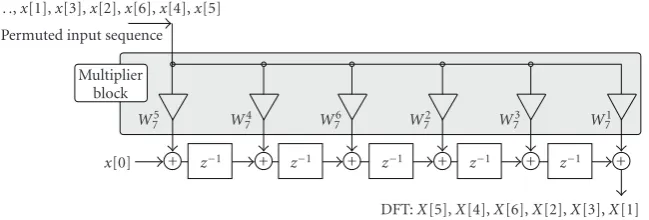
Figure1: Lengthp=7 Rader prime factor DFT implementation.
digit (CSD) system, that is, digits with the ternary values {0, 1,−1} = {0, 1, 1}, and no two adjacent nonzero digits, the density of the nonzero elements becomes 33%. However, sometimes it can be more efficient to first factor the coef-ficient into several factors, thus realizing the individual fac-tors in an optimal CSD sense [15–18]. This multiplier adder graph (MAG) representation reduces, on average, the imple-mentation effort to 25% when compared to the number of product terms used in an array multiplier [3,19].
In many DSP algorithms, we can achieve additional cost reduction if we combine several multipliers within a multi-plier block. The transposed FIR filter shown inFigure 1 is a typical example for a multiplier block. It has been noted by Bull and Horrocks [15,16] that such a multiplier block can be implemented very efficiently. Later, Dempster and Macleod [20] introduced a systematic algorithm, which pro-duces an n-dimensional reduced adder graph(RAG-n) of a block multiplier. In general, however, finding the optimal
RAG-n is an NP-hard problem. RAG-n determines when the design is optimal; for the suboptimal case, heuristics are used. The full 10-step RAG-nalgorithms can be found in [20].
Another alternative to implementing multiple constant multiplication is to use the subexpression technique first in-troduced by Hartley [21]. Here, common patterns in the CSD coding are identified and successively combined. For random coefficients, minor improvements were observed compared with RAG-n. For multiplier blocks with redundancy, RAG-n generally offered the best performance [23].
3. FIR FILTER STRUCTURES USED TO COMPUTE THE DFT
FIR filters are widely studied DSP structures. Their behavior in terms of quantization error, BIBO stability, and the ability to build fast-pipelined structures make FIR filters very attrac-tive. Two algorithms have been used to compute the DFT via the FIR structure. These two are the Rader algorithm, which requires an I/O data permutation and a cyclic convolution, and the Bluestein chirp-z algorithm, which uses a complex I/O multiplication and a linear FIR filter. These two algo-rithms are briefly reviewed below. Details can be found in the DSP textbooks [24,25], as well as in a wide variety of FFT books [26–30].
The DFT is defined as follows:
X[k]= N−1
n=0
x[n]WNnk k,n∈ZN, WN =ej2π/N. (1)
The Rader algorithm [31,32] used to compute the DFT is defined only for prime lengthN. BecauseN= pis a prime, we know that there is a primitive element, ageneratorg, that generates all elements ofnandkin the fieldZp, excluding zero. We substitutenwithgnmodNandkthroughgkmod
Nand get the following index transform:
XgkmodN−x[0]=N−2 n=0
xgnmodNWgn+kmod (N−1)
N
(2)
fork ∈ {1, 2, 3,. . .,N−1}. We notice that the right-hand side of (2) is a cyclic convolution, that is,
xg0modN,xg1modN,. . .,xgN−2modN
WN,WNg,. . .,WNgN−2 mod (N−1). (3)
The DC component must be computed separately as
X[0]= N−1
n=0
x[n]. (4)
Figure 1shows the Rader algorithm forN=7 using the mul-tiplier block technique.
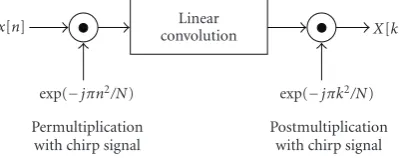
The second algorithm that transforms a DFT into an FIR filter is the Bluestein chirp-z transform (CZT) algorithm. Here the DFT exponentnkis a quadratic expanded to
nk= −(k−n)2
2 +
n2
2 +
k2
2. (5)
The DFT therefore becomes
X[k]=Wk2/2
N N−1
n=0
x[n]WNn2/2WN−(k−n)2/2. (6)
The computation of the DFT is therefore done in three steps:
(1) Nmultiplications ofx[n] withWNn2/2; (2) linear convolution ofx[n]WNn2/2∗W−n2/2
x[n]
exp(−jπn2/N) Permultiplication
with chirp signal
Linear convolution
exp(−jπk2/N) Postmultiplication
with chirp signal X[k]
Figure2: The Bluestein chirp-zalgorithm.
Table1: Number of coefficients and costs of Rader multiplier block implementation for 12-bit plus sign coefficients.
DFT length 7 17 31 61 127 257
CN 6 16 30 60 126 256
RN 6 16 30 60 124 253
CSD 21 59 100 201 428 810
MAG 18 51 85 175 360 688
RAG-n 11 23 35 61 124 237
(3) Nmultiplications withWNk2/2.
This algorithm is graphically interpreted inFigure 2. For a complete transform, we need a lengthNlinear con-volution and 2N complex multiplications. The advantage, compared with the Rader algorithms, is that there is no re-striction to primes in the transform lengthN. CZT can be defined for every length.
3.1. RAG-nimplementation of DFTs
Because the Rader algorithm is restricted to prime lengths, there is less redundancy in the coefficients compared with the Bluestein chirp-zDFT algorithms, which can be defined for any length.Table 1shows, for the primes next to length 2n, the implementation effort of the circular filter in trans-posed form. The numbers of adders required to implement the 12-bit filter coefficients are shown for CSD, MAG [17], and RAG-n[20].
The first row in Table 1 shows the cyclic convolution lengthN, which is also next to the number of complex co-efficientsCN = N−1, shown in row 2. Row 3 shows the numberRNof different real sin/cos coefficient multiplier that must be implemented. Comparing row 3 and the worst case with 2(N−1) real sin/cos coefficients, we see that redundancy and trivial coefficients reduce the number of nontrivial coef-ficients by a factor of 2. The last three rows show the costs (i.e., the number of adders) for a 12-bit multiplier precision implementation using CSD, MAG, or RAG-nalgorithms, re-spectively. Note the advantage of RAG-n, especially for longer filters. RAG-nonly requires about 1/3 the adder of CSD-type filters.
The effort for the CSD, MAG, and RAG-nmethods for all the Rader DFTs up to a length of 257 is graphically inter-preted inFigure 3.
Narasimha et al. [33] have noticed that in the CZT al-gorithm many coefficients of the FIR filter part are trivial or
12-bit real coefficients 1200
1000 800 600 400 200 0
Nu
m
b
er
o
f
ad
d
er
0 50 100 150 200 250
DFT length CSD
MAG RAG
Figure3: Effort for a complex multiplier block design in the Rader algorithm.
Table2: Number of coefficients and costs of a CZT multiplier block implemented with 12-bit plus sign coefficients.
N 8 16 32 64 128 256
CN 4 7 12 23 44 87
RN 2 3 6 11 22 43
CSD 6 10 19 38 70 148
MAG 6 9 17 34 62 129
RAG-n 5 7 11 19 24 44
identical. For instance, the length-8 CZT has an FIR filter of length 15,C(n)=ej2π((n2/2 mod 8)/8)
,n=1, 2,. . ., 15, but there are only four different complex coefficients. These four coef-ficients are 1,j, and±ejπ/8, that is, we have only two
nontriv-ial real coefficients to implement in the length-8 CZT. In general, power-of-two lengths are popular building blocks for Cooley-Tukey FFTs, so we useN =2ninTable 2
for a comparison.
The comparison ofTable 2with the Rader data shown in
Table 1shows the advantages of the CZT implementation. The effort for the CSD, MAG, and RAG-nmethods for the CZT DFT up to a length of 256 is graphically interpreted inFigure 4. Note that the DFTs with a maximum transform length are connected through an extra solid line. Due to co-efficient redundancy explored in the CZT design, we see that some longer transform lengths may have a lower implemen-tation effort than some shorter transforms. For this reason, we might try to use the longer transform whenever possible.
3.2. Complex RAG-nDFT implementations
Thus far we have implemented a DFT of a real input sequ-ence; the complex twiddle factor multiplicationWnnk is im-plemented with two real multiplications. For complex in-put DFTs, we have two choices for how to implement the complex multiplication. We might use a straightforward approach with 4 real multiplications and 2 real additions:
12-bit real coefficients 200
150 100 50 0
Nu
m
b
er
o
f
ad
d
er
0 50 100 150 200 250
DFT length CSD
MAG RAG
Figure4: Effort for a real coefficient multiplier block design in the Bluestein chirp-zalgorithm. The solid line shows the maximum transform length for a specific cost value.
Or, we might use a different factorization such as
s[1]=a−b, s[2]=c−s, s[3]=c+s,
m[1]=s[1]s, m[2]=s[2]a, m[3]=s[3]b,
s[4]=m[1] +m[2], s[5]=m[1] +m[3],
(a+jb)(c+js)=s[4] +js[5],
(8)
which uses 3 real multiplications and 5 real additions,2 as
shown inFigure 5.
Figure 7shows that for a transform length of up to 257, the algorithm with 4×2+ is superior (for both Rader and CZT) when compared with the 3×5+ algorithms. This is due to the fact that with the 4×2+ algorithms for a filter withN complex coefficients, two multiplier blocks with size 2Nare designed, while for the 3×5+ algorithmsthreereal multiplier block filters with block sizeNmust be used. To have cleaner results, we do not show the implementation effort for all CZT lengths; only the maximum transform lengths for the same implementation effort are shown.
The overall adder budget now consists of three parts: (a) the multiplier-block adders, used for CSD, MAG, or RAG coding; (b) the two output adders required to compute the complex multiplier outputs; and (c) the 2 structural adders used for each tap. Because CZT uses only a few different co-efficients, the required number for (b) is much smaller than for the Rader transform. However, the filter structure for the CZT is about twice as long when compared with the Rader transform.Table 3shows a comparison for the overall adder budget required for a CZT of length 64 and a Rader trans-form of length 61. Again, the direct comparison of Rader and CZT shows a reduced effort for CZT.
2Note that in the 3∗×5+ block multiplier architecture, the sums[2]=c−s ands[3]=c+sis precomputed and is therefore sometimes called a 3×3+ algorithm.
(a+jb)×(c+js)=R+jI ×
×
×
× +
+ −
R
I
(a) (a+jb)×(c+js)=R+jI
+ × +
− R
+ ×
−
+ × + I
(b)
Figure5: The two complex multiplier versions (a) 4×2+, (b) 3×5+.
CPU DFT/FFT
co-processor
Datax,X Program
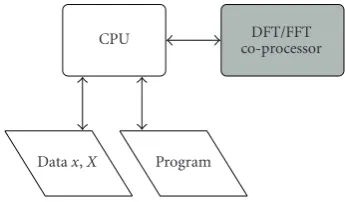
Figure6: Co-processor configuration of FFT core.
3.3. Alternative DFT implementations and synthesis data
In a typical OFDM or DVB configuration [34], the FFT core is used as a coprocessor to speed up the host processor per-formance as shown inFigure 6. The computation of the DFT as coprocessor then has three stages.
(a) The serial data transfer to the coprocessor.
(b) The computation of the DFT, until the first output value is available.
(c) The data transfer back to the host processor.
12-bit complex coefficients 600
500 400 300 200 100 0
Nu
m
b
er
o
f
ad
d
er
0 50 100 150 200 250
DFT length 3×5+ Rader
4×2+ Rader
3×5+ CZT 4×2+ CZT
Figure7: Comparison of complex multiplier block effort for the Rader and CZT algorithm.
Table3: Total required adders for complex DFTs.
CZT-64 points Rader-61 points
CSD MAG RAG CSD MAG RAG
Mul. block 76 68 38 402 350 120
Cmul 22 22 22 120 120 120
Structural 252 252 252 124 124 124
Total 350 342 312 646 594 366
The gate count is measured as equivalent gates as used in cell-based ASIC design. The latency is the number of clock cycles the FFT core needs until the first output sample is available (see (b) above).
Alternative DFT implementations of the CZT RAG-n de-sign include a direct implementation via DFT matrix multi-plication [22] using subexpression sharing. Here a length 8 DFT (8-bit) already requires 74 adders; a 16-point DFT in 16 bits requires 224 adders.
For short length DFTs, the Winograd algorithm seems to be an attractive alternative as well, because it reduces the number of multiplications to a minimum. Unfortunately, the number of structural adders in the Winograd algorithm in-creases more than is proportional to the length. For instance, a complex length 8 DFT requires 52 structural adders [32].
Another common approach uses radix-2 or 4 FFT pro-cessor elements [5,35]. A fully pipelined Cooley-Tukey FFT (called Stream I/O by Xilinx) can benefit from MAG coeffi -cient coding, but each butterfly in 12-bit precision will re-quire, on average, 12×4×25% + 2=14 adders. A 64-point FFT therefore requires 32×6×14=2688 adders if MAG cod-ing is used. If we use the optimum rotator from [3], then the required adder can be further reduced to 1684 in a radix-2 scheme. A mixed radix-2/4 algorithm is reported with 1412
Table4: Size (measured via equivalent number of gates for com-binational and noncomcom-binational elements) and speed as latency (measured as clock cycles until first output value are available) for different DFT lengths sorted by latency.
Method DFT length
4 8 16 32 64
Matrix Size — 26 640 80 640 — —
Mult.∗[22] Latency — 2 2 — —
Winograd Size 5129 14 137 36 893 — —
Latency 2 2 2 — —
CSD-CZT Size 10 349 14 192 23 630 41 426 78 061
Latency 4 4 4 4 4
RAG-CZT Size 9970 13 728 22 578 39 234 73 171
Latency 4 4 4 4 4
Xilinx Radix-2 Size — — 29 535 30 455 32 255
Min. Resource [5] Latency — — 45 112 265
Xilinx Radix-4 Size — — — — 137 952
Stream I/O [5] Latency — — — — 64
∗Estimated.
adders in [3]. In Table 3, the same transform is listed with 312 adders for the chirp-zalgorithm.
Minimum FFT resources are achieved with a single radix-2 Cooley-Tukey butterfly processor (called a minimum re-source design by Xilinx) at the cost of high latency, shown as the radix-2 entry in Table 4. Faster but more resource intensive is a column processor that uses a separate butter-fly processor in each stage, shown as the radix-4 streaming I/O in Table 4 [5].
Winograd, CSD, and RAG-n CZT circuits have been synthesized from their VHDL description and optimized for speed and size with synthesis tools from Synopsys. The
lsi_10kstandard-cell library under typical WWCOM oper-ating conditions has been used. We used two pipeline stages for the multiplier and two for the RAG in the design.
From the comparison inTable 4, it can be concluded that the RAG-CZT provides better results in size compared to the Winograd DFT or the matrix multiplier for more than 16-point DFTs. Therefore, only CZT implementations were used for longer DFTs. When compared with a 64-point Cooley-Tukey FFT processor, only the single butterfly processor gives a smaller area, while a faster pipelined streaming I/O proces-sor requires a 64 clock cycle latency and is twice the size of the RAG-CZT.
3.4. Alternative MCM arithmetic concepts
Other possible arithmetic modifications that can be used to implement the multiple constant multiplication (MCM) block in fast DFTs are the (exclusive) use of carry-save adders [36], distributed arithmetic [37], common subexpression sharing (CSE) [21], or the residue number system (RNS) [38].
It has also been suggested3that the MCM problem can be
considered as a more general design of a 2N×2 matrix mul-tiply problem. This will then also cover the two cases 4×2+ and 3×5+ discussed in this paper. However, the conventional RAG-nalgorithm used in this study with a single input and multiple outputs then needs to be modified to include such a CSE-like input permutation search. The same idea can also be applied to the 13 different methods discussed by Macleod [3]. We have also recently seen successful improvements of the RAG-nheuristic based on the HCUB metric [39] and the differential RAG [40], which will be especially beneficial for coefficient bit widths larger than the 12 bits used in this pa-per.
Some of the above-mentioned MCM arithmetic concepts may in fact further improve the implementation effort of the fast DFT algorithms for certain length or bit width and may be the basis for further studies. The main result of this pa-per, however, is that due to recent advances in MCM algo-rithms, Rader and chirp-zhave become viable options over the conventional radix-2 FFT. This contrasts with previously accepted understanding, as expressed by Burrus and Parks [28, page 37], who state: “if implemented on digital hard-ware, the chirp-ztransform does not seem advantageous for calculating the normal DFT.”
3.5. Quantization noise of alternative DFT algorithms
Since fast DFTs and FFTs can be used, for instance, to imple-ment a fast convolution, it is important to analyze and deter-mine the required quantization error of the algorithms. To simplify our discussion let us make the following assump-tions that are used in textbooks, like [25,30].
(a) The quantization errors are uncorrelated.
(b) The errors are uniformly distributed random variables of (B+ 1)-bit signed fractions, such that the variance becomes 2−2B/12.
(c) The complex multiplication with 4 multiplications has a quantization error ofσ2=4×2−2B/12=2−2B/3. (d) The input signalxis random white noise with variance
σ2
x=1/(3N2).
With this assumption we can determine the quantization noise of the DFT sinceNsource contributes to each output as
EDFT=N×σ2. (9)
3The authors are grateful to an anonymous referee for this suggestion.
From (d) we compute the output variance of the DFT/FFT as
EX=E X[k]2= N−1
n=0
Ex[n]2WNnk,
EX=Nσx2=31N,
(10)
and the noise-to-output ratio becomes
EDFT
EX =3N
2σ2. (11)
This results in a one-bit loss in the noise-to-signal ratio as the length doubles. If inside the DFT a double wide accumulator is used, the noise reduces to
EDFT2accu=σ2, (12)
which provides the best performance of all algorithms. The same results occur with the Rader DFT if we use a double-width accumulator. For the chirp-zDFT, the input and out-put complex multiplications introduce another 2σ2 noise,
and the overall output budget becomes
ECZT=3×σ2 (13)
assuming that we use a double width accumulator in the FIR part for the chirp-z DFT. For the FFT, let us have a look at the popular radix-2 Cooley-Tukey FFT. Here, a double-length accumulator does not help to reduce the round-off noise since the output of the butterfly must be stored in the same (B−1)-bit memory location. To avoid overflow, we can scale the input byN, but the quantization error
EFFTinput=N×σ2 (14)
will be essential. Double FFT length results in a loss of 1 bit in accuracy. A better approach is to scale at each stage by 1/2. Then each of theN=2noutput nodes is connected to 2n−s−1
butterflies and therefore to 2n−snoise sources. Thus the out-put mean-square magnitude of the noise is
EFFT=σ2
n−1
s=0
2n−s
1 2
2n−2s−2
=4σ21−0.5n≈4×σ2,
(15)
and the noise-to-signal ratio becomes
EFFT
EX =12N×σ
2. (16)
Now we only have a 1/2-bit per stage reduction in the noise-to-signal ratio, as first shown by Welch [41].Table 5 summa-rizes the results for the different methods.
Table5: Noise in lengthN =2nDFT and FFT algorithms width
σ2=2−2B/3.
Algorithm type Noise Noise-to-signal
variance ratio
Direct DFT matrix multiply Nσ2 3N2×σ2
DFT double width accumulator σ2 3Nσ2
Rader double width
FIR accumulator σ2 3Nσ2
Chirp-zDFT 3σ2 9Nσ2
Radix-2 FFT input scaling (N−1)σ2 3N(N−1)σ2
Radix-2 FFT
intermediate scaling 4σ2(1−0.5
n) 12Nσ2(1−0.5n)
4. CONCLUSION
This paper shows that both Rader and Bluestein Chirp-z DFTs are viable implement paths for DFT or large Radix FFTs when the multiplier block is implemented with a reduced adder graph technique. This paper shows that the CZT offers lower costs than the Rader design due to the larger number of redundant coefficients in the CZT, which is beneficial to RAG-n. The DFT hardware effort in an implementation via RAG-nCZT has onlyO(N) effort (i.e., not quadraticO(N2)
as for the direct DFT method) and provides a DFT with very short latency, which is attractive when the DFT is used as a coprocessor. For a 64-point RAG-CZT, 92% of the resources are used for the linear filter, 7% for the complex I/O multi-plier, and 1% for coefficient storage.
From a quantization standpoint, both Rader and Blues-tein Chirp-zDFTs perform better than the Radix-2 Cooley-Tukey FFT for fixed-point implementations. The Rader algo-rithm reaches the minimum quantization error of the direct matrix DFT algorithm.
ACKNOWLEDGMENTS
The authors would like to thank Xilinx and Synopsys (FSU ID 10806) for their support under the university program. Thanks also to the anonymous reviewers for their helpful suggestions for improving this paper.
REFERENCES
[1] M. T. Heideman, D. H. Johnson, and C. S. Burrus, “Gauss and the history of the fast Fourier transform,”IEEE Acoustic Speech & Signal Processing Magazine, vol. 1, no. 4, pp. 14–21, 1984. [2] C. S. Burrus, “Index mappings for multidimensional
formula-tion of the DFT and convoluformula-tion,”IEEE Transactions on Acous-tics, Speech, and Signal Processing, vol. 25, no. 3, pp. 239–242, 1977.
[3] M. D. Macleod, “Multiplierless implementation of rotators and FFTs,” EURASIP Journal on Applied Signal Processing, vol. 2005, no. 17, pp. 2903–2910, 2005.
[4] Altera Corporation,FFT: MegaCore Function User Guide, Ver. 2.1.3, 2004.
[5] Xilinx Corporation, “Fast Fourier Transform,” LogiCore v3.1, November 2004.
[6] B. Baas, “SPIFFEE: an energy-efficient single-chip 1024-point FFT processor,” 1998,http://nova.stanford.edu/∼bbaas/
fftinfo.html.
[7] G. Sunada, J. Jin, M. Berzins, and T. Chen, “COBRA: an 1.2 million transistor expandable column FFT chip,” in Proceed-ings of IEEE International Conference on Computer Design: VLSI in Computers and Processors (ICCD ’94), pp. 546–550, Cambridge, Mass, USA, October 1994.
[8] Texas Memory Systems, “TM-66 swifft chip,” 1996, http:// www.texmemsys.com.
[9] SHARP Microeletronics, “Bdsp9124 digital signal processor,” 1997,http://www.butterflydsp.com.
[10] P. Lavoie, “A high-speed CMOS implementation of the Wino-grad Fourier transform algorithm,”IEEE Transactions on Sig-nal Processing, vol. 44, no. 8, pp. 2121–2126, 1996.
[11] G. Panneerselvam, P. Graumann, and L. Turner, “Implementa-tion of fast Fourier transforms and discrete cosine transforms in FPGAs,” inProceedings of the 5th International Workshop on Field-Programmable Logic and Applications (FPL ’95), vol. 975 ofLecture Notes in Computer Science, pp. 272–281, Oxford, UK, August-September 1995.
[12] G. Goslin, “Using Xilinx FPGAs to design custom digital signal processing devices,” inProceedings of the DSPX, pp. 565–604, January 1995.
[13] N. Shirazi, P. M. Athanas, and A. L. Abbott, “Implementa-tion of a 2-D fast Fourier transform on an FPGA-based cus-tom computing machine,” inProceedings of the 5th Interna-tional Workshop on Field-Programmable Logic and Applications (FPL ’95), vol. 975 ofLecture Notes in Computer Science, pp. 282–292, Oxford, UK, August-September 1995.
[14] C. Dick, “Computing 2-D DFTs using FPGAs,” inProceedings of the 6th International Workshop on Field-Programmable Logic, Smart Applications, New Paradigms and Compilers (FPL ’96), vol. 1142 ofLecture Notes in Computer Science, pp. 96–105, Darmstadt, Germany, September 1996.
[15] D. R. Bull and D. H. Horrocks, “Reduced-complexity digital filtering structures using primitive operations,”Electronics Let-ters, vol. 23, no. 15, pp. 769–771, 1987.
[16] D. R. Bull and D. H. Horrocks, “Primitive operator digital fil-ters,”IEE Proceedings G: Circuits, Devices and Systems, vol. 138, no. 3, pp. 401–412, 1991.
[17] A. G. Dempster and M. D. Macleod, “Constant integer mul-tiplication using minimum adders,”IEE Proceedings: Circuits, Devices and Systems, vol. 141, no. 5, pp. 407–413, 1994. [18] A. G. Dempster and M. D. Macleod, “Comments on
“Mini-mum number of adders for implementing a multiplier and its application to the design of multiplierless digital filters”,”IEEE Transactions on Circuits and Systems II: Analog and Digital Sig-nal Processing, vol. 45, no. 2, pp. 242–243, 1998.
[19] O. Gustafsson, A. G. Dempster, and L. Wanhammar, “Ex-tended results for minimum-adder constant integer multipli-ers,” inProceedings of IEEE International Symposium on Cir-cuits and Systems (ISCAS ’02), vol. 1, pp. 73–76, Phoenix, Ariz, USA, May 2002.
[20] A. G. Dempster and M. D. Macleod, “Use of minimum-adder multiplier blocks in FIR digital filters,”IEEE Transactions on Circuits and Systems II: Analog and Digital Signal Processing, vol. 42, no. 9, pp. 569–577, 1995.
[22] M. D. Macleod and A. G. Dempster, “Common subexpression elimination algorithm for low-cost multiplierless implementa-tion of matrix multipliers,”Electronics Letters, vol. 40, no. 11, pp. 651–652, 2004.
[23] M. D. Macleod and A. G. Dempster, “Multiplierless FIR fil-ter design algorithms,”IEEE Signal Processing Letters, vol. 12, no. 3, pp. 186–189, 2005.
[24] S. D. Stearns and D. R. Hush,Digital Signal Analysis, Prentice-Hall, Englewood Cliffs, NJ, USA, 1990.
[25] A. V. Oppenheim and R. W. Schafer,Discrete-Time Signal Pro-cessing, Prentice-Hall, Englewood Cliffs, NJ, USA, 1992. [26] E. Brigham,FFT, Oldenbourg, M¨unchen, Germany, 3rd
edi-tion, 1987.
[27] R. Ramirez,The FFT: Fundamentals and Concepts, Prentice-Hall, Englewood Cliffs, NJ, USA, 1985.
[28] C. Burrus and T. Parks,DFT/FFT and Convolution Algorithms, John Wiley & Sons, New York, NY, USA, 1985.
[29] D. Elliott and K. Rao,Fast Transforms Algorithms, Analyses, Ap-plications, Academic Press, New York, NY, USA, 1982. [30] H. Nussbaumer,Fast Fourier Transform and Convolution
Algo-rithms, Springer, Heidelberg, Germany, 1990.
[31] C. Rader, “Discrete Fourier transform when the number of data samples is prime,”Proceedings of the IEEE, vol. 56, no. 6, pp. 1107–1108, 1968.
[32] J. McClellan and C. Rader,Number Theory in Digital Signal Processing, Prentice-Hall, Englewood Cliffs, NJ, USA, 1979. [33] M. Narasimha, K. Shenoi, and A. Peterson, “Quadratic
resi-dues: application to chirp filters and discrete Fourier trans-forms,” in Proceedings of IEEE International Conference on Acoustics, Speech, and Signal Processing (ICASSP ’76), vol. 1, pp. 376–378, Philadelphia, Pa, USA, April 1976.
[34] U. Meyer-B¨ase, D. Sunkara, E. Castillo, and A. Garcia, “Cus-tom instruction set NIOS-based OFDM processor for FP-GAs,” inWireless Sensing and Processing, vol. 6248 of Proceed-ings of SPIE, Kissimmee, Fla, USA, April 2006, article number 62480O.
[35] S. F. Gorman and J. M. Wills, “Partial column FFT pipelines,”
IEEE Transactions on Circuits and Systems II: Analog and Digi-tal Signal Processing, vol. 42, no. 6, pp. 414–423, 1995. [36] O. Gustafsson, A. G. Dempster, and L. Wanhammar,
“Multi-plier blocks using carry-save adders,” inProceedings of IEEE International Symposium on Circuits and Systems (ISCAS ’04), vol. 2, pp. 473–476, Vancouver, BC, Canada, May 2004. [37] S. A. White, “Applications of distributed arithmetic to
digi-tal signal processing: a tutorial review,”IEEE Transactions on Acoustics, Speech and Signal Processing Magazine, vol. 6, no. 3, pp. 4–19, 1989.
[38] M. Soderstrand, W. Jenkins, G. Jullien, and F. Taylor,Residue Number System Arithmetic: Modern Applications in Digital Sig-nal Processing, IEEE Press Reprint Series, IEEE Press, New York, NY, USA, 1986.
[39] Y. Voronenko and M. P¨uschel, “Multiplierless multiple con-stant multiplication,” to appear inACM Transactions on Algo-rithms.
[40] O. Gustafsson, “A difference based adder graph heuristic for multiple constant multiplication problems,” in Proceedings Proceedings of IEEE International Symposium on Circuits and Systems (ISCAS ’07), New Orleans, La, USA, May 2007, sub-mitted.
[41] P. Welch, “A fixed-point fast Fourier transform error analysis,”
IEEE Transactions on Audio and Electroacoustics, vol. 17, no. 2, pp. 151–157, 1969.
Uwe Meyer-B¨ase received his B.S.E.E., M.S.E.E., and Ph.D. “Summa cum Laude” degrees from the Darmstadt University of Technology in 1987, 1989, and 1995, respec-tively. In 1994 and 1995, he hold a Postdoc-toral position in the “Institute of Brain Re-search” in Magdeburg. In 1996 and 1997, he was a Visiting Professor at the University of Florida. From 1998 to 2000, he was a Re-search Scientist for ASIC Technologies for
The Athena Group, Inc., where he was responsible for develop-ment of high-performance architectures for digital signal process-ing. He is now a Professor in the Electrical and Computer Engi-neering Department at Florida State University. During his gradu-ate studies, he worked part time for TEMIC, Siemens, Bosch, and Blaupunkt. He holds 3 patents, has supervised more than 60 mas-ter thesis projects in the DSP/FPGA area, and gave four lectures at the University of Darmstadt in the DSP/FPGA area. In 2003, he was awarded the “Habilitation” (venia legendi) by the Darmstadt Uni-versity of Technology a requirement for attaining tenured Full Pro-fessor status in Germany. He received in 1997 the Max-Kade Award in Neuroengineering and the Humboldt Research Award in 2005. He is an IEEE, BME, SP, and C&S Society Member.
Hariharan Natarajan was born on 11th February 1980, in Chennai, India. After fin-ishing high school in Hyderabad, India, he graduated from Madras University with B.S. degree in instrumentation and control en-gineering. He started his Masters of Science programme at Florida State University in fall 2001 and graduated in Summer 2004. His area of specialization is digital electron-ics and ASIC design.
Andrew G. Dempster is Director of Re-search in the School of Surveying and Spa-tial Information Systems at the Univer-sity of New South Wales, Sydney, Australia. He holds B.E. and M.Eng.Sc. degrees from UNSW and a Ph.D. from the University of Cambridge. He worked for several years in telecommunications and satellite systems, leading the development of the first GPS re-ceiver designed in Australia. For nine years,