Space-Time Coded MC-CDMA: Blind Channel
Estimation, Identifiability, and Receiver Design
Wei Sun
Department of Electrical and Computer Engineering, Villanova University, Villanova, PA 19085, USA Email: [email protected]
Hongbin Li
Department of Electrical and Computer Engineering, Stevens Institute of Technology, Hoboken, NJ 07030, USA Email: [email protected]
Received 8 June 2002 and in revised form 19 July 2002
Integrating the strengths of multicarrier (MC) modulation and code division multiple access (CDMA), MC-CDMA systems are of great interest for future broadband transmissions. This paper considers the problem of channel identification and signal com-bining/detection schemes for MC-CDMA systems equipped with multiple transmit antennas and space-time (ST) coding. In particular, a subspace-based blind channel identification algorithm is presented. Identifiability conditions are examined and spec-ified which guarantee unique and perfect (up to a scalar) channel estimation when knowledge of the noise subspace is available. Several popular single-user based signal combining schemes, namely the maximum ratio combining (MRC) and the equal gain combining (EGC), which are often utilized in conventional single-transmit-antenna-based MC-CDMA systems, are extended to the current ST-coded MC-CDMA (STC-MC-CDMA) system to perform joint combining and decoding. In addition, a linear mul-tiuser minimum mean square error (MMSE) detection scheme is also presented, which is shown to outperform the MRC and EGC at some increased computational complexity. Numerical examples are presented to evaluate and compare the proposed channel identification and signal detection/combining techniques.
Keywords and phrases:MC-CDMA, OFDM, space-time coding, blind channel identification, identifiability, multiuser detection.
1. INTRODUCTION
Multicarrier (MC) technologies (e.g., [1] and the references therein), in particular OFDM (orthogonal frequency divi-sion multiplexing), are considered very promising for fu-ture broadband data services in fading environments. OFDM has been proposed in various standards, for example, digital audio/video broadcasting [2, 3] and wireless local area net-works including the IEEE802.11a [4, 5] and HIPERLAN/2 [6, 7, 8]. Recently, the combination of MC modulation with CDMA (code division multiple access) has been of signifi-cant interest as a means to take such advantages as bandwidth efficiency, fading resilience, and interference suppression ca-pability which are crucial in future broadband data transmis-sions [9, 10].
There are several multiple access schemes based on the combination of MC modulation and CDMA, including multicarrier CDMA (MC-CDMA), multicarrier DS-CDMA (MC-DS-CDMA), and multitone CDMA (MT-CDMA) (see [11] and the references therein). In OFDM based MC-CDMA systems, the frequency selective fading channel is di-vided into a number of narrowband subchannels that are
(approximately) frequency nonselective. At the transmitter, the information symbol is first spread by a spreading code, followed by OFDM modulation (via the inverse fast Fourier transform, IFFT) such that each chip of the spreading code is modulated by one subcarrier [11, 12, 13]. A cyclic prefix (CP) of length longer than the delay spread of the impulse response of the multipath channel is then inserted into each OFDM symbol before transmission. At the receiver, the CP, which contains the intersymbol interference (ISI), is first re-moved. The ISI-free signal is then FFT (fast Fourier trans-form) converted, which effectively performs OFDM demod-ulation. Finally, the OFDM demodulated signals correspond-ing to different subcarriers are combined to produce decision variables for detection.
different phase shift. To reduce MUI, several signal combin-ing schemes have been proposed (e.g., [11] and the refer-ences therein). These combining schemes, however, require the knowledge of the channel status information (CSI). The CSI has to be estimated at the receiver either with the help of pilot carriers [15] or through blind (self-recovering) identi-fication schemes [16, 17].
It has been shown that significant performance improve-ment can be obtained when adaptive modulation is used with OFDM [18]. Adaptive modulation allocates subcarriers to users based on the instantaneous channel gain so that the subcarriers can be used more effectively [19]. Optimized bit-loading and power allocation are important techniques to in-crease the capacity of OFDM systems [19]. The implementa-tion of adaptive modulaimplementa-tion and bit/power loading, however, requires the CSI at the transmitter, which is usually estimated at the receiver and relayed back to the transmitter through some feedback links.
In this paper, we consider MC-CDMA systems equipped with multiple transmit antennas and some space-time (ST) block coded transmission schemes [20] in order to provide transmit diversity to the receiver. In particular, we consider the simple and yet effective Alamouti’s ST coding scheme that involves two transmit antennas [21]. While it has been found that transmit diversity and ST coding in MC-CDMA systems can significantly increase the transmission rate and improve the overall system performance, channel estimation for such systems is a challenging task, due to the fact that the received signal is mixed both temporally and spatially [22]. We present herein a subspace-based blind channel identifica-tion algorithm for ST-coded MC-CDMA (STC-MC-CDMA) systems. We examine the associated identifiability issue and specify conditions under which unique and perfect (up to a scalar) channel estimation is guaranteed when exact knowl-edge of the noise subspace is available.
Subspace-based estimation has been extensively studied recently and various applications have been reported (see [23, 24, 25, 26, 27, 28] and the references therein). For ex-ample, blind channel identification via subspace estimation was first introduced in [23], where a single-user TDMA-like system in frequency selective channels was consid-ered. Subspace-based blind channel identification for single-carrier CDMA systems were studied in [25, 26], where the related identifiability issue was also investigated. Mul-tiuser detection, using subspace decomposition for single-carrier CDMA systems, was considered in [27]. Subspace-based channel estimation for asynchronous single-carrier CDMA was studied in [28] where the problem of code ac-quisition was also stressed. The proliferation and success of subspace-based estimation in the above systems make it a well-motivated effort to extend this technique and investigate its performance in STC-MC-CDMA systems, where chan-nel estimation is known to be very challenging [22]. Iden-tifiability of subspace-based estimation for STC-MC-CDMA is also an important issue by itself since existing identifi-ability results for single-carrier CDMA (e.g., [26]) cannot be applied here, due to the use of MC modulation and ST coding.
Once the estimates of the channel response are available at the receiver, several signal combining schemes can be im-plemented to demodulate and decode the ST-coded trans-mission. Specifically, we extend herein two signal combin-ing schemes, namely the maximum ratio combincombin-ing (MRC) and the equal gain combining (EGC) which are often utilized in conventional single-transmit-antenna-based MC-CDMA systems [11], to STC-MC-CDMA to perform joint combin-ing and decodcombin-ing. While both MRC and EGC are scombin-ingle- single-user detection schemes based onper-subcarriercombining, we also present a linear MMSE (minimum mean square error) multiuser detector which performs joint-subcarrier combining and decoding. The performance of the MRC, EGC, and MMSE combining/detection schemes is com-pared with one another via numerical examples. We also il-lustrate the performance gain of STC-MC-CDMA systems over conventional MC-CDMA systems without transmit diversity.
The rest of this paper is organized as follows. In Section 2, we introduce the baseband data model for STC-MC-CDMA systems and formulate the problem of inter-est. The subspace-based blind channel identification algo-rithm is presented in Section 3. We also discuss therein the identifiability conditions and implementation issues of the proposed identification algorithm. In Section 4, we dis-cuss the MRC, EGC, and linear MMSE combing/detection schemes for STC-MC-CDMA systems. Section 5 contains numerical examples which evaluate the performance of the proposed blind channel identification and signal detec-tion/combining schemes. Finally, we conclude the paper in Section 6.
Notation
Vectors (matrices) are denoted by boldface lower (upper) case letters; all vectors are column vectors; superscripts ∗, T, andHdenote the complex conjugate, transpose, and con-jugate transpose, respectively;IN denotes theN×Nidentity
matrix;0 denotes an all-zero vector/matrix; ran(·) denotes the range space of a matrix argument;E{·}denotes the sta-tistical expectation;⊗denotes the matrix Kronecker product [29]; and diag{·}denotes a diagonal matrix.
2. PROBLEM FORMULATION
2.1. System model
Decision
Figure1: Diagram of a baseband STC-MC-CDMA system.
frequency-selective channel between each Tx and Rx over the entire system bandwidth is divided intoQnarrowband sub-channels. With a proper choice of Q, each subchannel can be treated as (approximately) frequency nonselective. At the transmitter, the ST encoder (specified in Section 2.2) first maps each user’s incoming symbol stream{b(k)(n)}drawn from some unit-energy constellationᏮ into two ST-coded streams: {d¯(k)(n)} and {d˜(k)(n)}.1 Next, each of the two ST-coded streams is multiplexed intoQparallel substreams and subsequently spread by a distinctive spreading code (see Figure 1). In this system, each user is assigned to two spread-ing codes of processspread-ing gainP, ¯φ(k) =[ ¯φ0(k), . . . ,φ¯(Pk−)1]T and
˜
φ(k)
=[ ˜φ(0k), . . . ,φ˜ (k)
P−1]T to spread symbols transmitted from Tx1 and Tx2, respectively. A trade-off is often made be-tween the bandwidth allocated to an MC-CDMA system and the processing gain P such that Q is an integer mul-tiple of P [11]. Here, we assume that P = Q to simplify the presentation; in the event that Q > P, multiple user symbols can be spread and transmitted across the entire system bandwidth simultaneously [11]. After spreading, the IFFT of the spread signal is computed (to perform OFDM modulation) along with CP insertion. Finally, the STC-MC-CDMA signal is parallel-to-serial (P/S) converted and sent out by the two Tx’s. At the receiver, the received signal is first serial-to-parallel (S/P) converted and followed by CP removal and FFT (to perform OFDM demodulation). The FFT processor outputs are then weighted and combined to generate decision variables by utilizing channel estimates ob-tained by either some training or blind channel estimation scheme.
The frequency selective channel between Tx1 and Rx is di-vided intoQ = P subchannels with normalized center fre-quencies (subcarriers)ϕp = p/P,p = 0,1, . . . , P−1. (The
1Throughout the paper, ¯(·) (resp., ˜(·)) is designated to quantities associ-ated with the first (resp., the second) transmit antenna.
channel between Tx2 and Rx is similarly divided.) Note that spreading is performed in the frequency domain as in stan-dard MC-CDMA systems [11]. The subcarriers at frequen-cies{ϕp}Pp−=10are orthogonal to each other. Hence, when (fre-quency) coherent demodulation is utilized, interference be-tween subcarriers can be avoided [31]. Unlike plain OFDM systems which suffer from channel fading (i.e., some sub-carriers are severely attenuated), MC-CDMA systems are in-sensitive to channel fading since each information symbol is transmitted across the entire system bandwidth.
The baseband discrete-time signal of userk correspond-ing to thepth sample of thenth OFDM symbol is (see [1])
¯
Equivalently, the OFDM symbol can be obtained by comput-ing theP-point IFFT of ¯u(k)(n),
¯
x(k)(n)=FHu¯(k)(n), (3) where ¯x(k)(n) = [ ¯x(k)
0 (n), . . . ,x¯(Pk−)1(n)]T andF denotes the P × P FFT matrix with the (p, q)th element given by P−1/2exp(−j2π pq/P) (and so FH denotes theP×P IFFT
matrix). The signal from allK users to be transmitted from Tx1 is thus given by
¯
Before transmission, a CP of lengthLis inserted in ¯x(n) to combat ISI. The lengthLis chosen such thatL≥M, where Mdenotes the maximum length of the channel between Tx1 and Rx (and the channel between Tx2 and Rx as well). The CP consists of the lastLsamples of ¯x(n) and is inserted at the beginning of ¯x(n) [32], resulting in an (composite) OFDM symbol of (P+L) samples.
The frequency selective channel between Tx1 (resp., Tx2) and Rx is modeled as an FIR (finite-duration impulse re-sponse) filter with at mostMtaps [33]. Let
¯
hh(0), . . . ,¯ h(M¯ −1)T, ˜
hh(0), . . . ,˜ h(M˜ −1)T,
which collect the channel coefficients. Let ¯gand ˜gbe the fre-quency response of ¯hand ˜h, respectively. That is,
¯
g=FMh¯ =
¯
g(0), . . . ,g¯(P−1)T, ˜
g=FMh˜=
˜
g(0), . . . ,g˜(P−1)T,
(6)
whereFM ∈ CP×M is composed of the firstMcolumns of
theP×PFFT matrixF.
At the receiver, the CP of each OFDM symbol is first removed, followed by OFDM demodulation (via aP-point FFT). Lety(n)=[y0(n), . . . , yP−1(n)]Tconsisting of the out-put samples of theP-point FFT processor applied to thenth OFDM symbol. Then,
y(n)=
K
k=1 ¯
d(k)(n) ¯Φ(k)g¯+ ˜d(k)(n) ˜Φ(k)g˜+v(n), (7)
where
¯
Φ(k)
=diagφ¯(0k), . . . ,φ¯(Pk−)1
,
˜
Φ(k)
=diagφ˜(0k), . . . ,φ˜ (k)
P−1
,
(8)
andv(n) = [v0(n), . . . , vP−1(n)]T consisting of the channel noise samples (after FFT). To have a more compact expres-sion fory(n), define
d(k)(n)d¯(k)(n),d˜(k)(n)T,
Φ(k)Φ¯(k)
,Φ˜(k),
G
¯
g 0 0 ˜g
.
(9)
Then, (7) can be rewritten as
y(n)=
K
k=1
Φ(k)Gd(k)(n) +v(n). (10)
2.2. ST encoder
The ST encoder implements the Alamouti’s ST coding scheme [21]. Assume that the user symbols {b(k)(n)} are drawn from some unit-energy constellation (e.g., PSK). For userk, the ST encoder takes in two consecutive data symbols b(k)(2n) andb(k)(2n+ 1) and outputs the following code ma-trix:
D(k)(n)
d¯(k)(2n) ¯d(k)(2n+ 1) ˜
d(k)(2n) ˜d(k)(2n+ 1)
, (11)
where ¯
d(k)(2n)=b(k)(2n), d¯(k)(2n+ 1)= −b(k)∗(2n+ 1),
˜
d(k)(2n)=b(k)(2n+ 1), d˜(k)(2n+ 1)=b(k)∗(2n).
(12)
The two columns ofD(k)(n) are transmitted in two consecu-tive time slots, with the first element of each column trans-mitted from Tx1 and the second one from Tx2, respectively.
The problem of interest to us is to estimate the unknown channel coefficients {h(i)}¯ M−1
i=0 and{h(i)}˜ Mi=−01 from the re-ceived signaly(n) and to recover the user symbols{b(k)(n)}, k=1, . . . , K.
3. SUBSPACE-BASED BLIND CHANNEL
IDENTIFICATION
The channel status information (CSI) is needed at the re-ceiver for coherent signal detection. Training-assisted chan-nel estimation for STC-MC-CDMA systems was investi-gated in [34]. However, training-assisted schemes consume precious bandwidth. Alternatively, differential ST coding schemes [35, 36] can be utilized to bypass the need for chan-nel estimation, but at the cost of a loss in SNR (signal-to-noise ratio) of about 3 dB compared to coherent de-tection [35]. In this section, we present a subspace-based blind channel identification method which utilizes only the second-order statistics of the received signal and, thus, leads to higher bandwidth efficiency than training-assisted schemes.
3.1. Subspace blind channel identification
DefineΦ[Φ(1), . . . ,Φ(K)]∈RP×2PKandd(n)[d(1)T(n),
. . . ,d(K)T(n)]T. Then, (10) can be expressed as
y(n)=ΦIK⊗G
d(n) +v(n). (13) Denote byRythe covariance matrix ofy(n),
RyE
y(n)yH(n)=ΦIK⊗G
IK⊗G
H
ΦH+σ2
vIP, (14)
whereσ2
vdenotes the variance of the noise samples{vp(n)},
and we also made the following assumption.
(A1) User symbols{b(k)(n)}are i.i.d. (independently and identically distributed) and drawn from a unit-energy constellation so thatE{d(n)dH(n)} =I
2K.
Let R denote the rank of Φ(IK ⊗G). It is clear that
R ≤ 2K and the equality holds if the 2K signature vectors {ψ¯(k),ψ˜(k)}K
k=1are all linearly independent, where the signa-ture vectors are defined as
¯
ψ(k)Φ¯(k) ¯
g=Φ¯(k)F
Mh¯,
˜
ψ(k)Φ˜(k) ˜
g=Φ˜(k) FMh˜.
(15)
Therefore, we have the following eigenvalue decomposition (EVD) ofRy:
Ry=ΓsΛsΓHs +σv2ΓnΓHn, (16) whereΛs=diag{λ1, . . . , λR}contains theRlargest
Rsignal eigenvectorswhich span thesignal subspace, that is, ran{Γs} =ran{Φ(IK⊗G)}, andΓn∈CP×(P−R)contains the (P−R)noise eigenvectorswhich span thenoise subspace. The orthogonality between the noise and signal subspace implies that
ΓH
nΦ
IK⊗G
=0. (17)
For userk, the above equation is reduced to
ΓH
nΦ¯ (k)F
Mh¯=0, (18)
ΓH
nΦ˜ (k)
FMh˜=0. (19)
Hence, ¯h and ˜h are in the null space of ΓHnΦ¯(k)FM and
ΓH
nΦ˜ (k)
FM, respectively. If the nullity of these matrices is one,
then ¯hand ˜hcan be uniquely and perfectly (up to a scalar) solved from (18) and (19), respectively. The residual scalar ambiguity can be resolved by transmitting a few pilots, sim-ilarly to the semiblind schemes developed in [37, 38]. The key idea behind such a semiblind approach is that, in order to resolve the scalar ambiguity, onlya fewpilot symbols are needed, thus leading to a higher spectral efficiency compared to a full training scheme which has to estimate all channel coefficients by training.
The remaining question is under what conditions the nullity ofΓH
nΦ¯ (k)
FM andΓHnΦ˜ (k)
FM is one so that
identi-fiability is guaranteed.
3.2. Blind identifiability
To determine the identification conditions, we first note that the dimensions ofΓHnΦ¯
(k)F
MandΓHnΦ˜ (k)
FMare (P−R)×M.
Since for anyL×MmatrixX, dim(null(X)) + rank(X)=M [29], it is necessary to have
(A2) P−R≥M−1.
Otherwise, the nullity of both ΓHnΦ¯ (k)F
M and ΓHnΦ˜ (k)
FM
will always be greater than one. When the signature vectors {ψ¯(k),ψ˜(k)}K
k=1 are linearly independent of each other (e.g., with independent spreading codes plus mild conditions on the channel), (A2) imposes an upper limit on the number of users allowed in the system
K≤ P−M+ 1
2 . (20)
Next, we present the identifiability conditions. Define ¯
Ψ [ ¯ψ(1), . . . ,ψ¯(K)] and ˜Ψ [ ˜ψ(1)
, . . . ,ψ˜(K)
] which col-lect all signature vectors. Let ¯Ψ(k) ∈ CP×(K−1) and ˜Ψ(k) ∈ CP×(K−1)be obtained from ¯Ψand ˜Ψ, respectively, by delet-ing thekth column. The following result specifies conditions which guarantee unique and perfect (up to a scalar) estima-tion of the channel from (18) and (19).
Proposition 1 (Identifiability). In addition to conditions (A1) and (A2), suppose the following are also satisfied:
(A3) ¯Φ(k)FMandΦ˜
(k)
FMhave full column rank;
(A4) the following ranges do not intersect:
ranΦ¯(k)FM
∩ranΨ¯(k),Ψ˜= ∅, (21)
ranΦ˜(k)FM
∩ranΨ˜(k),Ψ¯= ∅. (22)
Then, channel vectorsh¯ andh˜are uniquely and perfectly (up to a scalar) determined by the solutions of (18)and(19), re-spectively.
Proof. In the sequel, we will only prove that the solution of (18) is unique and perfect. The uniqueness and perfectness of the solution of (19) follow similarly.
The proof of uniqueness goes by contradiction. Assume that there exists another solution of (18)
ΓH
nΦ¯ (k)F
Mh¯=0. (23)
Then, ¯Φ(k)FMh¯∈ran([ ¯Ψ,Ψ˜]). That is, there exists
nontriv-ial [¯αT,α˜T]T∈C2K×1such that
¯
Φ(k)F
Mh¯= K
l=1 ¯
αlψ¯(l)+ ˜Ψα˜, (24)
where ¯αldenotes thelth element of ¯α. Since ¯ψ(k)=Φ¯(k)FMh¯,
we rearrange the above equation as follows: ¯
Φ(k) FM
¯
h−αkh¯
=
l =k
¯
αlψ¯(l)+ ˜Ψα˜=0, (25)
where the last equality follows from (21), which necessitates ˜
α =0and ¯αl =0, forl = k. Meanwhile, assumption (A3)
implies that
¯
h=α¯kh¯. (26)
That is, ¯hmust be collinear with ¯hwhich proves the unique-ness (up to a scalar).
The perfectness of the solution follows since the true channel vector ¯his a solution of (18).
We note that assumption (A1) may be relaxed as long as E{d(n)dH(n)}has full rank. This is essential for subspace
de-composition. Without it, in general, ran(Γs) =ran{Φ(IK⊗
not reside in the range of ¯Φ(k)FM (or ˜Φ
(k)
FM). We found
that with standard spreading codes (e.g., bipolar spread-ing codes that are linearly independent of one another) and mild conditions on the channel, this assumption is usually satisfied.
3.3. Implementation issues
In practice,Γnis unknown and needs to be computed from some estimate of Ry. While other estimates are possible, a
simple one based on block processing is the sample covari-ance matrix estimate
where Ny denotes the block size. An estimate of the noise
eigenvectors ˆΓncan be obtained from the EVD of ˆRy. Due to
(finite-sample) estimation errors in ˆΓn, (18) and (19) will not hold exactly. In this case, we can solve it in the least squares (LS) sense by minimizing the two norm of the vectors on the left side of (18) and (19), respectively.
In some applications, it is also possible that the receiver may have knowledge of some other users’ spreading codes (informed by the base station through a control channel). When such additional information is available, it is beneficial to incorporate it in the channel estimation, which in general improves estimation accuracy. To do so, we may utilize the following criteria:
where the summation (averaging) is with respect to the set of users whose spreading codes are known. When the nullity of the matrices within the curly brackets of (22) and (23), respectively, is greater than one, the channel be-comes unidentifiable. It is interesting to note that in such a case, knowing spreading codes of additional users al-lows further averaging, which helps building up the rank of those matrices and may render the channel identifiable. That is, knowing more spreading codes can relax the iden-tifiability conditions. Although a strict analysis appears dif-ficult, if not impossible, this has been observed in our simulations.
Equations (27), (16), and (28), (29), in that order, summarize the proposed subspace blind channel estima-tor for the STC-MC-CDMA system. The above block-processing based implementation is, however, known to be computation-wise and complexity-wise inefficient. All subspace-based schemes rely on an estimate of the signal and/or noise eigenvectors. In practice, these eigenvectors can be obtained with significantly reduced complexity by adap-tive subspace tracking methods (see, e.g., [39, 40, 41] and references therein). The subspace tracking method in [41],
for example, estimates only one noise subspace vector at a time and enjoys such desired properties as fast conver-gence, no need for exact rank information, and estimating directly the noise subspace without tracking the signal sub-space (which is not needed in our channel identification scheme). It should be noted that most of the above subspace tracking algorithms can be applied to the current STC-MC-CDMA systems with little modification. The only notable change is that because of OFDM modulation, noise subspace tracking is now performed in the frequency domain as op-posed to the conventional time-domain subspace tracking. Due to space limitation, we will not pursue this topic fur-ther in this paper. Interested readers are referred to the above cited references for details about standard subspace tracking methods.
4. RECEIVER DESIGN
In conventional MC-CDMA systems (without transmit di-versity), the OFDM demodulated signals are often com-bined in the frequency domain in order to collect the over-all received signal energy scattered on different subcarri-ers. Typical signal combining schemes include the maxi-mum ratio combining (MRC) and the equal gain ing (EGC) [9, 11]. In this section, we extend these combin-ing schemes to STC-MC-CDMA systems to perform joint combining and decoding. Both MRC and EGC are single-user detection schemes based on per-subcarrier combin-ing, that is, the signals at individual subcarrier are indepen-dently weighted and summed to generate decision variables. In what follows, we also present a linear multiuser MMSE detector which jointly weights and combines signals on all subcarriers.
4.1. Single-user coherent signal combining
and decoding
in (12), we can rewrite (30) as follows: In the sequel, we present the MRC and the EGC coherent sig-nal combining schemes for STC-MC-CDMA systems, both treating the MUI in (31) as noise.
4.1.1 Maximum ratio combining
Incorporating the Alamouti decoding [21] while maximizing the output SNR, we obtain the MRC combiner applied on subcarrier pfor the detection ofb(1)(2n) andb(1)(2n+ 1),
The decision variables are obtained by combining the MRC outputs from all subcarriers
ˆ
4.1.2 Equal gain combining
Likewise, applying the Alamouti decoding along with (coher-ent) EGC yields
Except for the incorporation of the Alamouti decod-ing, the MRC and EGC vectors in (32) and (34) are similar to their counterparts for conventional MC-CDMA systems without ST coding [9, 11]. Previous studies have found that these single-user schemes are sensitive to the MUI [11]; also see the numerical results in Section 5. The suboptimal per-formance of these single-user schemes motivates the pursuit of more sophisticated multiuser detection schemes, such as the linear MMSE detector which is discussed next.
4.2. Linear MMSE multiuser detector
Recently, linear MMSE detection has been considered for MC-CDMA systems without ST coding [42, 43]. In the se-quel, we extend it to the current STC-MC-CDMA systems to perform joint combining and decoding over all subcarri-ers. To facilitate our presentation, we rewrite (10) in a slightly different but equivalent form
y(n)=G¯Ψ¯d¯(n) + ˜GΨ˜d˜(n) +v(n), (36)
We consider two OFDM demodulated symbols at a time. Us-ing again the signal mappUs-ing in (12), we have
y(2n)=G¯Ψ¯b(2n) + ˜GΨ˜b(2n+ 1) +v(2n),
formation symbols of the first user at time 2nand 2n+ 1. The MMSE receiver minimizes the following mean square error (MSE) criterion (e.g., [44]):
W(1)
MMSE=arg min W∈C2P×2E
WHz(n)−b(1)(n)2, (40)
the solution of which is given by W(1)
MMSE=R−z1R
(1)
zb, (41)
betweenz(n) andb(1)(n),
R(1)zb Ez(n)b(1)H(n)=
G¯φ¯(1) G˜φ˜(1) ˜
G∗φ˜(1) −G¯∗φ¯(1)
. (42)
The decision variables yielded by the linear MMSE detector are given by
ˆ
b(1)(n)bˆ(1)(2n),bˆ(1)(2n+ 1)T =W(1)H
MMSEz(n). (43) Note that the covariance matrix Rz required by the
MMSE receiver can be computed either based on block pro-cessing or adaptively from the received data. Hence, simi-lar to the MRC and EGC schemes, the MMSE receiver re-quires only the desired user’s spreading codes for detection. As we will see in Section 5.2, the MMSE receiver yields im-proved performance over the MRC and EGC receivers. This is achieved at the cost of increased complexity. Specifically, while both the MRC and EGC have a linear complexity
ᏻ(P), a direct, block-processing based implementation of the MMSE receiver results in a complexity of ᏻ(P3). Adaptive implementation of the MMSE receiver with some decreased complexity is possible [44]. Even so, the adaptive MMSE re-ceiver would incur more computations than the MRC and EGC receivers.
Finally, the hard estimatebˆˆ(1)(n) is obtained by compar-ing the decision variable ˆb(1)(n), obtained by any of the above detection/combining schemes, with every constellation point
ˆˆ
b(1)(n)=arg min
b∈Ꮾbˆ
(1)(n)−b. (44)
5. SIMULATION RESULTS
In this section, we present simulation results to evaluate the performance of the proposed blind channel identification al-gorithm and the signal detection/combining schemes. In our simulation, user symbols are drawn from a unit-energy BPSK (binary phase shift keying) constellation. Walsh-Hadamard codes with processing gainP =Q=32 are used for spread-ing. We assume a rich scattering environment and generate the FIR channel coefficients{h(m)}¯ M−1
m=0 and{h(m)}˜ Mm=−01 as i.i.d. complex Gaussian random variables with zero-mean and variance 1/M. The SNR is defined as SNR=10 log101/σ2
v
in dB.
5.1. Channel identification
The figure of merit used for evaluating the performance of channel identification is the averaged MSE defined as
MSEhˆ¯=
1
M−1 m MSE ˆ¯
h(m), (45)
where ˆ¯h(m) denotes the estimate of ¯h(m); MSE( ˆ˜h) is similarly defined. The channel estimates ˆ¯hand ˆ˜hare normalized with respect to the first element of ¯hand ˜h, respectively, due to the inherent scalar ambiguity in all blind channel estimates. As mentioned before, the residual scalar ambiguity can be
40 35 30 25 20 15 10 5 0
SNR (dB) 10−5
10−4 10−3 10−2 10−1 100 101
Av
er
ag
ed
M
S
E
K=5 K=10
(a)
500 450 400 350 300 250 200 150 100 50 0
Ny 10−4
10−3 10−2 10−1 100 101 102
Av
er
ag
ed
M
S
E
K=5 K=10
(b)
Figure 2: Averaged MSE of channel estimation versus (a) SNR whenNy=250 and (b)Nywhen SNR=20 dB.
removed by differential coding or utilizing (a few) pilot sym-bols (e.g., [37, 38]). We consider two cases involvingK =5 andK = 10 users, respectively. A total of 200 independent Monte Carlo trials were conducted to obtain the averaged MSE. Figure 2a depicts the averaged MSE versus the SNR whenNy=250 data samples are used to compute the sample
covariance matrix ˆRy(see (27)) whereas Figure 2b shows the
averaged MSE versusNywhen SNR=20 dB. In both cases,
we see that the accuracy of the channel estimates is improved as the SNR and/or the number of data samples increases.
5.2. Signal detection
15 10
5 0
SNR (dB) 10−5
10−4 10−3 10−2 10−1 100
BER
EGC MRC MMSE
(a)
15 10
5 0
SNR (dB) 10−5
10−4 10−3 10−2 10−1 100
BER
EGC MRC MMSE
(b)
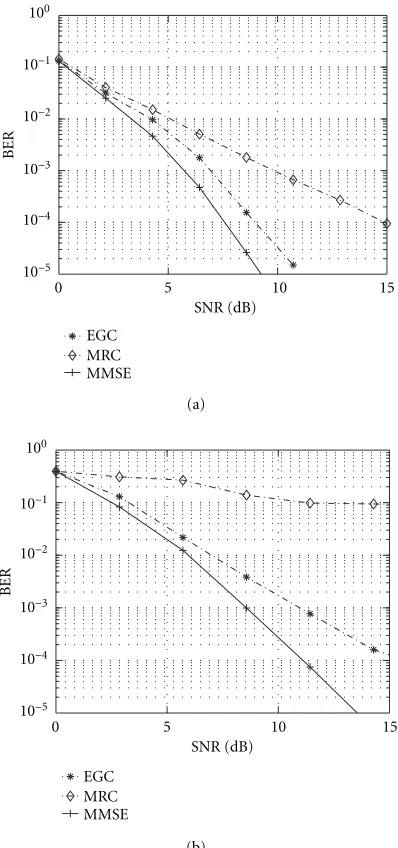
Figure3: BER versus SNR of the MRC, EGC, and MMSE schemes when (a)K=5 and (b)K=10.
the proposed channel identification algorithm, using Ny =
500 samples of data. The BER results presented in the follow-ing are averaged over 500 independent channel realizations to emulate a Rayleigh fading environment.
The BER of the three signal detection/combining schemes as a function of the SNR is depicted in Figure 3a whenK =5 and Figure 3b whenK =10, respectively. The MRC scheme is known to be optimal when there is only one user in the system. It is very sensitive to the presence of MUI which degrades its performance [9]. A comparison of Figure 3a (K = 5 users) with Figure 3b (K = 10 users) shows that the degradation of MRC becomes more severe as the number of users increases. The EGC and the MMSE re-ceivers are observed to outperform the MRC scheme for both cases, with the MMSE receiver being the best.
The relative performances of the three detection schemes for STC-MC-CDMA systems are similar to those reported in [11] for conventional MC-CDMA systems (i.e., no ST cod-ing) with orthogonal spreading codes. It should be noted that there is no analytical evidence that EGC may always outper-form MRC or vice versa. Both are single-user based detec-tion schemes, and may suffer from MUI. The relative perfor-mance depends on such factors as spreading codes, user pow-ers, and the underlying channel. When orthogonal spreading codes are used, our simulation results and those in [11] ap-pear to suggest that EGC may be better than MRC in restor-ing the user orthogonality, to which the performance gain is attributed.
5.3. Diversity gain
Finally, we examine the diversity gain offered by ST coding in Rayleigh fading environments. In particular, we compare the BER of the STC-MC-CDMA system and a conventional single-transmit-antenna based MC-CDMA system without ST coding. The transmitted power for the conventional MC-CDMA system is twice that of the STC-MC-MC-CDMA sys-tem to ensure that the SNR in both syssys-tems are compara-ble. The three detection/combining schemes, namely MRC, EGC, and MMSE, are employed for detection in the two systems, utilizing both true and estimated channel coeffi -cients. In the latter case, the subspace-based blind chan-nel identification algorithm is used for chanchan-nel estimation. Figure 4 depicts the BER versus the SNR for the two systems. We note that STC-MC-CDMA performs considerably better than the conventional MC-CDMA system, yielding signifi-cant diversity gain (even with estimated channels). We also note that channel estimation for STC-MC-CDMA is less ac-curate than the single-transmit-antenna based MC-CDMA system, particularly when the input SNR is relatively low. This is not surprising since the number of unknown chan-nel coefficients doubles in STC-MC-CDMA. As the SNR in-creases, the performance difference between using true and estimated channels is noted to be less than 1 dB for all three detectors.
6. CONCLUSIONS
15 10
5 0
SNR (dB) 10−5
10−4 10−3 10−2 10−1 100
BER
Tx=2 (estimated channel) Tx=2 (true channel)
Tx=1 (estimated channel) Tx=1 (true channel) (a)
15 10
5 0
SNR (dB) 10−5
10−4 10−3 10−2 10−1 100
BER
Tx=2 (estimated channel) Tx=2 (true channel)
Tx=1 (estimated channel) Tx=1 (true channel) (b)
15 10
5 0
SNR (dB) 10−5
10−4 10−3 10−2 10−1 100
BER
Tx=2 (estimated channel) Tx=2 (true channel)
Tx=1 (estimated channel) Tx=1 (true channel) (c)
Figure4: BER versus SNR whenK=5. (a) MRC detector; (b) EGC detector; (c) MMSE detector.
ACKNOWLEDGMENT
This work was supported in part by the New Jersey Com-mission on Science and Technology and Center for Wireless Network Security at Stevens Institute of Technology.
REFERENCES
[1] J. Bingham, “Multicarrier modulation for data transmission: An idea whose time has come,”IEEE Communications Maga-zine, vol. 28, no. 5, pp. 5–14, 1990.
[2] ETSI, “Digital video broadcasting: frame structure, channel coding, and modulation for digital terrestrial television,” EN 300 744, August 1997.
[3] ETSI, “Radio broadcasting system: digital audio broadcasting (DAB) to mobile, portable and fixed receivers,” EN 300 401, 2nd edition, May 1997.
[4] IEEE 802.11, “IEEE standard for wireless LAN medium ac-cess control (MAC) and physical layer (PHY) specifications,” November 1997.
[5] B. P. Crow, I. Widjaja, J. G. Kim, and P. T. Sakai, “IEEE 802.11 wireless local area networks,” IEEE Communications Maga-zine, vol. 35, no. 9, pp. 116–126, 1997.
[6] ETSI, “Radio equipment and systems, high performance ra-dio local area network (HiperLAN) Type I,” ETS 300-652, Oc-tober 1996.
[7] ETSI, “Broadband radio access networks (BRAN; Hiper-LAN Type 2 technical specification Part I: physical layer,” DTS/BRAN030003-1, October 1999.
[8] R. van Nee, G. Awater, M. Morikura, H. Takanashi, M. Web-ster, and K. W. Halford, “New high-rate wireless LAN stan-dards,” IEEE Communications Magazine, vol. 37, no. 12, pp. 82–88, 1999.
[9] N. Yee, J.-P. Linnartz, and G. Fettweis, “Multicarrier CDMA in indoor wireless radio networks,” inIEEE Personal Indoor and Mobile Radio Communications (PIMRC) Int. Conference, pp. 109–113, Yokohama, Japan, September 1993.
[10] Z. Wang and G. B. Giannakis, “Wireless multicarrier commu-nications,”IEEE Signal Processing Magazine, vol. 17, no. 3, pp. 29–48, 2000.
[11] S. Hara and R. Prasad, “Overview of multicarrier CDMA,”
IEEE Communications Magazine, vol. 35, no. 12, pp. 126–133, 1997.
[12] S. Hara and R. Prasad, “Design and performance of multi-carrier CDMA system in frequency-selective Rayleigh fading channel,”IEEE Trans. Vehicular Technology, vol. 48, no. 5, pp. 1584–1595, 1999.
[13] E. A. Sourour and M. Nakagawa, “Performance of orthogo-nal multicarrier CDMA in a multipath fading channel,”IEEE Trans. Communications, vol. 44, no. 3, pp. 356–367, 1996. [14] T. S. Rappaport, Wireless Communications: Principles and
Practice, Prentice-Hall, Upper Saddle River, NJ, USA, 1996. [15] J. Choi, “Channel estimation for coherent multi-carrier
CDMA systems over fast fading channels,” inProc. IEEE Vehicular Technology Conference, vol. 1, pp. 400–404, Tokyo, Japan, May 2000.
[16] U. Tureli, D. Kivanc, and H. Liu, “Channel estimation for multicarrier CDMA,” inProc. IEEE Int. Conf. Acous-tics, Speech, Signal Processing, vol. 5, pp. 2909–2912, Istanbul, Turkey, June 2000.
[18] A. Czylwik, “Adaptive OFDM for wideband radio channels,” inProc. IEEE Global Telecommunications Conference, pp. 713– 718, London, UK, November 1996.
[19] C. Y. Wong, R. S. Cheng, K. Letaief, and R. Murch, “Multiuser OFDM with adaptive subcarrier, bit, and power allocation,”
IEEE Journal on Selected Areas in Communications, vol. 17, no. 10, pp. 1747–1758, 1999.
[20] V. Tarokh, H. Jafarkhani, and A. R. Calderbank, “Space-time block codes from orthogonal designs,” IEEE Transactions on Information Theory, vol. 45, no. 5, pp. 1456–1467, 1999. [21] S. M. Alamouti, “A simple transmit diversity techniques for
wireless communications,” IEEE Journal on Selected Areas in Communications, vol. 16, no. 8, pp. 1451–1458, 1998. [22] Z. Liu, G. B. Giannakis, B. Muquet, and S. Zhou,
“Space-time coding for broadband wireless communications,” Wire-less Systems and Mobile Computing, vol. 1, no. 1, pp. 35–53, 2001.
[23] E. Moulines, P. Duhamel, J.-F. Cardoso, and S. Mayrargue, “Subspace methods for the blind identification of multichan-nel FIR filters,” IEEE Trans. Signal Processing, vol. 43, no. 2, pp. 516–525, 1995.
[24] A. J. van der Veen, S. Talwar, and A. Paulraj, “A subspace ap-proach to blind space-time signal processing for wireless com-munication systems,” IEEE Trans. Signal Processing, vol. 45, no. 1, pp. 173–190, 1997.
[25] X. Wang and H. V. Poor, “Blind equalization and multiuser detection in dispersive CDMA channels,” IEEE Trans. Com-munications, vol. 46, no. 1, pp. 91–103, 1998.
[26] P. Loubaton and E. Moulines, “On blind multiuser forward link channel estimation by the subspace method: Identifiabil-ity results,” IEEE Trans. Signal Processing, vol. 48, no. 8, pp. 2366–2376, 2000.
[27] X. Wang and H. V. Poor, “Blind multiuser detection: A sub-space approach,” IEEE Transactions on Information Theory, vol. 44, no. 2, pp. 677–690, 1998.
[28] S. E. Bensley and B. Aazhang, “Subspace-based channel esti-mation for code division multiple access communications sys-tems,”IEEE Trans. Communications, vol. 44, no. 8, pp. 1009– 1020, 1996.
[29] G. H. Golub and C. F. Van Loan,Matrix Computations, Johns Hopkins University Press, Baltimore, Md, USA, 3rd edition, 1996.
[30] P. Bender, P. Black, M. Grob, R. Padovani, N. Sindhushayana, and A. Viterbi, “CDMA/HDR: A bandwidth-efficient high-speed wireless data service for nomadic users,”IEEE Commu-nications Magazine, vol. 38, no. 7, pp. 70–77, 2000.
[31] S. Kondo and L. B. Milstein, “Performance of multicarrier DS CDMA systems,”IEEE Trans. Communications, vol. 44, no. 2, pp. 238–246, 1996.
[32] R. D. J. van Nee and R. Prasad, OFDM Wireless Multimedia Communications, Artech House, Boston, Mass, USA, 2000. [33] J. G. Proakis, Digital Communications, McGraw-Hill, New
York, NY, USA, 3rd edition, 1995.
[34] Y. (G.) Li, N. Seshadri, and S. Ariyavistakul, “Channel estima-tion for OFDM systems with transmitter diversity in mobile wireless channels,”IEEE Journal on Selected Areas in Commu-nications, vol. 17, no. 3, pp. 461–471, 1999.
[35] V. Tarokh and H. Jafarkhani, “A differential detection scheme for transmit diversity,”IEEE Journal on Selected Areas in Com-munications, vol. 18, no. 7, pp. 1169–1174, 2000.
[36] B. M. Hochwald and Q. Sweldens, “Differential unitary space-time modulation,” IEEE Trans. Communications, vol. 48, no. 12, pp. 2041–2052, 2000.
[37] H. Li, X. Lu, and G. B. Giannakis, “Capon multiuser receiver
for CDMA systems with space-time coding,”IEEE Trans. Sig-nal Processing, vol. 50, no. 5, pp. 1193–1204, 2002.
[38] S. Zhou, B. Muquet, and G. B. Giannakis, “Subspace-based (semi-) blind channel estimation for block precoded space-time OFDM,”IEEE Trans. Signal Processing, vol. 50, no. 5, pp. 1215–1228, 2002.
[39] G. W. Stewart, “An updating algorithm for subspace tracking,”
IEEE Trans. Signal Processing, vol. 40, no. 6, pp. 1535–1541, 1992.
[40] B. Yang, “Projection approximation subspace tracking,”IEEE Trans. Signal Processing, vol. 43, no. 1, pp. 95–107, 1995. [41] X. Li and H. Fan, “Blind channel identification: Subspace
tracking method without rank estimation,”IEEE Trans. Signal Processing, vol. 49, no. 10, pp. 2372–2382, 2001.
[42] S. L. Miller and B. J. Rainbolt, “MMSE detection of multicar-rier CDMA,” IEEE Journal on Selected Areas in Communica-tions, vol. 18, no. 11, pp. 2356–2362, 2000.
[43] J. F. Helard, J. Y. Baudais, and J. Citene, “Linear MMSE de-tection technique for MC-CDMA,”Electronics Letters, vol. 36, no. 7, pp. 665–666, 2000.
[44] S. Haykin, Adaptive Filter Theory, Prentice-Hall, Upper Sad-dle River, NJ, USA, 3rd edition, 1996.
Wei Sunreceived the B.S. degree from Xi-dian University, Xi’an, China, in 1992, the M.S. degree from the Chinese Academy of Telecommunications Technology (CATT), Beijing, China, in 1995, and the Ph.D. degree from Stevens Institute of Technol-ogy, Hoboken, NJ, in 2001, all in electri-cal engineering. From 1993 to 1997, he was a Telecommunication Engineer with the R&D Center of Telecommunications
Tech-nology, CATT, Beijing, China. From 1997 to 2001, he was a Re-search and Teaching Assistant with the Department of Electri-cal and Computer Engineering, Stevens Institute of Technology, Hoboken, NJ. Currently, he is a Post-Doctoral Research Fellow with the Department of Electrical and Computer Engineering, Villanova University, Villanova, PA. His research interests include signal pro-cessing for wireless communications, multiuser detection, space-time coding, and OFDM. Dr. Sun received the Outstanding Doc-toral Dissertation Award from Stevens Institute of Technology in 2002.
Hongbin Lireceived the B.S. and M.S. de-grees from the University of Electronic Sci-ence and Technology of China (UESTC), Chengdu, in 1991 and 1994, respectively, and the Ph.D. degree from the University of Florida, Gainesville, FL, in 1999, all in elec-trical engineering. From July 1996 to May 1999, he was a Research Assistant in the De-partment of Electrical and Computer Engi-neering at the University of Florida. Since