Scholarship at UWindsor
Scholarship at UWindsor
Electronic Theses and Dissertations Theses, Dissertations, and Major Papers
3-10-2019
Capturing Word Semantics From Co-occurrences Using Dynamic
Capturing Word Semantics From Co-occurrences Using Dynamic
Mutual Information
Mutual Information
Yaxin Li
University of Windsor
Follow this and additional works at: https://scholar.uwindsor.ca/etd
Recommended Citation Recommended Citation
Li, Yaxin, "Capturing Word Semantics From Co-occurrences Using Dynamic Mutual Information" (2019). Electronic Theses and Dissertations. 7644.
https://scholar.uwindsor.ca/etd/7644
This online database contains the full-text of PhD dissertations and Masters’ theses of University of Windsor students from 1954 forward. These documents are made available for personal study and research purposes only, in accordance with the Canadian Copyright Act and the Creative Commons license—CC BY-NC-ND (Attribution, Non-Commercial, No Derivative Works). Under this license, works must always be attributed to the copyright holder (original author), cannot be used for any commercial purposes, and may not be altered. Any other use would require the permission of the copyright holder. Students may inquire about withdrawing their dissertation and/or thesis from this database. For additional inquiries, please contact the repository administrator via email
Co-occurrences Using Dynamic Mutual
Information
By
Yaxin Li
A Thesis
Submitted to the Faculty of Graduate Studies through the School of Computer Science in Partial Fulfillment of the Requirements for
the Degree of Master of Science at the University of Windsor
Windsor, Ontario, Canada
2019
c
by
Yaxin Li
APPROVED BY:
A. Hussein
Department of Mathematics and Statistics
R. Gras
School of Computer Science
J. Lu, Advisor School of Computer Science
I hereby certify that I am the sole author of this thesis and that no part of this thesis has
been published or submitted for publication.
I certify that, to the best of my knowledge, my thesis does not infringe upon anyones
copyright nor violate any proprietary rights and that any ideas, techniques, quotations, or
any other material from the work of other people included in my thesis, published or
oth-erwise, are fully acknowledged in accordance with the standard referencing practices.
Fur-thermore, to the extent that I have included copyrighted material that surpasses the bounds
of fair dealing within the meaning of the Canada Copyright Act, I certify that I have
ob-tained a written permission from the copyright owner(s) to include such material(s) in my
thesis and have included copies of such copyright clearances to my appendix.
I declare that this is a true copy of my thesis, including any final revisions, as approved
by my thesis committee and the Graduate Studies office, and that this thesis has not been
Semantic relations between words are crucial for information retrieval and natural
lan-guage processing tasks. Distributional representations are based on word co-occurrence,
and have been proven successful. Recent neural network approaches such as Word2vec
and Glove are all derived from co-occurrence information. In particular, they are based on
Shifted Positive Pointwise Mutual Information (SPPMI). In SPPMI, PMI values are shifted
uniformly by a constant, which is typically five. Although SPPMI is effective in
prac-tice, it lacks theoretical explanation, and has space for improvement. Intuitively, shifting
is to remove co-occurrence pairs that could have co-occurred due to randomness, i.e., the
pairs whose expected co-occurrence count is close to its observed appearances. We
pro-pose a new shifting scheme, called Dynamic Mutual Information (DMI), where the shifting
is based on the variance of co-occurrences and Chebyshev’s Inequality. Intuitively, DMI
shifts more aggressively for rare word pairs. We demonstrate that DMI outperforms the
I would like to express my sincere appreciation to my supervisor Dr. Jianguo Lu for his
constant guidance and encouragement during my whole Master’s period at the University
of Windsor. Without his help, this thesis would not have been possible.
I would also like to express my appreciation to my thesis committee members Dr. Robin
Gras and Dr. Abdulkadir Hussein. Thank you all for your valuable suggestions to this
thesis.
Last but not least, I want to express my gratitude to my parents and my friends who are
DECLARATION OF ORIGINALITY III
ABSTRACT IV
ACKNOWLEDGEMENTS V
LIST OF TABLES VIII
LIST OF FIGURES XI
1 Introduction 1
2 Review of The Literature 4
2.1 Different Co-occurrences . . . 4
2.2 Distributional Models . . . 5
2.3 Neural Network Models . . . 6
2.4 Matrix Factorization and Neural Network Models . . . 7
3 Co-occurrence 9 3.1 Window Sytles . . . 10
3.1.1 Basic Window . . . 10
3.1.2 Word2vec Window . . . 11
3.1.3 Weighted Window . . . 14
3.1.4 Relationship Between Different Window Styles . . . 14
3.2 Expected Co-occurrences . . . 23
3.2.1 From the Perspective of Windows . . . 25
3.2.2 From the Perspective of Word Pairs . . . 25
3.3 Fij andFˆij . . . 27
3.3.1 Mean, variance and rse ofFij . . . 27
3.3.2 Mean, variance and rse ofFˆij . . . 28
4 Pointwise Mutual Information (PMI) 32 4.1 PMI andFˆij . . . 32
4.2 Shifted Positive PMI (SPPMI) . . . 33
4.2.1 Shifted PMI . . . 33
4.2.2 SPPMI . . . 34
4.2.3 Why Positive . . . 35
4.3 Singular Value Decomposition (SVD) . . . 36
5 Dynamic Mutual Information (DMI) 38 5.1 Variance ofr . . . 38
6.2 Word Pair Selection . . . 48
6.3 Values of Mutual Informations . . . 49
6.4 Word Vectors . . . 61
7 Experiments 62 7.1 Data Sets . . . 62
7.1.1 Corpus . . . 62
7.1.2 Test Data Sets . . . 63
7.2 Word Similarity Tasks . . . 64
7.2.1 Choosing Parameters for SPPMI . . . 65
7.2.2 Word2vec Settings . . . 67
7.2.3 Results . . . 68
7.3 Statistical Significance on Word Similarity Tasks . . . 78
7.4 Word Analogy Tasks . . . 79
7.5 Implementation . . . 83
7.5.1 Space Complexity . . . 84
7.5.2 Word Pair Collection . . . 84
7.5.3 Scalability . . . 85
7.6 Examples of SPPMI and DMI . . . 86
8 Conclusions 90
REFERENCES 93
1 Notations. . . 9
2 A simple text corpus . . . 10
3 Steps of collecting word pairs using basic windows . . . 12
4 The co-occurrence matrix using basic window . . . 12
5 Steps of collecting word pairs using Word2vec window . . . 13
6 The co-occurrence matrix using word2vec window . . . 14
7 Steps of collecting word pairs using weighted window . . . 15
8 The co-occurrence matrix using weighted window . . . 15
9 Frequencies of Word Pairs Using Different Windows. The window size is 6. The data set is Wiki-100. . . 20
10 Frequencies of Word Pairs Using Different Windows. The window size is 6. The data set is Wiki-500. . . 21
11 Frequencies of Word Pairs Using Different Windows. The window size is 6. The data set is Wiki-1000. . . 22
12 Most frequent word pairs using different windows. The window size is 6. The data set is Wiki-100. . . 23
13 Most frequent word pairs using different windows. The window size is 6. The data set is Wiki-500. . . 24
14 Most frequent word pairs using different windows. The window size is 6. The data set is Wiki-1000. . . 24
15 A samll PMI matrix. . . 35
16 Frequency ofFij after Shifting on Wiki-100. . . 48
17 PPMI, SPPMI and DMI of word pairs whoseFij >10,000. Dataset: Wiki-100. . . 50
Fij <2,000. Dataset: Wiki-100. . . 52
20 PPMI, SPPMI and DMI of 100 randomly selected word pairs whose500 < Fij <600. Dataset: Wiki-100. . . 53
21 PPMI, SPPMI and DMI of 100 randomly selected word pairs whose100 < Fij <200. Dataset: Wiki-100. . . 54
22 PPMI, SPPMI and DMI of 100 randomly selected word pairs whose50 < Fij <60. Dataset: Wiki-100. . . 55
23 PPMI, SPPMI and DMI of 100 randomly selected word pairs whose10 < Fij <20. Dataset: Wiki-100. . . 56
24 PPMI, SPPMI and DMI of 100 randomly selected word pairs whose 0 < Fij <5. Dataset: Wiki-100. . . 57
25 Word pairs in Table 17, 18, 19, 20, 21, 22, 23, 24 when only DMI=0 or only SPPMI=0. Part I. . . 58
26 Word pairs in Table 17, 18, 19, 20, 21, 22, 23, 24 when only DMI=0 or only SPPMI=0. Part II. . . 59
27 Word pairs in Table 17, 18, 19, 20, 21, 22, 23, 24 when only DMI=0 or only SPPMI=0. Part III. . . 60
28 Corpora Statistics . . . 63
29 Test Sets Statistics . . . 64
30 A sample of word analogy test set. . . 64
31 An example of Spearman’s correlation. . . 65
32 The word similarity results on different corpus.Min-count=0 . . . 69
33 The word similarity results on different corpus.Min-count=5 . . . 70
34 Improvements in WS353. Dataset: Wiki-1000. . . 74
35 Improvements in Mturk. Dataset: Wiki-1000. . . 76
36 Improvements in Men. Dataset: Wiki-1000 . . . 77
37 Significance test on the improvements . . . 79
1 The variance ofras theFˆij increases. . . 2
2 The architecture of Word2vec Skip-Gram model, and the current word pair is(money, bank). . . 6
3 Three kinds of co-occurrences. The window size is 6. . . 10
4 Distribution of co-occurrences using different windows on 3 datasets. Stop words are included. . . 17
5 Distribution of co-occurrences using different windows on 3 datasets. Stop words are removed. . . 18
6 Mean ofFij whenFˆij is between 0 and 300. . . 28
7 Variance ofFij whenFˆij is between 0 and 300. . . 29
8 Rse ofFij whenFˆij is between 0 and 300. . . 29
9 Mean ofFˆij whenFij is between 0 and 500. . . 30
10 Variance ofFˆij whenFij is between 0 and 500. . . 31
11 Rse ofFˆij whenFij is between 0 and 500. . . 31
12 Vector of word “percent” from PMI, SPMI and DMI matrix. . . 34
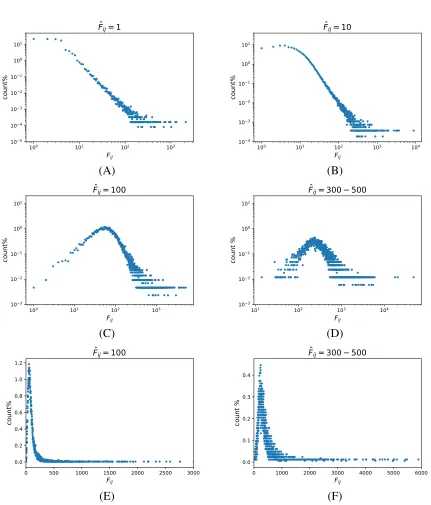
13 The distribution ofFij whenFˆij = 1,10,100 and300−500. (E) and (F) are another versions of (C) and (D) without loglog plot. The data set is Wiki-100. . . 40
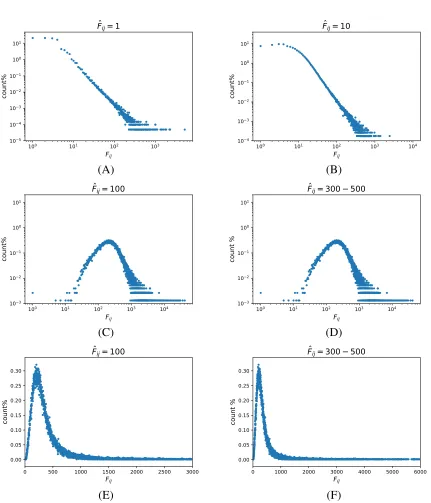
14 The distribution ofFij whenFˆij = 1,10,100 and300−500. (E) and (F) are another versions of (C) and (D) without loglog plot. The data set is Wiki-500. . . 41
15 The distribution ofFij whenFˆij = 1,10,100 and300−500. (E) and (F) are another versions of (C) and (D) without loglog plot. The data set is Wiki-1000. . . 42
18 Mean ofrasFij increases on different data sets. . . 47
19 Mean of different MIs whenFij = 1−500. . . 50
20 The influence of different shifting values in SPPMI on Wiki-100. . . 66
21 The influence of different shifting values in SPPMI on Wiki-1000. . . 66
22 The influence of different shifting values in SPPMI on Reuters. . . 67
23 The word similarity results on different corpus. . . 71
24 The word similarity results on different corpus.Min-count=5 . . . 72
25 The average number of non-zero elements in the word vector as the word frequency increases . . . 75
26 Word pairs with SPPMI and DMI representations in 2D plot. The dimen-sion is reduced by PCA, the dataset is Wiki-1000 . . . 87
Introduction
Semantic relations between words is crucial for information retrieval and natural language
processing problems, such as entity extraction [31], word similarity and analogy [18, 13].
Word co-occurrence has been widely used for extracting word semantics and
representa-tions.
The most simple word distributional representation is the co-occurrence raw count
ma-trix in HAL [16]. Each row in the co-occurrence mama-trix is used to represent a word
vec-tor. COALS [25] improves HAL model by ignoring the left-right distinction in word pair
collection, replacing the raw co-occurrence count with Pearson’s Correlation coefficient
between two words. More importantly, it removes negative values in the matrix. It
outper-forms HAL on word similarity tasks and word classification tasks. More generally, more
measures of word association can be applied in the matrix, each cell of which is the word
association between two words.
The first influential research on word association norms [21] is based on empirical
estimates. This study measured 200 words by asking subjects from grade school to
col-lege to write down a word after one word is given. As more computational resources are
available, we can analyse the word relationships on large corpora, and more measures are
proposed to represent word associations, such as Pointwise Mutual Information (PMI) [6],
log-likelihood ratio [8] andχ2 measure [11].
Recent neural network approaches to word representation learning, such as Word2Vec,
are all based on word co-occurrences within a text window [19]. Those approaches are also
tied to more traditional measurement of co-occurrence, e.g., using pointwise mutual
0 50 100 150 200 250 300
̂F
ij 1.0
1.5 2.0 2.5 3.0 3.5 4.0 4.5
σr
variancêof̂r
FIGURE 1: The variance ofras theFˆij increases.
PMI matrix, of which each cell is the PMI of the corresponding word pair shifted by a
con-stant, typicallylog 5. Moreover, they found that, if all the negative values are nullified, the
word representations generated from shifted positive PMI(SPPMI) matrix can also achieve
great performance on different tasks.
PMI measures the logarithm of the ratio r between the co-occurrence count and the
expected count, assuming that two wordsi andj are independent. P M I(i, j) = logr =
logFij/Fˆij. If the co-occurrence count is larger than expected, the ratior will be larger
than 1, thus its P M I(i, j) > 0. This means that wordsi andj co-occur more often than
randomness, and they are associated positively. Although P M I(i, j) > 0indicates that
x and y associate positively, [6] observed that ”genuine“ association requiresI(i, j) 0.
P M I(i, j)(the logarithm in this work is based on 2 ) should be greater than 3 by manually
inspecting word pairs and MI values. Associations with MI value less than 3 are found to
be generally not interesting. [14] shows a similar value (P M I = log25 = 2.3), they shift
all the ratios by 5.
SPPMI nullifies unreliable values, i.e., the values less than log 5 or ratios less than 5,
in a PMI matrix. Intuitively, the ratio is unreliable for rare words. However, for popular
words, i.e., whenfi andfj are large, the ratio becomes more reliable. More formally, the
variance of the ratio changes over the frequency of the words, which is shown in Figure 1.
ratio.
This paper proposes Dynamic Mutual Information (DMI), where the PMI of each word
is dynamically shifted according to the variance of ratior. We show that DMI outperforms
SPPMI on different word similarity test sets, and an improved Steiger’s test [24] is used to
compute how significant the improvements of our DMI against are SPPMI, and most of the
Review of The Literature
This chapter reviews related research works about word co-occurrences and different word
representation models.
2.1
Different Co-occurrences
Lexical co-occurrence is widely used to construct semantic spaces. Almost all the word
representation models are based on word co-occurrences, and they belongs to two main
categories: one is the distributional model and the other is the neural network based model.
The distributional models [16, 25, 14] are derived from the co-occurrence matrix, and the
popular neural network based models also utilize the information of word co-occurrences.
There are different word co-occurrences that are commonly used. The first and simplest
is to use a window of lengthkthat moves across the corpus: every two words in this window
is considered one co-occurrence count. Another version of this window is that, for every
word in the corpus, its neighbor word will receive a weighted count of k −1 if they are adjacent,k−2if it is 2 words from the word, and so forth. In Section 3.1, we will discuss how different windows capture the co-occurrence between two words, and prove that these
windows are roughly the same. There are also some variations of this kind of window, but
they are all based on the same idea that closer words have higher co-occurrence weights.
In distributional models, these word co-occurrences can form a co-occurrence matrix,
of which each row and each column represents one word in the vocabulary and each
el-ement is the co-occurrence count of two corresponding words. However, it is impossible
co-occurrence matrix is extremely sparse. [29] proposed Neural Latent Relational Analysis
(NLRA) to relieve the sparseness problem, and can obtain the embeddings of word pairs
that do not co-occur in the corpus.
Apart from word pair co-occurrences, k-way word co-occurrences [4], which is
gen-erated from random walk are also used. Associated words do not always occur as pairs
in the sentences, in natural languages multiple words can be related and co-occurring in
the context. By splitting the sentences into word pairs, we lose some information. For
example, in the sentenceThe University of South California is located in Los Angeles, we
can have one three-way co-occurrence (University, South, California), if it is split into 3
word pairs(University,South),(South, California)and(South, University), the information
is incomplete.
Moreover, [33] introduced ngram statistics to explore more information in the source
text. They use “ngram-ngram” type of co-occurrences instead of “word-word”. To solve
the problems brought by ngrams, new methods are proposed to build the co-occurrence
matrix more efficiently.
2.2
Distributional Models
The most explicit model is Hyperspace Analogue to Language(HAL) [16], which uses
word co-occurrence count directly as the word vector. Word co-occurrences are recorded
by moving a window over the corpus in one word increment, and for each word pair within
a window, their co-occurring counts are weighted inversely proportional to the number of
other words separating them. Also, the word pair is direction sensitive, which means word
pairs(x, y)and(y, x)are different. In this way, the co-occurrence matrix is not symmetric
and the representation of theith word is the concatenation of theith column and theith row.
In the end, they use the Minkowski family of distance metrics to measure the similarity of
different words. HAL gives a simple way of finding the word representations and yields
good results. However, it suffers from the extremely high frequency of popular words or
stop words, because they use raw counts directly.
..
.
0
1
0
0 money
..
.
Σ
Σ
..
.
..
.
bank 0
0
1
0
w1
w2
w3
wn
H1
Hm
c1
c2
c3
cn Input Layer
One-hot Vector
Hidden Layer Linear Neurons
Ouput Layer Softmax Classifier
Label
W C
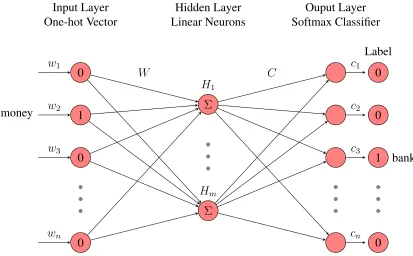
FIGURE 2: The architecture of Word2vec Skip-Gram model, and the current word pair is
(money, bank).
solved the problems caused by raw counts. Besides, it used a similar window, but ignores
the left-right distinction between word pairs. Another improvement is discarding the
nega-tive values, which greatly boosts the performance of word vectors. In the end, each row of
the matrix is the representation of the corresponding word, and COALS measures the word
similarity with correlations.
In practice, the co-occurrence count in the matrix can be replaced with different
mea-sures of word association, such as Pointwise Mutual Information (PMI) [6], log-likelihood
ratio [8] andχ2 measure [11].
2.3
Neural Network Models
Neural network based models are becoming popular in discovering word semantic
rela-tions. They use neural network’s internal word vectors to represent the word [3, 7], and the
most popular models are Word2vec [19, 18] and GloVe [22]. These models are also using
word co-occurrence information to create word embedding.
and several context wordscj which are within k tokens to each side of the center word. As
the window moves, each word can be a center word or context word and the actual window
size will be shrunk by a random integer r (0≤r≤k−1). Thus, the closer a context word is to the center word, the higher probability the context word can be considered as a word
pair with the center word. Note that the window is the same as that used in COALS.
Simi-larly, GloVe also gives higher weights to the closer context word, but a different weighting
scheme is applied, less weights are given to the farther context word than that in word2vec
window.
Figure 2 shows the simple architecture of Word2vec Skip-Gram model. The input layer
is the one-hot vector of the center word “money”, which means the element in “bank”
position is 1 and all the other elements are 0s. The hidden layer consists of m linear
neurons andmis the dimension of word embeddings. In the output layer, it uses softmax
classifier to predict the probability of each word being its context, and its ground truth is
“bank” in this case. Moreover, Word2vec uses stochastic gradient descent to minimize the
loss function. In the end, the input vectorsW are used as word representations and output
vectorsCare the context vector. It is reported that the word vectors from Word2vec have
a more promising performance than any other neural network models. Glove is similar to
Word2vec, but it takes the global word statistics into account.
Compared with distributional models, neural network based models project the word
representations into a very low dimension, usually a few hundred, but the dimension is
much higher in distributional models: it is the size of the vocabulary. The low-dimensional
dense vectors have its advantages in improving the computational efficiency over
distribu-tional models. However, the neural network based models have several hyper parameters
and it suffers from parameter tuning. The parameters have to be changed for different
corpus, and this process is time-consuming.
2.4
Matrix Factorization and Neural Network Models
[14] related the neural network models with the traditional distributional models. They
a shifted Pointwise Mutual Information (PMI) matrix, of which each cell is the PMI
val-ue between two words shifted by a constant. Furthermore, in order to take the advantage
of dense low-dimensional word vectors, [15] proposed to use Singular Value
Decompo-sition(SVD) to find the optimal rankd factorization of the shifted PMI matrix to get the
low-dimensional word representations, and gave some suggestions on tuning the hyper
parameters in generating word embeddings. [28] discussed further about all kinds of
pa-rameters in the matrix factorization, and introduced canonical correlation analysis (CCA)
to improve the performance of matrix decompositions. [2] gives a theoretical justification
for PMI based models, as well as hyper parameter choices by proposing a new generative
Co-occurrence
There are several different methods to calculate the co-occurrences of word pairs [16, 25,
18, 22]. Usually, a window is introduced, and the co-occurrences of every word pair within
one window are recorded. As the window moves across the corpus by one token, a
co-occurrence matrix is formed to record the co-co-occurrence values of every two words in the
corpus. Each column and each row of the matrix represents a unique word in the corpus,
and the value of each cell is the co-occurrence count between two corresponding words.
More formally, suppose that the vocabulary (the set of distinct words) isV ={w1, w2, . . . , w|V|},
and the size of the co-occurrence matrix is|V| × |V|. Given a corpus that consists of a se-quence of words wx1, wx2, . . . , wxn, where xi ∈ {1,2, . . . ,|V|} and n is the number of
tokens in the corpus . Let k be the window size. The notations we are going to use are
listed in Table 1, and we will talk about three popular window styles in collecting word
pairs.
Corpus n Corpus length, i.e., # words in the corpus
V Vocabulary size, # unique words in the corpus
fi Frequency of wordiin corpus
k Window size
N # pairs sampled. N = (n−k)k(k−1)≈nk(k−1)
Pairs Fi # word pairs whose first word is wordwi. Fi =fik(k−1).
Fj # word pairs whose second word is wordwj. Fj =fjk(k−1).
Fij Cooccurrence of word pair(wi, wj)in sampled word pairs
ˆ
Fij Estimated cooccurrence count of wordiandj if they are independent.
ˆ
Fij = FiFj
n =
fifj
n k(k−1).
how much wood would a woodchuck chuck, if a woodchuck could chuck wood? as much wood as a woodchuck would,if a woodchuck could chuck wood.
TABLE 2: A simple text corpus
...wi−5wi−4wi−3wi−2wi−1wiwi+1wi+2wi+3wi+4wi+5...
...wi−5wi−4wi−3wi−2wi−1wiwi+1wi+2wi+3wi+4wi+5...
...wi−5wi−4wi−3wi−2wi−1wiwi+1wi+2wi+3wi+4wi+5...
...wi−5wi−4wi−3wi−2wi−1wiwi+1wi+2wi+3wi+4wi+5...
...wi−5wi−4wi−3wi−2wi−1wiwi+1wi+2wi+3wi+4wi+5...
...wi−5wi−4wi−3wi−2wi−1wiwi+1wi+2wi+3wi+4wi+5...
(A): Basic Window
...wi−5wi−4wi−3wi−2wi−1wiwi+1wi+2wi+3wi+4wi+5...
1 5
2 5
3 5
4 5
5 5
1 5 2 5 3 5 4 5 5 5
(B): Word2vec Window
...wi−5wi−4wi−3wi−2wi−1wiwi+1wi+2wi+3wi+4wi+5...
1 2 3 4 5 5 4 3 2 1
(C): Weighted Window.
FIGURE 3: Three kinds of co-occurrences. The window size is 6.
3.1
Window Sytles
In this section, we will introduce three most common window styles, and compare the
differences between them by analysing their word pair distributions. In order to make each
method easier to understand, we will give a sample co-occurrence matrix for each window
style using a short text in Table 2.
3.1.1
Basic Window
The basic window is the most straightforward way of collecting word pairs. We move
considered as one co-occurrence. As the window moves, a co-occurrence matrix is formed.
Even though it ignores the order and position of words, adjacent words have a higher
weight than words lying farther apart. Figure 3(A) shows that, with a window of size 6,
adjacent words(wi−1, wi)has five co-occurrences when the window slides by, while words
four positions apart like(wi−4, wi)has only two co-occurrence.
Some steps of collecting word pairs are shown in 3, and the final co-occurrence matrix is
shown in Table 4. Since we ignore the left-right distinction of word pairs, the co-occurrence
matrix is symmetric, for example, the co-occurrence count of wi andwj is Fij = 5, thus
the value ofith row andj th column is 5, so is the value ofj th row andith column, and
Fji = 5.
For the word pair (a, chuck), they first co-occur in the window(size 6)...much wood
would a woodchuck chuck ..., when the window moves, the following three windows also
contain this pair, so the count increases to 4. Then 3 windows also contain this pair starting
at ...chuck, if a woodchuck could chuck wood..., next, the pair also appears in another 3
windows starting at...would, if a woodchuck could chuck wood.... In total,F(a, chuck) =
4 + 3 + 3 = 10.
Let the corpus length be n, and there are totaln−kwindows if there are no sentence breaks in the corpus, i.e., the sliding window does not restart for each sentence. Since
n k, the total number of windows is approximaten. Within each window, there are k2 word pairs collected, and because Fij = Fij, we have 22k
more co-occurrence count on
the co-occurrence matrix.
3.1.2
Word2vec Window
Word2vec window is a very popular window style in neural network based models. The
length of the window varies as it moves over the sentence. In a dynamic window with size
Current Window Pairs Count
how much wood would a woodchuck (how much) +1
(how wood) +1
(how would) +1
(how a) +1
(how woodchuck) +1
(much wood) +1
(much would) +1
8 more pairs...
much wood would a woodchuck chuck (much wood) +1
(much would) +1
(much a) +1
(much woodchuck) +1
(much chuck) +1
(wood would) +1
(wood a) +1
8 more pairs...
... ... ...
TABLE 3: Steps of collecting word pairs using basic windows
a as chuck could how if much wood woodchuck would
a 8 9 14 8 1 16 5 12 28 13
as 9 6 5 3 0 2 9 16 7 3
chuck 14 5 2 12 0 9 4 14 16 4
could 8 3 12 0 0 6 2 9 12 2
how 1 0 0 0 0 0 1 1 1 1
if 16 2 9 6 0 0 0 4 16 7
much 5 9 4 2 1 0 0 11 5 3
wood 12 16 14 9 1 4 11 6 12 5
woodchuck 28 7 16 12 1 16 5 12 8 12
would 13 3 4 2 1 7 3 5 12 0
Center Word
Dynamic Length
Context Word
Word Pair Count
how 3 much (how much) +1
wood (how wood) +1
would (how would) +1
much 5 how (much how) +1
wood (much wood) +1
would (much would) +1
a (much a) +1
woodchuck (much woodchuck) +1
chuck (much chuck) +1
... ... ... ... ...
TABLE 5: Steps of collecting word pairs using Word2vec window
the context word is kk−−d1, which can be illustrated in Figure 3 (B). After collecting the pairs
in the current window, the window moves forward by one token, so does the center word.
For example, the center word in Figure 3 (B) iswi and the center word of the next window
will bewi+1.
Some word collecting steps in Word2vec window are shown in Table 5, and the final
co-occurrence matrix is shown in Table 6. The matrix is supposed to be symmetric because
as the window moves, the current center word can be the context word of the next several
center words, but the matrix is not symmetric due to the dynamically changed window size.
Similar to the basic window style, there are approximate n windows, and within each
window, we collectkco-occurrence count on average due to the probability, which means if
we run Word2vec window(k−1)times, we will collect the same number of co-occurrence counts as that in basic window.
Word2vec window gives a higher probability to the closer words, and it works fine for
the neural network based methods, because the neural network models usually have more
than one iteration(epoch), and the corpus will be scanned several times. In this way, even
the distant word pairs with lower probabilities can be sampled in one of these iterations.
However, such windows were also applied in some count-based models [15], where the
corpus is scanned only once, and if we use dynamic window on a small corpus to count the
word pairs, the relations between distant word pairs will be lost, which leads to degraded
a as chuck could how if much wood woodchuck would
a 2 2 1 0 1 4 2 3 5 2
as 1 1 1 0 0 0 2 3 1 1
chuck 3 1 0 3 0 2 0 3 4 2
could 2 1 3 0 0 2 1 2 2 0
how 0 0 0 0 0 0 1 1 0 1
if 3 1 2 1 0 0 0 2 2 1
much 2 2 2 1 1 0 0 3 3 2
wood 2 3 4 3 1 2 3 2 3 2
woodchuck 5 0 3 2 0 3 1 2 2 3
would 3 1 1 1 0 1 2 2 3 0
TABLE 6: The co-occurrence matrix using word2vec window
3.1.3
Weighted Window
Another window style is widely used in distributional models [16, 25], and here we call
it weighted window. It used a length k window, and for every word wi in the corpus, its
neighbor word will receive a weighted count ofk−1if they are adjacent,k−2if it is 2 words fromwi, and so forth. The window and the weighting schemes are shown in Figure
3(C). We can see that the weighted window is another version of Word2vec window, and it
replaces the probabilities with the real count to avoid the uncertainty. Whenk = 6, if we
run the Word2vec window 5 times, it should be equal to the weighted window.
Some steps of collecting word pairs are shown in Table 7. After all the pairs are
col-lected, the co-occurrence matrix is in Table 8, where each row represents the center words
and the columns are the context words. Note that, the matrix is symmetric.
3.1.4
Relationship Between Different Window Styles
From the section 3.1.2 and 3.1.3, we can see that the Word2vec window and weighted
window are the same if we run Word2vec windowk−1times. So what is the relationship between basic window and weighted window? Intuitively, we should compare the
co-occurrence matrix between these two windows, and the matrices are shown in Table ??
and Table 8 respectively. Their co-occurrence matrices for the small sample corpus are
similar to each other, and it is likely that when the corpus grows larger, their co-occurrence
Center Word
Context Word
Word Pair Count
how much (how much) +5
wood (how wood) +4
would (how would) +3
a (how a) +2
woodchuck (how woodchuck) +1
much how (much how) +5
wood (much wood) +5
would (much would) +4
a (much a) +3
woodchuck (much woodchuck) +2
chuck (much chuck) +1
...
TABLE 7: Steps of collecting word pairs using weighted window
a as chuck could how if much wood woodchuck would
a 8 9 14 8 2 16 6 13 28 14
as 9 6 5 3 0 2 9 16 7 3
chuck 14 5 2 12 0 9 4 14 16 4
could 8 3 12 0 0 6 2 9 12 2
how 2 0 0 0 0 0 5 4 1 3
if 16 2 9 6 0 0 0 4 16 7
much 6 9 4 2 5 0 0 14 5 5
wood 13 16 14 9 4 4 14 6 12 7
woodchuck 28 7 16 12 1 16 5 12 8 12
would 14 3 4 2 3 7 5 7 12 0
First of all, there will be approximaten windows in both basic window and weighted
window styles, and within each window, they will both collectk(k−1)word co-occurrence counts in the matrix, which means the total co-occurrence counts on both the matrices are
the same.
Then for the word pair (wi, wi+d), where d(−k < d < k) is an integer indicating the distance between two words in a window, the co-occurrence count of(wi, wi+d)in both
basic window and weighted window isk−d. For example, ifd= 1, in basic windows, there will bek−1consecutive windows passing by containing the word pairs, and in weighted windows, the weight given the word pair is also k−1. In conclusion, the co-occurrence matrices for the basic window, the weighted window and Word2vec window(repeatedk−1
times) are the same.
We use a small dataset Wiki-100 to demonstrate our points. Wiki-100 contains
para-graphs randomly selected from English Wikipedia(July 2017 dump). All the “\n” or “\r” are removed from the text to meet our assumption. The small corpus contains 18,939,641
tokens in total, after removing the stop words(used in Lucene), there are 12,828,356 tokens
left.
Figure 4 shows the distribution of word pair co-occurrences(Fij) on three different data
sets, and k = 6. In Figure 4(A) (C) (E), x-axis is the word pair co-occurrence Fij, and
y-axis is the frequency ofFij. The subplot 4(B) (D) (F) shows the rank ofFij, all theFijs
are ranked from the largest to the smallest, the largest Fij ranked first and when there are
several same Fijs, they have different ranks. In the left three plots, we can see that the
co-occurrence distributions of the basic window, the weighted window and the Word2vec
window repeated 5 times are roughly the same, and the distribution of Word2vec window
run only one time is so different from all the others. Similar observations can be found in
the right three plots.
In all the windows except for word2vec window(run one time), when Fij = 1 ∼ 5,
the frequencies of co-occurrence are similar to each other, that can be explained by the
window. Suppose we have a sequence of text containing n distinct words, which means
there are no words repeated in the corpus, if we use, for example, weighted window to
100 101 102 103 104 105 106 Fij 10−6 10−5 10−4 10−3 10−2 10−1 100 101 102 fr eq % =-2.0x+2.2 weighted window word2vec window word2vec window 5 times basic window
100 101 102 103 104 105 106 107 108
rank 100 101 102 103 104 105 106 Fij weighted window word2vec window word2vec window 5 times basic window y=-0.8x+6
(A): Frequency ofFij, Wiki-100. (B): Rank ofFij, Wiki-100.
100 101 102 103 104 105 106 107
Fij 10−6 10−5 10−4 10−3 10−2 10−1 100 101 102 fr eq % y=-2.0x+2.2 weighted window
word2vec window word2vec window 5 times basic window
100 101 102 103 104 105 106 107 108
rank 100 101 102 103 104 105 106 107 Fij weighted window word2vec window word2vec window 5 times basic window y=-0.9x+7
(C): Frequency ofFij, Wiki-500. (D): Rank ofFij, Wiki-500.
100 101 102 103 104 105 106 107
Fij 10−6 10−5 10−4 10−3 10−2 10−1 100 101 102 fr eq % y=-2.0x+2.2 weighted window
word2vec window word2vec window 5 times basic window
100 101 102 103 104 105 106 107 108
rank 100 101 102 103 104 105 106 107 Fij weighted window word2vec window word2vec window 5 times basic window y=-0.9x+7
(E): Frequency ofFij, wiki-1000. (F): Rank ofFij, Wiki-1000.
100 101 102 103 104 105 Fij 10−6 10−5 10−4 10−3 10−2 10−1 100 101 102 fr eq % =-2.2x+2.4 weighted window word2vec window word2vec window 5 times basic window
100 101 102 103 104 105 106 107 108
rank 100 101 102 103 104 105 106 Fij weighted window word2vec window word2vec window 5 times basic window y=-0.7x+6
(A): Frequency ofFij, Wiki-100. (B): Rank ofFij, Wiki-100.
100 101 102 103 104 105
Fij 10−6 10−5 10−4 10−3 10−2 10−1 100 101 102 fr eq % =-2.0x+2.2 weighted window word2vec window word2vec window 5 times basic window
100 101 102 103 104 105 106 107 108
rank 100 101 102 103 104 105 106 Fij weighted window word2vec window word2vec window 5 times basic window y=-0.7x+6
(C): Frequency ofFij, Wiki-500. (D): Rank ofFij, Wiki-500.
100 101 102 103 104 105 106
Fij 10−6 10−5 10−4 10−3 10−2 10−1 100 101 102 fr eq % =-2.0x+2.2 weighted window word2vec window word2vec window 5 times basic window
100 101 102 103 104 105 106 107 108
rank 100 101 102 103 104 105 106 Fij weighted window word2vec window word2vec window 5 times basic window y=-0.7x+6
(E): Frequency ofFij, wiki-1000. (F): Rank ofFij, Wiki-1000.
k −1, and the frequencies of different Fij should be the same. In our experiment, many word frequencies are larger than 1. Thus there areFijs larger than 5. However, in natural
languages, according to Zipf’s law, most words are irrelevant, and the chances of them
co-occurring more than 5 are extremely low, only the small portion of highly associated word
pairs can have Fij larger than 5. Thus, the shape of the line when Fij = 1 ∼ 5 can be explained.
Table 9, 10 and 11 show the detailed frequencies of word co-occurrence on different
datasets. With the basic window, weighted window and the Word2vec window repeated
5 times, we collect 384,850,570, 384,850,610 and 384,848,534 word occurrences
respec-tively, which is roughly k(k −1) = 30times of the length of the corpus and 5 times as that in Word2vec window. The distribution ofFij in weighted window and basic window
is the same in general, and the Word2vec window repeated 5 times is not exactly the same
but similar to them because of the probabilities. Moreover, the basic window and weighted
window collect the same number of unique pairs.
In basic windows, most of the pairs occur 1 to 5 times, taking up to 79.9% among all the
collected word pairs, and only 20.1% word pairs occur more than 6 times. It means there
are approximately 80% irrelevant word pairs. In other words, those pairs co-occurring less
than 5 times in weighted windows are mostly irrelative pairs.
In word2vec windows, 76,961,221 pairs are collected in total, and there are 34,666,638
unique pairs. What is the most different thing from the other two window styles is that
around 76.1% pairs only co-occur once. Unlike the other two window styles, if two
con-secutive words only co-occur in a window once, their co-occurrence would be 1, or if two
words co-occur in a window a couple of times, but they are separated by some words, their
co-occurrence can still be one or zero because the length of the window is dynamically
changed. For example, wordwi−4 and word wi are separated by 3 words, when the center
word iswi the length if the current window can be 2, then the co-occurrence ofwi−4 and
wi is 0. In word2vec window, most irrelevant pairs will co-occur once. However, when
we repeat the word2vec window 5 times on the same corpus, the total number of pairs is 5
times of that in word2vec window and we collect more unique pairs, but not as many as in
Fij Word2vec-5 Word2vec Weighted Basic
Count % Count % Count % Count %
#pairs 384,848,534 76,961,211 384,850,610 384,850,570
#unique pairs 49,191,978 34,666,638 52,815,864 52,815,864
1 6,579,534 13.4 26,384,294 76.1 8,614,908 16.3 8,620,542 16.3
2 7,333,837 14.9 4,011,748 11.6 8,722,926 16.5 8,723,964 16.5
3 7,357,958 15.0 1,444,174 4.2 8,713,212 16.4 8,720,802 16.5
4 6,765,531 13.8 743,057 2.1 8,563,100 16.2 8,564,841 16.2
5 10,687,163 21.7 448,149 1.3 7,585,648 14.4 7,589,946 14.4
6 1,277,879 2.6 298,833 0.86 1,505,118 2.8 1,499,370 2.8
7 1,200,338 2.4 212,008 0.61 1,289,290 2.4 1,290,643 2.4
8 1,089,929 2.2 158,127 0.46 1,162,499 2.2 1,155,473 2.2
9 907,100 1.8 122,190 0.35 893,452 1.7 894,365 1.7
10 1,031,031 2.1 97,508 0.28 830,810 1.6 827,584 1.6
11 437,238 0.89 78,589 0.23 457,858 0.87 458,518 0.87
12 397,499 0.81 65,912 0.19 416,664 0.79 415,469 0.79
13 354,053 0.72 55,026 0.16 344,134 0.65 344,641 0.65
14 305,198 0.62 47,033 0.13 304,169 0.57 303,344 0.57
15 322,515 0.66 40,239 0.12 289,154 0.55 289,590 0.55
16 209,521 0.43 34,949 0.10 219,709 0.41 218,739 0.41
17 191,863 0.39 30,394 0.088 187,698 0.36 188,020 0.36
18 172,076 0.35 26,975 0.078 171,501 0.32 170,886 0.32
19 153,665 0.31 23,705 0.068 150,610 0.29 150,879 0.29
20 158,054 0.32 21,033 0.061 150,290 0.28 149,460 0.28
Fij Word2vec-5 Word2vec Weighted Basic
Count % Count % Count % Count %
#pairs 1,913,934,197 382,802,641 1,914,005,300 1,914,005,260
#unique pairs 164,700,978 117,626,027 176,429,876 176,429,876
1 21268854 12.9 84287775 71.7 27892424 15.8 27,906,332 15.8
2 23684984 14.4 14487468 12.3 28152484 16.0 28,155,136 16.0
3 23636736 14.4 5619888 4.8 27896948 15.8 27,915,854 15.8
4 21684144 13.2 3052189 2.6 27185962 15.4 27,191,947 15.4
5 33174939 20.1 1909129 1.6 23514786 13.3 23,525,899 13.3
6 4549812 2.8 1314720 1.1 5338138 3.0 5,324,328 3.0
7 4287086 2.6 960984 0.8 4568502 2.6 4,572,185 2.6
8 3908159 2.4 734233 0.6 4178551 2.4 4,160,033 2.4
9 3283245 2.0 579771 0.5 3231618 1.8 3,234,217 1.8
10 3656721 2.2 467884 0.4 2999387 1.7 2,991,075 1.7
11 1676934 1.0 386903 0.3 1749500 1.0 1,751,323 1.0
12 1533016 0.9 324428 0.3 1596962 0.9 1,593,749 0.9
13 1373102 0.8 277345 0.2 1343182 0.8 1,344,506 0.8
14 1195105 0.7 238483 0.2 1184341 0.7 1,182,054 0.7
15 1236938 0.8 206919 0.2 1125236 0.6 1,126,375 0.6
16 847375 0.5 181804 0.2 882771 0.5 879,835 0.5
17 776434 0.5 160560 0.1 764742 0.4 765,597 0.4
18 705686 0.4 142994 0.1 703199 0.4 701,440 0.4
19 633445 0.4 128521 0.1 619458 0.4 620,185 0.4
20 644154 0.4 115498 0.1 617535 0.4 615,484 0.3
Fij Word2vec-5 Word2vec Weighted Basic
Count % Count % Count % Count %
#pairs 3,843,280,467 768,625,759 3,843,332,150 3,843,332,110
#unique pairs 272,588,032 195,555,046 291,800,831 291,800,831
1 34795644 12.8 136823084 70.0 45694370 15.7 45714556 15.7
2 38658403 14.2 24533724 12.5 45984696 15.8 45988192 15.8
3 38507472 14.1 9728170 5.0 45366684 15.5 45394235 15.6
4 35254143 12.9 5365872 2.7 44017908 15.1 44028515 15.1
5 53234219 19.5 3400208 1.7 37698070 12.9 37715357 12.9
6 7666642 2.8 2369222 1.2 8993757 3.1 8973863 3.1
7 7229875 2.7 1743580 0.9 7663400 2.6 7669197 2.6
8 6594292 2.4 1345017 0.7 7066801 2.4 7038696 2.4
9 5562734 2.0 1063819 0.5 5469932 1.9 5473993 1.9
10 6174160 2.3 868215 0.4 5094179 1.7 5081151 1.7
11 2890078 1.1 719325 0.4 3010530 1.0 3013282 1.0
12 2646029 1.0 605803 0.3 2752077 0.9 2747377 0.9
13 2369257 0.9 519019 0.3 2322336 0.8 2324514 0.8
14 2072730 0.8 449801 0.2 2050103 0.7 2046392 0.7
15 2128946 0.8 392697 0.2 1946408 0.7 1948200 0.7
16 1481054 0.5 345995 0.2 1540044 0.5 1535524 0.5
17 1360027 0.5 306726 0.2 1340158 0.5 1341493 0.5
18 1236490 0.5 275517 0.1 1234415 0.4 1231654 0.4
19 1112755 0.4 247714 0.1 1095896 0.4 1097079 0.4
20 1129695 0.4 224069 0.1 1084175 0.4 1081049 0.4
Rank Basic Window Word2vec window Weighted window
Fij pair Fij pair Fij pair
1 69,115 his he 69,480 his he 69,115 his he
2 60,548 s s 60,778 s s 60,548 s s
3 60,062 has been 60,095 has been 60,062 has been
4 59,428 united states 59,433 united states 59,428 united states
5 42,755 new york 42,726 new york 42,755 new york
6 42,683 been have 42,718 been have 42,683 been have
7 40,627 been had 40,633 been had 40,627 been had
8 34,915 u s 34,942 u s 34,915 u s
9 34,684 he also 34,747 he also 34,684 he also
10 34,340 s he 34,385 s he 34,340 s he
11 33,764 his his 33,690 his his 33,764 his his
12 33,371 th century 33,428 th century 33,371 th century
13 31,520 from from 31,476 from from 31,520 from from
TABLE 12: Most frequent word pairs using different windows. The window size is 6. The data set is Wiki-100.
Figure 4(B) (D) (F) shows the ranking ofFij, and the largestFij ranks the first. If there
is a tie, we also give them different rankings. The top 20 largest Fij and most frequent
word pairs are listed in Table 12, 13 and 14. It is shown that the most frequent word pairs
are similar between 3 different methods and for word2vec window repeated 5 times and
weighted window, the most frequent pairs are exactly the same, even the rank.
In the above discussion, we can see that the basic window, weighted window and the
word2vec window(repeated k−1 times) are the same theoretically, and in distributional models, the basic window is a better choice, because it is much simpler and convenient
to analysed statistically. Some distributional models [14, 15] used word2vec windows and
only run it once on the corpus. Thus, some word pair information will be lost and lead to
degraded performance.
3.2
Expected Co-occurrences
The co-occurrence count of words wi and wj is the number of windows that contain
both words wi and wj. Let Fij denote that co-occurrences and Fˆij be the expected
Rank Basic Window Word2vec window Weighted window
Fij pair Fij pair Fij pair
1 345,147 his he 345,317 his he 345,147 his he
2 302,362 s s 301,666 s s 302,362 s s
3 297,837 has been 297,780 has been 297,837 has been
4 289,911 united states 289,890 united states 289,911 united states
5 215,331 have been 215,314 have been 215,331 have been
6 214,960 new york 214,985 new york 214,960 new york
7 197,783 been had 197,855 been had 197,783 been had
8 175,313 u s 175,413 u s 175,313 u s
9 171,971 he also 171,837 he also 171,971 he also
10 170,510 his his 170,519 his his 170,510 his his
11 168,960 th century 168,944 th century 168,960 th century
12 168,713 s he 168,879 s he 168,713 s he
13 157,422 from from 157,572 from from 157,422 from from
TABLE 13: Most frequent word pairs using different windows. The window size is 6. The data set is Wiki-500.
Rank Basic Window Word2vec window Weighted window
Fij pair Fij pair Fij pair
1 688,261 his he 688,131 his he 688,261 his he
2 608,818 s s 608,645 s s 608,818 s s
3 600,074 has been 599,959 has been 600,074 has been
4 582,584 united states 582,606 united states 582,584 united states
5 435,134 have been 435,295 have been 435,134 have been
6 428,427 new york 428,548 new york 428,427 new york
7 402,518 been had 402,517 been had 402,518 been had
8 347,405 u s 347,372 u s 347,405 u s
9 346,707 he also 346,673 he also 346,707 he also
10 340,712 s he 341,014 s he 340,712 s he
11 337,702 th century 337,683 th century 337,702 th century
12 335,264 his his 335,275 his his 335,264 his his
13 313,374 from from 313,391 from from 313,374 from from
co-occurrencesFij? We can answer this question from two perspectives, the first is from
the perspective of windows and another is from pairs. Let fi denote the occurrences of
wordwi in the corpus, and we will talk about the expected co-occurrence from different
perspectives.
3.2.1
From the Perspective of Windows
If we use the basic window, this problem can be modelled as the Capture-Recapture
prob-lem: givennwindows, and the order of words in the window is ignored. We use wordwito
capture (approximately)fikwindows. It is multiplied bykbecause each occurrence in the
corpus will occur inksliding windows. It is an approximation because there are cases for
multiple occurrences of a word in one window. When the word is not a very popular one,
and considering that the window size is small, we can neglect the multiple occurrences for
the sake of simplicity. Next, we usewj to capture windows under the condition that
win-dows containingwi are marked. After the capture, one position in each window is taken
and there are 4 tokens left. Thus, among the rest (k-1) tokens in each window, we can
recapturefj(k−1)windows containingwj. Among those recapturedfj(k−1)windows, there are Fˆij windows containing wi. When words wi and wj are independent, the total
number of windows can be estimated by
n= fik×fj(k−1)
Fij
= fifj ˆ
Fij
k(k−1) (1)
In other words, the expected count is
ˆ
Fij =
fifj
n k(k−1) (2)
3.2.2
From the Perspective of Word Pairs
The expected co-occurrences betweenwi andwj can also be derived from word pairs we
collected. Suppose we have a word pair (X, Y), where X and Y are two random
independent, the expected co-occurrence count for(wi, wj)is
ˆ
Fij =P(X =wi)P(Y =wj)×N (3)
whereP(X =wi)andP(Y =wj)are the chance ofX =wiandY =wj respectively,N
is the total number of co-occurrences.
In the symmetric co-occurrence matrix, the sum of all the cells is the total number of
co-occurrence countsN. Since in each window we collect k(k −1)word co-occurrence counts, and there arenwindows, the total co-occurrences are
N =nk(k−1) (4)
The sum of i th rowFix is the total number of word pairs containing wi. For eachwi
in the basic window, we will collect k−1word pairs containing wi, and there will bek windows passing by the wordwi, thusFixis:
Fix =
|V|
X
j=1
Fij =fik(k−1) (5)
Thus, the chance ofX =wi is
P(X =wi) =
Fx i
N =
fi
n (6)
Similarly, we can have the change ofY =wj
P(Y =wj) =
Fjy
N =
fj
n (7)
where Fjy is the total number of word pairs containing wj, and is also the sum of j th
With Equation 3,6,7, we have the expected co-occurrence ofwi andwj
ˆ
Fij =
fifj
n k(k−1) (8)
In this section, we derive the expected co-occurrence Fˆij from two different
perspec-tives: windows and word pairs. The Equation 2 and 8 shows theFˆij values from different
perspectives, and they are the same. Therefore, we can see the advantage of using basic
windows; it is much easier to understand and calculateFˆij.
3.3
F
ijand
F
ˆ
ijIn this section, we will talk about the mean, variance and rse ofFij whenFˆij is in different
ranges and the mean, variance and rse ofFˆij whenFij is of different values.
3.3.1
Mean, variance and rse of
F
ijWhen theFˆijs of word pairs are in a certain range, theirFijs can be very different: larger or
smaller thanFˆij or even be 0, because whenFij = 0for a word pair, theirFˆij can never be
zero. It means even two words never co-occur in a window; their expected co-occurrence
is still larger than 0. It is impossible to get all the word pair combinations and their Fˆij
andFij, thus we randomly select two words, and the probability of selecting the word is
proportional to its word frequency in the corpus. We select over 7 million random pairs to
analyse the mean, variance and rse ofFij whenFˆij is between 0 and 300, which are shown
in Figure 6, 7 and 8 respectively. The rse ofFij is calculated as:
rse(Fij) =
p
var(Fij)
E(Fij)
(9)
wherevar(Fij)is the variance ofFij andE(Fij)is the mean ofFij.
In Figure 6, we can see that the mean ofFij is roughly equal to its corresponding mean
ofFˆij. Figure 7 shows the variance ofFijincreases as theFˆijgets larger, and that is because
101 102 ̂ Fij 100 101 102 me an ̂of ̂ Fij
mean̂of̂Fij
expected̂mean̂y=x
100 101 102
̂ F 100 101 102 me an ̂of ̂ Fij mean expected̂mean̂y=x
(A): Wiki-100 (B): Wiki-500
100 101 102
̂ Fij 100 101 102 me an of Fij mean expected mean y=x
100 101 102
̂ Fij 100 101 102 me an ̂of ̂ Fij
mean̂of̂Fij
expected̂mean̂y=x
(C): Wiki-1000 (D): Reuters
FIGURE 6: Mean ofFij whenFˆij is between 0 and 300.
depicted in Figure 8. The rse of Fij decreases with the growth ofFˆij, and it means as the
ˆ
Fij increases, theFij is getting more stable. In other words, when the word frequencies are
larger, the estimated co-occurrence is closer to its real value.
3.3.2
Mean, variance and rse of
F
ˆ
ijAs in Section 3.3.1, we will show the mean, variance and rse of Fˆij, which is shown in
Figure 9, 10 and 11 and x-axis is changed toFij.
Figure 9 shows that the mean ofFˆij is slightly smaller thanFij asFij increases. This
can be explained by how we estimate the word co-occurrences. It is easy to have
|V|
X
i=1 |V|
X
j=1
Fij =
|V|
X
i=1 |V|
X
j=1
ˆ
Fij (10)
100 101 102 ̂F ij 101 102 103 104 105 106 107 va ri an ce ̂o f̂ Fij variance
100 101 102
̂F ij 101 102 103 104 105 106 va ri an ce ̂o f̂ Fij variance
(A): Wiki-100 (B): Wiki-500
100 101 102
̂F ij 101 102 103 104 105 106 va ri an ce ̂o f̂ Fij variance
100 101 102
̂F ij 102 103 104 105 106 107 va ri an ce ̂o f̂ Fij variance
(C): Wiki-1000 (D): Reuters
FIGURE 7: Variance ofFij whenFˆij is between 0 and 300.
0 50 100 150 200 250 300
̂F ij 1.0 1.5 2.0 2.5 3.0 3.5 4.0 4.5 rse ̂o f̂ Fij rse
0 50 100 150 200 250 300
̂F ij 2 3 4 5 rse ̂o f̂ Fij rse
(A): Wiki-100 (B): Wiki-500
0 50 100 150 200 250 300
̂F ij 2 3 4 5 6 7 rse ̂o f̂ Fij rse
0 50 100 150 200 250 300
̂F ij 4 6 8 10 12 rse ̂o f̂ Fij rse
(C): Wiki-1000 (D): Reuters
100 101 102
Fij
100
101
102
me
an
of
̂
Fij
y = 0̂7x mean
100 101 102
Fij
100
101
102
me
an
of
̂
Fij
y = 0̂8x mean
(A): Wiki-100 (B): Wiki-500
100 101 102
Fij
100
101
102
me
an
of
̂
Fij
y = 0̂8x mean
100 101 102
Fij
100
101
102
me
an
of
̂
Fij
y ̂ x mean
(C): Wiki-1000 (D): Reuters
FIGURE 9: Mean ofFˆij whenFij is between 0 and 500.
non-zeroFij, the estimation will be smaller than it should be.
The variance of Fˆij is shown in Figure 10, and it increases with the growth of Fij,
because the mean ofFˆij is also getting larger. In the same way, we use rse to remove the
influence of mean, and to see the variance ofFˆij. The rse ofFˆij drops very quickly asFij
increases and becomes stable whenFij is large. It means the estimation is getting closer to
100 101 102 Fij 100 101 102 103 104 105 va ri an ce o f
̂ Fij
y = x^1̂8 variance
100 101 102
Fij 100 101 102 103 104 105 va ri an ce o f
̂ Fij
y = 1̂5x^1̂8 variance
(A): Wiki-100 (B): Wiki-500
100 101 102
Fij 100 101 102 103 104 105 va ri an ce o f
̂ Fij
y = 1̂5x^1̂8 variance
100 101 102
Fij 101 102 103 104 105 106 va ri an ce o f
̂ Fij
y = 12̂x^1.6 variance
(C): Wiki-1000 (D): Reuters
FIGURE 10: Variance ofFˆij whenFij is between 0 and 500.
0 100 200 300 400 500
Fij 0.75 1.00 1.25 1.50 1.75 2.00 2.25 2.50 rse o f
̂ Fij
y = 1.5x^̂0.1 rse
0 100 200 300 400 500
Fij 0.75 1.00 1.25 1.50 1.75 2.00 2.25 2.50 rse o f
̂ Fij
y = 1.5x^̂0.1 rse
(A): Wiki-100 (B): Wiki-500
0 100 200 300 400 500
Fij 0.75 1.00 1.25 1.50 1.75 2.00 2.25 2.50 rse o f
̂ Fij
y = 1.5x^̂0.1 rse
0 100 200 300 400 500
Fij 1.0 1.5 2.0 2.5 3.0 3.5 rse o f
̂ Fij
y = 3.5x^̂0.2 rse
(C): Wiki-1000 (D): Reuters
Pointwise Mutual Information (PMI)
4.1
PMI and
F
ˆ
ijThe Pointwise Mutual Information(PMI) was proposed to measure the word associations
by church1990word, and the PMI is defined as
P M I = log P(X, Y)
P(X)P(Y) (11)
whereP(X, Y)is the joint probability of the variable X andY, P(X)andP(Y)are the
chance ofXandY respectively.
For the PMI of the word pair(wi, wj)can be defined as:
P M Iij = log
P(X =wi, Y =wj)
P(X =wi)P(Y =wj)
(12)
where P(X = wi) and P(Y = wj) are already explained in Section 3.2.2 and P(X =
wi, Y =wj)is the probability ofwiandwj co-occurring, and we have
P(X =wi, Y =wj) =
Fij
N (13)
With Equation 3, we have
P(X =wi)P(Y =wj) =
ˆ
Fij
and with Equation 13 and 14, the PMI can be rewritten as
P M Iij = log
Fij
ˆ
Fij
(15)
= log Fijn
fifjk(k−1)
(16)
The PMI between two words is the (logarithm) ratio of its co-occurrence and expected
co-occurrence. The co-occurrence count in the matrix can be replaced with PMI values
between word pairs, and each row of the PMI matrix can be used as the word vector.
4.2
Shifted Positive PMI (SPPMI)
4.2.1
Shifted PMI
[14] found that the skip-gram model with negative sampling in word2vec is implicitly
fac-torizing a matrix, of which each cell is the shifted PMI (SPMI) of the corresponding word
pair, and the shifted PMI can be defined as
SP M Iij =P M Iij −logs= log
Fij
sFˆij
(17)
wheresis a constant(typically 5).
With all the SPMI value between all the pairs, a SPMI matrix is formed.
In Word2vec, each wordwi is represented by a word vector−→wiand a context vector−→ci. It has been proved that
SP M Iij =−→wi· −→cj (18)
and
SP M I =W ·CT (19)
0 200 400 600 800 1000 1200 1400 1600 0
1 2 3 4 5 6 PMI
SPMI DMI
0 200 400 600 800 1000 1200 1400 1600 0.000
0.005 0.010 0.015 0.020 0.025 0.030
PMI SPMI DMI
(A): the original vectors (B): the normalized vector
FIGURE 12: Vector of word “percent” from PMI, SPMI and DMI matrix.
Word2vec is implicitly factorizing the SPMI matrix to get the word vectors for all the
words, that is matrixW.
4.2.2
SPPMI
We can use each row in the SPMI matrix to represent one word directly without
factoriza-tion, and as [25] and [14] suggested, if all the negative values are removed, great
perfor-mances can also be achieved using this word representations. Then we change SPMI into
SPPMI(Shifted Positive Pointwise Mutual Information).
SP P M Iij =
0, if Fij
b
Fij < s;
logFij b
Fij
−logs, otherwise.
(20)
Usually, sis set to be 5, SPPMI simply removes all the pairs whoseFij is not 5 times
larger than its Fbij, that is nullify the PMIs smaller than log 5 ≈ 1.6. There are similar
observations in [6], they found the word pairs whoseP M I <3(the logarithm is based on
2, andlog25≈2.3) are not interesting. The difference between using SPPMI and directly using PMI can be demonstrated in Figure 12(A), which shows the vector of word “percent”
in SPPMI and PMI matrix. SPPMI(green) shifts all the values of PMI(blue) downwards by
a constant (log 5 = 1.6).
a b c d e f a 1 −2 −1 −3 1 0
b −2 −1 −2 −3 2 1
c −1 −2 0 2 0 1
d −3 −3 2 −1 2 0
e −1 2 0 2 0 1
f 0 1 1 0 1 0
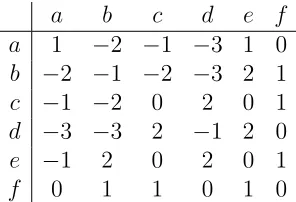
TABLE 15: A samll PMI matrix.
word pairs whose ratio(Fijˆ
Fij)is less than 5. However, the ratioris more unreliable for rare words, for popular words, i.e., whenfi andfj are large, the ratio becomes more reliable,
that is, the variance of the ratio changes over the frequency of word pairs, which is shown
in Figure 1. Therefore,sshould be dynamically changed according to the reliability ofFbij.
4.2.3
Why Positive
[14] suggested, if all the negative values in the matrix are removed, the performance of
word vectors on the word similarity tasks will be improved. Why do the negative relations
degrade the performance?
It is because the negative relations are not transitive. Suppose Table 15 is a very small
PMI matrix, and we have the word vectors fora and b. We can see from the matrix that
aand bhave negative relations, and they both have negative relations with cand d. If we
do not remove the negative values in the matrix, the cosine similarity of the worda andb
is positive, which disagrees with the fact that aand b are negatively related. It is mainly
due to the negative values. The third element and the fourth element in both vectors are
negative, if they are multiplied, it would be a large positive value, and the cosine similarity
is a positive value.
Here comes the question: if a is irrelevant to candb is also irrelevant to c, does that
meanaandb are similar? Obviously not. In natural languages, most words are irrelevant
to each other, for example, the words “tiger”, “car” and “next”, the first two words are
both irrelevant to the third word, but they are not related neither. Of course, there are cases
words are all irrelevant to each other are more common.
It means the negative relations are not transitive, but positive relations are. To remove
the influences of the negative relations, nullifying the negative values is necessary.
4.3
Singular Value Decomposition (SVD)
Though high dimensional word vectors work well, it is always better to have vectors with
lower dimension, because it is faster and easier to generalize. A common way to factorize
the SPMI matrix is to do the Singular Value Decomposition(SVD) [12], which finds the
optimal rankdfactorization according toL2loss.
SVD factorize the m×n matrixM into the product of three matricesUΣVT, where
U andV are unitary matrices, and their shapes arem×mandn×nrespectively. Σis an
m×n diagonal matrix of eigenvalues in decreasing order. To reduce the dimension and keep most information at the same time, we only keep the topd elements in Σ, thus we
have
Md =UdΣdVdT (21)
If we use SVD to factorize the SPMI matrix,Ud·Σdcan be replaced withW, whereW is the word vector matrix, and useVdto represent context vector matrixC, we have
W =UdΣd (22)
C =VdT (23)
Each row ofW represent the word vector, and the dimension of the vector isd. Each row
ofC is the context vector for each word and the dimension is alsod.
the quality of word vectors will be better. In this way, we use
W =UdΣαd (24)
C = Σ(1d−α)VdT (25)
whereαis usually set to 0.5.
The performance of word vectors from matrix factorization should be similar to that
from Word2vec theoretically, but in our experiment, the SVD vector dose not have much
advantage over Word2vec, and it is not scalable. When the corpus is very large, it is
time-consuming to perform SVD on the co-occurrence matrix, though the matrix is a sparse
Dynamic Mutual Information (DMI)
To improve the SPPMI, we propose Dynamic Mutual Information, which dynamically
shifts the PMI values according to the variance of ratios, and preserves only the reliable
values. Let r = Fijˆ
Fij, andσ 2
r be the variance ofr, the estimation forr is useful only when
its varianceσis within certain range. Applying Chebyshev’s Inequality, we have
P(|r−rˆ| ≥cσ)≤ 1
c2. (26)
This means the probability that the value ofrfalls outside the interval(ˆr−cσ,rˆ+cσ)does not exceed c12. For example, ifc=
√
2, the probability ofr≤rˆ−√2σorr≥rˆ+√2σis less than 12. Also, therˆ= 1, because theFij is expected to be equal toFˆij.
Hence, we derive DMI as follows:
DM Iij =
0, if Fij
b
Fij <
√
2σr+ 1;
logFij b
Fij
−log(√2σr+ 1), otherwise.
(27)
In our DMI, we preserve all the PMIs larger than√2σr+ 1. In the following sections, we will talk about how to get the variance ofr.
5.1
Variance of
r
The variance ofris:
σr2 =var Fij
c
Fij
!
= var(Fij)
E(Fbij)2
Letσ2
F be the variance ofFij, we can have
σr =
σF
E(Fbij)
(29)
If we can get the value of σF, then we can calculate σr. However, the distribution of
Fij is pretty complicated, which is shown in Figure 13. The distribution ofFij is similar
to power law distribution whenFˆij is small in a log-log plot, but whenFˆij gets larger, the
distribution ofFij is more like log-normal distribution. It is very difficult to calculateσF
norσr.
However, after examining several data sets, we find that the value ofσrcan be roughly
approximated using the functiony = √a
Fij, as shown in Figure 16. Each dot in Figure 16
represents the variance ofrwhenFˆ = 0−300. There are 7 million word pairs are collected for each plot. For two words in a word pair, they are randomly selected from the corpus,
and the probability of each word being sampled is proportional to its word frequency in
the corpus, which means frequent words are more likely to be selected than rare words and
someFijs can be 0. The window size is 5.
5.2
DMI
It is time-consuming to get the plots such as Figure 16 and very difficult to get enough
samples whenFˆij is very large. Thus it is much easier to use an approximated function if
the variance ofrcan be represented by a general function on different datasets.
Our DMI can be rewritten as:
DM I(wi, wj) =
0, if Fij
b
Fij <
√
2a
√
Fij+1;
log
Fij
b
Fij/
√
2a
√
Fij + 1
, otherwise.
(30)
wherea= 6 ∼19for different data sets. In our experiment, whenais around 10, we can see a significant improvement over SPPMI, if not the best.
Intuitively, DMI throws away the co-occurrence ratio r when it is not ’large enough’.