ISSN(Online): 2320-9801
ISSN (Print): 2320-9798
I
nternational
J
ournal of
I
nnovative
R
esearch in
C
omputer
and
C
ommunication
E
ngineering
(An ISO 3297: 2007 Certified Organization)
Vol. 4, Issue 8, August 2016
An Enhanced AODV-Based Algorithm for
Undersized Area MANETs
Mahendra Kumar Verma1, Amit Kumar Mishra2
PG Student, Department of C.S.E, Sri Balaji College of Engineering & Technology, Jaipur, India1 Assistant Professor, Dept. of C.S.E, Sri Balaji College of Engineering & Technology, Jaipur, India2
ABSTRACT: In the current scenarios of MANET there are various types of routing protocols those are used and implemented in mobile Ad hoc networks. This research has been implemented and carried out comprehensive analysis between unipath on-demand routing protocol (AODV) and the multipath on-demand routing protocol (AOMDV) using NS-2.34 simulation environment. The proposed E-AODV, which is a simplest algorithm based on the previous AODV which is having better performance than the previous AODV and AOMDV for the undersized area network. At the similar time, its better advantages are its simple nature and specification, light physical weight and no routing overheads. This protocol will be implemented in NS-2.34 and the performance of it will be compared with the previous AODV and AOMDV.
KEYWORDS: MANETS, AODV, AOMDV, NS-2.34 Simulator, Networks Animator I. INTRODUCTION
Wireless networking is an emerging technology that permits users to access information and services electronically, regardless of their geographic position. Today, wireless networks a technology which is accessible to anyone, anywhere and anytime [1, 2].
Multihop [3, 4] network such as MANET is an extension to Ad hoc model: packets are routed by nodes on behalf of others so that a number of intermediate nodes are contained in a route when a data packet is sent from a source to a destination. The data packet header is then examined by these intermediate nodes and the forwarded on to the next hop along a formed route. On the surface this provides numerous advantages, such as
1 Low cost to deploy in terms both time and money.
2 Ease of set up and can be setup at anywhere and at any time. 3 High survivability of network.
4 No central administration required.
In recent years, on-demand routing protocols have attained more attention in mobile Ad hoc networks as compared to other routing schemes due to their abilities and efficiency. There exist many on-demand routing protocols for mobile Ad hoc networks (MANETS).
Fig 1.1 Infrastructure Wireless Networks
ISSN(Online): 2320-9801
ISSN (Print): 2320-9798
I
nternational
J
ournal of
I
nnovative
R
esearch in
C
omputer
and
C
ommunication
E
ngineering
(An ISO 3297: 2007 Certified Organization)
Vol. 4, Issue 8, August 2016
Fig 1.2 Infrastructures less Wireless Network The mobile Ad hoc networks has the following features-
1 Autonomous terminal 2 Distributed operation 3 Multihop routing
4 Dynamic network topology 5 Fluctuating link capacity
II. RELATED WORK
In [2] authors used average residual battery level of the entire network and it was calculated by adding two fields to the RREQ packet header of a on-demand routing algorithm i) average residual battery energy of the nodes on the path ii) number of hops that the RREQ packet has passed through. According to their equation retransmission time is proportional to residual battery energy. Those nodes having more battery energy than the average energy will be selected because its retransmission time will be less. Small hop count is selected at the stage when most of the nodes have same retransmission time. Individual battery power of a node is considered as a metric to prolong the network lifetime in [3]. Authors used an optimization function which considers nature of the packet, size of the packet and distance between the nodes, number of hops and transmission time are also considered for optimization. In [ 4] initial population for Genetic Algorithm has been computed from the multicast group which has a set of paths from source to destination and the calculated lifetime of each path. Lifetime of the path is used as a fitness function. Fitness function will select the highest chromosomes which is having highest lifetime. Cross over and mutation operators are used to enhance the selection. In [5] authors improved AODV protocol by implementing a balanced energy consumption idea into route discovery process. RREQ message will be forwarded when the nodes have sufficient amount of energy to transmit the message otherwise message will be dropped. This condition will be checked with threshold value which is dynamically changing. It allows a node with over used battery to refuse to route the traffic in order to prolong the network life. In [6] Authors had modified the route table of AODV adding power factor field. Only active nodes can take part in rout selection and remaining nodes can be idle. The lifetime of a node is calculated and transmitted along with Hello packets. In [7] authors considered the individual battery power of the node and number of hops, as the large number of hops will help in reducing the range of the transmission power. Route discovery has been done in the same way as being done in on-demand routing algorithms. After packet has been reached to the destination, destination will
wait for time δt and collects all the packets. After time δt it calls the optimization function to select the path and send
RREP. Optimization function uses the individual node’s battery energy; if node is having low energy level then optimization function will not use that node.
III.PROPOSED ALGORITHM
AODV combines the use of destination sequence numbers in DSDV with the on-demand route discovery technique in DSR to formulate a loop-free, on-demand, single path, distance vector protocol. Unlike DSR, which uses source routing, AODV is based on hop-by-hop routing technique. Every node maintains a routing table.
ISSN(Online): 2320-9801
ISSN (Print): 2320-9798
I
nternational
J
ournal of
I
nnovative
R
esearch in
C
omputer
and
C
ommunication
E
ngineering
(An ISO 3297: 2007 Certified Organization)
Vol. 4, Issue 8, August 2016
Neighbours also store the neighbour’s id from which they received the RREQ, which represents the reverse path to the destination. Any node that has already processed this RREQ discards any duplicate RREQs.
Route maintenance- Route maintenance is done using route error (RERR) packets. When a link failure is detected (by a link layer feedback, for example), a RERR is sent back via separately maintained predecessor links to all sources using that failed link. Routes are erased by the RERR along its way. When a traffic source receives a RERR, it initiates a newer route discovery if the route is still needed. Unused routes in the routing table are expired using a timer-based technique.
Sequence Numbers and Loop Freedom- Every node maintains a monotonically increasing sequence number for itself. It also maintains the highest known sequence numbers for every destination in the routing table (called “destination sequence numbers”).Destination sequence numbers are tagged on all routing messages, thus providing a mechanism to determine the relative freshness of two pieces of routing information generated by two various nodes for the similar destination.
if (seqnum
id<seqnum
jd) or
((seqnum
id= seqnum
jd) and
(hopcount
id>hopcount
jd)) then
seqnum
id= seqnum
jd;
hopcount
id: = hopcount
jd+ 1;
nexthop
id: = j;
endif
AODV is used whenever a node I receives a route advertisement to a destination d from a neighbor j. The variables seqnumid, hopcountid and nexthopid represent the destination sequence number, hop count and the next hop,
respectively, for a destination d at node i.
IV.PSEUDO CODE
To accomplish this E-AODV requires slightly various operations when as compared to AODV. It is able to do this by requiring only destinations to reply to RREQ and uses end-to-end hello messages to maintain routes. Removing sequence numbers requires the destination to respond to RREQ (Fig 1.3 (a)); no intermediate nodes may respond. This also removes the need for Gratuitous RREP since all routes will be bidirectional. This requires the destination to occasionally send a packet to the source. If data traffic is unidirectional periodic messages (connect) are sent to maintain the route (Fig 1.3 (b)). If data communications are bidirectional, no additional overhead is needed. Using this end-to-end strategy, hello messages, RERR and precursor lists are not needed.
(a)
ISSN(Online): 2320-9801
ISSN (Print): 2320-9798
I
nternational
J
ournal of
I
nnovative
R
esearch in
C
omputer
and
C
ommunication
E
ngineering
(An ISO 3297: 2007 Certified Organization)
Vol. 4, Issue 8, August 2016
(c)
Fig. 1.3: E-AODV Operations V. SIMULATION RESULTS
The entire simulations were carried out using NS-2.34 network simulator which is a discrete event driven simulator developed at UC Berkeley [6] as a part of the VINT project.
The procedural flow involved in NS-2 simulation programming is as follows-The user has to program with OTcl script language to initiate an event scheduler, set up the network topology using the network objects and informs traffic sources to start and stop transmitting packets through the event scheduler. OTcl script is executed by NS-2.
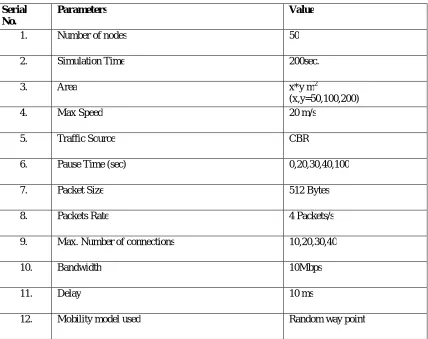
1. Mobility Creation Model. It is used to study the effect of mobility of nodes on overall performance of the network. 2. Traffic Creation Model. It is used to study the effect of traffic load on the network. Implementation study begins with simulation of Network Simulation Environment. This requires setting of simulation network parameters. These parameters are depicted in the Table 1.1.
Table 1.1: Simulation Parameters
Serial No.
Parameters Value
1. Number of nodes 50 2. Simulation Time 200sec. 3. Area x*y m2
(x,y=50,100,200) 4. Max Speed 20 m/s
5. Traffic Source CBR
6. Pause Time (sec) 0,20,30,40,100 7. Packet Size 512 Bytes 8. Packets Rate 4 Packets/s 9. Max. Number of connections 10,20,30,40 10. Bandwidth 10Mbps 11. Delay 10 ms
ISSN(Online): 2320-9801
ISSN (Print): 2320-9798
I
nternational
J
ournal of
I
nnovative
R
esearch in
C
omputer
and
C
ommunication
E
ngineering
(An ISO 3297: 2007 Certified Organization)
Vol. 4, Issue 8, August 2016
These parameters are depicted in the Table 1.1. To analyze the effect of variation of area, area was varied from 50 m2 x 50 m2 to 500 m2 x 500 m2 with all other simulation parameters as similar. The results are presented in tabular and graphical form in Table 1.2
TABLE 1.2:PACKET DELIVERY RATIO FOR AODV,AOMDV AND E-AODV.
Area (Max.) AODV AOMDV E-AODV
50x50 0.9995239 0.99971338 0.99990479 100x100 0.99971308 1 1 200x200 0.99961803 0.99980974 0.99990447 300x300 0.99220162 0.99094721 0.95267234 400x400 0.98939119 0.95592603 0.84060451 500x500 0.99207335 0.92071831 0.61584196
To analyze the effect of mobility, pause time was varied from 0 seconds (high mobility) to 100 seconds (no mobility). The numbers of nodes are taken as 50 and the maximum number of connection as 10, 20, 30 and 40.
Fig 1.4 Packet Delivery Ratio Vs Area Fig 1.5 Packet Delivery Ratio Vs Area Therefore, AODV and AOMDV are currently amongst the easiest and most widely implemented MANET protocol. While, their specification still contains many sections prone to erroneous programming. E-AODV is a simplified variant of AODV specification which removes all but the essential elements of AODV. From the results, it can be seen that E-AODV has better performance in comparison to both AODV and AOMDV.
VI.CONCLUSION AND FUTURE WORK
We have then proposed E-AODV, a simple algorithm based on AODV which has performance nearly similar as that of AODV but its main advantages are its simplicity, light weight and no routing overheads. E-AODV has better performance in comparison to both AODV and AOMDV.
REFERENCES
1. Ramjee Prasad, editor, “Universal wireless personal communications”, Artech House, Norwood, MA, pages 355-362, 1998.
2. Seiichi Sampei, editor, “Applications of Digital Wireless Technologies to global Wireless Communications”, ISBN: 0-13-214272-4, Prentice Hall PTR, Upper Saddle River, NJ, 1997.
3. IEEE 802.11e Working Group, Specific Requirements Part 11: Wireless LAN Environment Access Control (MAC) and Physical Layer (PHY) Specifications, Amendment 8: Environment Access Control (MAC) Quality of Service Enhancements, IEEE Standard, 2005.
4. J. Broch, D.A. Maltz, D. B. Johnson, Y.C. Hu and J. Jetcheva, “A performance comparison of multi hop wireless ad hoc network routing protocol”, MobiCom’98,
ISSN(Online): 2320-9801
ISSN (Print): 2320-9798
I
nternational
J
ournal of
I
nnovative
R
esearch in
C
omputer
and
C
ommunication
E
ngineering
(An ISO 3297: 2007 Certified Organization)
Vol. 4, Issue 8, August 2016
5. Acharya. A, A. Misra, and S. Bensal, “A label switching packet forwarding architecture for multihop wireless LANs”, Proceedings of the ACM Workshop on Mobile Multimedia (WoWMoM -2002), Atlanta, GA, pages 33-40,2002.
6. 5th VNIT/NS Simulator Tutorial/Workshop slides and the NS Manual [2009].
7. Y. B. Lin and I. Chaamtac, “Wireless and Mobile Network Architecture”, John Willey &sons,Oct 2000.
8. J. Broch, D. A. Maltz, D. B. Johnson, Y.-C. Hu, andJ. Jetcheva. “A performance comparison of multihop wireless ad hoc network routing protocol,” MobiCom’98, Proceedings of Annual ACM/IEEE Inter. Conf. on Mobile Computing and Networking, pages 85–97, October 1998.