A Survey on Collaboration of Internet of
Things and Cloud Computing in Smart Cities
Khan Atiya Naaz
M.Tech Student, Dept. of C.S.E, Dr. K. N. Modi University, Newai, Rajasthan, India
ABSTRACT: India is developing, most of population is moving to the cities. That’s why we need smart cities, smart people and smart governance. Our P.M Modi has announced to construct 100 smart cities until 2022. So, this paper is intended to be the guide of information technology in smart cities, basically applying concept of internet of things merging with a very emerging technology Cloud Computing together to provide efficient, cheaper and better integrated services and interoperability for citizens mobility, traffic congestion,transportation, hospitals, homes and crime prevention.
KEYWORDS: Internet of things, cloud computing, smart city, Information and Communication Technology
I. INTRODUCTION
Improvement in the quality of life experienced by the citizen, with the help of emerging technology is the only objective behind this. As India is on its way to develop and construct 100 smart cities to fulfill the need of rapidly growing and urbanizing population. It will require construction of new cities and renovation of existing cities by using cutting-edge technologies. This paper proposes about technologies like cloud computing and Internet of Thing, will ultimately efficient, cheaper and better integrated services.
It also concentrate on vertical integration within independent infrastructure and services, which is compatible in technologies, that achieved through common and census based standards that ensure interoperability. We have need both of this to increase mobility in our citizens, traffic congestion, crime prevention, private and public transportation system, commercial buildings, hospitals and homes. It provide necessary connectivity because it is very necessary to integrated collaborative approaches that are responsible to number of coming ideas. Without this, cities will have serious repercussions for economic and social development.
II. OVERVIEW
A. Internet of Things:
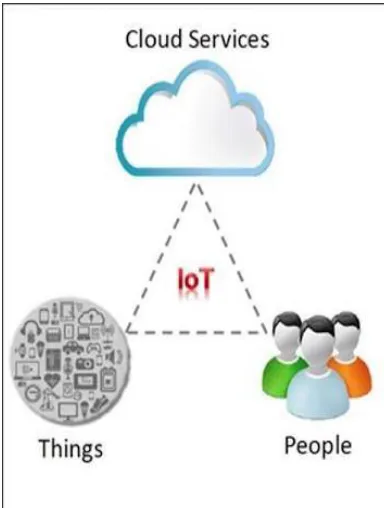
IoT is a network of “things” that include identifiable devices, appliances, equipment, machinery of all forms and sizes with the intelligence to seamlessly connect, communicate and control or manage each other to perform a set of tasks with minimum intervention.From the IT industry perspective, it will open up new gateways to provide services, analytics and applications.IoT becomes the fore-standing in the present era, the overall intension of setting up smart cities in India is to establish IoT industry worth $15 billion throughout the India in the upcoming 6 years, which will create new job opportunities in India in different industrial fields. IoT offers golden opportunities for telecom operators and system integrators. The development of IoT based platforms to achieve smart city initiatives cannot happen overnight. The creation of proper digital infrastructure is the first step for setting up an IoT platform in our country.
In order to achieve this, the digital program has been launched. The main objective of this program is to transform India into digital empowered society and knowledge economy and will also provide the backbone for the development of IoT industry in India.
radio-frequency identification (RFID) tags and IP-enabled devices, and on the other side different producers are developing new technology using their own communication specifications and data protocols.
B. Cloud Computing:
Cloud computing has come forth as a new model for providing services over the internet .This come forth of cloud computing has made awe-inspiring effect on the information technology (IT) industries, over the past few years, where Google, Amazon, Microsoft to make strenuous effort to provide reliable, highly scalable, powerful cloud platforms, and business enterprises acquire business models to achieve benefits from cloud computing.
Cloud Computing has a specialty to build and maintain computing infrastructure in-house. It has a nature of (i) Self Service provisioning in which computing resources may be used for any type of workload on-demand; (ii) Elasticity, according to the demand of company it may scale up or down; (iii) pay-per-use, we only pay for that resources which we used.
There are three types of clouds which we will used in our smart city:
1. Private Cloud: These services are provided for internal users of the company and business and its data center, and provided versatility and convenience, management control and security.
2. Public Cloud: These services are provided by third over the internet. In this, services are sold on-demand, customers only pay for storage, CPU they consume. There are main public are: Amazon Web Services (AWS), Microsoft Azure, IBM/Soft layer, Google Compute Engine.
3. Hybrid cloud: These services is provided by the combination of public cloud services and private cloud. The cloud is unified, automated, scalable environment which takes advantage of infrastructure by public cloud andmaintain control over mission critical data by private cloud.
For eg. Cloud Computing maximizes the utilization of the resources as the same resources can be used in more than one time zones with different. From this advancement, multiple users can access a single server for their usage. This will maximize the computing power and reducing the environmental damage, air conditioning, Rackspace etc.Cloud computing offers these services as Infrastructures, Platforms or Software where the full potential of human creativity can be tapped using them as services. The data generated, tools used and the visualization created disappears into the background, tapping the full potential of the Internet of Things in various application domains.
C. Smart city:
A city in which hard infrastructure and social infrastructure is fulfilled and the information and communication technology is used to deliver services remotely over networks and to move the vast majority of their processes for engaging with and delivering content or services to citizens online, such that the interaction between the citizen and the public authority is carried out on a connected device, and forms a platforms by which a community including administration, industries, and people can develop altogether where there is ease in creation and sharing of application and services. A city equipped with sensors & capable of providing the best services possible at every citizens by processing all the data collected from the sensor network and efficiently utilizing the natural resources as water, electricity, air quality, waste management among many services.
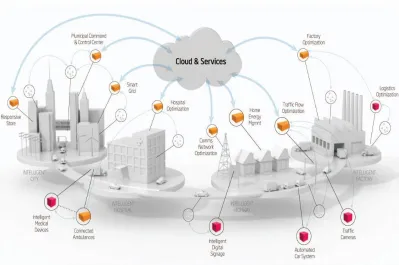
In order to act smartly, these cities should have the Artificial Intelligence to understand the data and information acquired from sensors and cameras, store them and process the data using data centers and servers and take action to resolve it in real-time.Smart city services like building management, transportation, and health care, are provided in single domain. With this, application drive all system-component design and determine most technical choices, ranging from sensors and smart devices to middleware components and computing infrastructure.
F i
Figure 2: Smart city architecture
III.COMBINATION OF CLOUD AND IOT IN SMART CITY
The first academic paper on smart city was published in year (Gibson et-al, 1992),that was more than 20 years ago. And now we conclude two more paradigm of cloud computing and IoT in this, to make it more and more efficient from every aspect.
In the recent years the rate of technological progress has been very fast. Cloud Computing, IoT, Hyper Connectivity and modern analytics are the new technological breakthroughs providing opportunities at affordable cost that could not have been foreseen just a few years ago. New applications and services are ignited by technology, and in turn, creates better living and working conditions for all of us, everyone has now access to powerful smart devices at all time. The challenge is to enhance living standards, improve social equity, and ideally enable more efficient responses from authorities to the city challenges at potentially lower cost.
Everyone knows that the latest emerging technology will form cities for the future. Transporting people easily from home to work or anywhere and the best lifestyle imaginable are the things which are possible with the use of better cloud management and merging it with the Internet of Things (IoT), this will grant them the ability to individuals to perform operations through smart applications and better opportunities to develop their personal and entrepreneurial potential by affordable services and infrastructure.
The overall thing is that smart cities need both the technologies(IoT and Cloud Computing)to be embedded in the city so that is can collect the data directly from the sensors, camera and the other IoT devices with are installed all over the city and then the collected data is transmitted to the cloud where we can analyze and calculate or manipulate the data with minimum human intervention. This will guarantee the confidentiality and the integrity of the data.The Governing authorities can process the data collected by the devices and can improve their plans and operation by comparing every days data and citizens support or oppose, they can get the bottom of the problem that from where did the problem started or what is causing it and then eliminate the issue, all this can only be possible if the digital data is available for all of the days on the cloud and can be access from anywhere.
A smart city will be smart where all the resources are used smartly, energy managementsystem and intelligent traffic system are available, where the people will not waste their timein waiting in the queues for their turn, where the criminals can be caught with the minimumloss of time and minimum casualties, where each and every person can feel safe at all time of the day and night and that can only be achieved when the whole city will be undersurveillance with the best technology available and the action are taken in the real time. So asmart city must combine legacy networks and sensors and actuators with the environment.The connectivity of a nervous system of the city and key intelligence of tomorrow.The purpose of this collaboration is to enable the development and evolution of smart cities through software and service techniques. It aims particularly at providing strong sustainability support over the whole life cycle of the various complex systems in smart-city environments. [16]
A. Technologies behind IoT and Cloud Computing
A city in which information and communication systems are invisibly embedded in the environment around us can only be achieved by using Radio Frequency Identification (RFID) and sensor network technologies. By doing so, we will generate enormous amounts of data which have to be stored, processed and presented in a seamless, efficient, and easily interpretable form and that is where will need to utilize Cloud Computing. Cloud computing can provide the virtual infrastructure for such utility computing which integrates monitoring devices, storage devices, analytics tools, visualization platforms and client delivery.
For developing a common operating picture enabling innovative applications we need the ability to share information across platform through a unified framework which can be provided by the interconnection of sensing and actuating devices. This can be achieved by ubiquitous seamless, data analytics and information representation with cloud computing as the unifying framework. And to further make it even smarter, the data have to be stored and used intelligently for smart monitoring and actuation at the data centers that run on harvested energy and are centralized will ensure energy efficiency as well as reliability.
Cloud computing service providers have presented a new type of Platform as a Service (PaaS) that integrates IoT devices and infrastructure, large amount of data of distributed data sources are processed in real time, and lets applications employ both IoT and cloud resources on demand. The application providers don't have permission or access to the management of both IoT infrastructure and cloud resources. The required provisioning of computing resources involved in service delivery must be ensured by the platform providers. The services provided by the platform that will let stakeholders share resources and establish flexible business relationships such as cloud services, including service metering, billing, and tenant management.
The traditional domain-specific solution providers will be directly influenced by emergence of such a platform. Solution providers can leverage cloud resources with a cloud-based platform to integrate IoT infrastructure and develop domain-specific applications, which will enables virtualized vertical solutions, or virtual verticals. In virtual verticals, software services can be reused by solution providers and scale up services without investing in the computing infrastructure.Furthermore, they can also provide IoT Infrastructure as a Service (IaaS) on the cloud to open IoT device capabilities to third-party application developers.
Cloud application providerswho specialize mainly in Web and cloud application development will also benefit from the platform. The service-delivery platform lets these providers access IoT services to create novel applications for users. Domain-specific knowledge will not be needed by application providers for managing IoT infrastructures because on the cloud such infrastructures’ capabilities are provided as services, and the platform facilitates the important components for service delivery. Thus application providers can focus on application logics and enjoy on-demand use of both cloud and IoT resources. There are some examples given below:
Intelligent street lighting:
Street lights can be made intelligent by placing sensors on them, which enables them to detect movement and daylight. Additional technology enables the street lights to communicate with one another. When a passer-by is detected by a sensor, it will communicate this to neighboring street lights, which will brighten so that people are always surrounded by a safe circle of light. And the daylight sensor will allow it to illuminate only when the visibility is low in the surrounding, it will even help when there is a storm and the visibility gets lower, then the lights will turn on automatically. It will save energy, reduce CO₂ emission, reduce maintenance costs and maintenance of safety as it becomes clear from far away when movement is approaching (the lights brighten).
Face recognition & thumb prints scanners around the city:
The idea is to install and use applications like face recognition and thumb prints scanners to enable the citizens to access the facilities offered in the city, such as City Metro, Intercity Bus Transportation and ATM. This can help governing administration and the citizen in a drastic way. In place of using any Identification Card or Metro card we should use face recognition and thumb prints scanners to identify someone and allow them to use the facilities. This will increase the security and confidentiality in the city, administration will have the information about the whereabouts of every citizens which will decrease the crime rate in the city.
Smart Parking:
Here the idea is to constantly monitoring the occupancy of each parking space via ultrasonic or magnetic sensors. The information from these sensors is collected with the help of data concentrators and then is sent to the cloud and the computers where the softwares can accurately direct drivers to the empty parking space. And we can also show the number of empty parking spaces at the entrance of the parking so that no extra vehicle will enter the parking lot and there will be no traffic in front of the parking area. Moreover we can have the digital record of each and every car that when did they enter or exit the parking lot. This will provide accurate information and reliable performance, reduces traffic congestion and environmental pollution, and support customer satisfaction.
IV.UPCOMING AND ONGOING PROJECT
India to be leader in IT use in services – health, education, banking Digitally empowered citizens – public cloud, internet access. Digital Locker facility will help citizens to digitally store their important documents like PAN card, passport, mark sheets and degree certificates. Digital Locker will provide secure access to Government issued documents. It uses authenticity services provided by Aadhaar. It is aimed at eliminating the use of physical documents and enables sharing of verified electronic documents across government agencies. Single window access to all persons by seamlessly integrating departments or jurisdictions, availability of government services in online and mobile platforms.
An agreement has been signed by the government of Karnataka with the network solution provider Cisco for a development project of the Bangalore city as an intelligent, smart and sustainable city. The project will aim at developing information and communication technology solutions to help promote sustainable, intelligent urban development in the city. The company will also work in the improvement of management, better quality of life for citizens and economic development. Some steps are already under process, for example they have installed 180 cameras around the city managed by Bangalore's traffic police department from a control room.
Another agreement has been signed by Reliance Communications Ltd. with the U.S. based Jasper, a global Internet of Things (IoT) platform leader to offer IoT services in India which will enable enterprises and individuals the capability launch and manage business activities and monitor individual behavioral patterns through the IoT platform. This partnership will support enterprises and governments throughout India in optimizing and automating every stage of their IoT service life-cycle, enabling companies to get the most out of their devices, networks and applications by facilitating the diverse array of projects under the Smart Cities and the ‘Digital India’ initiative.
V. CONCLUSION
In this paper, we discussed about how we can merge and implement Internet of Things (IoT) and Cloud Computing, which are not so different that they cannot be used together or they cannot work in synchronization. It will, however, take time, money and a combined effort on part of governing administration, technical industries and the citizens. If both the technologies are combined together and used in the infrastructure of the smart cities, then it will create a role model for the upcoming smart cities. India is developing day by day and now it is planning to establish 100 smart cities across the country. And from the point of view of information and communication technology, the most important aspect of smart city is the implementation of Internet of Things (IoT) and Cloud Computing.
REFERENCES
1.www.indiaonward.com
2.www.ubmfuturecities.com
3. www.usibc.com, A nation of smart cities, USINDIA BusinessCouncil
4. A.D. Guerrero-Pérez, A. Huerta, F. González and D. López. Network Architecture based on Virtualized Networks for Smart Cities
5. V.M. Larios, J.G. Robledo, L. Gómez, and R. Rincon, IEEE-GDL CCD Smart Buildings Introduction, IEEE Guadalajara Physical Infrastructure Working Group for Smart Cities
6. Qi Zhang · Lu Cheng · Raouf Boutaba (2010), Cloud computing: state-of-the-art and research challenges, © The Brazilian Computer Society 2010 7.Pablo E. Branchi *, Carlos Fernández-Valdivielso and Ignacio R. Matias. (2014) Analysis Matrix for Smart Cities
www.mdpi.com/journal/futureinternet
8. Annalisa Cocchia (2014) A. Cocchia (*), Smart and Digital City: A SystematicLiterature Review. Springer International Publishing Switzerland 2014
9. Andrea zanella, Lorenzo vangelista (February 2014) Internet of things for smart cities,IEEE INTERNET OF THINGS JOURNAL, VOL. 1, NO. 1, FEBRUARY 2014
10. http://forbesindia.com/blog/business-strategy/building-a-smart-city-landscape-in-india/
11. Somayya Madakkam, R. Ramaswamy, The state of art: Smart Cities in India A Literature review report www.ijird.com
12. V.M. Labrio, J.G. Robledo, L. Gomez and R.Rincon IEEE GDL CCD Smart Building Introduction IEEE-GDL CCD Smart Cities White Paper. 13. Jayavardhana Gubbi, Rajkumar buyya, Slaven Marusic, Marimuthu Palaniswami (2013) , Internet of Things(IoT): A Vision, architectural elements, and future direction.www.elsevier.com/locate/fgcs future generation computer systems 1645-1660.
14. http://www.livemint.com/Companies/zK9o44ZIy4gVQR4MF2dnpM/RCom-partners-Jasper-to-offer-IoT-platform.html
15. https://en.wikipedia.org/wiki/Intelligent_street_lighting