ISSN(Online): 2320-9801
ISSN (Print): 2320-9798
I
nternational
J
ournal of
I
nnovative
R
esearch in
C
omputer
and
C
ommunication
E
ngineering
(An ISO 3297: 2007 Certified Organization)
Vol. 3, Issue 4, April 2015
An Energy Efficient Data Collection Scheme
for Multiple Sinks in Wireless Sensor Network
Mohan Kadasali
1,Geetha N B
2, Mohamed Rafi
3Student, Department of Computer Science, UBDTCE (VTU), Davanagere, India1 Assistant Professor, Department of Computer Science, UBDTCE (VTU), Davanagere, India2
Professor, Department of Computer Science, UBDTCE (VTU), Davanagere, India3
ABSTRACT: In a multi-hop WSN a sensor node spends most of its energy for relaying data packets due to which energy reduction is one of the major issue in the designing of a wireless sensor network to prolong the lifetime of a network. One of the solutions of this problem is to shorten the hop distance a sensor‟s data that has to travel until reaching the sink. These distances can be reduced effectively by deploying multiple sinks instead of one and every sensor communicates with its closest sink. We also develop EL(energy and lifetime) to be closely integrated with compressive sensing, an emerging technique that promises considerable reduction in total traffic cost for collecting sensor readings under loose delay bounds. Finally, we systematically evaluate performance graph to compare its performance with default placement and optimal placement.
KEYWORDS: Wireless sensor networks, hop distance, particle swarm optimization, Data collection, energy efficiency, heuristic algorithms.
I. INTRODUCTION
Wireless Sensor Networks (WSNs) that consist of a large number of small low cost, battery operated sensor node capable of wireless communication has wide range of application in many areas like environmental monitoring, field survey, disaster relief and so on. The efficiency of the sensor network is directly related with the length of the reliable monitoring duration of the field which must be achieved with better energy control of sensor nodes and the network management. Therefore, the limited battery resource of the sensors should be handled efficiently. In recent past years, the focus of research in wireless sensor networks was on improvement of network performance assuming that there is a single stationary sink in flat multi-hop wireless sensor networks however suffers from two major problems, one is hotspot and another is Latency.
ISSN(Online): 2320-9801
ISSN (Print): 2320-9798
I
nternational
J
ournal of
I
nnovative
R
esearch in
C
omputer
and
C
ommunication
E
ngineering
(An ISO 3297: 2007 Certified Organization)
Vol. 3, Issue 4, April 2015
large. Multiple sinks are placed in the network with each being used to gather sensed data of the sensors within a certain number of hops from the sink, which results in decreasing the relay workload of each sensor, lowering the latency. The sinks often placed at strategic locations to enable the network of homogeneous or heterogeneous architecture to operate as long as possible. We introduce Heuristic
algorithm to obtain approximate solutions. This algorithm designs also take into account load balancing of individual nodes to maximize the system lifetime.
II. LITERATURE SURVEY
In recent past years, the focus of research in wireless sensor networks was on improvement of network performance assuming that there is a single stationary sink in flat multi-hop wireless sensor networks. In wireless sensor networks consisting of single static sink, a sink have more capabilities than normal sensor nodes and powered by unlimited energy source. The function of sink node is to gather the data generated by sensors in the network via multi-hop relays. This traditional single sink paradigm however suffers from two major problems, one is hotspot and another is Latency. Hotspot problem also called as single sink neighborhood problem , where the sensors within one-hop distance from the sink have to relay the data for the other sensors that cannot reach the sink directly. These one hop sensors uses most of its energy in relaying data and rate of their energy consumption is much more than the other sensors. As a result, they deplete their energy, the network will partition and the sink will disconnected from the rest of sensors even if those sensors are with sufficient residual energy. The latency is a delay between sending data from the source node and receiving at a sink node. If the paths between the sources to sink are long on average, the latency will also be higher. Every hop in the path to the sink, data packet has to wait for certain time, so more hops in this path will directly lead to higher latency. These problems become worse if network size is considered to be large. These problems are addressed in many literatures and multiple sink strategy has been exploited and demonstrated in large to improve various network performance including network lifetime average data delivery latency and system throughput. Multiple sinks are placed in the network with each being used to gather sensed data of the sensors within a certain number of hops from the sink, which results in decreasing the relay workload of each sensor, lowering the latency.
The sinks often placed at strategic locations to enable the network of homogeneous or heterogeneous architecture to operate as long as possible. In large-scale wireless sensor network, multi-sink positioning is challenging issue and is defined as the optimization problem to maximize a performance metrics. In general, the complexity of the multi-sink positioning problem varies based on the network architecture. In a flat network topology, the problem is NP completes [8]. In hierarchical network architecture in which some sensors are designated as cluster heads, forming a two-tier topology, the complexity depends on the network clustering and sinks positioning procedures [9] and NP complete . Since optimal sink positioning in WSN has proved to be NP-complete, several heuristics were propos to find sub-optimal solutions. In this paper, address energy balancing aware k-sink node deployment problem in large .
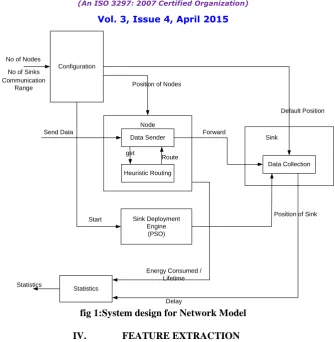
III. SYSTEM DESIGN
We consider model of stationary homogeneous multi-hop wireless sensor network, composed of sensors equipped with equal transmission capabilities. The network contains n sensor nodes having identical initial energy and each mounted with an omni-directional antenna, which can transmit in its coverage area are randomly located in a 2-dimensional plane. Each sensor node gathers the data within its range, and sends them to the closest sink using a geographical routing. The sensor uses single hop or multi-hop to travel the messages to sink.
ISSN(Online): 2320-9801
ISSN (Print): 2320-9798
I
nternational
J
ournal of
I
nnovative
R
esearch in
C
omputer
and
C
ommunication
E
ngineering
(An ISO 3297: 2007 Certified Organization)
Vol. 3, Issue 4, April 2015
Configuration
Data Sender
Heuristic Routing
Data Collection
Sink Deployment Engine (PSO)
Statistics No of Nodes
No of Sinks Communication
Range Position of Nodes
Default Position
Send Data
get
Route
Forward
Start Position of Sink
Sink Node
Energy Consumed / Lifetime Statistics
Delay
fig 1:System design for Network Model IV. FEATURE EXTRACTION
Particle Swarm Optimization (PSO) biologically inspired computational search and optimization method developed by Eberhart and Kennedy. Each individual in the swarm is referred to as a particle or agent. All the particles in the swarm fly through N dimensional space and act individually under the same governing principle: accelerate toward the best personal location - personal best (pbest) and their neighbourhood's best location - global best (gbest)while constantly checking the value of its current location. Position of the particle is influenced by velocity. All of particles have fitness values which are evaluated by the fitness function to be optimized, and have velocities which direct the flying of the particles. The first gbest is selected from among these initial positions. The fitness function calculates fitness value using the coordinates of the particle in solution space and returns this value to be assigned to the current location, xi. If that value is greater than the value at the respective pbest for that particle, or the global gbest, then the appropriate locations are replaced with the current location, xi. The velocity of the particle is changed according to the relative locations of pbest and gbest. It is accelerated in the directions of these locations of greatest fitness according to the following equation:
vid = w*vid + c1*r1* (pid - xid) + c2* r2*(gid-xid) (1)
Once the velocity has been determined it is simple to move the particle to its next location. The velocity is applied for a given time-step and new coordinate is computed for each of the dimensions according the following equation:
xid= xid+ vid (2)
The particle is then moved to the location calculated by (2).
ISSN(Online): 2320-9801
ISSN (Print): 2320-9798
I
nternational
J
ournal of
I
nnovative
R
esearch in
C
omputer
and
C
ommunication
E
ngineering
(An ISO 3297: 2007 Certified Organization)
Vol. 3, Issue 4, April 2015
I V.RESULT
A Framework of Network has been created. In this results we are going perform the following 3 operation with respect to experimental parameter
1. Creation of Network: Network should contain Number of Nodes, Number of sinks, Range of network. 2. Sending Data or Message to Base station or Sink through the node.
3. Plot the performance graph with respect with „n‟ rounds
Finally we will plot performance graph with respect to three parameter I. number of node vs energy consumption
II. number of nodes vs first node dies III. number of node vs all node dies
fig 2:Creating Network fig3 : sending data from node to sink
ISSN(Online): 2320-9801
ISSN (Print): 2320-9798
I
nternational
J
ournal of
I
nnovative
R
esearch in
C
omputer
and
C
ommunication
E
ngineering
(An ISO 3297: 2007 Certified Organization)
Vol. 3, Issue 4, April 2015
fig5: last node dies IV. CONCLUSION
In order to maximize the lifetime of a sensor network, each sensor node must consume its energy resource effectively. we have addressed the multiple sink network design problem, where the optimal location for the sink nodes is calculated to have maximum average sink node degree and average hop count in the resultant network. PSO uses exhaustive search in calculating the locations of sink nodes. Our future work is on using PSO into a distributed computing manner for multiple sink WSN design. we propose EL, an Energy-efficient Lifetime-balancing protocol for data collection in wireless sensor networks, which is inspired by recent techniques developed for open vehicle routing problems with time deadlines operational research. The goal of EL is to generate routes that connect all source nodes with minimal total path cost, under the constraints of packet delay requirements and load balancing needs.
REFERENCES
[1].Energy Balancing Multiple Sink Optimal Deployment in Multi-hop Wireless Sensor Networks Deepak R Dandekar Department of Electronics Engineering B D College of Engineering Sevagram Wardha (M.S.), India [email protected]
[2].Vincze Zoltan, Vida Rolland, Vidacs Attila,“Deploying Multiple Sinks in Multi-hop Wireless Sensor Networks,” IEEE International Conference on Pervasive Services
[3]. Soltan, Maryam; Maleki, Morteza; Pedram, Massoud,” LifetimeAware Hierarchical Wireless Sensor Network Architecture with Mobile Overlays”, Radio and Wireless Symposium, IEEE,
BIOGRAPHY
Mr.Mohan Kadasali is presently pursuing MTech.final year in Computer Science and Engineering Department (Computer Science) from UBDTCE, Davangere, India.
Mrs.Geetha N.B.is working as a Assistant Professor in Computer Science and Engineering Department, from UBDTCE, Davangere, India