1712 | P a g e
Technique for Drug Discovery in Medical Image
Processing
Neha Tendon
1, Pankaj Bhambri
21
Research Scholar I.K.G.P.T.U,
Kapurthala (India)
2Asst. Prof. Guru Nanak Dev Engineering College, Ludhiana, (India)
ABSTRACT
A complex structure that focuses on the analysis of variety of levels in regular manner is known as the ontology process. There has been an involvement in the programmed learning methods for constructing the ontology which is completely a level-based method. There are different strategies included for various levels. There are all these levels that are defined at various levels. For the purpose of mapping the two base classes, the object properties are utilized. In this work, technique is been proposed which is based on the neural networks which will mark the area for which the drug need to be discovered. The proposed technique is implemented in MATLAB and it is been analyzed that accuracy is increased and execution time is reduced.
I. INTRODUCTION
On the basis of properties of quantum mechanics the simulating molecules are allowed to interact with each other within the structural bioinformatics tools. This has been developed with the advancements in the biomedical research area. The techniques developed have been a part of the drug design and drug discovery methods. The gathered information is used for identification, design and optimization of newly evolving drugs within this field. The discovery of a molecule that is ready to bind and activate or inhibit a molecular target which is mainly a protein, is done in the drug search and discovery method. The lead components are those compounds that exceed certain threshold value as they can exceed the exceptions of a protein. The search proposed here is a very manual procedure followed. For the searching methods, the high-throughput screening (HTS) is the most commonly utilized technique that helps in searching within the lead compounds. The researchers are allowed to test a large number of molecules with the help of robots. However, it is expensive and needs large number of drugs and compounds for it. For the purpose of assisting drug design the discussed concerns are to be taken care of. The quantity of compounds that are tried are to be minimized for computing by the interactions amongst the molecules.
1713 | P a g e
interactions within these techniques. Due to the generalization capacity, the different hits are to be discovered as compared to the various similarity methods. A solid resurgence is provided by the AI as well as the other machine learning techniques. A quantitative and qualitative requirement is to be ensured within this area of research which is to be ensured b the deep learning (DL) as well as the other latest techniques within the neural networks. Within the bioinformatics and computational biology however, these methods have not achieved much involvement.
II. KUDA APPROACH
The overhead of the customary method is minimized with the help of division of monitoring and analyzing of CPU and GPU together. Here, both of the tasks are executed on the similar threads or cores. The speed of program and the examination code is similar. Once the program terminates, the code also ends soon after that. The implementation of a prototype tool known as KUDA is done here. The KUDA is linked with the collection of multithreaded benchmarks. There are two parts in which the KUDA algorithm is divided [20]:
1. The first part involves the core functionality which includes the routines in which the events are recorded, the event frames are manages and the execution of race detection kernels on the GPU, all within the dynamic library. The kernels can be written and called with the help of CUDA 4.0 library which will help in analyzing frames. Also, the GPU resources can be managed through this process. Global memory is utilized for executing the experiments, however, the constant and texture memory can also be utilized within this method. The constant and texture memory are utilized for the utilization in the manner of the working of event frames with the help of kernel. The fast readonly access holds such frames within its cache.
2. The x86 binaries are to be dynamically instrumented with the help of Pin tool. The main objective here is to callback the routines within the dynamic library in respect of specific events. The multithreaded programs that are created with the help of pthreads library are supported by the Pin tool. Various actions are performed through this tool such as the creation, joining, and synchronization of various threads.
III. LITERATURE REVIEW
Koutalonis et al. [27] with the help of the postal and dispatch administrations, the drugs are pirated within a nation. For the purpose of avoiding such actions, there is a need to check the exchanging parcels across the nations and to do so there is a need to develop higher level of security systems. The checking of some infield systems for identifying the drug is the main aim of this study. The optimum that is produced within this method is settled here. This systems has provided improvement in the results.
Sindhu et al. [28] Due to the expansion of GenBank database, the biologists have put forth the information that is similar to this context. By studying the merits and demerits of the DNAs of the daily lives of various individuals, the reconstruction of branches is to be done with the help of researchers. The study of the historical patterns of relationships amongst various organisms that has evolved from the actions of evolutionary process is known as the phylogeny process.
1714 | P a g e
genome annotation groups. The extensive documentation within the GO project is provided with complete access with the help of the GO web applications. The community development related to the bioinformatics standards is provided with the help of the ongoing case of GO project.
Saitou et al. [30] proposed another method for the reconstruction of phylogenetic trees, method known as the neighbor-joining method. This is to be done from the evolutionary distance data. The appropriate unrooted tree is also to be chosen by comparing with the other five tree-making technologies. The efficiency of the approaches is tested and the results are provided.
Bryant et al. [31] used neighbor-net, a distance based method for constructing the phylogenetic networks. This method is based on the Neighbor-Joining (NJ) calculation of Saitou and Nei. The initial step towards the complete reconstruction for the recombination histories is present within the splits graph. There is a treelike evolutionary history of the each gene or pair of contiguous segments present within the standard evolutionary model. The composition of the various histories is present within this system. The proposed method has provided a very strong initial step in this paper.
Dereeper et al. [32] presented three modes within the Phylogeny.fr method. There are various methods utilized here. They are MUSCLE that is used for multiple arrangements, PhyML that is utilized for tree building, and TreeDyn mainly used for tree rendering. For providing facilities to almost all the studies, these methods have been proposed which have all the variations for executing various methods. There are various tools selected here for providing various needs. The neighbor sequences can be used as input for the phylogeny pipeline within the guide tree. The new features can be expanded within the modular architecture of the phylogeny.fr pipeline. There are new programs proposed as per the evolution of the field.
IV. RESEARCH METHODOLOGY
GPU becomes a highly parallel processor for the purpose of heavy workloads due to its ease of being programmed by Compute Unified Device Architecture (CUDA). GPU is an array which contains number of streaming processors (SPs). It also includes Single Instruction Multiple Threads multiprocessors. Memory spaces are also available in the GPU which is helpful to microprocessors. A thread is known as the basic execution unit of a CUDA programming model. The GPU architecture is based to discovery new patterns for the drug discovery. To increase the accuracy of drug discovery technique c-mean clustering is applied with the SVM classifier.
Pseudo Code of Proposed Algorithm
Step 1: Input the training and test data for the drug classification Step 2: Repeat while loop for clustering
Step 2.1: Start for loop to input training set data
Step 2.1.1: Apply c-mean technique to clustering of the data End for
End While
Step 3: Repeat while unless all the data get classified
Step 3.1: Match the training data and test data features using SVM classifier Step 3.2: Classify most similar and dissimilar data
1715 | P a g e
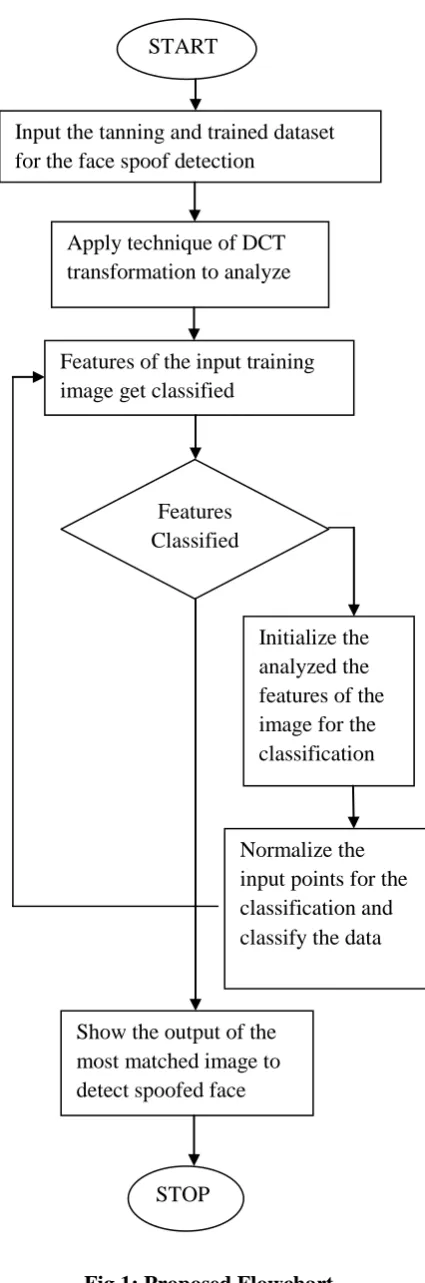
Fig 1: Proposed Flowchart
START
Input the tanning and trained dataset
for the face spoof detection
Apply technique of DCT
transformation to analyze
Features
Classified
Initialize the
analyzed the
features of the
image for the
classification
Features of the input training
image get classified
Normalize the
input points for the
classification and
classify the data
Show the output of the
most matched image to
detect spoofed face
1716 | P a g e
V. EXPERIMENTAL RESULTS
Fig 2: PSNR Comparison
As shown in the figure 2, The PSNR comparison of proposed and existing algorithm is done. It is been analyzed that PSNR of the proposed algorithm is more as compared to existing due to the use of classification technique
1717 | P a g e
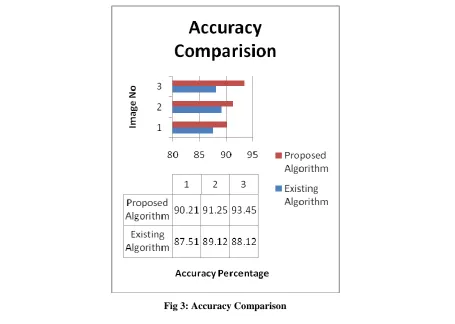
As shown in the figure 3, the accuracy of the proposed and existing technique is compared and it is been analyzed that due to use of classification technique accuracy is increased at steady rate.
VI. CONCLUSION
For the purpose of lifting the performance of GPU in terms of its high-performance, the speed of the application is made to be higher in terms of the view of client. The code will keep running in a highly parallel manner on the GPU. Further, a parallel code can be written on the basis of this which can help in scaling the devices which have various parallel processing capabilities. The memory modules that can be physically separated from each other can be executed on the basis of CPU and GPU. In this work, it is been concluded that classification technique is applied which will classify the area for which disease need to discovered. The proposed technique is implemented in MATLAB and analyzed that accuracy is increased and execution time is reduced.
REFERENCES
[1] Buneman P., “Mathematics in the Archaelogical and Historical Sciences”, 1971, F Hodson Edinburgh Univ Press, Edinburgh, UK, pp 387–395.
[2] Gascuel O, Steel M, “Neighbor-joining revealed”, 2006, Mol Biol Evol 23:1997–2000.
[3] Aitken AC, “On least squares and linear combinations of observations”, 1935, Proc R Soc Edinburgh A 55:42–48
[4] Vinh S, von Haeseler, “A Shortest triplet clustering: Reconstructing large phylogenies using representative sets”, 2005, BMC Bioinf 6:92
[5] Jukes T, Cantor C, “Mammalian Protein Metabolism”, 1969, H Munro (Academic, Waltham, MA), pp 21– 132.
[6] Beyer W, Stein M, Smith T, Ulam S, “A molecular sequence metric and evolutionary trees”, 1974, Math Biosci 19:9–25
[7] Atteson K, “The performance of neighbor-joining methods of phylogenetic reconstruction”, 1999, Algorithmica 25:251–278
[8] Susko E, Inagaki Y, Roger A, “On inconsistency of the neighbor-joining, least squares, and minimum evolution estimation when substitution processes are incorrectly modeled”, 2004, Mol Biol Evol 21:1629–
1642
[9] Vatanjeet Singh, Aman Nag, Ekambir Sidhu,” High Gain Ultra Wide Band (UWB) Multi Resonant Antenna for Biomedical Applications, Security Purposes and Drug Detection”, 2016, IEEE, 978-1-4673-9338-6 [10] Nima Aliakbarinodehi, Giovanni De Micheli, Sandro Carrara,” Optimized Electrochemical Detection of
Anti-Cancer Drug by Carbon Nanotubes or Gold Nanoparticles”, 2015, IEEE, 978-1-4799-8229-5
[11] Patricia Vazquez, Conor O’Mahony, Joseph O’Brien, Grégoire Herzog,” Microneedle sensor for voltammetric drug detection in physiological fluids”, 2014, IEEE, 978-1-4799-0162-3
1718 | P a g e
[13] Daniela De Venuto, Sandro Carrara, Andrea Cavallini, Giovanni De Micheli,” pH Sensing with Temperature Compensation in a Molecular Biosensor for Drugs Detection”, 2011, IEEE, 978-1-61284-914-0