A STUDY OF EMISSION AND PERFORMANCE
CHARACTERISTICS OF C.I. ENGINE
IMPLEMENTING BIODIESEL ADDING
NANOPARTICLES COMPONENTS AS AN ADDITIVE
Mukesh Kumar Vaishnav
1, Pramod Mekhuri
2, Dr.Ashish Mathew
31,2
B.Tech. Scholar,
3Professor, Vedant College of Engineering and Technology,
Bundi, Rajasthan (India)
ABSTRACT
Diesel engine play necessary role within the field of business transportation and agricultural machinery on
account of its superior fuel potency. because of shortage of diesel oil and its increasing value furthermore as
venturous emission emitted by diesel, the employment of biodiesel and its blends has gained importance over the
past 20 years because of its environmental and economic advantages. supported results accessible in literature
the employment of biodiesel and its blends with diesel improve diesel performance and scale back emissions.
There exists scope for performance improvement and emission reduction with diesel, biodiesel as base fuel with
nanoparticle as additive. during this review paper work has been done to demonstrate the result of assorted
nanoparticles other diesel and biodiesel on performance and emission characteristics of CI engine.
Keywords - Diesel engine, Biodiesel, Nanoparticles, Performance, Emission,ICE Internal
Combustion Engine.
I. INTRODUCTION
The direct usage of edible fat in ICE is restricted thanks to their high viscousness, poor atomization, incomplete combustion and carbon deposition on the fuel injectors. the utilization edible fat in lower mix concentration with diesel ends up in engine performance and emission near neat diesel, however with higher mix concentration performance and emission a lot of inferior compare to neat diesel thanks to increase in viscousness [2, 3]. The viscousness of edible fat reduced by the method of transesterification by changing edible fat into methyl radical organic compound or alkyl group organic compound called biodiesel. The significant work has been administrated by several researchers on performance and emission characteristics of ICE with biodiesel and its blends and showed vital improvement in engine performance and reduction in emission of CO, HC and smoke, however Roman deity emission was higher with biodiesel and its blends thanks to their higher O content [4-7]. The recent advance in engineering provides the thanks to manufacture energetic nanoparticles. The addition nanoadditives in base fuel improve thermo physical properties of fuel like high expanse to volume, thermal conduction and mass diffusivity. the utilization of nanoparticles as additive can act as liquid fuel catalyst and there by enhance the combustion characteristics of engine which is able to improve engine performance and scale back emissions.
II. NANOPARTICLES: ITS TYPES AND REQUIREMENTS
Nano-additives are considered as a propitious fuel-borne catalyst to improve the fuel properties, owing to their enhanced surface area/volume ratio, quick evaporation and shorter ignition delay characteristics. The size of nanoparticles varies from 1 to 100 nm [1]. Following are the main requirements of naonoparticles as fuel additive:
1. The nanoparticles act as catalyst should reduce exhaust emission as well as increase the oxidation intensity in the engine and in the particulates filters.
2. It should maintain the typical operational properties of engine.
3. The stability of additive in the fuel must be retained under all operational condition.
III. COMBUSTION MECHANISM OF NANOPARTICLES ADDED FUELS
diffusion-limit model. The droplet surface becomes more concentrated with the less volatile, high-boiling-point component, and the droplet interior has a higher concentration of the more volatile, low-boiling-point component. The latter can be heated beyond its local boiling point, leading to an onset of homogenous nucleation and intense internal pressure buildup and thereby causes fragmentation of the primary fuel droplet. At the end of microexplosion stage nearly all liquid fuel consumed and flame become weaker and finally extinguished and leaving behind agglomerates coated with un-burnt nanoparticles. At the end of microexplosion stage, second flame appear around nanoparticles due combustion of surfactant. This stage known as surfactant flame stage and exists only if fuel droplet contain surfactant. The extinction of surfactant flame is followed by ignition of nanoparticles known as nanoparticle droplet flame stage. In this stage oxygen diffuse on the surface of nanoparticles causes oxidation of nanoparticles. Shortly after nanoparticles are ignited. H. tyagi et al. [10] conducted hot plate ignition probability taste to examine ignition properties of aluminium and aluminium oxide nanoparticles added diesel fuel. They concluded that addition of nanoparticles to fuel improve heat transfer properties and hence droplet ignited at much loweR TEMPERATURE THAN PURE DIESEL. Nanoparticles added fuel shows shortened ignition delay, longer flame sustenance, rapid oxidation and hence complete combustion.
IV. LITERATURE REVIEW
In this section review of various literatures has been presented on effects of adding various nanoadditives in base fuel on performance and emission characteristics of diesel engine.
A. Effects of metal based nanoadditives on performance and emission characteristics of CI engine
Metal based nanoadditives are used as combustion catalyst to promote complete combustion and to reduce consumption of fuel and emission for hydrocarbon fuels. Metal based nanoadditives reduce diesel emission in two ways: (i) metals react with water vapor in the exhaust emission to produce highly reactive hydroxyl radicals (ii) metal serve as an oxidation catalyst which oxidize CO into CO2, HC into CO2 and water vapor and carbon
(soot) into CO2. The commonly used metal nanoadditives for hydrocarbon fuels are aluminium, iron, boron and
ferric chloride. G.R. Kannan et al. [11] examined effects of 20 μmol/L ferric chloride (FeCl3) added to waste
cooking palm oil biodiesel on combustion, performance and emission characteristics of single cylinder direct injection CI engine operated at constant speed of 1500 rpm at different operating conditions. The test results showed that the FeCl3 added biodiesel resulted in decreased brake specific fuel consumption by 8.6% while
brake thermal efficiency increased by 6.3% at optimized operating condition of 280 bar injection pressure and 25.5obTDC injection timing. The FeCl3 added biodiesel showed lower nitric oxide emission (NO) and slightly
higher carbon dioxide emission (CO2) as compared to diesel at standard operating condition. Carbon monoxide
(CO), total hydrocarbon (THC) and smoke emission of FeCl3 added biodiesel decreased by 52.6%, 26.6% and
6.9% respectively compared to biodiesel without FeCl3 at an optimized operating condition, but NO emission
slightly increased by 4.1% with FeCl3 added biodiesel compared to without FeCl3 added biodiesel at optimum
operating condition because FeCl3 present in fuel oxidize nitrogen into nitric oxide during combustion process.
adding nanoparticles of aluminium (A1), iron (F1) and boron (B1) in base diesel. These fuels showed reduced
ignition delay and improved combustion rates. The brake thermal efficiency increased by 9%, 4% and 2% for A1, F1 and B1 respectively as compared to diesel at maximum loading conditions. At higher load the SFC
reduced by 7% when engine fuelled with A1 as compared to diesel, while SFC for F1 and B1 was almost same to
that of diesel. Volumetric reduction of 25-40% in CO emission, 8% and 4% in hydrocarbon emission was observed when engine fuelled with A1 and F1 respectively as compared to diesel. The NOX emission marginally
increased compare to pure diesel because of increase in burning temperature in the combustion chamber.
B. Effects of metal oxide nanoadditives on performance and emission characteristics of CI engine
The metal oxide nanoadditives used for hydrocarbon fuels are TiO2, ZnO, MnO, Al2O3 and CuO. The metal
based nanoadditives act as oxygen donating catalyst which provide oxygen for oxidation of CO or absorbs oxygen for the reduction of NOx. Arul Mozhi Selvan et al. [13] evaluated performance and emission
characteristics of CI engine by using 25 ppm cerium oxide (CeO2) nanoparticles as additive in neat diesel and
diesel-methyl ester of castor oil-ethanol blends (D70B10E20). The authors found that the SFC was lower and BTE was higher with addition of CeO2 in diesel and D70B10E20 blend compare to diesel and D70B10E20
blend. The addition of CeO2 in diesel and D70B10E20 blend lower emission of CO, HC and smoke, while
marginally increased NOX emission compare to pure diesel and D70B10E20 blend . Sajith et al. [14] carried out
experimental investigation on performance and emission characteristics of single cylinder constant speed diesel engine fuelled with CeO2 nanoparticles (10 to 20 nm) added to jatropha biodiesel with dosing level of CeO2 vary
from 20 to 80 ppm. The tests results showed that BTE increased and SFC reduced by adding nanoparticles in biodiesel compare to pure biodiesel. The nanoadditives promote longer and more complete combustion compared to base fuel because CeO2 act as an oxygen buffer and thus increase efficiency. Also CeO2 oxidize
carbon deposits from the engine leading to efficient operation and reduced fuel consumption. The addition of CeO2 nanoparticles to biodiesel decreased CO, HC and soot emission compare to biodiesel without CeO2. CeO2
nanoadditive has the ability to undergo transformation from stoichiometric CeO2 (+4) valence state to Ce2O3
(+3) (cerous oxide) via relatively low energy reaction. CeO2 supplies oxygen for the reduction of HC as well as
soot and converted to Ce2O3 as per reactions. M.A. Lenin et al. [15] carried out comparative study on
performance and emission characteristics of diesel engine fuelled with 100 mg/L manganese oxide (MnO) and copper oxide (CuO) nanoparticles added in diesel fuel. The brake thermal efficiency of diesel+MnO fuel was higher compare to diesel+CuO and neat diesel for all loads. The brake thermal efficiency for neat diesel and diesel+CuO fuel was nearly same. The emission of CO and NOx for diesel+MnO fuel was lower compare to neat
diesel and diesel+CuO fuel for all loads. The emission HC for neat diesel, diesel+CuO and diesel+MnO fuels was nearly same for all load conditions .M. Santhanamuthu et al. [16] evaluated performance and emission characteristics of single cylinder CI engine fuelled with polanga oil and diesel blend with iron oxide nanoparticles doped as additive. The BTE and BSEC for POD-iron oxide nanoparticle blends were on par with that of neat diesel. The CO emission was within the range of ±5% of diesel up to 65% load condition and higher beyond 65% load condition for POD-iron oxide nanoparticle blends and HC emission was lesser than neat diesel by 10-20% for POD-iron oxide nanoparticle blends. NOx emission was lower for POD-iron oxide nanoparticle
ethanol and isopropanol blend as additive with diesel-soybean biodiesel blend fuel on combustion, performance and emission characteristics of naturally aspirated diesel engine and results were compared with those of neat diesel. Cylinder pressure and heat release rate were higher with D80SBD15E4S1+alumina fuel blend compare to diesel and B20 fuel at higher load condition. The thermal efficiency increased by 15.8% and 17.9% at full load in case of B20 and D80SBD15E4S1+alumina fuel blend respectively compare to pure diesel. The BSFC reduced by 10.60% and 11.46% at full load, when engine was fuelled with B20 and D80SBD15E4S1+alumina fuel blend respectively compare to that of pure diesel. The emission of CO and UBHC reduced, while NOX
emission slightly increased in case of D80SBD15E4S1+alumina fuel blend compare to diesel and B20 fuel. Syed Aalam et al. [18] conducted experimental investigation to evaluate performance, emission and combustion characteristics of single cylinder CRDI system assisted diesel engine using blend of diesel and zizipus jujube methyl ester blended fuel (ZJME25) along with aluminium oxide nanoparticles (AONP) in mass fraction of 25 ppm and 50 ppm. There was reduction in BSFC with AONP added ZJME25 fuel compare to diesel and ZJME fuel with maximum reduction of 6% observed with 50 ppm AONP concentration ZJME fuel. The brake thermal efficiency increased in comparison with diesel fuel with maximum improvement of 2.5% with 50 ppm AONP concentrated ZJME fuel. Smoke emission reduced by about 15-20% with AONP added ZJME fuel. The HC and CO emission significantly reduced, while NOX emission slightly increased. The heat release rate and cylinder
pressure increased with the addition of AONP to biodiesel.
Prabhu L et al. [19] conducted experiment to investigate performance and emission characteristics of CI engine fuelled with blend of diesel and neem oil methyl ester (B20) along with 250 ppm and 500 ppm TiO2
nanoparticles. The authors reported that brake thermal efficiency increased and brake specific fuel consumption decreased with TiO2 added biodiesel blend compare pure diesel and biodiesel blend. The emission of CO, HC
and smoke reduced, while NO emission slightly increased with TiO2 added biodiesel blend compare pure diesel
and biodiesel blend.
C. Effects of carbon nanotube additive on performance and emission characteristics of CI engine
Carbon nanotubes are wonder material of 21st century. J. Sadhik Basha et al. [21] carried out experimental
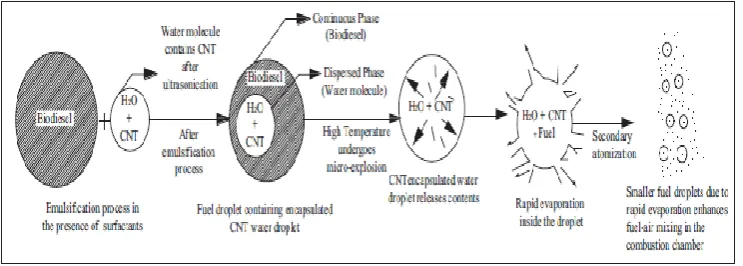
Fig 1 Micro-explosion phenomenon of CNT blended JME emulsion fuel
There was reduction in brake specific fuel consumption (BSFC) with CNT blended JME emulsion fuel compare to that of JME2S5W. At full load BSFC for JME2S5W fuel was 0.346 kg/kW h, whereas it was 0.315, 0.308 and 0.301 kg/kW h for the JME2S5W25CNT, JME2S5W50CNT and JME2S5W100CNT fuels respectively. There was a significant reduction in the peak cylinder pressure and heat release rate for CNT blended JME emulsion fuels when compare to that of neat JME emulsion fuel. At full load, the cylinder gas pressure was 72.3 bar for neat JME fuel, whereas it was 79.77, 76.21, 74.11 and 72.15 bar for the JME2S5W, JME2S5W25CNT, JME2S5W50CNT and JME2S5W100CNT fuels respectively. There was also significant reduction in the level of harmful pollutants in the exhaust gases with CNT blended JME emulsion fuel compare to that of neat JME fuel because of micro explosion and secondary atomization. At the full load, the magnitude of NOx and smoke
opacity for the neat JME was 1282 ppm and 69%, whereas it was 910 ppm and 49% for the JME2S5W100CNT fuel respectively. Author concluded that CNT blended emulsion fuel has potential advantage of improving engine performance and reducing emissions.
D. Effects of organic nanoadditives on performance and emission characteristics of CI engine
The research work on organic nanoadditive in the field of CI engine is limited. W.M. Yang et al. [22]evaluated performance and emission characteristics of 4 cylinder diesel engine fuelled with emulsion fuel with 82.4% diesel, 4% water and 12.6% nano-organic additives by volume. The brake thermal efficiency of engine was 5% higher than pure diesel because of micro-explosion of water droplet contained in emulsion fuel and there was slight reduction in brake power with emulsion fuel compare to diesel because of lower heating value. The BSFC of emulsion fuel was higher than that of diesel fuel. There was also slight reduction in BMEP and IMEP with emulsion fuel. The NOX and smoke emission significantly reduced with emulsion fuel compare to that of diesel.
There was reduction in HC and CO emission with emulsion fuel compare to pure diesel. The ignition delay of emulsion fuel was slightly longer than that of pure diesel.
E. Effects of magnetic nanofluid additives on performance and emission characteristics of CI engine
comparison with that of 0.8 vol%. There was reduction in BSFC values for 0.4 vol%NF fuel compare to that of neat diesel, whereas 0.8 vol%NF fuel shows an enhancement in BSFC values compared to that of neat diesel and 0.4 vol% fuels. Also experimental results reveled that NOx and SO2 emissions reduced, while CO emission and smoke opacity increased with increasing the dosing level of nanoparticles. The NOx emission reduced because iron oxide nanoparticles absorb oxygen for the reduction of NOX, with the average reductions of around 56% and 67% in the cases of 0.4 vol%NF and 0.8vol%NF fuels respectively compare to that of neat diesel. The emission of sulfur dioxide decreased around 14% and 20% in the cases of 0.4 vol%NF and 0.8vol%NF fuels respectively compare to that of neat diesel.
F. Effects of mixed nanoadditives on performance and emission characteristics of CI engine
M. Mirzajanzadeh et al. [24] examined effects of adding hybrid nanocatalyst (CeO2+Multi walled carbon
nanotube) in diesel and waste cooking oil methyl ester blends (B5 and B20) on performance and emission characteristics of diesel engine. The hybrid nanocatalyst was added in dosing level of 30, 60 and 90 ppm. The engine torque and power increased by adding hybrid nanocatalyst compare to pure blend. The maximum increase in power and torque was 7.81%, 4.91% respectively with B20 (90 ppm) compare to B20. The BSFC
reduced by adding nanocatalyst in blend with maximum reduction of 4.50% with B20 (90 ppm) compare to B20.
Because of unique oxygen absorption and donation properties of CeO2 nanoadditive the emission of CO, HC,
NOx and soot reduced. The MWCNT acts as support for CeO2. The maximum reduction in CO, HC, NOx and
soot were 18.9%, 38.8%, 71.4% and 26.3%, respectively with B20 (90 ppm) compare to neat B20. The MWCNT acts as catalyst to accelerate burning rate which result in decreased ignition delay. The CeO2 nanoparticles act as oxygen donating catalyst which oxidize CO into CO2 and absorb oxygen for reduction of NOx into nitrogen. The activation energy of CeO2 burn off carbon deposits within the combustion chamber and hence lower HC and soot emission. Selvan et al [25]studied performance and emission characteristics of VCR engine at optimum compression ration of 19:1 using diesterol (diesel-castor oil biodiesel – ethanol blend) - CeO2 – CNT blends. They used CeO2 and CNT of each 25, 50 and 100 ppm of concentrations added with
diesterol blends. The addition of nanoparticles in diesterol blends increased thermal efficiency by 7.5%, reduced HC and smoke emission by 7.2% and 47.6% respectively compare to diesterol blends without nanoparticles.
V. CONCLUSION
From the above literature review it has been concluded that
The nanoadditives act as combustion catalyst which reduce delay period and promote complete combustion
when added to base fuel and hence increase efficiency of engine and lower brake specific fuel consumption.
There is reduction in CO emission with all type nanoparticles except magnetic nanoparticles added to base
fuel compare to base fuel without nanoparticles because nanoparticles oxidize CO into CO2. With magnetic nanoparticles CO emission increase compare to base fuel without nanoparticles.
The activation energy of nanoparticles burn off carbon deposits within combustion chamber which lower
HC and smoke emission.
With nanoparticle added emulsion fuel because of micro-explosion and secondary atomization phenomenon
Some researchers found that addition of nanoparticles to diesel and biodiesel lower NOx emission, while
some researchers found that addition of nanoparticles to diesel and biodiesel increase NOx emission.
REFERENCES
[1] T. Shaafi, K. Sairam, A. Gopinath, G. Kumaresan and R. Velraj, “Effect of dispersion of various nanoadditives on the performance and emission characteristics of a CI engine fuelled with diesel, biodiesel and blends- A review”, Renewable and Sustainable Energy Reviews, vol. 49, pp. 563-573, May 2015.
[2] B. De, R. S. Panua, “An experimental study on performance and emission characteristics of vegetable oil blends with diesel in a direct injection variable compression ignition engine”, Procedia Engineering, vol.
90, pp. 431-438, 2014.
[3] N. Kapilan, T.P. Ashok Babu and R.P. Reddy, “Improvement of performance of vegetable oil fuelled agricultural diesel engine”, Bulgarian Journal of Agricultural Science, vol. 15, pp. 610-616, 2009.
[4] D. Laforgia and V. Ardito, “Biodiesel fuelled IDI engines: performances, emission and heat release investigation”, Bioresource Technology, vol. 51, pp. 53-59, 1995.
[5] L.G. Schumacher, S.C. Borgelt, D. Fosseen, W. Goetz and W.G. Hires, “Heavy-duty engine exhaust emission tests using methyl ester soybean oil/diesel fuel blends”, Bioresource Technology, vol. 57, pp.
31-36, March 1996.
[6] Raheman and A.G. Phadatare, “Diesel engine emissions and performance from blends of karanja methyl ester and diesel”, Biomass and Bioenergy, vol. 27, pp. 393-397, March 2004.
[7] P.K. Sahoo, L.M. Das, M.K.G. Babu, P. Arora, V.P. Singh, N.R. Kumar, T.S. Varyani, “Comparative evaluation of performance and emission characteristics of jatropha, karanja and polanga based biodiesel as fuel in a tractor engine”, Fuel, vol. 88, pp. 1658-1707, March 2009.
[8] Yanan Gan, Li Qiao, “Combustion characteristics of fuel droplets with addition of nano and micron-sized aluminum particles”, Combustion and Flame, vol. 158, pp. 354-368, 2011.
[9] C. K. Law, “Recent advances in droplet vaporization and combustion”, Progress in Energy and Combustion Science, vol. 8, pp. 171-201, 1982.
[10] Himanshu Tyagi, Patrick E. Phelan, Ravi Prasher, Robert Peck, Taewoo Lee, Jose R. Pacheco, and Paul Arentzen, “Increased hot-plate ignition probability for nanoparticle-laden diesel fuel”, Nano Letters, vol.
8,pp.1410-1416, April 2008.
[11] G.R. Kannan, R. Karvembu and R. Anand, “Effect of metal based additive on performance emission and combustion characteristics of diesel engine fuelled with biodiesel”, Applied Energy, vol. 88, pp.
3694-3703, May 2011.
[12] Rakhi N. Mehta, Mousumi Chakraborty and Parimal A. Parikh, “Nanofuels: combustion, engine performance and emission”, Fuel, vol. 120, pp. 91-97, December 2013.
[14] Sajith, C.B. Shobhan and G.P. Peterson, “Experimental investigations on the effects of cerium oxide nanoparticles fuel additives on biodiesel”, Advances in Mechanical Engineering, vol. 36, pp. 1-16, 2010.
[15] M.A. Lenin, M.R. Swaminathan and G. Kumaresan, “Performance and emission characteristics of a DI diesel engine with a nanofuel additive”, Fuel, vol. 109, pp. 362-365, March 2013.
[16] M. Santhanamuthu, S. Chittibabu, T. Tamizharasan, and T.P. Mani, “Evaluation of CI engine performance fuelled by Diesel-Polanga oil blends doped with iron oxide nanoparticles”, International Journal of Chem Tech Research, vol. 6, pp.1299-1308, June 2014.
[17] T. Shaafi, R. Velraj, “Influence of alumina nanoparticles, ethanol and isopropanol blend as additive with diesel-soybean biodiesel blend fuel: combustion, engine performance and emissions”, Renewable Energy, vol. 80, pp. 655-663, March 2015.
[18] C. Syed Aalam, C.G. Saravanan and M. Kannan, “Experimental investigation on a CRDI system assisted diesel engine fuelled with aluminium oxide nanoparticles blended biodiesel”, Alexandria Engineering Journal, vol. 54, pp. 351-358, April 2015.
[19] Prabhu L, S. Satish Kumar, A. Anderson and K. Rajan, “Investigation on performance and emission analysis of TiO2 nanoparticle as an additive for biodiesel blends”, Journal of Chemical and
Pharmaceutical science, issue 7, pp. 408-412, 2015.
[20] C. Syed Aalam, C.G. Saravanan, “Performance enhancement of common rail diesel engine using nanoparticles blended biodiesel”, International Research Journal of Engineering and Technology, 2015,
2, 1400-1410.
[21] J. Sadhik Basha and R.B. Anand, “Performance, emission and combustion characteristics of a diesel engine using carbon nanotubes blended jatropha methyl ester emulsions”, Alexandria Engineering
Journal, vol. 53, pp. 259-273, April 2014.
[22] W.M. Yang, H. An, S.K. Chou, K.J. Chua, B. Mohan, V. Sivasankaralingam, V. Raman, A. Maghbouli, J. Li, “Impact of emulsion fuel with nano-organic additives on the performance of diesel engine”,
Applied Energy, vol. 112, pp. 1206-1212, 2013.
[23] Nasrin Sabet Sarvestany, Abdulali Farzad, Ehsan Ebrahimnia-Bajestan and Massoud Mir, “Effects of magnetic nanofluid fuel combustion on the performance and emission characteristics”, Journal of
Dispersion Science and Technology, vol. 35, pp. 1745-1750, July 2014.
[24] Mehrdad Mirzajanzadeh, Meisam Tabatabaei, Mehdi Ardjmand, Alimorad Rashidi, Barat Ghobadian, Mohammad Barkhi, Mohammad Pazouki, “A novel soluble nano-catalysts in diesel–biodiesel fuel blends
to improve diesel engines performance and reduce exhaust emissions”, Fuel, vol. 139, pp. 374-382, September 2014.