Scholarship@Western
Scholarship@Western
Electronic Thesis and Dissertation Repository
3-22-2013 12:00 AM
Decentralized Resource Scheduling in Grid/Cloud Computing
Decentralized Resource Scheduling in Grid/Cloud Computing
Ra'afat O. Abu-Rukba
The University of Western Ontario
Supervisor
Hamada Ghenniwa
The University of Western Ontario
Graduate Program in Electrical and Computer Engineering
A thesis submitted in partial fulfillment of the requirements for the degree in Doctor of Philosophy
© Ra'afat O. Abu-Rukba 2013
Follow this and additional works at: https://ir.lib.uwo.ca/etd
Part of the Computer and Systems Architecture Commons
Recommended Citation Recommended Citation
Abu-Rukba, Ra'afat O., "Decentralized Resource Scheduling in Grid/Cloud Computing" (2013). Electronic Thesis and Dissertation Repository. 1153.
https://ir.lib.uwo.ca/etd/1153
This Dissertation/Thesis is brought to you for free and open access by Scholarship@Western. It has been accepted for inclusion in Electronic Thesis and Dissertation Repository by an authorized administrator of
(Thesis format: Monograph)
by
Ra’afat Abu-Rukba
Graduate Program in Engineering Science Department of Electrical and Computer Engineering
A thesis submitted in partial fulfillment of the requirements for the degree of
Doctor of Philosophy
The School of Graduate and Postdoctoral Studies The University of Western Ontario
London, Ontario, Canada
ii
Abstract
In the Grid/Cloud environment, applications or services and resources belong to different
organizations with different objectives. Entities in the Grid/Cloud are autonomous and
self-interested; however, they are willing to share their resources and services to achieve their
individual and collective goals. In such open environment, the scheduling decision is a
challenge given the decentralized nature of the environment. Each entity has specific
requirements and objectives that need to achieve. In this thesis, we review the Grid/Cloud
computing technologies, environment characteristics and structure and indicate the
challenges within the resource scheduling. We capture the Grid/Cloud scheduling model
based on the complete requirement of the environment. We further create a mapping between
the Grid/Cloud scheduling problem and the combinatorial allocation problem and propose an
adequate economic-based optimization model based on the characteristic and the structure of
the Grid/Cloud. By adequacy, we mean that a comprehensive view of required properties of
the Grid/Cloud is captured. We utilize the captured properties and propose a bidding
language that is expressive where entities have the ability to specify any set of preferences in
the Grid/Cloud computing environment. The language is to also enable entities to express
structured preferences directly. We propose a winner determination model and mechanism
that utilizes the proposed bidding language and finds a scheduling solution. Our proposed
approach integrates concepts and principles of mechanism design and classical scheduling
theory. Furthermore, we argue that in such open environment privacy concerns by nature is
part of the requirement in the Grid/Cloud. Hence, any scheduling decision within the
Grid/Cloud computing environment is to incorporate the feasibility of privacy protection of
an entity. Each entity has specific requirements in terms of scheduling and privacy
preferences. We analyze the privacy problem in the Grid/Cloud computing environment and
propose an economic based model and solution architecture that provides a scheduling
solution given privacy concerns in the Grid/Cloud. Finally, as a demonstration of the
applicability of the approach, we apply our solution by integrating with Globus toolkit (a
well adopted tool to enable Grid/Cloud computing environment). We also, created simulation
iii
Keywords
Grid/Cloud computing Scheduling, Decentralized Environment, Combinatorial Auction,
iv
Dedication
v
Acknowledgments
First and foremost, I would like to thank and praise Allah almighty, the only One God, for the
opportunities and support I was given along the way. This work would not have been
possible otherwise.
I would like to express my gratitude to my supervisor Professor Hamada Ghenniwa for his
encouragement, guidance, and support. I value his respect towards professionalism and the
desire to excel higher and higher. He has made me competent in organizing and managing
research activities and projects within the CDS Group and in applying them within the
industry environment.
I wish to express my gratitude to my co-supervisor Dr. Weiming Shen for his support and for
being there whenever I needed his help and feedback.
I am also very grateful to the members of the examining board for their recommendations
and suggestions. Their feedback was quite valuable to the final revisions and editing of this
work.
I would also like to acknowledge the support of:
EK3 technologies for providing me the opportunity to work with their team to apply my
research within their domain and environment;
Natural Sciences and Engineering Research Council of Canada (NSERC) for the financial
support over the years;
Afshan and Adrian for the collaborative work of Privacy and the Grid implementation;
wise people who inspired my thinking through many discussions and collaborative
projects in the Cooperative Distributed Systems Engineering Group (Dr. Abdulmutalib,
Dr. Chun, Dr. Yunjiao, Dr. Daisy, Wafa, Mohammed, Sherif) and EK3 technologies
(Nick, Ed, Ken, Dennis, David, Weiping, Mark, Justin, Kevin, George, Shawn, Adam).
My wholehearted thanks to my parents (Dr. Omar Aburukba and Mrs. Tharwat Almadhoon),
my wife (Raghdah Eldaour), and my children (Marya and Omar) for their continuous love,
vi
Table of Contents
Dedication ... iv
Acknowledgments... v
Table of Contents ... vi
List of Tables ... x
List of Figures ... xi
List of Models ... xiii
Chapter 1 ... 1
1 Introduction ... 1
Overview ... 1
1.1 Scheduling Problem in the Grid/Cloud ... 3
1.2 Problem Scope and Issues ... 4
1.3 Outline of the Thesis ... 6
1.4 Chapter 2 ... 7
2 Related Work ... 7
Scheduling Structures Overview... 7
2.1 Scheduling Objective ... 8
2.2 Entities Coordination in the Grid/Cloud ... 8
2.3 2.3.1 Coordination Mechanism ... 9
2.3.2 Coordination Structure ... 9
Economic-Based Approaches Background... 10
2.4 Price-Taking/Competitive Equilibrium Approaches ... 11
2.5 2.5.1 General Equilibrium Market Mechanisms ... 11
vii
Grid/Cloud Scheduling Approaches ... 18
2.6 2.6.1 Economic-based Scheduling Approach ... 18
2.6.2 Heuristics ... 22
2.6.3 Other Scheduling Approaches in the Grid/Cloud ... 23
Privacy in the Grid/Cloud ... 24
2.7 Chapter 3 ... 27
3 Grid/Cloud Computing System ... 27
The Grid/Cloud System: High-Level View ... 28
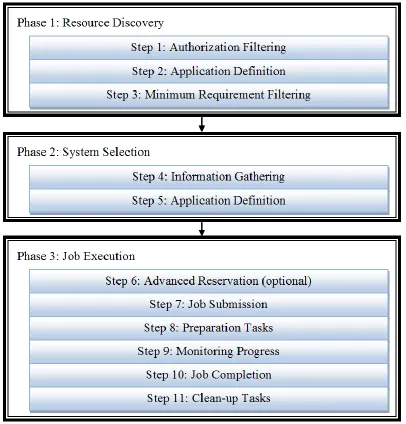
3.1 The Grid/Cloud Scheduling Phases ... 30
3.2 3.2.1 Phase 1: Resource Discovery ... 32
3.2.2 Phase 2: System Selection ... 33
3.2.3 Phase 3: Task Execution ... 34
Characteristics of the Grid/Cloud System... 34
3.3 Chapter 4 ... 38
4 Scheduling Problem in the Grid/Cloud ... 38
Overview ... 38
4.1 Grid/Cloud Providers ... 39
4.2 Grid/Cloud Consumers ... 40
4.3 Formulation ... 41
4.4 4.4.1 Completion Time Formulation ... 41
4.4.2 Resource Utilization Formulation ... 44
Grid/Cloud Scheduling Problem and Structure ... 45
4.5 Privacy: a Required Attribute in the Grid/Cloud ... 46
viii
Problem ... 52
4.8.1 Mapping to the Combinatorial Allocation Problem... 54
4.8.2 Combinatorial Auction Model ... 56
Chapter 5 ... 60
5 Requirement Based Bidding Language for Resource Scheduling in the Grid/Cloud .. 60
Grid/Cloud Scheduling Properties ... 61
5.1 5.1.1 Time-based Requirements and Availability... 61
5.1.2 Support for Requirements ... 62
5.1.3 Support for Allocation constraints ... 63
5.1.4 Reserve Value on bundles ... 63
5.1.5 Consumer’s expressiveness on bundles of items and Resource Composites ... 64
5.1.6 Sell, Consume Multiple Identical Units of items ... 64
5.1.7 Multiple consumers and multiple goods expressiveness ... 65
5.1.8 Trade of Resources ... 65
Related work on Bidding Language ... 65
5.2 Tree Based Specification Bidding Language ... 68
5.3 Bidding Language Expressiveness ... 70
5.4 Bidding Language Expansion for the Grid/Cloud Scheduling with Privacy 5.5 Concerns ... 73
Proposed Bidding Language Conciseness ... 75
5.6 Chapter 6 ... 79
6 Winner Determination ... 79
Market Mechanism Properties ... 79
6.1 The Winner Determination Problem: Formulation ... 80
ix
6.4.1 Providers’ Resource Insertion ... 83
6.4.2 Consumers’ Bids Insertion ... 84
6.4.3 Auction clear ... 87
Chapter 7 ... 88
7 Implementation and Validation ... 88
Proposed Grid/Cloud Scheduling Architecture ... 88
7.1 Proposed Grid/Cloud Scheduling Architecture with Privacy Concerns ... 90
7.2 Bidding Language Representation ... 91
7.3 Implementation Environment ... 94
7.4 Experimentation Environment and Results ... 98
7.5 7.5.1 Economic Efficiency ... 99
7.5.2 Run Times Results ... 101
Chapter 8 ... 102
8 Summary and Conclusion ... 102
Summary of Contributions ... 102
8.1 Conclusions ... 104
8.2 Directions for Future Research ... 104
8.3 Bibliography ... 107
x
List of Tables
xi
List of Figures
Figure 1: Supply and demand curves and equilibrium point. Image from the economic blog:
http://enthusiasm.cozy.org/ ... 4
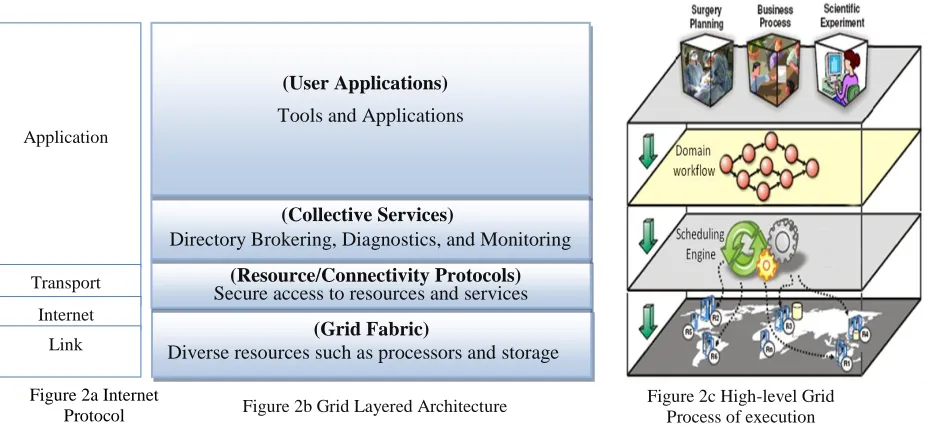
Figure 2: Grid Layered Architecture in relationship to the Grid Process Execution. ... 29
Figure 3: Logical Grid Scheduling Architecture. ... 31
Figure 4: Grid Scheduling Phases. ... 32
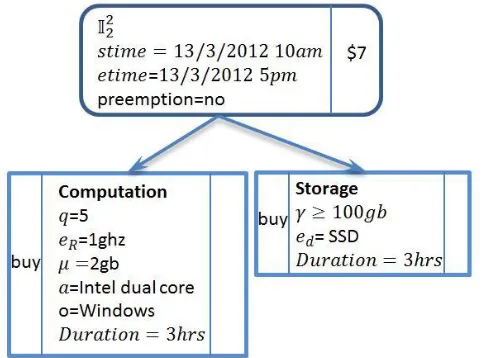
Figure 5: Expressiveness to CPU quantity and time. ... 70
Figure 6: Expressiveness of CPU quantity and time to be consecutive. ... 71
Figure 7: Expressiveness of Service Requirements that has precedence constraints. ... 71
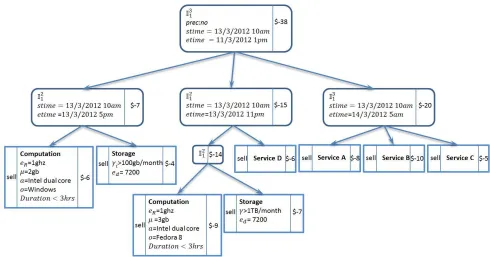
Figure 8: Expressiveness of a Trade Case. ... 72
Figure 9: Provider Expressiveness using the bidding language... 73
Figure 10: Grid/Cloud Tree Bidding Specification Language with Privacy Attributes Requirement Example. ... 75
Figure 11: TBBL Representation for the case in Figure 5. ... 76
Figure 12: TBBL Representation for the case in Figure 6. ... 76
Figure 13: Continuous time requirement for items. ... 77
Figure 14: Discontinuous time requirement for items. ... 78
Figure 15: Time-Based Bin Architecture Example. ... 85
Figure 16: High-level Architecture. ... 89
Figure 17: High-level view of the allocation of resource given the privacy concerns. ... 91
xii
xiii
List of Models
Model 1: Minimizing the completion time of the workflow. ... 43
Model 2: Resource Utilization Provider’s Objective. ... 44
Model 3: Auction Model ... 58
Model 4: Winner Determination Problem Formulation. ... 81
Chapter 1
1
Introduction
This chapter introduces the context of the research explored in this thesis. It starts with
the fundamental motivations behind decentralized and coordinated organization of
Grid/Cloud systems; including resource allocation systems. The chapter thereafter
provides discussion on the problem and the issues scope of the work and the outline of
the thesis.
Overview
1.1
In the last few years, we have seen the emergence of a new generation of business that
operates over the Internet. The Internet has become a medium for organizations,
businesses and individuals to collaborate because of technological and economic benefits.
The complexity of these networks is increasing given their assets of the sub-networks that
provide access to services and resources. These networks serve to strengthen
business-customer relationships, increases profitability and business-customer satisfaction. Grid/Cloud
computing paradigm has quickly become to realization. However, the integration of
decentralized services and resources over the internet is still a challenge.
In the mid-1990s, the term Grid was coined to describe technologies that would allow
consumers to obtain computing power on demand. Ian Foster [Foster et al., 2002] and
others proposed that by standardizing the protocols used to request computing power, the
creation of a Computing Grid could happen, analogous in form and utility to the electric
power grid. Standards organizations (e.g., OGF, OASIS) defined relevant standards. The
term was also adopted by industry as a marketing term for clusters. But no viable
commercial Grid Computing providers emerged, at least not until recently.
In early 2008 the term “cloud computing” was created. Many definitions exist in the
literature about Grid and Cloud computing. However, the vision of both the cloud and the
Grid is the same which is to reduce the cost of computing, increase reliability, and
ourselves to something that is operated by a third party [Foster et al., 2008]. We view the
“cloud” term as another marketing term hype of the Grid computing as they share the
same vision, fundamental characteristics and challenges. A similar view is given by many
experts defined in [Geelan, 2009].
Grid/Cloud computing is a computational paradigm that utilizes networked computing
systems in which applications or services plug into a “power Grid” or “Internet Cloud” of
computation for execution. A Network computing system is a virtual system that is
formed by processors and networks that agree to work together by pooling their
resources. Grid/Cloud computing is a generalized networked computing system that
scales to internet levels and handles data and computation seamlessly.
Traditional computational models include three elements: computational power
(processors and memory), storage, and software (services). The overall goal of
Grid/Cloud computing is to allow applications to utilize computational power, storage,
and services as exchangeable commodities. Utilizing such computational power from
multiple sources increases the system throughput.
The Grid/Cloud systems can be classified depending on the type of usage. Similar to
traditional computation model, those computation elements are the main elements in the
Grid/Cloud system. However, instead of the traditional centralized node that does all the
computation, the Grid/Cloud has different nodes that are distributed. The Grid/Cloud
computing systems can be classified into:
Computational: denotes a system that has a high aggregate capacity of distributed processors. It harnesses machines in “cycle-stealing” mode to have higher
computational capacity than the capacity of any constituent machine in the system. Data: provides an infrastructure for creating information from data repositories such
as data warehouses.
Service: refers to systems that provide services that are not provided by any single
This thesis focuses on the Grid/Cloud systems, where participants have the will to
collaborate with others in contributing their resources within the environment. In such
setting, users provide their resources to be utilized.
Scheduling Problem in the Grid/Cloud
1.2
This thesis focuses on the scheduling problem within the Grid/Cloud environment. In
traditional scheduling, a central decision maker is equipped with all the relevant
knowledge of the problem, and would be asked to derive a solution that fulfills all the
necessary side constraints, optimizing a global performance criterion. The nature of the
Grid/Cloud environment is that decisions are taken by several independent entities and
those entities might be aiming at optimizing their own objectives rather than the
performance of the system as a whole. Entities in this environment are self-interested and
willing to share their resources. Such environment calls for models and techniques that
take the strategic behavior of individual units into account, and simultaneously keep an
eye on the global performance of the system. Strategic situations are traditionally
analyzed in Economic theory. In classical economic theory, there are several market
models for specific trading situations and structural behaviors. We view Grid/Cloud
environment as a marketplace with several participants whose behavior is bound and
determined by a diverse set of specialized services, resources and objectives. Economic
theory proposed the use of markets to govern and provide efficient allocation of
resources.
The MIT Dictionary of Modern Economics [Pearce, 1986] defines a market as a context
in which the sale and purchase of goods and services take place.
The Dictionary of economics [Rutherford, 1992] suggests a definition by which market is
a medium of exchanges between buyers and sellers. A good is the economic abstraction
for a thing that imparts utility to its possessor or recipient.
[Tucker, 1998], "a market is a medium in which autonomous agents exchange goods
Market-based resource allocation systems rely on consumers to set values on resources
that they require. Market mechanism is to provide an allocation that is optimal. The
fundamental principle is that resources are priced based on the aggregated supply and
demand. Consumers seek a quantity of resource that maximizes their utility given the
current market price. Trade occurs at a clearing price that balances supply and demand as
shown in Figure 1. Such allocations are economically efficient. This means no
reallocation can make one better off without making another worse. Applying the
economic-based framework offers an effective way to solve the issues of scheduling
problems in the Grid/Cloud environment such as decentralization, autonomy, resource
sharing, heterogeneity, and quality of solution.
Figure 1: Supply and demand curves and equilibrium point. Image from the economic blog: http://enthusiasm.cozy.org/
Problem Scope and Issues
1.3
In this thesis, we address the challenges related to modelling and developing a practical
architectural solution for resource scheduling in the Grid/Cloud environment that
supports both economic efficiency and allocation adequacy based on the characteristics
of the environment. Moreover, there is an emergent demand for expressive mechanisms
in the Grid/Cloud computing environment. For example, the ability to express time and
mechanisms must support a bidding language with the ability to express complicated
valuations over multiple attributes. The design of a bidding language plays a key role in
the allocation problem, preference elicitation and winner-determination [Lehmann et. al.
2006]. A well-known expressive mechanism is a combinatorial auction (CA) [Benisch et.
al. 2008][Lubin et. al., 2008], which allows participants to express valuations over
bundles of items. In this thesis, we develop a tree-based requirement specification
language (TBRSL) that allows bidders to directly express their requirements, such as
time boundaries, resource requirement specification, and valuations. The proposed
bidding language addresses challenges related to expressiveness as the ability to specify
any set of preferences in the Grid/Cloud; ease-of-use as the ability to express structured
preferences directly; computational-efficiency as the ability to support computationally
tractable winner-determination algorithms. In addition to the computational efficiency,
we address other attributes that are essential to the winner determination mechanism in
the Grid/Cloud. Such attributes are: allocative efficiency, strategy-proofness, and
individual rationality.
Moreover, in an open environment such as the Grid/Cloud, it is inadequate to assume that
entities consider privacy of information. It is essential that entities receive privacy
protection in order to safely coordinate with each other. The work in [Samani et. al.,
2012] identifies the elements of privacy situations and proposes a risk assessment model
for evaluating the risk of interactions of two entities. This includes elements such as trust
level, severity of operation on information, negotiated agreement between entities,
relevancy of the type of the requested information and the type of the offered service,
sensitivity, cost and criticality of information and the information gain of exposing the
information to other entities. The risk assessment model considers all these elements and
calculates the risk of privacy violation in a specific interaction [Samani et. al., 2012].
Utilizing the risk assessment procedure facilitates quantifying privacy interactions. It can
lead to evaluate privacy interactions in terms of Privacy Protection Level (PPL). In this
thesis, we provide a scheduling solution given privacy concerns requirements. We
analyze the privacy concerns to be applied to the Grid/Cloud computing scheduling
and the winner determination mechanism proposed in Chapter 6 within the solution for
the scheduling problem given privacy concerns.
Outline of the Thesis
1.4
The rest of the thesis is structured as follows. Chapter 2 reviews scheduling problem
models and related solution approaches for the Grid/Cloud environment. Chapter 3
presents an overview of the Grid/Cloud computing system. Chapter 4 analyzes the
scheduling problem in the Grid/Cloud and formulates models based on the completion
time of consumers and resource utilization or providers and describes the mapping of the
scheduling problem in the Grid/Cloud to economic based models. Chapter 5 describes the
proposed Grid/Cloud based bidding language. Chapter 6 proposes a winner determination
algorithm for the Grid/Cloud scheduling problem. Chapter 7 presents the implementation
architecture, integration with Globus, and results validation. Chapter 8 provides a brief
Chapter 2
2
Related Work
Effective scheduling is a key challenge for performance and quality driven requirements
of Grid/Cloud computing requests. Scheduling is a process of finding the capable
resources that can execute the Grid/Cloud requests (tasks) at specific times that satisfy
specific performance quality measure such as execution time minimization, as specified
by Grid/Cloud users. In this chapter, we review scheduling algorithms, techniques, and
frameworks used for scheduling tasks on the Grid/Cloud.
Scheduling Structures Overview
2.1
The architecture of a scheduling infrastructure is very important with regards to
scalability, autonomy, and performance of the system [Hamscher, 2000]. It can be
divided into three categories: centralized, distributed and decentralized.
In a centralized scheduling architecture [Yu and Buyya, 2009], scheduling decisions are
made by a central controller for all the tasks. The scheduler maintains all information
about the tasks and keeps track of all available resources in the system. Centralized
scheduling organization is simple to implement and easy to deploy. However, it is not
adequate for the Grid/Cloud because of the nature of the Grid/Cloud computing
environment.
In distributed scheduling, there is a central manager and multiple lower-level entities.
This central manager is responsible for handling the complete execution of a task and
assigning the individual tasks to the low-level providers. Each lower-level entity
scheduler is responsible for mapping the individual tasks into Grid/Cloud resources. Such
approaches are not adequate since it requires entities to deploy different scheduling
policies to the central manager [Hamscher, 2000]. The failure of the central manager
results in entire system failure.
In contrast, decentralized scheduler [Ranjan et. al., 2008] negates the limitations of
and most importantly the adequacy for the Grid/Cloud computing environment as it will
be analyzed in Chapter 3. A decentralized scheduling approach assumes that each entity
is autonomous and has its own control that derives its scheduling decision based on its
policies. However, if the decisions are taken by several independent units, it might be the
case that these units aim at optimizing their own objectives rather than the performance
of the system as a whole. Such situations call for models and techniques that take the
strategic behavior of individual units into account, and simultaneously keep an eye on the
global performance of the system. Strategic situations are traditionally analyzed in Game
Theory as well as certain areas of Economic Theory.
Scheduling Objective
2.2
Generally, schedulers generate the mapping of tasks to resources based on some
particular objectives. Schedulers employ a function that takes into account the necessary
objectives to optimize a specific outcome. The commonly used scheduling objectives in a
Grid/Cloud computing environment are related to the tasks completion time and resource
utilization.
The scheduler uses a specific strategy for mapping the tasks to suitable Grid/Cloud
resources in order to satisfy user requirements. However, the majority of these scheduling
strategies are static in nature [Topcuoglu et al. 2002]. They produce a good schedule
given the current state of Grid/Cloud resources and do not take into account changes in
resource availability. On the other hand, dynamic scheduling [Rahman et. al., 2007]
considers the current state of the system. It is adaptive in nature and able to generate
efficient schedules, which eventually minimizes the completion time of tasks as well as
improves the overall performance of the system.
Entities Coordination in the Grid/Cloud
2.3
Entities in the Grid/Cloud are viewed as independent entities that are able to perform
some functionality and have their own will in sharing their capabilities. The challenge
with such systems is how to manage the interdependencies among the entities having no
Grid/Cloud depends on the coordination among different entities in the environment.
Lack of coordination results in communication overhead and eventually reduces
performance of the system. The process of coordination with respect to
application/service scheduling and resource management in the Grid/Cloud involves
dynamic information exchange between various entities in the system.
2.3.1
Coordination Mechanism
Coordination mechanism reduces and resolves the problems associated with
interdependencies. Hence, a coordination mechanism contains a set of decision points
(coordinated-control) and interaction protocols directed to deal with the interdependency
problems. Interaction protocols are the mean by which an entity interacts with another
entity through some communication protocol. Effective coordination amongst entities in
the Grid/Cloud requires adequate coordination mechanisms and negotiation policies.
Market-based coordination mechanisms are well adopted in the Grid/Cloud environment.
A Market based mechanism views the Grid/Cloud computing environment as a virtual
marketplace in which economic entities interact with each other through buying and
selling computation, storage resources, and services. Such a coordination mechanism is
used to facilitate efficient resource allocation. In such mechanism, the resource provider
works as a manager that exports its local resources to contractors, and resource brokers
are responsible for decision regarding admission control based on negotiated Service
Level Agreements (SLA).
2.3.2
Coordination Structure
Coordination structure is the pattern of decision making and communication that are
required while resolving problems associated with interdependencies between entities.
The interaction among entities is coordinated by the utilization of some particular
communication devices that can be divided into two types: One-to-one and One-to-many.
One-to-many broadcast communication is simple but very expensive in terms of the
reduced by adopting One-to-one among the resource providers and consumers through
establishment of a Service Level Agreement.
Economic-Based Approaches Background
2.4
The economic approaches are based on microeconomic theories, particularly general
equilibrium theory and mechanism design. The economic based approaches take the
assumption that agents chose their own strategies. In other words, agents have control of
their own behavior. In microeconomics, there are two approaches to modeling agent
behavior:
1. Price-taking/competitive equilibrium: In this model the equilibrium state is defined
by the condition that an agent plays a best-response to the current price and allocation
in the market, without modeling either the strategies of other agents or the effect of its
own actions on the future state of the market.
2. Game-theoretic/mechanism design: In this model the equilibrium state is defined by
the condition that agents play a best-response strategy to each other and cannot
benefit from a unilateral deviation to an alternative strategy.
Mechanism design theory and game-theoretic modeling is most relevant when one or
both of the following conditions hold:
the equilibrium solution concept makes weak game-theoretic assumptions about
agent behavior, such as when a mechanism can be designed with a dominant
strategy equilibrium, in which agents have a single strategy that is always optimal
whatever the strategies and preferences of other agents; or
there are a small number of agents and it is reasonable to expect agents to be
rational and well-informed about the likely preferences of other agents.
Competitive equilibrium theory and price-taking modeling is most relevant in:
large systems in which the effect of an agent’s own strategy on the state of a
market is small, or
when there is considerable uncertainty about agent preferences and behaviors and
Hence, competitive equilibrium approaches is more relevant for the Grid/Cloud systems
given its nature. In the next sections, we review the different approaches within the
competitive equilibrium theory.
Price-Taking/Competitive Equilibrium Approaches
2.5
Markets provide a level of abstraction based on which desirable global effect can be
achieved, such as fair allocation of resources, through coordination, i.e. buying and
selling, among individual agents. Market-based approaches can provide several
advantages [Wellman et al., 2001]. Markets are naturally decentralized. This means that
agents in the market have their own knowledge and control where agents are capable to
making decisions about how to bid based on the prices and their own relative valuations
of the goods. The bids and valuations reflect the agent’s strategies to achieve its goal.
This implies that agents are autonomous and rational in its decision whenever it is
feasible. Communication is limited to exchange decisions (bids and prices) between
agents. Negotiation mechanisms can elicit the information necessary to achieve Pareto
and global optimal. Pareto optimal solution implements outcomes for which no
alternative outcome is strongly preferred by at least one agent, and weakly preferred by
all other agents.
Several economic models that support distributed rational decision making have been
studied in [Sandholm, 1999]. Some of them, including general equilibrium market
mechanisms, and auctions. In the rest of this section, we review these models.
2.5.1
General Equilibrium Market Mechanisms
In economics, the concept of a set of interrelated goods in balance is called general
equilibrium [Wellman, 1993]. General equilibrium theory provides a distributed method
for efficiently allocating goods and resources among agents based on market prices. This
model assumes agent behaviour as price-taking or myopic best-response. The equilibrium
state is defined by the condition that an agent plays a best-response to the current price
and allocation in the market, without modeling either the strategies of other agents or the
effect of its own actions on the future state of the market. The model is most relevant in
small, or when there is considerable uncertainty about agent preferences and behaviors
and no useful mechanism with dominant strategy equilibrium. In other words, producers
are sharing their goods (such as capabilities) by putting specific price values based on
their strategy, and consumers must have the goods from the producers to achieve their
goals.
One of the first general equilibrium based approaches is called market-oriented
programming (MOP) [Wellman, 1993]. In MOP, agent activities are defined in terms of resources required and produced, reducing an agent’s decision problem to evaluating the
tradeoffs of acquiring different resources [Wellman et. al., 2001]. These tradeoffs are
represented in terms of market prices, which define a common scale of value across the
various resources. The problem for designers of computational markets is to specify the
configuration of resources traded, and the mechanism by which agent interactions
determine prices. The advantages of utilizing market approaches for decentralized
scheduling problems are:
Markets are naturally decentralized. Agents make their own decisions about how to
bid based on the prices and their own relative valuations of the goods.
Communication is limited to the exchange of bidsand prices between agents and the
market mechanism. In particular settings, it can be shown that price systems minimize
the dimensionality of messages required to determine Pareto optimal allocations. In some well-characterized situations, some mechanisms can elicit the information
necessary to achieve Pareto and global optima.
2.5.2
Commodity Market
In a commodity market various suppliers and consumers register in the commodity
market. Each participant decides upon a course of action, which may consist of the sale
of some commodities and the purchase of others. Thus supply and demand functions for
each commodity can be defined as the aggregate behavior of all participants. These are
determined by the set of market prices for the various commodities. Equilibrium for the
has a zero value). Practically, it will be sufficient to find approximate equilibrium in the
sense of finding a price that makes the values of the excess demands close to zero.
The commodity market governs the trading behavior of the participant entities in the
session. The market recognizes three types of entities, namely, market-mediators,
consumers, and suppliers. Each market session is assigned to a mediator to coordinate the
actions taken by consumers and suppliers in a way that will eventually clear its respective
market. There is a one-to-one correspondence between market mediators and
commodities. Initially, a mediator is assigned to a specific commodity market and
broadcasts a randomly chosen initial price vector to all registered participants in its
market. Then, each participant computes the demand function for each of its commodities
of interest. Each demand function specifies the net quantity demanded of a commodity
(which for a net supply is negative) as a function of its price, assuming that the prices for
the remaining commodities are constant. The mediator, upon receiving the demand and
supply from all participants, computes the clearing price, for which the aggregate excess
demand is zero. The mediator then notifies the participants of the new price. Upon seeing
new prices, the consumers and suppliers compute revised demand functions as necessary
based on these new prices. This process continues until the prices’ changes are within a
specified threshold. Then the process terminates and the mediator reports the final state of
the price vector as the equilibrium.
2.5.3
Auction Market
The three key players involved in auctions are: resource owners (providers), auctioneers
(mediators), and buyers (consumers). The auctioneer sets the rules of auction which is
agreed by both consumers and the providers. Auctions basically use market forces to
negotiate a clearing price for the service. Usually auctions are used particularly for selling
goods/items within a set duration. Auctions can be classified into two types, single
auctions and double auctions.
The single auction model supports one-to-many negotiation, between a provider (seller)
of auctions related to the one-to-many negotiation are: English Auction, First-price
sealed-bid auction, Vickrey auction, and Dutch auction.
In the double auction model, buyers (bids) and sellers (asks) may be submitted at anytime
during the trading period. If at any time there are open bids and asks that match or are
compatible in terms of price and requirements (e.g., quantity of goods or shares), a trade
is executed immediately. In this auction orders are ranked highest to lowest to generate
demand and supply profiles. From the profiles, the maximum quantity exchanged can be
determined by matching asks (starting with lowest price and moving up) with demand
bids (starting with highest price and moving down). All auctions can be classified as open
or closed (sealed) auctions.
Closed Auction
The closed auction uses the direct-revelation principle which states that it is sufficient to
restrict attention to incentive compatible mechanisms related to collecting bids from
participants only once. In a single-bid mechanism each agent is simultaneously asked to
report its valuation. In an incentive-compatible (IC) mechanism each agent finds it in
their own best interest to report its valuation truthfully. The mechanism design problem
defines functions that map valuations to outcomes, subject to constraints that ensure that
the mechanism is incentive-compatible.
The single-bid mechanism does not imply that incentive-compatibility is given. The
single-bid principle conditions that if a particular set of properties can be implemented in
the equilibrium of some mechanism, then the properties can be implemented in an
incentive-compatible mechanism. On the other hand, the single-bid principle ignores
computation and communication complexity.
Open Auction
The open auction type uses the indirect-revelation principle. The principle is based on
mechanisms, in which agents are not required to submit (and compute) complete and
exact information about their private valuations Indirect mechanisms, such as those based
mechanism across agents rather than requiring the mechanism infrastructure (such as the
auctioneer) to compute the winners and the payments.
An example of indirect mechanisms include ascending-price auctions, in which agents
submit bids in response to prices and the auctioneer maintains a provisional allocation
and adjusts prices. For example, the English auction is an ascending-price auction for a
single item in which the price increases until there is only one bidder left in the auction.
For the open auction market to happen there must be at least two agents in the bidding
process to make progress towards the outcome and agents can follow the equilibrium
strategies.
2.5.3.1
Auction Mechanisms
Vickrey Auction
The GVA is a sealed bid auction. Each bidder submits one bid without knowing the
others’ bids. The highest bidder wins the item at the price of the second highest bidder
[Sandholm et al., 2005]. The dominant strategy in Vickrey is for bidders to report its true
valuation function.
The auctioneer agent
Calculates the allocation that maximizes the sum of the bids subject to the items constraint.
Calculates the allocation that maximizes the sum of the bids other than that of bidder agent i such that it excludes all items allocated to agent i.
Announces the winners and their payment given by
∑ ∑ .
Under the assumption of quasilinear preferences, each bidder agent calculates its utility.
For bidder agent i the utility will be
First-price sealed-bid auction
This auction is a single-bid type where each bidder submits one bid without knowing the
others’ bids. The highest bidder wins the item at the price of his bid. The best strategy is
bid less than its true valuation and it might still win the bid, but it all depends on what
others bid.
Call Market
Call market is a double auction type of market in which each transaction takes place at
predetermined intervals and where all of the bids and asks are aggregated and handled at
once. The exchange determines the market clearing price based on the number of bids
and asks. In call market, orders are filled as soon as a buyer/seller is found for any given
order at an agreed price.
English Auction
This auction is an outcry type where all bidders are free to increase their bids exceeding
other offers. When none of the bidders are willing to raise the price anymore, the auction
ends, and the highest bidder wins the item at the price of his bid.
The dominant strategy for English auction is to always bid a small amount “higher” than
the current highest bid, and stop when its private value price is reached. In correlated
value auctions, the policies are different and allow the auctioneer to increase the price a
constant rate or at a rate the entity wishes. Entities that are not interested in bidding
anymore can openly declare so (open-exit) without re-entry possibility. This information
helps other bidders and gives a chance to adjust their valuation.
Dutch Auction
This auction is an outcry type where the auctioneer starts with a high bid/price and
continuously lowers the price until one of the bidders takes the item at the current price or
a predetermined reserve price (the seller's minimum acceptable price) is reached. The
Continuous Double Auction
Continuous Double Auction allows for many buyers and sellers to continuously submit
bids for the purchase and sale of a commodity.
Iterative Bundle Auction
The iterative bundle auction has the similar strategy as the GVA mechanism with the
exception of allowing iteration. Iterative bundle auctions are indirect implementations of
GVA [Parkes and Ungar, 2000, Parkes and Kalagnanam, 2005, Bikhchandani and Ostroy,
2006]. This class of auction has practical significance change in the agents behaviour
from GVA since it allows agents to reveal their preference information as necessary as
the auction proceeds, and agents are not required to submit (and compute) complete and
exact information about their private valuations.
Agents can use bundle bids to directly express contingent demands for items. However, a
direct implementation of GVA cause prohibit computation and communication cost. To
avoid this, indirect implementations of GVA have been proposed. This class of auction,
called iBundle, has practical significance because it addresses the computational and
informational complexity of bundle auctions and allows a tradeoff between performance
and computation.
Sequential and Simultaneous Auctions
Sequential and simultaneous auctions price bundles as the sum price of the individual
items. Sequential auctions suppose that the set of resources of interest are auctioned in
sequence. Agents bid for resources in a specific, known order, and can choose how much
(and whether) to bid for a resource depending on past successes, failures, and prices.
Sequential auctions are particularly useful in situations where setting up a combinatorial
or simultaneous auctions are infeasible.
Simultaneous auctions sell multiple goods in separate markets simultaneously. Agents
have to interact with simultaneous but distinct markets in order to obtain a combination
separately and concurrently despite significant interactions in preferences or costs
[Wellman et al., 2004].
Grid/Cloud Scheduling Approaches
2.6
2.6.1
Economic-based Scheduling Approach
Mechanisms inspired in economic principles come from observing of how economies
allocate resources. The work in [Nakai et al., 2003] made a critical analysis of the
General Equilibrium theory and the applicability of markets to global scheduling in
Grid/Cloud. Their conclusion is that General Equilibrium fails due to the perfect
competition that drives an economy. Certainly, competition in a market does not lead to
finding an equilibrium solution. In other words, the optimal scheduling solution can not
be reached when entities do not cooperate. For that reason mechanism design has been
studied to enable entities to participate cooperatively in a market.
Market-based models for resource allocation can bring benefits to Grid/Cloud
infrastructures. The work in [Shneidman et al., 2005] points out that many computer
systems have reached a level where the goal is not always to maximize utilization;
instead, when demand exceeds supply and not all needs can be met, a policy for making
resource allocation decisions is required. Hence, market-based approaches are a good
choice to carry out policy-directed resource allocation. It is natural to consider
mechanisms based on economic principles for the Grid/Cloud because it comprises
multiple entities, established by different communities that are heterogeneous in terms of
goals, priorities and quality of service requirements.
OurGrid [Andrade et al., 2003]: is a resource sharing system organized as a P2P network
of sites that share resources fairly forming a Grid to which they all have access. OurGrid
provides connected sites with access to the Grid resources with the minimal guarantees
needed. OurGrid supports the execution of Bag-of-Tasks (BoT) applications; parallel
applications composed of a set of independent tasks that do not communicate with one
another during their execution. OurGrid does not require offline negotiations if a resource
owner wants to offer their resources to the Grid. The three participants in OurGrid’s
to run their applications, the consumer receives requests for resources from clients,
proceeds to find the resources able to serve the request, and then executes the tasks on the
resources, and the provider manages the resources shared in the community and makes
them available to consumers. OurGrid uses a resource exchange mechanism termed
network of favors. A participant A is doing a favor for participant B when A allows B to
use A’s resources. According to the network of favors, every participant does favors for
other participants expecting the favors to be reciprocated. In conflicting situations,
participants prioritize those who have done them favors in the past. The more favors
participants do, the more rewards they expect. The participants account locally for their
favors, and cannot profit from them other than expecting other participants to do favors
for them in return. Experiments demonstrated that the mechanism performs more fairly
when the network is large. This approach does not support other Grid/Cloud
characteristics such as QoS. Moreover, tit-for-tat mechanism is expensive with respect to
communication between entities in a distributed system.
Nimrod-G: [Buyya et al.,2000a] [Buyya et al.,2000b] is a Grid resource broker that
allows managing and routing task applications on computation Grids. It employed the
commodity market for resource management and scheduling. Several algorithms called
deadline and budget constrained (DBC) scheduling algorithms are presented which
consider the cost and makespan of a job simultaneously. These algorithms implement
different strategies. For example, guaranteeing the deadline and minimizing the cost or
guaranteeing the budget and minimizing the completion time. The difficulties to optimize
these two parameters in an algorithm lie in the fact that the units for cost and time are
different, and these two goals usually have conflicts (for example, high performance
resources are usually expensive).
The Time Optimization scheduling algorithm attempts to complete as quickly as possible,
within the available budget. The algorithm initially considers the next available
completion time given the current assigned jobs. The resources are sorted by the next
completion time and then one job is assigned to the first resource for which the cost per
The Cost Optimization scheduling algorithm attempts to find a schedule as economically
as possible within the deadline. The algorithm sorts the resources by increasing cost, then
for each resource assign jobs to the resources without exceeding the deadline.
The Conservative Time Optimization scheduling algorithm attempts to complete the
schedule as quickly as possible within specific budget constraint. It ensures that a
minimum of “the budget-per-job” from the total budget is available for each unprocessed
job. The algorithm splits a resource by whether the cost per job is less than or equal to the
budget per job. Then for the cheaper resources, assign jobs in inverse proportion to the
job completion time (e.g. a resource with completion time = 5 gets twice as many jobs as
a resource with completion time = 10).
The work experiments with the commodity market. We believe market approaches is a
suitable approach, however, with it comes other challenges that need to be addressed
such as communication, strategic, and winner determination complexities. Entities in the
Grid are autonomous. Market mechanisms provide a way for entities to coordinate,
however, they are not necessarily cooperating. The reason we need entities to cooperate
is that by doing so we are guaranteed to find a pareto optimal solution in the
decentralized environment. Otherwise, a market mechanism is not guaranteed to work
effectively.
[Ernemann et al., 2005] proposed a scheduling model that is not restricted to a single
central scheduling instance. Each domain can act independently and may have individual
objective policies. Also, each task request can include an individual objective function.
They defined a description language to formulate objective functions that are then
evaluated to scalar values at run time. The scheduling system combines the different
objective functions to find the equilibrium between supply and demand. The work used
two heuristics: one to fix a job size and another to estimate start times. They divide the
job into several smaller parts as specified using two parameters, the minimum and
maximum number of resources a job part may be allowed to use. The second heuristic
estimates the start times for the entire job. All job parts must be executed at the same
on the other resources. The work used the commodity market model. The result of this
work showed that the economic scheduling outperforms the conventional come
first-served strategy.
This approach utilizes commodity market and specified a description language for users
to describe their requirement to achieve specified criterions. In a decentralized
environment criterions are not common between entities and we believe that a bidding
language is required to gather entities requirements, yet does not interfere with the
entities’ private information such as entities’ objectives. A mechanism is also required to
induce entities not to miss represent their requirements. We believe more studies need to
be conducted to find the suitability of the approach given the other types of markets
instead of comparing to the first-come first-served strategy.
[Young et. al 2003] compared game theory approach (static game of complete
information) with the simulated annealing under the criteria of time and cost
optimization. The proposed game theory algorithm uses a list structure and iterates
through every single strategy within the list without having a specific search heuristic.
Their results show that the simulated annealing approach achieved better quality than
game theory approach. Their claim is that game theory approach has proved
disappointing, being outperformed by simulated annealing approach. This is due to the
implementation limitation of uncooperative game theory.
Those two approaches are not suitable since both approaches require entities to provide
information to the center that provides the scheduling solution. The Grid environment on
the other hand, is decentralized and entities are autonomous. Moreover, they focused on
non-cooperative entities. As mentioned earlier if entities do not cooperate, the outcome of
the scheduling solution can be far away from the optimal.
[Wang et al., 2007] This work presented an auction-based winner determination
formulation and algorithm for the decentralized scheduling problem. The work used the
mathematical modeling of the winner determination. The proposed approach consists of
an iterative bidding protocol, requirement-based bidding languages, and a
allow bidders to bid for the processing of a set of jobs with constraints by imposing a
time window discretization on resources. The winner determination algorithm uses a
depth first branch and bound search. Also, the work used a constraint directed scheduling
procedure at each node to verify the feasibility of the allocation. The work employed an
experiment against the commercial optimization engine CPLEX 10.0 and showed that the
proposed algorithm is faster on average over a set of winner determination problems of
decentralized scheduling generated based on job shop constraint satisfaction benchmark
problems.
2.6.2
Heuristics
Since the Grid/Cloud computing scheduling is an NP-hard problem, we rely on heuristic
based strategies to achieve near optimal solutions within polynomial time. The following
subsections present some of the well-known heuristics for scheduling.
Min-Min
This approach prioritizes tasks and generates a schedule based on the priority. This
priority is generated based on the task’s Expected Completion Time on a resource. The
approach arranges the tasks into several independent tasks groups. Those groups are then
scheduled iteratively. Every iteration takes the set of unmapped independent tasks and
generates the Minimum Expected Completion Times (MECT) for each task. The task that
has the smallest MECT value over all tasks is selected to be scheduled first at this
iteration to the corresponding resource. This continues until all tasks are scheduled. This
approach was proposed by Maheswaran et al. [Maheswaran et. al.,1999] and has been
employed for scheduling tasks in Grid projects such as vGrADS [Blythe et. al., 2005] and
Pegasus [Mandal et. al., 2005].
Max-Min
This approach is similar to the Min-Min approach, however, Max-Min sets the priority to
the task that requires the longest execution time. Every iteration takes the set of
unmapped independent tasks and generates the Maximum Expected Completion Times
assigning longer tasks to comparatively best resources. The approach is proposed in
[Maheswaran et. al.,1999] and [Mandal et. al., 2005]
HEFT
Heterogeneous Earliest Finish Time (HEFT) [Topcuoglu et al. 2002] gives higher priority
to the tasks having higher rank value. The rank value is calculated by utilizing average
execution time for each task and average communication time between resources of two
successive tasks, where the tasks in Critical Path get comparatively higher rank values.
Then it sorts the tasks by decreasing order of their rank values and the task with higher
rank value is given higher priority. In the resource selection phase, tasks are scheduled
based on their priorities. Each task is assigned to the resource that can complete the task
at the earliest time. This approach considers the entire workflow tasks rather than
unmapped independent tasks. This approach was used by [Topcuoglu et al. 2002]
[Wieczorek et. al, 2005] [Fahringer et. al., 2005].
2.6.3
Other Scheduling Approaches in the Grid/Cloud
Condor-G: Condor-G [Frey et al., 2001] employs components from Globus [TGA, 2013]
and Condor [Wright, 2003] to allow users to utilize resources spanning multiple domains
as if they all belong to one personal domain. Condor-G uses Condor mechanisms to
match locally queued jobs to the resources advertised in a FIFO strategy without any
long-term optimization.
Sun Grid Engine (SGE) [Bulhoes et al., 2004]: a resource management and scheduling
system from Sun Microsystems that is used to optimize the utilization of software and
hardware resources. Tasks submitted to the master node in and SGE cluster are held in a
spooling area until the scheduler determines that the task is ready to run. SGE matches
the available processors/resources to a task’s requirements such as, available memory,
CPU speed, which are periodically collected by the execution node. Once a
processor/resource becomes available for execution of a new task, SGE dispatches the
task with the highest priority and matching the requirements. SGE uses two sets of
The task priority criterion concerns the order of the scheduling of different tasks, a
first-in-first-out (FIFO) rule is applied by default. All pending tasks are inserted in a list, with
the first submitted task being at the head of the list, followed by the second submitted
task and so on. The FIFO rule sometimes leads to issues, especially when a series of tasks
are submitted at almost the same time. All the tasks that are submitted in this case are
assigned within the same queue and have to potentially wait a very long time before
execution.
The Portable Batch System (PBS) [Li and Baker, 2005]: a resource management and
scheduling system in a cluster-based computing environment. PBS uses a master node,
and an arbitrary number of execution and tasks submission nodes. The master node is the
central manager of a PBS cluster. PBS supports the following constraints of the tasks: Tasks can be sequential or individual tasks.
Tasks can have a list of required processors (speed, capabilities) Tasks can have priority constraints
Tasks can have a duration for execution Tasks can have dependencies with other tasks Tasks can be suspended and later resumed
Jobs submitted to PBS are put in job queues. Two main queue types are defined: routing
and execution queues. Jobs in the execution queue are candidates for execution. Jobs in
the routing queue are candidates for routing to a new destination.
Privacy in the Grid/Cloud
2.7
Privacy is a subjective concept and would be treated differently within entities in the Grid
[Dey et. al., 2002]. Privacy is a concept that has a major focus in several fields of
research. However, because of the subjective nature of privacy, it is difficult to define it.
It varies from one perspective to another and from one context to another. There are
several theories in privacy such as “the right to be left alone”, “limited access to self” and
control over personal information [Solove, 2008]. However, in the Grid/Cloud
environment, privacy is typically addressed in the context of “information privacy”. The
categorized as information collection, information processing and information
dissemination. One of the challenges in information privacy is identification which is
applying any operation that relates sensitive information to entities [Schwartz and Solove,
2011]. Information or attributes can be classified based on their ability to identify
entities. There are attributes that are identifiers to entities such as SIN numbers, personal
number and identification information in scheduling tasks and resources. There are also
attributes that can be used in combination with others to identify an entity; for example,
combination of date of birth, gender, name and zip code. In another example,
combination of attributes such as computer design, processor type, vendor and delivering
site of a computer can identify super computers. The attributes that directly identify the
entities are called “identified” and the attributes that can result in identifying an entity are called “Personally Identifiable Information” (PII). The challenge is that due to improving
technology and information processing by which the non PII attributes can be converted
to PII attributes, it becomes not possible to directly identify the personally identifiable
information [Schwartz and Solove, 2011].
Among the approaches for resolving PII complications, there are rule-based and
standard-based approaches. In the context of PII, rule-standard-based approaches are not sufficiently
effective. Usually, the rule-based approaches are convenient when the area of social and
technological development have reached a fairly stable state [Schwartz and Solove,
2011]. Therefore, in the setting of the Grid/Cloud, a standard (architectural) based
privacy management system is required.
Considering the non-clear barrier between PII and non PII information, there are
approaches to resolve the PII problem.
Reduction: focuses on “identified” attributes and concerns only with information
about identified entities. The “identifiable” concept has been eliminated from this
approach [Schwartz and Solove, 2011].
Expansion: In this approach, the identifiable information is considered as critical as
identified information. However, from the practical point of view, almost any kind of
information can be attributed to an identity. This approach treats the identified and
identifiable information equally. This can be considered flawed [Schwartz and Solove,
PII 2.0: It has been observed that not all of identifiable information has the same risk
level of privacy violation. This introduces the concept of risk of revealing information.
If the risk of a set of identifiable information is high, then information should not be
disclosed [Schwartz and Solove, 2011]. Based on the possibility of conversion of
non-PII to non-PII class and similarly for identifiable information to be converted to identify
information, a dynamic risk re-evaluation becomes essential.
Considering the existing scheduling solutions in the Grid/Cloud, attending to privacy
issues is lacking. There have been attempts to resolve privacy concerns in DCOP
(Distributed Constraint Optimization Problem) [Greenstadt, 2008][Greenstadt et. al.,
2006]. DCOP consists of entities that set and control valuation of variables. Entities
decide which valuation of the variables has more benefit for them. However, the setting
of the problem is based on the assumption that all entities are aware of the constraints of
other entities and only the valuation of variables is the private information [Greenstadt et.
al., 2006]. Moreover, there is no matching process between what they need and what is
offered [Greenstadt, 2008][Greenstadt et. al., 2006]. In contrary, the context of
scheduling problem in the Grid/Cloud contains providers that have capabilities and
consumers that have requirements. Entities in this configuration are not willing to share
their constraints. Therefore, the solutions in DCOP are not fully compatible with the
setting of scheduling problem in the Grid/Cloud and are designed for less complicated
configurations. Additionally, privacy solutions in DCOP are from an information
theoretic perspective [Greenstadt et. al., 2006]. They can be categorized as utility-trade
off solutions for privacy [Such et. al., 2012]. For confronting privacy issues in the
Grid/Cloud, considering information gain is necessary. However, the social aspects of
relationships between entities have a significant role in evaluating privacy [Such et. al.,