Article
1
Dynamic Measurement Errors Prediction Model of
2
Sensors Based on NAPSO-SVM
3
Minlan Jiang 1,*, Lan Jiang 1, Dingde Jiang 2,*, Fei Li 1 and Houbing Song 3
4
1 College of Mathematics, Physics and Information Engineering, Zhejiang Normal University, Jinhua 321004,
5
China;
6
[email protected](L.J.); [email protected](F.L.)
7
2 School of Astronautics and Aeronautic, University of Electronic Science and Technology of China,
8
Chengdu 611731, China
9
3 Department of Electrical, Computer, Software, and Systems Engineering, Embry-Riddle Aeronautical
10
University, Daytona Beach, FL 32114 USA; [email protected]
11
* Correspondence: [email protected](M. Jiang); [email protected](D. Jiang); Tel.: +86-138-6797-9259
12
13
14
Abstract: Dynamic measurement error correction is an effective method to improve the sensor
15
precision. Dynamic measurement error prediction is an important part of error correction, support
16
vector machine (SVM) is often used to predicting the dynamic measurement error of sensors.
17
Traditionally, the parameters of SVM were always set by manual, which can not ensure the model’s
18
performance. In this paper, a method of SVM based on an improved particle swarm optimization
19
(NAPSO) is proposed to predict the dynamic measurement error of sensors. Natural selection and
20
Simulated annealing are added in PSO to raise the ability to avoid local optimum. To verify the
21
performance of NAPSO-SVM, three types of algorithms are selected to optimize the SVM’s
22
parameters, they are the particle swarm optimization algorithm (PSO), the improved PSO
23
optimization algorithm (NAPSO), and the glowworm swarm optimization (GSO). The dynamic
24
measurement error data of two sensors are applied as the test data. The root mean squared error
25
and mean absoluter percentage error are employed to evaluate the prediction models’
26
performances. The experiment results show that the NAPSO-SVM has a better prediction precision
27
and a less prediction errors among the three algorithms, and it is an effective method in predicting
28
dynamic measurement errors of sensors.
29
Keywords: Sensors; Dynamic measurement errors; Prediction; Improved PSO; Support Vector
30
Machine
31
32
1. Introduction
33
Today, sensors are widely used in the real world, sensor error is on of the key to evaluate the
34
measurement quality of the sensor results. With the development of modern measurement
35
technology, dynamic measurement has gradually become the mainstream of modern measurement.
36
As an effective theory to improve the measurement accuracy and reduce the measurement error,
37
real-time error correction of sensors have been widely used in the dynamic measurement. Predicting
38
the dynamic measurement error is useful to correct the errors of sensor. Dynamic measurement errors
39
of sensors are difficult to modeling with traditional mathematics cause they has four features[1]:
time-40
varying, randomness, correlation and dynamic. Because its complexity, predicting the dynamic error
41
has been a popular research fields[2-3].
42
In recent years, several modeling methods are used to predict dynamic error like the gray theory,
43
Bayesian networks and neural network. Every method has its own advantages and drawbacks.
44
Harmonic analysis method is suitable to model the periodic sequences, but it is not suitable for the
45
random sequence[4]. Bayesian networks is useful for prediction modeling, however, it requires the
46
prior distribution and independent samples, which is difficult to achieve in the real systems[5]. Grey
47
theory model can be constructed by a few samples, but it only depicts a monotonically increasing or
48
decreasing process[6]. Artificial neural network has a good performance of non-linear mapping,
49
however, it has disadvantages, such as over-fitting and easy to falls into a local minimum[7].
50
Support vector machine (SVM) adopts structural risk minimization to improve generalization
51
ability[8]. It can better solve the problems of nonlinear data and small samples. SVM has been widely
52
applied to solve the problem of function fitting[9]. However, the generalization ability of SVM
53
depends heavily on the appropriate parameters, the model's parameters has huge influence on the
54
precision of the model predictions[10-11]. Thus, many optimization algorithms have been adopted to
55
optimize the SVM parameters, like the particle swarm optimization algorithm, genetic algorithm and
56
glowworm swarm optimization algorithm. There are limitations in these methods, the particle swarm
57
optimization and genetic algorithm fall into the local extremes easily[12-14], the glowworm swarm
58
optimization algorithm has low convergence precision and slow convergence speed[15]. NAPSO
59
algorithm is an improved particle swarm optimization algorithm based on the natural selection
60
strategy and simulated annealing mechanism. these two methods are used to improve the global
61
search ability and convergence speed. In this study, a method of dynamic measurement error
62
prediction for sensors based on NAPSO optimize support vector machine is proposed.
63
The rest of the paper is organized as follows, in section 2, the overview of SVM algorithm is
64
provided in detail. Then, in section 3, PSO, NAPSO algorithm and the process of Optimization are
65
described briefly. Section 4 reports on a simulation of the dynamic measurement error prediction
66
model. The results of experiments are discussed in section 5. Conclusions are drawn in the last section.
67
2. SVM Algorithm
68
2.1. SVM
69
SVM is a machine learning method based on the statistical learning theory developed in
mid-70
1990s. The basic idea of SVM is that the data of input space
R
n are mapped to a high dimensional71
feature space
F
by a nonlinear mapping, then finish the linear regression operations in the high72
dimensional feature space.
73
For a given training dataset
{(
x
i,
y
i),
i
=
1
,
2
,
n
}
,x
i is a n-dimensional input vector andy
i74
is the corresponding output value,
φ
(
x
)
is the nonlinear mapping from input spaceR
n to high75
dimensional feature space
F
.76
)
(
:
x
x
F
R
n→
→
φ
(1)
77
The regression function of SVM is formulated as follows:
78
( ) [
( )]
m,
f x
=
ω ϕ
⋅
x
+
b
ω
∈
R b R
∈
(2)79
Where
ω
is the weight vector andb
is the threshold, the main goal of the SVM is to find the80
optimal
ω
, the optimization equation can be expressed as follows:81
2
,
1
min ( )
2
s.t.
y
if x
( )
i, i 1,2, , n
ω ξ
ϕ ω
ω
ε
=
−
≤
=
(3)
82
Where
ε
is a parameter of the insensitive loss function. In practice, two slack variables,
ξ ξ
i i* and83
a punishment coefficient
C
are introduced in the equation (3). According to the risk minimization,84
equation (3) can be rewritten as the equation (4). The first item of equation (4) is the regularization
85
part, which is used to smooth the function, improves generalization ability. And the second item is
86
an empirical error term.
C
is the punishment coefficient, which can regulate the balance of the two87
2 * , 1 * *
1
min
( , )
(
)
2
s.t.
( )
( )
,
0
(
1, 2, , )
n
i i i
i i i
i i i
i i
C
y
f x
f x
y
i
n
ω ξϕ ω ξ
ω
ξ ξ
ξ ε
ξ ε
ξ ξ
==
+
+
−
≤ +
− ≤
+
≥
=
(4)89
Introduce the Lagrange multipliers
α
i andα
i*, then the regression problem can be solved by90
solving a dual problem as equation(5).
91
* * * , 1 * * 1 1 * 1 *1
max ( ,
)
(
)(
) ( , )
2
(
)
(
)
s.t.
(
) 0
0
,
,
1, 2, ,
n
i i i i j j i j
i j
n n
i i i i i
i i
n
i i i i
i i
W
K x x
y
y
C
i
n
α α
α α α α
ε
α α
α α
α α
α α
= = = == −
−
−
−
+
+
−
−
=
≤
≤
=
(5)92
Where
K
(
x
i,
x
j)
is the Kernel function. In the last, the SVM regression function is formulated as:93
*
1
( )
(
) ( , ) b
n
i i i j i
f x
α α
K x x
=
=
−
+
(6)94
2.2. Kernel Function
95
Kernel function is a key concept of SVM, the performance of SVM mainly depends on the kernel
96
function. As shown in the equation (1), the kernel function establishes a relation between the input
97
space
R
n and the high dimensional feature spaceF
. Different selection of kernel functions will98
construct different regression models.
99
)
(
)
(
)
,
(
T ji j
i
x
x
x
x
K
=
φ
⋅
φ
(7)100
The common kernel functions include the polynomial kernel function, linear kernel function,
101
fourier kernel function and radial basis function (RBF) kernel function. The kernel function
102
parameters has a directly influence on the complexity of the function, RBF kernel function has the
103
advantages of fewer parameters and good performance. Thus, RBF kernel function is used in this
104
paper.
105
The RBF kernel function is expressed as follows:
106
2
2
( , ) exp 2 i j i j
x x
K x x
σ − = − (8)
107
Where σ is the width coefficient of the kernel function.
108
The SVM parameters determine both its generalization ability and learning ability, the
109
punishment coefficient
C
and RBF kernel function width σ have a directly impact on the accuracy110
and efficiency of the SVM prediction model.
C
adjusts the balance between generalization and111
empirical error. When
C
is greater, the model’s complexity will be increased and it will fall into the112
“over-fitting” phenomenon easily, if
C
is too small, the model’s complexity will be reduced and it113
will fall into the “under-fitting” phenomenon easily. The value of σ affects the complexity of the
114
sample data distribution in feature space. In this paper, NAPSO algorithm is used to optimize the
115
two parameters to achieve a better prediction results.
116
3.1. PSO
118
Particle swarm optimization was proposed by Eberhart and Dr. Kennedy in 1995[12], PSO was
119
derived from research on bird flocks’ preying behavior. When a flock of birds is looking for food in
120
an area randomly, if there is only one piece of food in the area being searched, the most effective and
121
simple method to find the food is to follow the bird that is closest to the food.
122
In PSO algorithm, every single solution is a particle in the search space. Each particle has a fitness
123
value, which is determined by an optimization function, each particle has its own velocity and
124
position. The velocity and position of each particle will be changed by the particle best position and
125
global best position. The update equations of the velocity and position are shown by the following
126
expression:
127
.
(
1)
.( )
1 1[
.( ))]
2 2[
.( ))]
i d i d best i d best i d
v
t
+ =
ω
v
t
+
c r p
−
x t
+
c r g
−
x
t
(9)128
)
1
(
)
(
)
1
(
. ..
t
+
=
x
t
+
v
t
+
x
id id id (10)129
In the D-dimensional space,
t
is the iteration number,v
i d.( )
t
is the velocity of particlei
at130
iteration
t
,v
i d.(
t
+
1)
is the velocity of particlei
at iterationt
+
1
,x t
i d.( )
is the position of131
particle
i
at iterationt
,x
i d.(
t
+
1)
is the position of particlei
at iterationt
+
1
,ω
is the132
inertia weight.
c
1 is the cognition learning factor,c
2 is the social learning factor,r
1 andr
2 are133
random numbers that are uniformly distributed in [0,1],
p
best is the particle best position for the134
individual variable of particle
i
,g
best is the global best position variable of the particle swarm.135
The initial position and velocity of each particle are randomly generated and will be updated
136
based on the formula (9) and formula (10) until a satisfactory solution is found. In the PSO algorithm,
137
a single particle moves to its pbest and gbest, each particle’s movement generates fast convergence,
138
thus PSO algorithm converges rapidly. However, the fast convergence also makes the update of each
139
particle depend too much on its pbest and gbest, which makes the algorithm fall into local optimum
140
and premature convergence easily. Therefore, in this paper, an improved PSO algorithm (NAPSO) is
141
used to optimize the parameters of SVM.
142
3.2. NAPSO
143
NAPSO algorithm is an improved PSO algorithm based on the methods of natural selection and
144
simulated annealing. In the NAPSO algorithm, the simulated annealing mechanism is used to
145
improve the ability of the algorithm to jump out of a local optimum trap, the natural selection method
146
is employed to accelerate the rate of convergence.
147
NAPSO algorithm starts with a set of random velocities and positions. Before the iteration, each
148
particle’s personal best position and global best position are calculated by the fitness function. Each
149
particles update its velocity and position by the formula (9) and formula (10) at each iteration.
150
After updating a particle’s speed, position
l
and fitness valuef
', the particle moves to a151
random position
l
1' in its neighborhood and computes its new fitness valuef
1'. The movement152
formula is expressed as follows:
153
'
1 3
[
max min]
1l
= +
l r * v
- v
* r
(11)154
Where
r
3 is the normally distribution random numbers of D-dimension that are distributed in [0,1],155
4
r
is a random number that is uniformly distributed in [0,1],v
max is the maximum value of the156
velocity, and
v
min is the minimum value of the velocity.157
When
f
1'>
g
best, keep the positionl
. When'
1 best
f
<
g
, iff
1'<
f
', use the new position ' 1l
158
to replace the position
l
; iff
1'>
f
', use the new positionl
1' to replace the positionl
by the159
' 1
exp(( 1)*( ) / 4) exp(( 1)*( ) / 4)
' ' 1 ' ' 1
l if f - f T r l
l if f - f T r
− >
=
− <=
(12)
161
Where
r
4 is a random number that is uniformly distributed in [0,1],T
is the simulated annealing162
temperature.
163
Each particle uses the simulated annealing operation to determine whether to accept the new
164
position, and then updates the particle's
p
best andg
best by its position. The simulated annealing165
operation can significantly enhance the ability of the algorithm to jump out of the local optimum trap.
166
At the end of each iteration, all particles have been ranked by their fitness values, from best to worst,
167
and using the better half to replace the other half. In this way, the stronger adaptability particles are
168
saved. Finally, the NAPSO algorithm is terminated by the satisfaction of a termination criterion.
169
The pseudo code of the NAPSO algorithm is presented as follows:
170
Algorithm NAPSO Input
ω
,c
1,c
2,T
Output
g
bestInitialization:
x
,p
best,g
bestwhile t<maximum number of iterations and
g
best>minimum fitness do for each particle doupdate the velocity v, positionl, and fitnessf'
find a new position l1' in the neighborhood and Calculate its fitness value ' 1
f
if1 ( f1'<gbest) then
if2 ( f1'− f'<0) then
accept the new position l1' else if2
accept the new position l1' by the simulated annealing operation end if2
else if1
accept the old position l
end if1
update the
p
best,g
best and Simulated temperatureT
end for
rank all particles by their fitness value, use the better half to replace the other half. t=t+1
end while
return the
g
bestThe simulated annealing operation will slow the rate of convergence, thus increasing the
171
convergence time. The natural selection operation will reduce the sample diversity of samples.
172
However, these two operations can compensate for each other, the simulated annealing operation
173
can increase sample diversity, and the natural selection operation can speed up the convergence rate.
174
These two operations are used to both ensure the convergence rate of the algorithm and guarantee
175
that the ability of the algorithm to jump out of the local optimal trap can be enhanced.
176
3.3. Otimization Process
177
The NAPSO algorithm is applied to optimize the SVM parameters
C
and σ as follows:178
Step 1: Initialize the NAPSO algorithm, set the number of particles velocity, particles positions
179
and the other parameters. Because the search space is 2 dimensional, the position of each particle
180
lower limit of
T
is 1°C. Calculate the fitness value of each particle. The fitness evaluation function182
is defined as follows:
183
=−
=
ni
i i
Y
n
Y
J
1
2
'
)
/
(
(13)184
Where
Y
i is the actual value,Y
i' is the predicted value andn
is the number of the training samples.185
Step 2: According to the fitness value of each particle to set the personal best position
p
best and186
global best position
g
best.187
Step 3: Update the position
l
and velocity of each particle. Evaluate the fitness valuef
'.Then,188
randomly find a new position
l
1' in the neighborhood of the particle, calculate the new fitness value189
(
f
1') of the new position.190
Step 4: Calculate the difference between the fitness value
f
'and the new fitness valuef
1',191
' '
1
f
f
f
=
−
Δ
.192
Step 5: When
f
1'>=
g
best , keep the original positionl
. WhenΔ
f
>
0
andf
1'<
g
best ,193
according the formula (12) to accept the new position
l
1', ifΔ
f
<
0
andf
<
g
best'
1 , replace the
194
original position with the new position. Then, update the
p
best andg
best.195
Step 6: When the updates of each particle has completed, then rank all of the particles according
196
to the each particle’s fitness value, employ the better half particles’ information to replace the other
197
half particles’ information and update the temperature
T T
=
*0.9
.198
Step 7: If the termination conditions are satisfied, output the two variables of the
g
best ;199
Otherwise, return to Step 2.
200
4. Experiments
201
4.1. Data Description
202
In this paper, two cases have been considered to illustrate the effectiveness of the proposed
203
method. The data of case 1 is the dynamic error sequence, which is derived from the measuring error
204
of the angular instrument with anticlockwise rotation (speed 2r/min) based on standard value
205
interpolation under room temperature, the error sequence contains a total of 240 samples. In case 2,
206
the measuring error sequence of the length grating contains a total 141 samples. The process of
207
collecting data is expressed as follows: the measurement range is 500mm and the sample interval is
208
25mm, the computer receive the actual displacement from the laser interferometer and the measuring
209
displacement from the length grating. The difference of the two data is the dynamic measurement
210
error of the length grating.
211
4.2. Preprocessing
212
The two datasets both are one-dimensional data, in order to achieve the better predict results
213
and get more information from the data, these two one-dimensional data must be converted to
multi-214
dimensional data[16]. Assuming
p
is the dimension of the input vector, the reconstructed samples215
are listed in Table 1.
216
According to the reconstructed method listed in the Table 1, in case 1,the dimension number
p
217
is 16, the number of restructured sample is 224, selecting the first 124 samples for training and the
218
final 100 samples for testing. The proportion of training samples to testing samples is 1.24:1, in case
219
2, the dimension
p
is 12, the number of restructured sample is 129, the first 100 samples are selected220
as training data and the rest are used as testing data. The proportion of training samples to testing
221
Table 1. Reconstructed samples.
223
Input Output
) ( , ), 2 ( ), 1
( X X p
X X p( +1)
) 1 ( , ), 3 ( ), 2
( X X p+
X X(p+2)
… …
) 1 ( , ), 1 ( ),
(n−p X n−p+ X n−
X X(n)
Preprocess the data by the normalized method, then perform parameter optimization and train
224
the model.
225
4.3. Valuation Index
226
To further evaluate the prediction of the NAPSO-SVM model, the root mean square error
227
(RMSE) and mean absolute percent error(MAPE) are used as evaluation indices. The definition of
228
MAPE and RMSE are expressed as follows:
229
=
−
=
ni
i i
Y
Y
n
12 '
)
(
1
RMSE
(14)230
'
1
1
MAPE
n i ii i
Y Y
n
=Y
−
=
(15)231
Where
Y
i is the actual value,Y
i' is the prediction value andn
is the number of the training232
sample.
233
Using the NAPSO algorithm to determine the punishment coefficient C and RBF kernel
234
function width σ. The SVM model is built based on the training samples and optimal parameters.
235
To show the performance of the proposed method, the particles swarm optimization and glowworm
236
swarm optimization are also implemented.
237
5. Results
238
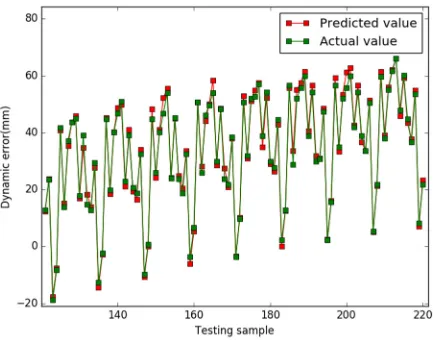
In case 1, the prediction results of three models are shown in Figures. 1, 2 and 3, respectively.
239
240
Figure 1. Predicted results of the NAPSO-SVM (case1)
241
To make a fair comparison, the maximum generation, population size, minimum fitness value,
242
range of gains, dimension of search space and initial positions are identical for all the algorithms. The
243
maximum number of generations is 100, the minimum fitness value is 0.1, the size of the population
244
is 100, and the dimension of the search space is 2. The parameters for NAPSO were set as follows: the
245
inertia weight
w
=
0
.
9
, the acceleration constantc
1 andc
2 are 2, the initial temperature is246
10000℃, the lower limit of temperature is 1℃, the maximum value of velocity is 1, the minimum
247
attractiveness is 0.8, the maximum value of attractiveness is 1.0, the value of initial step size factor is
249
0.5. The PSO algorithm has the same inertia weight and acceleration constant as the NAPSO
250
algorithm.
251
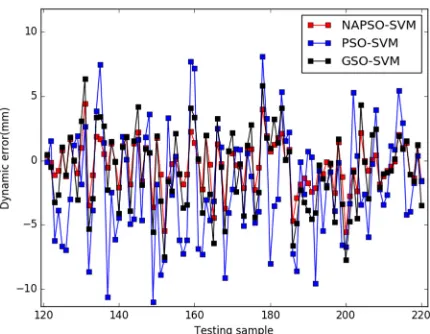
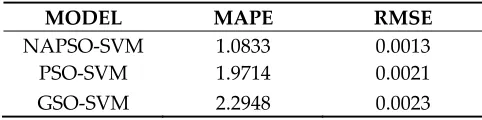
Figure.4 presents the comparison results of predicted residuals by the three models. The MAPE
252
value and RMSE value of the three models are listed in Table 2.
253
254
Figure 2. Predicted results of the PSO-SVM (case1)
255
256
Figure 3. Predicted results of the GSO-SVM (case1)
257
258
Figure 4. Comparison of three models for predicted residuals (case 1)
By comparing Figures. 1-3, we find that the NAPSO-SVM model outperforms the PSO-SVM and
260
GSO-SVM model. The prediction performance of NAPSO-SVM is better than GSO-SVM model and
261
accuracy much better than PSO-SVM.
262
The residual curves of the three models are shown in the Figure. 4, The prediction residual curve
263
of the PSO-SVM model is large, ranging from -11 to 8'', and the prediction residual of the GSO-SVM
264
model is smaller than the PSO-SVM model. But it is still relatively large, ranging from -8 to 6''. The
265
predicted residual of the NAPSO-SVM is smaller than the others and tends to more gentle, ranging
266
from -5 to 4''.The results prove that dynamic measurement error prediction ability of NAPSO-SVM
267
model is better than PSO-SVM and GSO-SVM model, and the NAPSO algorithm is an effective
268
method for parameters optimization.
269
To further verify the ability of the three models. Table 2 lists the comparison results between the
270
three models for prediction accuracy indexes.
271
Table 2. Comparison of the index value among the three models (case 1).
272
MODEL MAPE RMSE
NAPSO-SVM 0.0744 0.1879
PSO-SVM 0.2423 0.4710 GSO-SVM 0.1493 0.3128
In Table 2, the MAPE value and RMSE value of the NAPSO-SVM model are smaller than the
273
PSO-SVM and GSO-SVM model. The MAPE value is approximately 0.0744 for NAPSO-SVM model
274
compared with approximately 0.2423 and 0.1493 for the PSO-SVM and GSO-SVM model, respectively.
275
Furthermore, the RMSE value is 0.1876 in the case of NAPSO-SVM model. Compared with the
276
NAPSO-SVM model, the RMSE value of the GSO-SVM model and PSO-SVM model are 0.4710 and
277
0.3128 respectively. In summary, the results of the Table 2 are accorded with the Figure. 4, the
278
NAPSO-SVM model has the best dynamic measurement error prediction ability among the three
279
methods.
280
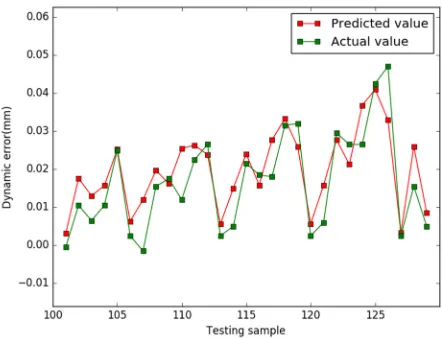
In case 2, the parameters of each algorithm are essentially the same as the previous case, the
281
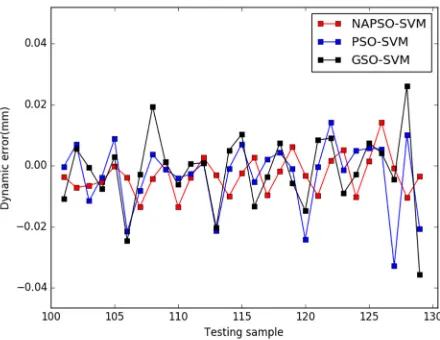
prediction results of three models are shown in Figures.5, 6 and 7. Figure.8 shows the comparison
282
results of predicted residuals by three models. The MAPE value and RMSE value of the three models
283
are listed in the Table 3.
284
285
Figure 5. Predicted results of the NAPSO-SVM (case 2)
286
In Figures.5-7, when the ratio of training samples and testing samples is approximately 3.5, the
287
prediction curve of the NAPSO-SVM model is closest to the actual value curve, and the prediction
288
curve of the NAPSO-SVM model is approximately the same as the actual value curve. However,
289
unlike the case 1, The prediction results of the PSO-SVM model is better than the PSO-SVM model,
290
292
Figure 6. Predicted results of the PSO-SVM (case 2)
293
294
Figure 7. Predicted results of the GSO-SVM (case2)
295
296
Figure 8. Comparison of the predicted residuals of the three models(case2)
297
In Figure.8, the prediction residual of the NAPSO-SVM model is smallest among the three
298
models, ranging from -0.013 to 0.014 mm. The prediction residual of the GSO-SVM model is ranging
299
from -0.035 to 0.026 mm, and the prediction residual of the PSO-SVM model is ranging from -0.032
300
Table 3. Comparison of the index value among the three models (case 2).
302
MODEL MAPE RMSE
NAPSO-SVM 1.0833 0.0013
PSO-SVM 1.9714 0.0021 GSO-SVM 2.2948 0.0023
As Table 3 shows, the MAPE value is approximately 1.0833 for the NAPSO-SVM model
303
compared with approximately 1.9714 and 2.2948 for the PSO-SVM model and GSO-SVM model.
304
NAPSO-SVM model has the smallest RMSE value of the three algorithms, acquiring RMSE value of
305
0.0013 and the RMSE values of the PSO-SVM model and GSO-SVM model are 0.0021 and 0.0023,
306
respectively. The prediction ability of the NAPSO-SVM model is clearly better than the other models,
307
and GSO-SVM model has the worst performance.
308
The results of the two cases show that the NAPSO-SVM model has the best prediction accuracy
309
among the three methods. This indicate that the NAPSO algorithm has the better capability of global
310
search than the other two algorithm, the reason is that the updating of the position and velocity of
311
the particles in the PSO algorithm are dependent too much on current best particle. Compared with
312
the PSO algorithm, the NAPSO algorithm uses the simulated annealing and natural selection
313
mechanism, it is easier jump out of the local trap and search the global optimal solution in the global
314
space.
315
6. Conclusions
316
Dynamic measurement has been a hot area of research for several years, and dynamic
317
measurement error prediction is an useful method to improve the sensor measurement accuracy. In
318
this study, a method of dynamic measurement error prediction based on NAPSO-optimized SVM
319
parameters is proposed. To improve the prediction accuracy, the NAPSO algorithm is used to
320
optimize the SVM parameters to avoid the problems of “over-fitting” and “under-fitting” of SVM.
321
The results of the two cases show that compared with the PSO-SVM and GSO-SVM model, the
322
NAPSO-SVM model has the better prediction accuracy. The proposed method provides a new way
323
for predicting the sensor’s dynamic measurement error and has definite value for application in
324
dynamic measurement. However, like the standard PSO, NAPSO has the intrinsic property
325
randomness. In the future, we plan to study which is the more effective method for improving the
326
prediction results.
327
Acknowledgments: The work was supported in part by the National Natural Science Foundation of China (Nos.
328
51305407, 61571104).
329
Author Contributions:. M.J. and L. J. were the main designers of the proposed scheme and wrote the paper. F.L.
330
focused on the research, and part of the paper writing, D.J. and H.S. revised the paper and analyzed the results.
331
Conflicts of Interest: The authors declare no conflict of interest.
332
References
333
1. Yakovlev, V.T. Method of Determining dynamic Measurement Error Due to Oscillographs. Measurement
334
Techniques1987, 30, 331-334.
335
2. Chen, Y. Area-Efficient Fixed-Width Squarer with Dynamic Error-Compensation Circuit. IEEE Transactions
336
on Circuits and Systems II: Express Briefs2015, 62, 851-855.
337
3. Yakovlev, V.T.; Collins, E.; Flores, K.; Pershad, P.; Stemkovski, M.; Stephenson, L. Statistical Error Model
338
Comparison for Logistic Growth of Green Algae (Raphidocelis subcapitata). Applied Mathematics Letters
339
2017, 64, 213-222.
340
4. Trapero, J.; Kourentzes, N.; Martin, A. Short-term solar irradiation forecasting based on dynamic harmonic
341
regression. Energy2015, 84, 289-295.
342
5. Yang, H.; Zhang, L.; Zhou, J.; Fei, Y.; Peng, D. Modelling of dynamic measurement error for parasitic time
343
grating sensor based on Bayesian principle. Guangxue Jingmi Gongcheng/Optics and Precision Engineering
344
2015, 24, 2523-2531.
6. Ge, L.; Zhao W.; Zhao, S; Zhou, J. Novel error prediction method of dynamic measurement lacking
346
information. Journal of Testing and Evaluation2012, 40, n1.
347
7. Barbounis, T.G.; Theocharis, J.B. A locally recurrent fuzzy neural network with application to the wind
348
speed prediction using spatial correlation. Neurocomputing2007, 70, 1525-1542.
349
8. Sasikala, S.; Balamurugan, S.; Geetha, S. A Novel Memetic Algorithm for Discovering Knowledge in Binary
350
and Multi Class Predictions Based on Support Vector. Machine.Applied Soft Computing Journal2016, 49,
407-351
422.
352
9. Malvoni M.; De G.; M, G.; Photovoltaic Forecast Based on Hybrid PCA–LSSVM Using Dimensionality
353
Reduced Data. Neurocomputing2016, 211, 72-83.
354
10. Wang X.; Kang M.; Fu X.; Li C. Predictive Modeling of Surface Roughness in Lenses Precision Turning
355
Using Regression and Support Vector Machines. International Journal of Advanced Manufacturing Technology
356
2016, 87, 1273-1281.
357
11. Suganyadevi, M.; Babulal, C. Support Vector Regression Model for the Prediction of Loadability Margin of
358
a Power System. Applied Soft Computing2014, 24, 304-315.
359
12. Kennedy J.; Eberhart R. Particle Swarm Optimization. In Proceedings of the First IEEE International
360
Conference on Neural Networks, Perth, Australia,1995;pp, 1942-1948.
361
13. Liu Y. Study on an Improved PSO Algorithm and its Application for Solving Function Problem.
362
International Journal of Smart Home2016, 10, 51-62.
363
14. Zhong Y.; Ning J.; Zhang H. Multi-agent Simulated Annealing Algorithm based on Particle Swarm
364
Optimisation Algorithm. International Journal of Computer Applications in Technology2012, 43, 335-342.
365
15. Zainal N.; Zain A.; Radzi N.; Glowworm Swarm Optimization (GSO) for optimization of machining
366
parameters. Journal of Intelligent Manufacturing2016, 27, 998-1006.
367
16. Jiang M.; Luo J.; Jiang D.; Xiong J.; Song H.; Shen J. A Cuckoo Search-support Vector Machine Model for
368
Predicting Dynamic Measurement Errors of Sensors. IEEE Access2016, PP, 99.