ISSN(Online): 2319-8753 ISSN (Print): 2347-6710
I
nternational
J
ournal of
I
nnovative
R
esearch in
S
cience,
E
ngineering and
T
echnology
(A High Impact Factor & UGC Approved Journal) Website: www.ijirset.com
Vol. 6, Issue 8, August 2017
Improving Network Lifetime by Using
Analytic Model
in Wireless Sensor
Networks
1
Dr.K. Suresh Babu, 2S.Prasannalaxmi 1
Assistant Professor, Department of CSE, School of Information Technology, JNTUH, Kukatpally, Hyderabad, India
2
M.Tech Student, Department of CSE, School of Information Technology, JNTUH, Kukatpally, Hyderabad, India
ABSTRACT: In Wireless sensor networks, the sensors are connected with the devices to observe their performance anddata. The Wireless sensor network, the energy consumed by the resources are measured across the remotelocation (base stations).There are varied performance metric used like network life to evaluate battery poweredsensor nodes.These nodes transfer the information packets from one station to a different. Because of energy hole in wireless sensornetwork, the entire network gets disabled. This technique determines the boundary of energy hole in information gatheringwireless sensor network and estimate the traffic load, energy consumption and lifetime of sensor nodes throughout theentire network lifetime. Thissystem defines the analytical model to balance the energy consumption and improve thenetwork lifetime.
I. INTRODUCTION
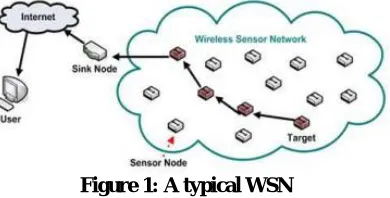
Wireless sensor Network (WSN) may be a collection of sensor nodes that are placed geographically in a very distributed environment. The nodes within the network are capable of performing sensing. Usually they capture information from surroundings and send to base station or sink. The sensor nodes so play important role in several world applications like temperature watching, surveillance, home monitoring, learning life environment besides serving different civilian and military purposes. A typical WSN appears as shown in Figure 1. The network may be connected to Internet servers and so individuals from remote places will view information collected by sensor network. Theproblem with such devices in WSN is that they need restricted energy with batter power;once energy is completed, a sensor node gets changed. So the lifetime of the network goes down drastically.
Figure 1: A typical WSN
ISSN(Online): 2319-8753 ISSN (Print): 2347-6710
I
nternational
J
ournal of
I
nnovative
R
esearch in
S
cience,
E
ngineering and
T
echnology
(A High Impact Factor & UGC Approved Journal) Website: www.ijirset.com
Vol. 6, Issue 8, August 2017
requirement for evaluating network life time and evolution of energy hole. As energy holes drain the energy of WSN, this study assumes significance. However, since the nodes close to the sink should forward the information packets from different nodes, they exhaust their energy quickly, resulting in an energy hole round the sink. As a result, the whole network is subject to premature death as a result of its separated by the energy hole. There are many existing works finding out the energy consumption and network time period analysis for WSNs. Most of them target the period from network data format to the time once the primary node dies (i.e., 1st Node Died Time, FNDT), about to improve the network performances and optimize the FNDT. although most of existing works are effective to estimate FNDT, the amount from FNDT to the time once all the sensor nodes are dead or the network is completely disabled (i.e., All Node Died Time, ANDT) is relatively long .For most applications, little portion of dead nodes may not cause a network failure, though they'll impact the network performances Energy hole is crucial and difficult for time period analysis in WSNs, as a result of it will cause a premature death of the network.Olariu et al. 1st prove that the energy hole drawback is inevitable within the WSN below some specific conditions. Perillo et al. analyze in what condition the energy holes may appear. Rahim et. al. discuss the load balancing techniques to mitigate energy hole drawback in large- scale WSNs, and propose a distributed heuristic answer to balance the energy consumption of sensor nodes by adjusting their transmission power. The energy hole drawback has additionally been studied in cluster-based WSNs. Most of the prevailing works, that energy hole locates round the sink, and style energy-efficient routing protocols to mitigate the unbalanced energy consumption and prolong the network lifetime. However, recent investigations mean that energy hole doesn't always emerge near the sink and extremely depends on some network parameters, like the energy consumption model and transmission vary of sensor nodes. However, theoretic analysis isn't provided in existing works to estimate the emerging time and location of the energy hole, also as its evolution method.
II. RELATED WORK
ISSN(Online): 2319-8753 ISSN (Print): 2347-6710
I
nternational
J
ournal of
I
nnovative
R
esearch in
S
cience,
E
ngineering and
T
echnology
(A High Impact Factor & UGC Approved Journal) Website: www.ijirset.com
Vol. 6, Issue 8, August 2017
an application specific, complementary and ultra-low power detector. The experimental results and simulations prove that this study will guarantee survivability of energyinefficient sensor networks. This paper exploits these techniques to require advantage of the advantages to increase the lifetime of the network whereas maintaining similar (or improved) security.
III. FRAME WORK
In this section, we tend to in theory estimate the traffic load andenergy consumption of detector nodes, similarly because the periodof each network stage supported our system model.
Fig: 1. Description of the entire process of network lifetime
The main plan of the analytic model is represented asfollows. We have a tendency to initial divide the network into variety of tinyregions wherever the nodes have similar distances to the sink.Since the energy consumption of the detector nodes within the sameregion (i.e., with the similar distances to the sink) should bethe same from a statistical purpose of read, we use the commonenergy consumption of this region because the nodal energyconsumption of this
region. Fig. 2 shows a sector zone of thenetwork, wherever Ax could be a region with the width of ε and θ is that
theangle shaped by Ax and therefore the sink. The nodes’ distances to thesink in Ax equal or are near x. Since the nodal transmissionradius is r, Ax is meant to forward the information from Ax+rwhosedistance to Ax is r. Likewise, Ax+rrelays
the information from Ax+2r.However, if the divided region is comparatively large (i.e., ε isrelatively large), the energy
consumption of the sensor nodesin it can't be balanced. On the opposite hand, if the dividedregion is just too small, there can be no node during this region.
Fig: 2 Dataforwarding model
3.1 Traffic Load Analysis at S0 indicates a stage once no node dies, and therefore is that the mostimportant stage with the simplest performance. We initial analyzethe traffic load of sensor nodes supported our analytic modeldescribed higher than, by the subsequent theorem.
3.2 Energy Consumption Analysis at S0 and Estimation of l0The traffic load of detector nodes at S0. If every
information packet contains τ bits, the totalamount of transmitted information is PX0τ. During this paper,
energyconsumption for network management isn't thought of since it'salmost a similar for every node and comparatively tiny in greedygeographic routing. Therefore, we have a tendency to confirm the energyconsumption of detector nodes at S0 within the following theorem.The energy consumption of node j consists of the subsequentthree elements:
ISSN(Online): 2319-8753 ISSN (Print): 2347-6710
I
nternational
J
ournal of
I
nnovative
R
esearch in
S
cience,
E
ngineering and
T
echnology
(A High Impact Factor & UGC Approved Journal) Website: www.ijirset.com
Vol. 6, Issue 8, August 2017
3.3 Estimation on Traffic Load, Energy Consumption andNetwork lifetime from S1 to Sk-1
In the previous subsections, we've determined the trafficload and energy consumption of detector nodes at S0. In thissubsection, we have a tendency to analyze the traffic load and energyconsumption of the sensor nodes once S0, which iscomplicated as a result of network routing methods changedynamically once S0.At first, we should always decide that that a part of sensor nodes diefirst. In step with the sensor nodes with the utmost energyconsumption can die initially. In step with our analytic model,the energy consumption of the sensor nodes during a region withwidth of ε are a similar and therefore the energy consumption of theregions with a similar distance to the sink should be a similartoo. Therefore, the network is divided into variety ofring regions with similar energy consumption and therefore the widthof
ε.
3.4 Energy Hole and Network Characteristics 3.4.1Analysis on the Energy Hole Evolution
In this section, we have a tendency to investigate the temporal and spatialevolution of energy hole supported our analytical result. Thetraffic load and energy consumption of the sensor nodes andthe network period of time are determined, where thetermination condition is that the sink cannot receive any informationin a information amount, that consists of 2 cases. One is all nodesdie as a result of energy exhaustion. the opposite is a few nodes stillhave remaining energy, however the sink is separated from theouter nodes once the formation of the energy hole. Thus, evenif the network still has remaining energy, the networkbecomes useless and is additionally thought of as disabled.
3.4.2 Observation on Network characteristics
The higher than analysis provides a comprehensive answer todetermine the traffic load, energy consumption, and networklifetime, similarly because the energy hole boundary for a WSN;Based on these analytical results, we have a tendency to conclude 2observations on network characteristics as follows.
(1)If the sensor nodes are uniformly deployed within thenetwork, the node density has no impact on theFNDT. In step with our analytical results, FNDTdepends on most nodal energy consumption atS0, whereas nodal energy consumption is decidedby the traffic load of sensor nodes. Consistent withThm. 1, traffic load is unrelated to node density,which proves that node density has very little impact ontraffic load. It additionally indicates that it's useless toimprove the period of time by increasing the node density.
(2)There exists a best transmission vary r tomaximize the network lifetime. In step with thm 1,the transmission varies of the detector nodes r directlyimpacts the traffic loads of detector nodes, whichdetermines the energy consumption and lifetime ofthe network. Therefore, we will set the besttransmission vary r for the detector nodes tomaximize the network lifetime. Since networklifetime is estimated under a needed deathratio in the middle of Corollary, and therefore the choices of r are restricted,the best r is found to maximize li% withbrute-force testing.Here density management protocol is introduced for reducing theenergy consumption and increase the network lifetime.Itconsists of that the node density will increase means that networkcoverage are going to be lesser and therefore the node density decreases means thatnetwork coverage are going to be higher.Due to the method,we canreduce the energy consumption and increase the lifetime ofthe sensor network. Density management during a wireless sensornetwork refers to the method of deciding that node iseligible to sleep (enter power-saving mode) once randomdeployment to conserve energy whereas holding networkcoverage. A replacement density management protocol that desires nolocation data; It attemptsto approach a bestsensor choice pattern that demands the smallest amount range ofworking (awake) sensors;
IV. EXPERIMENTAL RESULTS
ISSN(Online): 2319-8753 ISSN (Print): 2347-6710
I
nternational
J
ournal of
I
nnovative
R
esearch in
S
cience,
E
ngineering and
T
echnology
(A High Impact Factor & UGC Approved Journal) Website: www.ijirset.com
Vol. 6, Issue 8, August 2017
V. CONCLUSION
Proposed system performsplanning to overcome the network traffic load, reduce energy consumption, and lifetime of sensor nodes in a very information assortment. During this system, we've evaluated the network lifetime under failing nodes, and analyzed the rising time and placement of energy hole, similarly as its evolution method. Additionally to the present, two network characteristics are found supported our analytic results, which might be leveraged to guide the WSN design and optimization. Our simulation results demonstrate that the planned analytic model will estimate the network lifetime and energy hole evolution method inside an error rate smaller than five-hitter. Finally, we've applied our analytic results to WSN routing. Proposed routing scheme is leads to results of with efficiency balance the energy consumption and increase the network lifetime.
REFRENCES
[1] Y. Tung et al., “The generic design of a high-traffic advanced metering infrastructure using zigbee,” IEEE Trans. Ind. Informat., vol. 10, no. 1, pp. 836–844, Feb. 2014.
[2] C. Tung et al., “A mobility enabled inpatient monitoring system using a zigbee medical sensor network,” Sensors, vol. 14, no. 2, pp. 2397–2416, 2014.
[3] C. Caione, D. Brunelli, and L. Benini, “Distributed compressive sampling for lifetime optimization in dense wireless sensor networks,” IEEE Trans. Ind. Informat., vol. 8, no. 1, pp. 30–40, Feb. 2012.
[4] M. Magno, D. Boyle, D. Brunelli, E. Popovici, and L. Benini, “Ensuring survivability of resource intensive sensor networks through ultra-low power overlays,” IEEE Trans. Ind. Informat., vol. 10, no. 2, pp. 946–956, May 2014.
[5] J. Ren, Y. Zhang, and K. Liu, “An energy-efficient cyclic diversionary routing strategy against global eavesdroppers in wireless sensor networks,” Int. J. Distrib. Sensor Netw., vol. 2013, pp. 1–16, 2013.
[6] Q. Chen, S. Kanhere, and M. Hassan, “Analysis of per-node traffic load in multi-hop wireless sensor networks,” IEEE Trans. Wireless Commun., vol. 8, no. 2, pp. 958–967, Feb. 2009.
[7] J. Li and G. AlRegib, “Network lifetime maximization for estimation in multihop wireless sensor networks,” IEEE Trans. Signal Process., vol. 57, no. 7, pp. 2456–2466, Jul. 2009.
[8] Y. Chen and Q. Zhao, “On the lifetime of wireless sensor networks,” IEEE Commun.Lett., vol. 9, no. 11, pp. 976–978, Nov. 2005.
[9] Z. Cheng, M. Perillo, and W. Heinzelman, “General network lifetime and cost models for evaluating sensor network deployment strategies,” IEEE Trans. Mobile Comput., vol. 7, no. 4, pp. 484–497, Apr. 2008.