Raspberry Pi Based Remote Lab
Implementation
Darshana D. Magdum 1, Dr. L.K.Ragha 2 , R.D.Patane3
P.G. Student, Department of Electronics Engineering, Terna Engineering College, Nerul, Navi Mumbai, India1
Professor, Department of Electronics Engineering, Terna Engineering College, Nerul, Navi Mumbai, India 2
Head, Department of GeneralEngineering, Terna Engineering College, Nerul, Navi Mumbai, India3
ABSTRACT: This paper presents a new design of remote laboratory multiuser based embedded web server that is used for the lab microcontroller system. Architecture of Remote Lab System consists of a computer server, one experiment module microcontroller system and embedded web server for controlling lab modules. The computer server is used as a web server remote lab that serves as a homepage and user management. Embedded web server serves as the user interface to control the lab module microcontroller via the internet. The propose of the system is the remote laboratory architecture is multi user, so that it can be used by more than one user.
KEYWORDS:ARM, AVR, Embedded server, LAB View, Raspberrypi
I. INTRODUCTION
Because of the rapid development and expansion in the field of internet and microprocessors the application performed by those to the end user also kept on increasing and demanding .This paper is on such issues of remotely programming microcontrollers, where a prototype of remote lab is setup with the help of Raspberrypi which can program any microcontrollers attached to it if it is specified and setup properly. This paper also comes up with a design solution of an embedded web-based remote monitoring system for the environment in the laboratories, which realizes the local management and remote publishing applications for large scale dynamic data of sensor networks. The design proposed in this paper is expected to answer the issues often raised in the implementation of the remote lab. The remote labs find much application in industrial and educational institutions. It’s advantages over conventional PC servers are explained below.
Implementation on Embedded Web Server for the remote lab will provide advantages like cost effectiveness because the required hardware is cheaper when compared to using a PC server and software is built on open source utilities and the power required is very optimum since the system is running on minimum requirements and the dimension of equipment are also smaller providing easy installation and maintenance.
Remote labs can be multiuser, so that at an instant multiple users can log onto to the system and through proper context switching all can access the system resources depending on processing speed of processor and the number of experimental module installed.
II. LITERATURE SURVEY
The embedded web server has the advantages over the traditional remote monitoring system. A. IOT [internet of Things][2]
1. The Internet of Things (IoT) is defined as an integrated part of the future Internet, which ensures that ‘things’ with identities can communicate with each other.
1. In GSM Bluetooth based remote monitoring system there is restriction of distance 2. But it is not efficient in situations which have strong real time requirements
3. Also in GSM-Bluetooth monitoring system there is no stability also it’s not a real time system. C. PC based monitoring system [3]
Pc based remote monitoring system has drawback high cost, unsatisfactory stability and reliability. Moreover in the Client/Server architecture, the maintenance burden on the server would be heavy because some particular monitor software should be installed on each remote monitor terminal. In various Internet applications based on client server architecture, it is better to use embedded WEB server other than PC server for decreasing volume, cost and power consumption.
D. Proposed Work [1][9]
To overcome the disadvantages of GSM and Bluetooth based remote lab implementation , we are going to implement the remote lab implementation on embedded web server. The embedded web server which can control and monitor The remote lab implementation on embedded web server has advantages like cost effectiveness, easy to install and require less power.
III. SYSTEM HARDWARE
A new design of remote laboratory multiuser based embedded web server. Architecture of Remote Lab System consists of a computer server, experiment module microcontroller system and embedded web server for controlling lab modules.
The computer server is used as a web server of remote lab that serves as a homepage and user management. Embedded web server serves as the user interface to control the lab module microcontroller via the internet. The novelty of the implemented system is multi user.
The central processing unit is a raspberrypi board consisting of ARM cortex A-8 processor. The general framework of remote lab can be classified into two. The remote monitoring system consisting of various sensors whose calibrated values can be published on the LCD and the expansion board which can be programmed remotely which is the Arduino uno in this design. The remote labs find much application in industrial and educational institutions.
A.Raspberry pi
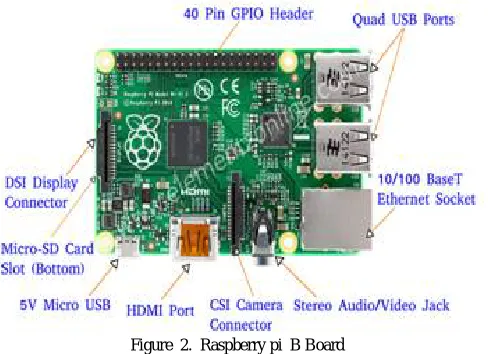
Raspberry Pi is a single-board computer developed in the UK by the Raspberry Pi Foundation with the intention of promoting the teaching of basic computer science. The original Raspberry Pi is based on the Broadcom BCM2835 system on a chip (SoC), which includes an ARM1176JZF-700 MHz processor, VideoCore IV GPU, 512Mb of RAM.
Figure 2. Raspberry pi B Board
More GPIO. The GPIO header has grown to 40 pins, while retaining the same pin out for the first 26 pins as
the Model A and B.
More USB. We now have 4 USB 2.0 ports, compared to 2 on the Model B, and better hot plug and over current behavior.
Micro SD. The old friction-fit SD card socket has been replaced with a much nicer push-pull micro SD version.
Lower power consumption. By replacing linear regulators with switching ones we’ve reduced power
consumption between 0.5W and 1W.
Better audio. The audio circuit incorporates a dedicated low-noise power supply.
B. Arduino Uno
High Performance 8-Bit MCU RISC Architecture
– 32 Registers
– 2-Address Instructions – Single Cycle Execution Low Power
Large linear address spaces
On-chip in-system programmable memories
C.SENSORS
The LMT01 series are precision integrated-circuit temperature devices with an output voltage linearly proportional to the Centigrade temperature. The LMT01 device has an advantage over linear temperature sensors calibrated in Kelvin, as the user is not required to subtract a large constant voltage from the output to obtain convenient Centigrade .
The DHT22 is the series of humidity. Humidity is the presence of water in air. The amount of water vapour in air can affect human comfort as well as many manufacturing processes in industries. The presence of water vapour also influences various physical, chemical, and biological processes. Humidity measurement in industries is critical because it may affect the business cost of the product and the health and safety of the personnel. Hence, humidity sensing is very important, especially in the control systems for industrial processes and human comfort. The FC28 is the series of Moisture sensor. Moisture sensors measure the volumetric water content in soil.
IV. SYSTEM SOFTWARE
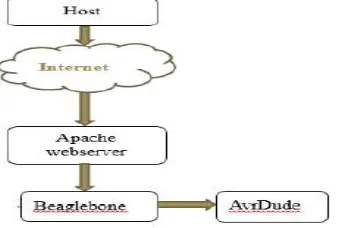
Raspberry PI is configured as server which has the capability to program the Arduino using AVRDUDE installed on it. Raspberry PI is ported with raspbian jessie OS based on Linux Kernel, Firmware of Raspberry PI controller is written in python. On the Client side a software application created using Labview which connects to the server and capable of transferring hex file to the server and Communication commands for certain actions of the server through TCP/IP Protocol.
Figure 3. Remote programming system overview
LabVIEW is an integrated development environment designed specifically for engineers and scientists. LabVIEW is a graphical programming language (G) that uses a dataflow model instead of sequential lines of text code, empowering you to write functional code using a visual layout that resembles your thought process. This means you spend less time worrying about semicolons and syntax and more time solving the problems that matter.
transmits the hex file and once its successfully done socket connection is closed
2. Client can send program command to the server and server Initiates the programming of Arduino using AVRDUDE which in turn uses concept of Bit Banging, converting GPIO lines of the raspberry PI into SPI lines and programs the arduino using ICSP lines
3. Client application is Event based which connects to the server only when transmit button click event happens or program button click event happen.
4. Number of Devices can be connected to the Raspberry PI but limited by the number of GPIO lines available on the PI.
B. Features of the Implemented system:
1. Client is able to connect to the server on port 8888 with server IP details and instructs the server to program the Arduino devices connected to it.
2. Multiple clients can be connected to the server and Multiple devices can be programmed accordingly
3. The communication is over the TCP/IP Protocol but for this project the server as well as the client has to be in the same network.
V. EXPERIMENTAL RESULT
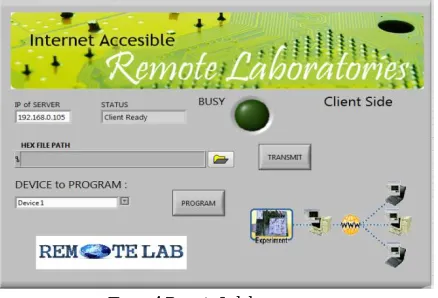
In this project the server is always On which has the constant IP for that particular network .which we are using and we will get to know the IP of server .Once user is ready with the hex file which they want to burn in device they will use. The client application created using LABVIEW and communicate with the server to dump the hex file to the controller. To see their behavior and working of the remote laboratories.
Figure 4:Remote Lab home page
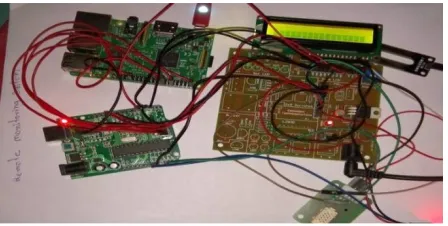
Figure 5:Experimental setup of remote lab
VI. CONCLUSION
An embedded web server thereby reducing the implementation cost, power consumption, boot-up and runtime. Also result shows that the system designed realizes safe, less time consumption, user-friendly and convenient remote monitoring and local management of the environment in laboratories and has high availability, reliability and popularization.
REFERENCES
[1]Darshana Magdum, Dr. L. K. Ragha, Mr. R. D. Patane, “Implementation of Remote Lab on Embedded Web Server” International Journal of Innovative Research in computer and communication Engineering Volume 5,Issue 4,April 2017.
[2] Ivan Ganchev, Zhanlin Ji, M´airt´ın O’Droma “A Generic IoT Architecture for Smart Cities” ISSC 2014 / CIICT 2014, Limerick, June 26–27 [3] Vini Madan , S.R.N Reddy “GSM-Bluetooth based Remote Monitoring and Control System with Automatic Light Controller” International Journal of Computer Applications (0975 – 8887) Volume 46– No.1, May 2012 .
[4] Arkhomenko Anzhelika, Gladkova Olga, Eugene Ivanov, Aleksandr Sokolyanskii, Sergey KursonP “Development and Application of Remote Laboratory for Embedded Systems Design” 978-1-4799-7839-7/15/$31.00 ©2015 IEEE
[5] Alexander P J, N. Radhakrishnan “Remote Lab Implementation on an Embedded Web Server” 2015 International Conference on Circuit, Power and Computing Technologies [ICCPCT], 2015.
[6] Martin Kalu´z, L’ubosˇ Cˇ irka and Miroslav Fikar “Simplifying the Implementation of Remote Laboratories in Educational Environments Using Industrial Hardware” 2013 International Conference on Process Control (PC) pp 18–21, 2013.
[7] Anzhelika Parkhomenko, Aleksandr Sokolyanskii, Olga Gladkova, Sergey Kurson “Investigation of Remote Lab Design Technologies” MEMSTECH 2015, pp 2-6 September, 2015.
[8]Shuang Wang; Huiyang Zhao, "Design and implementation of remote virtual network lab," Systems and Informatics (ICSAI), 2012 International Conference on , vol., no., pp.1005,1007, pg 19-20 May 2012
[9]Alexander P J, N.Radhakrishnan “Remote Lab Implementation on an Embedded web server “ 2015 International conference on circuit ,Power and computing Technologies [ICCPCT],2015