Hegemony, Habitus and Identity in Japanese University Men’s Rowing
Brent Douglas McDonald
A thesis submitted for the degree of Doctor of Philosophy
Victoria University Melbourne, Australia
STUDENT DECLARATION
I, Brent Douglas McDonald, declare the PhD thesis entitled “Hegemony, Habitus and Identity in Japanese University Rowing” is no more than 100,000 words in length, exclusive of tables, figures, appendices, references, and footnotes. This thesis contains no material that has been submitted previously, in whole or in part, for the award of any other academic degree or diploma. Except where otherwise indicated, this thesis is my own work.
ABSTRACT
Investigating the intersections between sport, education, identity and culture provides insight into commonsense understandings of the social world and hence hegemony at play. Education in Japan is highly valued and is a site of not only academic learning but also explicit and implicit moral and social education. One of the primary vehicles of this moral and social education is located in sporting practice and the multitude of sports clubs that exist within the framework of the educational curriculum. Of significance is the 'cultural curriculum' embodied in the practices of members of a university rowing club.
This thesis draws on my personal experience as a rugby player in Japan. Using the symbolic capital I accumulated allowed my ongoing involvement with a university rowing club over a period spanning almost six years. The logics and ideologies behind the practice of rowing are explored through ethnographic techniques that emerged as contact with the field grew.
Reading the Japanese body opens a new and potentially enlightening paradigm of body culture and sport. Drawing upon theoretical perspectives of Gramsci, Bourdieu, Foucault, and others provides a 'mixed bag' of analytical devices, which, when fine tuned to Japanese sensibilities, offers to make sense of the regularities of the university rower's life. In particular Bourdieu's concepts of habitus, field and capital prove powerful.
The mechanisms of reproduction of this identity and its enduring nature are of significance.
ACKNOWLEDGEMENTS
I would like to acknowledge a number of people without whom this thesis would probably never have been undertaken or finished.
Firstly I would like to thank my supervisor Chris Hallinan for encouraging me to undertake this project and for his guidance and wisdom over the past years in achieving its completion. Chris has allowed me to find my own path to completion and his patience and support during this period has been unwavering. I would also like to thank my co-supervisor Michael Burke whose support and editorial suggestions, particularly during the final write up have insightful and invaluable. Secondly I would like to thank Terry Roberts, Head of the School of Human Movement, Recreation and Performance for his continued leadership in encouraging and supporting research such as this in the field of sociology of sport. Without this departmental support it is unlikely this project would have been able to begin.
I am indebted to the support and friendship of Professor Hajime Hirai from Shiga University in Japan. Hajime's openness, suggestions and guidance was particularly welcome during my times in Japan and his insight and scholarship continues to influence my thinking on sport in Japan. I am also grateful to Shiga University graduate students who helped with the process of reflexivity during the research periods, especially Hitoshi Tanaka, whose willingness to help out was exceptional. I would like to acknowledge all those at BURC that I had the privilege of getting to know, live with and train with. The warmth and acceptance that I received at BURC will always be remembered with the fondest memories. I would especially like to mention Shigenobu Yagi for all those rowing discussions over a beer and katsu-curry and for setting up my stays in Japan.
TABLE OF CONTENTS
DECLARATION ii
ABSTRACT iii
ACKNOWLEDGEMENTS v
CONTENTS vi
LIST OF TABLES AND FIGURES ix
GLOSSARY x
CHAPTER ONE: Going To Japan
‘At a Loose End’ 1
Sport and Commonsense 4
Studying Up on Sport 6
Naturalistic Perspectives of Sport in Japan 8
Orientalism 9
Overview of an Approach to Japanese Sport in Education 12 CHAPTER TWO: Historical Influences on Japanese Education and Sport 19
Join the Club 19
Pre-Togukawan Influences 22
The Importance of Zen 25
The Togukawa Shogunate 26
Samurai Masculinity 29
Seishin and Bushidō 32
The Meiji Restoration 36
Muscular Confucianism 39
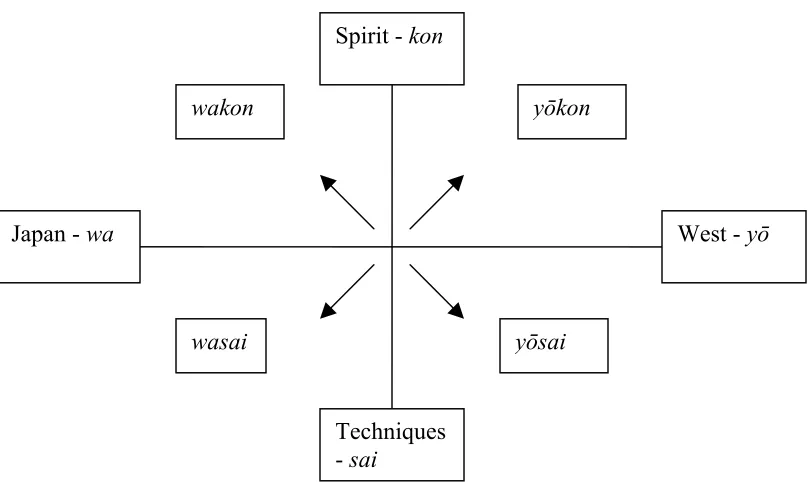
Wakon Yōsai 43
CHAPTER THREE: Sport and Education after the Pacific War 49
Modern Education 51
Moral Education 52
University 54
Sport and Education 56
Considering Conformity and Homogeneity - Breaking stereotypes 59
Sport and Club Activities 63
Sports in Japanese Universities 66
Globalisation and Change 68
Conclusion 75
CHAPTER FOUR: Methodology - Gaijin Research 77
The Ethnographic Approach 77
Constructing Rowing Reality 78
Trustworthiness in Ethnography 79
Ethnographic Setting 82 Reporting the research: Fictionalised Identities and Amalgamated Data 85
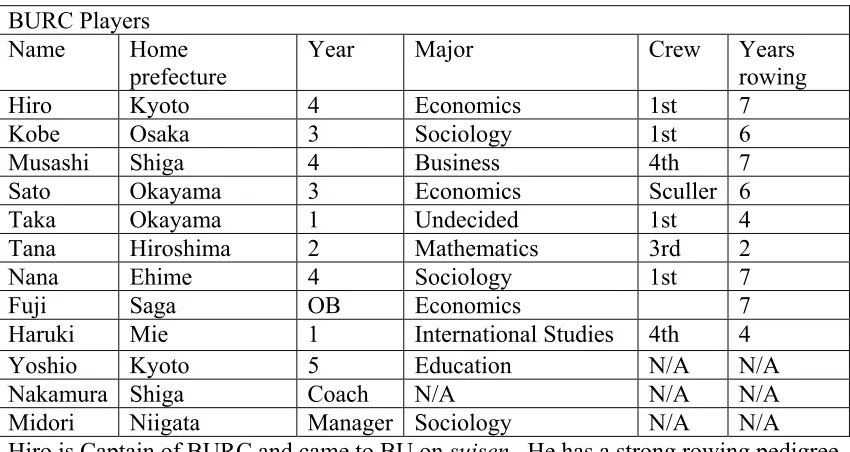
Introducing the Best Players 86
Gaijin Research - Accessing the Field 90
Accidentally in Ishiyama 92
Staying in the Field - Living at BURC 94
Multiple Gatekeepers 95
Coffee and the Research Ritual 97
Interviews - Finding the Best Players 99
Another Layer of Reflexivity 102
Confirmation - Returning to BURC 103
Emergent Methodology 105
Conclusion 105
CHAPTER FIVE: A Bourdieusian Boathouse 107
Conceptual Tools 109
Defining the Field 113
Bourdieu at BURC 114
Putting the Tools to Work – Women’s Captain Nana 116
The Rowing Habitus 119
Conclusion 120
CHAPTER SIX: Being a Member of Biwa University Rowing Club (BURC) 122
Becoming a Member – Suisenand Kindness 126
More than Just a Boathouse 129
Ningenkankei - The Dynamics of BURC 132
BURC Members – A Brief Demographic of Thoughts 135
The Women 140
Behind the Scenes 142
Once an Old Boy, Always an Old Boy 145
Natural Selection - Making the Crew 148
CHAPTER SEVEN: The Ritual of Training 154
Putting in the Hours 158
Japanese Rower/Western Boat 159
Drills and Exercises 161
Village Life - Hierarchy and Affirmation 163
Suffering and Sacrifice 166
Expectations and the Insurance Policy 169
Regatta Day 170
Nomihodai1 – Getting Drunk 175
Nomihodai2 – Getting Really Drunk 178
Leadership 180
Distinction 182
CHAPTER EIGHT: Seishin Capital 186
Valuing the Japanese Body 187
I Know Where You're Coming From 190
Self-Cultivation 192
Social Positioning 198
Seishin Capital 203
CHAPTER NINE: Hegemony and the Internalisation of the Critical Gaze 206
There’s Something About Rowing 206
Pedagogic Action 209
Discipline 211
The Panopticon 216
Keeping up Appearances Through Covert Resistance 219 Looking the part – The Cult of Paraphernalia 222 Making it Look Right – The Aesthetics of the Boathouse 225
‘Ichi, ni, yoshi’ - An Open Boathouse 230
Loyalty 231
The Enduring Effect 237
CHAPTER TEN: The Secondary Curriculum 239
Moral and Social Education 239
Levels of Power 243
Jōge kankei - Up and Down Masculinity 245
BU-dō - The Way of the BU Rower 251
Conclusion – Looking Back 254
REFERENCES 258
APPENDICES 277 Appendix 1. Basic Plan For the Promotion of Sports 277
List of Tables and Figures
Tables
Table 1. The Best Players 86
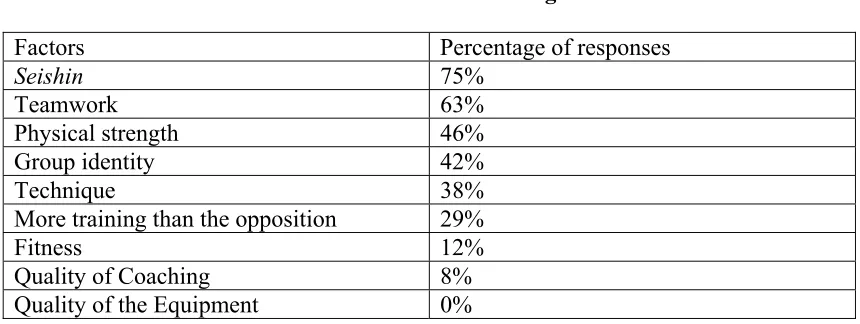
Table 2. Factors Needed for Successful Rowing 138
Table 3. Weekly Training Regime of BURC 154
Table 4. Daily Training Regime of BURC 155
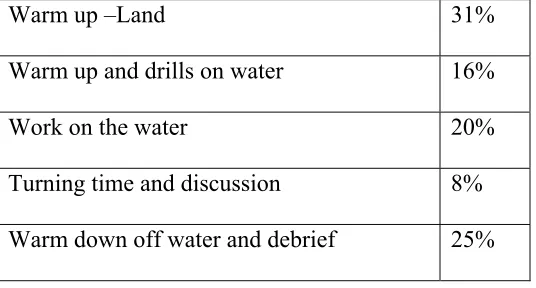
Table 5. Summary of Relative Time Spent on Each Training Component 159
Figures
Glossary
Amae dependence
BURC Biwa University Rowing Club (fictional) Bushidō the way of the samurai
ganbaru do your absolute best
Gaman endurance, perseverance Gakusei student
Giri responsibility, duty Ie traditional family system Isshokenmei give everything (regarding effort) Jōge kankei hierarchical relationships
Karada de oboeru learning through the body
Koha the embodiment of hard masculinity it is a traditional image of adolescent masculinity which combines violence, valour, and bravado with stoicism and chivalry
Kōhai junior
Kojinshugi individualism Kokoro heart
Konjō guts/courage
Kosei individuality
Kurō hardship
kyō chō cooperation magokoro sincerity makoto purity of motive
manga Japanese comic books
MEXT Ministry of Education, Culture, Sports, Science and Technology
ningenkankei human relationships
Nihon taiiku do way of Japanese physical culture Nomihodai all you can drink party
Rajio taisō group exercise to music- similar to callisthenics
Ronin literally masterless samurai, this refers to students who gain entry to university via private study, usually cram school Ryokan a traditional style hotel
Seishin spirit
seishin kunren spiritual training seishin kyōiku spiritual education
sempai one's senior
senmon gakko special vocational schools shakaijin person in society
suisen recruitment or special entry to university
wa harmony
CHAPTER ONE:
Going to Japan
The body and body culture are central to understanding sport in Japan. Indeed, the concept of 'physical' education takes on a completely different meaning when placed in a paradigm that doesn't recognise the Cartesian mind/body dualism that dominates much Western inquiry into the body. In a Japanese context the 'physical' education of the body implies the training of the 'human being, the spirit or mind by training the body' (Yuasa, 1993: 7). In other words, training of the human body has the potential of perfecting one's spirit and enhancing personality - the overriding implication being that mind and body are inseparable. With this inseparability in mind, bodily activities take on a different meaning and purpose. That is, the project of education becomes one of self-cultivation. This thesis was initially driven by a desire to make sense of Japanese sport, and to use sport as a vehicle of insight into Japanese identity and the hegemony at work in day-to-day life. One of the best ways to understand the commonsense ideology at work in everyday life is to do so through those activities that are themselves regarded as commonsense, such as sport.
‘At a Loose End’
port city of Shimizu. I had just completed a season of playing 1st Grade rugby in Australia and vividly remember arriving at training on my second evening in Japan, hoping to make an impression. I was warmly welcomed as a new member of the club. Those first months were marked by the forty minute ride through the humidity of late Summer and early Autumn along the beach front on an old 'mama chan' bike to the high school training ground. There was almost no English spoken by any of the members so we used to work out what was going on by drawing pictures and running lines in the gravel of the training ground. After the first few weeks we no longer needed to draw pictures - not because I had miraculously learnt the language, but rather because I had learnt the drills. Training was totally repetitious, physically demanding, and increasingly seemed to me (backed by my sense of cultural (rugby) superiority) to be pointless and inconsistent with developing skills and game sense. In fact, the longer I trained with the team the more confused and frustrated I became with this version of rugby. My first game seemed so far removed from my memories of my last game in Australia. I struggled with my own ethnocentrism as rather than address technical problems at training, the team went straight back into drills like the dreaded 'run, pass' exercise.
clear that the practice of rugby (and other sports) was generated from a variety of different prerogatives and influences, and that these ways of doing were reproduced at various (school, club, community) organisational levels. I finally gained full-time employment, kept playing rugby and left Japan eighteen months later intent on further and deeper understanding of what I had experienced. Returning to Australia I enrolled in another degree which had a subject titled 'Sport and Society' as a core requirement. This began an introduction to sociological thinking and methodology, and I found myself attracted to the work of Bourdieu and Gramsci and the ethnographic approach to field work.
So why is this thesis about rowing and not rugby? Prior to going to Japan I had been heavily involved in rowing both as a coach and a competitor. As is common in Australia I had grown up playing a winter (rugby) and summer (rowing) sport. I had been selected as a State representative in rowing in 1992 and continued competing up until my departure to Japan. Rowing training during the summer months typically involved six days a week and three to four hours a day. With the addition of coaching it was not uncommon to be active in the rowing environment five to six hours a day for several months at a time. Rowing as a social and physical practice was an environment in which I had great familiarity.
On returning to Australia I continued playing rugby. However, during the Summer I returned to coaching rowing. Casual coaching transformed itself into full-time employment and for the past eight years I've essentially been a fulltime rowing coach. Rowing was therefore a 'natural' sporting practice (in that I understood it on a deeper level) for me to utilise as a way in to Japanese university sporting clubs.
area for rowing in Japan. My Japanese family lived close to the river and this allowed me the ease of riding down to the river whenever I wanted to watch the crews training. I had before me somewhat a marriage of convenience between my professional skill as a rowing practitioner and the entry point of my connections in Otsu. Further rowing in Japan is produced and reproduced almost entirely within the organisational framework of education. To para-phrase TV crime shows, I had now had the motive, opportunity and weapon to commit the research.
Sport and Commonsense
From my experience in Japan sport was clearly a place where commonsense ideology was created and reproduced. Consider the following from the Japanese Ministry of Education, Sport, Culture and Technology (MOE) (2000, see appendix 1):
Apart from the life-enriching and fulfilling role of sport, it is also part of man's common culture in that it responds to an inherent human physical and mental desire. Sport as a cultural phenomenon affecting both man's physical and mental aspects is essential for the development of a happy and vigorous society and for the attainment of the individual's psychosomatic health. It is therefore of the greatest significance that people should engage in sports throughout their lives.
differences1 between the work of Foucault and Gramsci, for both ‘the concern is with a dominant ideology which becomes progressively commonsensical and taken for granted, inscribed in practice, all pervasive, (and) embodied in institutions' (Werbner, 1997: 37). Cultural reproduction through education reinforces existing power relations and ruling ideas (Bourdieu & Passeron, 1977). Furthermore, these authors believe that the pedagogic action of education (in its broadest sense) plays a significant part in the reproduction of culture and the whole social system. However, whilst the hegemonic discourses explored by Gramsci and Foucault persist over long periods of time (Werbner, 1997), change in this culture can occur. Gramsci (1971) suggests that culture is contested and therefore there is the potential for resistance or counter culture (Bourdieu & Passeron, 1977).
Clammer (1995:1-2) discusses how explanations about Japanese society usually fall in one of two camps, either those analysts who 'exclude consideration of culture as part of their framework' or the Nihonjiron (Japanese studies) who tend to exclude structure and base ideas on 'cultural uniqueness'. There was a need to construct an appropriate multi-disciplinary approach drawing from phenomenology, critical studies, symbolic interactionism, structuralism, and cultural studies so as to provide provides the tools for sufficient understanding. Further, this assemblage of concepts and vocabulary must be re-oriented toward ideas that are central to understanding Japanese society such as 'nature, body, emotions and aesthetics' (Clammer, 1995: 3) as such ideas are, in fact, peripheral to the mainstream Western usage of social theory.
Modern education and educational institutions are considered to be at the forefront of cultural reproduction through the shaping and defining of students into socially
1 Foucault's notion of discourse and micro-power is different from Gramsci's hegemony in that
functional individuals (Bourdieu & Passeron, 1977; Gramsci, 1971; Foucault, 1977). In approaching the institutional reproduction of society through the inevitable pedagogy imbedded in 'the school' we are dealing with the process of socialisation. Coakley (2003: 98) provides an understanding of the concept of socialisation as
an active process of learning and social development that occurs as people interact with one another and become acquainted with the social world in which they live, and as they form ideas about who they are, and make decisions about their goals and behaviours.
That is, the process of socialisation is a two way relationship where the human being is active rather than passive, and where there is a constant adjustment of goals and values according to a myriad of variables.
Using Bourdieu's perspectives of field, capital and habitus to overcome the opposition between agency and structure provides an opportunity to make sense of the processes involved in the socialisation of individuals in the Japanese education system. Through these processes a person learns to become a member of society, and 'with a feel for the game' reap the benefits of such membership. The forces of economics and political powers, that is the historical construction of the field, serve to reinforce and replicate the status quo of those who practice in it. The reproduction of power is especially effective within the education system (Bourdieu & Wacquant, 1992: 114-115) as the relationships of power created are simultaneously pedagogical in nature. The state of play, being inscribed in the field, is therefore replicated by the field as the players attempt to play the game to the best of their ability.
Studying up on Sport
to intersect with other sociological fields of interest. For example, sport intersects with gender, race, violence, socialisation, identity, economy, and exploitation, in some of the many emerging areas of analysis.
The study of sport in Japan has been focused on major professional sports such as Baseball (Whiting, 1977, 1990; Bikel, 1989; Hirai, 2001; Kelly, 1998; Kusaka, 1987; Loy, Curtis, & Hillen, 1987; Springwood, 1992) and Soccer (Watts, 1998; Horne & Manzenreiter, 2004), Martial Arts (Inoue, 1998), Sumo (Light & Kinnaird, 2002; Thompson, 1986, 1998; Yamaguchi, 1998; Amano, 2004). Other research has included leisure sports, participation rates (Kanezaki, 1993; Kanezaki & Hashimoto 1995; Yamaguchi, 1984) and general sports history (Guttmann & Thompson, 2001; Manzenreiter, 2001; Pempel, 1998).
of hegemonic masculinity (Light & Kirk, 1997; Light, 1999a, 1999b, 2000a, 2001). Throughout his research, Light explores the role of sport in Japanese secondary education in the construction of identity and the reproduction of ideology.
Through the utilisation of grounded theory, whereby the modes of analysis of any data gathered actually arise from the data itself (Glaser & Strauss, 1967), this thesis follows on from the work of Light’s fieldwork, empirical studies and ethnographies by extending the realm of critical sports studies into the world of university sport and the sport of rowing as an extension of the pedagogical process central to Japanese education.
Naturalistic Perspectives of Sport in Japan
Institutions are one of the major sites of cultural reproduction and hegemony. Educational institutions with their reliance on pedagogical practice are particularly strong sites for socialisation and the creation of an identity that understands the world in terms of commonsense and consent. Due to the nature of pedagogy these ‘commonsenses’ tend to be reproduced from generation to generation. Sporting clubs in Japanese University education are social and physical environments that demand high levels of student’s time and effort and as such have the potential of being significant sites for the construction of identity.
investment, and the effect of the club experience on the individual identities constructed there.
Orientalism
Edward Said (1978: 12), whilst pragmatically limiting his 'orient' to the 'near East', traces the generational construction of the orient as a concept. Said defines
orientalism as:
an elaboration not only of a basic geographic distinction but also of a whole series of "interests" which, by such means as scholarly discovery, philological reconstruction, psychological analysis, landscape and sociological description, it not only creates but also maintains; it is, rather than expresses, a certain will or intention to understand, in some cases to control, manipulate, even to incorporate, what is a manifestly different world; it is above all, a discourse that is by no means in direct, corresponding relationship with political power in the raw, but rather is produced and exists in an uneven exchange with various kinds of power, shaped to a degree by the exchange with power political (as with a colonial or imperial establishment), power intellectual (as with reigning sciences like comparative linguistics or anatomy, or any modern policy sciences), power cultural (as with orthodoxies and canons of taste, texts, values), power moral (as with ideas about what "we" do and what "they" cannot do or understand as "we" do).
The practice of Orientalism is not limited to an understanding of only the near East. Rather, as a concept it can be extended to any context outside of the Occident. Orientalism is drawn from a body of work, (itself a construction, interpretation, observation) that creates an authority of knowledge between the Occident and the Orient and in turn determines power, domination and hegemony. Said suggests that these representations offer more insight regarding Western power over, then truths about, the Orient.
As a field of discourse, the sociology of sport must also be wary of Orientalism, ethnocentrism, or as Lim (2001: 56) suggests from 'uncritically engaging in a neo-enlightenment global knowledge project of Westernisation'. Further he stresses the need for the sociology of sport to free itself from accusations of being a 'historically constructed realm of knowledge production that, in part, is rooted in Anglo-centric, andro-centric, and rationalistic cultural and political agendas' (Lim, 2001: 63). To achieve this end he recommends the need for self-reflexivity in research.
Thinking reflexively, where does an Australian researcher fit in all of this? Generally, and not without reason, modern Australia draws from Western epistemology2. However, due to historical conditions and geographical location (nearness to southernmost Asia), Australia could perhaps have the potential to offer new ways of seeing the world. The concept of globalisation in Australia could certainly have the effect of 'de-mystifying' or 'de-orientalising' Asia rapidly compared to Europe or North America. In many ways this study is born out of reflexive experience and a search to make sense of sport as culture. The methodology I employed was emergent. Ethnography can rely heavily on interview. However the various schools of ethnography and anthropology approach methodology with surprising diversity. Adler and Adler (1999) identify a multitude of varying ethnographic approaches including post modern ethnography, auto-ethnography, interpretive discourse analysis, realist ethnography, dramaturgical ethnography, grounded theory and visual sociology. Of particular salience is the notion that 'direct observation serves as the bedrock of human knowledge' (Adler and Adler, 1999: 445).
2 Legally and politically Australia draws heavily on English models. The way in which Australians
In a Japanese context how valid are interviews as a tool of inquiry3? Some interviews, despite the rapport I had (or thought I had) with the interviewee, turned out to be nothing more than monosyllabic, taciturn responses. None of those rich, symbolically loaded quotes here. However, the same individual in responding to a questionnaire wrote in detail and at length about his experiences as a BURC rower. Of course, many interviewees did provide detailed responses to questions during the four-year research period. My point is not to highlight whether people did or didn't speak, rather it is to question the hierarchy of techniques that one uses. Indeed, any hierarchy needs to be negated as it un-critically authorises more value to some forms of inquiry than to others.
The great power in being 'other' is the potential ability to see through commonsense. Just entering into an environment and opening one’s eyes can’t achieve this. If difference between one's self and the field is too great, then all that can be observed is meaningless difference because nothing can make sense. There needs to be a certain level of congruity between habitus and field. Indeed, using Bourdieu, one would require at least some capital4 to be able to enter into the field, some habitus to be able
to utilise that capital. Surely the idea should be to try at least to 'play the game', become part of the game. If you don't know the rules then playing the game will be hard to achieve. Capital that may or may not help one play the game in Japan (and in most every other case) is directly relative to the field and would include (in no particular order); age, gender, occupation, experience in the field (in this case sport),
3 Regarding the use and quality of interviews it is necessary to understand the cultural tendency to
respond in a way that maintains superficial harmony (tatemae) as opposed to expressing one's real feelings (honne). As a result interview material doesn't guarantee a representation of participants' thoughts; rather it may often represent their understanding of what they think they should say. A more detailed understanding of tatemae/honne is provided in Chapter 3.
4 Capital here refers to Bourdieu's understanding of capital being not only financial but also
ethnicity, class, previous experience (in this case living in Japan), language ability, marital status etc.
In addressing culture, Manzenreiter (1998: 370-371), insists that it is the 'total of common world experiences that provide implicit and explicit models for structuring life for a given community'. Further, he suggests that the prerequisite for understanding and proper behaviour in any contextual situation is knowledge of the 'cultural text - encoded in systems of symbols'. It is the 'complexity and compactness of the links that cohere the text' that produce the reality that something that to us is so 'absolutely strange' is 'most familiar' to those who have mastered the 'text' (Manzenreiter, 1998: 370-371). That is, one possesses enough practical mastery of the text to be able to make sense of what is going on.
One of the major goals of this research was to make sense of Japanese sporting experience without falling into ethnocentrism. In saying this, exposing commonsense logic and consensus ideology can appear as ethnocentric. However, the intention is to explain not to judge. Often in a bid to make the Japanese text comprehensible I have relied on a level of explanation that may indeed be expressing the most obvious and self evident of observations. In light of Manzenreiter's (1998: 371) explanation that in 'intercultural studies there is nothing that goes without saying' I have attempted to cover as many aspects of BURC life as possible.
Gordon (1998: 21) in his analysis of labour management styles in Meiji Japan where industrialists utilised the 'time honoured "beautiful customs" of obedience and loyalty from below matched by the sympathetic understanding from above that would suffice to solve problems such as resistance to factory discipline, low morale, or poor health'. The notion of 'we Japanese' and homogeny are very much the omote or outward expression of a collective identity that on the inside is far more diverse and heterogenous.
Overview of an Approach to Japanese Sport in Education
the leaders of a future Japan. Following the use of sport in education into the Pacific War illustrates the use of ideology to legitimate hegemony and highlights how the legitimate body can become instrumental and indoctrinated for the service of an Empire.
Chapter three utilises Government legislation, ‘white papers’ and press releases in an attempt to follow the progress of sporting clubs in education post World War II from the perspective of continued moral and social education, and in fact, as the decades pass, from a secondary curriculum intended to maintain certain forms of Japanese identity. Examination of the understanding of the group, of the importance of belonging, of social nexus and the inside/outside nature of expression, develops the concept of the individual in Japanese social interaction. Similarly common stereotypes of Japanese society usually derived from Nihonjinron, particularly those of total homogeneity and conformity, are addressed and can be perceived more as hegemonic devices that tend to deny the multiplicity of identity and diversity of existence in Japan. Finally, in introducing the modern university and the so called ‘leisure land’ experience provides an opportunity to continue with the examination of rowing clubs as sites for the development of identity, the expression of habitus and collection of capital, and the reinforcement of hegemony.
processes of over coming this otherness are pertinent. By living, eating, sleeping and training with the BURC rowers on a daily basis it becomes possible to begin to understand and embody their experiences on a deeper level. Reflexivity becomes essential, not only in positioning one's self in the field relative to those around you, but also in constantly checking for elements of generalisation, ethnocentrism and misinterpretation. Systems such as double translation, routine data recording methods, peer debriefing and confirmability, all provide useful in avoiding the pitfalls in being 'other'. Further these processes allowed for the development of the direction of inquiry, the identification of the 'best players' and the formulation of research practice.
Chapter five introduces the theoretical approach of Pierre Bourdieu, especially the concepts of habitus, field and capital. In using these 'tools' Bourdieu is able to overcome many of the problems inherent in the oppositions of dualisms such as object/subject, mind/body and agency/structure. I apply Bourdieu's tools to a small case study in the form of an interview with the captain of BURC women's club. The concept of capital (in her case physical and symbolic) is particularly important as is her 'feel for the game' or her habitus which is demonstrated by her skills of appreciation and perception, not only physically in the boat but more importantly in the social space of the boathouse. From this example it is possible to develop the notion of a 'rowing habitus' that operates to indicate the logics at work at BURC.
discussion. In particular, this chapter describes the various social groups that make up the entirety of BURC and their demographic background. Further, it investigates some of the belief systems under which members operate on a day to day basis.
Chapter seven continues the themes of the previous chapter by looking at the various rituals that mark the BURC experience. In describing these rituals the aim is to be exhaustive rather than narrow in observation and as a result description is made about everything from daily meals to celebration drinking parties; from the monotony of training to the excitement of regattas; from the use of time in training to the lack of time in studying; from individual relationships to the collective identity; from the individual to the entire collective hierarchy; and from the notion of sameness and solidarity to the belief in distinction and difference. This chapter does not attempt to discuss theoretically elements of the description. This is left for the following chapters. Throughout this chapter footnotes and other tools have been utilised to explain aspects of rowing and of my own experience, again in a reflexive way. This is not designed to be comparative rather it is to ground the direction of my observations.
and indeed the investments made up until this point in their capital development (for example belonging to the rowing club at high school). Being a member of BURC needs to be seen in the light of a continuing project of the self and not some form of past-time or hobby. Seen in this way members engage in the field with the very specific goals of developing themselves in a way that will enhance their employability upon graduation.
Chapter nine approaches the influences of being a rower from the perspective of Gramsci's notion of hegemony. It is concerned predominantly with why the rowers do what they do and uncovers the commonsense logic at work in the field of University boathouses. I have utilised Foucault's typology on creating discipline, surveillance and his reading of Bentham's panopticon to look at the boathouse from a different perspective. Further the impact of Confucian based hierarchy on the perceived choices one has options to make at any stage of their life is considered from the point of view of loyalty and the notion of shakaijin or being a person in society.
CHAPTER TWO:
Historical Influences on Japanese Education and Sport
In order to better understand Japanese education and the role of sport at the beginning of the twenty first century it is necessary to observe the influences that have shaped not only education but also concepts of the body throughout Japanese history. In examining Japan's rich and multi-dimensional history it is possible to track a pathway towards modern physical education that draws upon the tenets of Confucian thought and Buddhist philosophy. Further, it is established that there exists a connection between sport and the moral education of the individual in Japan (Light, 1999a; 1999b: Rohlen, 1983; 1986). This connection is not dissimilar to the concept of Muscular Christianity that explained the suggested value of sport in much of the Western world into the Twentieth Century (Dunning & Sheard, 1979). Understanding the way in which the body, education and sport have been constructed and interact is essential if we are to be able to make sense of the experiences of Japanese university rowers at the beginning of the twenty first century.
Join the Club
commitment required in belonging to university rowing clubs together with the near total autonomy of these clubs with respect to university control, makes for a hegemonic environment that effectively constructs the experience of membership According to Gramsci (1971) the stronger the ‘common sense’ of groups and individuals within that group, the stronger the element of hegemony. Common sense may be understood as a ‘series of stratified deposits’, an ‘infinity of traces without an inventory’ (Adamson, 1980: 150). For example, the budō-isation (Kiku, 2000 in Manzenreiter, 2001:112) of rowing in Japanese universities illustrates how many of these deposits and traces come from the early periods of rowing. Gramsci (1971) argued that ‘in short, hegemonies always grow out of historical blocs, but not all historical blocs are hegemonic’ (Adamson, 1980: 177-178). Every field of power should similarly be seen as a historical product which, as such, generates the interest of its functioning from a precondition founded in an appropriate or significant past (Bourdieu, 1990: 88).
A significant debate in the emergence of modern sociological thought has been between the concept of the individual as a totally autonomous, conscious agent capable of free choice and the structuralist position of society's priority over the individual and the reduction or complete absence of individual agency. Pierre Bourdieu's use of the concepts of field and habitus are useful here in overcoming the potentially limiting dualism between structure and agency. According to Wacquant (1992: 16), Bourdieu's concept of the field consists
Of a set of objective historical relations between positions and certain forms of capital or power while habitus consists of a set of historical relations 'deposited' within individual bodies in the form of mental and corporeal schemata of perception, appreciation, and action
of the Japanese body can be considered as influenced by the various deposits from Shinto, Buddhist and Confucian philosophy and practice that remain important in contemporary Japan. Major periods of political change such as the Tokugawa Shogunate, Meiji restoration and the end of the Pacific War highlight crucial 'historical blocs' where education and physicality (sport from post Meiji onward) are defined, contested and created. For university rowing clubs one of the historical blocs when dominant ideology was deposited was during this post Meiji period of modernisation. The Meiji restoration is significant in particular for the transference of certain values and ideologies of the Samurai classes into newly developed elite educational institutions. At a time when notions of Japanese identity were challenged by the effects of rapid modernisation, the successful universalisation and subsequent making commonsense of these values ensured there acceptance as dominant ideology as Japan leapt into the twentieth century.
of power. Indeed, it is at these levels that commonsense ideology is most effective by its very nature of operating below the level of consciousness.
Pre-Tokugawan Influences
The complex hierarchies, linguistic and psychological set up, political, social and religious dynamics that are central to understanding modern Japanese life can be grasped by examining their past. The popular view of Japan as a longstanding, unified nation is far from accurate. Prior to the establishment of Tokugawa rule in 1600, Japan had been in a constant flux of power. Power was (and still is) controlled by the use of ideologies designed to indoctrinate the general populace in attitude and values, which could assist the maintenance of the dominant hegemonies. These ideologies were sufficiently altered in order to fit with the dominant framework of the “Japanese character”. As Nakamura (1964: 400) suggests in regard to the influence of foreign thought and technology, the Japanese 'try to recognise the value of each of these different cultural elements, and at the same time they endeavour to preserve the values inherited from their own past'.
The indigenous religion of Japan is Shinto. As a religion it particularly stresses ancestor worship, is the corner stone of the unbroken imperial line, and was a primary force in Japan from 1868-1945. Whilst dating into B.C, Shinto lacked a solid ideological framework and rule based structure. In the 5th Century AD, Confucianism entered Japan from the Chinese mainland and was added to the Shinto tradition. Van Wolferen (1989: 203) suggests this ‘fitting’ between a ‘borrowed’ concept and Japanese culture by stating: 'Its precepts sanctifying a strictly hierarchical social order were blended with native practices as a justification for political organisation'. Confucianism lent itself well to feudal societies, and helped legitimise one’s place within a social framework.
Buddhism arrived as a diplomatic gift from Korea in the 6th Century AD. Nakamura (1964: 362) offers the following insight about how the ‘gift’ was received by Japanese culture,
In confronting Buddhism as an imported system of culture, the traditional Japanese culture was too weak to resist it.... It was, however, impossible for Buddhism to change completely the inclination to this worldliness for the Japanese general public. On the contrary it was the Japanese themselves that transformed Buddhism, which they accepted from the continent, into a religion centred upon this world.5
Buddhism became propagated as the national religion sometime after 592AD during the reign of Empress Suiko. Following this, the Constitution written by Prince Shotoku contains large Buddhist overtones. The Prince begins by praising the nobility of the wa (basically translated as harmony). Wa espoused 'conciliation, gentleness, accord, accommodation, mellowness, moderation, mollification, peace, pliancy, amiability, appeasement, conformity, softness, order, unison, compromise and so on'
5 According to Nakamura (1964) Indian Buddhism wishes to be delivered from this world,
(Van Wolferen, 1989: 314).6 Shinto, Buddhism and Confucianism actually served to strengthen each other. For example, being Buddhist meant rebirth into this world that strengthened the Confucian sense of loyalty as it could be applied through several lifetimes (Nakamura, 1964). Hachiman, the Shinto God of war, was transformed into a Bodhisattva of high rank. Buddhists could pray to the same figure as the Shintoists, resulting in a unifying experience.7 The point here is to identify that from the fifth century onwards, elements of thought from China and Korea had made their way to Japan and were utilised by varying ruling groups to strengthen power and maintain control over there populations. Whilst it important to note that there is no sense of Japan as a nation State or centralised government before the Tokugawa Shogunate in 1600 (van Wolferen, 1989: 35-36), the practice of assimilating foreign cultures and utilising them in a political fashion is apparent. The use of Buddhism, Confucianism and Shinto in this manner continues throughout Japanese history and into modernity though the emphasis of any of these doctrines was rarely equally balanced. Shotoku emphasised Buddhism, the Tokugawa utilised Confucian thought, and the Meiji Restoration used Shinto as a mandate for legitimation of political power. However, the imbalances in the relative importance of Buddhism, Shinto and Confucianism occurred as a direct result of political posturing by the ruling classes to maintain power. For example, in the case of Prince Shotoku, Buddhism was utilised 'to promote popular obedience' (Van Wolferen, 1989: 203).
6 “Forget resentment, forsake anger, do not become angry just because someone opposes you.
Everyone has a mind, every mind comes to a decision, and decisions will not always be alike. If he is right, you are wrong; if you are not quite a saint, then he is not quite an idiot. Both disputants are men of ordinary mind; who is decisively capable of judging an argument between them? If both are wise men or both foolish men their argument is probably a vicious circle. For this reason, if your opponent grows angry, you had better be all the more cautious lest you too should be in error. Although you might think you are quite right, it is wiser to comply with the other man.” From the seventeen article Constitution attributed to Prince Shotoku X. (Nakamura, p.383)
7 The mix of Confucian natural order blended with Buddhism was able to produce a type of Karmic
The Importance of Zen
Buddhism in Japan broke into a variety of off shoots and sects that often fell into conflict. Ryonin (1072-1132) founded the Yuzu Nembutsu Sect, Honen (1132-1212 the Pure Land Sect, Eisai (1141-1215) the Zen Sect, Shinran (1173-1262) the Jodo Shinshu Sect, Nichiren (1222-1282) the Nichiren Sect, Dogen (1200-1253) the Soto Zen Sect (Nakamura, 1964). Whilst Pure Land Buddhism gained support amongst the general populace and some smaller esoteric sects fell in and out of favour with the nobility, it was Zen that became popular with the Samurai and other fighting classes. Zen is important to understand because it fit best with Confucianism and Tao (Van Wolferen, 1989; King, 1993). King (1993) believes that some qualities of Tao are central to Zen, particularly focusing and strengthening one’s life energy through concentration of one’s basic life force, the hara (belly) and not through the senses, which cause weakness8. Dogen’s Zen emphasised that enlightenment was 'not a function of the mind but that of the body', and that in attaining the way 'one should follow a good teacher and practice in a group. Then since one is not relying on one’s own resources one naturally attains the way' (Nakamura, 1964:366:453). Being concerned with enlightenment through 'sitting in oblivion', Zen was anti-intellectual and influenced strongly by Confucian properties such as strict rules and attention to minute detail. For example, on the battlefield 'soldiers were expected to get rid of their fears and worldly concerns. (For this purpose) Zen in particular was observed as a guiding doctrine' (Nakamura, 1964: 492). Zen particularly endorsed the warrior code of Bushidō. The practice of sitting in meditation to gain tranquillity for monks became a 'method for warriors and laymen to acquire mental training'. The practice of
8 In the context of sport participation and the reproduction of cultural hegemony, Zen has particular
Zen was, and is, a quest for self-cultivation, and methods to achieve this aim have been transmitted continuously throughout Japanese history, particularly influencing the development of artistry and the martial arts (Yuasa, 1993). Hendry (1997: 122) refers to the Zen practice of zazen or sitting in meditation as being used by several Japanese companies as a training method for new employees that is 'supposed to develop one's strength, or one's spirit (seishin)'.9 Thus, not only are the ancient methods such as zazen put into use in a modern context, there is a modern day acceptance of the significance of such self-cultivation and of its philosophical underpinnings.
The Tokugawa Shogunate
In 1600 the Battle of Sekigahara ended almost 300 years of intermittent civil war and placed Tokugawa Ieyasu as Shogun over all Japan (van Wolferen, 1989: 36). The Tokugawa Shogunate proceeded to rule Japan for over 250 years10. In times of relative peace, Zen became central to the maintenance of warrior values. The Tokugawa were to rule through Confucian ideals and Zen fitted well with these ideals. To maintain the purity of the warrior code (bushidō) the Samurai emphasised detail in every formality. As peacetime lengthened warrior codes became arts and the Samurai were encouraged to perform every duty as if it were his last living action (King, 1993: 129). According to King (1993: 163), ‘truth and salvation in Zen lay
9 The practice of corporations to train new recruits in 'company culture' is not a uniquely Japanese
phenomenon. Exercises that involve corporate jargon such as team building, problem solving, and work shopping are prevalent in much of Western corporate practice. The Japanese approach is unique because activities such as sitting in zazen draw directly from religious philosophy.
10 It is important to note that the Tokugawa never established a truly centralised national government
within the person, in one’s own self and capacities. Truth was existential not intellectual; its realisation and practice were visceral not cerebral’.
The emphasis was on enlightenment through physicality that encouraged repetition to the point where responses would occur without conscious thought. There is the general perception in this mentality that physical capacities are limited by cerebral reasoning and that it is only through detachment from the conscious mind that perfection can be attained. The Yagyu School of martial arts suggests that mastery can only be achieved when 'technique works through your body and limbs as if independent of your conscious mind' (King, 1993: 172).
learning through the body. An emphasis on repetition, learning through observation, and exhaustive use of time and effort are central to the secular Zen approach to self-cultivation whether it be the practice of a tea-ceremony, making furniture or rowing. Significantly, the permanent nature of this knowledge is not merely physical but rather it becomes a representation of one's spirit and character.
However, one cannot simply begin an activity at a level where 'the way' (mastery) could be attained. Rather, Zen combined with Confucian thought so secular acts could only offer enlightenment after moving through pedagogy. In the case of the confectionary artisan this means 'cleaning, sweeping, cooking and other tasks with no apparent relation to the trade' (Kondo, 1992: 46). Following this comes seeing and learning, based on the belief that there is some sort of osmotic relationship between observation and action. Essential within this ‘apprenticeship’ is the concept of kurō
(hardship) often in the form of physical hardships and tests and varying forms of humiliation. Kurō aims at “tempering” the inner self. Hendry (1995: 174) refers to The Way of the Carpenter by Bill Coaldrake (1990) and a decade long apprenticeship which involves years of 'miscellaneous chores' and no instruction. Self-cultivation, repetition, kurō and learning through the body became a framework for education in all things from various traditional arts to trades. This framework endures into the twenty first century. At the time of the Meiji restoration formal education (in the form of schools and universities) was largely absent from Japan. As formal education was introduced in the process of modernisation, the Tokugawan framework for learning was transferred into these emerging institutions.
around the education of the children of commoners based around the so-called Three R's, that is, reading, writing and arithmetic. According to Okano and Tsuchiya (1999: 14):
The education that children received was to equip them with the knowledge and skills that they would require in performing the tasks of their respective classes when they reached adulthood
After 250 years of relative peace and self imposed isolation the Tokugawa era began to come to an end. Before considering the Meiji restoration and the creation of modern university education it is necessary to understand some of the central identity of the Samurai classes. In the new Japan it would be the samurai who would shape the political landscape, who would change from warrior to bureaucrat, and put down the sword in exchange for a Western suit and pen. It was from the Samurai classes that the first university teachers and students originated. Therefore, it is necessary to consider Samurai masculinity and the concepts of seishin and bushidō so as to better understand the continuing samurai influence on education after the Meiji restoration.
Samurai Masculinity
Connell (1995: 77), the 'configuration of gender practice which embodies the currently accepted answer to the problem of the legitimacy of patriarchy'. Importantly hegemonic and other forms of masculinity are not fixed character types, rather they 'configurations of practice generated in particular situations' (Connell, 1995: 81). As with other societies, the 'culturally valued aspects of masculinity' (Messner, 1990: 99) are those that are sought after or hold the most social capital. Japanese popular culture tends to emphasise a particular brand of masculinity, which is based on Samurai identity. Eiji Yoshikawa’s ‘Musashi’ (based on a real life master swordsman) is the epitome of Japanese maleness and this image is seen replicated many times over, particularly in Samurai and Yakuza movies and literature. Van Wolferen (1989: 101) provides the Yamaguchi-gumi (famous Yakuza gang) directive regarding the “development of our country and our society according to the kyōdō spirit” as follows:
-preserve harmony in order to strengthen the group.
-love and respect people outside the group and remember what is owed to them. -always be courteous and always be aware of senior-junior relationship.
-learn from the experience of seniors and work for self-improvement. -show restraint in contacts with the outside world.
To paraphrase Connell (1995: 70)11, that few men 'actually match the blue print' of Musashi has no bearing on the power of such a blue print on gendered identity. This romanticised version of traditional manliness values actions and no words; it is taciturn and anti-intellectual. As such, it is the embodiment of hard masculinity (koha). Koha is 'a traditional image of adolescent masculinity which combines violence, valour, and bravado with stoicism and chivalry' (Sato 1991: 86 in Standish, 1998).
Whitson (1990: 19) posits that sport is one of the 'central sites in the social production of masculinity in societies characterised by longer schooling and by a decline in the social currency attached to other ways of demonstrating physical prowess (e.g. physical labour or combat)'. However, it should not be seen that all sports produce the same type of masculinity. Rather, sporting cultures 'express different and frequently competing masculinities' (Kidd, 1990: 37). The type of masculinity produced is something of an intersection between the nature and history of the sport within a specific cultural context and the individual histories of the participants. In Japan, the concept of koha thus applies to the approach taken by some, but not all, sports (baseball, martial arts, rowing, rugby) in Japanese schools and universities. Light (2000a: 98) examined the type of masculinity developed from the practice of rugby in Japanese high schools and universities over the past century and suggested that this form of masculinity is one that holds qualities such as 'ganbaru (do your absolute best), issō kenmei (give everything), konjō (guts/courage) and gaman (endurance, perseverance)' as admired and dominant. Even though some players believe this identity to be out-dated, they still consent to it through their practice. Light (2000b) is quick to point out that this form of 'samurai' masculinity is specific to particular groups, in this case rugby, in particular locations and may indeed be considered 'unfashionable' in modern Japan (though unfashionable is different to un-hegemonic). Coupled with koha is the quality known as makoto (purity of motive). Interestingly,
makoto takes precedence over the production of efficiency (Standish, 1998). Thus the model of ideal masculinity is created according to traditional cultural values that clearly favour intent and execution of action rather then the actual result.12 Closely
12 There is however a strong belief that the strength of one’s makoto allows the individual to overcome
stronger opposition. A clear example of this is the animated character ‘Astro Boy’, the pint sized robot whose sense of ‘justice’ (makoto) enables him to beat opponents of far greater size and strength.
linked with this form of Japanese masculinity are the key hegemonic concepts in Japanese society of seishin and bushidō.
Seishin and Bushidō
Seishin is the expression of one’s spiritual strength. Seishin should not be regarded as spirit in a Western sense, as something separated from body or from mind. It is derived from the Buddhism that melds mind-body into an inseparable unity. Seishin is unquantifiable and potentially unlimited and is thus capable of overcoming impossible odds. One’s seishin must be developed and cultivated usually through physical training and hardships. Moeran (1984) states 'both Confucian and Buddhist ideals are found in seishin', and suggests that a myriad of activities- art, sport, advertising, theatre, etc, can be defined under the umbrella of this term. Moreover,
seishin is closely linked with the Japanese sense of aesthetics. The method of attaining seishin and its display is an austere and ascetic pursuit. In many ways
seishin sums up the Japanese cultural affinity with minimalism and a sense of drama that is developed with the absence of vocabulary. It is interesting also to note that linguistically, the concepts of pleasure and play have no connection with seishin
(Moeran, 1984).
Seishin whilst being developed through sport via conformity to an ethos and work ethic is nevertheless a reflection upon the individual. However, as Hendry (1995) points out, the expression of one’s seishin is part of one’s ‘kosei’ (individuality) and not one’s ‘kojinshugi’ (individualism). The former is looked on favourably whilst the latter possesses an almost entirely negative meaning in Japanese culture. There is a subtle but important difference that allows the baseball pitcher, for example, to be the centre of attention without losing membership of the group. The pitcher uses his kosei
to enhance the potential of the team, not himself.
Seishin is one of the central constructs in the concept of bushidō (Samurai code of conduct). Bushidōincorporated a range of Buddhist, Confucian and Shinto values and provided a framework of behaviour for becoming a Samurai. In more modern times,
Bushidō has dispersed into the wider population and stresses ‘such values as loyalty, self-discipline, reverence for nature, simplicity, modesty, and unquestioning obedience' (Light & Kirk, 1997). In many ways the pursuit of seishin through bushidō
is no less a secular Zen experience than the tea ceremony or calligraphy. That is, all these pursuits/practices are commonly thought to share the processes of self discipline, learning through hierarchical observation, the long periods of time required, and the goal of action without conscious thought. On the other hand bushidō
can be seen as merely a method to encourage systemised and predictable patterns of behaviour.
institutions and from there into every activity. Collective knowledge and competitive conformity (Kuwayama, 1992) then provide a form of regulation of the pursuit. Certainly such general values as courage, benevolence, politeness, veracity, honour, loyalty, duty, and self control (Nitobe, 1905) can be applied generally to a multitude of disciplines from music to sport to poetry. Within schools and universities many clubs (whether sporting or other) can be seen to be based on a framework of bushidō
whereby the goal of developing seishin is possibly achieved via its practice. Indeed, the very nature of bushidō is such that its’ development must be of a spiritual and not intellectual nature. According to Nitobe (1905: 101) bushidō involves the education of ‘character not intelligence’, of ‘the soul and not the head’. Bushidō as such should be seen as anti-intellectual.13 As Yuasa (1993) insists, with self-cultivation as the goal, sport has the components to become a valid site for the development of seishin.
Seishin is thus a multi origin concept of Confucian, Shinto and Buddhist values that replicate traditional hierarchies and power relationships. It is paradoxical that seishin, which is anti-intellectual in nature, would be so widely practiced in institutions where one would assume that the encouragement of intellectual activity was important. This attitude indicates the differing approach of the Japanese toward the human being when compared to western philosophies. The mind and body are seen as an inseparable duality in Japanese culture, unified via the internal spirit of seishin.
Seishin disciplines both mind and body to express real truth. Similarly pure physiology is not enough to gain respect or admiration. Though certainly officially toned down since the end of the Pacific War (Beauchamp & Vardaman, 1994) the Japanese belief that seishin is capable of guiding the body to overcome any obstacle
13 Regarding intellectualism and bushidō, Nitobe (1905:33-34) goes on to explain that samurai classes
is still widely held. Pure physiology may be distrusted (though often awed) for its lack of sincerity. This is where the close tie between seishin and aesthetics comes into play, as any human action/expression that lacks qualities of internal spirit will almost certainly lack beauty according to Japanese sensibilities. The sense of drama stems from the determination to appreciate the triumph of the individual against seemingly insurmountable odds. Consider Thompson’s (1986) observations of professional wrestling and the victories had by the legendary Rikidozan over a succession of American, and physically far bigger, challengers;
After being mercilessly beat up and baited by a ferocious looking foreign wrestler, the Japanese wrestler in black tights finally ran out of patience. Indignantly rising to his feet with a furious look, he let loose a karate chop. “Go Riki! That’s it” the crowd shouted at ringside... that night I saw a great man. Fighting spirit embodied in a pair of black tights, that was Rikidozan. He taught me that to win, you have to endure single mindedly, and when the right time comes, fight like a man, fearlessly and with everything you’ve got. He didn’t just talk about it, he did it...(1986: 73)
This fan’s description of events points toward many of the elements of seishin and hegemonic masculinity in Japan. Regardless of the good versus evil emphasis and overtures toward nationalism, there is no doubt that the fan has found a purity in Rikidozan’s performance that embodies ‘Japanese Spirit’.14
Expression through the body, whether occurring in the subtleties of a look or the physicality of a home run hitter, places implications on physical education and sport that run deeper than the more pragmatic Western models. Indeed, through the systematic application of an ethos such as bushidō one would assume that fairly uniform results were possible; that is, many/most practices sought collective spirituality, socialisation and submission. Many of the valued traits of seishin: such as patience, endurance, and harmony, require by definition, submission to be attained.
14 The irony being that Rikidozan was in fact Korean (though this was buried) and that the discovery
To become a good individual requires one to submit. In a Western sense individuality usually assumes freedom of expression and independence. As discussed later in chapter three, in Japan the individual exists only as a part of a bigger social group. Such social organisation requires individuals to behave in line with the expectations of the group. Therefore, whilst individuals experience freedom of expression and independence they do so in a way that is more sensitive or aware of those around them. In a sense one's identity is a relational construction with others within the group often based on various hierarchical relationships. The expectations of these relationships shape the potentiality of individual behaviour in a way that can be seen as submission. However, it should be noted that the use of 'submission' should not be construed as a negative connotation, rather it is an inevitable and accepted outcome of one's identity.
The Meiji Restoration
Kinnaird, 2002), and foremost of these was the education system. However, with rapid modernisation, Japan also experienced a heightened fear of losing a cultural identity. Ito Y (1998: 84) provides,
The search for Japanese national identity became a serious issue in the mid Meiji period when the flood of Western culture had caused the destruction of traditional moral values in Japan....
Whilst Meiji leaders 'borrowed heavily from Western industrial, military, educational, legal and communication systems' they were also 'keenly aware of the advantages of keeping Japanese traditional values specifically for the maintenance of autocratic control' (Kawamura, 1994: 18).
responsible for 'defining the legitimate body and the legitimate use of the body in society'. This legitimate use of the body is achieved via moral cultivation and instrumental practice. Bourdieu particularly refers to physical education in totalitarian states, such as Japan leading into the Second World War. However, I would suggest that this legitimation of the body can be seen in most programmes of physical education.
The appointment of Mori Arinori as minister of education in 1885 brought with it a distinctive understanding of education in Japan such that the ‘prosperity of the nation relied on the education of the masses rather than on the promotion of the individual.’ (Manzenreiter, 2001: 497) The education system was redesigned around dual tracking. There was a system for those students, predominantly from Samurai classes (Kusaka, 1987), who were going to be leaders of the State (gakumon) and a system for the majority to become filial imperial subjects (kyōiku) (Okano & Tsuchiya, 1999). The effects of this dual tracking system on the capital associated with school sporting performance is explained by Abe, Kiyohara & Nakajima (2000: 19) who observe that for the imperial subjects:
though sports achieved their athleticism, they could not extend themselves beyond the elitist educational institutions and the upper middle class. The liberalism of sport was no more diffusive into the lower classes than the Western theory of play. On the other hand, the Dai Nippon Butokukai (Great Japan Martial Virtue Society) not only reconstructed diverse kinds of Japanese martial arts but also engrafted the traditional bushido into the modern military spirit.
education in 1890 emphasized 'five human relationships considered necessary by Confucians for a good society: loyalty to the Emperor, filial piety, affection among siblings, harmony between husband and wife, and trust among friends' (Beauchamp, 1998: 128). In keeping with the Imperial Re-script, the establishment of clubs (especially sporting) within the social framework of companies, schools, public offices etc, in turn 'developed into a characteristic trait of the social landscape of sport in Japan' (Manzenreiter, 2001).
Muscular Confucianism
Just prior to and during the Meiji restoration education in England was undergoing its own changes. In particular, the rapid rise of school sports was used as a mechanism of education. The concept of Muscular Christianity has long been attributed to the great reformer of the English public school system, Thomas Arnold, who was headmaster of Rugby School from 1828 to 1842. Muscular Christianity expressed the belief that the rigours of physical activity, particularly codified activity in the form of games, would mould young boys into Christian gentlemen. Arnold was not a great believer in sports. However, he did see games as a useful method of maintaining control over his student body (Birley, 1993). Other headmasters pushed the cause of Muscular Christianity further and it was the driving force behind the proponents of sports such as cricket, soccer, rugby, rowing and cross country running during the games cult that swept the public schools of England from approximately 1850 onwards. Charles Kingsley advocated the value of sport as follows:
world, and without which, indeed, his success is always maimed and partial. (Holt, 1990: 93)
Whilst sports had general acceptance as a positive influence on the character of young men in moulding them into fine Christian leaders, there is another side to their justification. For example, Earle (1977: 41) saw football as achieving two things. The first was the imposition of discipline which in the 'long run would turn them (the boys) into loyal obedient men who would serve or fight for England with the same thoughtless self sacrifice that they were expected to show when they played footer for their house at Harrow'. The second was that football would do for public school boys 'what stone breaking did for hooligans, keep them out of trouble in the day time and send them to bed exhausted'. The notion of building character through sport infers that one's original character is flawed or inferior. Indeed, one's body is thus seen as disobedient, rebellious and immoral and therefore in need of various bodily disciplines, of which sport is especially effective at delivering. The industrialisation of Europe and the emergence of nation states demanded that the resistant body and hence subject be regulated in order to provide a function in the modern world.15
The activities of English (and subsequently American) Public schools and Universities reached Japan. For example, Englishman Frederick W. Strange was particularly instrumental in the propagation of Western sports into the Japanese education system (Guttmann & Thompson, 2001). Filled with a strong Victorian conviction in the benefits of sport for students, Strange instituted a sports day in 1883 at the first higher middle school in Tokyo. In the same year he released a book 'Outdoor Games' as an instructional manual into various Western sports. 'Outdoor Games' was translated into
15 For an understanding of the evolution of the modern 'body' see Foucault (1977). A Foucaultian