The HERA Proton
Shiraz Habib
On behalf of the H1 and ZEUS Collaborations e-mail: [email protected]
1Deutsches Elektronen-Synchrotron (DESY)
Notkestrasse 85 22607 Hamburg
Abstract. The almost 1 fb−1of
epdata collected by the H1 and ZEUS collider
exper-iments at HERA allows for a precise determination of the proton’s parton distribution functions (PDFs). Measurements used to constrain the PDFs — inclusive and jet cross
sections, charm contribution to theF2 proton structure function, F2c¯c— are presented
herein. The measurement process itself includes cataloguing the sensitivity of the cross sections to the various sources of correlated systematic uncertainties. In the jet measure-ment, correlations of a statistical nature are also quantified and catalogued. These corre-lations provide a basis to combine measurements of the same physical observable across
different time periods, experiments and measurement methodology. The subsequent PDF
fitting procedure also takes into account such correlations. The resulting HERAPDF1.5 set based on inclusive data as well as PDF sets derived from inclusive plus charm data
are presented togeteher with their predictions forppcross sections at the LHC.
1 Introduction
The complete 1 fb−1 epHERA data set included both electron and positron beams at 27.6 GeV and proton beams at 920, 820, 575 and 460 GeV. The lepton beam polarization1 Pe, ranged between -1/3
Pe +1/3 including ensemble states ofPe =0. The volume of data together with the rich mix of
initial states provide tight constraints on different PDF sensitivities.
The H1 and ZEUS experiments housed at HERA typically measured the same cross sections over time using different experimental methods. These measurements when combined by using aχ2 min-imization method [1] which takes into account correlations between different sources of systematic uncertainty, results in significant improvements in both statistical as well as systematic errors. The combined cross sections form a well understood consistent data set. This allows its use as a constraint on the PDFs of a parametrized proton with the conventionalχ2tolerance ofΔχ2=1.
2 Results
The unpolarized NC and CC HERA I measurements of H1 and ZEUS are combined[2]. The data span six orders of magnitude in negative four-momentum transfer squaredQ2 and Bjorken-x. Altogether
1Defined as the fraction of the beam that was right-handed minus the left-handed fraction. DOI: 10.1051/
C
Owned by the authors, published by EDP Sciences, 2014
0 0. 1 1.
0 0.2 0.4 0.6
1 a
σr
(
2 ) 2
300 e2 2
00 e2 2
1000 e2 2
1 00 e2
2
2000 e2
102
101
2
3000 e2
102
101
2
000 e2
102
101
2
8000 e2
102
101
2
1 000 e2
A e
1
0 0.0 0.1 0.1 1 a
2
e2
σr
(
2)
0.0002 0.002
0.008
0.032
0.08
0.2
A e
1
0 0.2 0.4 0.6 0.8 1 1.2 1.4 1.6
1 10 102 103 104
(a)
(b)
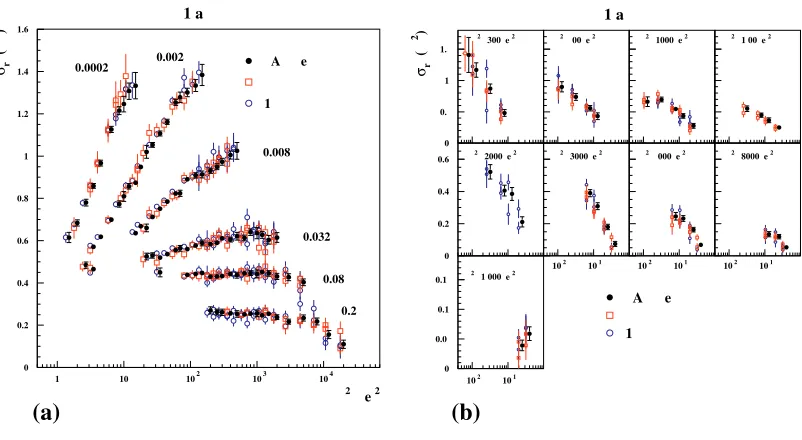
Figure 1. (a) HERA combined NCe+preduced cross section as a function ofQ2for sixx-bins compared to
the separate H1 and ZEUS data input to the combination procedure. The individual measurements are displaced
horizontally for better visibility. (b) HERA combined CCe+preduced cross section compared to the separate
H1 and ZEUS data input to the averaging procedure. The individual measurements are displaced horizontally for better visibility.
1402 measurements with 110 correlated sources of uncertainty are combined to 741 cross sections giving aχ2/ndf of 636.5/656. Figure 1(a) shows the NCe+preduced cross section as a function of Q2 for sixxbins. Shown are the individual H1 and ZEUS measurements as well as the combined measurement. As can be seen, the precision of the measurement improves significantly after the combination. The overall precision of the NC cross sections is 2% for 3<Q2 <500 GeV2 and reaches 1% for 20<Q2 <100 GeV2. Figure 1(b) shows the CC e+p reduced cross section as a function ofxfor at fixedQ2values.
0.2 0.4 0.6 0.8 1
4
10 103 102 101 1
0.2 0.4 0.6 0.8 1
A F1. ( re .) e . u cert.
e u cert. ara etri ati u cert.
2
2 e
2
u
0.0 ) × ( 0.0 )
× g (
A
tructure
Fu
cti
s
r
i
g
r
u
u
2010
1 a A bi e F Fit
0.2 0.4 0.6 0.8 1
0.2 0.4 0.6 0.8 1
4
10 103 102 101 1
0.2 0.4 0.6 0.8 1
A F1.0 e . u cert.
e u cert. ara etri ati u cert.
2
1. e
2
u
0.0 ) ×
( g (×0.0 )
1 a
0.2 0.4 0.6 0.8 1
(a)
(b)
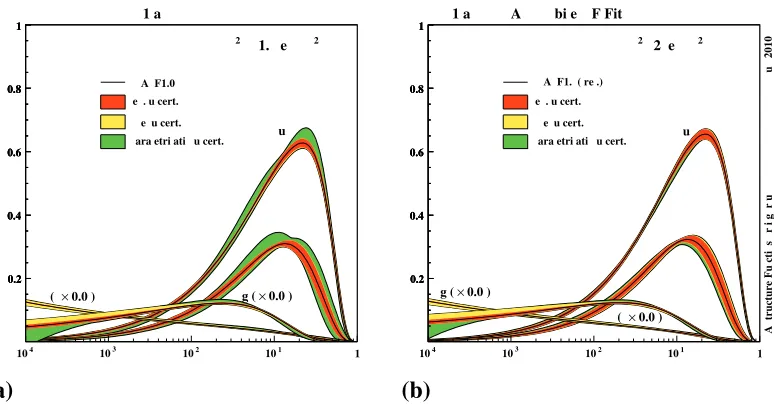
Figure 2. (a) The parton distribution functions from HERAPDF1.0,xuv,xdv, xS = 2x(U+D),xg, atQ2
=1.9 GeV2. The gluon and sea distributions are scaled down by a factor 20. The experimental, model and
parametrisation uncertainties are shown separately. (b) PDFs from HERAPDF1.5 (NLO) for the valence quarks,
sea quarks and gluon atQ2 =2 GeV2as a function of Bjorken-x. Uncertainties from experimental, model and
parameterization sources are indicated.
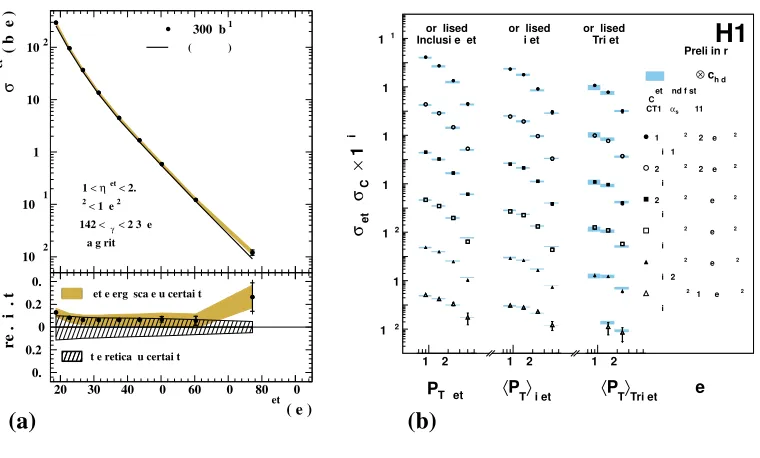
Jet cross sections by ZEUS[6] in the photoproduction regime and by H1 in DIS[5] are shown in Figure 3(a) and 3(b) respectively. The ZEUS measurement takes into consideration different jet algorithms in an environment close to that ofppcollisions. H1’s measurement corresponds to jet, dijet and trijet cross sections and uses an unfolding matrix which quantifies the statistical correlations between the measurement bins, thus providing an extra constraint for the PDF fits.
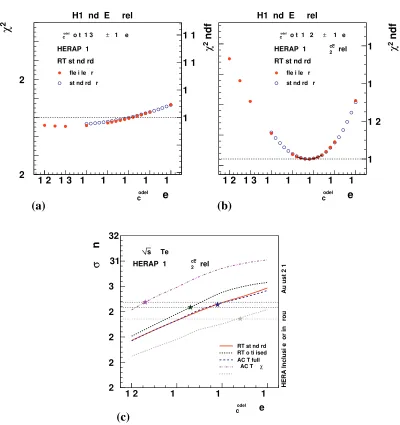
Charm measurements from H1 and ZEUS using different measurement techniques — D meson production, semi-leptonic decays and inclusive track measurements — are combined to give theFcc¯ 2 structure function. This is used together with the combined inclusive data to extract the PDFs. The PDF fit was found to be clearly sensitive to the charm quark mass parametermmodelc when the charm
data was included (Figure 4(b)) in contrast to the case when only inclusive data was used (Figure 4(a)) as seen by theχ2/ndf of the PDF fit as a function ofmmodel
c . Different heavy flavour treatment schemes
were found to have different optimum values ofmmodel
c defined as that value giving the leastχ2from a
scan ofmmodel
c , and are shown as the points in Figure 4(c). The predictions of W and Z cross sections
at the LHC from the different heavy flavour treatments agreed considerably better at these optimized mmodel
c values, than at any arbitrarily chosen value, as shown for Z production in Figure 4(c). In this
i
1
×
C
σ
et
σ
2
1 1
2
1 1 1 1
1
1
T et P 1 2
i et 〉 T P
〈 1 2
e Tri et 〉 T P
〈 1 2
2 2 e 2 1
i 1
2 2 e 2 2
i
2 e 2 2
i
2 e 2 i
2 e 2 i 2
2 1 e 2 i
h d
c
⊗
11 s α
CT1 Cet nd f st
Inclusi e et or lised
i et or lised
Tri et or lised
H1
Preli in r
10 2 10 1 1 10 102
300 b1
( )
1< ηet<
2.
2
<1 e2
142<γ<2 3 e a g rit
et e erg sca e u certai t
t e retica u certai t
σ
et
(b
e)
0. 0.2 0 0.2
0.
20 30 40 0 60 0 80 0
et
( e )
re
.i.
t
(a)
(b)
Figure 3. (a) ZEUS Jet cross section in photoproduction as a function of transverse jet energy. (b) H1 normalized
jet, dijet and trijet cross sections in DIS as a function of transverse momentum for fixed ranges ofQ2.
3 Conclusion
e
odel
c
1 2 1 3 1 1 1 1 1
2
χ
1
fle i le r st nd rd r
ndf
2
χ
1 1 2 1 1
H1 nd E rel
rel
c c 2
HERAP 1
RT st nd rd
1 e
±
o t 1 2
odel c
e
odel
c
1 2 1 3 1 1 1 1 1
2
χ
2 2
fle i le r st nd rd r
ndf
2
χ
1 1 1 1 1 1
H1 nd E rel
HERAP 1
RT st nd rd
1 e
±
o t 1 3
odel c
e
odel
c
1 2 1 1 1
n
σ
2 2 2 2 3 31 32
RT st nd rd RT o ti ised AC T full
χ
AC T
Te s
rel
c c 2
HERAP 1
HERA
Inclusi
e
o
r
in
rou
Au
ust
2
1
(a)
(b)
(c)
Figure 4. (a)χ2of the HERA I data fit (HERAPDF1.0) in the standard RT scheme as a function ofmmodel
c . Open
and closed symbols represent flexible and standard parametrisation repsectively. (b)χ2 of the HERA I+
Fc¯c
2
fit in the standard RT scheme as a function ofmmodel
c . Open and closed symbols represent flexible and standard
parametrisation repsectively. (c) Total Z production cross section predictions at√s=7 TeV using PDFs derived
from inclusive and charm data for different heavy flavour treatment schemes. The stars indicate the cross sections
corresponding to the optimum value of the charm quark mass parametermmodel
References
[1] F. Aaron et al. [H1 Collaboration] (2009), [arXiv:0904.0929].
[2] F. D. Aaronet al.[H1 and ZEUS Collaboration], JHEP1001, 109 (2010) [3] H1 and ZEUS Collaborations, H1prelim-10-142 , ZEUS-prel-10-018, 2010 [4] H1 and ZEUS Collaborations, H1prelim-11-042, ZEUS-prel-11-002, 2011 [5] H1 Collaboration, H1prelim-12-031, 2012
[6] H. Abramowiczet al.[ZEUS Collaboration], Nucl. Phys. B864, 1 (2012) [7] H1 and ZEUS Collaborations, H1prelim-09-171, ZEUS-prel-09-015, 2009 [8] H1 and ZEUS Collaborations, H1prelim-10-143, ZEUS-prel-10-019, 2010 [9] Dokshitzer Y. L., Sov. Phys. JETP, 1977, 641-653