University of South Carolina
Scholar Commons
Theses and Dissertations
2017
Consumer Decision Making for Accommodations
in the Shared Economy
Jeffery C. Kreeger
University of South Carolina
Follow this and additional works at:https://scholarcommons.sc.edu/etd
Part of theHospitality Administration and Management Commons
This Open Access Dissertation is brought to you by Scholar Commons. It has been accepted for inclusion in Theses and Dissertations by an authorized administrator of Scholar Commons. For more information, please [email protected].
Recommended Citation
CONSUMER DECISION MAKING FOR ACCOMMODATIONS IN THE SHARED ECONOMY
by
Jeffery C. Kreeger
Bachelor of Science Biola University, 1983
Master of Business Administration University of Colorado at Denver, 1988
Submitted in Partial Fulfillment of the Requirements
For the Degree of Doctor of Philosophy in
Hospitality Management
College of Hospitality, Retail and Sport Management
University of South Carolina
2017
Accepted by:
Scott J. Smith, Major Professor
Mark Ferguson, Committee Member
Marketa Kubickova, Committee Member
H.G. Parsa, Committee Member
DEDICATION
I dedicate this dissertation ultimately to God, who carried me through this most
challenging journey. Also, I would like to dedicate this work to the following folks
including my late father, who supported me and lived vicariously through many of my
pursuits – he would have been so proud. Also, my mom, who always wanted a doctor in
the family. Well, I’m not ‘that kind of doctor,’ but I so appreciate her support as well
through the years! My parents have always supported me. Perhaps the greatest example of
this was their encouraging me to pursue a vocal performance undergraduate degree – that’s
a degree that requires a huge step of faith because that’s not a degree that typically lands
anyone a job of any kind! Luckily, I changed majors! In order to show her support, my
sister had feather extensions added to her hair (to go along with the University of South
Carolina Gamecock mascot), which she used as a reminder to pray for me. My brother
traveled with me on my initial move from Denver to Columbia to ensure his ‘bubba’ got
off to a good start! My kids also helped keep my focus on finishing this marathon journey.
I would also like to thank all my friends and colleagues who helped me stay positive and
reminded me of the important things in life. I never would have made it through this
journey without their unwavering support and encouragement. I offer a heartfelt thank you
ACKNOWLEDGEMENTS
I acknowledge my advisor and mentor Dr. Scott Smith, whose dedication and
commitment to me has made me a much better teacher and researcher. I will always be
indebted to Dr. Smith, who took a wide-eyed Ph.D-wanna-be and taught me so much about
the new-to-me academic world in three years! He taught me so much about research and
teaching and continues to be a role model for me to follow in my upcoming academic
career. I owe him so much! I am so fortunate to have had him as my adviser. I could not
have had a better advisor who knew when to stretch me and when to cut me some slack!
He knew when I was hanging on by a thread and guided me accordingly. He talked me
down from many steep cliffs during this most difficult journey and he always had a way
of making me breathe and reassess circumstances in new ways. He was a great calming
force during some of my most turbulent trials during these past three years. Dr. Smith is
the quintessential voice of reason and calmness and his future advisees are more fortunate
than they realize. Although I know he had to maintain a scholarly distance in his capacity
as my advisor, I will always consider him a close friend.
I would also like to personally thank Dr. H. G. Parsa, who encouraged me to pursue
a Ph.D. in Hospitality in the first place. He saw something in me and helped me to believe
in my abilities at a time when I doubted my own capabilities. Based on Dr. Parsa’s
recommendation, I applied to hospitality schools across the nation and packed up and
moved from my home away from family and all things familiar to move to South Carolina,
your vote of confidence, Dr. Parsa! It wasn’t until much after my move I realized what a
renowned researcher Dr. Parsa is. I feel very privileged to have had him take a special
interest in me.
Also, I thank Dr. Marketa Kubickova for her guidance in many research aspects of
my dissertation. As the methodology specialist committee member, she drew the shortest
of straws since research was new to me (within the past five years); however, she was
always patient with me and guided me along the research paths I needed to pursue. Finally,
I thank Dr. Mark Ferguson from the Darla Moore Business School (at USC) for his
combination of complex forecasting techniques combined with practical applications. He
stretched me through his Revenue Management class I took and through his direction and
very creative comprehensive exam question. He also provided valuable input into the
creation of my survey instrument, which greatly assisted in determining respondents who
were paying attention versus those who were merely racing through the survey to finish it.
Also, I thank my professors at USC who were part of the village that helped raise
this Ph.D.!
ABSTRACT
Although many components of the shared economy have existed over time, it has
recently blossomed into a thriving business that facilitates sharing of assets and services
with strangers by using applications on the Internet. Recently, a convergence of many
factors favorable to the development of the shared economy occurred and has become a
new way of doing business for many and has introduced a new business model. Many
people are shifting their goals from owning assets to borrowing them. This is not only
economically favorable, but it is also environmentally favorable for the planet.
The Lodging Shared Economy (LSE) is the portion of the shared economy that
focuses on the sharing of accommodations such as Airbnb and Vacation Rental by
Owner (VRBO). The LSE enables homeowners and tenants, where it is legal, to rent out
an extra room or full house/apartment either while they share the residence or while the
host is away from the property. This new accommodation arrangement has become very
popular with leisure travelers and more recently with business travelers, but little is
known about how much business travelers utilize LSE properties for their business
travel. Much of Airbnb’s advertising campaign is targeted at showing a stay at an Airbnb
property is more about creating an experience rather than merely spending the night.
This dissertation focuses on business travelers’ motivations and preferences for travel
while away from home on business. Specifically, this dissertation explored how much
independent variables are as follow: Price/Value, Financial Security, Personal Safety,
Location, Empathy, Amenities, and Cleanliness. It then proceeds to evaluate whether
three moderators of Gender, Age, and Accommodation Type affect the individual
relationships between the independent variables and satisfaction.
This dissertation begins with an introduction to shared economy (and LSE)
concepts that are necessary to understand to better comprehend the studies. This is
followed by a literature review, which describes and catalogues the current body of
literature available regarding the LSE including several theories that guide guests to
choose between diverse accommodation options. Chapter 2 ends with a conceptual
model. Chapter 3 discusses the methodology of designing the survey instrument as well
as methods used to conduct the test. Additionally, the pilot study results were presented
and discussed as a precursor to the final study, which were presented to business and
leisure hotel respondents as selected using the MTurk respondent database.
Results of the final study were presented and discussed in Chapter 4 within the
framework of a Structural Equation Modeling (SEM) framework along with various
statistical tests and safeguards to ensure valid and reliable results. Chapter 5 discussed
implications from the study and makes suggestions for both LSE hosts and hoteliers
based on results found.
TABLE OF CONTENTS
DEDICATION ... iii
ACKNOWLEDGEMENTS ... iv
ABSRACT ... vi
LIST OF TABLES ... xii
LIST OF FIGURES ...xv
LIST OF ABBREVIATIONS ...xvi
CHAPTER 1: INTRODUCTION ... 1
1.1 SHARED ECONOMY BACKGROUND AND CONTEXT ...1
1.2 LODGING SHARED ECONOMY ...5
1.3 PURPOSE OF STUDY...9
1.4 RESEARCH QUESTIONS ...11
1.5 ASSUMPTIONS FOR THE STUDY ...12
1.6 EXPECTED RESULTS BASED ON LITERATURE ...13
1.7 DEFINITION OF TERMS ...16
1.8 CHAPTER SUMMARY ...17
CHAPTER 2: LITERATURE REVIEW ... 19
2.2 THE LODGING SHARED ECONOMY ...32
2.3 DIFFERENCES BETWEEN AN LSE AND HOTEL STAY ...34
2.4 ENVIRONMENTAL CONSCIOUSNESS (SUSTAINABILITY) ...40
2.5 OPERATIONAL CONCERNS ...41
2.6 EMPLOYEE VERSUS CONTRACTOR DISCUSSION ...48
2.7 STUDY CONSTRUCTS ...50
2.8 MODERATORS ...66
2.9 THEORETICAL FRAMEWORK ...74
2.10 THE CONCEPTUAL MODEL ...85
2.11 CHAPTER SUMMARY ...87
CHAPTER 3: METHODOLOGY ... 89
3.1 SURVEY RESEARCH ...89
3.2 SURVEY PROCEDURE ...89
3.3 INSTRUMENT DEVELOPMENT ...90
3.4 SURVEY SCALES ...91
3.5 COMMENSURATE UNITS FOR LSE ROOMS ...98
3.6 INSTRUMENT PRE-TEST AND PILOT STUDY ...101
3.7 FINAL STUDY SAMPLE SIZE ...115
3.8 FINAL STUDY DATA COLLECTION ...117
CHAPTER 4: RESULTS AND FINDINGS... 122
4.1 DATA CLEANSING ...122
4.2 CFA AND SEM RESULTS ...133
4.3 ACCOMMODATION TYPE MODERATION—ORTHOGONAL ...150
4.4 ACCOMMODATION TYPE MODERATION—NON-ORTHOGONAL DESIGN: HYPOTHESIS H18 ...161
4.5 THE MODERATING EFFECT OF GENDER: HYPOTHESIS H16 ...164
4.6 THE MODERATING EFFECT OF GENERATION: HYPOTHESIS H17 .167 4.7 SUMMARY OF HYPOTHESES ...172
4.8 CHAPTER SUMMARY ...174
CHAPTER 5: DISCUSSION AND CONCLUSION ... 176
5.1 STUDY SUMMARY...176
5.2 INDEPENDENT VARIABLE DISCUSSION: HYPOTHESES 1-7 ...177
5.3 DEPENDENT VARIABLE DISCUSSION: HYPOTHESES 8-9 ...186
5.4 DISCUSSION ABOUT OTHER PATHS: HYPOTHESES 10-15 ...187
5.5 DISCUSSION ABOUT MODERATORS: HYPOTHESES 16-18 ...192
5.6 OVERALL IMPLICATIONS FOR PRACTITIONERS ...197
5.7 LIMITATIONS ...199
5.8 FUTURE RESEARCH OPPORTUNITIES ...206
5.9 CONCLUSION ...208
APPENDIX A: TRIAL STUDY SURVEY INSTRUMENT ... 232
APPENDIX B: HOTEL FINAL STUDY SURVEY INSTRUMENT ... 239
APPENDIX C: LSE FINAL STUDY SURVEY INSTRUMENT ... 251
LIST OF TABLES
Table 2.1: Price/Value References ...52
Table 2.2: Financial Security References ...53
Table 2.3: Personal Safety References ...54
Table 2.4: Location References ...55
Table 2.5: Empathy References ...55
Table 2.6: Amenities References ...56
Table 2.7: Cleanliness References ...58
Table 2.8: Satisfaction References ...59
Table 2.9: Word-of-mouth References ...62
Table 2.10: Return Intention References ...63
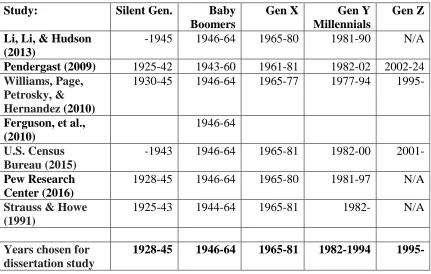
Table 2.11 Generation Period Assignment ...71
Table 3.1 Total Effects ...105
Table 3.2 Mean, STDEV, T-Values, & P-Values ...107
Table 3.3 Cross Loadings ...108
Table 3.4 Trial Study Goodness of Fit Values ...109
Table 3.5 Items Included in CFA ...110
Table 3.6 Total Effects ...112
Table 3.7 Qualifying Questions ...119
Table 4.1 Number of responses per state ...128
Table 4.3 Final Study Reliability and Validity: Initial Run ...138
Table 4.4 Final Study Reliability and Validity: Adjusted Run ...139
Table 4.5 Results of Confirmatory Factor Analysis and Descriptive Analysis ...142
Table 4.6 Mean, Standard Deviation, T Statistics, & Probability Values ...143
Table 4.7 Final Study Goodness of Fit Values...144
Table 4.8 Items Included in CFA ...146
Table 4.9 Total Effects ...147
Table 4.10 Final Study Reliability and Validity ...152
Table 4.11 Results of Confirmatory Factor Analysis and Descriptive Analysis ...154
Table 4.12 Mean, Standard Deviation, T Statistics, & Probability Values ...155
Table 4.13 Final Study Goodness of Fit Values ...156
Table 4.14 Items Included in CFA ...156
Table 4.15 Total Effects ...157
Table 4.16 PLS Multigroup Analysis—Hotel vs. LSE ...160
Table 4.17 Welch-Satterthwaite Test—Hotel vs. LSE ...161
Table 4.18 PLS Multigroup Analysis—Hotel vs. LSE ...163
Table 4.19 Welch-Satterthwaite Test—Hotel vs. LSE ...164
Table 4.20 PLS Multigroup Analysis—Male vs. Female ...166
Table 4.21 Welch-Satterthwaite Test—Male vs. Female ...166
Table 4.22 PLS Multigroup Analysis—Boomers vs. GenX ...168
Table 4.23 Welch-Satterthwaite Test—Boomers vs. GenX ...169
Table 4.24 PLS Multigroup Analysis—Boomers vs. GenY ...169
Table 4.26 PLS Multigroup Analysis—Gen X vs. Gen Y ...171
Table 4.27 Welch-Satterthwaite Test ...171
LIST OF FIGURES
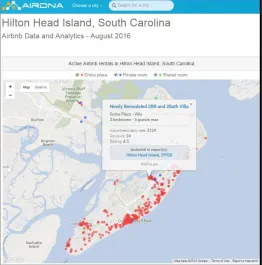
Figure 2.1 Airdna Spatial View of Airbnb Properties ...32
Figure 2.2 Some Airbnb host locations on Hilton Head Island, SC ...46
Figure 2.3 Expected Utility Theory ...76
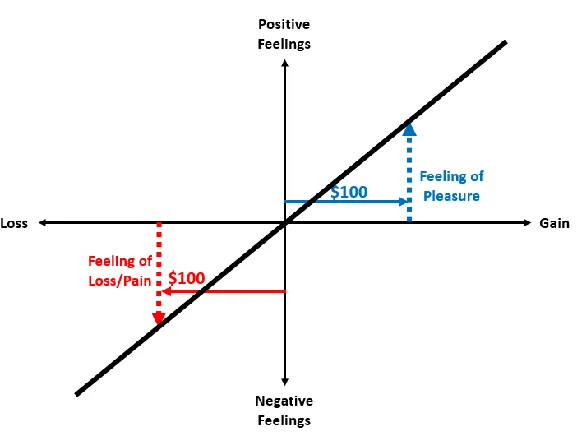
Figure 2.4 Prospect Theory Gains and Losses ...78
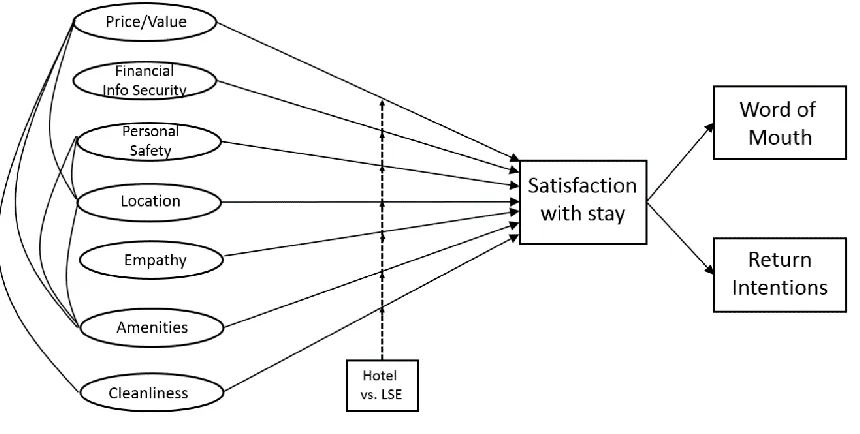
Figure 2.5 Conceptual Model...86
Figure 2.6 Conceptual Model with Hypotheses ...87
Figure 3.1 Results of Stuctural Modeling ...110
Figure 3.2 Bootstrapping Statistical Significance Results ...112
Figure 3.2 Qualification Survey Instrument ...118
Figure 4.1 Geocoded Respondents Across the World ...126
Figure 4.2 Geocoded Respondents Across the Continental United States ...127
Figure 4.3 Results of Structural Model ...145
Figure 4.4 Results of Structural Model (Adjusted) ...147
Figure 4.5 Bootstrapping Statistical Significance Results ...148
Figure 4.6 Results of Structural Model ...156
LIST OF ABBREVIATIONS
ATax ... Accommodation Tax
BRT ... Bounded Rationality Theory
CFA ... Confirmatory Factor Analysis
EFA ... Exploratory Factor Analysis
EUT ... Expected Utility Theory
GPS ... Global Positioning System
FICO ...Fair Isaac Corporation
HHI ... Hilton Head Island
KMO ... Kaiser-Meyer-Olkin
LSE ...Lodging Shared Economy
MSA ... Metropolitan Statistical Area
Mturk ... Mechanical Turk
PRT ... Perceived Risk Theory
RFP ... Request For Proposal
SEM... Structural Equation Model
CHAPTER 1:
INTRODUCTION
1.1SHARED ECONOMY BACKGROUND AND CONTEXT
The shared economy has evolved over time and only recently has it flourished due
to the convergence of optimal components that made it possible. Although many of the
individual components of the shared economy have existed for years in some form or
another, the shared economy only recently has reached critical mass (Philip, Ozanne, &
Ballantine, 2015). For being what some refer to as ‘anti-consumption,’ the shared
economy has taken roots and arguably is here to stay (Albinsson, Wolf, & Kopf, 2010).
The shared economy is exemplified by applications such as Uber and Airbnb, which
allow people to emulate taxi drivers or hoteliers, respectively, and make use of personal,
underutilized assets in order to make money. However, there are many other categories
and participants in the shared economy and it continues to grow and further define itself.
Lesser known segments of the shared economy include a plethora of companies
and applications that facilitate the sharing of goods and services such as tools, bicycles,
sporting equipment, etc. (Botsman & Rogers, 2010; Philip, Ozanne, & Ballantine, 2015;
McDonald, 2014). Entrepreneurs introduce to the market many new sharing offerings
each day and the shared economy is continuously growing as it becomes increasingly
more accepted (Geron, 2013a; Nadler, 2014). However, Belk (2014b) claims many
participants in the shared economy are not truly ‘sharing,’ but instead are
‘pseudo-sharing.’ He claims many participants are not truly collaborative, but are merely ‘for
(1986) further explore guest’s views of fairness in pricing as well as the automatic checks
and balances that help regulate prices for shared economy items. While profits are a
major goal of hotels and Lodging Shared Economy (LSE) hosts, the customer and his
needs cannot be neglected without serious backlash (Kimes and Wirtz, 2013; Kimes,
2010).
Botsman (2012) mentions several favorable circumstances occurred during a short
period such as the great recession of 2008, eBay, the advent of smartphone technology,
which converged and created the shared economy, which had an estimated value of $26
billion in 2014 (Malhotra & Van Alstyne, 2014). The shared economy has over an
estimated 10 million users who reported using a shared economy service in the past
twelve months (Owyang, Samuel, & Grenville, 2014). One component of this ‘perfect
storm’ was the United States’ recent recession (at the end of the first decade of the
twenty-first century) coupled with high unemployment. This combination of events left
many homeowners fearing they would lose their homes (Geron, 2013). By using Airbnb,
many homeowners were able to keep their homes and not default on their loans (Noone
& McGuire, 2016). Another factor in this shared economy ‘perfect storm’ was
consumers’ desire to behave in a more sustainable manner and slow down the rate of
consumption of the planet’s resources and the improvement of GPS technology and
digital street maps (Nadler, 2014; Botsman & Rogers, 2010).
An additional factor that contributed to this shared economy ‘perfect storm’ was
the explosion of Internet applications that allowed users to advertise their good or service
literally to anyone in the world who owns a computer and an Internet connection
business transactions, thereby reducing costs and increasing efficiencies Schor, &
Fitzmaurice, 2015). In an ailing economy, some people sought alternative sources of
income. Shared economy companies such as Airbnb facilitated a means for homeowners
to create a new, viable income stream, which was a substantial factor for many
homeowners to be able to keep their homes. In fact, 13% of Los Angeles Airbnb hosts
reported that the act of renting their houses prevented them from losing them due to
foreclosure (Economic Impact Studies, n.d.).
Transportation shared economy companies rely almost exclusively on riders using
their smartphones to hail a ride. Uber and Lyft transportation applications use
smartphone technology to attract customers. Therefore, the exponential growth of
smartphone coverage and consumer adoption of smartphones also contributed to shared
economy success. In 2015, 68% of the United States’ population owned a cell phone,
which is almost double from 2011 when only 35% of the U.S. population owned a cell
phone. People’s love for their cell phones was taken to an extreme by Aaron Chervenak,
when he married his cell phone in Las Vegas. Chervenak said, “what I hope my wedding
will do is to somehow act as a symbolic gesture to show how precious our phones are
becoming in our daily lives, and hopefully get others to ask that same questions of
themselves and their relationships with their phones” (Tempesta, 2016, p. 1).
Companies such as Uber and Lyft capitalize on transporting people from one
place to another like a taxi service. These companies capitalize on the fact that most
American automobiles are under-utilized and are typically used only about 5% of the
time (Fraiberger & Sundararajan, 2015). There are several other companies that allow the
assets. Hall and Krueger (2015) mention that Uber drivers work to add to their income. In
fact, many Uber drivers make as much if not more than chauffeurs and taxi drivers, from
an average of $23.00 to $27.00 per hour (Benenson Survey Group, 2014).
Uber has further economic implications beyond mere added income for drivers
and cheaper, faster rides for riders. An AlixPartners study indicates that the addition of
one ride-sharing vehicle can decrease the purchase of up to 32 vehicles for personal use
(AlixPartners, 2014). Although this has positive ecological and sustainable consequences,
it does not bode well for the automobile industry, especially given that the level of
awareness of the concept of car-sharing is not yet universal. Presumably the popularity of
services such as Uber and Lyft will only increase as long as municipalities don’t ban the
service – as was done when the country of Germany banned Uber from operating within
the country (Malhotra & Van Alstyne, 2014). Currently, however, according to an
intercept study in San Francisco—a city that should have a high awareness—showed a
low awareness of the availbility of car-sharing (Ballús-Armet, Shaheen, Clonts, &
Weinzimmer, 2014).
The number of shared economy companies increases daily as the entrepreneurial
spirit mixes with creativity. For example, TaskRabbit allows customers, using a minimal
amount of effort, to submit a request for proposal (RFP) – anything from putting together
IKEA furniture to catering a formal dinner (Botsman, 2012; Hoshaw, 2011). Customers
utilize TaskRabbit by drafting an RFP for the service they would like provided and wait
for ‘task rabbits’ to bid on it. The customer then awards the bid to the rabbit with the
The shared economy offers alternatives to products and services provided by
conventional businesses. Through Internet technology, average people can rent their
assets (cars, spare bedrooms, camera equipment, etc.) to guests who choose to rent rather
than purchase these items from conventional sources. This shared economy was once
thought to be merely a fad, but now is becoming an extremely powerful force (Gansky,
2010).
One other factor that contributed to the adoption of the LSE was Craigslist, which
decreased apartment and housing rental vacancies and substantially reduced its
competition – classified advertisements in newspapers. This more efficient, online
solution essentially replaced traditional searches (Kroft, & Pope, 2014). Platforms such as
eBay and Craigslist introduced the first phase of the success of the shared economy
through selling objects (and some trading goods between sellers and buyers) in a more
efficient manner whereas companies such as Airbnb and Uber transcended to another
level and capitalized on sharing objects (Zervas, Proserpio, & Byers, 2015). Instead of
merely selling products, the shared economy focuses on facilitating the matchmaking of
hosts/providers with guests/users in order to share resources, assets, and services, most
times for a price. Perhaps one of the greatest barriers is that of trusting strangers, which is
discussed below. This new ‘currency of trust’ is becoming increasingly understood and
valued in the shared economy (Botsman, 2012).
1.2LODGING SHARED ECONOMY
The Lodging Shared Economy (LSE), which is made up of companies like
Airbnb, Vacation Rental by Owner (VRBO) and Roomorama allows hosts to rent
conduit. Just as Uber connects passengers with drivers, LSE companies match those
seeking accommodations with LSE hosts who have an extra room/apartment/house to
rent for one or more nights. Most LSEs (most notably Airbnb) claim their rentals do not
compete with traditional hotels (McCracken, 2016) and Airbnb offerings are attracting
additional travelers (Martin, 2016); however, this was found not to be the case with the
study conducted by Zervas, Proserpio, and Byers (2015), who found the presence of
Airbnb properties decreased ADR of nearby hotels. Further, Guttentag, D. A., & Smith,
S. L. (2017) conducted a study of over 800 tourists who used an Airbnb within the past
year to determine how many of them used Airbnb as a substitute for a hotel and found
that two-thirds claimed Airbnb was a substitute for a hotel.
Zervas, Proserpio, and Byers (2015) reported that in their study of Airbnb
locations in Texas, many Texas hotels apparently lowered their room rates slightly
because of Airbnb’s entry into the market. Zervas et al. (2015) state, “affected hotels
have responded by reducing prices, an impact that benefits all consumers, not just
participants in the sharing economy” (p. 17). While this may be good news for
consumers, it may not be positive for hoteliers. Reduced room rates result in overall
decreased accommodation revenue. This results in a further decrease of accommodation
taxes collected by each jurisdiction. Ayscue and Boley (2016) note that according to the
Zervas study, hotels that cater to business travelers were more insulated from the
competitive forces of Airbnb than hotels which did not cater to business travelers.
Cusumano (2014) does not forsee traditional hotel chains going out of business because
unique advantages—or they will become much diminished versions of what they used to
be” (p. 34).
Airbnb claims they are attracting travelers that normally wouldn’t travel and are
not in direct competition with hotels and have increased the total number of travelers
(Airbnb, 2016). Boyd, Gallun, and Paladino (2015) speculate that even though both hotel
and LSE business is growing, this trend will change with the next recession. They
forecast that hotels will see a marked decrease in business with the next recession. This
may be the impetus hotels need to realize LSEs are indeed serious, direct competition.
Meanwhile, Airbnb continues to gain market share. In fact, according to the
Airbnb web site, 141,000 guests stayed in Airbnb properties worldwide on New Year’s
Eve of 2012, which is approximately 50% more rooms than are available in the entire Las
Vegas strip (Geron, 2013). Hotel News Now reported that in the second quarter of 2015,
“Airbnb captured 5% of total room revenue in New York City” (Mayock, 2015). Shatford
(2015) illustrates how much of a threat the LSE has become using data from Santa
Monica, CA as he shows Airbnb supply is larger than hotel rooms and additionally
showed Airbnb rooms booked also exceeded the amount of hotel rooms booked. Airbnb’s
supply is roughly one-fifth the supply of all hotels in Santa Monica. Further, the number
of rooms booked by Airbnb is also roughly one-fifth of those booked by hotels. This
could become a liability for conventional hotels.
Many hoteliers seem indifferent to the danger of companies such as Airbnb or
VRBO, which allow everyday people to rent out a spare bedroom, apartment, or house
as if they were a guest in a hotel room (Botsman, 2012). Perhaps at greatest risk are
economy is a threat to hotels of every scale (Geron, 2013; Varma, Jukic, Pestek, Shultz,
& Nestorov (2016). Viewed as a lower scale threat, midscale to luxury hotels and resorts
do not appear to consider companies such as Airbnb (and other shared economy
companies) a serious threat to their businesses (Zervas, Proserpio, & Byers, 2015).
Many hotel owners believe their business travelers will not be interested in staying in an
LSE property. This assumption is very important because about 70% of U.S. travelers
travel for business purposes (Noone & McGuire, 2016). Therefore, if business travelers
do indeed begin to use LSE properties, they could have a substantial impact on
conventional hotels. Yavas and Babakus (2005) study the differences between leisure
and business travelers and conclude each group has many unique characteristics and do,
in fact, have differing wants and requirements from a hotel. Because of this, they suggest
not combining these two groups together, but instead, they mention each group should
be studied separately. This was part of the basis for choosing to focus only on business
travelers for this dissertation.
There are uncertainties and risks associated with traveling—especially with
staying at a hotel for the first time and even more risk using an online site to book a hotel
stay. Companies such as Airbnb, which capitalize on the LSE, have had to overcome trust
issues—mostly through the establishment of reputation scores (Botsman, 2012). Similar
to scores used by eBay customers to determine the trustworthiness of vendors, the shared
economy uses such reputation scores for both vendors/hosts as well as guests/users,
which are also tied to a social media account such as Facebook or Google (Botsman,
In a Ted Talk, Botsman (2012) describes three ‘trust waves’ consumers have
undergone to feel more comfortable doing business over the Internet. The first ‘trust
wave’ began with sharing personal information over social media such as Facebook.
Consumers overcame the second ‘trust wave’ when they became comfortable making
financial transactions over the Internet such as online purchases and banking. Finally, the
third and current ‘trust wave’ involves trusting strangers online using trust indicators.
Currently, the LSE appears to affect mostly the following customer segments:
non-business focused hotels (although more business travelers are using LSE services);
independent hotels; and hotels lower on the price point scale—economy hotels are
currently more affected than are luxury properties (Boyd, Gallun, & Paladino, 2015).
LSE properties typically offer fewer amenities than hotels; therefore, since higher scale
hotels offer more amenities than those on the lower end of the price point spectrum, these
luxury guests are more resistant to the allure of the shared economy than those requiring
lower priced scales (Zervas, Proserpio, & Byers, 2015).
Boyd, Gallun, and Paladino (2015) acknowledge that Airbnb public relations
officers communicate that Airbnb is expanding overall room supply such that overall
tourism revenue is benefitting (and that Airbnb is not a competitive threat to hotels).
However, Boyd et al. (2015) predict that during the next economic downturn, Airbnb will
undoubtedly present an increased competitive threat.
1.3PURPOSE OF STUDY
The purpose of this dissertation is to determine what business travelers value
when they stay at an LSE property and if their valuations are different than those of
two-fold: first, it informs hotels what their competitions’ competitive advantages are so they
can target the business traveler segment; and secondly, it identifies qualities that attract
business customers to LSE properties so LSE hosts can further develop their market
strategy to better target business travelers. This study will assess which of the following
constructs are most important to different types of business travelers: Price/Value,
Financial Security, Personal Safety, Location, Empathy, Amenities, and Cleanliness. This
information is relevant to hoteliers so they can alter their marketing strategies if
necessary to keep their business customers from using LSE properties.
Leisure travelers have championed the LSE movement and as a result, many
economy and lower scale hotels have felt the impact of declining occupancy, but few
hotels feel threatened by the potential loss of business travelers because many of these
hoteliers do not believe business travelers will utilize an LSE property (Geron, 2013).
Not only is there little concern about business travelers, but currently there is also a gap
in literature regarding the participation of business travelers to stay in an LSE. As of
today, there is little known research that has been published regarding business travelers
staying in LSE properties. Therefore, the likelihood of business travelers to stay at an
LSE property is not currently known. Also, still not known is whether business travelers
will switch their loyalty from traditional hotels to LSE properties. The overarching
categorical research question for this study is, ‘How willing are business travelers to stay
in an LSE property and what aspects of the LSE attract or repel business travelers from
staying in an LSE property instead of a traditional hotel?’ The following specific research
1.4RESEARCH QUESTIONS
The first research question addresses the issue of LSE properties allegedly having
a lower price tag than a similar room at a conventional hotel. Therefore, this dissertation
presents the following research question:
Research Question 1: Does the price/value of an accommodation affect a
consumer’s level of satisfaction?
The second research question addresses guests’ comfort level with utilizing LSE
web sites to pay for their stay. While guests are presumably more comfortable using
established brands’ web sites such as the website for Hilton hotels,
http://www3.hilton.com, many are not as comfortable with the relatively new LSE
companies such as VRBO and Airbnb. Therefore, this dissertation presents the following
research questions:
Research Question 2: When paying for or reserving a room, do guests feel more
satisfaction from the transaction if they feel their transaction is secure?
Research Question 3: Does the safety of business travelers affect their level of
satisfaction?
Research Question 4: Does an accommodation’s location affect a business
traveler’s level of satisfaction?
Research Question 5: Does empathy shown to business travelers affect their level
of satisfaction?
Research Question 6: Do amenities make a significant difference to business
Research Question 7: Does cleanliness have an effect on the level of satisfaction
experienced by business travelers?
1.5ASSUMPTIONS FOR THE STUDY
Many hoteliers believe the LSE only poses a competitive threat to economy and
mid-scale hotels (Geron, 2013). They believe upper midscale, upper scale and luxury
scale hotels are safe from LSE intrusion. Further, many hoteliers believe only leisure
travelers and smaller groups stay in LSE properties and therefore feel comfortable about
retaining their business traveler revenue. Specifically, Boyd, Gallun, and Paladino (2015)
declare that, “sole proprietors, independent consultants and small groups are the most
logical business users of Airbnb. On the leisure side, Fitch expects budget and adventure
travelers and small groups (i.e. families, sports teams) to find Airbnb most appealing.
However, in both cases we expect hotels to remain the preferred choice for these
customers” (p. 1).
One major assumption of this study is that this conventional thinking (regarding
LSE users, which believes LSE is used mostly for leisure and business travelers are much
less likely to stay in an LSE property) will not hold in the future. Currently, most LSE
guests are leisure travelers and business travelers are less likely to stay in an LSE
property; however, many companies (including Airbnb) are targeting business travelers
(Levere, 2016). Many businesses, like Google, see the financial advantage of
encouraging employees to stay in an Airbnb-type property when traveling on business.
(Economist, 2014). Further, Airbnb’s recent focus on businesses also indicates a trend
toward the LSE focusing on growing their business by attracting more business travelers
have begun using LSE properties when convention centers have no remaining capacity.
This adds familiarity and increases overall use for LSEs.
Another assumption is municipalities will take years to begin a war on LSE
activities in their regions. Even though many municipalities may not embrace LSE
activities, public demand may force policies to allow LSE activities since much of the
public has experienced the LSE experience/format through Uber, Lyft, Airbnb, and/or
VRBO (Hartl, Hofmann, & Kirchler, 2015).
1.6EXPECTED RESULTS BASED ON LITERATURE
Based on the literature, this dissertation expects the following results:
LSE guests will expect to get a better deal (price/value proposition) than hotel guests.
Specifically, business travelers expect to pay less money to stay at a larger place because
they will be staying in a whole apartment or house instead of merely a hotel room. Based
on this, it is expected that this better price/value proposition will contribute to a positive
feeling associated with a previous stay that will translate into the propagation of positive
word-of-mouth accolades for the LSE experience as well as an intention to stay in an
LSE in the future. Conversely, hotels could have a negative feeling associated with the
price/value proposition paid at a hotel from a previous stay that will translate into the
propagation of negative word-of-mouth communications for the hotel stay as well as an
intention to stay in a hotel property in the future.
Guests will feel their financial information is more safe/secure when paying for a
reservation using a hotel than paying for an LSE stay? Based on this, it is expected that
this feeling of financial security will contribute to a positive feeling associated with a
for the hotel stay as well as an intention to stay in a hotel in the future—perhaps even the
same hotel or hotel chain. Conversely, LSE properties could have a negative feeling
associated with an LSE protecting a guest’s financial information from a previous stay
that will translate into the propagation of negative word-of-mouth communications for
the LSE stay as well as an intention to stay in an LSE property in the future.
Guests will feel safer (personally) at a hotel than at an LSE property? Because a
hotel has a history of providing safety for its guests (and an LSE does not have this same
track record), customer will feel safer at a hotel and at an LSE. Based on this, it is
expected that this feeling of personal safety will contribute to a positive feeling
associated with a previous stay that will translate into the propagation of positive
word-of-mouth accolades for the hotel stay as well as an intention to stay in a hotel in the
future—perhaps even the same hotel or hotel chain. Conversely, LSE properties could
have a negative feeling associated with an LSE protecting a guest’s person and assets
during a previous stay that will translate into the propagation of negative word-of-mouth
communications for the LSE stay as well as an intention to stay in an LSE property in the
future.
Guests will expect to find better business locations at a hotel than at an LSE
property because most business hotels are located in metropolitan districts near
businesses; however, many LSE properties are not located near business districts. Based
on this, it is expected that this feeling of financial security will contribute to a positive
feeling associated with a previous stay that will translate into the propagation of positive
word-of-mouth accolades for the hotel stay as well as an intention to stay in a hotel in the
have a negative feeling associated with an LSE’s location (closeness to guest’s place of
business) from a previous stay that will translate into the propagation of negative
word-of-mouth communications for the LSE stay as well as an intention to stay in an LSE
property in the future.
Business guests expect LSE hosts to have more compassion (empathy) than hotel
employees? Based on this it is expected that this better price/value proposition will
contribute to a positive feeling associated with a previous stay that will translate into the
propagation of positive word-of-mouth accolades for the LSE experience as well as an
intention to stay in an LSE in the future. Conversely, hotels could have a negative feeling
associated with the empathy (or lack thereof) at a hotel from a previous stay that will
translate into the propagation of negative word-of-mouth communications for the hotel
stay as well as an intention to stay in a hotel property in the future.
Business guests expect (and value) hotels to have more (and better) amenities than
LSE properties? Based on this, it is expected that this better level of empathy will
contribute to a positive feeling associated with a previous stay that will translate into the
propagation of positive word-of-mouth accolades for the LSE experience as well as an
intention to stay in an LSE in the future. Conversely, LSE properties could have a
negative feeling associated with the number and quality of amenities at an LSE from a
previous stay that will translate into the propagation of negative word-of-mouth
communications for the LSE stay as well as an intention to stay in an LSE property in the
future.
Business guests perceive hotels will have cleanliness standards that are better (and
expectations of more consistently clean rooms at a hotel will contribute to a positive
feeling associated with a previous stay that will translate into the propagation of positive
word-of-mouth accolades for the hotel stay as well as an intention to stay in a hotel in the
future—perhaps even the same hotel or hotel chain. Conversely, LSE properties could
have a negative feeling associated with the cleanliness encountered on a previous stay
that will translate into the propagation of negative word-of-mouth communications for
the LSE stay as well as an intention to stay in an LSE property in the future.
Regarding moderating, this dissertation study expects to find the following
variables to be moderated by Gender: Personal Safety, Location and Cleanliness.
Specifically, the expected outcome is that women value Personal Safety, Location and
Cleanliness more than men. Further, this dissertation study expects to find the following
variables to be moderated by Age: Price/Value, Financial Information Security, Personal
Safety, Location and Amenities. Accommodation Type is expected to moderate all of the
Independent variables.
1.7DEFINITION OF TERMS
The following terms are defined for use in this study:
1) Entire Home/Apt: The guest has full privacy in the home or apartment and
shares their stay with only those in his/her party.
2) Full Mesh Model: An asset sharing arrangement where the company owns
the assets such as with Zipcar where Avis Rental group owns the vehicles
(Gansky, 2010).
3) Hospitality Exchange: A guest stays at a host’s home while the host also
4) Lodging Shared Economy (LSE): Sharing economy services which involve
lodging, such as Airbnb and VRBO.
5) Non-simultaneous Exchange: A guest stays at a host’s second property or
vacation home.
6) Own-To-Mesh Model: An asset sharing arrangement where the company
does not own the assets such as with Airbnb where the company itself
owns no apartments or houses (Gansky, 2010).
7) Private Room. An LSE property where the guest has his/her own room for
sleeping. The sleeping room is guaranteed to be private however bathroom
and common areas may be shared with the host(s) and/or other guests.
8) Shared Economy: Transactions between peers (peer to peer) similar to
bartering.
9) Shared Room: The sleeping room is not private for the guest. This could
be a couch/bed in a common area of the home (e.g., living room) where
privacy is not guaranteed.
10)Simultaneous Exchange: Home swapping where a host stays in a second
host’s home in exchange for that same second host being a guest in the
first host’s home at the same time.
1.8CHAPTER SUMMARY
Even though the shared economy has existed in one form or another for centuries,
it has only recently grown to its current level of popularity and acceptance. Many factors
converged at that same time, which quickened the rise of enormous shared economy
ideas and lives over the Internet. Craigslist and eBay paved the way for trusting strangers,
which is a key component for the shared economy to thrive. Another hurdle was
consumers becoming comfortable making financial transactions over the Internet.
Improvements in GPS technology and more accurate digital street maps combined with
the ubiquity of cell phone usage/ownership also assisted in the creation of this ‘perfect
storm.’ The final hurdle was to overcome when consumers found they can trust strangers
using a trust indicator.
Many hoteliers believe LSE only poses a competitive threat to economy and
lower budget hotels and only leisure travelers stay in LSE properties, and therefore feel
comfortable about retaining revenues from their business travelers. This dissertation
explores how valid this belief is and analyzes what draws business travelers to a hotel for
business travel.
The next chapter will discuss in greater detail the shared economy including the
LSE as explained through literature. Differences between an LSE stay and a conventional
hotel stay are explored as well as the positive and negative attributes of each option.
Applicable Theories that apply to this subject matter are explained and related to the
study’s purpose. Each research question and its specific hypotheses is discussed and the
chapter will conclude with a conceptual model, which is the foundation for this study
CHAPTER 2:
LITERATURE REVIEW
2.1THE SHARED ECONOMY
A common version of the American Dream has traditionally involved owning a
house, a car, and many other assets. This focus on ownership has been changing over the
past couple of decades. There appears to be a shift from owning assets to borrowing or
accessing them when they are needed (Huefner, 2015; Bardhi & Eckhardt, 2012). There
is an ongoing blurring of boundaries between what is one’s own, what is others’, and
what belongs to everyone(Casserly, 2011). Instead of owning a car (or many cars), many
people use Uber or a similar service in lieu of automobile ownership. This is the premise
of the shared economy, also referred to as collaborative consumption, Gig economy, or
peer-to-peer transactions.
According to Bainbridge (2013), in 1978, Felson and Spaeth first coined the
phrase ‘Collaborative Consumption’—almost 48 years ago, Felson and Spaeth (1978)
analyzed what Hawley (1950) wrote regarding the rhythm, tempo, and timing of
community participation. Specifically, Hawley, “identified and discussed three important
temporal components of community structure: (1) rhythm - the regular periodicity with
which events occur, as with the rhythm of alcoholic beverage consumption or the
rhythms of commuting into the central city; (2) tempo - the number of events per unit of
time, such as the number of meals consumed per week or the number of supermarket
visits per month; (3) timing - the coordination among different activities which are
calls” (Hawley, 1950, p. 615). Even though Hawley was more describing the structure of
human community and how it works, Felson and Spaeth (1978) used his work to better
define what they coined as the ‘Collaborative Community.’ They determined that timing
was a key factor in interactions among the community. This dissertation addresses the
variations in timing in a different section. Felson et al. (1978) explained the futuristic
concept of car sharing from a 1978 predictive understanding as a way this ‘Collaborative
Community’ could work well. After a brief introduction of the shared economy,
Bainbridge suggested the need for businesses to incorporate certain practices of the
collaborative consumption movement to augment their business models, which will
become increasingly important in the near future (Sacks, 2011). Further convinced of the
shared economy’s popularity, Lisa Gansky (2010) wrote a book called The Mesh, which
describes how businesses should incorporate the shared economy in order to take
advantage of it.
Just as eBay connects bargain hunters with sellers, similarly, LSE companies such
as Airbnb match accommodation bargain hunters (or those seeking an insider’s
experience) with LSE hosts who have an extra room/apartment to rent for one or more
nights. Alternatively, LSE providers also rent entire houses, castles, or tree houses, to
name a few of the more unique offerings (Airbnb opening video, 2017). Airbnb
advertisements emphasize the human touch ‘home-like’ feeling guests get when they stay
at an Airbnb property. The opening video (as well as their recent national ad campaign)
on the Airbnb web site has the following quote, “Don’t go to Paris. Don’t tour Paris and
the quote, “Wherever you go, don’t go there. Live there, even if it’s just for a night”
(“Airbnb opening video,” 2017).
Christensen, Cook, and Hal (2006) emphasize the need for businesses to focus on
what consumers ultimately want versus the process involved for delivering the
product/service as conveyed in the following, “People don't want to buy a quarter-inch
drill. They [customers] want a quarter-inch hole!" (p. 1). Their approach is
customer-focused instead of product-customer-focused and is at the center of the shared economy where
customers pay for sharing services versus owning them (Bardhi & Eckhardt, 2012; Sacks,
2011; Botsman & Rogers, 2010). The U. S. economy has been so focused on selling
products that it has forgotten what people really want.
Some researchers believe the shared economy will ultimately carry the United
States into its third economic system, eclipsing capitalism (Fainstein, 2014; Rifkin,
2014). Other groups are raising awareness of overconsumption and waste in an effort to
encourage more of a shared economy (Albinsson & Perera, 2012). Authors Albinsson,
Wolf, and Kopf, (2010) study participants’ attitudes toward opposing acquiring
products—especially cheap, inexpensive, throw-away items. These authors depict in
Eastern Germany a discontent between the haves and have-nots, in which participants
blame the capitalism system. There is a radical movement that swings far away from
capitalism to more of a sharing-related system or economy. Although the shared
economy does not rely on such a radical economic transformation, it has the potential to
disrupt existing capitalist economies and/or shift our current economic drivers (Bauwens,
Hardin (1968) was not a proponent of the shared economy (‘the commons’) and
insisted it would only function correctly in low populated environments, which is
contrary to Botsman and Rogers (2010) who suggest a ‘critical mass’ must be reached
where enough people offer a good or service in order for it to be convenient. Keymolen
(2013) uses the example of needing to rent a power tool. If it is too inconvenient such as
requiring a long car drive to rent the tool, the consumer will not engage in the transaction.
Contrary to Hardin (1968), Botsman and Rogers (2010) assert the more people involved
allow the shared economy to reach ‘critical mass’ and be more efficient and convenient.
2.1.1RISK AND REPUTATION
Increased use of e-commerce such as eBay and other online purchasing behavior
has decreased the perceived risk of online financial transactions (Kim, Qu, & Kim, 2009;
Nunes, & Correia, 2013), but allowing strangers to stay in one’s home and “subletting
your house or apartment to someone, or simply hosting an out-of-town visitor, is no
trivial social exercise” (Green, 2011, p. 1). In some cases, LSE providers provide a less
risky option as is the case with Uber, which points out it is actually safer than taxis,
because when a rider uses Uber, a record is generated—something that does not occur
with a traditional taxi (Gebhart, 2015). Trust of strangers is a major deterrent for most
guests to participate in the shared economy (Tussyadiah, 2015; Keetels, 2013).
Trust is an important factor in any given exchange-type transaction common in
the LSE (Jenkins, Molesworth, & Scullion, 2014; Papadopoulou, Andreou, Kanellis,
Martakos, 2001). Just as an individual’s Fair Isaac Corporation (FICO) credit score has
become increasingly important in getting a loan or credit card, a similar reputation score
and sellers of goods and services. (Botsman, 2012; Green, 2011; “Fair Isaac
Corporation,” 2016; Melnik & Alm, 2002). An LSE host’s reputation is as important
today as travel agencies’ reputation and needs to be monitored closely (Horster, 2011).
This is especially critical when considering that Malhotra & Van Alstyne (2014) reported
that 16% of Yelp reviews are fabricated for revenge or to denigrate a given business (e.g.,
a competitor). One’s reputation is expected to become increasingly more valuable.
Further, many of these shared economy companies emphasize relationship
building to combat fear and trust issues. They capitalize on creating friendships by
referring to strangers as “friends you haven’t met yet” (“Couchsurfing Main Page,” 2015)
and “See how Airbnb hosts create a sense of belonging around the world,” n. d.).” Kim,
Qu, and Kim (2009) found the reputation of the web provider, as well as the reputation of
the brand, were two key concerns from airline guests when booking online reservations.
They also found security risk to be the greatest fear of online airplane ticket customers.
Walsh (2011) touts one of the most significant attractions of the sharing community to be
the act of connecting with strangers. Further, Walsh relays that there is a physical
reaction, which occurs when a person feels trusted; specifically, “one researcher has
found that people get a spike of the pleasant neurotransmitter oxytocin when they're
entrusted with another’s goods” (Walsh, 2001, p. 3).
Svantesson (2009) believes “the right of reputation has never been more
important than it is in our information-driven society and its importance is likely to
continue to increase. Further, it has never been more difficult to protect one’s reputation
than it is today and doing so is not likely to get any easier” (p. 8). Disputes over
drivers can decline to pick up someone if they don't like their rider’s reputation
(Cusumano, 2014). If this passenger happens to be traveling, their negative reputation
score could cause them hardship and could have legal consequences to the previous
reviewer who gave the rider a bad review.
In their study, Papathanassis and Knolle (2011) found that holiday travelers rely
on a plethora of information sources, one of which is online reviews. Travelers
increasingly research many sources in order to best match their holiday preferences with
available providers. According to the study by Papathanassis and Knolle (2011), online
reviews played a secondary role in destination decision making. They asserted that guests
look for collaboration from various sources and are less willing to blindly trust a
reviewer’s post or posts from one source. This emphasizes the danger in posting artificial
reviews in order to boost guests’ perception (Papathanassis & Knolle, 2011).
Shtatfeld and Barak (2009) conducted a study which implied that online dating
site participants seek out partners who are like them or slightly better than they perceive
themselves (e.g., smarter, better writer, more attractive). They found that people were
drawn to those with similar demographics and this appeared to give them a feeling of
comfort and security. Another desirable factor was the perceived availability of the
potential partner. If the viewed dating partner recently joined the site, he or she was
considered more available and accessible. This could have carryover effects in Airbnb
response times from hosts since Airbnb identifies ‘new’ listings. If this same behavior
transfers, guests might be more attracted to newer, more recent listings. From a host’s
perspective, this may motivate totally revamping their listing, so their property appears as
listings and could make monitoring LSE offerings difficult for other uses such as tax
collection and other compliance purposes. Listed in each Airbnb advertisement is a
method to contact the host as well as the host’s anticipated response time. Another factor
in the decision-making process is the speed of communication response from the host. A
quicker host response time could provide the potential guest with a more accepting
feeling.
Dillahunt and Malone (2015) found that low-income subjects in their study had a
lower trust level than the overall population. These unemployed subjects used shared
economy applications—specifically, they were encouraged to share their own excessive
resources with other employment seekers. Their experiment illustrated the power of the
shared economy.
HomeLink is a home swapping arrangement where you needed to trust complete
strangers to stay in your home. “HomeLink is celebrating its 60th anniversary this year.
In all of the years we’ve been in business, there’s never been a case of reported theft or
vandalism. In the end, they’re staying in your home and you’re staying in theirs, so
mutual trust is fundamental.” (Costello, 2013, p. 4). Lamberton and Rose (2012) identify
another fear many people have about the shared economy, which is availability of the
service. Contrary to owning your own vehicle (or other product), a shared economy rider
is vulnerable to a shortage of sharing vehicles (or products) or an inflated price if they
happen to need a vehicle during a high demand period.
As its name suggests, couchsurfing is a network of hosts and guests who sleep on
the host’s couch for free. In an effort to increase trust and sense of belonging among its
area build a sense of belonging and sense of inclusion in the given community. These
gatherings have been shown to significantly increase trust among the participants (Rosen,
Lafontaine, & Hendrickson, 2011).
2.1.2THE ROLE OF TECHNOLOGY
Although other factors contributed to the popularity of the shared economy, the
role of technology offered enormous contributions to this phenomenon. Technological
advancements have allowed LSE providers ease of access to information and lower
transactional costs per transaction, which allows them to operate more efficiently as a
business (Gretzel, Werthner, Koo, & Lamsfus, 2015; Hamari, Sjöklint, Ukkonen, 2013;
Slee, 2014). As already mentioned, customers’ trust of online transactions has evolved to
be a non-event. While at one time online financial transactions might have been
considered risky, now they are widely accepted and embraced (Kim, Qu & Kim, 2009).
Improvements in GPS technology and more accurate digital street maps allowed for
pinpoint accuracy for riders and drivers of Uber and other transportation providers. In
addition to exploring the use of drones to deliver packages, Amazon has also considered
using shared economy drivers (e.g., Uber, Lyft, etc.) to help deliver packages (Bensinger,
2015). The proliferation of cell phone adoption and the ubiquitous embracing of
smartphones also played a key role in the success of the shared economy.
Bartering has occurred for many years, but what makes the shared economy
different is the role played by technology, which fuels the success of the many shared
economy businesses. For example, Uber picks up 90% of passengers within 10 minutes
(compared to 30% to 40% for traditional taxis) which is very attractive to riders (Gebhart,
request for properties from all over the world from the convenience of their computer or
smartphone from one application. Griffith and Gilly (2012) identify that the very act of
using a smartphone signals to those around them that the phone user does not want to be
social. Ironically, the very act of using a smartphone to join the shared economy actually
shuns the act of sharing oneself socially.
Additionally, the reputation of each host and guest allows all involved to feel
more secure about the transaction and fulfillment of the stay. Applications such as this
allow the host to display properties or hide properties with lightening speed and also
allows hosts to experiment with pricing (Zervas, Proserpio, & Byers, 2015). Similarly,
the TaskRabbit application allows People or ‘rabbits’ from all over the world to compete
for business through the use of computer connectivity technology (Botsman, 2012). The
introduction of technology has made some services safer than their more established
versions, such as taxis: Uber points out that when a rider uses Uber, a record is generated
for the ride—something that does not occur with a traditional taxi (Gebhart, 2015).
Additionally, Uber provides information about the driver along with previous riders’
reviews—something also not available with a traditional taxi ride.
Prior to May of 2000, the U.S. Government entwined error into the GPS signal
for civilians which produced a signal that was only accurate to about 100 meters (GPS,
2013). After May of 2000, this error (‘Selective Availability’) was removed, which
allowed for signal accuracy to a few meters. Prior to May 2, the GPS signal accuracy was
an average of 100 meters different from the real location, but after May 2, the accuracy
and vertical elevation. This improved accuracy allowed more businesses to use and rely
on GPS technology.
The quality of the data for city street shapes and addresses was also greatly
improved over time, not only from large data providers, but even more recently from a
collaborative ‘crowd-sourcing’ type of effort from individuals who report inaccuracies in
electronic maps (Haklay & Weber, 2008). Individuals act as electronic map company
employees by identifying errors in the data. Then companies like GoogleMaps and
TomTom can make their maps even more accurate. These psuedo-data-corrective
employees typically utilize their smartphones to report inaccuracies, although GPS was
not added to the iPhone until 2009 (Nield, 2015). While these employees were able to
report inaccuracies prior to 2009, their impact was substantially improved with the added
tool of GPS.
Park and Yang (2006) conducted a study that captured peoples’ attitudes toward
mobile security. This study was published one year before the introduction of the first
Apple iPhone GPS and revealed that at the time, customers had much apprehention about
using mobile technology. Less than ten years later, computer programmers have adapted
most web applications to work on cell phones and customers use them especially for
coordinating transportation through an application such as Uber or Lyft; however,
customers also use their cell phones to contact other shared economy companies such as
Airbnb and VRBO. Lu, Mao, Wang, and Hu (2015) found compatibility, perceived ease
of use, and perceived usefulness to have a significant effect on customers’ intentions to
use cell phone applications for travel. The only thing slowing the incorporation of
security offered by cell phone security measures. Even as recently as the past couple of
years, Park and Tussyadiah (2016) noted that the adoption of smartphone reservations is
not as robust as with desktop and notebook computers. Park, et al. (2006) attribute this to
the issue of trust.
Another aspect of the role of technology is the role social media plays in the
success of a company such as an LSE. Naftanaila (2013) discusses how social media can
add or subtract from a city’s image. Unfavorable social media messages can substantially
decrease (or increase) the number of tourists who chose to visit the given city. Similarly,
social media can have the same impact on shared economy companies and can induce
prospective customers to make a purchase decision or boycott the product or service.
2.1.3REVENUE MANAGEMENT PERSPECTIVE
Zervas, Proserpio, and Byers (2015) state how many newspaper businesses
became bankrupt when Craig’s list began taking away their classified ads business and
additionally forced newspapers to reduce the fees charged for these ads. Perhaps this
decrease in ad prices benefitted consumers in the short run, but it can be argued that the
extinction of many newspapers has not been in each consumer’s best interest.
Additionally, Zervas et al. (2015) mention how shared economy companies such as Uber
employ revenue management to increase their revenues by using ‘surge pricing’ during
periods of high demand, which is very similar to high demand pricing utilized by airlines
and hotels in order to maximize revenue opportunies during high demand events. The
shared economy appears to be learning how to utilize revenue management in order to
increase revenues, although they are not yet as sophistocated as the airlines, who increase
minute (Doreswamy, Kothari, & Tirumalachetty, 2015). From this real-world example, it
is clear that care must be taken in order to ensure a sense of fairness is upheld. Otherwise,
consumers will generate ill will toward the company.
Anecdotally, the author noticed while collecting daily data from
www.airbnb.com, some property owners seemed to be more savvy than others about their
listing quality. Some owners changed their daily rates many times a month versus other
owners who seldom, if ever, changed their price. Additionally, some owners appeared to
list several properties whereas most appeared to own a single unit. A consulting company
can assist Airbnb providers to maximize revenue and improve the performance of their
property (Shatford, 2016). Shatford illustrates how he used these same methods to
purchase properties strictly for use as an investment. A consulting company, Airdna,
offers services to Airbnb hosts from a basic review of their Airbnb listing for $199,
providing customized services to maximize revenues and to recommend best locations to
invest in a rental in order to make the most return on investment (“Airbnb consulting
services,” n.d.). The LSE appears to be shifting from hosts renting out a spare bedroom to
using this sharing model as an investment or source of employment. In their report on
Airbnb participants, O’Neill and Ouyang (2016) revealed that during the fiscal year
beginning in September 2014, 16.8% of Airbnb hosts (hosts who rent out two or more
units) made a disproportional 39% of total revenue in the largest Metropolitan Statistical
Areas (MSAs) in the United States. These include “New York, Chicago, Los Angeles,
Philadelphia, Miami, Houston, Dallas, Phoenix, San Antonio, San Diego, San Francisco,