DEVELOPMENT A N D VALIDATION OF THE SPORT IMAGERY ABILITY MEASURE
by
Anthony Watt
Student ID: 3044403
Submitted to satisfy the requirements for the degree of Doctor of Philosophy
Department of Human Movement, Récréation, and Performance Faculty of Human Development
Victoria University of Technology
II
Abstract
Mental imagery is widely accepted by sport psychologists, coaches, and athlètes
to be a useful psychological technique in the training of athlètes for excellence (Hall,
1998; Janssen & Sheikh, 1994). If imagery training is to be maximally effective,
practitioners need to establish an understanding ofthe athlètes' ability to image. To
achieve this, it is necessary to assess imagery ability in a reliable, valid, and
comprehensive manner (Moran, 1993). As yet no multi-modal, multi-dimensional, sport
spécifie test has been fully validated. The purpose of this thesis is to describe the
development, reliability, and validation of an assessment tool for use in imagery
research and training programs, the Sport Imagery Ability Measure (SIAM).
The original SIAM is a 72-item task-oriented imagery ability measure.
Participants décide on a sport spécifie version of each of six generic sport-related scènes
and image each scène for 60 seconds. After imaging each scène, they respond to 12
items that assess five imagery dimensions (vividness, control, ease of génération, speed
of génération, duration), six sensés during imagery (visual, auditory, kinaesthetic,
olfactory, gustatory, tactile), and émotion. Responses are made on 10-cm analogue
scales. Each 10-cm line séparâtes two opposing anchor statements for example, no
feeling and very clearfeeling (tactile). Twelve subscale scores are calculated by adding
together the relevant dimension or sensory item scores for the six scènes.
The first phase of Study 1 involved logical analyses ofthe SIAM including
domain représentative measure development, comprehensibility, face, and content
validation. Test construction involved the development of an item pool and format
design. The measure was reviewed for comprehensibility by five secondary school
III
served as sources to face and content validate the SIAM. Each expert examined the draft
measure and completed a set of review questions on an attached proforma. Following
the examination ofthe experts' responses, relevant changes were made to this version of
the SIAM. The second phase of Study 1 involved 474 participants of both genders
completing a redrafted version ofthe measure. School, university, and club athlètes
were included in the sample. The internai consistency scores (Cronbach's alpha) for
each ofthe 12 subscales indicated adéquate reliability with values ranging from .63
(ease) to .8 (olfactory). To test the temporal stability ofthe SIAM, 47 university students
completed the measure a second time after a 4-week interval. Results revealed moderate
but signifïcant subscale test-retest corrélations, varying from .44 (speed) to .83
(gustatory). The SIAM did not demonstrate any bias in relation to social on the
Shortened Marlowe-Crowne Social Desirability Scale. An exploratory factor analysis
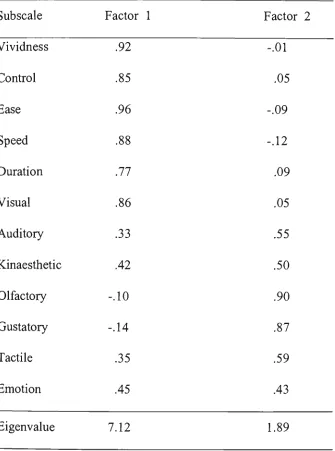
items did not résolve to a clear structure. Factor analysis on the subscale totals showed a
clear two-factor structure with non-visual sensé modalities as one factor and dimensions
plus vision as the other. The émotion subscale did not load above .5 on either factor.
The SIAM was revised by reducing scored scènes from 6 to 4, randomising
items, and incorporating the fitness scène as a practice activity. The measure was then
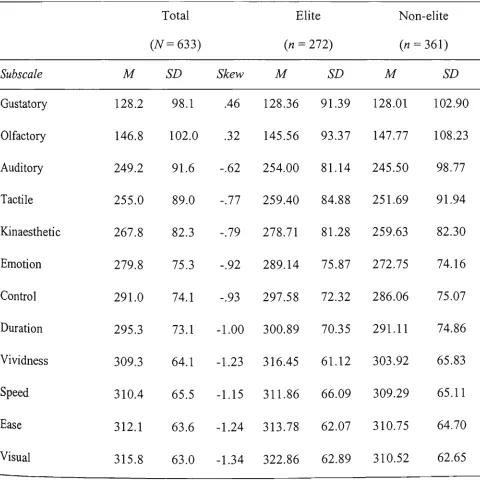
examined for reliability, criterion validity, and factor structure. In Study 2, 633
participants, ranging in âge from 12 to 55 years and including 334 maies and 299
females, completed the revised SIAM. The Cronbach alpha values indicated good to
very good internai consistency with coefficients ranging from .66 (speed subscale) to .87
(gustatory subscale). Test-retest reliability results for 58 participants over a 4-week
interval revealed moderate to very good corrélations for the spécifie subscales, varying
from .41 (auditory) to .76 (gustatory). The findings suggested that the revisions to the
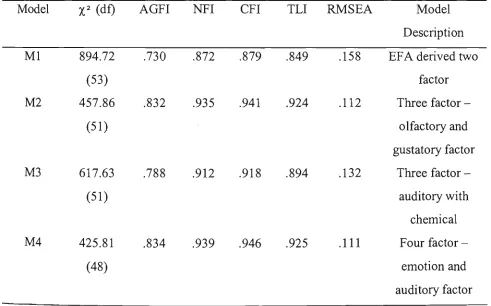
T h e factor structure ofthe revised S I A M w a s examined with structural équation
modelling. Models based on individual items did not resuit in a good fit, so models
derived from subscale scores were evaluated. The two-factor model from Study 1 did
not reflect strong indices of fit. Three alternative models produced fit statistics that were
comparable and broadly acceptable (e.g., Conroy, Motl, & Hall, 2000; Cramer, 2000).
Based on the évaluation ofthe fit data and a logical review ofthe model structure, it was
decided that the three-factor model involving auditory sensé grouped with the other
single organ sensés of taste and smell, visual/dimensions, and bodily feeling had the
greatest conceptual cohérence as a représentation of sport imagery ability.
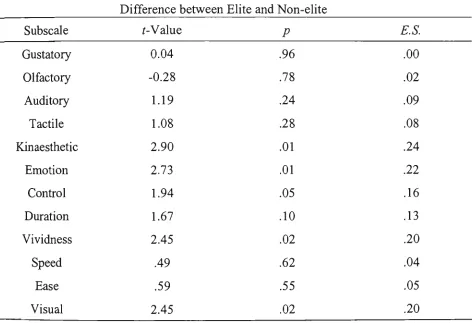
To test the criterion validity ofthe revised SIAM, subscale différences between
élite (n = 272) and non-elite athlètes (n =361) were examined. National and state level
athlètes were grouped as élite, and the district, local, and school athlètes grouped as
non-elite. The results ofthe set of independent samples t tests indicated signifïcant
différences between the groups for the vividness, control, visual, kinaesthetic, and
émotion subscales. Résultant effect sizes for différences between the athlète groups
were ail in the small range. Overall, athlètes participating at a higher compétition level
reported that they are better able to generate and manipulate the visual, kinaesthetic, and
emotional characteristics ofthe images related to their sport, consistent with
expeetations.
The purpose of Study 3 was to détermine the convergent and discriminant
characteristics ofthe revised SIAM. Convergent and discriminant validity évidence was
examined by comparing the SIAM with tests examining (a) self-reported gênerai
imagery, including vividness and control; (b) movement imagery; (c) objective imagery
ability; and (d) non-imagery cognitive functioning. Individual subscale scores ofthe
V
Shortened Form ofthe Questionnaire on Mental Imagery (SQMI); Vividness of
Movement Imagery Questionnaire-LT (VMIQ); Gordon Test of Visual Imagery Control
(GTVIC); and Multidimensional Aptitude Battery (MAB - Spatial Ability and Verbal
Compréhension). Participants (N= 436) from high schools, university physical
éducation courses, and élite sports groups completed the six measures over two
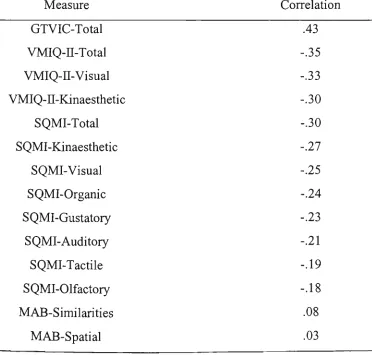
sessions. Small to moderate corrélations (.27 to .48) were found for the SIAM control,
vividness, visual, and kinaesthetic subscales with a number ofthe related dimension and
modality variables ofthe other imagery measures, providing support for the convergent
validity of thèse subscales ofthe SIAM. Very low to small corrélations (.01 to .20) were
typically reported between the SIAM subscales and (a) the cognitive ability measures
and (b) unrelated dimension and modality variables ofthe other imagery measures,
supporting the discriminant validity ofthe SIAM. In spite ofthe small corrélations found
between SIAM subscales and the various imagery measures, the findings were generally
représentative ofthe predicted pattern ofrelationships.
Study 4 involved the comparison ofthe SIAM's subscale scores with data
derived from a qualitative analysis ofthe sport imagery characteristics of athlètes.
Participants were 33 state-level junior and senior water polo players and coaches that
included 19 maies and 14 females (M= 17.91 years). Each athlète was required to read
through and familiarise themselves with a common water polo performance situation
and use the procédure of concurrent verbalisation (CV) to describe their imagery
relating to involvement in this type of situation. This procédure was repeated with four
différent water polo scénarios. The athlètes also completed the SIAM. Descriptive
statistics were reported for the visual, kinaesthetic, tactile, and auditory modalities, and
expérience of émotion for the CV task, and corresponding SIAM subscales. The results
Similar distributions of scores existed for the other identified sensés and émotion within
both the CV task and the SIAM subscales. Small to very small, non-significant
corrélations were found between the two measures for ail modalities for the total
sample. Overall, the examination of concurrent évidence provided only limited support
for the validity ofthe SIAM. The findings ofthe four studies are discussed in terms of
Acknowledgements
I wish to sincerely thank my supervisor Professor Tony Morris for his guidance,
support, and encouragement over the several years ofthe data collection and préparation
of this manuscript. His positive attitude toward the task of supervision has been
invaluable in assisting me to establish a direction for my research skills. I am also very
grateful to Associate Professor Mark Andersen who demonstrated great patience in his
rôle as co-supervisor of this thesis. His meticulous critique of ail facets ofthe research
process and the thesis manuscript have ensured that I carefully considered the procédure
in which I conducted each study and adhered to the correct format in writing the
dissertation.
I very much appreciate the time and energy the students, teachers, coaches, and
athlètes involved in each ofthe studies were prepared to contribute. Without so many
willing participants, this type of research program would have been impossible. I also
wish to thank those individuals that assisted in the recruiting of participants, including
Harriet Speed, Jon Mowat, Clark Perry, and Vicki Plaisted.
Most importantly, I wish to express the deepest gratitude to my wife, Ruth, and
my children, Robinson and Houston, who have always supported my goals in relation to
my studies. Whenever I needed to change a family plan or was unable to attend a
particular function, they were always both accepting and understanding. I hope we will
ail share the benefïts of my achievements.
Finally, thank you to the other members of my family, my friends, my work
colleagues, the Schools of Human Movement and Education in Victoria University and
my international colleagues. You have ail contributed in a spécial way in supporting my
VIII
T A B L E O F C O N T E N T S
ABSTRACT H
ACKNOWLEDGEMENTS VII TABLE OF CONTENTS V1TJ LISTOF TABLES XHI
LIST OF FIGURES XVI LIST OF APPENDIXES XVII CHAPTER 1: INTRODUCTION 1
CHAPTER 2: L1TERATURE REVIEW 4
Introduction 4 Définitions 4 Théories ofHow Imagery Works 14
Psychoneuromuscular Theory 15 Symbolic Learning Theory 17 Attentional-Arousal Set Theory 18 Bioinformational Theory 19 Triple Code Theory 21 Psychological State Hypothesis 22
Applied Model of Imagery Use in Sport 23
Measurement of Imagery Ability 26 Components of Imagery Ability 27
Classification of Imagery Ability Measures 31 Tests of Imagery Ability Used in Sport Psychology 37
Psychometric Issues Related to Imagery Ability Tests 52
Reliability 52 Validity 57 Evidence Related to the Construct Validation of Imagery Ability Measures 62
Relationship Between Imagery Ability Measures 63
General Subjective Measures 63
Objective Measures 65 Movement-Based Measures 66
Relationship Between Imagery Ability Measures and Other Psychological
Variables 69 Cognitive Abilities 70
Memory 72 Social Desirability 76
Other Psychological Attributes 77
Factor Structure 79 Imagery Ability Assessment and Motor Performance 85
IX
Motor Performance Research Involving Movement Imagery Ability Measures 93
Imagery Ability Assessment and Sports Performance 99 Sports Performance Research Involving General Measures of Imagery Ability.... 100
Sports Performance Research Involving Qualitative Assessment O f Imagery 108
Sports P erforrnance Research Involving Measures of Imagery Use 110 Sports Performance Research Involving Measures of Movement Imagery 113
Sports Performance Research Involving Measures of Sport Imagery 122
Summary 125
C H A P T E R 3: D E V E L O P M E N T A N D RELIABILITY O F T H E S P O R T I M A G E R Y
A B I L I T Y M E A S U R E (SIAM) 130
Introduction 130 Development ofthe Sport Imagery Ability Measure 130
Test Construction 131 Comprehensibility 132 Face and Content Validity 133
Examination of Reliability and Factor Structure 133
Methods 134 Participants 134 Measures 135
Personal détails information sheet 135 Sport Imagery Ability Measure (SIAM) 135 Shortened Marlowe-Crowne Social Desirability Scale (SM-C S D S ) 135
Procédure 136 Analyses 137 Results 139
Descriptive Statistics for the S I A M Subscales and Scènes 139 Internai Consistency, Test-Retest Reliability, and Social Desirability ofthe
S I A M Subscales 141 Item Analysis 142 Exploratory Factor Analyses 142
Subscale Inter-Correlations 145
Discussion 147 Relationships with Research and Theory 147
Descriptive Data 147 Reliability 149 Subscale Inter-Correlation 151
Factor Analysis 153
Summary 157 Future Research 158 Implications for Practice 160
Conclusion 161
C H A P T E R 4: RELIABILITY, F A C T O R S T R U C T U R E , A N D C R I T E R I O N
V A L I D I T Y O F T H E R E V I S E D S P O R T I M A G E R Y A B I L I T Y M E A S U R E (SIAM) 163
Introduction 163 Revision ofthe Sport Imagery Ability Measure 164
Internai Consistency, Test-Retest Reliability, Factor Structure, and Criterion Validity... 166
X
Participants 168
Measures 169 Personal détails information sheet 169
Revised Sport Imagery Ability Measure ( S I A M ) 169
Procédure 169 Statistical Analyses 171
Results 173 Descriptive Statistics for the Revised S I A M Subscales 174
Test-Retest Reliability and Internai Consistency, ofthe Revised S I A M
Subscales 175 Subscale Inter-Correlations 177
Confirmatory Factor Analyses 178 Evidence of Criterion Validity 184
Discussion 185 General Conclusions 186
Descriptive Statistics 186 Reliability Data 187
Subscale Inter-Correlation 191
Factor Structure 193 Evidence of Criterion Validity 196
Relationships to Existing Theory and Conceptualisations 204
Methodological Issues 209 Implications for Research and Practice 212
S u m m a r y of Conclusions 214
C H A P T E R 5: E V I D E N C E O F T H E C O N V E R G E N T A N D D I S C R I M I N A N T
V A L I D I T Y O F T H E R E V I S E D S P O R T I M A G E R Y A B I L I T Y M E A S U R E (SIAM) 217
Introduction 217 Method 219
Participants 219 Measures 221
Personal détails information sheet 221 Revised Sport Imagery Ability Measure (SIAM) 221
Shortened Form ofthe Questionnaire on Mental Imagery ( S Q M I ) 221
Gordon Test of Visual Imagery Control (GTV1C) 222 Vividness of Movement Imagery Questionnaire-II ( V M I Q - H ) 222
Multidimensional Aptitude Battery ( M A B ) 223
Procédure 224 Statistical Analysis 226
Results 227 Descriptive Statistics for ail Convergent and Discriminant Validity Measures 227
Relationship of S I A M Subscales with Convergent and Discriminant Validity
Measures 229 S I A M Vividness Subscale 231
S I A M Control Subscale 232 S I A M Ease of Génération Subscale 233
S I A M Speed of Génération Subscale 234
X I
SIAM Kinaesthetic Subscale 237
S I A M Auditory Subscale 238 S I A M Tactile Subscale : 239
S I A M Olfactory Subscale 240 S I A M Gustatory Subscale 241 S I A M Emotion Subscale 242
Discussion 243 Relationship of Findings to Theory and Research 244
Descriptive Data 244 Relationship ofthe S I A M and Imagery Variables 247
Relationship ofthe S I A M and Non-Imagery Variables 259
Methodological Issues 262 Instrument-Related Issues 263 Expérimenter and Administration Related Issues 269
Participant Related Issues 274 Implications for Research 276
Measuring Imagery Ability in Sport 276
Testing Théories and Models 278
Implications forPractice 279
Conclusion 281
C H A P T E R 6: E X A M I N A T I O N O F T H E C O N C U R R E N T V A L I D I T Y O F T H E
S P O R T I M A G E R Y A B I L I T Y M E A S U R E ( S I A M ) 282
Introduction 282 Method 286
Participants 286 Measures 287
Personal détails information sheet 287 Revised Sport Imagery Ability Measure ( S I A M ) 287
Water Polo Imagery Concurrent Verbalisation ( C V ) Activity 287
Procédure 289 Treatment of Data and Analyses 291
Results 294 C V Transcripts Language Units representing Imagery Characteristics 295
Inter-Rater Reliability 296 Descriptive Statistics for the Concurrent Verbalisation ( C V ) Data and the
Revised S I A M 298 Relationship Between C V Imagery Characteristic Percentages and S I A M
Subscales 300
Discussion 301 General Conclusions 302
Relationships to Research and Theory 306
Methodological Issues 315 Implications for Research 319 Implications forPractice 321
Conclusion 322
C H A P T E R 7: G E N E R A L D I S C U S S I O N 325
XII
Summary of Findings 326
Development and Reliability ofthe Original S I A M 326
Revision ofthe S I A M 327 Confirmatory Factor Analysis 328
Criterion Validity 329 Convergent and Discriminant Validity 329
Concurrent Validity 331 The S I A M in Relation to Conceptualisations of Imagery in Sport 333
Définitions 333 Théories and Models 334
Status of S I A M in Measuring Imagery Abilities in Sport 337
Future Research Involving the S I A M 342 Revision and Psychometric Evaluation ofthe S I A M 342
Expérimental Investigations 346 Theory and Model Development 347
Applied Use ofthe S I A M 352 Assessment of an Athlète's Imagery Abilities 352
Evaluation of Imagery Training 353 Manipulation Checkof Imagery Content 354
Identification of Components of Imagery 354
Concluding Comments 355
REFERENCES... 358
XIII
LIST OF TABLES
Table 2.1 A : Review of Existing Imagery Measures. Part A 38
Table 2.1B: Review of Existing Imagery Measures. PartB 41
Table 3.1: M e a n s and Standard Déviations for S I A M Subscale and Scène Scores for the
Total Sample and the Spécifie Subgroups 140
Table 3.2: Internai Consistency Coefficients, Test-Retest Reliability, and Corrélations
with Social Desirability for S I A M Subscales (N - 474) 141
Table 3.3: Rotated Factor Pattern Matrix for S I A M Subscales (N = 474) 144
Table 3.4: Inter-Correlations ofthe S I A M Subscales (N = 474) 146
Table 4.1 : Means, Standard Déviations, and Skewness for Revised S I A M Subscale
Scores for the Total Sample and the Participation Level Subgroups 174
Table 4.2: Internai Consistency Coefficients and Test-Retest Reliability for Revised
S I A M Subscales 176
Table 4.3: Inter-Correlations ofthe Revised S I A M Subscales (N = 633) 177
Table 4.4: Goodness of Fit Indices for C F A Individual Item Model for the revised
S I A M 180
Table 4.5: Goodness of Fit Indices for C F A Models for S I A M Subscale Data 182
Table 4.6: S u m m a r y of Différences between Elite and Non-elite Groups 184
Table 5.1: Descriptive Statistics for ail Convergent and Discriminant Validity
Measures 228
Table 5.2: Pearson Product-Moment Corrélations between the Convergent and
Discriminant Validity Measures and the S I A M Vividness Subscale 231
Table 5.3: Pearson Product-Moment Corrélations between the Convergent and
Table 5.4: Pearson Product-Moment Corrélations between the Convergent and
Discriminant Validity Measures and the SIAM Ease of Génération Subscale ... 233
Table 5.5: Pearson Product-Moment Corrélations between the Convergent and
Discriminant Validity Measures and the SIAM Speed of Génération Subscale. 234
Table 5.6: Pearson Product-Moment Corrélations between the Convergent and
Discriminant Validity Measures and the SIAM Duration Subscale 235
Table 5.7: Pearson Product-Moment Corrélations between the Convergent and
Discriminant Validity Measures and the SIAM Visual Subscale 236
Table 5.8: Pearson Product-Moment Corrélations between the Convergent and
Discriminant Validity Measures and the SIAM Kinaesthetic Subscale 237
Table 5.9: Pearson Product-Moment Corrélations between the Convergent and
Discriminant Validity Measures and the SIAM Auditory Subscale 238
Table 5.10: Pearson Product-Moment Corrélations between the Convergent and
Discriminant Validity Measures and the SIAM Tactile Subscale 239
Table 5.11 : Pearson Product-Moment Corrélations between the Convergent and
Discriminant Validity Measures and the SIAM Olfactory Subscale 240
Table 5.12: Pearson Product-Moment Corrélations between the Convergent and
Discriminant Validity Measures and the SIAM Gustatory Subscale 241
Table 5.13: Pearson Product-Moment Corrélations between the Convergent and
Discriminant Validity Measures and the SIAM Emotion Subscale 242
Table 6.1 : Examples of Language Units Représentative of Imagery Ability
Characteristics 295
Table 6.2: Inter-Rater Reliabilities for Initial and Final Concurrent Verbalisation
Table 6.3: M e a n s and Standard Déviations for C V Imagery Characteristics
Percentages 299
Table 6.4: Means and Standard Déviations for Revised SIAM Subscale Scores 300
Table 6.5: Corrélation Between CV Imagery Characteristic Percentages and
LIST O F F I G U R E S
Figure 3.1: Proposed hierarchical model of imagery ability 155
Figure 4.1: Specified individual item CFA model for the revised SIAM 179
Figure 4.2: EFA derived two factor model (Ml) including standardised estimâtes ... 181
Figure 4.3: Specified Three-Factor Subscale Model (M3) for revised SIAM data
including standardised estimâtes 183
XVII
LIST OF APPENDIXES
Appendix A: Sport Imagery Ability Measure (SIAM) 386
Appendix B: Expert Evaluation Proforma for SIAM 395
Appendix C: Summary of Expert Reviews 398
Appendix D: Shortened Marlowe-Crowne Social Desirability Scale 401
Appendix E: Examples of information and consent forms 403
Appendix F: Individual Item EFA ofthe SIAM 406
Appendix G: Revised SIAM 410
Appendix H: Shortened Form ofthe Questionnaire on Mental Imagery 418
Appendix I: Gordon Test of Visual Imagery Control 422
Appendix J: Vividness of Movement Imagery Questionnaire-TJ 425
Appendix K: Spatial and similarities subtests of MAB 429
Appendix L: Water Polo Imagery Concurrent Verbalisation (CV) Activity 438
Appendix M: Example of CV transcript 441
1
CHAPTER 1: INTRODUCTION
Sport psychologists, coaches, and athlètes typically accept that mental imagery is a
valuable psychological technique in the training of athlètes for excellence (Hall, 1998;
Janssen & Sheikh, 1994). If imagery training is to be maximally effective, practitioners
need to establish an understanding of athlètes' ability to image. To achieve this, it is first
necessary to assess imagery ability in a reliable, valid, and comprehensive manner.
Practitioners can benefit from knowledge ofthe individual différences in athlètes'
imagery ability in relation to both the development and évaluation of imagery training
programs. Imagery ability information can aid in the sélection and placement of
participants within an imagery program (Moran, 1993) and in the identification of spécifie
imagery dimensions and sensory modalities that warrant emphasis during implementation
and review ofthe program (Vealey & W alter, 1993; Weinberg & Gould, 1999). Valid
imagery ability measures can highlight thèse individual différences (Hall, Pongrac, &
Buckolz, 1985), help demonstrate changes in imagery abilities as an outeome of training
programs, and contribute to a clearer understanding ofthe dominant characteristics
associated with imagery ability.
Initial development of imagery ability tests began with the work of Betts (1909).
Since that time a large number and variety of measures purporting to assess either a gênerai
factor or spécifie factors of imagery ability have appeared (Anderson, 1981a; Moran, 1993;
Richardson, 1994; White, Sheehan, & Ashton, 1977). The developers of many measures
often pursued unsystematic approaches to the sélection ofthe dimensions or modalities
assessed (e.g., Lane, 1977; Switras, 1978). The measures generally focus on one or two
spécifie dimensions and modalities of imagery ability, particularly the visual modality and
the vividness dimension. Although information regarding the reliability of imagery ability
2
have failed to provide adéquate validity data relating to their development and continued
usage.
Imagery assessment studies have resulted in a wide variety of reported research
findings. The main procédures undertaken by researchers are to distinguish between groups
in terms of imagery ability or to correlate imagery ability with performance on another
variable. Reviewers of imagery assessment measures have urged caution in interpreting
results, because basic psychometric properties need to be substantiated (Ernest, 1977; Hall
et al., 1985; Hiscock, 1978; Kaufmann, 1983; Moran, 1993; Richardson, 1994; White et
al., 1977). Several authors have concluded that the initial construction and development
phase of imagery ability measures requires additional attention, if future research is to
report imagery ability characteristics, or changes in imagery abilities resulting from
interventions, accurately (Kaufmann, 1983, Katz, 1983, Perry & Morris, 1995, Tower,
1981).
Construct validation is a vital component of any instrument development program.
It is the procédure in which researchers empirically examine the theory used to develop the
instrument, and the ensuing findings used to revise both the instrument and theory (Marsh,
1996). The construction of multidimensional psychological instruments requires initial
design grounded in reputable theory. Subséquent évaluation nécessitâtes item and
reliability analysis, factor analysis, tests of convergent and discriminant validity, and use of
the measure within a quantifiable research framework (Gill, Dzewaltowski, & Deeter,
1988). An on-going dilemma in the development of many sport psychology instruments has
been their restricted use in practice and lack of implementation of accepted test
construction procédures (Ostrow, 1996).
The purpose ofthe current research is to develop and evaluate a self-report,
3
examination of current théories, models, and définitions of imagery, which will provide a
foundation on which to assemble the instrument, so that it appropriately reflects relevant
interprétations of this complex process. The appraisal of existing measures and the review
ofthe relevant investigations involving the use of thèse measures will allow for the design
ofthe new measure to suitably reflect the positive attributes of imagery tests used in both
research and practice. Construction and refmement of this measure will primarily focus on
following established psychological instrument development practices (e.g., Marsh, 1998),
to achieve the acceptable psychometric standards (McKelvie, 1994) that have appeared to
be lacking in other imagery ability measures.
A reliable and valid measure of sport imagery ability could provide sport
psychology practitioners with an assessment device that can generate useful information
regarding the design of imagery training programs to suit individuals' strengths and
weaknesses. Information about imagery ability characteristics can also help researchers
improve their understanding of imagery processes. The acquisition and dissémination of
knowledge about how imagery functions will assist in the resolution ofthe current
theoretical and assessment concerns in the fields of both sport and gênerai psychology.
Finally, outcomes ofthe findings associated with the psychometric évaluation of a new
measure of sport imagery ability may lead to the initial foundation of a conceptualisation of
4
CHAPTER 2: LITERATURE REVIEW
Introduction
As with many similar subjective psychological phenomena, no single description of
the imagery process constitutes a uniformly accepted conceptualisation. A broad range of
définitions and théories exist that differ relative to the situation in which they were
developed. This review briefly examines conceptualisations from gênerai psychology and
présents a more detailed examination ofthe theoretical perspectives regularly discussed
within the field of sport psychology.
Literature examining the measurement of imagery ability is reviewed to highlight
the key issues related to test development. Thèse include the nature of assessable
components, frameworks for the design and classification of measures, the relationship
between imagery measures and other cognitive processes, and the spécifie structure of
existing test instruments. The psychometric properties ofthe imagery measures that
consistently appear in research literature related to motor skills and sport are considered.
Research examining individual différences in imagery ability and motor skills, or
with a spécifie emphasis on athletic performance and imagery ability, is then summarised.
The key focus of this section ofthe review is to détermine the applicability and potential
contribution of a new measure of imagery ability within the field of sport psychology. To
conclude the literature review, I présent the aims ofthe présent thesis.
Définitions
The primary goal in reviewing the major imagery définitions and conceptualisations
is to clarify their rôle in the establishment of a theoretical framework for the development
of a measure of sport imagery ability. Currently, only minimal consensus exists as to which
conceptualisations represent accurate descriptions ofthe phenomenon. Richardson (1983a)
5
ubiquitous and used for the purposes of both description and explanation. He suggested
that the term typically referred to "either a class of inferred cognitive constructs or
processes or a class of more or less percept-like expérience" (p. 36). The définitions and
conceptualisations considered in the following section will focus primarily on the cognitive
processes associated with mental imagery.
Limited consistency is apparent in the formulation of définitions of mental imagery
from within the field of cognitive psychology. The focus of each définition varies
dépendent on the purpose for which the imagery description is used. Finke (1989), whose
work examined information retrieval using mental images, defined mental imagery as "the
mental invention or récréation of an expérience that in at least some respects resembles the
expérience of actually perceiving an object or an event, either in conjunction with, or in the
absence of, direct sensory stimulation" (p. 2). Paivio (1971) also working within the field
of learning and memory proposed a description oriented toward neurological functioning
within which imagery is "used to refer to a memory code or associative mediator that
provides spatially parallel information that can médiate overt responses without necessarily
being consciously experienced as a visual image" (pp. 135-136). Richardson (1994) has
suggested that the intention of this définition was to contrast the verbal and visual aspects
of imaginai processing emphasised within Paivio's dual code theory of imagery
functioning. Contrasts based on use within the existing set of imagery définitions has
limited the utility of many descriptions and caused possible confusion in the adoption of
conceptualisations within research.
Other researchers have provided operational définitions of imagery as an important
component in their development of imagery theory. In relation to bioinformational theory,
Lang (1979a) described imagery in the context ofthe brain's information processing
6
reduced to spécifie propositional units" (p. 109). Subséquent examination of Lang's theory
lead to the description of imagery as a process involving the activation of networks of
stimulus and response propositions stored as coded information in long-term memory
(Hecker & Kaczor, 1988). Lang (1979b) has suggested that images are strictly controlled
by "a finite propositional structure (and not the analogue représentation suggested by
phenomenology)' (p. 495). Lang has presented substantial research emanating from the key
éléments of his original conceptualisation of imagery, an approach that remains necessary
in development of accurate définitions of mental imagery.
Anderson (1981a) also présents an operational or working définition, but from the
perspective of imagery assessment, rather than theory development.
"Imaginary expériences" will refer, at a minimum, to awareness of sensorylike
qualities in the absence of environmental stimuli appropriate to the sensation. This
will usually involve awareness of visual qualities, but not always. Along with the
minimum requirement of sensory awareness, imaginary expériences may also
include thought segments that are part of, or that occur in the context of, the
imaginai sensory awareness. (p. 151)
Formulation ofthe définition involved the assumption that imagery is a
constructive behaviour, actively undertaken. Anderson was quite clear in pointing out that
the primary rôle ofthe définition is in aiding the practitioner and investigator in the design
and sélection of appropriate instruments for imaginai assessment.
Of existing définitions, the classic description of mental imagery formulated by
Richardson (1969), is a description ofthe imagery process that pro vides an important
foundation for the development of many measures of imagery ability (e.g., Shortened
Questionnaire Upon Mental Imagery). Irrespective that the development basis ofthe
7
acknowledgement in the sport psychology literature (e.g., Janssen & Sheikh; 1994; Martin,
Moritz, & Hall, 1999; Murphy & Jowdy, 1992; Perry & Morris, 1995). This définition, or
one or more of its composite éléments, has also served as a commencement viewpoint for a
variety of imagery studies (e.g., George, 1986; O'Halloran & Gauvin, 1994) and
constituted a base for more elaborate discussions of imagery functioning (e.g., M.artin et al.,
1999; Murphy & Jowdy, 1992). The définition has lost little relevance or validity in the 30
years since its création.
Mental imagery refers to (1) ail those quasi-sensory and quasi-perceptual
expériences of which (2) we are self-consciously aware and which (3) exist for us in
the absence of those stimulus conditions that are known to produce their genuine
sensory or perceptual counterparts, and which (4) may be expected to have différent
conséquences from their sensory or perceptual counterparts. (Richardson, 1969, pp.
2-3)
Murphy and Jowdy (1992) considered this définition to be of great value in relation
to sport imagery. They outlined three key features ofthe définition concerning the nature of
imagery within a sporting context. The first is the mimicking ofthe sensory or perceptual
expérience, such as the "feeling of movement". The second is that the individual is
conscious ofthe expérience in that they may purposefully generate an image of a familiar
sporting venue, for example. The third feature is that the expérience occurs without known
stimulus antécédents, such that no track or competitors need to be présent to imagine an
athletic event. Perry and Morris (1995) suggested that the Richardson définition does not
adequately distinguish imagery from other cognitive processes. For example, whereas
Murphy and Jowdy (1992) interpreted the référence to conscious awareness within the
définition as a way to differentiate imagery from dreaming and daydreaming, Perry and
8
have suggested that the concept of volitional control of images constitutes a more
appropriate distinction. Generally, the Richardson définition does provide sufficient
complexity and flexibility to allow for its use as a suitable descriptor ofthe characteristics
of images experienced in the sporting domain.
In addition to his définition of mental imagery, Richardson (1969) also described
four types of imagery, several of which have relevance to the présent thesis. They are (a)
afterimagery, (b) eidetic imagery, (c) thought or memory imagery, and (d) imagination
imagery. Of greatest relevance to sport imagery, and indeed discussed briefly within the
sport psychology literature, are the latter three types of imagery. Eidetic imagery refers to a
percept-like imagery, based on exposure to a récent stimulus that does not require a fixed
gaze, but does require some form of attentional focus. Descriptions ofthe image détails are
in the présent tense, under voluntary control, and may remain available for an extended
period of time (Morris & Hampson, 1983; Richardson, 1969). Green (1994) suggested that
this form of imagery is of great use to athlètes with respect to performance enhancement
and stated "the eidetic form of imagery, as used by athlètes, recréâtes a multi-dimensional
expérience that encourages the intégration of ail sensory modalities" (p. 44). Richardson's
(1969) and Morris and Hampson's (1983) interprétations of eidetic imagery inferred that
imagery of this type is only experienced by a limited number of individuals (predominantly
children) and is operating as a form of retrieval imagery dominated by the visual sensé. Its
applicability within the sporting context is limited. Green (1994) described eidetic imagery
more as a form of memory or thought imagery.
Memory or thought imagery is the most common form of imagery practised on a
regular basis in everyday life (Richardson, 1969). It is experienced by most individuals,
relates to both the présent and to anticipatory events, is voluntarily produced, opérâtes
9
control over its content (Richardson, 1994). It is this form of imagery that has the greatest
significance in the sporting context. Green (1994) specifïcally discussed the functions of
thought imagery in relation to athletic performance. He described processing examples
such as imagery ofthe exécution of spécifie sporting skills or imagery relating to the more
holistic involvement of an athlète within a particular sporting contest. From an imagery
assessment perspective, Richardson (1994) maintained that thought imagery is the imagery
type predominantly examined within self-report measures of imagery ability.
Imagination imagery is the final category Richardson described. He suggested that
this form of imagery usually involves images of new construction generated from mémorial
éléments. The images tend to be novel, substantial, clear, and vivid. They differ from
memory images primarily on the basis that the imager has never previously experienced the
exact events detailed within the images. Imagination imagery has received no direct
attention within the sport psychology literature. In the applied context, however, it seems
that images dealing with unique expériences, such as winning an important event, or
mastering a diffïcult new élément of a routine, could be categorised as forms of
imagination imagery.
Several straightforward définitions of mental imagery from the sport psychology
literature relate directiy to the mental expérience. Moran (1993), as a component of his
examination of imagery assessment in sport, referred to two simple définitions ofthe term.
The first, originally presented by Matlin (1989), described mental imagery as "the capacity
to represent in the mind expériences of things that are not physically présent" (Moran,
1993, p. 156). The second définition, developed by Solso (1991), described mental imagery
as " a mental représentation of a nonpresent object or event' (p. 267). Moran (1993) also
emphasised that imagery should not be restricted to the visual sensé, but should incorporate
psychology literature, even in quite récent texts (e.g., C o x , 1998; W a n n , 1997) has been the
defming of imagery from the visual perspective only, through terms such as visualisation,
mental picture, or the mind's eye (Morris, 1997). Hardy, Jones, and Gould (1996) avoid
this problem by focussing on the sensorial nature of imagery, in describing imagery "as a
symbolic sensory expérience that may occur in any sensory mode" (p. 28). This set of
définitions has tended to oversimplify a complex concept that is becoming of ever
increasing importance within sport psychology.
Vealey and Greenleaf (1998) have also produced a functional définition that is as
follows: "Imagery may be defined as using ail the sensés to recreate or create an expérience
in the mind" (p. 201). This définition is best understood when considered in conjunction
with their extended discussion ofthe three key characteristics associated with
sport-oriented imagery. Thèse éléments are in part derived from their définition and include (a)
imagery as recreating or creating an expérience, (b) imagery as a polysensory expérience,
and (c) imagery occurring in the absence of external stimuli. Although Vealey and
Greenleaf s définition is relatively distinct from that of Richardson's (1969), their
broadened conceptualisation ofthe term includes several éléments related to his earlier
définition. Finally, it is Vealey and Greenleaf s emphasis ofthe re-creation and création of
the imaginai expérience that distinguish it from other définitions, and their présentation of
a broader conceptual framework provides their description with a distinctive quality.
Denis (1985) has formulated a définition that highlights the dynamic and créative
properties of images:
Imagery is a psychological activity which evokes the physical characteristics of an
absent object (either permanently or temporarily absent from our perceptual field).
It is worth emphasising hère that imagery is not restricted to recollection ofthe
11
transformations, in other words, to dynamic events. The scope of imagery is not
limited to recalling objects or events that have been perceived in the past (récent or
distant past) but imagery also refers to objects or events that have not yet been
accomplished. Imagery allows people to anticipate future (or even purely
theoretical) events. (p. 4S-5S)
This définition has shown itself to be a popular conceptualisation, specifically
through its alignment with the extensive imagery research work of Hall and his colleagues
(e.g., Hall, 1998). The définition is useful in the manner in which it considers the spécifie
properties of an image, possibilities for which an image may be useful, and the
involvement of other cognitive processes such as memory. The detailed nature of this
définition provides a substantial basis for the possible development of instruments to assess
individual différences in the dimensional and sensorial characteristics of imagery ability.
Distinguishing between commonly used terms relating to imagery within sport
psychology research has been the focus of several authors (Murphy & Jowdy, 1992; Perry
& Morris, 1995). The terms regularly used with the least discrimination are imagery,
mental rehearsal, and imagery rehearsal (e.g., Corbin, 1972; Driskell, Copper, & Moran,
1994; Richardson, 1967a). Mental practice according to Corbin (1972) is the "répétition of
a task without observable movement, with the spécifie intent of learning" (p. 94). It is
important to acknowledge that in mental practice, imagery may not be used at ail, and that
mental practice could include non-image based stratégies, such as verbal rehearsal or
self-talk. For the purposes of this review, in which imagery is of primary importance, a
distinction outlined by Murphy and Jowdy (1992), which considers imagery as a mental
process and mental practice as a particular non-physical rehearsal or practice technique
used by athlètes, is most useful. Aligned with this distinction is the définition of mental
12
practise an act" (p. 28). The emphasis hère is also on mental rehearsal as a technique rather
than imagery as a process.
Developed within an applied sport psychology context, Suinn (1976, 1983, 1993)
used the term imagery in relation to his imagery rehearsal procédure known as visuomotor
behaviour rehearsal (VMBR, 1976). According to Suinn (1976):
The imagery of visuomotor behavior rehearsal apparently is more than sheer
imagination. It is a well-controlled copy of expérience, a sort of body-thinking
similar to the powerful illusion of certain dreams at night. Perhaps the major
différence between such dreams and VMBR is that the imagery rehearsal is subject
to conscious control. (p. 41).
Another important component of Suinn's analysis ofthe imagery construct is the
multi-modal nature of visuomotor behaviour rehearsal and its relation to mental
expériences. Suinn described VMBR as "a covert activity whereby a person expériences
sensory-motor sensations that reintegrate reality expériences, and which include
neuromuscular, physiological, and emotional involvement" (1993, p. 499).
Additional important éléments of Suinn's (1984) VMBR program are that the
process of imagery is holistic and multi-sensory involving the réintégration of expériences
derived from visual, auditory, tactile, kinaesthetic, and emotional eues (Murphy, 1990).
The process also involves the spécifie use of imagery by individuals in completing the
rehearsal of sporting involvement (Murphy, 1994). As a form of imagery rehearsal, VMBR
has shown itself to be adequately detailed, systematically analysed, and a popular technique
within sport psychology practice. When examined as an imagery conceptualisation, the
quality and depth ofthe description of VMBR facilitâtes the incorporation of pertinent
content within the design of a measure examining a broad range of imagery abilities.
13
imagery as a psychological skills training technique. The information of relevance to the
définition of imagery emanated from his concluding thoughts on the manner in which
athlètes process imagery. Simons described the process as:
Imagery is intriguing for its close relationship to perception and action. It is such a
rich memory System, matching the complexity of information presented by the
environment and contained in the exécution of motor skills. Images bind personal
thoughts and émotions to expérience, and they have qualities far beyond simple
stimulus/response propositions Imagery can be créative, allowing one to
expérience attitudes and actions mentally in ways that have not yet been
encountered in real performance, (p. 92)
This description of sport-oriented imagery succinctly highlights many ofthe
important conceptual characteristics contained within the conceptualisations outlined
previously. It is necessary that future imagery investigations align applied interprétations of
the phenomenon with those définitions formulated from research findings and the analysis
of theory.
For the purpose of this research, it was vital that a thorough and complète définition
supported the theoretical framework underlying the development ofthe imagery ability
measure. This provided a spécifie focus for the content and format ofthe test items
generated for this new measure. The following définition may be considered a compilation
of spécifie éléments of relevance from the définitions of Richardson (1969) and Denis
(1985), the conceptualisations of Suinn (1976, 1983, 1993) and Vealey and colleagues
(1993, 1998), and the applied interprétation of Simons (2000). The emphasis for the
présent description centres upon the nature of mental imagery in relation to involvement in
sport. Imagery in the context of sport may be considered as the création or récréation of an
quasi-14
perceptual, and quasi-affective characteristics, that is under the volitional control ofthe
imager, and may occur in the absence ofthe real stimulus antécédents normally associated
with the expérience. This définition is obviously not unique when examined on the basis of
its collective éléments, what is distinctive is the attempt to create a useful association ofthe
key components of existing définitions into an operational framework relevant to the
assessment of sport imagery ability.
Théories of How Imagery Works
Much ofthe literature that examines the imagery process in relation to physical
activity has highlighted the théories proposed as explanations ofthe opération of imagery
in facilitating performance (e.g., Hall, 2001; Murphy, 1990; Perry & Morris, 1995;
Weinberg & Gould, 1999). In a review of mental practice research, Grouios (1992) listed
twelve théories as interprétations ofthe relationship between mental practice and enhanced
motor performance. In conducting the current review, I examined a range of théories
discussed within a diverse collection of sport psychology and human movement research
and theoretical review material (e.g., Corbin, 1972; Feltz & Landers, 1983; Grouios, 1992;
Hinshaw, 1991; Richardson, 1967). A number ofthe théories have been detailed
minimally, whereas, a spécifie set of théories appear to be consistently represented within
the examined literature (e.g., symbolic learning, bioinformatïonal, psychoneuromuscular).
For the purposes of this review, the analysis of théories focuses on the discussion of
their conceptual association with the procédures involved in assessing sport imagery
ability. Moran (1993) highlighted a pertinent problem existing between theory and measure
development and stated that the "theoretical advances by cognitive psychologists in
understanding the nature and properties of imagery have not yet been translated into the
domain of imagery assessment, where the self-report paradigm reigns suprême" (p. 166).
reviewed théories and determining possibilities for the constructive représentation of their
key éléments in the context ofthe measurement of sport imagery ability.
Generally, the research literature detailed four main théories as explanations for the
relationship between imagery and physical performance (e.g., Hall, 2001; Murphy &
Jowdy, 1992; Perry & Morris, 1995; Suinn, 1993, 1997; Weinberg & Gould, 1999). Thèse
are the: (a) psychoneuromuscular theory (Jacobson, 1930, 1932), (b) symbolic learning
theory (Sackett, 1934), (c) attentional-arousal set theory (Schmidt, 1982), and (d)
bioinformational theory (Lang, 1977). In addition, I review two alternative explanations,
the triple code model (Ahsen, 1984) and the psychological state hypothesis (Weinberg &
Gould, 1995). Finally, the récent présentation ofthe applied model of mental imagery use
in sport (Martin et al, 1999) constituted an important conceptual représentation that
acknowledged the importance of imagery ability as a variable and therefore, warranted
review.
Psychoneuromuscular Theory.
The psychoneuromuscular theory, initially discussed by Jacobson (1930, 1932), is a
dérivation ofthe ideomotor principle of imagery (Carpenter, 1894). Jacobson (1931)
proposed that low-level nerve impulses generated during imagined movement are similar to
those patterns produced within the actual movement, but of a smaller magnitude. In
addition, Jacobson maintained that the generated images are représentative of covert motor
activity. Although no spécifie movement occurs during the imagery, the low level nerve
impulses help create a 'muscle memory' (Vealey & Greenleaf, 1998) ofthe correct firing
séquence ofthe muscles, which in turn should make the exécution ofthe movement easier
(Janssen & Sheikh, 1994).
The theory has been supported by a number of imagery rehearsal studies (Bird,
monitor the motor-efferent patterns generated while participants imagine spécifie physical
movements or sport activities. Suinn (1980) reported that for a downhill skier, the
electromyography (EMG) activity ofthe thigh muscles recorded during sport-oriented
imagery (skiing a downhill run) matched the EMG activity expected during the physical
exécution ofthe sporting task. Haie (1982), following the investigation of EMG and ocular
activity in relation to the imaging of a biceps curl, suggested that the minute localized
EMG and ocular innervations provide both visual and kinaesthetic feedback to the motor
cortex and subsequently enhance the motor schéma of that movement. Evidence that
confirms the existence of visual and kinaesthetic electrical responses to imagery tasks also
provides basic support for the proposai that athlètes may be capable of subjectively
quantifying the strength of their imagined responses for both the visual and kinaesthetic
modalities.
A number of researchers have highlighted concerns with this theory. Feltz and
Landers (1983) concluded, following an extensive meta-analysis of existing mental
practice research, that (a) the inadéquate quantitative analysis ofthe theory, (b) the failure
to include any task performance measures in addition to the measurement of muscular
activity, and (c) the fact that muscle innervation was not always localised to the muscle
groups ofthe imagined movement restrict the usefulness ofthe theory in explaining how
imagery enhances sport performance. Hecker and Kaczor (1988) criticised the inadéquate
explanation ofthe rôle of modality feedback within the theory. Their final analysis
suggested that the theory is more a "description of an important aspect of imagery
rehearsal rather than an explanation ofthe processes involved in improved
performance" (p. 364). The psychoneuromuscular theory assists minimally in
substantiating the proposai of sport imagery as a multi-modal, multi-dimensional cognitive
17
modalities, and without any acknowledgment ofthe generational aspects ofthe
phenomenon. Therefore, in summary, I do not consider this explanation to be a signifïcant
contributor to the conceptual basis underlying the development of a measure of imagery
ability in sport.
Symbolic Learning Theory
Symbolic learning theory is primarily concerned with the cognitive process
associated with imagery. Sackett (1934) posited the initial explanation of how the theory
operated. It was proposed that imagery allows the performer to symbolise the required
movement séquences in the brain, and through rehearsing thèse symbolic components,
facilitate performance. Sackett also maintained that skills that are cognitive in nature are
easier to code than primarily motor skills (Janssen & Sheikh, 1994). Récent discussion of
the theory by Vealey and Greenleaf (1998) lead to their conclusion that the use of imagery
strengthens the "mental blueprint" that facilitâtes the processing ofthe skill to an automatic
status.
Several mental rehearsal studies have been able to demonstrate consistent support
for the symbolic learning theory by showing that imagery is more effective on tasks with
large cognitive components than on purely motor tasks (Hird, Landers, Thomas, & Horan,
1991; Ryan & Simons, 1982; Wrisberg & Ragsdale, 1979). The results ofthe meta-analysis
presented by Feltz and Landers (1983) indicated that effect size was much larger in studies
that were based on cognitive tasks than studies involving motor or strength tasks. Hecker
and Kaczor (1988) detailed the existence of possible problems with the theory. They
suggested that although the theory can account for the use of mental practice in initial skill
acquisition, it fails to explain how imagery actually relates to the performance enhancement
of established athletic skills. They also shared a concern with Richardson (1967) as to the
18
examination ofthe key éléments and approaches to the symbolic learning theory, Murphy
and Jowdy (1992) concluded that "Without a rigorous explanatory framework, the
symbolic learning approach cannot serve as a useful heuristic for future researchers" (p.
237).
Although the contribution of this theory to the understanding of sport imagery
ability assessment is limited, an association may exist between the cognitive blueprint
proposai and the imaginai représentation of coded movement information entailed within
certain imagery ability assessment tasks. Such a simple relationship, however, does not
constitute a sufficient basis for the inclusion ofthe symbolic learning theory as a primary
interprétation of imagery functioning in the development of a measure of sport imagery
ability.
Attentional-Arousal Set Theory
The attention-arousal set theory posits that there is an optimal arousal level for each
athlète to achieve peak performance (Janssen & Sheik, 1994) and that imagery provides a
method of closely approximating this optimal level of arousal or physiological activation
(Schmidt, 1982). Imagery is also bénéficiai in focussing an athlete's attention on the
requirements for superior performance and aiding in the screening of possible distractors
(Janssen & Sheik, 1994). Vealey and Greenleaf (1998) have used the term "mental set" as a
basic framework to explain the theory.
Empirical data to support the theory has been generated indirectly by examining the
function of gênerai arousal in mediating imagery effects, rather than as the resuit ofthe
direct examination ofthe theory (Budney, Murphy & Woolfolk, 1994). Lee (1990) found
that participants using task-relevant imagery (positive images of actual physical
performance) produced significantly better scores on a sit up task than participants using
imagery effects on performance were not the resuit of arousal optimisation as indicated by
positive mood state. Feltz and Riessinger (1990) concluded that "in vivo émotive imagery"
was more effective than performance feedback in enhancing both self-efficacy and
performance of a muscular endurance task. Although the theory has a certain intuitive
appeal (Feltz & Landers, 1983), the major weaknesses of this theory are that it fails to
explain how imagery optimises arousal and attention, and that it is yet to be validated
through suitable research (Hecker & Kaczor, 1988; Vealey & Greenleaf, 1998).
Perry and Morris (1995) concluded that the rôle ofthe attention-arousal set theory
in explaining the imagery process is unclear. Consequently, the contribution ofthe theory
in establishing a framework for the construction of a self-report imagery ability measure
would appear to be minimal. Imagery scripts written with the purpose of arousing a
participant and encouraging them to attend to the spécifie requirements of their sporting
involvement should still remain an important considération in the development of a
measure of sport imagery ability.
Bioinformational Theory
The bioinformational theory developed from Lang's (1977, 1979a) research
examining imagery and the associated psychophysiology of phobias and anxiety disorders.
Lang argued that an information-processing model could explain the opération of mental
imagery. The model specified that images are sets of functionally-organised propositions
stored within the long-term memory. The modification of propositions may generate
changes in overt behaviour. The model considered two types of propositions: (a) stimulus
propositions that describe spécifie characteristics ofthe imagery scène, and (b) response
propositions that describe typical behavioural outcomes, that include cognitive,
physiological, and emotional responses to the imagined situation. Lang proposed that any
proposition types. Imagery represents a process that facilitâtes the strengthening of thèse
links (Lang, 1979a).
Research évidence exists supporting the bioinformational theory (e.g., Haie, 1982;
Hecker & Kaczor, 1988). Typical méthodologies involved the démonstration of variations
on a range of physiological responses dépendent on the modification of imagery variables
such as scène familiarity (Hecker & Kaczor, 1988), response orientation versus stimulus
orientation (Lang, Kozak, Miller, Levin, & McLean, 1980), and imagery perspective (Haie,
1982).
A number of studies have attempted to demonstrate performance enhancement
outcomes from research applications ofthe bioinformational theory. Ziegler (1987) could
not find any signifïcant différence in basketball free throw shooting between groups using
active imagery (stimulus and response propositions) and passive (stimulus propositions).
Kremer and Pressing (1998) found greater improvement in pistol shooting performance for
the group using stimulus only propositions when compared to a group using stimulus and
response propositions. This suggests an equivocal status for the influence of proposition
type on performance. Although additional research to further test this theory is required,
Hecker and Kaczor (1988) concluded "the strength of Lang's theory lies in its heuristic
value since it provides a conceptual model that can guide research into imagery rehearsal"
(p. 367).
In terms of imagery ability self-report assessment, review ofthe bioinformational
theory highlights several key issues that warrant considération within the development of
any new measure. Firstly, the image scripts prepared should endeavour to include both
stimulus and response style propositions (Haie, 1986; Hardy et al., 1996). This practice
represents a positive attempt to construct a measure that provides the imager with an
21
it is important that the scripts contain propositions représentative ofthe sensorial and
emotional variables the measure examines (e.g., fatigue, excitement). The thorough
préparation of stimulus material may facilitate the génération of response évidence related
to both the qualities of image processing, such as vividness and ease of génération, and the
modal characteristics ofthe psychophysiological efferent outflow, such as visual and
kinaesthetic sensations.
Triple Code Theory
The triple code model of imagery, as proposed by Ahsen (1984), shares an
emphasis on the psychophysiological processes of imagery with Lang's (1977, 1979)
bioinformational theory. Ahsen (1984) further developed the information-processing model
by defining three essential components warranting considération within the analysis ofthe
imaginai process. The first part ofthe triple code model, also referred to as ISM, is the
image itself (I), the second part is the somatic response (S) that represents the
psychophysiological stimulation the image may generate, and, thirdly, the meaning (M) or
significance ofthe image to the individual must be evaluated. Additionally, Ahsen (1997)
recognised the importance of multi-sensory imagery. He noted that "performance,
especially in sports, is never sensory-specific in an absolute way, as it involves other
sensés, such as muscles and other viscéral feelings" (p. 13).
Murphy and Jowdy (1992) examined the nature ofthe triple code theory with
respect to sporting performance and concluded that the "model recognizes the powerful
reality of imagery for the individual and also reminds sports psychologists to pay attention
to the meaning ofthe images they employ and their clients report" (p. 240). In addition,
Murphy and Jowdy outlined three important aspects of Ahsen's (1984) model to which
22
ofthe résultant imaginai expérience; the measurement of various physiological Systems in
response to imagery; and the évaluation ofthe meaning the image has for the individual.
The triple code model has had limited empirical or applied évaluation in relation to
sport imagery apart from Murphy's (1990) citation of his own clinical and académie work.
Murphy was, however, adamant that the ISM represents a minimum theoretical standard
researchers should adopt in relation to future imagery investigations in sport psychology. In
considering the key éléments ofthe ISM in association with the procédural suggestions
outlined earlier by Murphy and Jowdy (1992), several issues of relevance to the
development of a self-report imagery ability assessment instrument become apparent.
Firstly, test developers should attempt to ensure that script content extends beyond the
bio-informational theory and incorporâtes the image meaning élément proposée within the ISM
model. Secondly, any new measure requires appropriate script détail capable of stimulating
abroad range of dimensional, sensory (quasi-physiological), and emotional imagery
characteristics représentative ofthe three components detailed in the ISM model (Murphy
& Jowdy, 1992).
Psychological State Hypothesis
Several authors have put forward théories, models, or explanations that examine the
effect of imagery on a range of associated psychological states (Budney et al., 1994; Gould
& Damarjian, 1996; Grouios, 1992; Jannsen & Sheik, 1994; Perry & Morris, 1995;
Weinberg & Gould, 1995). Gould and Damarjian (1996) outlined the gênerai nature of this
relationship and stated that: "imagery is also thought to influence athletic performance
through its effect on other psychological states, such as self-efficacy or confidence and
anxiety" (p. 34). Examples ofthe spécifie investigations of imagery in relation to particular
psychological states include (a) improvement in motivation through the imagination of
theory (Bandura, 1977) as a contributing factor in increased confidence, achieved via the
use of imagery to vicariously model observed behaviour (Perry & Morris, 1995); and (c)
the use of imagery-based programs to control and reduce anxiety as a component of
performance enhancement (Gould & Udry, 1994).
The lack of conceptual specificity ofthe psychological state hypothesis limits its
contribution toward the détermination of those imagery ability components that could be
incorporated within any measure. An understanding ofthe relationship between imagery
abilities and other psychological states may still provide directions for future research and
insight into the multi-dimensional nature ofthe cognitive activities occurring in the mind
ofthe athlète. This would still require the development of an imagery measure that
pro vides detailed knowledge ofthe spécifie characteristics that détermine an individual's
imagery ability.
Applied Model of Imagery Use in Sport
Although the Applied Model of Imagery Use in Sport (AMIUS, Martin et al., 1999)
does not specifically détail the characteristics typically associated with imagery ability, the
model does represent a useful overview ofthe opération of imagery in relation to athletic
performance. Of importance to the current review is the incorporation of imagery ability as
a key component within the framework ofthe AMIUS.
An important élément in the AMIUS is Paivio's (1985) functional analysis of
imagery in relation to behaviour médiation. Paivio suggested a 2 X 2 imagery model in
which the dimension of cognitive and motivational processing contrasts the dimension of
the achievement of gênerai and spécifie behavioural goals. The dimensions are
distinguishable based on image content. As an outeome of their extensive involvement in
the field of sport and movement imagery, Hall and colleagues, have provided