THE ACT OF EXPLANATION IN A CLASSROOM CONTEXT \ND LEARN■Ncr WITH PARTICULAR REFERENCE TO THE TEACHING
A OF SCIENCE
by
J. W. RICHARDS
(Jill Winifred Richards)
UNIVERSITY OF LONDON
INSTITUTE OF EDUCATION LIBRARY
NOT 10 BE REMOVED FROM LIBRAR'
Thesis submitted in fulfilment of the requirement for the degree of Doctor of Philosophy at the University of London Institute of Education
ICULAR REFERENCE TO THE TEACHING AND LEARNING OF SCIENCE ABSTRACT
The thesis is concerned with the act of explanation in class-room contexts, with emphasis upon secondary teaching part-icularly in science. Over one hundred explanations in eight subjects (Mathematics, Physics, Chemistry, Biology, English, History, Geography, Foreign Languages) are analysed and
some fifty teachers, teaching more than one thousand pupils, are involved in studies which are cross-sectional, analytic and descriptive, utilising four instruments, namely, rating sheets, experiments, typologies and models to investigate the concerns of ten hypotheses.
The rating sheets used with teachers and pupils in relation to Hypotheses H1 and H2 reveal explaining as the most central and important activity of teaching and learning, especially in science.
Typologies employed for Hypotheses H4, H5 and H7 reveal respectively:
relationships between question type, concept type, comm-unicated meaning and subject origin of an explanation, understanding by pupils of their teacher's explanation shows wide variety and ranges from satisfactory to fragmentary.
Experiments conducted in relation to Hypotheses H6 and H8 give results that show respectively:
the gap between intended meaning and received meaning to be wider than teachers realise,
unfamiliar, non-technical terms block pupil understanding. Models used in analysis for Hypotheses H3, H9 and H10 reveal respectively;
two-thirds of explanations given by teachers meet philosophical conditions for deeming them to be such, contextual features influence the success of an act of explanation,
conceptual features influence the success of an act of explanation,
ACKNOWLEDGEMENTS
I particularly wish to thank Professor Harold Rosen, my supervisor, for his invaluable advice, helpful criticisms and general support.
My gratitude also goes to teachers, especially those on in-service courses at Worcester College of Higher Education, for co-operating in the investigation,
and to the pupils to whom they gave their explanations.
Finally, thanks are due to Mrs Elaine James for initial draft typing and duplicating, to Mr William Eaton for assistance with photocopying and most of all to
Mrs Celia Witherick for re-typing the draft and checking the typescript, to bring the thesis to its present
TABLE OF CONTENTS
LIST OF TABLES 6
CHAPTER 1
1.0 INTRODUCTION 8
CHAPTER 2
1.0 THE ACTIVITIES OF TEACHING 12
2.0 EXPLANATION AND EXPLAINING IN TEACHING 25 CHAPTER 3
1.0 KINDS OF EXPLANATION 33
2.0 THE NATURE OF EXPLAINING SOMETHING TO SOMEONE 47 CHAPTER 4
1.0 UNDERSTANDING SOMETHING 83
2.0 MEANING AND ITS COMMUNICATION IN THE ACT OF
EXPLANATION 92
3.0 EFFECTIVENESS IN EXPLAINING SOMETHING TO
SOMEONE 133
CHAPTER 5
ABBREVIATIONS USED IN PRESENTING THE RESULTS 149 1.0 ARRIVING AT AND JUSTIFYING THE HYPOTHESES 150 2.0 PROBLEMS AND DESIGN STRATEGIES 163 CHAPTER 6
1.0 PRELIMINARY EXPERIMENTS TO OBTAIN SAMPLES AND
TO TEST HYPOTHESES H1, H2 AND H3 175 2.0 ANALYSIS OF THE EXPLANATIONS GIVEN IN THE FIRST
SAMPLE OF EXPLAINING EPISODES AND TO TEST
HYPOTHESES H4 AND H5 188
CHAPTER 7
1.0 THE GAP BETWEEN INTENDED MEANING AND RECEIVED
CHAPTER 8
1.0 DISCUSSION OF RESULTS IN THE CONTEXT OF
PROFESSIONAL PRACTICE AND THEIR IMPLICATIONS...265 2.0 CONCLUSIONS, RECOMMENDATIONS AND FUTURE
RESEARCH 288
BIBLIOGRAPHY 296
APPENDICES 310
APPENDIX Al METHODOLOGICAL MATERIAL 311 APPENDIX A2 EXPLANATIONS AND THEIR OUTCOMES 322 APPENDIX A3 TEACHER EFFECTIVENESS IN EXPLAINING
SOMETHING TO SOMEONE 415
APPENDIX A4 FACTORS INFLUENCING PUPIL UNDER-
STANDING 431
TABLE
TABLE 1:
2:
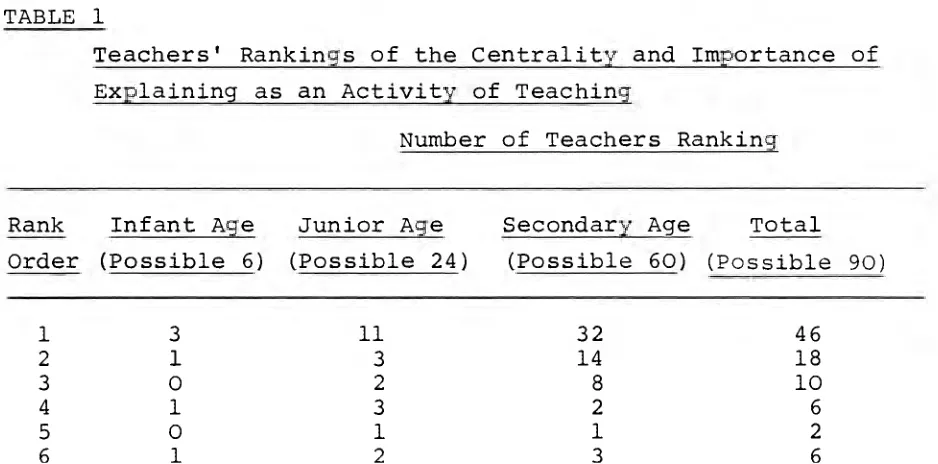
Teachers'Rankings of the Centrality and Imp-ortance of Explaining as an Activity of Teaching
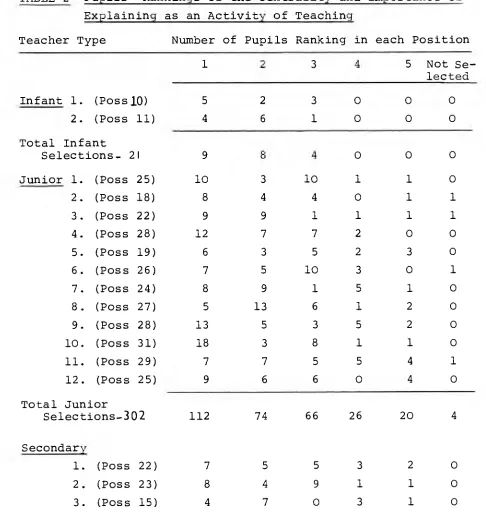
Pupils' Rankings of the Centrality and Imp-ortance of Explaining as an Activity of Teaching
176
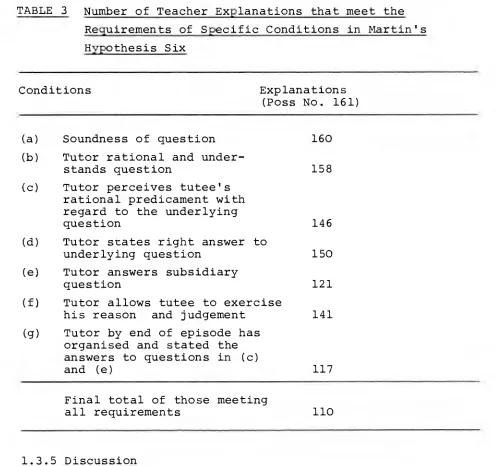
179 TABLE 3: Number of Teacher Explanations that Meet the
Requirements of Specific Conditions in Martin's
Hypothesis Six 184
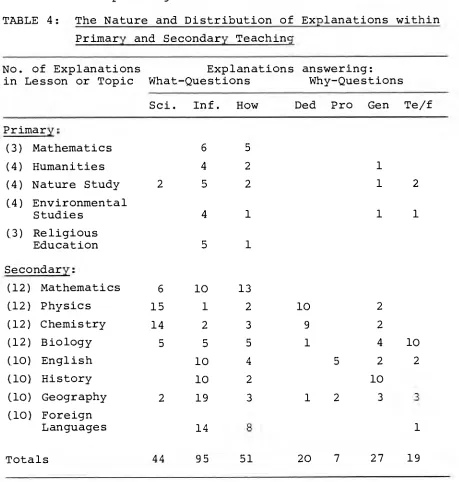
TABLE 4: The Nature and Distribution of Explanations
within Primary and Secondary Teaching 190 TABLE 5: Nature and Distribution of Concept Types in
Primary and Secondary Teaching 191 TABLE 6: Distribution of What and Why-Questions
Throughout all Explanations 192 TABLE 7: Distribution of What-Question Categories in
Arts and Science Subjects at Secondary Level 193 TABLE 8: Distribution of Why-Question Categories in
Arts and Science Subjects at Secondary Level 194 TABLE 9: The Nature and Distribution of Communicated
Meanings within Primary and Secondary
Teaching 203
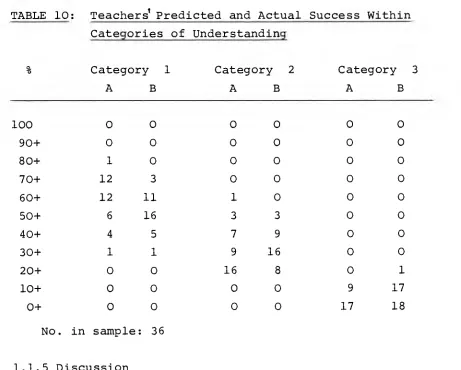
TABLE 10: Teachers Predicted and Actual Success within
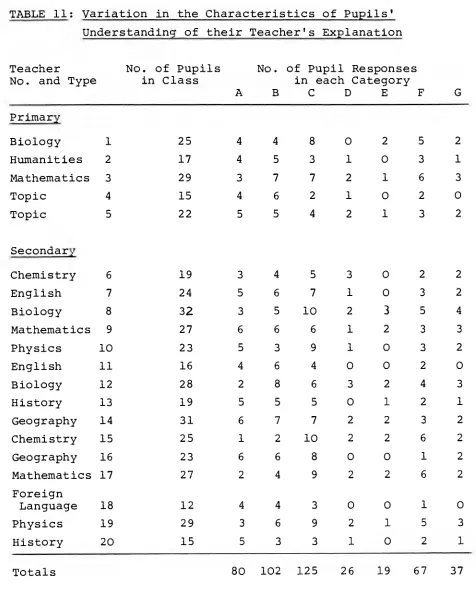
Categories of Understanding 211 TABLE 11: Variation in the Characteristics of Pupils'
Understanding of their Teacher's Explanation 215 TABLE 12: Pupil Attainment on Original and Modified
Questions in Chemistry and Biology Tests 222 TABLE 13: Underlying and Subsidiary Question Types in
Subject Explanations 229
TABLE 14: Ideational Function in Subject Explanations 230 TABLE 15: Inter-Personal Function in Subject
Explanations 232
TABLE 16: Functional Tenor in Subject Explanations 233 TABLE 17: Analysis of Mode of Discourse - (a) Spoken,
in Subject Explanations 237
TABLE 18: Conceptual Analysis of the Learning Demands
CHAPTER 1
Educational theory is normally in advance of general professional practice but given a period of change of the order experienced over the past forty years and it is impossible not to come across in schools resources and
practices of one kind and another that were not in evidence at the beginning of the period. The reverse is also true. There are things that occur but rarely now, if at all, that were once common practice. To assess the influence upon day-to-day teaching and learning at this time is a difficult task. In the first place, the period of change is an
extensive one and though there are signs that the rate of production of new theories and methods is slowing down there is something of a backlog of schemes and innovatory ideas that it is only just catching up with many schools. At the same time, a substantial number of schools have tried out some of the innovations and are either continuing with them or, having found them wanting, have discarded them.
One change that schools have in common, regardless of an individual school's response to change in general, is their willingness to admit as 'teaching' a much wider range of activities than was the case forty years ago. This is not to say that individuals necessarily make use of all or any of the newer activities in their own teaching. There is still great variation among teachers over what they accept and reject in relation to their own organisation, methods and performance.
The focus of this thesis is explaining, but the context in which it is examined is that of teaching and learning. Therefore, it is necessary and potentially useful to consider the characteristic behaviours that go to make up the activity of teaching with the object of revealing the position of
explaining within teaching. It is likely that not all the activities of teaching are seen by teachers to be of equal
which activities are perceived as central, irrespective of ideological persuasions. These matters will be
discussed within the context of teaching behaviours with the object of establishing explaining as one of the central activities. It will also be necessary to examine the
features that teaching and explaining have in common and to identify distinctions. This task is more difficult because of the range of activities that are covered by the term teaching and the fact that explaining and explanation are not straightforward concepts.
Teachers are concerned both with the activity of explaining and with the communication of ready-made
explanations. It is therefore necessary to define the verb 'to explain' and make clear how it is used in teaching. It is also necessary to identify the different kinds of
explanations that teachers will be expected to handle and justify the choice of explaining something to someone as being the most relevant for teaching and learning. Exam-ination of the conditions necessary for deciding that explaining something to someone is taking place will be undertaken and because the activity is being considered in the context of teaching and learning it will involve the discussion of philosophical and pedagogical factors.
There is all the difference between obtaining a set of conditions that account for explaining something to
someone and achieving the objective of an explaining episode, which is understanding for the receiver of the explanation. The problem of understanding and the associated problem of the communication of meaning will demand discussion in the light of philosophical consideration and theories of
language use and communication. Even so there may be other factors that are not covered by these theories which are influential in relation to accounting for the gap that can exist between a teacher's intended meaning and that which is received by the pupils.
discussion of the 'gap' concerns differences among teachers in respect of their effectiveness in explaining something to their pupils. Certain research findings will be cited that reveal a variety of variables from categories that are broadly linguistic or strategic in character. These and the conditions identified from philosophical and communication theory will be used as a foundation for converting the questions that the thesis seeks to answer into hypotheses to be examined through a number of practical studies. The questions arise from the three major issues of the theoretical discussion, namely, the extent to which
explaining (rather than telling) is a central activity of teaching; the nature of the gap between a teacher's intended meaning and the pupils' received meaning and, finally, the
dentification of some of the features that cause confusion of meaning and others that appear to facilitate
CHAPTER2
1.0 THE ACTIVITIES OF TEACHING 1.1 The Concept of Teaching
1.2 The Status of Explaining as an Activity of Teaching
1.3 The Relationship of Learning with Teaching and Explaining
2.0 EXPLANATION AND EXPLAINING IN TEACHING 2.1 Explaining Something. as an Achievement
and a Task
1.0 THE ACTIVITIES OF TEACHING
Teaching is essentially a practical activity and, in attempting to arrive at conclusions about what is involved in it, it is useful to observe the behaviour of teachers as they go about their normal every-day work. Among the information gained in this way will be many items that can be eliminated because they occur when the teacher is not engaged in teaching. Those items that do occur during teaching sessions will be unequal in respect of their
generality and of variable importance from one session to another.
1.1 The Concept of Teaching
Green (1971:4) in an analysis of the activities of
teaching suggests three major categories into which the acts of teaching may be placed, namely, logical acts, strategic acts and institutional acts. He offers
of each category as follows:
an expanded version
The Logical Acts The Strategic Acts The Institutional Acts 1. Explaining 1. Motivating 1. Collecting money 2. Concluding 2. Counselling 2. Chaperoning
3. Inferring 3. Evaluating 3. Patrolling the hall 4. Giving reasons 4. Planning 4. Attending meetings 5. Amassing
evidence
5. Encouraging 5. Taking attendance 6. Demonstrating 6. Disciplining 6. Consulting parents 7. Defining 7. Questioning 7. Keeping reports 8. Comparing
For the purpose of this work it is not necessary to take account of institutional acts and, indeed, Green himself (ibid:5) states that 'there is no inconsistency in the idea that teaching may go on even when the institutional acts of teaching are not going on.' As a major concern of the thesis is with explanation, the activity of 'explaining', which
with reference to 'questioning' which appears under the head of strategic acts. Presumably, Green's choice of the strategic category for questioning is informed by the use teachers make of the activity as a strategy for eliciting a range of distinctive responses from pupils, which include the giving of reasons or explanations. However, questioning is more closely involved with explaining than is suggested by its categorisation as a strategic act. The relationship has to do with the notion that contained within the concept of explaining (and, indeed, explanation) is the implication that there exists some underlying question that has set the activity in motion and to which the explainer addresses
himself. Furthermore, the question need not be formulated explicitly before, during or after the explaining episode. This view, which is popular with philosophers concerned with explaining and explanations, will be given fuller discussion in the next chapter.
Although Green (ibid:6) does not see the institutional acts of teaching as essential for believing that teaching is going on he takes up a different position in respect of the logical and strategic acts. The absence of either would, he believes, 'count heavily against the view that teaching was going on' while, in the absence of both, it would seem
'impossible to maintain that we have considered a case of teaching.' He suggests that differences do exist between the logical acts and the strategic acts of teaching which are largely to do with their evaluation. He maintains that the 'performance of the logical acts of teaching is appraised on logical grounds' and that in the case of strategic acts of teaching, it is appraised by its consequences for learning. Thus, a logical act of teaching, such as giving reasons,
can be evaluated independently of its result for the learning. It can be deemed well done even though no one learns, because the criteria for appraisal are to do with the subject to
of the teacher an understanding of human development, motivation and learning theory. In practice, the
distinctions between logical and strategic acts of teach-ing are not apparent. This is because logical acts rarely appear other than in the context of some teaching strategy.
There is support for Green's view that teaching need not necessarily entail learning in the writings of
B. Othanel Smith (1969:108) who contends that 'just as one can learn without being taught, one can be taught without learning.' Smith (ibid:109) takes the view that teaching is everywhere fundamentally the same and that a theory of teaching will consist in:
(a) a statement of the variables comprizing teaching behavior,
(b) a formulation of the possible relations among those variables, and
(c) hypotheses about the relations between the variables comprizing teaching behavior and the variables descriptive of the psychological and social conditions within which teaching behavior occurs.
He is at pains to point out that when using the term teaching he is not thinking of it as an activity that can be carried on without talking nor as one that can be described through reference to books on methods. He views teaching as 'a system of action involving an agent, a situation and an end-in-view.' Within the 'situation' he identifies two sets of factors - one set cannot be controlled by the agent (for example, size of classroom, age of pupils, etc.) while the other set can be modified by the agent with respect to the end-in-view. (For example, asking questions, giving home-work, etc.)
which are ways of manoeuvering type (a) factors, he calls procedural means.
This division may appear to be similar to Green's logical and strategic categories and, indeed, Green's strategic acts and Smith's procedural means are concerned with activities that are of the same kind. However, logical acts and material means do not match up readily. Most items classified under logical acts would qualify as procedural means. Smith does not engage in a full discussion of what he means by material means, his investigations being solely con-cerned with procedural means.
In his discussion of procedural means Smith (ibid:110), like Green, makes use of the term 'strategy'. For him, it is a large-scale manoeuvre, which he distinguishes from the smaller tactical elements of strategies that he calls
'episodes'. He expands the meaning of the term strategy with a statement about it referring to a 'pattern of acts that
serves to attain certain outcomes and to guard against certain others' and identifies a number of general objectives towards which a strategy may be directed. Among these are:
to ensure that certain learnings will be acquired in as brief a time as possible; to induce students to engage in exchange of ideas; and to minimize the number of wrong responses as the student attempts to learn a concept, principle, etc.
Smith further agrees that strategies are often used by
teachers to ensure the attainment of certain content object-ives and are not confined to ways of thinking or open-ended discussion. Episodes are described as 'pedagogically sig-nificant units of classroom discourse' consisting of two or more utterances, where an utterance is what an individual says at a given time. The simplest form may be A asks a question of B, B responds with the answer and A acknowledges the response. In short, episodes are verbal exchanges
who are alternately responding to one another; this kind of episode Smith (ibid:ll1-12) refers to as a reciprocat-ing episode. Where the episode involves more than two
people, response is to the entry rather than to one another so that the responses are co-ordinated, which gives the unit the name of co-ordinating episode. He suggests that from a psychological standpoint an episode represents 'a gap to be filled with information.' A subject is offered, or a piece of information given at the opening of the
episode - or entry - in which some specific outcome is more or less implicit. The behaviour that is stimulated by the entry fills the gap between the entry and the closing of the episode.
Smith (ibid:113) contends that it is possible for episodes to be viewed as logical operations because of their similar-ity to ideal logical operations whose performance is rule-guided. From his studies of teaching behaviour he identifies twelve logical operations as follows:
defining, describing, designating, stating, reporting, comparing and contrasting,
substituting, classifying, opining, valuing, conditional inferring and explaining.
A comparison of these operations with Green's logical acts (see p.12) finds half of Green's items (explaining, inferring, defining, comparing) present in Smith's list. Furthermore, seven items cited by Smith but absent from Green's analysis (describing, designating, stating, reporting, substituting, classifying, opining) and three items in Green's logical acts not identified by Smith (concluding, giving reasons, amassing evidence), appear to be activities of the same order.
Two discrepancies are present that are worthy of further examination. In the first case, demonstrating is not identi-fied by Smith as a logical operation. This may be because on many occasions the activity will involve non-verbal
However, there are numerous instances in teaching when demonstrating is verbal and rule-governed, and thus would qualify as a logical operation and its non-appearance in Smith's list may be nothing more than an omission of the kind that commonly occurs when attempts are made to identify and categorise all the behaviours that qualify for inclusion in a complex activity such as is the activity of teaching. The same point can be made in respect of Green's logical
and strategic acts and, indeed, he makes no claim that either list is exhaustive.
The other discrepancy is found in the categorisation of valuing and evaluating. If we take them to be different terms for the same activity, Smith categorises the activity as a logical operation and Green as a strategic act. Examination of the use of evaluation suggests that categorisation under both heads is justifiable. The reason for this is that the function of evaluation varies, as does the subject to be evaluated.
A teacher evaluating an argument in support of a content-ion, the force of a theory, or conflicting interpretations of a problem arising in a specific subject area is engaging in rule-bound activity, or in Green's terms, a logical act, requiring a knowledge of the methods of knowing, the perform-ance of which will be appraised on logical grounds. On the other hand, if the teacher is using evaluation to place pupils (placement evaluation) obtain feedback for himself and the (1) pupils (formative evaluation)(2) identify gross learning
problems (diagnostic evaluation) or to attest a pupil at (3) the end of a course (summative evaluation) he is engaging (4) in a strategic act that will be appraised by its consequences for learning.
(1-4) The terms are those used by Airasian P.W, and Madaus G.F. in their paper 'Functional Types of Student Evaluation' in Mehrens W.A. (ed) (1976) Readings in Measurement and Evaluation in Education and Psychology.
Before passing from attempts to analyse the activity of teaching to closer examination of certain operations within this activity one further example of a classificat-ion is worthy of note. Komisar (1969:73) from a standpoint that distinguishes teaching from non-instructive activities by viewing it as 'an end-chasing performance, takes learn-ing as the end belearn-ing chased.' He (ibid:76) distlearn-inguishes between intellectual acts and teaching acts, as follows:
Intellectual Acts Teaching Acts introducing demonstrating citing reporting hypothesising conjecturing confirming contrasting explaining proving characterising justifying explicating defining rating appraising amplifying vindicating interpreting indicating instancing questioning elaborating designating comparing
For the performance of an intellectual act to count as teaching, the teacher is committed to putting and keeping the learner in 'a perceiving - and - learning - able state
r and rendering the subject matter teaching - comprehend.
Although this model offers many items that appear in the two already examined (see p.12 and p.16) and the simila-rity between Komisar's intellectual acts and the logical acts and operations of Green and Smith is marked, the comparison
The attempts of Green, Smith and Komisar to arrive at an adequate description of the activity of teaching are of use primarily because they draw attention to the number and variety of acts that pass as teaching, through their 'lists'. They further attempt to impose some order upon the items
included by categorising them on the basis of defining
attributes that have to do with the nature of the act. This is also helpful, as far as it goes, but it leaves unsolved the problem of interpreting the exact nature of an act. The finer the categories become, the more difficult interpretation becomes, until in cases where there is a high degree of
similarity, for example, 'explaining' and giving reasons, it becomes a matter for personal judgement. It is also true that the lists offer no information about the status of any one act compared with another in the same category.
The discussion of the concept of teaching attempted here is, of necessity, nothing more than a brief introduction to the factors involved but already it can be seen that teaching is best understood as a 'family' of activities certain of which are central and highly significant, while others are peripheral and of less importance.
1.2 The Status of Explaining as an Activity of Teaching It has been suggested although teaching is best under-stood as a family of activities, some activities occupy a more central and important position than others. The com-parison of the categories of Green, Smith and Komisar
reveals certain activities that are common to each analysis within the category of logical acts. An activity of which this is true is that of explaining, a revelation that
probably would come as no surprise to members of the general public who regularly offer evidence of their belief that school learning involves explanation and that they expect teachers to be involved in explaining as and when the need arises.
of explaining in teaching and learning. The evidence obtained by the present writer from an exercise in which some sixty teachers were asked to rank a combination of Green's logical acts and Smith's intellectual acts(1) in order of importance as activities of teaching found that over three-quarters of the sample placed 'explaining' first in the order and no teacher placed it lower than third
position. Pressed to give reasons for their selection, most perceived explaining as giving answers to questions, clearing up perplexities, resolving uncertainties of the sort that pupils would be unlikely to settle for themselves. As one put it, 'explaining removes the blocks to understanding.' While we could argue that certain of the other activites included in the list have a similar function it is true that the relationship with understanding is very clearly marked in the case of explaining.
1.3 The Relationship of Learning with Teaching and Explaining Teaching as a concept has a special status in education although it can equally well apply in more informal contexts, involving parents and children, friend and friend, specialist and group sharing a leisure interest.
It is also possible to identify the prime objective of all teaching as a quest for understanding which provides the strongest link with the concept of learning. Indeed, some writers discuss teaching and learning as though they are inseparable elements of the same concept. There are weak-nesses in this position for, as has been mentioned earlier, teaching can occur without promoting learning and learning can occur in the absence of teaching. Attempts to define teaching come up against its characteristic conceptual vague-ness - a problem that does not occur in defining learning.
(1) The combination used is as follows: defining, describing, designating, concluding, classifying, comparing and
contrasting, explaining, demonstrating, inferring,
However, once the behaviours that qualify as teaching are agreed its overt nature ensures that there are no difficult-ies associated with deciding when it is taking place. This is not so in the case of learning where it is necessary to identify a change in behaviour as evidence for deciding that learning has occurred.
Their conceptual independence is suggested further by what Green (1969:12) refers to as an inability to discover in the concept of learning 'any principles sufficient to
distinguish those kinds of learning aimed at in teaching from those which are not.' It seems reasonable to interpret the notion of 'learning that is not aimed at teaching' as
including: (a) learning desirable and otherwise that may be acquired within the school or elsewhere but which is not perceived of as a goal towards which teaching is directed, and (b) undesired learning outcomes in which the learning interpretation of a teaching episode has been confused, idiosyncratic or erroneous.
Both desired and undesired learning outcomes may owe their genesis to an explaining episode. These episodes,
which are much in evidence within subject teaching throughout the child's education, have as their goal, understanding, which in turn is normally a necessary outcome in the process of learning. In the case of desired outcomes it can be
argued that as learners become involved in tasks that are more demanding in respect of their complexity, conceptual level and the range of cognitive activity called for, the more crucial to effective understanding is the act of explain-ing. Pupils appear to be well aware of this for among studies of their perceptions of the 'good' teacher are those who find 'the ability to explain things well' as the most frequently identified characteristic, many ranking it higher than
affective qualities such as fairness, warmth and friendliness.
explaining as a 'task' verb. Many view the task as (I) among the most challenging for the teacher and admitted
that by implication there is no guarantee that understanding and, thus, learning will follow an act of explaining. This position is helpful when looking for reasons for the appear-ance of undesired learning outcomes from an explaining
episode and, when appraised on logical grounds, meets the criteria satisfactorily. To use the distinction drawn by Green (1971:6) the performance as a logical act of teaching can be deemed well done but it has failed as a strategic act of teaching because strategic acts are concerned with getting someone to learn. In real life the situation is rarely as simple as this. More often a teacher will perform satisfact-orily in a logical sense while explaining something to a class but the understanding and subsequent learning that arises out of the episode shows considerable variation from one pupil to another. Some of the possible variations (and the list is not intended to be exhaustive) are as follows:
acquires a sound understanding of the kind intended by the teacher;
will acquire a sound understanding with the addition of a small amount of information to clarify certain points;
acquires understanding of part of the explanation but has a distorted perception of the remainder of which he is unaware;
interprets the entire explaining episode inadequately and attempts to proceed on the basis of a false premiss; makes no contact with the reasoning contained in the explaining episode, thus inhibiting the codifying and storage of information coming in to a degree that may result in total loss of the message.
With this small but distinctive range of outcomes in mind it is anything but a simple task to evaluate the per-formance of a teacher engaged in explaining something as a strategic act of teaching. Indeed, it appears unlikely that
anyone would wish to defend a position where a necessary condition for judging a performance successful is that all pupils receiving the explanation understand it.
In the main teachers do show some awareness of the discrepancy between the result desired from an explaining episode and what occurs in reality. It is important to bear this in mind when attempting to interpret the kind of expect-ations teachers have of the responses they will receive from pupils in answer to what could be described as 'checking up' questions posed immediately after an explaining episode. For example:
Has everyone understood that? Are you all with me?
Before I go on, is anyone not clear?
Any questions before you start work on the examples?
Most of these questions, which are common enough in both
primary and secondary classrooms, tend to give the impression that the teacher expects that all but one or two pupils will have grasped the explanation and that the exceptions will need only a little additional information to reach a state of understanding. In the case of some teachers the impres-sion is an accurate one and they will confidently assure one that 'the third year, top set, know all about the process of osmosis' because they'explained it in detail the previous week.' Most teachers show greater awareness of the problems associat-ed with getting an explanation understood than this. They may expect their pupils to perceive that the questions are giving them opportunities for seeking clarification of confusions, reiteration of crucial points or simply additional information in order that sense may be made of the message. In other
words, the teacher is prepared to elaborate further, change forms of expression, offer more exemplars, etc. in response to cues from pupils regarding the gaps in or blocks to under-standing that still exist.
important though it is in teaching and learning, will not necessarily prevent a teacher from making assumptions about the success of explaining episodes that do not match the facts. A familiar response to questions asked after an explaining episode is not a battery of demands for further explanation but a steady silence that remains unbroken even when the questions are repeated. When this happens there will be occasions where teachers are tempted to interpret the
silence as positive feedback. On rare occasions they will be right but, more often, the assumption is false. A mistake of this kind will be corrected later, if conscientious teachers check pupils' work based on the explanation, against clearly defined criteria for deciding how well the explanation has been understood. However, the difficulty of this task when some thirty pupils are involved, is very considerable and certain practices (getting pupils to mark their own or each other's work) prevent it taking place at all.
It is, of course, possible for teachers to ask for pupil responses in a manner that promises psychological rewards for asking questions in order to gain understanding, and still be met with silence. In this case, teachers are more justified than in the previous example in interpreting the silence as meaning that every pupil has understood the message, but it is doubtful that this state of affairs occurs as often as do the silences.
have not, themselves, failed to understand. Examples
include overt expressions of impatience to get on with the next stage, contempt for what is deemed the stupidity of the pupils having difficulty understanding the explanation and expressions of superiority that reflect a state of mind that is likely to be in direct contrast with that of those pupils still confused. It is also true that the pupils who are confident that their peers perceive them as able in the subject show a greater willingness to admit to a degree of ignorance than those who are known, and know themselves to be struggling.
Several of the last points are worthy of fuller examination and this will be undertaken when problems of understanding are discussed in Chapter 4. At this stage they are mentioned in order to draw attention to the way in which 'learner' factors become crucial to the success of an explaining episode when explaining is evaluated as a strategic act (to use Green's terms) or procedural means (to use Smith's terms). What is necessary before proceeding further is some exploration of the concept of explanation with a view to arriving at an interpretation of its nature that is helpful to a consideration of its function in teaching and learning.
2.0 EXPLANATION AND EXPLAINING IN TEACHING
Explanation is a concept about which there are various theories. A selection offered by Taylor (1970:1) is sum- marised as follows:
To tell us the purpose of things; to describe; to go beyond description and give in terms of laws an
explanation of the behaviour of matter; to have as its aim understanding; the ability to predict and control events.
or communicating knowledge. The distinction draws attention both to 'explaining' which is active and a matter of pedagogy and to 'explanations' which are neither action nor process, but products of investigatory activity to be gained, found, given, listened to, ignored, etc.
2.1 Explaining Something as an Achievement and a Task
The distinction that has been suggested above has much in common with that recognised by Ryle (1949) in respect of the verb 'to explain'. Ryle proposes that there are contexts in which it is an 'achievement' verb and other contexts in which it is a task verb. A context likely to call forth the former interpretation is that with which the researcher is familiar. In seeking to provide an explanation of a
phenomenon for which no satisfactory explanation is known he is concerned with the discovery of new knowledge and the testing of hypotheses. His problem is one of deciding the appropriate kind of enquiry that will produce the information he needs to provide an explanation. When he succeeds in this it can be said that he has 'explained' something in the
achievement sense of the verb.
One who explains in the task sense is not trying to find something out. He is concerned with imparting knowledge
rather than seeking it. His problem is not one of deciding a method of enquiry, but of communication, of getting someone to understand a message. Martin (1970: 16) using Ryle's
achievement/task interpretations reminds us that, ultimately, both are connected with knowledge and that both have as their goal, understanding. She goes on to say, however, that one who explains something (in the achievement sense) is a
producer of explanations which constitute the raw material used in explaining something (in the task sense) to someone. Martin (ibid: 17) also points out that,
Clearly, studies in child development, learning theory, etc. which can inform the giver of explanations are not of use to the producer of explanations, unless they happen to be his area of research. Nor do we expect the giver of explanat-ions to add to the body of public knowledge. His
pre-occupation is with enabling a person to understand something. The practical activity he engages in is not to do with con-trolled research but with finding effective ways of
present-ing explanations without loss of accuracy and with motivatpresent-ing people to come to grips with the notions they contain.
While teachers can be said to handle explanations in the achievement sense of 'explain', that part of teaching activity that would be categorised as explaining is clearly of the
task kind, i.e. they are concerned with explaining something to someone. Although the essential differences between
explanations that are for someone and those that are not may seem to be of small importance, if clarity is to be attained, and in a tutor-tutee relationship this is essential, the
differences are of prime importance.
2.2 Explaining as Teaching and as Distinct from Teaching In thinking of explaining something to someone as a tutor-tutee activity it is necessary to bear in mind that tutoring (or teaching), though it may involve explaining, is different from it. Reason and rationality are given a central role in explaining: that the same can be claimed of teaching is a view that has considerable support, including that of Scheffler (1960:57) who maintains:
To teach in the standard sense, is at some points at least to submit oneself to the understanding and independent judgement of the pupil, to his
capacity to grasp and are our reasons. Teaching, in this way, requires us to reveal our reasons to the student and, by so doing, to submit them to his evaluation and criticism.
This view is typical of what is commonly referred to as rationality theory. The theory postulates that ration-ality and reason enter into teaching in at least two distinct ways; the one relating to the manner in which teaching
proceeds; the other to the learning at which teaching aims. As in the case of explaining, not every way of getting some-one to behave according to some norm would qualify as teach-ing. Hempel (1965:465) suggests 'a general constraining principle on manner governing teaching', namely, whatever method you use the pupil's reasoning must be acknowledged or you will not be teaching. A criticism of this notion is that a method could take account of the pupil's reasoning and not be rational or that it could acknowledge pupil reasoning but be ineffective in achieving goals.
Another interpretation of the theory is that dialogue or conversation must take place in the course of teaching. While this is the case in explaining, it again poses problems for teaching. It is possible to teach without language and to speak not as dialogue or conversation, for example,
lecturing. Indeed, asking and answering questions is not necessarily dialogue. Martin (1970:96-9) also rejects the proposal that dialogue or conversation must take place at some points in the lesson on the grounds that if teaching containing no dialogue or conversation has been effective in promoting learning it seems irrational to label it wrong. She suggests that a dispositional interpretating of the rat-ional constraint on manner is more useful (i.e. the pupil's)
reason must be acknowledged if the appropriate situation were to arise) because it allows more things to qualify as teach-ing than the categorical. However, this is not necessary in the case of explaining.
constraint on manner does not constitute a recommendation of what students ought to learn, but a criteria against which specific aims and objectives are tested. The theory proposed that whatever you want your pupil to learn you must intend him to achieve a level of learning or mastery such that his reason is acknowledged; or you will not be teaching. Furthermore, teaching must aim not simply at the acquisition of belief but that, plus proper backing for them. This would seem a wholly reasonable constraint were it not the case thatEr22er backing is not to be the authority of the teacher or the textbook. In other words, pupils should not be asked to believe things merely because teachers and textbooks say so.
In the usual sense of 'teach' this constraint is un-helpful and does not take account of the possibilities that a teacher could set his sights this high and not be teaching, or, in the activity sense of teaching, one whose role is
that of a teacher could be prevented from engaging in teaching.
While there is likely to be considerable support for attempts by proponents of rational theory to distinguish
teaching from indoctrination and brain washing, many involved with education and teaching would draw the line at taking up a position that would rule out methods involving lectures, assignments concerned with reciting, television teaching and machine approaches. In the case of the rational constraints upon learning, much of the activity engaged in by teachers would not qualify as teaching and, thus, to be at all accept-able this part of the theory would have to be interpreted as applying to teaching as a whole. Indeed, as Martin (ibid:101) points out the narrow interpretation suggested builds into the definition of 'teach' -
a decision which ought to be backed up by arguments showing that the sort of learning in question really is desirable.
of teaching is that shared by people who advocate learning with understanding as opposed to what they claim is rote learning. While there may be a case to be argued during curriculum planning, etc. she does not accept that it
qualifies as a conceptual point about teaching. Indeed, she contends that:
An analysis of teaching should be open enough to include as teaching those cases in which for good reasons something less than learning with under-standing is aimed at.
(ibid:102)
In the light of the range of criticisms that she offers, Martin (ibid:104) contends that her loosening up of the definition of teaching offered by writers presenting the rational theory of teaching is justified and that if, indeed, teaching involves acknowledging pupil rationality, the sense in which it must be acknowledged 'is a good deal weaker than their writings at times lead one to believe.'
All the points that have been raised in the brief exam-ination of the rational theory of teaching are applicable to explaining something to someone. When the theory is applied to explaining, the rational constraint upon manner governs explaining strictly. The explainer is expected to proceed on the assumption that the explainee is rational regardless of the explainee's actual state or the explainer's view of that state. In requiring the explainer to shift the question in an explaining episode over to the explainee it, in effect, requires that he acknowledges the explainee's reason. A further constraint is that a tutor in an explaining episode must try to answer an underlying question and at least one other question which, in his view, is helpful in ministering to the basis of the state the tutee is in.
dispositional interpretation that Martin considers necessary in teaching (i.e. subsidiary question and answer only re-quired in teaching episode if appropriate occasion occurs) to explaining. Explaining something to someone does involve both a particular division and a kind of discourse. In this respect it diverges markedly from teaching.
CHAPTER3
1.0 KINDS OF EXPLANATION
1.1 A System of Classification Applied to Explanations
1.2 A Typology of Why-Questions 1.3 Scientific Explanations
1.4 A Conceptual Classification Applied to Explanations
2.0 THE NATURE OF EXPLAINING SOMETHING TO SOMEONE 2.1 Explaining Something to Someone as Gap
Filling
2.2 The Philosophical Conditions Governing Explaining
2.3 Explaining as Reason-Giving
2.4 Contributions from Linguistic Theories of Teaching
2.5 Explaining as a Use of Language
1.0 KINDS OF EXPLANATION
In the previous chapter, in considering explanation and explaining within the activity of teaching, it was suggested that teachers can be described as 'handlers' of explanations but that their major concern is with explaining something to someone. In order to understand the former activity better it is necessary to examine the kinds of explanations which may be their concern.
1.1 A System of Classification Applied to Explanations Taylor (1970:2-3) distinguishes three major kinds of explanation, namely: what-explanations, reason-giving or why-explanations, and scientific.
He sees what-explanations as making clear what some-thing or some sequence of events is. They can either relate events and objects to scientific theories, or be connected with decisions about actions.
Reason-giving explanations explain why something had to happen and may attempt to influence the assessments or evaluations others make of our beliefs and actions.
Scientific explanation involves hyothesising a law of nature. Such an explanation will only be correct if the hypothesis is true and since hypothesis or law may, on further investigation, turn out to be false, this type is always open to correction. These three are in common use by writers in the field, with some admitting how-explanations as another category. There are also those who consider that correct answers to why-questions are the only explanations, although when this position is taken an attempt is made to define what is meant by a why-question.
How-questions have no difficulty in calling forth a response. The problem is that the responses to these
describing are more readily categorised as what- or why-explanations. An example of this is, 'How do I set up my apparatus?' It could be argued that in responding to this question the teacher is doing no more than telling or showing the pupil a pattern of joins that will fit the apparatus
together. On the other hand, it can be argued that telling and showing are functioning as explaining in the example. If this is the case it cannot be denied that the purpose of the explanation is to tell the pupil what he must do.
Furthermore, should the teacher explain the reason for join-ing a to b and not to c he will be utilisjoin-ing a why-explanation.
It is not difficult to identify one of the central confusions here. Most how-questions are asking, by what means something comes or came about, and thus could be seen as a particular kind of what-question. As a philosophical point the matter is unlikely to be of concern to teachers but as how-questions occur very frequently during lessons it could be of pedagogical interest. To know more about the way in which teachers interpret such questions would shed light upon their conceptions of the appropriate response. Is it generally accepted that a description is called for rather than a what-explanation? How general is the feeling that implicit why-questions should be identified and
answered with why-explanations? These are matters that will be considered again later in the study.
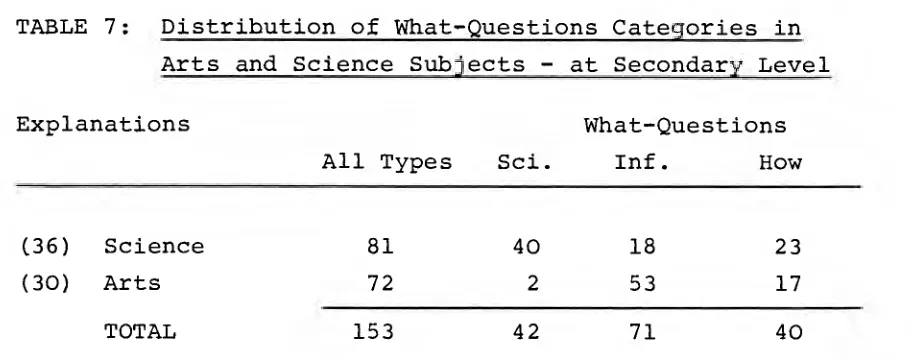
What-explanations may simply say what something is, or be related to scientific explanation, often as a preliminary to it. Taylor (1970:35-6) suggests the following types:
(1) There are what-explanations which are attempts to satisfy a theoretical or scientific interest. These explanations are redescriptions in terms which link the thing or event to scientific laws from which the event or the behaviour of the thing could be deduced, and future events or behaviour predicted. Such explanations may or may not have consequences for the actions of hearers.
which may affect practical decisions in ordinary life.
He warns that it is easy to make the mistake of thinking that a what-question has a scientific interest when it has not. For example, an explanation that predicts on the basis of past experience, or one that is based on generalisations may be regarded as acceptable but they are not scientific.
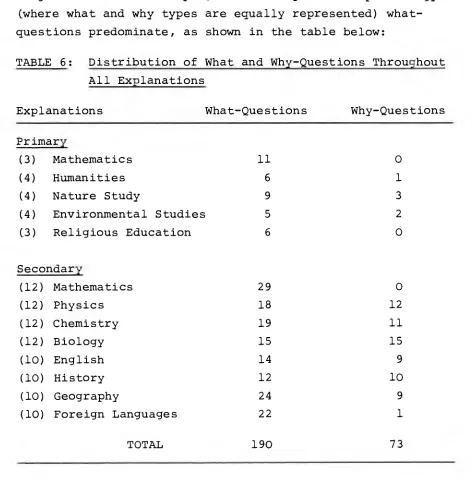
An analysis of the questions asked by teachers during lessons, typically, would identify what-questions as the main stock in trade of many subjects and very popular with the rest. Both Barnes (1969) and Richards (1978) showed that they dominated questioning sessions although not all were concerned with what-explanations. Further examination of this phenomenon will be undertaken later in the study.
Why-questions always call for explanations involving the giving of reasons but there are a number of different kinds of why-questions each calling for a specific response. Green (1971:147) suggests:
There is the "why" that asks for a causal "because" and the "why" that asks for a motive. There is the "why" that searches for a purposive "because" and the "why" that calls for an historical narrative. There is the "why" that is asking for a priori proof and the "why" that is looking for a moral reason.
He thinks that,though there exists no generally accepted way of classifying these different kinds of questions and their respective explanations, some attempt to offer an orderly classification should be of use to teachers and to a
philosophy of pedagogy.
it is not a true reason. He justifies this further by contending that the connection between a thing to be
explained and explanation 'is not that the explanation is true but that it explains.' This view is similar to that of Taylor (1970: 51) who having placed scientific questions in a separate category from other why-explanations, sees the latter as giving reasons to explain both why we did, are doing, or will do something, or to advise others how to act, or decide our own course of action. He points out that:
Whether when a man gives something as his
reason, he is properly said to have this reason is a matter of what beliefs and views he holds. This is a question of fact about himself. No matter how bizarre the beliefs or views he expresses in giving his reasons if he has them (or thinks he does) he would be correctly
described as having these reasons.
(Ibid: 55)
It follows from the above position that though a man may not be able to accept the evaluative views behind an explanation offered by another he can still concede that the other has a reason though he need not accept it as being the reason he would put forward. It is not difficult to see why Taylor does not include scientific explanations in the same category as the why-questions described above and why one(1) view of the relationship between scientific exp-lanations in terms of reasons, is that they are incompatible The reasons for this view will be examined in the discussion of scientific explanations but, before moving to this
category, it is useful to consider the analysis of why-explanations attempted by Green (1970: 148) in which
(1) Collingwood R.G. (1961) and Winch P. (1958)
The Idea of History O.U.P. The Idea of Social
scientific explanations are accounted for under specific heads that indicate the kind of procedures that have been carried out in arriving at them.
1.2 A Typology of Why-Question Explanations
1.2.1 Deductive Explanations form the first group identified by Green. These are explanations in which that which is to be explained is logically deduced from statements that explain the phenomenon in question, a necessary requirement being
that the explanandum (what is to be explained) is shown to be a logical consequence of the explanans (the explanation). The deductive argument is a form of proof or demonstration. The purpose of the proof goes further than to show that it is a necessary claim. Green (ibid: 149) says:
In this case the request to give a reason why will elicit a demonstration that the explanandum is true, and true a priori.
He identifies distinctions within the category of deductive explanations that have to do with necessary claims and con-tingent claims. In the case of the former the mode of ex-planation coincides with the method of proof, i.e. to have explained the proposition is to have established the truth. This is not so for contingent claims, the truth of which can be established without necessarily explaining them. Nor is it necessary to establish that the deductive mode of explana-tion in quesexplana-tion is a necessary claim. In short, for both types, the explanandum is a necessary consequence of the exp-lanans, but only in necessary claims is the explanandum it-self a necessary statement. According to Green this position
corresponds to distinctions that exist between the empirical and formal sciences. He cites Nagel(1) as follows:
Few, if any, experimental scientists today believe that their explananda can be shown to be inherently necessary. Indeed, it is just because the propo-sitions (whether singular or general) investigated
(1) Nagel E. (1961) The Structure of Science Harcourt,
p. 21 Brace &
by the empirical sciences can be denied without logical absurdity that observational evidence is required to support them. Accordingly, the justification of claims as to the necessity of propositions, as well as the explanation of why propositions are necessary, are the business of formal disciplines like logic and mathematics and not of empirical inquiry.
This statement of Nagel serves as a reminder that there are other conditions to be satisfied where the deductive pattern of explanation is used in scientific studies. These will be elaborated when scientific explanations are under con-sideration.
1.2.2 Probabilistic Explanations is the next category that Green (1971: 152) recognises in his analysis of why-explan-ations. These are explanations in which the truth of the explanans does not guarantee the truth of the explanandum, but offers an account that is probable and, characteristical-ly, some implicit reference to the degree of probability in the explanans. This type can occur in the sciences and are thought by some, for example Hempel (1966), to be scientific when certain conditions are met. Probabilistic explanations differ from deductive explanations, in which cause is
related to the truth of the explanans being a sufficient condition for the truth of the explanandum, because no such correspondence exists in their case. Their ability to
explain obtains through the establishment of some kind of statistical invariance between the explanandum and the explanans.
Frequently, in every-day life, probabilistic explanat-ions are used in the same way that causal explanatexplanat-ions are used even though they do not qualify as such. This is not very surprising when it is borne in mind that causal
explanations set forth regularities which is exactly what probabilistic explanations attempt to do.
1.2.3 Green (1971: 154) suggests that, in addition to
that occurs 'whenever ideas of development or evolution play a large explanatory role.' For these he suggests the name genetic-explanations. This is not because they occur only in the biological sciences, but because they are concerned with genesis or the coming into being of something, for example, the sort of inquiry with which geology and history are commonly concerned. The kind of 'because' they require is one that describes how a state of affairs developed or by what process it came about.
Green (ibid: 155) mentions two points that are usually made about genetic explanations:
... in giving a genetic explanation, not all events in the past will be selected as pertinent to the explanandum. Secondly, what is selected will usually be chosen on the basis of some assumptions about the causal links these events have in the development to be explained. Thus, although genetic explanations are not causal in any strict sense, nevertheless they will make
use of causal assumptions and sometimes explicitly so.
He suggests that it may be helpful to think of genetic explanations as responding to a 'why' that looks back in time, but it would be misleading to think of this feature as a defining characteristic. The reference back is not concerned with an event in the past but with a process of development, because what is sought is to explain some
present or past state of affairs in reference to its genesis.
Gallie (1970: 158) describes the characteristics of genetic explanations somewhat similarly in his discussion of explanations in history and the genetic sciences. The points are summarised below, each referring to a character-istic genetic explanation:
(1) Seeks to establish or at least helps to indicate some kind of continuity between one or a number of temporally prior
(2) Does not pretend to predictive power: the prior event is not taken in con-junction with certain universal laws, to constitute a sufficient condition of the occurrence of the subsequent event. (3) Emphasizes that what came earlier explains,
in the genetic sense, what came before and not vice versa. i.e. The prior event is not taken, in conjunction with certain universal laws, to constitute both a sufficient and a necessary condition of the occurrence of the subsequent event.
Green (1971: 156) argues that genetic explanations may be used for explaining future expectations and, thus, an answer to the question 'Why do modern societies tend to require a great deal of education?' might call for a 'kind of explanation framed in genesis but not in terms of history.' It seems a reasonable response to say that the example he
gives is somewhat doubtful in respect of the way it could be interpreted and that others he cites, for example, 'What might be the necessary and sufficient conditions under which a society would require a great deal of education of all its citizens?', although genetic in character would qualify as a what-explanation in Taylor's categories (see p.28) and not as an example of a why-explanation.
1.2.4 The final category of why-explanations that Green (1971: 156) identifies are, typically, forward looking. He calls the category teleological and functional explanations. By teleological he means purposive or goal directed and, thus, answers to this kind of why-question will refer to the future. The contexts he has in mind are those in which there is
remaining outside the system. Thus, they describe
consequences and effects rather than intentions and goals. This last category completes his analysis of different kinds of why-questions.
1.3 Scientific Explanations
As would be expected Green's discussion of deductive why-explanations (see p. 37) contains statements that are much the same as those found in Taylor's description of scientific explanations. Taylor (1970: 4) takes as his model Hempel's view of explanation, known as the 'covering law model of explanation'. He considers it to be 'especia-lly clear and elegant', giving a correct account of what explanation is and ought to be in the field of science. Taylor argues that the chief questions to which scientific explanations address themselves are:
Why did this happen? Why have things changed, or developed in this way rather than that? Why, when things happen, does that happen?
He says that these questions tend to be thought of as causes, i.e. events that bring about certain others which are called their effects and he warns that thinking of scientific expla-nations in this manner produces problems as the event picked
out as a cause of an event will almost certainly be one of a set of others, all of which are necessary for the event to take place. He maintains that though scientists do try to discover how events are connected and how given a particular set of facts the occurrence of an event is necessary, they do so by looking for universal propositions and general laws rather than for causes which both precede and necessitate their effects. Thus, an explanation of why an event occurs shows how the event is related to others by general laws.
Using the covering law model of explanation Taylor
(1) a universal generalisation, or law statement: whenever an event of type 'b' happens, an event of type 'a' happens;
(2) a statement of initial conditions: 'b' happened;
(3) a statement of the consequent conditions; 'a' happened.
He points out that the relationship between (1), (2) and (3) can be stated another way, namely, 'If the generalisation in (1) is true then, given the facts stated in (2), the event mentioned in (3) must occur.'
This model works equally well for explaining laws, the laws and definitions. Two features are worthy of note. 'The statements in the explanation logically entail(1)the state-ment that the event being explained occurred', and the explan-ation must contain a universal generalisexplan-ation. The reason for these respective stipulations is that, in the former case, in any valid argument, 'the premises taken together entail the conclusion', and in the case of the latter, explanations with-out universal generalisations will not entail what they are supposed to explain.(2)
Hempel, himself, in conjunction with Oppenheim (1970: 8-10) makes clear that the general agreement that exists about what constitutes the major objectives of science is not carried into opinions concerning the function and essential character-istics of scientific explanation. - Their own pattern of
scientific explanation divides it into two constituents, namely the explanandum(3) and the explanans,(4) the latter
(1) Entail - a term used by logicians that refers to the relation between propositions when the step from one to the other is a valid deductive inference.
(2) There are very exceptional circumstances in which this would not be the case.
(3) By the explanandum, they understand the sentence des— cribing the phenomenon to be explained - not the phenomenon itself.
being divided again into those containing sentences that cite particular antecedent conditions and those sentences
representing general laws. For an explanation to be sound, its constitutents have to satisfy logical and empirical conditions of adequacy, as shown in the summary below:
I.
Logical conditions of adequacy:R1 The explanandum must be logically deducible from the information in the explanans.
R2 The explanans must contain general laws which are actually required for derivation of the explanandum.
R3 The explanans must have empirical content, i.e. must be capable, at least in principle, of test by experiment or observation.
II. Empirical condition of adequacy.
R4 The sentences constituting the explanans must be true.
described on p.40. The kind of phenomena they include in this are the various types of behaviour of animals and humans that, for example, are explained in psychology:
.... by subscription under laws or even general theories of learning or conditioning; and while frequently the regularities involved cannot be stated with the same generality and precision
as in physics and chemistry, it is clear at least, that the general character of those explanations canformsto our earlier characterization.
(ibid: 13)
Not all scientific explanations are based on laws of strictly universal form. Hempel (1966: 58-9) recognises a type that he calls probabilistic explanations, again a
category included by Green in his analysis of why-explanations. Hempel contends that probabilistic explanations share certain basic features with corresponding deductive-nomological
explanations. Both explain the event in question by referring to other events with which the explanandum event is connected by laws. The first major difference is that in the deductive type the laws are of universal form and, in the other type, of probabilistic form - hence the name for this type of
ex-planation. The second, that going on information contained in the explanans of a deductive explanation, the explanandum was to be expected with deductive certainty. On the other hand, an inductive explanation, of the kind necessary in probabilistic explanations
shows only that, on the information contained in the explanans, the explanandum was to be expected with high probability, and perhaps with "practical certainty"; it is in this manner that the latter argument meets the requirement of explanatory relevance.
(ibid: 59)
is a controversial topic in the philosophy of science.
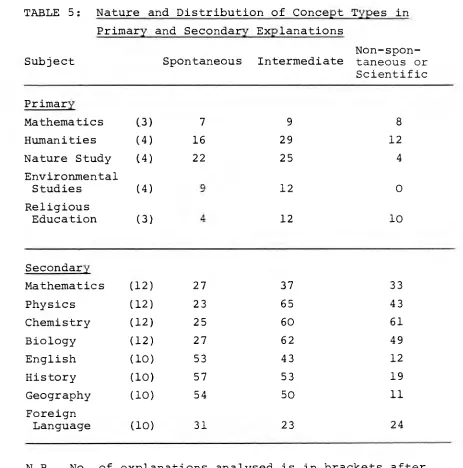
1.4 A Conceptual Classification Applied to Explanations A dimension that could be used as an analytical base for identifying different kinds of explanation cuts across the categories that have been arrived at through the systems of classification discussed thus far. It has to do with the nature and level of the concepts embodied in explanations of one kind and another and is well exemplified by the distinction that Vygotsky (1962) makes between spontaneous and
non-spontaneous (or scientific) concepts. The former, he thinks, can be acquired by an individual before he is conscious enough of them to be able to define them in words. On the other hand, scientific concepts which are usually non-spontaneous start their development with a verbal formulation and their use in non-spontaneous operations. In other words, they start their lives in a child's mind at a level which a spontaneous concept reaches much later.
Within the context of explaining something to someone, questions concerning the kind of concepts to be found within specific explanations are very pertinent and could lead to the identification of distinct categories. One such category
would be for explanations that are to do with phenomena that can be understood in terms of spontaneous concepts and,
another, that would accommodate explanations that involved scientific concepts that can be acquired only through specific teaching. However, categorisation would not be as clear cut as this for some explanations demand both spontaneous concepts and scientific ones. Furthermore, a stage between the two extremes can be recognised in which a spontaneous concept reaches a level in an individual at which it is possible for a related scientific concept to be absorbed. It is possible to think of these concepts as intermediate, which indicates that they have started out as spontaneous concepts but are developing into scientific concepts as a result of further experience and learning. Vygotsky (ibid: 109) describes the
In working its slow way upward, an everyday concept clears a path for the scientific concept and its downward development. It creates a series of structures necessary for the evolution of a concept more primitive; elementary aspects which give it body and vitality. Scientific concepts, in turn, supply structures for the upward development of the child's concepts towards consciousness and deliberate use.
It is likely that at different stages in an individ-ual's life one or other conceptual category will dominate the
explanations he seeks to have and those which others consider necessary for him to understand. This is certainly true in school where, at the primary stage, explanations based upon spontaneous concepts abound and at higher secondary level most explanations utilise scientific concepts. But perhaps the concepts with which most explanations are concerned in school learning will be those in the intermediate category. This view is supported by Carroll (1964: 81) who goes on to say that they are usually acquired through the study of verbal formulations and the practice of recognition of instances and non-instances. In this they have more in common with scien-tific concepts than spontaneous concepts and the same is likely to be true of the explanations that embody them.
It is not the case that different subjects demonstrate any common consistency in their use of the different concept-ual categories of explanation and thus in the intellectconcept-ual de-mands they make upon pupils through their explanations. Certain
subjects early on at the secondary stage deal in explanations that contain scientific concepts, both those which start life as such and others which have grown out of spontaneous ones. For example, the first year of a chemistry course set for C.S.E. or G.C.E. ordinary level, involves the employment of scientific explanations on a large scale. Geography, on the other hand, can utilise spontaneous concepts in the explanations it is concerned with at this level.
place some constraints upon the number of options open to a teacher as a means of putting across an explanation. More particularly, it may influence choice when it comes to deciding between practical procedures in which first-hand experience of the phenomena is possible and procedures that rely upon verbal formulations. Indeed, certain explanations, by their very nature, lend themselves to one rather than other kinds of procedures. An attempt to classify the concepts they utilise can provide some guidelines for deciding how best to organise the explanation, other things being equal.
It would be illuminating to discover the extent to which teachers are aware of the specific characteristics of satisfact-ory scientific explanations or, indeed, of the variety of types of explanation that they encounter, each type with its own
peculiarities and requirements. As they will be called upon to handle explanations it could be pedagogically useful to know which types are dominant in specific subject areas and at different stages of pupil development. Questions concerned with the positive advantages of knowing more about the
characteristics of explanations will be discussed in relation to explaining and understanding in education which is under-taken in Chapter 4. At this stage suffice it to say that unless the various notions of explanation are kept distinct it is very easy to move from one to another without realising it and it is difficult to understand general claims about the function of explanation in education.
2.0 THE NATURE OF EXPLAINING SOMETHING TO SOMEONE
It is now the turn of the notion, explaining something to someone to be examined with the object of identifying the conditions necessary to the success of this activity. As in the case of explanation, there are a range of models to