C. WAYNE COOK2
Professor and Head, Department of Range Science,
Colorado State University, Ft. Collins.
Highlight
Criticisms of current teaching in many biological disci- plines are that instruction is fragmented, textbook oriented and lacks interdisciplinary presentation. It is, therefore, suggested that college curricula in Range Science be re- oriented to present material in a coherent manner that will give a holistic concept of biological systems. Course ma- terial should be updated and scheduled in context for a logical sequence of study for student matriculation. Teach- ing, research, and the application of academic learning must, by necessity, become more meaningful and more pre- cise if range management is to maintain professional stature and retain identification with a discipline or area of ex- pertise.
The Range Ecosystem
A suggested method of teaching Range Science
is through the ecosystem approach whereby the
structure and function of biological systems are
presented to the student as an integrated whole of
an interdisciplinary subject matter. The ecosystem
is a matrix of fundamental knowledge and under-
standing that yields the many unifying concepts
that are necessary for coordinated land resource
management.
It has been suggested that the ecosystem ap-
proach to teaching biology start in the elementary
schools (Reed, 1969). Such an approach presents
biology as a functional system of plants and animals
in relation to their environment. The new meth-
odolo<gy of teachin g mathematics in elementary
schools provides a model of teaching the biological
sciences to students in a sequential manner during
their first introduction to plant and animal life.
There can then be an integrated program for teach-
ing mathematics and biological science which will
prepare students in college to study biological
systems at an advanced level.
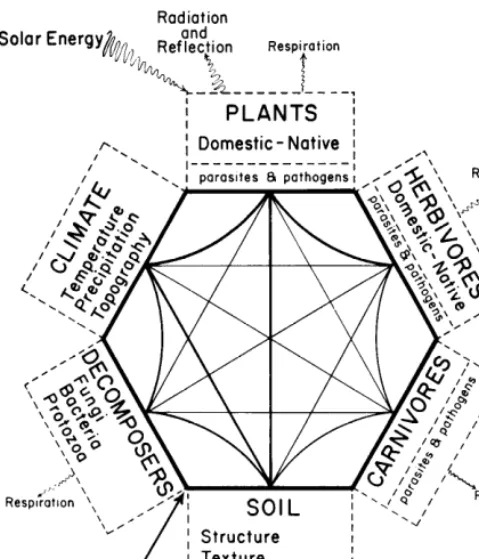
A single method of presenting both structure
and function of the ecosystem is through a flow
chart showing six compartments (Fig. 1). The com-
partmental enclosures contain the components that
characterize the structure of the ecosystem. This
could be referred to as descriptive ecolo<gy involving
natural biotic communities which represent an as-
semblage of organisms and their environment. The
connecting lines within the hexagon represent the
interdependence between compartments or the
function of the ecosystems. These show the inter-
1 Received February 2, 1970; accepted for publication July 7, 1970.
2 The author is indebted to the range staff at CSU for their helpful reviews of the manuscript.
pendency or interaction among compartments.
An ecosystem can be viewed as a living entity or
as a plant-animal-place unit that operates under
the control of many regulatory mechanisms. “Life”
of the ecosystem depends upon the amount of solar
energy converted to biochemical energy by the pri-
mary producers and the amount of energy trans-
ferred from one trophic level to another. Thus,
nutrients are cycling within the system in a some- what balanced state. This process could represent
the circulatory or transference function of the eco-
system. The ecosystem likewise responds or reacts
to stimuli. If weather brings about a metabolic
interruption, the functions of the ecosystem are
subsequently disturbed. If a limiting factor or a
regulatory control is changed by natural factors or
is manipulated by man, the chain of events may
affect many components of the ecosystem. Like a
living organism, the ecosystem may adjust physio-
logically or physically to minimize the influence
of a disturbance. This would involve a change in
population structure and dynamics.
The ecosystem can be any area of any size, large or small, any plant and animal assemblage, or any site, including all of the biotic expressions and all of the abiotic or physical factors that affect these expressions.
The ecosystem approach to education involves
acquiring and synthesizing information and sub-
sequently presenting it in a total systems context.
Such an approach brings to light the voids in our
knowledge of the system. Thus, inquisitive minds
are stimulated to carry on intensive research in
areas where information is meager or completely
lacking.
Undergraduate Training
Course schedules in the ecosystem approach
would first consider the basic material to be cov- ered. These should include the newly organized method of teaching biology through animal and
plant relationships including a general understand-
ing of biological systems and their development.
This replaces the conventional introductory courses
in botany and zoology. Courses in physics, chemis- try and molecular biology can logically be included as an integrated sequence.
The current trend is to allow the students in Range Science more freedom to use elective courses.
Therefore, an abundance of suggested electives
gives the student and his advisor an opportunity to select from any number of a half dozen or more options. These might be ranching, land appraisal,
wildlife range management, range recreation man-
agement, range conservation, range entomology,
range watershed management, forest range manage-
ment, range plant pathology, range economics,
388 COOK
THE RANGE ECOSYSTEM
Radiation and.
?<f Iect$n Rerpjatlon
-%_--52---___I__ _ - l
I
, PLANTS i
I Domestic- Native
/
1 Structure I I 1 Texture I I
Residue/s I Development 1
1 Fertility I I
; Geology I
I L-___---_J
FIG. 1. A flow chart showing structural characteristics of the
ecosystem in six compartmental areas and connecting inter- action linkage among compartments as a function process.
range nutrition or range ecology. These electives
should be selected as a course sequence in a related
or complementary discipline and not in a hap-
hazard fashion.
Curriculum
The basic core of courses outlined by the panel
for education in natural resources (Natural Acad-
emy of Sciences, 1967) suggested a curriculum of
foundation training through the freshman and
sophomore years. The course outline presented in Table 1 is a minor deviation from the curriculum
recommended by the NAS panel. Suggested basic
courses include statistics and mathematics through
at least one course in calculus and preferably three courses in calculus if the student plans graduate work. At least two courses in physics, four courses in chemistry including inorganic, organic and bio- chemistry, and a course in each of plant physiology, taxonomy and agrostology should be considered.
Training beyond the two-year program would
consist of specialized professional courses dealing
with the range ecosystem. The course outline in
Table 1 allows for 25 quarter credits of free elec-
tives. These free electives could be concentrated in a second discipline to gain another area of com-
petence. Another alternative might be a selection
Table 1. A suggested course outline for a B.S. degree in Range Science.
Courses courses No. Quarter credits Basic core
Biology attributes of living systems 3 Chemistry-inorganic,
organic, biochemistry 4
Mathematics-algebra, trig., calculus 4
Physics 2
Plant classification 2
Soil microbiology 1
Weather and climate 1
Geology 1
Genetics 1
Soils 2
Plant physiology 1
Animal physiology 1
Animal nutrition 1
Economics 2
Communications 3
Statistical probability 1
Sociology 2
Political science 1
-
Total 33
Professional
Principles of ecosystem structure
and function 1
Range ecosystem structure (descriptive) 2
Range ecosystem function 3
Range ecosystem measurements 1
Range economics 1
Range ecosystem planning 1
-
Total 9
Total suggested courses 42
Free electives (optional specialties) -
Total -
13
20 16 8 8 5 5 5 5 10 5 5 5 8 9 3 6 5
141
34 175 25 200
of courses to broaden the student’s training in other
resource areas by distributing the 25 credits among
several related disciplines. A third choice by the
student might be courses to broaden his knowledge in social science related disciplines such as philoso-
phy, psycho1
ogy, sociology, and political scienceand/or humanities.
The ecosystem approach to training a range
management specialist assumes first of all that the
range scientist must have a thorough understanding of the structure of the ecosystem and all of the physi- cal and biological principles by which an ecosystem
functions. Therefore, professional courses must
cover ecosystem structure and function and their measurements.
Structure of the Ecosystem
The courses in structure of the ecosystem should
munity, population densities, constancy, age classes,
heterogeneity, and life forms. Abiotic factors such
as soil texture, soil parent material and soil profile features, along with weather, and micro- and macro-
climates; latitude, altitude and exposure are all
important in describing the range ecosystem. The
structure involves the descriptive trophic structure and the physical features of the ecosystem. Courses
in measurements of the structure of the ecosystem
can be used to introduce analysis methods which
will aid in eventual management decisions.
Function of the Ecosystem
Courses dealing with the function of the eco-
system should focus on the ecological and physio- logical processes within the biological system. The
order of events is influenced by the activity of
organisms and their responses to interactions from
other organism or environmental conditions. Both
physical and biological factors in the ecosystem
enter into the dynamic forces that regulate the
processes of the system.
Functions and interactions of the ecosystem are
indeed complex. In many respects the driving
forces and responses of the internal functions of the
system are not well understood. In theory all ex-
ported materials leave a deficit in the biological
system. However this deficit is at least partially
replaced through the import of minerals and nutri- ents that enter the system through parent material,
dust, silt, rain and ingress of native fauna. The
requirements of the detritus feeders compared to
the macroconsumers are not known. Such a holistic
evaluation that brings to light the many voids in
knowledge is a major reason for accepting the eco- system approach in research and teaching in range
science. Research should complement teaching by
furnishing information where voids appear. Other-
wise continued fragmented research and teaching
in special interest areas will leave many weaknesses
in our knowledge of the complicated interplay of
the physical and biological processes of the range
ecosys tern.
Ecological efficiency of the ecosystem is fre-
quently evaluated on the basis of energy flow among
the trophic levels. Parameters of energy flow into
and away from the ecosystem include incident sun-
light transformed into photochemical energy by
the primary producers, energy converted to animal
tissue and for physiological functions by the sec-
ondary producers, losses by radiation, and that re-
maining matter that is fixed in residues. The net
efficiency of energy conversion can be calculated
for each trophic level as the quantity of energy is passed along the food chain until it reaches the decomposers.
Plants convert solar energy into organic material that can be transferred in the system from one food
level to another and finally respired into the atmo-
sphere, exported from the system, or returned to
the soil. Bioenergetics of the ecosystem concerns
the total energy fixed through photosynthesis and
the use and transfer of energy by the complete bio- mass of organisms.
The flow of energy and the cycling of elements
through the organic and inorganic compartments
of the ecosystem present a challenge to scientists in
synthesizing and presenting information revealed
by the matrix of the ecosystem. Elements and com-
pounds originate from parent materials, through
the atmosphere, as sediment from adjacent areas,
or as soil amendments. These move through the
various compartments of the ecosystem in a compli-
cated manner. The conversion of energy within the
ecosystem is of paramount importance because of
the transfer of solar energy for sustenance of all life in the system. The existence of the ecosystem itself
depends upon this phenomenon. The function of
the ecosystem is more than the flow of energy or the
cycling of nutrients. Organism competition, inter-
action, and development of biota expressions are
also functions of the ecosystem.
Development and Maturity of the Ecosystem
Most conventional ecological concepts still apply
to ecosystem development and management. There
are a great number of basic ecological principles
that have evolved from our study of community ecology that apply to both the structure and func- tion of the ecosystem. The ecosystem may be in a
state of development, or can be fully developed.
This does not preclude the older concepts of plant succession and the dynamic climax or a balance of life in the ecosystem. The ecological system changes over time by means of its biological activity and the
influence of the physical environment. Ecological
succession may be defined as an orderly progression
of community development that terminates in a
reasonable state of stabilization or balance until
perturbed by man or some natural catastrophe. Ac-
cording to Odum (1969) this process of develop-
ment is both directional and predictable. The
structure at a particular time may be an interim
expression of the biota in any stage of development. The process is reversible and, as stated above, may be brought about by drastic and unusual climatic
conditions or through manipulation by man.
Trophic dynamics of the ecosystem may be a
known range of activities or events and therefore
may be limited or influenced by any of the many
components of structure of the ecosystem, but the
actual changes are a function of the ecosystem.
Both structural and functional changes occur dur-
ing development of the ecosystem. The degree and
rate will depend upon the climatic, edaphic, biotic
390
COOKMAN
(
Decision Moking )/I\
ECOSOCIOLOGICAL BIOLOGICAL
IMPACTS EFFICIENCY UTILIZATION ( Energy Transfer) (Harvests)
Pollution of environment Modification Ecological responses Economic benefits Converslon Biotic
Multiple uses mechanlcol growth
Recreotlon fire reproductmn
Export pestlctdes dlseose control Abtottc surwval livestock Management
timber edophtc
nutrltlon
water chmatlc
wldllfe breeding grazing systems
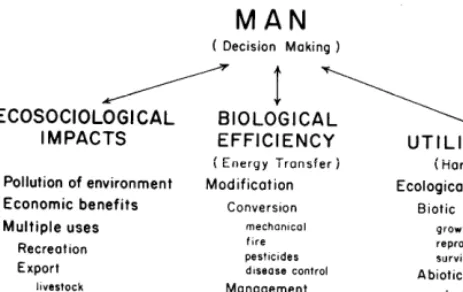
FIG. 2. Decisions to increase biological efficiency through modifi- cation of the ecosystem considers all adverse or beneficial effects upon other components or users of the ecosystem.
Biological Efficiency of the Ecosystem
Applied learning or conventional range manage-
ment courses should be identified with instruc-
tion concerning ecosystem functions. Such material
could be taught under the broad heading of bio-
logical efficiency of the ecosystem. In addition to
the natural perturbances in the ecosystem, man
may alter certain processes by deletions or additions
of heretofore controlling factors. This is the area
where conventional range courses have contributed
knowledge to the student. The material studied in these courses has been applied subject matter and
oriented toward special use of the ecosystem by
domestic livestock and game animals.
Multiple uses such as forestry, range, wildlife,
recreation and watershed all contribute to the
management practices and amount of export ma-
terial to be taken from the ecosystem. Decision-
making in manipulation and management of the
biological system must consider all the ecological
and ecosociological impacts (Fig. 2).
Manipulated or modified ecosystems may actually
produce more useful export material than natural ecosystems even though the natural ecosystem is in
a climax state. Management which requires alter-
ing the ecosystem must be done in a prescribed manner that is cognizant of the benefits to be ac-
crued and perturbances to be wrought. Sometimes
modification of the ecosystem to increase export
productivity conflicts with ecological principles in-
volving the theory of balance in the climax com- muni ty.
Course material must recognize that biological
systems are regulated by many complicated proc-
esses and factors involving complex interactions
among both the biotic and abiotic components of
the system. For instance the biological efficiency
of the ecosystem may be limited by transformation of energy by the primary producers or by physical
limitations of the ecosystem such as water, soil, fer-
tility and climate.
Graduate Work
Terminal courses at the graduate level should
include systems ecology courses designed to analyze
ecological principles, to study techniques in high-
speed digital and analog computers, and to synthe-
size ecological information and formulate mathe-
matical models that will optimize the predictability
of complex functions in the range ecosystem. A
system analysis procedure which evaluates all of the major ecological activity of the ecosystem and the
ecosociological impacts of prescribed manipulation
would bring to light voids in scientific information about the ecosystem.
In the ecosystem approach to graduate education
in Range Science the programs leading to the
Master of Science and Doctor of Philosophy degrees
are based upon foundation courses which have de-
veloped a thorough knowledge of the structure,
function and usefulness of the ecosystem.
Graduate programs, like undergraduate studies,
should provide a select area for specialization. This
might be centered in any compartment of the eco-
system (Fig. 1) or in any of the many complicated
functions or interactions within the biological sys-
tem. Complementary areas of specialization in-
clude soil chemistry, animal nutrition, plant or
animal physiology, hydrology and others. Inter-
disciplinary course work and research should be
emphasized.
Graduate training to the Ph.D. level would in-
clude intense academic and theoretical approaches
in identifying and measuring structure and func-
tion of the ecosystem. Advanced courses that in-
struct the student in measuring functions of the
ecosystem are important in a graduate program.
Measuring interactions among organisms, and orga- nism response to physical factors of the system are
paramount features of the ecosystem approach in
higher education. A Ph.D. program would be re-
miss if it did not include some quantitive systems
analysis courses. These would include modeling
and simulation of biological systems, synthesis of
data and use of high speed computers. These are
important to our understanding of and prediction
of biological phenomena within the range eco-
system.
Research programs to complement the teaching
program are necessary for complete fulfillment of
a student’s graduate education.
Summary and Conclusions
Range management is an integral part of land
resource management. The range scientist will
have an area of competence only after he demon-
strates to other related disciplines that he has a
sound understanding of the ecosystem, its structure
and its functions. He must know how manipula-
various components of the system. In decision- making the range scientist must defend his action
logically and scientifically so that his views are
clearly understood.
Three courses dealing with the structure of the ecosystem during the sophomore year, three courses
concerning the function of the ecosystem during
the junior year and three ecosystem analysis courses
along with planning and decision-making courses
during the senior year would be needed to earn a B.S. degree in range ecology.
Supporting courses would be similar to most de-
grees in biological sciences, i.e., three courses in
biology which form a foundation for advanced
ecology, six courses in chemistry and physics, four
courses in mathematics and statistics, two or three
courses in calculus, and at least one course each in
weather and climate, microbiology, geology, and
soils.
Initial courses dealing with the range ecosystem
would involve the description of the biotic compo-
nents of the ecosystem such as the trophic levels;
(1) primary producers-species composition, life
forms, constancy, age classes, and heterogeneity ;
and (2) consumers-the species composition of her-
bivores, carnivores, population densities and distri-
bution. Ecosystem structure courses would also
include the abiotic factors such as soil profile de-
scriptions, micro- and macroclimates along with
geographic, topographic, and other land form fea-
tures that identify a particular ecosystem.
Courses in ecosystem function must follow a
sequence that presents all the biotic and abiotic
interactions. A simple method is to initiate the
sequence of events by starting with energy flow
which introduces the interdependence of plants,
animals and soils and the relation of climate to
these biological phenomena. The complementary
and antagonistic relations among organisms are
omnipresent interactions in the ecosystem. These
processes are further complicated by the influences
of physical factors of the system. Soil bacteria,
fungi and the detritus feeders all serve as decom- posers which carry on a very important function in
enhancing soil fertility, organic breakdown and
mineral cycling. Increased biological efficiency as
a directed function of the ecosystem may be accom- plished through conversion of the vegetation type,
range improvement practices, use of grazing systems
and other desirable management methods.
Graduate programs should include more intense
academic training in identifying and measuring
structure and function of the ecosystem. A doctoral program should include systems analysis involving
modeling and simulation of ecological systems.
The educational program in Range Science
should be relevant to social changes and sustenance of the land resources under wise use.
Literature Cited
NATIONAL ACADEMY OF SCIENCES. 1967. Undergraduate education in renewable natural resources. Publication 1537. Washington, D.C.
ODUM, E. P. 1969. The strategy of ecosystem develop- ment. Science 164:262-270.
REED,ELIZABETHWAGNER. 1969. Special uses of biology in
elementary school curriculums. Bio. Science 19:820-825.
The First American and His Range Resource1
0. N. HICKS
A rea Range Conservationist, Bureau of
Affairs, Aberdeen, South Dakota. Indian
Highlight
Beginning with the introduction of livestock by the Spaniards, the Navajos have been prominent in the livestock industry. Stock raising has become so much a part of the Navajo life that its origin and development are involved in the religious ceremonies, social functions, and economic status of the people. The Sioux, on the other hand, have had to undergo significant cultural and social change to adapt to range management and livestock raising as a means of obtaining their livelihood. This transformation is proceeding at an acceler- ated pace. The history of the Navajo and the Sioux, their trials and frustra- tions, are relevant to other tribes in the production of livestock and involvements of range management.
l Paper presented at the 23rd Annual
Meeting, American Society of Range About 100 years ago, armed con- Management, February 9-l 2, 1970, flict with the American Indian had Denver, Colorado. Received April 9, virtually ended and the settling of 1970; accepted for publication June the West was in full swing. In 1868,
10, 1970. peace treaties were signed at Bosque