Jomd of RANGE MANAGEMENT Vozum~izy,
smber
4
Ediforial, Range Managemenf’s
Research ______ ____ ___ _________ ____ _____. Share of Agriculfural .Thadis W. Box Editorial, The Use of Common Names in fhe Journal
of Range Management .__________.____________..~..~~.._.__________.__.._____ ____ . . . . ..Alan A. How Heavy
Ranges Grazing and Proiecfion
Beetle Affeci Sagebrush-Grass
_.._..._.__.... __....__._.._..__.__.~. William A. Laycock Beef Producfion on Lodgepole Pine-Pinegrass Range in Southern
Br%ish Columbia _________________________________________.._..~..~._..._~~..__ __________ Alastair McLean Ferfilizafion and Ifs Effect on Range Improvemenf in fhe
Northern Greai Plains . . ..H. R. Cosper, J. R. Thomas, and A. Y. Alsayegh Thickening and Spread of Cresfed Wheafgrass Stands on Soufhern
Idaho Ranges __ ..______ _._...._..__.__.-.._..---....-...-.-..-- A. C. Hull, Jr. and G. J. Klomp Mechanical Confrol and Ferfilizafion as Brush Management Practices Affecf Forage Producfion in South Texas . . ___ _____ .-Jeff Powell and Thadis W. Box Bud Acfivify in fhe Sfem, Crown, and Rhizome Tissue
of Swifchgrass . . . ..G. S. Heidemann and G. E. Van Riper Influences of Grazing and Fire on Vegefafion and Soil of Longleaf
Pine-Bluesfem Range . . . ..Vinson L. Duvall and Norwin E. Linnartz The Relafionship of Tree Oversfory and Herbaceous
Undersfory Vegefafion ___________________________ _____ ________________ ___. . ..Donald A. Jameson Effecf of Grazing Infensify on Planf Composifion, Vigor,
and Producfion ________________________________~~.._ ____.____._...___.__.___.___ _ .._._ . . . ..Don B. Hazel1 Technical Nofes:
Eurotia Zmata Esfablishmenf Trials __ ___________ ____ _______ _ __.____________ Glen D. Statler Herbage Producfion on High Sierra
Nevada Meadows ____________ ____. _._ __._ _________ __________ _ ______________ H. Reed Sanderson Forage Analysis as Influenced by Sampling Position
and Processing ___.._.._..__ _ ._._._ E. R. Beaty, W. J. Miller and 0. L. Brooks Cheafgrass Colorafion- A Key fo Flammabilify? . . . ..Robert W. Mutch
Viability of Grass Seed Affer Long Periods of Unconfrolled
Siorage _____ ____ ___________ _____ . . . ..Arthur R. Tiedemann and Floyd W. Pond Managemenf Nofes:
My Range Use Affecfs Salmon and Sfeelhead Production ______ W. C. Gover Does Your Range Have Wheafgrass
Bugs? _______ ____________________..~._.~~..~.._~.~_.~ _____ J. W. Bohning and W. F. Currier Book Reviews:
The XIT Ranch of Texas and fhe Early Days of fhe Llano Esiacado (Wayne G. McCully); Hisfory of North Dakofa (Warren C. Whitman) Currenf Literature _ .__. _ ____ _._ ___. ____ __________ _ ________.__ _ .___ _ ________ ______ _____ ________________ _________ ____ _.__ _______ News and Nofes: _____.____________________________________._~_.._ ______ _._________ ____ ___________________ ____ ________ ____ __.____ Leifers fo fhe Edifor _____________________._._._.____________ ___._ ____._._____________._.._._.._._~._ _____ ____________ _____ ___
With fhe Sections ___._______________ _... ____________________~.._.._~~_____________________.__._.___~~_~..~.~_ _.__ _____ _.__ ______ Society Business ______________________________________________.__._..__..~___._.__._._________~~_ __________ __ ____ _______________
205 205 206 214 216 222 227 236 241 247
249 253 255 256 259 261
263 265
267 269 270 272 274 277
Cover
P&-Salmon
and Sfeelhead Production
Editorial
Range Management’s Share
of Agricultural Research
THADIS W. BOX
Professor of Range Management, Texas Technological College, Lub- bock.
The front cover of our Journal carries a statement of the pur- pose of our Society. Among other things, we are challenged to ad- vance the science and art of graz- ing land management and to pro- mote progress in conservation and sustained use. This is quite a challenge.
Grazing is still the largest single agricultural use of land in America. Over one billion acres are devoted to grazing by do- mestic animals and wildlife (Thomas and Ronnigen, 1965). A national survey conducted in 1962 (USDA, 1962) indicated that these lands were producing only about half their potential.
My association with people in the range management profes- sion has convinced me that there are no more devoted or able sci- entists in any group in the world than in the American Society of Range Management. Yet with these dedicated men working long and hard, our ranges still are producing only about half of the potential.
One of the major reasons we are barely holding our own is shown graphically in a recent report jointly sponsored by the U. S. Department of Agriculture and the Association of State Uni- versities and Land Grant Col- leges entitled “A National Pro- gram of Research for Agricul- ture” (Agriculture Research In- stitute, 1966). There simply are not enough people working in the range management research area.
Although the figure of 146 man years annually conducting range research does not include those working at non-land grant uni- versities and for private organi- zations, it can be used as a basis
of comparison with other fields. For instance in a “closely re- lated” area of timber and forest products there are 1004 annual man years of research to our 146. There is one more man year, 147, devoted to potato research each year than to research on the en- tire billion acres of rangeland.
Cotton, our major surplus com- modity, has 467 man years an- nually devoted to it. Tobacco, with all its recent publicity as a man killer, has 151 man years of research. Several other individ- ual crops have more man years of research than the entire range management field: citrus fruit 242 man years, small fruit and tree nuts 527, ornamentals and turf 245, corn 298, wheat 304.
Each major species of domestic animal produced in this country has far more annual man years of research than the entire range field. The man years for each animai are poultry 469, beef cat- tle 514, dairy cattle 601, swine 259, and sheep 203.
Not only does the report show we have fewer people working in range than in many less im- portant agricultural areas, but the projected growth in our field is behind other agricultural areas. The projection shows that 175 man years will be needed in range in 1977, while 1550 men will be needed in the area of improving biological efficiency of field crops.
These figures should say some- thing to us as a profession and as concerned individuals charged with the “wise use” of the larg- est block of our nation’s agri- cultural land. Either we have not made our needs known, or we are politically ineffective in get- ting the support our resource de- serves. In either case, we must re-examine our position and im- prove our tactics if we are to meet our responsibilities.
We must make our needs known at all levels. We must not be reluctant to tell our story in the popular press or spend funds
on advertising. We may or may not agree with the Sierra Club and the Audubon Society, but I dare say more congressmen know them and their objectives than know the American Society of Range Management.
If we are to truly live up to the aims of our Society, we can- not be content when only 146 man years of research each year are devoted to one billion acres of grazing land. We need to act as individuals, and corporately through our Society, to ensure that range management research is put in its proper perspective.
LITERATURE CITED
AGRICULTURAL RESEARCH INSTITUTE. 1966. A national program of re- search for agriculture. Agr. Res. Inst., Washington, D.C. 271 p. THOMAS, G. W., AND T. S. RONNIGEN.
1965. Rangelands-our billion acre resource. Agr. Sci. Rev. 3: 11-18. U.S.D.A. 1962. Basic statistics of the
national inventory of soil and water conservation needs. USDA
Statistical Bul. 317. 164 p.
Editorial
The Use of Common Names
in The Journal
of
Range Management
ALAN A. BEETLE
Range Management Section Head, Plant Science Division University of Wyoming, Laramie
In the early decades of the Twentieth Century, American literature developed a wealth of common names for plant spe- cies. In fact so many sprang into use that the American Joint Committee on Horticultural No- menclature sponsored the first compilation c a 11 e d “Standard- ized Plant Names” (1917). This list was enlarged, revised, and republished in 1941. Now that this, also, is out of print, more and more splinter lists (Bureau of Land Management, Forest Service, Weed Society of Amer- ict, and the like) are appear- ing. Does the range management
Editorial
Range Management’s Share
of Agricultural Research
THADIS W. BOX
Professor of Range Management, Texas Technological College, Lub- bock.
The front cover of our Journal carries a statement of the pur- pose of our Society. Among other things, we are challenged to ad- vance the science and art of graz- ing land management and to pro- mote progress in conservation and sustained use. This is quite a challenge.
Grazing is still the largest single agricultural use of land in America. Over one billion acres are devoted to grazing by do- mestic animals and wildlife (Thomas and Ronnigen, 1965). A national survey conducted in 1962 (USDA, 1962) indicated that these lands were producing only about half their potential.
My association with people in the range management profes- sion has convinced me that there are no more devoted or able sci- entists in any group in the world than in the American Society of Range Management. Yet with these dedicated men working long and hard, our ranges still are producing only about half of the potential.
One of the major reasons we are barely holding our own is shown graphically in a recent report jointly sponsored by the U. S. Department of Agriculture and the Association of State Uni- versities and Land Grant Col- leges entitled “A National Pro- gram of Research for Agricul- ture” (Agriculture Research In- stitute, 1966). There simply are not enough people working in the range management research area.
Although the figure of 146 man years annually conducting range research does not include those working at non-land grant uni- versities and for private organi- zations, it can be used as a basis
of comparison with other fields. For instance in a “closely re- lated” area of timber and forest products there are 1004 annual man years of research to our 146. There is one more man year, 147, devoted to potato research each year than to research on the en- tire billion acres of rangeland.
Cotton, our major surplus com- modity, has 467 man years an- nually devoted to it. Tobacco, with all its recent publicity as a man killer, has 151 man years of research. Several other individ- ual crops have more man years of research than the entire range management field: citrus fruit 242 man years, small fruit and tree nuts 527, ornamentals and turf 245, corn 298, wheat 304.
Each major species of domestic animal produced in this country has far more annual man years of research than the entire range field. The man years for each animai are poultry 469, beef cat- tle 514, dairy cattle 601, swine 259, and sheep 203.
Not only does the report show we have fewer people working in range than in many less im- portant agricultural areas, but the projected growth in our field is behind other agricultural areas. The projection shows that 175 man years will be needed in range in 1977, while 1550 men will be needed in the area of improving biological efficiency of field crops.
These figures should say some- thing to us as a profession and as concerned individuals charged with the “wise use” of the larg- est block of our nation’s agri- cultural land. Either we have not made our needs known, or we are politically ineffective in get- ting the support our resource de- serves. In either case, we must re-examine our position and im- prove our tactics if we are to meet our responsibilities.
We must make our needs known at all levels. We must not be reluctant to tell our story in the popular press or spend funds
on advertising. We may or may not agree with the Sierra Club and the Audubon Society, but I dare say more congressmen know them and their objectives than know the American Society of Range Management.
If we are to truly live up to the aims of our Society, we can- not be content when only 146 man years of research each year are devoted to one billion acres of grazing land. We need to act as individuals, and corporately through our Society, to ensure that range management research is put in its proper perspective.
LITERATURE CITED
AGRICULTURAL RESEARCH INSTITUTE. 1966. A national program of re- search for agriculture. Agr. Res. Inst., Washington, D.C. 271 p. THOMAS, G. W., AND T. S. RONNIGEN.
1965. Rangelands-our billion acre resource. Agr. Sci. Rev. 3: 11-18. U.S.D.A. 1962. Basic statistics of the
national inventory of soil and water conservation needs. USDA
Statistical Bul. 317. 164 p.
Editorial
The Use of Common Names
in The Journal
of
Range Management
ALAN A. BEETLE
Range Management Section Head, Plant Science Division University of Wyoming, Laramie
In the early decades of the Twentieth Century, American literature developed a wealth of common names for plant spe- cies. In fact so many sprang into use that the American Joint Committee on Horticultural No- menclature sponsored the first compilation c a 11 e d “Standard- ized Plant Names” (1917). This list was enlarged, revised, and republished in 1941. Now that this, also, is out of print, more and more splinter lists (Bureau of Land Management, Forest Service, Weed Society of Amer- ict, and the like) are appear- ing. Does the range management
206 EDITORIAL
profession have, or should it have, a policy in regard to the use of plant names?
One can easily see that com- mon names add interest and color to a world that would be, for many, coldly scientific and remote if only Latin designa- tions were available. A scientific name usually tells a story, re- flecting origin (virginiana), size
(gigantea), color (rosea), or form (squarrosa). The same is true of common names, and where they have a useful and significant meaning, some thought should be given to their preservation. A good example is
the unfortunate shortening of the Old World “goatfacegrass” to “goatgrass”. The first is de- scriptive, the second is mean- ingless.
Neither authority nor admin- istration should force upon the literature the common name “centaurea” (cf. Standarized Plant Names) when general usage has brought acceptance to “knapweed” and “starthistle”
(see list of Weed Society of America). Acceptance of a stan- dardized list, reserving the right to make changes, is a compro- mise for both extremes.
Range science needs common
8 8
How Heavy Grazing and Protection
Affect Sagebrush-Grass Ranges
WILLIAM A. LAYCOCK
Intermountain Forest and Range Experiment Station, Forest Service, U.S.D.A., Logan, UtahI.
Highlight
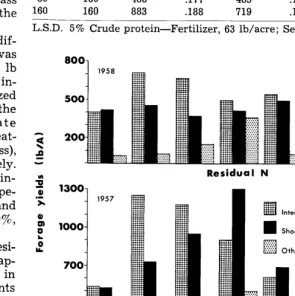
Heavy late-fall grazing by sheep following spring deferment improves deferiorafed sagebrush-grass ranges by reducing sagebrush and increas- ing fhe producfion of grasses and forbs. Fall grazing as a method for range improvement is more effec- five and practical than complete pro- tection from grazing and is less ex- pensive than mechanical or chemical means of sagebrush control. Heavy spring grazing damages good-condi- tion ranges by increasing sage- brush and reducing herbaceous pro- duction.
Since 1924, researchers at the U.S. Sheep Experiment Station2 near Dubois, Idaho, have been studying the sagebrush-grass ranges which provide the pri- mary source of forage for sheep 1 At Forestry Sciences Laboratory,
maintained in cooperation with Utah State University.
2 Cooperative research by the Inter- mountain Forest and Range Ex- periment Station, Forest Service; Animal Husbandry Research Divi- sion, Agricultural Research Ser- vice; and the University of Idaho.
in both spring and fall on the Upper Snake River plains of southeastern Idaho. As they have reported previously, heavy spring grazing by sheep followed by fall grazing results in dense stands of sagebrush and low pro- duction of palatable grasses and forbs. Craddock and Forsling (1938) reported results of this study through 1932; Mueggler (1950) continued the report through 1949, and Laycock (1961) summarized results through 1957. All these reports showed that grazing only in the late fall maintains an open stand of sage- brush. This paper reports con- tinuation of these studies through 1964; objectives of this continuation were to determine the effects on good and poor sagebrush-grass range of (1) com- plete protection, (2) heavy graz- ing in the spring only, and (3) heavy grazing in the late fall only.
names, just as it needs scientific names. Neither should be straight-jacketed into a status quo. Evolution and synthesis of lists will reflect a healthy growth in range science and re- lated fields. Let’s “standardize”, but let’s not overdo it.
(Editor’s Note: Dr. Beetle is a member of the Editorial Board of Journal of Range Manage- ment and has accepted the as- signment of preparing a pre- liminary Range Plant List of the American. Society of Range Man- agement. Those interested in this subject s h o u 1 d correspond di-
rectly with Dr. Beetle.)
The Study
This study was conducted in two 80-acre native range pas- tures. From 1924 to 1949 the two pastures were grazed at differ- ent seasons-one in the fall only, the other in both spring and fall. Stocking rates for the fall-grazed pasture averaged 43 sheep-days/ acre; stocking rates for the spring-fall pasture averaged 19 sheep-days/acre in the spring and an additional 10 in the fall.
In 1924, both pastures were in good condition when rated by the standards published by Pe- chanec and Stewart (1949). Both pastures had open stands of threetip sagebrush (Artemisia tripartita)3 and were producing abundant grasses and forbs. In 1949, the pasture grazed in the fall was still in good condition. The spring-fall pasture, however, dropped from good to poor con- dition during this period; sage- brush increased and grasses and forbs decreased. This deteriora- tion was attributed primarily to the heavy spring use during the first few years of the study when 3 Nomenclature jolZows Hitch-cock et
206 EDITORIAL
profession have, or should it have, a policy in regard to the use of plant names?
One can easily see that com- mon names add interest and color to a world that would be, for many, coldly scientific and remote if only Latin designa- tions were available. A scientific name usually tells a story, re- flecting origin (virginiana), size
(gigantea), color (rosea), or form (squarrosa). The same is true of common names, and where they have a useful and significant meaning, some thought should be given to their preservation. A good example is
the unfortunate shortening of the Old World “goatfacegrass” to “goatgrass”. The first is de- scriptive, the second is mean- ingless.
Neither authority nor admin- istration should force upon the literature the common name “centaurea” (cf. Standarized Plant Names) when general usage has brought acceptance to “knapweed” and “starthistle”
(see list of Weed Society of America). Acceptance of a stan- dardized list, reserving the right to make changes, is a compro- mise for both extremes.
Range science needs common
8 8
How Heavy Grazing and Protection
Affect Sagebrush-Grass Ranges
WILLIAM A. LAYCOCK
Intermountain Forest and Range Experiment Station, Forest Service, U.S.D.A., Logan, UtahI.
Highlight
Heavy late-fall grazing by sheep following spring deferment improves deferiorafed sagebrush-grass ranges by reducing sagebrush and increas- ing fhe producfion of grasses and forbs. Fall grazing as a method for range improvement is more effec- five and practical than complete pro- tection from grazing and is less ex- pensive than mechanical or chemical means of sagebrush control. Heavy spring grazing damages good-condi- tion ranges by increasing sage- brush and reducing herbaceous pro- duction.
Since 1924, researchers at the U.S. Sheep Experiment Station2 near Dubois, Idaho, have been studying the sagebrush-grass ranges which provide the pri- mary source of forage for sheep 1 At Forestry Sciences Laboratory,
maintained in cooperation with Utah State University.
2 Cooperative research by the Inter- mountain Forest and Range Ex- periment Station, Forest Service; Animal Husbandry Research Divi- sion, Agricultural Research Ser- vice; and the University of Idaho.
in both spring and fall on the Upper Snake River plains of southeastern Idaho. As they have reported previously, heavy spring grazing by sheep followed by fall grazing results in dense stands of sagebrush and low pro- duction of palatable grasses and forbs. Craddock and Forsling (1938) reported results of this study through 1932; Mueggler (1950) continued the report through 1949, and Laycock (1961) summarized results through 1957. All these reports showed that grazing only in the late fall maintains an open stand of sage- brush. This paper reports con- tinuation of these studies through 1964; objectives of this continuation were to determine the effects on good and poor sagebrush-grass range of (1) com- plete protection, (2) heavy graz- ing in the spring only, and (3) heavy grazing in the late fall only.
names, just as it needs scientific names. Neither should be straight-jacketed into a status quo. Evolution and synthesis of lists will reflect a healthy growth in range science and re- lated fields. Let’s “standardize”, but let’s not overdo it.
(Editor’s Note: Dr. Beetle is a member of the Editorial Board of Journal of Range Manage- ment and has accepted the as- signment of preparing a pre- liminary Range Plant List of the American. Society of Range Man- agement. Those interested in this subject s h o u 1 d correspond di-
rectly with Dr. Beetle.)
The Study
This study was conducted in two 80-acre native range pas- tures. From 1924 to 1949 the two pastures were grazed at differ- ent seasons-one in the fall only, the other in both spring and fall. Stocking rates for the fall-grazed pasture averaged 43 sheep-days/ acre; stocking rates for the spring-fall pasture averaged 19 sheep-days/acre in the spring and an additional 10 in the fall.
In 1924, both pastures were in good condition when rated by the standards published by Pe- chanec and Stewart (1949). Both pastures had open stands of threetip sagebrush (Artemisia tripartita)3 and were producing abundant grasses and forbs. In 1949, the pasture grazed in the fall was still in good condition. The spring-fall pasture, however, dropped from good to poor con- dition during this period; sage- brush increased and grasses and forbs decreased. This deteriora- tion was attributed primarily to the heavy spring use during the first few years of the study when 3 Nomenclature jolZows Hitch-cock et
the spring stocking rates were as high as 34 sheep-days/acre. Be- cause of the combined seasons of use, however, the separate ef- fects of spring and fall grazing could not be determined. The pasture arrangement and the study therefore were changed somewhat in 1950.
First, 10 acres of the spring- fall pasture were fenced off so that their rate of recovery could be compared with that of an ex- closure in the fall-grazed pasture that had been protected from grazing since 1941. Then the re- mainders of both the spring-fall and fall-grazed pastures were bi- sected with a fence. The former grazing practices, with some modification (Fig. l), were con- tinued in one half of each of the original pastures. The two re- maining halves, however, were put to new use. One was grazed in the spring only (May) at the heavy stocking rate of 40 sheep- days/acre, and the other was grazed in the fall only (Novem- ber and December) at the heavy stocking rate of 60 sheep-days. Craddock and Forsling (1938) and Laycock (1962) all show that moderate grazing rates for fair to good ranges in this area would be 10 to 20 sheep-days/acre in the spring and again in the fall.
These modifications, made in 1950, have enabled us to deter- mine whether heavy grazing solely in the spring damages the range as much as the heavy spring-fall grazing did prior to 1950. Similarly, the addition of the exclosures has provided for a comparison between fall graz- ing and protection as methods for improving range in poor con- dition and for maintaining range in good condition.
Fig. 1 shows the layout and grazing history of the pastures and exclosures. For convenience of discussion, the following terms are used to describe the grazing treatments:
Continued Fall -fall grazing
SAGEBRUSH-GRASS RANGES
FIG. 1. Layout and grazing history of the pastures and exclosures, US. Sheep Sta- tion Experimental Range, Dubois, Idaho, 1924-1963.
1924-1949; fall grazing contin- ued 1950-1963.
Continued Spring - spring-f all grazing from 1924-1949; spring grazing continued 1950-1963. New Fall - spring-f all grazing
from 1924-1949; use changed to fall only 1950-1963.
New Spring - fall grazing 1924- 1949; use changed to spring only 1950-1963.
Old Exclosure-fall grazing 1924- 1941; protected from grazing 1941-1963.
New Exclosure -spring-fall grazing 19 2 4- 19 4 9 ; protected from grazing 1950-1963.
Vegetation Sampling. - Each pasture contains 30 permanent 100-square-foot plots located on a grid. In the exclosures, the number and size of plots vary. The new exclosure contains fif- teen 100-square-foot plots; the old exclosure contains fifty 50- square-foot plots.
Vegetation on the plots in each area was sampled by the weight estimate method (Pechanec and Pickford, 1937a) in 1950,1957, and 1964. The pastures were not grazed in the spring during these years to permit sampling at the end of the spring growing sea- son. The pastures were also sampled in 1953 and 1960 without interrupting the planned grazing treatments. In 1964, additional information on plant density was
207
obtained from the sample plots by counting the number of plants in the following categories: ar- rowleaf balsamroot (BaZsamor- hixa sagittata), mature threetip sagebrush (6 in. or taller), and sagebrush seedlings and young plants (less than 6 in.).
Utilization of the major species was estimated on the plots after spring grazing every year from 1951 to 1956, and in 1958. Esti- mates of fall utilization of the grasses and shrubs were made only in 1955 and 1956. Estimates were made by the ocular esti- mate-by-plot method (Pechanec and Pickford, 1937b).
Resulfs and Discussion
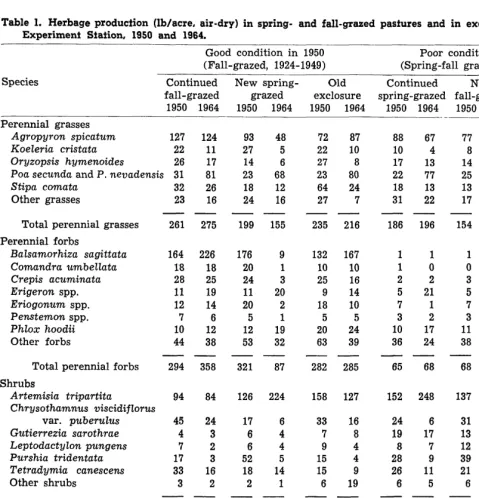
Trends Under Spring Grazing, 1950-I 964.-The range condition of the continued spring pasture, poor to begin with, declined further between 1950 and 1964. Sagebrush production increased more than 60%) and cheatgrass brome (Bromus tectorum) also increased (Table 1). Production of perennial grasses and forbs remained about the same.
In the new spring pasture, where the heavy grazing treat- ment was changed from fall to spring, the range condition de- clined from good to poor just as Mueggler (1950) reported it pre- viously had declined in response to use in both spring and fall. Sagebrush production increased 780/c, and cheatgrass brome in- creased more in this pasture than in any other. Total grass produc- tion decreased 22 % ; bluebunch wheatgrass (Agropyron spica-
turn) decreased 48%. Total forb production decreased 73 s. The forbs most palatable to sheep- arrowleaf balsamroot, common comandra (Comandra umbel- Zata), tapertip hawksbeard (Cre-
pis acuminata), and eriogonum (Eriogonum heracEeoides and E.
ovalifolium) -decreased more than 85%.
208
LAYCOCK
have been cited as a possible
cause of increased incidence of
rust in lodgepole pine (Mielke,
1961). At the Sheep Station,
comandra decreased rather than
increased on overgrazed ranges
because sheep eat it heavily in
the spring (see Table 1; also
Mueggler, 1950).
and measured 3 years after the
treatment was changed from fall
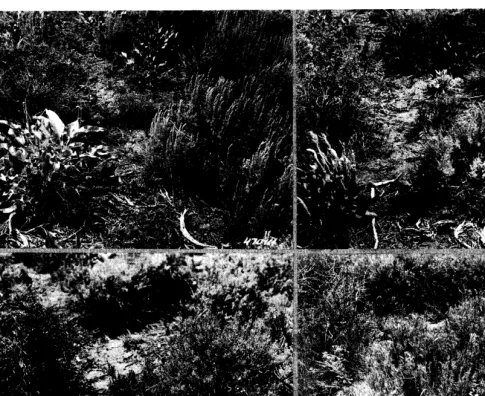
to spring grazing. Fig. 2 shows
some of the changes that took
place during the study on one of
the plot,s in this pasture.
The downward trend in the
new spring pasture could be seen
Trends under Fall Grazing and under Complete Protection.
-The pasture in which fall graz-
ing was continued remained in
good condition
from
1950
through 1964 just as it had dur-
ing the previous 25 years (Mueg-
gler, 1950). Production of sage-
brush, grasses, and most forbs
remained about the same. Pro-
duction of annuals, mainly cheat-
grass brome, was higher in both
fall-grazed pastures and in both
exclosures in 1964 than in 1950-
presumably in response to pre-
cipitation; but the differences
Table 1. Herbage production (lb/acre, air-dry) in spring- and fall-grazed pastures and in exclosures, U. S. Sheep Experimeni Station, 1950 and 1964.
Good condition in 1950 Poor condition in 1950 (Fall-grazed, 1924-1949) (Spring-fall grazed, 1924-1949)
Species Continued New spring- Old Continued New New
fall-grazed grazed exclosure spring-grazed fall-grazed exclosure 1950 1964 1950 1964 1950 1964 1950 1964 1950 1964 1950 1964 Perennial grasses
Agropyron spicatum 127
Koeleria cristata 22
Oryzopsis hymenoides 26 Poa secunda and P. nevadensis 31
Stipa comata 32
Other grasses 23
72 87 22 10 27 8 23 80 64 24 27 7 --
235 216
132 167 10 10 25 16 9 14 18 10 5 5 20 24 63 39 --
282 285
158 127 33 16 7 8 9 4 15 4 15 9 6 19 --
243 187
2 10 4 6 --
6 16
33 17 --
799 721 124 93 48
11 27 5
17 14 6
81 23 68 26 18 12 16 24 16
--
199 155
88 67 77 110 72 127
10 4 8 6 12 8
17 13 14 9 13 2
22 77 25 80 20 70
18 13 13 9 16 8
31 22 17 12 27 8
--
160 223 186 196 154 226
Total perennial grasses 261 275 Perennial f orbs
Balsamorhiza sagittata Comandra umbellata Crepis acuminata Erigeron spp. Eriogonum
spp.
Penstemon spp. Phlox hoodii Other forbs164 226 176 9
18 18 20 1
28 25 24 3
11 19 11 20
12 14 20 2
7 6 5 1
10 12 12 19 44 38 53 32
--
321 87
1 1 1 9 5 25
1 0 0 1 1 1
2 2 3 11 6 12
5 21 5 10 11 10
7 1 7 4 4 5
3 2 3 4 3 3
10 17 11 8 7 8
36 24 38 29 39 24
--
76 88 Total perennial forbs 294
Shrubs
Artemisia tripartita 94 Chrysothamnus viscidiflorus
var. puberulus 45 Gutierrezia sarothrae 4 Leptodactylon pungens 7
Purshia tridentata 17
Tetradymia canescens 33
Other shrubs 3
358 65 68 68 76
84 126 224 152 248 137 107 204 166
24 17 6
3 6 4
2 6 4
3 52 5
16 18 14
2 2 1
--
227 258
24 6 31 26 58 27
19 17 13 8 6 6
8 7 12 5 9 5
28 9 39 3 64 13
26 11 21 12 19 19
6 5 6 3 9 5
--
369 241 Total shrubs
Annuals
Bromus tectorum Annual forbs
203
2 2
134 263 303 259 164
9 4
2 53 2 6 --
4 59
3 33 7 12 2 7
4 7 3 8 3 6
Total annuals 4 13 7 40 10 20 5 13
Cactus
Opuntia polyacantha 75 31 13 19
--
764 578
30 62 31 36 9
--
646 574
SAGEBRUSH-GRASS RANGES 209
FIG. 2. This plot in the new spring pasture shows the damaging effects of heavy spring grazing by sheep on native sagebrush-grass range. Upper left, 1952, Arrowleaf balsamroot plants were vigorous following the favorable fall-grazing treatment before 1951. Upper right, 1955, The balsamroot plants are less vigorous, and more bare soil is evident. Lower left, 1958, The balsamroot plants have died, and the sagebrush plants have grown larger. Lower right, 1%4, Sagebrush has obscured the plot stake. The bitterbrush plant in the upper left was killed by tent caterpillar defoliation, not by grazing. Much of the grass is cheatgrass brome.
were comparatively smaller than those in the spring-grazed pas- tures.
Significantly, the deteriorated pasture improved under fall grazing (the new fall pasture- Fig. 3) and under protection (the new exclosure). The increase in total grass production, expressed mainly as increases in bluebunch wheatgrass and bluegrass (Poa
secunda and P. nevadensis), was 47% in the new fall pasture and 39% in the new exclosure. Sage- brush production decreased
about 20% in both areas (Table 1). Total forb production in- creased only slightly. After pa- latable forbs have been reduced or removed by heavy spring grazing, they recover slowly, even under favorable conditions.
Some forbs, such as tapertip hawksbeard, increased fairly uniformly throughout the new fall pasture. This species be- comes established quickly be- cause it has a light, wind-carried seed. In contrast, almost all the increase of arrowleaf balsam-
210 LAYCOCK
FK. 3. These two photographs on a plot in the new fall pasture show the increase in production of grasses and fork and the de-
crease in sagebrush from 1952 (left) to ‘1964 (right) as a result of heavy fall grazing.
nated because few of the remain- ing balsamroot plants in the new spring pasture now produce flowers or seed. However, bal- samroot plants now present in the new fall pasture should in- sure further increases as long as the favorable fall-grazing treat- ment is continued.
Number and Average Weight of Plants, 1964.-The number of arrowleaf balsamroot plants was not correlated with production in the new spring and new fall pastures in 1964. Production was 9 lb/acre in both pastures (Table l), but the new spring pasture had 8 times as many plants (Table 2). The air-dry weight of plants in both spring-grazed pas- tures averaged 2 to 4 g compared with 13 to 17 g for the plants in the fall-grazed pastures and the CdOSUIW.
Plant numbers and productiv- ity of mature sagebrush were highest in the two spring-grazed pastures and lowest in the con- tinued fall-grazed pasture. The mature sagebrush plants in the continued fall pasture also had the lowest average weight. The number of sagebrush seedlings and small plants (less than 6 in. tall) was not affected by graz- ing treatment.
Table 2. Average number and weight of arrowleaf balsamroof and maiure (taller fhan 6 in) sagebrush planfs in 1964.
Item
Fall-grazed, 1924.1949 Spring-fall grazed, 1924-1949 Continued New Old Continued New New
fall spring exclosure spring fall exclosure Ave. no. plants/lOO/ftz
Balsamroot Sagebrush Ave. plant weight
14.5 5.8 13.1 0.2 0.7 1.5
1.7 15.4 10.8 19.3 10.0 11.0 (g. airdry)
Balsamroot Sagebrush
16.2 1.6
11.5 15.1 13.3 12.3 13.3 3.6 11.2 13.9 17.5 15.8 Statistical Analysis.-Analysis
of variance was used to compare changes in production from 1950 through 1964 for bluebunch wheatgrass, arrowleaf balsam- root, threetip sagebrush, and to- tal perennial grasses and forbs. Counts of the number of balsam- root and sagebrush plants in 1964 were also analyzed. Each of these categories was analyzed sepa- rately using the six pastures and exclosures as six treatments in a completely randomized design with the individual sample plots as subplots within each treat- ment. In each analysis, the treatment sum of squares was subdivided into various single degree of freedom comparisons between pastures or groups of pastures. The three comparisons of greatest value in interpreting
SAGEBRUSH-GRASS RANGES 211
Table 3. Comparisons between pastures and exclosures of change in producfion from 1950 through 1964 and number of plank in 1964.
A B C
Item Fall
Spring grazing graz- &
ing protection F
Continued Old New New
fall exclosure F fall exclosure F Average change in prod.
(lb/acre), 1950-1964 Agropyron spicatum Balsamorhiza sagittata All grasses and forbs Artemisia tripartita Ave. no. of plants (per
100 ft.2) in 1964
Balsamorhiza sagittata Artemisia tripartita
-33 +25 **19.2 -3 +15 ns $33 +55 ns
-84 +31 **48.5 $62 +35 ns +8 $20 ns
-132 $54 ““19.7 f78 -16 *5.8 f80 +75 ns
$97 -27 ““77.5 -10 -31 ns -30 -38 ns
3.0 7.0 **12.6 14.5 13.1 0.7 1.5 ns
17.4 9.9 **70.8 7.7 10.8 *;.ss 10.0 11.0 ns
* Difference significant at the 5% probability level. ** Difference significant at the 1% probability level. ns Difference not significant at the 5% probability level.
of these comparisons were sig- nificant. First, from 1950 through 1964 production of all grasses and forbs increased in the continued fall-grazed pasture; however, it decreased slightly in the pro- tected old exclosure. Moreover, the continued fall pasture con- tained significantly fewer sage- brush plants in 1964 than did the old exclosure.
Vegetation Changes not Re- lated to Grazing Treatment.- Results discussed thus far were for the major species and those that showed definite responses to the experimental treatments. Precipitation may have had a greater effect than treatment upon some of the other species. Precipitation in 1950 and 1964 was:
1950 1964 Before the growing
season (July-March) 7.16 7.14 Growing season
(April-June) 3.20 7.52
Blaisdell (1958) found that
total production of grasses and forbs at the Sheep Station was most closely correlated with pre- cipitation prior to the growing season. However, precipitation during the growing season also affected the production of some individual species in this study. Cheatgrass brome and other an-
nuals, for example, were scarce in 1950; but they were relatively common in all areas in 1964 as a result of the abundant spring moisture.
The perennials most obviously affected by variations in precipi- tation were the Nevada and Sandburg bluegrasses; in 1964 they produced two to three times more in all pastures and exclo- sures than they had in 1950. These grasses generally start growth, mature, and become dry earlier than most other grasses. In 1964, the abundant and pro- longed spring moisture evidently favored extended growth and therefore relatively high produc- tion. The large decrease in the production of antelope bitter- brush (Purshia tridentata) in all areas was probably caused by damage from tent caterpillars in 1958-1960. When several pastures were sampled in 1960, almost all bitterbrush plants were com- pletely defoliated. By 1964 many were partly or completely dead (Fig. 2).
Utilization . - In the spring, grasses and forbs made up the bulk of the diet of the sheep. Average use of the highest pro- ducing grass, bluebunch wheat- grass, ranged from 20 to 40% of the current year’s growth in
the new spring pasture and from 40 to 60% in the continued spring pasture. Most other grasses were consumed in about the same quantity, or slightly less, as blue- bunch wheatgrass; however, In- dian ricegrass (Oryxopsis hyme- noides) and needle-and-thread
(Stipa comata) were usually grazed more heavily.
The average spring use of ta- pertip hawksbeard and arrow- leaf balsamroot ranged from 40 to more than 90%. Use of other forbs usually was less and varied considerably from year to year. Antelope bitterbrush was the main shrub utilized in the spring, with use ranging up to 60% of the growth at the time of graz- ing. Other shrubs received only light use in the new spring pas- ture, but up to 40% of the downy rabbitbrush (Chrysothamnus viscidiflorus var. puberulus) and the broom snakeweed (Gutier- rezia sarothrae) was used in the continued spring pasture. Evi- dently, the low production of palatable grasses and forbs in the continued spring pasture caused heavier use of the shrubs.
212
fall utilization data are available, the sheep consumed the follow-
ing percentages of the current
year’s growth of threetip sage-
brush:
Continued New
fall fall
pasture pasture
1955 26 19
1956 7 6
The greater utilization in 1955
probably was the result of deep- er snow cover. Little snow was present at any time in 1956, and in that year the use of sagebrush and other shrubs was light. In
1955, 5 to 8 inches of snow
covered the ground during the last month of fall grazing. Thus many of the grasses and forbs were buried, and heavier use of
sagebrush and other shrubs re-
sulted.
Continuous snow cover of 5
inches or more during the last half of the fall grazing period occurred in 6 of the 14 years of
the study. In 1951, the sheep
were removed from the fall-
grazed pasture about 10 days
earlier than had been planned
because the snow was about 15
inches deep. Portions of sage-
brush and other shrubs above the snow were used heavily, but
accurate estimates of total utili-
zation could not be made because of the deep snow.
Causes of Varied Response.-
As Mueggler (1950) previously
reported, heavy spring grazing
followed by fall grazing caused
sagebrush-grass range in good
condition to deteriorate quickly.
During the present study, heavy grazing only in the spring had
the same result: sagebrush in-
creased, and the more desirable
grasses and forbs decreased. By
contrast, late fall grazing im-
proved range in poor condition;
it reduced sagebrush and in-
creased the production of grasses and forbs.
Why does spring grazing dam- age the range while heavy fall grazing improves it?
The best answers seem to be
LAYCOCK
that the spring grazing period is also the active growing period for the native grasses and forbs. Grazing during this period, and
particularly heavy grazing, re-
moves photosynthetic material
from grasses and forbs at just the time when it is needed for the repair of winter damage and for renewed growth. When pro- tected in the spring, however, the grasses and forbs can reach full
maturity unhindered and in-
crease in vigor. Then in the fall, when their root systems are well
established and their foliage is
dry, they can be grazed without
significant damage. Sagebrush,
on the other hand, is not dor- mant in the fall; so utilization by
sheep results in a decline in
vigor. The established grasses
and forbs, vigorous as a result
of spring deferment, can, then
increase while the sagebrush de- creases.
Moreover, fall grazing prob-
ably helps to promote the estab- lishment of additional grass and forb seedlings during the follow- ing spring. The sheep scatter the newly shed seed and often cover
it by trampling (Pechanec and
Stewart, 1949). Then, if the area
is again protected in the spring, many of these grass and forb seedlings become established.
An area containing an open
stand of sagebrush resulting
from heavy fall grazing is prob- ably better sheep range than an
area from which sagebrush has
been eliminated. Sagebrush and
other shrubs constitute an im-
portant part of the diet of sheep in the fall because they supply
much more crude protein and
phosphorus at that time than do
the native grasses and forbs
(Blaisdell et al., 1952). The shrubs
also provide emergency feed
when early snows bury herbace- ous vegetation.
Thus, both fall grazing and
protection improved range in
poor condition. However, fall
grazing probably reduces sage-
brush more than protection from
grazing: (1) after prolonged fall grazing, there were significantly
fewer sagebrush plants in the
continued fall pasture than in
the old exclosure (Table 3), and
(2) the average weight of sage- brush plants was lower in the new fall pasture than in the new
exclosure (Table 2).
Application of Results. - The results of this study indicate that
depleted sagebrush-grass ranges
can be improved by use of a
properly planned grazing pro-
gram. The commonly used meth- ods of reducing dense stands of sagebrush (burning, spraying, or
mechanical treatment) are cost-
ly and eliminate grazing for one
or more years following treat-
ment. A program cf spring defer- ment combined with heavy fall
grazing offers an alternative
method of improvement. Its ad-
vantage is that it requires only
management of the sheep and
not costly cultural practices.
Fall grazing should be an
effective method of improving
sagebrush-grass ranges if:
(1)
(2)
The sagebrush has a good
understory of herbaceous
perennials, especially
grasses. (If the native
grasses and forbs have
been replaced by annuals,
little improvement can be
expected.)
The sagebrush is grazed in the late fall when snow is on the ground so that utili- zation is as heavy as possi- ble. On fairly level ground, the condition of the sheep
should determine the time
of removal in the fall
rather than any certain
level of utilization. (Sheep
were not weighed in this
study, but fall grazing
caused no observable de-
cline in weight or condi- tion.) On steep slopes, how- ever, grazing rates should
be lower than on level
ground to prevent exces-
sheep and the resulting ac- celeration in erosion. During this study, heavy fall grazing had noticeably improved the new fall pasture by 1953, only 3 years after the treatment was started. Such a rapid rate of improvement indicates that the combination of spring deferment and heavy fall grazing is a very practical method for range resto- ration. Because only 2 or 3 years are necessary to effect marked improvement, this program could be applied on a rotation basis to one range unit at a time, and it should thus upgrade the entire range over a period of years.
Whether this system could be used on a given range without reducing the number of sheep grazed in the spring would de- pend upon the condition of the range and the present grazing intensity. If the present grazing rate is quite heavy, deferment of one unit and thereby increasing the spring grazing pressure on the remainder of the range might cause considerable damage. In such a situation, additional spring range or supplemental feed might be necessary until the carrying capacity of part of the range is increased. If the present grazing rate is moderate, the sys- tem might be used without seri- ous damage, especially if the spring-grazed units were rotated so that a given unit would be grazed at a different time each spring (Laycock, 1962).
The only known test of fall grazing as a method of range im- provement is being conducted on the Benmore Experimental Area in Utah, where heavy fall graz- ing by sheep appears to have re- duced the amount of big sage- brush (Artemisia trident&a) in seeded cattle pastures.4
4 PerSonal communication, Neil C. Frischknecht, Intermountain For- est and Range Experiment Station, Provo, Utah.
SAGEBRUSH-GRASS RANGES
Summary
At the U.S. Sheep Experiment Station near Dubois, Idaho, one pasture, grazed only in late fall from 1924 to 1949, remained in
good condition with an open stand of threetip sagebrush and a good understory of perennial grasses and forbs. An adjacent pasture, grazed in both spring and fall, deteriorated to poor condition as grasses and forbs decreased markedly and sage- brush increased.
In 1950 additional fences were erected and grazing treatments were applied from 1950 through 1963 to determine the effects of spring grazing only, fall grazing only, and protection from graz- ing on some range in good condi- tion and some in poor.
Heavy spring grazing caused rapid deterioration of good-con- dition range; production of sage- brush increased 78% and produc- tion of grasses and forbs de- creased more than 50%. Arrow- leaf balsamroot and some of the palatable forbs decreased more than 85%. Heavy spring grazing on range already in poor condi- tion maintained the low produc- tivity of palatable forage species and further increased sagebrush.
Heavy late-fall grazing and complete protection maintained the range in good condition with an abundance of balsamroot, other forbs, and grasses. Like- wise, both heavy fall grazing and protection improved poor-condi- tion range; production of the de- sirable forage species increased more than 30% while sagebrush decreased 20%. Fall grazing, however, reduced sagebrush more than protection because the sheep browsed on the sagebrush in the fall. Grasses and forbs were not damaged by fall utiliza- tion because they are essentially dormant at that time.
Thus sagebrush-grass ranges can be improved by proper graz- ing rather than by costly spray- ing, burning, or mechanical treatments. Spring deferment
213
combined with heavy grazing in the late fall offers an alternative method of improvement. The loss of grazing in the spring is more than offset by the increased graz- ing rate allowable in the fall.
LITERATURE CITED BLAISDELL, JAMES P. 1958. Seasonal
development and yield of native plants on the Upper Snake River Plains and their relation to certain climatic factors. U.S. Dep. Agr. Tech. Bull. 1190. 68 p.
BLAISDELL, JAMES P., A. C. WIESE, AND C. W. HODGSON. 1952. Varia- tions in chemical composition of bluebunch wheatgrass, arrowleaf balsamroot, and associated range plants. J. Range Manage. 5: 346-353. CRADDOCK, G. W., AND C. L. FORSLING.
1938. The influence of climate and grazing on spring-fall sheep range in southern Idaho. U.S. Dep. Agr. Tech. Bull. 600. 43 p.
HITCHCOCK, A. S. 1951. Manual of the Grasses of the United States, 2nd ed. (revised by Agnes Chase). U.S. Dep. Agr. Misc. Pub. 200. 1051 p. HITCHCOCK, C. LEO, ARTHUR CRON-
QUIST, MARION OWNBEY, AND J. W. THOMPSON. 1955-1964. Vascular plants of the Pacific Northwest, Parts 2-5. University of Washing- ton Press, Seattle.
LAYCOCK, WILLIAM A. 1961. Improve your range by heavy fall grazing. Nat. Woolgrower 51(6) : 16, 30. LAYCOCK, WILLIAM A. 1962. Rotation
allows heavier grazing of sage- brush-grass range. Nat. Wool- grower 52 (6) : 16-17.
MIELKE, J. L. 1961. Comandra blister rust. U.S. Dep. Agr. Forest Pest Leafl. 62. 7 p.
MUEGGLER, WALTER F. 1950. Effects of spring and fall grazing by sheep on vegetation of the Upper Snake River Plains. J. Range Manage. 3: 308-315.
PECHANEC, J. F., AND G. D. PICKFORD. 1937a. A weight estimate method for the determination of range or pasture production. J. Amer. Sot. Agron. 29: 894-904.
PECHANEC, J. F., AND G. D. PICKFORD. 1937b. A comparison of some meth- ods used in determining percent- age utilization of range grasses. J. Agr. Res. 54: 753-756.
Beef Production on
Lodgepole Pine-Pinegrass
Range in Southern
British Columbia
ALASTAIR MCLEAN
Ecologist, Canada Department of Agriculture, Research Station, Kam- loops, British Columbia.
Highlight
Yearling sfeers on lodgepole pine- pinegrass summer range in British Columbia had an average daily gain of 1.75 lb for 103 days per year over a 5-year period. The average gain per acre was 19.3 lb for the season and the average stocking rate was 4.8 acres per AUM. Pinegrass, which provided over 50% of the forage yield, was readily accepted by cattle during early summer but became unpalatable by mid August.
The most important and char- acteristic range vegetation zone in interior British Columbia is the douglasfir zone. It comprises about 15 of the 19 million acres of grazing land in the Interior. The zone has been described by Tisdale and McLean (1957). The major plant association within the zone is douglasfir-pinegrass, the principal grazing species being pinegrass (Calamagrostis rubescens Buckl.). Lodgepole pine (Pinus contortu Dougl.) is the main seral tree species in the zone.
Few grazing studies have been made in the zone and yet this step is necessary if accurate grazing values are to be as- signed.
The Eastern Oregon Experi- ment Station is conducting graz- ing studies on pinegrass-domi- nated range in eastern Oregon (Hedrick, 1966). Indications are that early-summer grazing is the best time of use while the forbs are at peak production and the pinegrass is immature.
The Oregon pinegrass range is markedly different from ours in that the climax tree is grand fir
(Abies grandis L.) and the un- derstory contains a higher pro- portion of shrubs which make up 40% of the forage under mod- erate shade and about 20% in open areas.
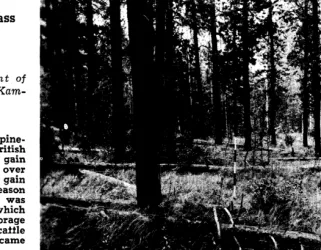
FIG. 1. Plant cover in the experimental fields, Pass Lake, B. C. Dominant tree is lodgepole pine with understory mostly of pinegrass.
Grazing trials were started in 1960 at the CDA Research Sta- tion, Kamloops, B.C. The work during 1960 and 1961 was super- vised by Dr. H. H. Nicholson, then Animal Scientist at the re- search station, and for the re- mainder of the time by the au- thor. The results must be in- terpreted with caution since there is no assurance that they are representative of the region as a whole. The trials are being continued, however, and ex- tended to other grazing districts.
Study Area and Procedures The experimental fields lie within the holdings of the Re- search Station near Pass Lake about 14 miles northwest of Kamloops. They are located in the douglasfir zone between 3400 and 4000 ft elevation. The pres- ent tree cover is a medium-dense stand of lodgepole pine alone or mixed with aspen (Populus tremuloides Michx.) (Fig. 1). Throughout the fields there is sufficient douglasfir to indicate a successional trend to that spe- cies. Pinegrass is the dominant ground-cover species. Plot rec- ords indicate that the species
214
dominates about 80% of the ground area. It is the only grass to contribute significantly to the forage yield. Plots clipped in 1966
indicated that the grasses, forbs, and shrubs had an average dis- tribution by weight of 56, 29, and 15% respectively.
The principal associated shrubs are rose (Rosa nutkunu Presl), oregongrape (Muhoniu repens
(L.) G. Don), whitetop spiraea
(Spirueu betulifoliu Pall,) and russet buffaloberry (Shepherdiu cunudensis (L.) Nutt.). The most commonly occurring forbs are heartleaved arnica (Arnicu cor- difoliu Hook.), showy aster
(Aster conspicuus L.) timber milkvetch (Astrugulus miser
Dougl. var. serotinus (Gray) Barneby), creamy peavine
(Luthyrus ochroleucus Hook.), and strawberry (Fruguriu gluucu
(Wats.)
Rydb.) .
Plot records indicated that dominant trees of lodgepole pine had an average diameter at breast height of 9.2 inches, an average age of 72 years and site index of 75.
BEEF PRODUCTION 215
Table 1. Number of days on pasfure, number of yearling sfeers on each field, and fheir average siarfing weighfs in a grazing frial on fhe Pass Lake experimenfal fields 1960 fo 1964.
NO. No. of days on pasture No. of yearlings on field Avg starting weights (lb)
__~- ______- ____
Field acres 1960 1961 196219631964Avg 1960 1961 1962 1963 1964 i96Ox61 1962 1963 1964 1 105 106 112 98 100 112 106 6 12 12 8+ 11” 15 648 508 571 486 459
2 81 106 112 98 72 98 97 6 9 8 11 12 634 537 637 484 476
3 90 106 112 98 100 112 106 6 9 9 12 12 630 532 628 505 479
Avg. 92 106 112 98 91 107 103 637 526 612 492 471
* Eleven animals were moved from Field 2 to Field 1 after 72 days when the former became overgrazed. area without having to climb
steep slopes. Water is available in several places in each field. The fields are fairly similar in their forage cover and topog- raphy.. The chief differences are that Field 3 contains a small, swampy meadow (about 2 acres) and Field 1 has a few more open patches dominated by Kentucky bluegrass.
Three fields were fenced in the fall of 1959 and continuously grazed during each pasture sea- son from 1960 to 1964. Grazing of the area had been light for a number of years prior to the start of the experiment and there was a good cover of forage spe- cies.
There was no fixed grazing period, animals being grazed for as long as possible depending on the forage growth and weather conditions. Yearling steers av- eraging 548 lb at turn out (Table 1) were used in the test and weighed every 2 weeks through- out the season. The animals were kept on pasture in the fall until the average gain became less than 1 lb/day. In 1960 the fields were obviously undergrazed so that stocking rate was increased the following year and adjusted as available forage dictated thereafter (Table 1). For report- ing, yearling steer units were converted to animals units (AU) by multiplying the former by 0.6.
The turn out dates for 1960 to 1964 inclusive were June 30, June 16, July 6, July 3, June 5. The closing dates were October 14, 6, 12, 11, and September 25, except that Field 2 was closed on September 13 and 11 in 1963 and
Table 2. Average daily gain of yearling sfeers, gain per acre, and average carrying capaciiy of fhree Pass Lake experimenfal fields for 5 years (1960 fo 1964).
Stocking rate Avg daily gain (lb) Gain per acre (lb) (ac/AUM)
Year 1 2 3 Avg 1 2 3 Avg 1 2 3 Avg
1960 ‘1.85 1.98 1.78 1.87 11.2 15.5 12.6 13.1 8.2 6.4 7.1 7.2 1961 1.89 1.85 1.98 1.91 24.2 23.0 22.2 23.1 3.9 4.0 4.5 4.1 1962 1.82 1.36 1.60 1.59 20.4 13.2 15.7 16.4 4.5 5.2 5.1 4.9 1963 1.53 1.79 1.61 1.64 13.0 17.5 21.5 17.3 4.7 5.1 3.7 4.5 1964 1.81 1.85 1.60 1.75 29.0 26.9 24.0 26.6 3.1 3.4 3.3 3.3 Avg 1.78 1.77 1.71 1.75 19.6 19.2 19.2 19.3 4.9 4.8 4.7 4.8 The averages joined by lines are not significantly different at the 5% level expressed by Duncan’s Multiple Range Test.
1.91 1.87 1.75 1.64 1.59 26.6 23.1 17.3 16.4 13.1 3.3 4.1 4.5 4.9 7.2 ~~
1964 respectively because of overgrazing.
The plant cover was estimated from sample plots using the method of Daubenmire (1959). Forage yield was determined in 1966 by clipping five 9.6 ft2 plots at random at each sample-plot site.
Plant nomenclature follows that of Hitchcock et al. (1955).
Resulfs and Discussion The fields compared well both as to animal performance and carrying capacity. The 5-year average daily gain of 1.75 lb for 103 days (Table 2) compares favorably with the 1.40 lb aver- age for 74 days obtained over 7 years on a sedge meadow in the same district (McLean, Nichol- son, and van Ryswyk. 1963).
The time of removal of the animals from the range greatly influenced the seasonal average daily gain because of reduced gains in the fall (Table 3). On the test fields the dates of first loss of weight of any animal in the fall was recorded on October
Table 3. Average daily gains (lb) of yearling sfeers on Pass Lake ex- perimenfal fields by 14.day weigh periods for 5 years (1960 fo 1964). Weigh
per. 1960 1961 1962 1963 1964 1 3.70* 3.71 2.45 3.00*** 3.29 2 2.62 0.85 2.49 2.20 2.35 3 1.67 3.36 1.36 1.73 2.24 4 2.83 2.33 1.59 1.53 1.46 5 1.34 1.60 1.64 0.92 2.17 6 1.96 1.06 0.89 0.66 2.01 7 1.07 1.77 0.75 0.29 -0.17
8 -.86** 0.57 0.30
* Weigh period 15 days; ** 7 days; *** 16 days.
14, 6, 12, 11 and September 11, for the years 1960 to 1964 re- spectively. There was no sig- nificant difference in the aver- age daily gain between years (Table 2).