Available online: https://edupediapublications.org/journals/index.php/IJR/ P a g e | 640
Mode Fuzzy Algorithm for Designing On-Line Tunable Gain
Fuzzy Sliding Mode Controller Using Sliding: Applied to
Internal Combustion E ngine
Dr. S. SUDHAKAR BABU
Professor and Principal
Geethanjali College Of Engineering & Technology
Nannuru (Vill), Orvakallu (Man), Kurnool(Dist).
[email protected]
Prof. K. Rajgopal
Vice Chancellor, SK University, Ananttapuram
A bstract: This paper expands a fuzzy sliding mode based controller which sliding function is on-line tuned by sliding mode fuzzy algorithm. The main goal is to guarantee acceptable trajectories tracking between the internal combustion engine (IC engine) air to fuel ratio and the desired input. The fuzzy controller in proposed fuzzy sliding mode controller is based on Mamdani’s fuzzy inference system (FIS) and it has one input and one output. The input represents the function between sliding function, error and the rate of error. The outputs represent fuel ratio, respectively. The sliding mode fuzzy methodology is on-line tune the sliding function based on self tuning methodology. The performance of the sliding mode fuzzy on-line tune fuzzy sliding mode controller (SFOFSMC) is validated through comparison with previously developed IC engine controller based on sliding mode control theory (SMC). Simulation results signify good performance of fuel ratio in presence of uncertainty and external disturbance.
Key words:Internal combustion engine Sliding mode controller Fuzzy sliding mode controller Sliding mode fuzzy on-line tune fuzzy sliding mode controller
Available online: https://edupediapublications.org/journals/index.php/IJR/ P a g e | 641 manifold. The development of these control strategies for the chattering in the systems output, boundary layer direct injection was not practical because the production method should be applied so beginning able to of direct injection automobiles did not begin until the mid recommended model in the main motivation which in this 1990's. Mitsubishi began to investigate combustion method the basic idea is replace the discontinuous control technologies for direct injection engines in 1996 method by saturation (linear) method with small [8]. Furthermore, engines that used both port fuel and neighborhood of the switching surface [11-17]. Slotine direct systems appeared a couple years ago, leading to and Sastry have introduced boundary layer method the interest of developing the correspondin control instead of discontinuous method to reduce the chattering strategies. Current production A/F ratio controllers use [18]. Estimated uncertainty method is used in term of closed loop feedback and feed forward control to achieve uncertainty estimator to compensation of the system the desired stoichio metric mixture. These controllers use uncertainties. It has been used to solve the chattering measurements from the oxygen sensor to control the phenomenon and also nonlinear equivalent dynamic. The desired amount of fuel that should be injected over the applications of artificial intelligence, neural networks and next engine cycle and have been able to control the A/F fuzzy logic on estimated uncertainty method have been very well. reported in [19-22]. Wu et al. [23] have proposed a simple Controller design is the main part in this paper as well fuzzy estimator controller beside the discontinuous and as the major objectives in the controller design is stability equivalent control terms to reduce the chattering.
and robustness. One of the significant challenges in In recent years, artificial intelligence theory has been control algorithms is design a linear behaviour controller used in sliding mode control systems. Fuzzy logic for nonlinear systems. When system works with various controller (FLC) can be used to control nonlinear, parameters and hard nonlinearities this technique is very uncertain and noisy systems. This method is free of some useful in order to be implemented easily but it has some model-based techniques as in classical controllers. Fuzzy limitations such as working near the system operating logic provides a method which is able to model a point[9]. Some of IC engines which work in industrial controller for nonlinear plant with a set of IF-THEN rules, processes are controlled by linear controllers, but linear or it can identify the control actions and describe them by controller design for IC engines is extremely difficult [1, 6]. using fuzzy rules. The applications of artificial Sliding mode controller (SMC) is one of the influential intelligence, neural networks and fuzzy logic, on nonlinear nonlinear controllers in certain and uncertain systems systemcontrol have reported in [24-26]. Wai et al.
which are used to solved stability and robustness [10]. [24-25] have proposed a fuzzy neural network (FNN) The main reason for this popularity is the attractive optimal control system to learn a nonlinear function in the properties which SMCs have, such as good control optimal control law. This controller is divided into three performance for nonlinear systems, applicability to MIMO main groups: arterial intelligence controller (fuzzy neural systems and well-established design criteria for discrete- network) which it is used to compensate the system’s time systems. Conversely, this controller is used in nonlinearity and improves by adaptive method, robust different applications; sliding mode controller has controller to reduce the error and optimal controller which subsequent drawbacks; firstly, there is the problem of is the main part of this controller.
Available online: https://edupediapublications.org/journals/index.php/IJR/ P a g e | 642
0
system in fuzzy logic controller has grown specially in recent years as the nonlinear system control [30-33]. Lhee
Pcyl
Pm
pnet
(1)et al. [32]have presented a fuzzy logic controller based on where Pcul( ) is pressure in cylinder, Pm( ) is Wiebe sliding mode controller to more formalize and boundary function, and Pnet( ) is motoring pressure of a cylinder. layer thickness. Air fuel ratio is the mass ratio of air and fuel trapped In various dynamic parameters systems inside the cylinder before combustion starts. (e.g., IC engine) which need to be training, on-line tunable Mathematically it is the mass of the air divided by the gain control methodology is used. In this research in mass of the fuel as shown in the equation below:
order to solve disturbance rejection and uncertainty dynamic parameter, on-line tunable method is applied to
artificial sliding mode controller. F Y Hsu et al. [34]have Air to Fuel m air
mfuel (2) presented adaptive fuzzy sliding mode control which can If the ratio is too high or too low, it can be adjusted update fuzzy rules to compensate nonlinear parameters by adding or reducing the amount of fuel per engine cycle and guarantee the stability robot manipulator controller. that is injected into the cylinder. The fuel ratio can be This paper is organized as follows: In section 2, main used to determine which fuel system should have a larger subject of engine operating cycle and detail dynamic impact on how much fuel is injected into the cylinder. formulation of modelling in IC engine are presented. Detail Since a direct fuel injector has immediate injection of its of proposed sliding mode fuzzy algorithm on-line fuzzy fuel with significant charge cooling effect, it can have a sliding mode controller is presented in section 3. In quicker response to the desired amount of fuel that is section 4, the simulation result is presented and finally in needed by an engine [37].
section 5, the conclusion is presented.
Design Proposed Slidin g M o d e Fu zzy On -lin e T u n e A pplication Fuzzy Sliding Mode Co n tro ller: Sliding mode controller In ternal Combustion Engine Dynamic Fo rmu latio n : In (SMC) is a powerful nonlinear controller which has been developing a valid engine model, the concept of the analyzed by many researchers especially in recent years. combustion process, abnormal combustion, and cylinder This theory was first proposed in the early 1950 by pressure must be understood. The combustion process is Emelyanov and several co-workers and has been relatively simple and it begins with fuel and air being extensively developed since then with the invention of mixed together in the intake manifold and cylinder. This high speed control devices[11-17].
air-fuel mixture is trapped inside cylinder after the intake A time-varying sliding surface s(x,t) is given by the valve(s) is closed and then gets compressed [35]. When following equation:
the air-fuel mixture is compressed it causes the pressure
and temperature to increase inside the cylinder. Unlike s x,t (
d dt )
n1 x 0 (3)
normal combustion, the cylinder pressure and temperature where is the constant and it is positive. A simple can rise so rapidly that it can spontaneously ignite the air- solution to get the sliding condition when the dynamic fuel mixture causing high frequency cylinder pressure parameters have uncertainty is the switching control law: oscillations. These oscillations cause the metal cylinders
to produce sharp noises called knock, which it caused to
abnormal combustion. The pressure in the cylinder is a U rdis U K x, t . sgn(s)
(4)
very important physical parameter that can be analyzed Where the switching function of sgn(S) defined as and from the combustion process. After the flame is the K x, t
is the positive constant;
developed, the cylinder pressure steadily rises, reaches a maximum point after TDC, and finally decreases during the expansion stroke when the cylinder volume increases. Since cylinder pressure is very important to the
1
sgn S 1
s 0
s 0
s 0
(5)
Available online: https://edupediapublications.org/journals/index.php/IJR/ P a g e | 643
j j j
1
j j
j TM T
M T
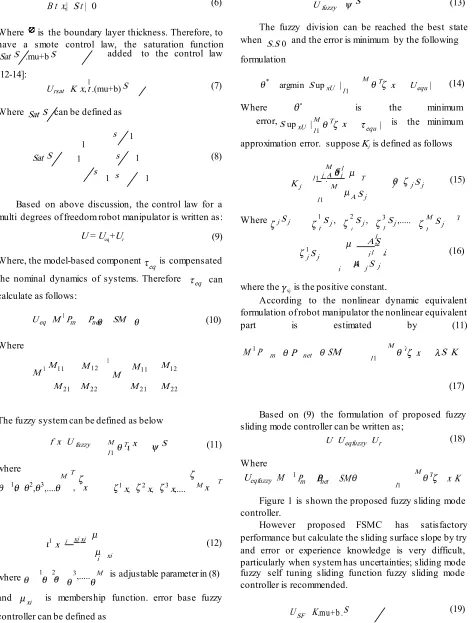
B t x,| S t | 0 (6) U fuzzy S
(13)Where is the boundary layer thickness. Therefore, to have a smote control law, the saturation function
The fuzzy division can be reached the best state when S.S 0 and the error is minimum by the following Sat S .mu+b S
[12-14]:
added to the control law formulation
* M T (14)
U rsat K x, t .(mu+b) S
(7) argmin S up xU | l 1 x
U equ |Where Sat S
can be defined as Where *
M
is the minimum error, S up xU |
Tl 1 x equ | is the minimum
s 1
1 approximation error. suppose Kj is defined as follows
Sat S 1 s 1
(8)M l
s
1 s 1
K j l 1 j AS j
T
M j j S j
(15)Based on above discussion, the control law for a
multi degrees of freedom robot manipulator is written as: Where j S j
l 1 1 S
j ,
A S j
2 S
j , 3 S j ,... M S j
U = Ueq+Ur
Where, the model-based component
(9)
is compensated j S j
A
l
S
l (16)
eq
the nominal dynamics of systems. Therefore can
i A j S j
calculate as follows:
U eq M 1 Pm
Pnet
S M
eq
(10)
where the sj is the positive constant.
According to the nonlinear dynamic equivalent formulation of robot manipulator the nonlinear equivalent
part is estimated by (11)
Where
M 1 P
P
S M
x S K
M 1 M11
1
M12 M11
M M12
m net l 1
M 21 M 22 M 21 M 22 (17)
The fuzzy system can be defined as below Based on (9) the formulation of proposed fuzzy sliding mode controller can be written as;
where
f x U fuzzy
M T
M T l 1
x S
(11)M T
Where
Ueqfuzzy M
U U eqfuzzy U r
1 P
m
Pnet
S M
(18)
xK
1
, 2, 3,...
, x
1x, 2 x, 3x,.... x
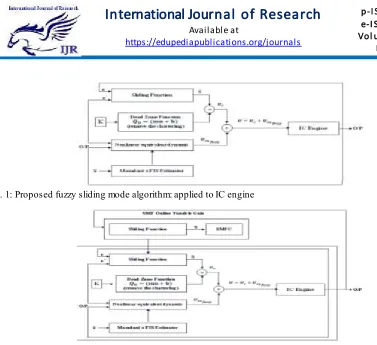
l 1Figure 1 is shown the proposed fuzzy sliding mode controller.
However proposed FSMC has satisfactory
1 x i xi xi (12) performance but calculate the sliding surface slope by try i xi and error or experience knowledge is very difficult, particularly when system has uncertainties; sliding mode
where
1, 2, 3,... M
is adjustable parameter in (8) fuzzy self tuning sliding function fuzzy sliding mode controller is recommended.
and xi is membership function. error base fuzzy
Available online: https://edupediapublications.org/journals/index.php/IJR/ P a g e | 644
j j
j
j
j T
j
Fig. 1: Proposed fuzzy sliding mode algorithm: applied to IC engine
Fig. 2: Proposed on line sliding fuzzy tune FSMC algorithm: applied to IC engine
Where USF is sliding mode fuzzy output function. The engine. The simulation was implemented in
adaption low is defined as Matlab/Simulink environment. Fuel ratio, torque
j sj S j j S j
(20) performance, disturbance rejection, steady state error andRMS error are compared in these controllers. It is noted where the Sj is the positive constant and that, these systems are tested by band limited white noise
j S j 1 S j , 2 S j , 3 S j ,... M S j with a predefined 40% of relative to the input signal
amplitude. This type of noise is used to external disturbance in continuous and hybrid systems.
1 S A l S
(21) Fu el Ratio Trajectory: Figure 3 is shown the fuel ratio in
j j l i Aj S j
As a result SFOFSMC is very stable with a good performance. Figure 2 is shown the block diagram of proposed SFOFSMC.
RESULT S
To validation of this work it is used IC engine and implements proposed SFOFSMC and SMC in this IC
proposed SFOFSMC and SMC in uncertain environment but without disturbance for desired.
By comparing this response, Figre 3, in SMC and SFOFSMC, conversely the SFOFSMC's overshoot is lower than SMC's, the rise time in both of methodologies have identical response. The Settling time in SFOFSMC is fairly lower than SMC.
Available online: https://edupediapublications.org/journals/index.php/IJR/ P a g e | 645 mentioned by, SMC is a robust nonlinear controller which REFERENCES
it is used as a base controller in this work. Besides a band
limited white noise with predefined of 40% the power of 1. Heywood, J., 1988. “Internal Combustion Engine input signal is applied to the trajectory response SMC and Fundamentals”, McGraw-Hill, New York,
SFOFSMC; it found slight oscillations in classical SMC 2. Rivard, J.G., 1973. "Closed-loop Electronic Fuel trajectory responses. Injection Control of the IC Engine," in Society of
Among above graph, relating to desired trajectory Automotive Engineers,
following with structure and unstructured disturbance, 3. Cassidy, J.F., et al, 1980. "On the Design of SMC has slightly fluctuations. SFOFSMC's overshoot is Electronic Automotive Engine Controls using linear lower than SMC's, SMC and SFOFSMC’s rise time are the Quadratic Control Theory," IEEE Trans on Control same and finally the Settling time in SFOFSMC is quite Systems, vol. AC-25,
lower than SMC. 4. Powers, W.E., 1983. "Applications of Optimal Control and Kalman Filtering to Automotive Systems," Ch attering Phenomenon: Reduce or remove the International J. Vehicle Design, vol. Applications of chattering in uncertain and noisy environment is plaed Control Theory in the Automotive Industry.
important role to design a good controller. Figure 5 is 5. Benninger, N.F., et al, 1991. "Requirements and shown the power of boundary layer (saturation) method Perfomance of Engine Management Systems under to reduce the chattering in SMC and SFOFSMC. Transient Conditions," in Society of Automotive
Figure 5 has indicated the power of chattering Engineers,
rejection in SMC and SFOFSMC, with disturbance and 6. Onder, C.H., et al, 1993. "Model-Based Multivariable uncertainties. Refer to this graph, SMC has slightly Speed and Air-to-Fuel Ratio Control of an SI fluctuations. Overall in this research in presence of Engine," in Society of Automotive Engineers, uncertainty and external disturbance, SFOFSMC has the 7. Cho, S.B., et al, 1993. "An Observer-based steady chattering compared to the SMC. Controller Design Method for Automotive Fuel- Injection Systems," in American Controls CONCLUSION Conference, pp: 2567-2571.
8. Kume, T., et al, 1996. "Combustion Technologies for Refer to the research, a sliding mode fuzzy online Direct Injection SI Engine," in Society of Automotive tune fuzzy sliding mode controller is design and applied Engineers,
to IC engine in presence of structure and unstructured 9. Frank L. Lewis. 1999. Nonlinear dynamics and uncertainties. Regarding to the positive points in classical control, Handbook, pp: 51-70. CRC press,
sliding mode controller and fuzzy sliding mode 10. Okyak Kaynak, 2001. “Guest Editorial Special methodology and self tuning sliding mode fuzzy Section on Computationally Intelligent algorithm, the response is improved. Fuzzy logic method Methodologies and Sliding-Mode Control”, Ieee by adding to the sliding mode controller has covered Transactions on Industrial Electronics, 48: 1. negative points. Obviously IC engine is nonlinear and 11. Piltan, F., et al., 2011. "Artificial Control of Nonlinear MIMO system so in proposed controller in first step Second Order Systems Based on AFGSMC," design free model controller based on fuzzy sliding mode Australian J. Basic and Applied Sci., 5(6): 509-522. controller and after that disturbance rejection is improved 12. Piltan, F., et al., 2011. Design sliding mode controller by on-line sliding mode fuzzy tunable gain. Higher for robot manipulator with artificial tunable gain. implementation quality of response and model free Canaidian J. pure and Applied Sci., 5(2): 1573-1579. controller versus an acceptable performance in chattering, 13. Piltan, F., et al., 2011. Design Artificial Nonlinear trajectory and error is reached by designing proposed Robust Controller Based on CTLC and FSMC with controller. This implementation considerably reduces the Tunable Gain, International J. Robotic and chattering phenomenon and error in the presence of Automation, 2(3): 205-220.
Available online: https://edupediapublications.org/journals/index.php/IJR/ P a g e | 646 15. Piltan, F., et al., 2011. Design of FPGA based sliding 26. Menhaj, M.B. and M. Rouhani, 2002. "A novel
mode controller for robot manipulator, International neuro-based model reference adaptive control for a J. Robotic and Automation, 2(3): 183-204. two link robot Arm," pp: 47-52.
16. Piltan, F., et al., 2011. A Model Free Robust Sliding 27. Hsu, Y.C. and H.A. Malki, 2002. "Fuzzy variable Surface Slope Adjustment in Sliding Mode Control structure control for MIMO Systems," pp: 280-285. for Robot Manipulator, World Applied Science J., 28. Hsueh, Y.C., et al., 2009. "Self-tuning sliding mode 12(12): 2330-2336. controller design for a class of nonlinear control 17. Piltan, F., et al., 2011. Design Adaptive Fuzzy Robust Systems," pp: 2337-2342.
Controllers for Robot Manipulator, World Applied 29. Temeltas, H., 2002. "A fuzzy adaptation technique for Science J., 12(12): 2317-2329. sliding mode Controllers," pp: 110-115.
18. Slotine, J.J. and S. Sastry, 1983. Tracking control of 30. Palm, R., 2002. "Sliding Mode Fuzzy Control," non-linear systems using sliding surfaces, with pp: 519-526.
application to robot manipulators. International J. 31. Lhee, C.G., et al., 2002. "Sliding mode-like fuzzy Control, 38: 465-492. logic control with self-tuning the dead zone 19. Ertugrul, M. and O. Kaynak, 2000. "Neuro sliding parameters," Fuzzy Systems, IEEE Transactions On,
mode control of robotic manipulators," 9: 343-348.
Mechatronics, 10: 239-263. 32. Lhee. C.G., J.S. Park, H.S. Ahn, and D.H. Kim, 1999. 20. Kachroo, P. and M. Tomizuka, 2002. "Chattering "Sliding-Like Fuzzy Logic Control with Self-tuning
reduction and error convergence in the sliding-mode the Dead Zone Parameters," IEEE International Fuzzy control of a class of nonlinear systems," Automatic Systems Conference Proceeding, pp: 544-549. Control, IEEE Transactions on, 41: 1063-1068. 33. Zhang, X., et al., "Adaptive Sliding Mode-like Fuzzy 21. Elmali, H. and N. Olgac, 2002. "Implementation of Logic Control for High Order Nonlinear
sliding mode control with perturbation estimation Systems," pp: 788-792.
(SMCPE)," Control Systems Technology, IEEE 34. Hsu, F.Y. and L.C. Fu, 2002. "Nonlinear control of Transactions On, 4: 79-85. robot manipulators using adaptive fuzzy sliding 22. Moura, J. and N. Olgac, 2002. "A comparative study Mode Control," pp: 156-161.
on simulations vs. experiments of SMCPE," 35. Lee, B., 2005. “Methodology for the Static and pp: 996-1000. Dynamic Model Based Engine Calibration and 23. Wu, B., et al., 2006. "An integral variable structure Optimization” Ph.D. Dissertation, The Ohio State
controller with fuzzy tuning design for electro- hydraulic driving Stewart Platform," pp: 5-945. 24. Wai, R.J., et al., 2003. "Implementation of artificial
intelligent control in single-link flexible robot Arm," pp: 1270-1275.
25. Wai, R.J. and M.C. Lee, 2004. "Intelligent optimal control of single-link flexible robot arm," Industrial Electronics, IEEE Transactions On, 51: 201-220,
University,
36. Dawson, J., 2005. “An experimental and Computational Study of Internal Combustion Engine Modeling for Controls Oriented Research” Ph.D. Dissertation, The Ohio State University,