A Versatile Multi-Input Multiplier
over Finite Fields
Haibo Yi,
Student Member, IEEE,
and Shaohua Tang*,
Member, IEEE
and Lingling Xu,
Member, IEEE
Abstract—Multiplication of three elements over finite fields is used extensively in multivariate public key cryptography and solving system of linear equations over finite fields. This contribution shows the enhancements of multiplication of three elements over finite fields by using specific architecture. We firstly propose a versatile multi-input multiplier over finite fields. The parameters of this multiplier can be changed according to the requirement of the users which makes it reusable in different applications. Our evaluation of this multiplier gives optimum choices for multiplication of three elements over finite fields. Implemented results show that we takes22.062ns and16.354ns to execute each multiplication of three elements overGF((24)2)based on table
look-up and polynomial basis on a FPGA respectively. Experimental results and mathematical proofs clearly demonstrate the improvement of the proposed versatile multiplier over finite fields.
Index Terms—versatile multiplier, multi-input multiplier, composite field, finite field, table look-up, polynomial basis, Field-Programmable Gate Array (FPGA).
F
1
I
NTRODUCTIONMultiplication over finite fields is one of the fun-damental and important arithmetical operations in many engineering fields, especially in the area of cryptography.
Most of multipliers over finite fields can be grouped into three families: polynomial basis [1], [2], normal basis [3], [4] and dual basis [5], [6].
Besides, there has been a growing interest to imple-ment the finite field arithmetic using composite field representations [7], [8], [9], which has been employed in cryptographic applications [10], [11] and coding technique [12]. Composite field is one of the specific form of finite fields. To some extent, composite field is a better choice for efficient implementation of many applications.
To our knowledge, all these multipliers are de-signed for multiplication of two elements. However, multiplication of three elements is playing a key role in cryptographic implementations and other mathe-matical problems.
Applications.One of the applications is to evaluate multivariate polynomials over finite fields. Generally, multivariate polynomial consists of multiplication of two elements, multiplication of three elements and addition over finite fields. For example, during the
im-• Corresponding Author. Shaohua Tang is with the School of Computer Science and Engineering, South China University of Technology, Guangzhou, China, 510641.
E-mail: [email protected]
• Haibo Yi is with the South China University of Technology and University of Cincinnati.
• Lingling Xu is with the School of Computer Science and Engineering, South China University of Technology.
plementation of multivariate public key cryptography [13], evaluating multivariate polynomials over finite fields is one of the most time-consuming operations. The multivariate polynomial in Rainbow signature scheme [14], which is one of multivariate signature schemes, can be represented by the form
X
i∈Ol,j∈Sl
αijxixj+
X
i,j∈Sl
βijxixj+
X
i∈Sl+1
γixi+η. (1)
Here are some definitions of the coefficients in (1).
Oiis a set of Oil variables in the thei−thlayer;Siis a
set of Vinegar variables in the thei−thlayer.α,βand
γ are coefficients;η is a constant. It can be observed from (1), computing multiplication of three elements is one of the important parts in the multivariate poly-nomials. Besides, evaluating multivariate polynomial is playing a key role in graphic computation [15], [16] and decoding of cyclic codes, Reed-Solomon codes [17].
Another application is to solve system of linear equations over finite fields. Gaussian elimination method [18] or Gauss-Jordan elimination method [19] can be employed to solve system of linear equations. These methods consist of pivoting, normalization and elimination. Letaijbe thei−throw andj−thcolumn
in a matrix.aii is the pivot element.akt is eliminated
via akt = akt +aii−1aitaki. It can be observed that
since elimination includes a multiplication of three elements and an addition, three-input multipliers can be employed. Besides, since solving system of linear equations has a variety of applications, e.g. [20], [21], [22] and [23], three-input multipliers can be adopted in these applications.
mul-Controller a
b c
k
p q d
Multiplier 2 ((2 ) )n
GF
Multiplier (2 )n
GF
Multiplier (2 )n
GF
Polynomial Basis Table Look-Up
Fig. 1. The architecture of proposed versatile multipli-er.
tiplication of three elements is computed by invoking multipliers with two inputs.
Our contributions. Therefore, we firstly propose a multi-input versatile multiplier in this paper. We en-hance the multiplication of multiple elements in three directions. First, the proposed multiplier can execute multiplications over finite fields GF(2n) and
com-posite fields GF((2n)2). Second, the proposed
mul-tiplier can compute multiplications of two elements and three elements. Third, the proposed multiplier can perform multiplications based on table look-up and polynomial basis. By integrating these designs, the proposed versatile multiplier is very efficient for FPGA and VLSI implementation.
We test and verify our design on a FPGA and the experimental results show that the proposed ver-satile multiplier has a remarkable performance on computing multiplication of multiple elements. We also demonstrate the improvement of the multiplier mathematically.
The rest of this paper is organized as follows: In Section 2, a versatile multi-input multiplier is pro-posed. In Section 3, we evaluate the performance of the proposed multiplier by mathematical analysis. In Section 4, the proposed multiplier is implemented on a FPGA and the experimental results are analyzed. In Section 5, conclusions are summarized.
2
V
ERSATILEM
ULTI-I
NPUTM
ULTIPLIER2.1 Overview of the Proposed Multiplier
The hardware architecture of proposed versatile multi-input multiplier is depicted in Fig. 1, which consists of four parts, i.e. controller, multiplier over
GF((2n)2), multiplier with polynomial basis over GF(2n) and multiplier with table look-up over
GF(2n).
In the proposed versatile multiplier, multiplication of two elementsa×b=dand multiplication of three elements a×b×c = d over GF(2n) and GF((2n)2)
are performed respectively. p(x) = xn+p
n−1xn−1+
TABLE 1
The Versatile Multiplier for Different Parameters
k Field Operand Method
(000)2 GF(2n) Two Polynomial basis
(001)2 GF(2n) Two Table look-up
(010)2 GF(2n) Three Polynomial basis
(011)2 GF(2n) Three Table look-up
(100)2 GF((2n)2) Two Polynomial basis (101)2 GF((2n)2) Two Table look-up (110)2 GF((2n)2) Three Polynomial basis (111)2 GF((2n)2) Three Table look-up
a(x)
c(x)
q(x) S1
S2
S3
D1
D8
ENB Controller
k 1
b(x)
d(x)
p(x)
Fig. 2. Controller of the proposed versatile multi-input multiplier.
...+p1x+ 1 and q(x) = x2 +x+e are irreducible
polynomials overGF(2n)andGF((2n)2)respectively,
where pn−1, pn−2, ..., p1 are the elements over GF(2)
andeis an element overGF(2n).
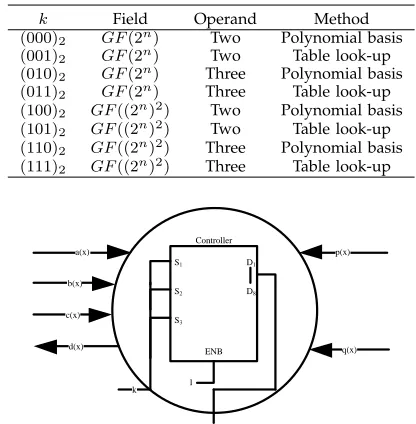
According to different value of the signal k, the versatile multiplier can be reused for different appli-cations, which is illustrated in Table 1. For example, when k = (111)2, the proposed multiplier executes
multiplication of three elements with table look-up overGF((2n)2).
2.2 Controller
Controller of the proposed versatile multiplier is de-picted in Fig. 2. According to different value ofk, con-troller invokes different computational components for different applications.
Signalkis decoded by a 38-line decoder. Three bits ofkare connected withS1,S2 andS3 of the decoder
respectively. D1, D2, ... D8 are connected with the
other computational components.
a(x),b(x),c(x),p(x)andq(x)are directly sent to the computational components. If there exists inputs from the computational components, the controller sends these inputs to its output portd(x).
2.3 Multiplier overGF(2n)with Polynomial Bases
Leta(x) =
n−1
P
i=0
aixi and b(x) = n−1
P
i=0
bixi be elements
inGF(2n), and
c(x) =a(x)×b(x)(mod(p(x))) =
n−1
X
i=0
cixi (2)
is the expected multiplication result, where p(x)is the irreducible polynomial overGF(2n).
First, we compute vij for i = 0,1, ...,2(n−1) and
j= 0,1, ..., n−1 according to
ximodp(x) =
n−1
X
j=0
vijxj. (3)
This step can be pre-computed andvij is pre-stored
in a look-up table.
Next, we compute Si by AND logic gates for i =
0,1, ...,2(n−1)via
Si=
X
j+k=i
ajbk. (4)
After that, we compute ci by XOR logic gates for
i= 0,1, ..., n−1via
ci=
2(n−1)
X
j=0
vjiSj. (5)
Finally, the multiplication result isc(x) =
n−1
P
i=0 cixi.
2.4 Multiplier overGF(2n)with Table Look-up
Multiplier overGF(2n)with table look-up is depicted
in Fig. 3.
Table look-up is always adopted to accelerate com-puting multiplication. The number of elements in
GF(2n)is2n. Ifαis chosen as the primitive element,
all non-zero elements can be represented as a power ofα. Hence these elements are stored sequentially in the look-up table. We store (i, ki(x)) in the look-up
table when αi mod p(x) = k
i(x), where p(x) is the
irreducible polynomial overGF(2n).
We define a look-up table by Table 2, wheren= 4
and the irreducible polynomialp(x)isx4+x+ 1. Here
are three examples for multiplications of two elements and three elements using table look-up respectively. Suppose the element in GF(24) is represented as (xxxx)2, where x∈GF(2), i.e.x= 0or x= 1.
Example 1. We are going to compute(1000)2×(1100)2.
Since (1000)2 = α3 and (1100)2 = α6, (1000)2 ×
(1100)2=α3×α6=α9. By looking up Table 2, we have α9= (1010)2. Then, (1000)2×(1100)2= (1010)2.
Example 2. The second example is to compute(1011)2× (1101)2. Since (1011)2 = α7 and (1101)2 = α13, (1011)2×(1101)2=α7×α13=α20=α20mod15=α5.
Looking up Table 2, we have α5 = (0110)2. Therefore,
(1011)2×(1101)2= (0110)2.
TABLE 2
Table Look-Up overGF(24)
Power Representation Binary Representation
α0 0001
α1 0010
α2 0100
α3 1000
α4 0011
α5 0110
α6 1100
α7 1011
α8 0101
α9 1010
α10 0111
α11 1110
α12 1111
α13 1101
α14 1001
p(x)
(2 )
nGF
Table Look-Upi Element
0
i
1
i
2n2
i
0( )
k x
1( )
k x
2n 2( )
k x
.
.
. .
.
.
a(x)
b(x)
c(x)
Multiplier
Fig. 3. Multiplier overGF(2n)with table look-up.
Example 3. The third example is to compute (1000)2× (1011)2×(1101)2. Since (1000)2 = α3, (1011)2 = α7
and(1101)2=α13,(1000)2×(1011)2×(1101)2=α3×
α7×α13 = α23 = α23mod15 = α8. Looking up Table
2, we haveα8= (0101)2. Therefore,(1000)2×(1011)2× (1101)2= (0101)2.
It can be observed from these examples that using table look-up in multiplication over GF(2n) is very efficient when executing multiplication of multiple elements simultaneously.
2.5 Multiplier overGF((2n)2)
In the multiplier over GF((2n)2), there exists multi-plication over subfieldsGF(2n), where multiplication
with polynomial basis is computed by invoking the multiplier with polynomial basis over GF(2n) and
multiplication with table look-up is computed by in-voking the multiplier with table look-up overGF(2n).
Multiplication of Two Elements.Let a(x) =ahx+
al and b(x) = bhx+bl be the elements in GF((2n)2),
whereah,al,bh and bl are elements inGF(2n).
b(x)overGF((2n)2)can be expressed as
a(x)×b(x) = (ahx+al)(bhx+bl)
= (ahbhx2+ (ahbl+albh)x+albl) mod q(x).
(6) We perform the polynomial multiplication and re-duction module q(x), where q(x) = x2 +x+e is
an irreducible polynomial over GF((2n)2)and e is a
constant inGF(2n). Then we have
ch=ahbl+albh+ahbh,
cl=albl+ahbhe.
(7)
Or
ch= (ah+al)(bh+bl) +albl,
cl=albl+ahbhe.
(8)
According to (7), the computational operations in-clude five multiplications and three additions over
GF(2n). (8) is an equivalent form of (7) and only
four multiplications and four additions over GF(2n)
are computed in (8). Usually one multiplication is more complex than one addition. Thus the latter is more efficient than the former. Hence, we adopt (8) to implement the multiplication of two elements over
GF((2n)2).
By observing (6) and (8), the critical path of mul-tiplication of two elements over GF((2n)2) includes one multiplication, one constant multiplication and one addition over GF(2n).
Multiplication of Three Elements.Supposea(x) = ahx+al,b(x) =bhx+blandc(x) =chx+clare elements
inGF((2n)2).
d(x) =a(x)×b(x)×c(x) mod q(x)is computed via
d(x) = (dhx+dl)
= (ahbhchx3+ (ahblch+albhch+ahbhcl)x2
+ (alblch+ahblcl+albhcl)x+alblcl) modq(x),
(9)
dl=e(ahbhch+ahblch+albhch+ahbhcl) +alblcl,
dh=eahbhch+ahbhch+ahblch
+albhch+ahbhcl+alblch+ahblcl+albhcl.
(10)
q(x) =x2+x+eis the irreducible polynomial over GF((2n)2), whereeis a constant inGF(2n). Therefore,
it can be observed that the critical path of multiplica-tion of three elements over GF((2n)2) includes one
constant multiplication, one multiplication, and three additions over GF(2n).
3
E
VALUATION OFP
ERFORMANCEIn the proposed versatile multiplier, multiplications of two elements and three elements with polynomial basis over GF((2n)2) are computed by invoking the two-input multiplier (P B2) and three-input multiplier (P B3) respectively. We can also compute multiplica-tion of three elements over GF((2n)2) by invoking these two multipliers respectively.
For presenting a mathematical analysis of the per-formance of the proposed multiplier, we give some definitions at first. M2 stands for one multiplication
of two elements over GF(2n), M
C stands for one
constant multiplication over GF(2n), A stands for
one addition over GF(2n) and M
3 stands for one
multiplication of three elements overGF(2n).
In order to prove invoking three-input multiplier
P B3overGF((2n)2)is faster than invoking two-input multiplierP B2 overGF((2n)2) twice when comput-ing multiplication of three elements over GF((2n)2), we give Lemma 1 from the view of critical path.
Lemma 1. When computing multiplication of three ele-ments by invokingP B2, the critical path includes2(M2+
MC +A). In the same condition, if we adopt P B3, the
critical path includesM3+MC+ 3A. The critical path by invokingP B3is shorter than the critical path by invoking
P B2 when computing multiplication of three elements.
Proof: First, the critical path of computing
mul-tiplication of two elements by invoking P B2 can be evaluated as follows,
T2=M2+MC+A. (11)
Second, the critical path of computing multiplica-tion of three elements by invokingP B2 is double,
2T2= 2(M2+MC+A). (12)
Third, the critical path of computing multiplication of three elements by invokingP B3 can be evaluated as follows,
T3=M3+MC+ 3A. (13)
The difference between2T2 andT3 is,
D= 2T2−T3= 2M2−M3+MC−A. (14)
Since the critical path of two multiplications of two elements is longer than the critical path of one multiplication of three elements, we have2M2> M3.
Moreover, since the critical path of one constant mul-tiplication is much longer than the critical path of one addition, we haveMC>> A.
Therefore,D >>0has been proved. In other words, when computing multiplication of three elements, the critical path of usingP B3once is shorter than the one of usingP B2twice.
4
I
MPLEMENTATION ANDE
XPERIMENTALA
NALYSIS4.1 Overview of Implementation
TABLE 3
Executing Time of the Proposed Multiplications overGF(2n)
n p(x) GLU T2(ns) GP B2(ns) GLU T3(ns) GP B3(ns)
2 x2+x+ 1 8.505 8.620 8.591 17.238
3 x3+x+ 1 8.631 8.791 10.616 17.580
4 x4+x+ 1 10.440 9.569 11.106 19.133
5 x5+x2+ 1 11.128 9.634 11.139 19.263
6 x6+x+ 1 10.575 18.102 11.229 36.198
7 x7+x+ 1 11.187 10.276 15.359 20.547
9 x9+x4+ 1 17.854 13.298 24.749 26.595
11 x11+x2+ 1 14.879 11.681 28.117 23.360
13 x13+x4+x3+x+ 1 23.145 12.643 37.737 25.282
15 x15+x4+x2+x+ 1 27.275 15.322 68.881 30.640
is a member of ALTERA Stratix II family. Further-more, this design can be generalized to cover other devices of FPGA.
4.2 Implementation of Versatile Multiplier for
Computing Multiplication overGF(2n)
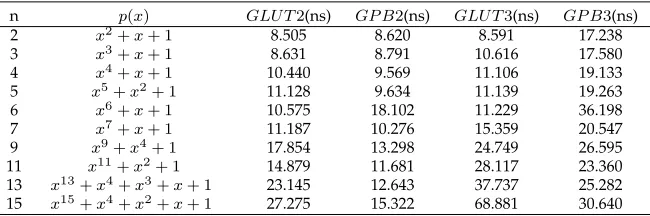
Table 3 depicts the performance of the proposed versatile multiplier when computing multiplica-tion of two elements with table look-up over
GF(2n)(GLU T2), multiplication of two elements with
polynomial basis over GF(2n)(GP B2),
multiplica-tion of three elements with table look-up over
GF(2n)(GLU T3) and multiplication of three elements
with polynomial basis over GF(2n)(GP B3)
respec-tively. An optimized irreducible polynomialp(x)over
GF(2n)is given for each field.
The comparison on the proposed multiplications overGF(2n)is given in Fig. 4, where(a)is the
com-parison of multiplication of two elements by invoking
GLU T2 and GP B2 and (b) is the comparison of multiplication of three elements by invoking GLU T3
and GP B3.
In Fig. 4, the horizontal axis is the value of nand the vertical axis is the value of the executing time (ns) of multiplication. The curves of the figure of the multiplication over GF(2n) show that multipli-cation with table look-up is faster than multiplimultipli-cation with polynomial basis when field size is small and multiplication with polynomial basis is faster than multiplication with table look-up when field size is large.
4.3 Implementation of Versatile Multiplier for
Computing Multiplication overGF((2n)2)
Table 4 depicts the performance of the proposed versatile multiplier when computing multiplica-tion of two elements with table look-up over
GF((2n)2)(LU T2), multiplication of two elements with polynomial basis over GF((2n)2)(P B2), multi-plication of three elements with table look-up over
GF((2n)2)(LU T3) and multiplication of three ele-ments with polynomial basis overGF((2n)2)(P B3) re-spectively. An optimized irreducible polynomialq(x)
overGF((2n)2)and an optimized irreducible
polyno-mialp(x)overGF(2n)are given for each field.
Example 4. By observing Table 4, if we chooseLU T2over
GF((22)2) to compute multiplication of three elements, 2×9.456ns is required. However, if we chooseLU T3over
GF((22)2) to compute multiplication of three elements,
10.229 ns is required. Since 2×9.456 > 10.229, LU T3
is faster thanLU T2 when computing multiplication over
GF((22)2)of three elements.
Example 5. When computing multiple multiplications of three elements and multiple multiplications of two ele-ments, e.g.
m−1
X
i=0 (
m−1
X
j=0
αijxixj) +
m−1
X
i=0 βixi,
we can useLU T3 and LU T2 respectively to perform the
computation.
If we only useLU T2,2m2+m multiplications of two
elements are required. If we only adopt LU T3, m2+m
multiplications are required. According to experimental results, if the computation is performed over GF((22)2),
the executing time by only using LU T2 is 9(2m2+m)
and the executing time by adoptingLU T3is10(m2+m).
Since m ≥ 1, 18m2+ 9m > 10m2+ 10m. It can be
observed that when performing the computation, adopting
LU T3 is faster.
Therefore, LU T3 and P B3 are faster than LU T2
and P B2 when computing multiplication over
GF((2n)2)of three elements.
The comparison on the proposed multiplications over GF((2n)2) is given in Fig. 5, where (c) is the comparison of multiplication of two elements by in-vokingLU T2 and P B2 and (d) is the comparison of multiplication of three elements by invoking LU T3
andP B3.
0 10 20 30 40 50 60 70 80
0 2 4 6 8 10 12 14 16
GLUT3 GPB3
0 5 10 15 20 25 30
0 2 4 6 8 10 12 14 16
GLUT2 GPB2
(a) (b)
Fig. 4. Comparison on the proposed multiplications overGF(2n).
TABLE 4
Executing Time of the Proposed Multiplications overGF((2n)2)
n p(x) q(x) LU T2(ns) P B2(ns) LU T3(ns) P B3(ns)
2 x2+x+ 1 x2+x+ 3 9.456 12.608 10.229 13.530
3 x3+x+ 1 x2+x+ 5 10.304 12.226 13.215 14.873
4 x4+x+ 1 x2+x+ 9 11.422 12.842 22.062 16.354
5 x5+x2+ 1 x2+x+ 8 15.072 13.792 16.653 17.706
6 x6+x+ 1 x2+x+ 33 14.535 14.698 21.234 20.425
7 x7+x+ 1 x2+x+ 113 15.563 14.689 21.698 20.989
9 x9+x4+ 1 x2+x+ 32 19.621 16.143 27.215 23.268
11 x11+x2+ 1 x2+x+ 1367 27.541 17.558 34.348 24.441
13 x13+x4+x3+x+ 1 x2+x+ 3085 30.133 19.125 36.794 27.642
15 x15+x4+x2+x+ 1 x2+x+ 16395 48.575 19.947 57.344 26.917
0 10 20 30 40 50 60
0 2 4 6 8 10 12 14 16
LUT2 PB2
0 10 20 30 40 50 60
0 2 4 6 8 10 12 14 16
LUT3 PB3
(d) (c)
Fig. 5. Comparison on the proposed multiplications overGF((2n)2).
multiplication with table look-up when field size is large.
4.4 Comparison of Versatile Multiplier for
Com-puting Multiplication over GF(2n) and
Multiplica-tion overGF((2n)2)
We compare the versatile multiplier for computing multiplication over GF(2n) and multiplication over
GF((2n)2).
Suppose GLU T2, GP B2, GLU T3 and GP B3 are performed overGF(2m)andLU T2,P B2,LU T3and
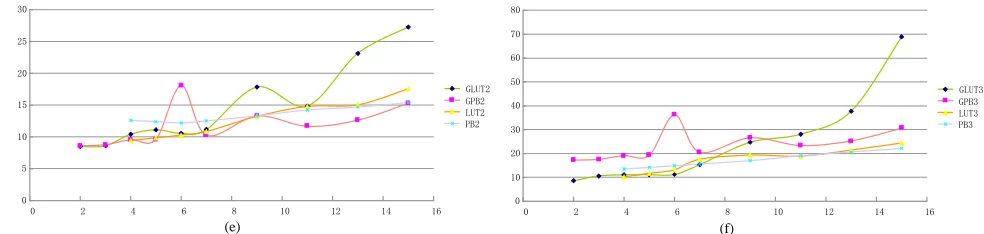
P B3are performed overGF((2(m/2))2). Therefore, the size ofGF((2(m/2))2)with composite field expression equals the size ofGF(2m)with finite field expression. The comparison on multiplications over GF(2m)
and GF((2(m/2))2)is given in Fig. 6, where(e)is the
comparison of the multiplications of two elements by invokingGLU T2,GP B2,LU T2andP B2respectively and (f) is the comparison of the multiplications of three elements by invoking GLU T3, GP B3, LU T3
andP B3 respectively.
In Fig. 6, the horizontal axis is the value ofm and the vertical axis is the value of the executing time (ns) of multiplication. The curves of the figure show that
LU T2andLU T3are faster thanGLU T2andGLU T3
0 5 10 15 20 25 30
0 2 4 6 8 10 12 14 16
GLUT2 GPB2 LUT2 PB2
0 10 20 30 40 50 60 70 80
0 2 4 6 8 10 12 14 16
GLUT3 GPB3 LUT3 PB3
(f) (e)
Fig. 6. Comparison on the proposed multiplications of two elements and three elements.
5
C
ONCLUSIONWe propose a versatile multi-input multiplier, which can compute multiplications of two elements and three elements over finite fieldsGF(2n)and compos-ite fields GF((2n)2) based on polynomial basis and
table look-up respectively. The parameters of the mul-tiplier can be changed according to the requirement of the users which makes the multiplier reusable in dif-ferent applications. The proposed versatile multiplier is very efficient for FPGA and VLSI implementation.
To the best of our knowledge, this is the first mul-tiplier with multiple inputs. We demonstrate the im-provement of our new designs mathematically. Then we implement the proposed multiplier on a FPGA and experimental results confirm our estimate.
The main characteristics of the proposed multiplier are presented as follows. First, when the field size is small, adopting multiplication with table look-up rather than polynomial basis is a better choice. Second, when the field size is large, adopting mul-tiplication with polynomial basis rather than table look-up is more efficient. Third, multiplication with polynomial basis is more efficient for finite fields and multiplication with table look-up is more efficient for composite fields. Fourth, when computing multiplica-tion of three elements, adopting three-input multiplier is more efficient than invoking two-input multiplier twice.
In addition, the proposed multiplier has a variety of applications, especially in cryptographic implemen-tations and solving mathematical problems. More-over, the proposed designs can be easily extended to
GF((2n)m).
Today’s modern processors, such as Intel’s and AMD’s, and graphic processors, such as NVIDIA’s and AMD/ATI’s, provide tremendous abilities for parallel computing. We believe our design can easily carry over to modern processors as well as graphic processors for software implementation and achieve a good performance for software implementation.
6
A
CKNOWLEDGEMENTThis paper is supported by the National Natu-ral Science Foundation of China under Grant No. U1135004 and 61170080, and Guangdong Province Universities and Colleges Pearl River Scholar Fund-ed Scheme (2011), and Guangzhou Metropolitan Sci-ence and Technology Planning Project under grant No. 2011J4300028, and High-level Talents Project of Guangdong Institutions of Higher Education (2012), and the Fundamental Research Funds for the Central Universities under Grant No. 2009Z-Z0035 and 2011ZG0015, and Guangdong Provin-cial Natural Science Foundation of under grant No. 9351064101000003.
R
EFERENCES[1] E. D. Mastrovito, “VLSI designs for multiplication over fi-nite fields GF(2m),” in Proceedings of the 6th International Conference, on Applied Algebra, Algebraic Algorithms and Error-Correcting Codes, 1989, pp. 297–309.
[2] G. Orlando and C. Paar, “A super-serial Galois fields multi-plier for FPGAs and its application to public-key algorithms,” inProceedings of the Seventh Annual IEEE Symposium on Field-Programmable Custom Computing Machines, ser. FCCM ’99, 1999, pp. 232–.
[3] H. Fan and M. A. Hasan, “Subquadratic computational com-plexity schemes for extended binary field multiplication using optimal normal bases,”IEEE Trans. Comput., vol. 56, pp. 1435– 1437, October 2007.
[4] c. K. Koc¸ and B. Sunar, “Low-complexity bit-parallel canonical and normal basis multipliers for a class of finite fields,”IEEE Trans. Comput., vol. 47, pp. 353–356, March 1998.
[5] H. Wu, M. A. Hasan, and I. F. Blake, “New low-complexity bit-parallel finite field multipliers using weakly dual bases,” IEEE Trans. Comput., vol. 47, pp. 1223–1234, November 1998. [6] S. T. J. Fenn, M. Benaissa, and D. Taylor, “GF(2m)
multipli-cation and division over the dual basis,”IEEE Trans. Comput., vol. 45, pp. 319–327, March 1996.
[7] C. Paar, “A new architecture for a parallel finite field multiplier with low complexity based on composite fields,”IEEE Trans. Comput., vol. 45, pp. 856–861, July 1996.
[8] S. Oh, C. H. Kim, J. Lim, and D. H. Cheon, “Efficient normal basis multipliers in composite fields,” IEEE Trans. Comput., vol. 49, pp. 1133–1138, October 2000.
[9] C. Paar, P. Fleischmann, and P. Roelse, “Efficient multiplier ar-chitectures for Galois fieldsGF((24)n),”IEEE Trans. Comput., vol. 47, pp. 162–170, February 1998.
[11] M. Mozaffari-Kermani and A. Reyhani-Masoleh, “A lightweight high-performance fault detection scheme for the advanced encryption standard using composite fields,” IEEE Trans. Very Large Scale Integr. Syst., vol. 19, pp. 85–91, January 2011.
[12] C. Paar and M. Rosner, “Comparison of arithmetic architec-tures for Reed-Solomon decoders in reconfigurable hardware,” inProceedings of the 5th IEEE Symposium on FPGA-Based Custom Computing Machines, 1997, pp. 219–.
[13] J. Ding and D. Schmidt, “Multivariate public key cryptosys-tems,”Advances in Information Security, 2006.
[14] ——, “Rainbow, a new multivariable polynomial signature scheme,” pp. 317–366, 2005.
[15] M. Allard, P. Grogan, and J. David, “A scalable architecture for multivariate polynomial evaluation on FPGA,” in Proc. 2009 International Conference on Reconfigurable Computing and FPGAs. IEEE, 2009, pp. 107–112.
[16] J. Rotg´e and J. Farret, “Universal solid 3D format for high performance urban simulation,” in Proc. 2007 Urban Remote Sensing Joint Event. IEEE, 2007, pp. 1–10.
[17] D. Schipani, M. Elia, and J. Rosenthal, “Efficient evaluations of polynomials over finite fields,” in Proc. 2011 Australian Communications Theory Workshop (AusCTW), Feb. 2011, pp. 154 –157.
[18] V. Strassen, “Gaussian elimination is not optimal,”Numerische Mathematik, vol. 13, no. 4, pp. 354–356, 1969.
[19] H. Hsieh, “Fill-in comparisons between Gauss-Jordan and Gaussian eliminations,” IEEE Trans. Circuits and Systems, vol. 21, no. 2, pp. 230 – 233, Mar. 1974.
[20] S. Kim, K. Ko, and S.-Y. Chung, “Incremental Gaussian elim-ination decoding of raptor codes over BEC,”IEEE Communi-cations Letters, vol. 12, no. 4, pp. 307 –309, Apr. 2008. [21] M. Atif and A. Rauf, “Efficient implementation of Gaussian
elimination method to recover generator polynomials of con-volutional codes,” inProc. International Conference on Emerging Technologies (ICET), Oct. 2009, pp. 153 –156.
[22] C. Hou, X. Guo, and G. Wang, “Cluster based routing scheme for distributed regression in wireless sensor networks: Gaus-sian eliminations,” inProc. 10th IEEE International Conference on High Performance Computing and Communications (HPCC), Sep. 2008, pp. 813 –818.