Composable Security Analysis of OS Services
Ran Canetti2, Suresh Chari1, Shai Halevi1, Birgit Pfitzmann1, Arnab Roy1, Michael Steiner1, and Wietse Venema1
1
IBM T.J. Watson Research Center⋆
2 Tel-Aviv University⋆⋆
Abstract. We provide an analytical framework for basic integrity properties of file systems, namely the binding of files to filenames and writing capabilities. A salient feature of our modeling and analysis is that it is composable: In spite of the fact that we analyze the filesystem in isolation, security is guaranteed even when the file system operates as a component within an arbitrary, and potentially adversarial system.
Our results are obtained by adapting the Universally Composable (UC) security framework to the analysis of software systems. Originally developed for cryptographic protocols, the UC framework allows the analysis of simple components in isolation, and provides assurance that these components maintain their behavior when combined in a large system, potentially under adversarial conditions.
1
Introduction
Contemporary software systems are complex, consisting of many millions of lines of code, spread across a myriad of components and sub-components. A natural approach for analyzing such large systems is by analyzing each component separately, and “hoping” to use the component-wise analysis to analyze the entire system. Unfortunately, applying this approach to security analysis is problematic. Even if a component is simple enough to analyze separately, its interaction with other components can yield unexpected results. Often, a component will be used in environments different from what its designers initially had in mind, alongside other components that perhaps did not even exist when the original component was analyzed, potentially violating some assumptions that were made in the analysis.
Ideally, we would like to analyze the behavior of a component in isolation, and have the assurance that this behavior remains intacteven when that component is embedded in a new environment.Within the realm of cryptography, the frameworks of Reactive Simulatability [19, 1] and Universal Composability (UC) [4, 5] ensure just that. These frameworks are aimed at capturing the security of cryptographic primitives and protocols, ranging from authentication and key exchange, to public-key encryption and signatures, zero-knowledge, and more (see [5] for many examples.) However, many of the features of these frameworks appear at first to be specific to the realm of cryptographic protocols. A natural question is whether the “composable security” approach sketched above can be carried out in a meaningful way even outside the limited domain of cryptography. In particular:
Can we obtain meaningful composable security in the context of general software systems?
A positive answer could significantly reduce the overhead in analyzing the security of large systems, while at the same time provide better overall security guarantees.
In this work we demonstrate that this can indeed be done, in the context of guaranteeing some basic integrity properties of filesystems. For this purpose we adapt the UC framework to software systems by establishing new conventions for modeling process management and scheduling. The current work is one of just a few attempts to apply the UC formalism to a large and complex software system, and we believe that it will enable further application of the UC formalism to other software systems.
⋆
This work is supported in part by the Department of Homeland Security under the grant FA8750-08-2-0091. ⋆⋆ Research supported by the Check Point Institute for Information Security. Part of this work was done when visiting
Analysis in the UC framework proceeds by defining an idealized specification model and an implementa-tion, and then proving that the implementation realizes the idealized specification. Our main contribution is a very simple filesystem specification model, called SimpFS, that captures many integrity concerns in contemporary filesystems, together with an implementation over existing POSIX filesystems [20] and a proof that the implementation realizes the specification model.
The composability properties of our analysis imply that software systems that use our implementation over POSIX behave essentially the same as if they were using the simple, idealized specification system
SimpFS.
This is a very strong security guarantee. In particular, it allows analyzing software systems without worrying about how the filesystem is implemented, and without worrying about potential bad interactions between the analyzed system and the filesystem implementation.
Our filesystem model is geared toward ensuring integrity of files and their names, and in particular preventing filename manipulation attacks. In such attacks, a victim program expects a particular filename to have certain semantics. (E.g., a mail program may expect the file/var/mail/rootto be the mail file for the super-user.) In the attack, the adversary creates a link by the same name in the filesystem, pointing to another file (e.g.,/var/mail/root -> /etc/passwd), thereby “tricking” the victim program into accessing an unexpected file. (In the mail example, such a link may cause a naive mail program to write incoming email into the system’s password file.) Such attacks were quite common in UNIX systems of old. Since creating links to files often takes lower permissions than accessing these files, this form of attack sometimes allows an attacker to leverage the permissions of a privileged victim program to read or write files that the attacker cannot access on its own.
Our implementation builds on the ideas presented in Chari et al. [7], who address the problem of privilege escalation attacks via filename manipulation. To counter these attacks, Chari et al. present a “safe” name resolution procedure, and deploy this system-wide on popular POSIX systems. The SimpFSinterfaces are designed to tightly bind files with their names: files can be accessed only via the names they were created with, which means that filename manipulation attacks are impossible in our model. Our proof — showing that implementation based on [7] realizes the model — implies in particular that it indeed eliminates these filename manipulation attacks.
SimpFS offers a simple interface that captures enough filesystem primitives for application developers to build meaningful applications. The simplicity of SimpFS is due to its very narrow interface (only four commands) and the fact that it does not have directories. We argue that the murky relation between files and their names in plain POSIX systems stem to a large extent from the fact that pathnames consist of many directories, each with its own permissions, which are combined in a non-obvious manner to yield the effective permissions for the entire name. In contrast, a filename in SimpFS is just a single entity with explicitly specified permissions. ThusSimpFSprovide applications with radically simplified semantics, making it easier to use the filesystem without falling into traps. At the same time, we argue that the vast majority of contemporary applications in POSIX systems do not really need directories, and can be implemented over the simpleSimpFSinterface without loss of functionality.
1.1 Related Work
Triggered by Joshi and Holzmann’s mini-challenge [13], there is a lot of recent work on formalization and verifications of file systems. Most notably, Freitas et al [10] specify and prove a POSIX file store in Z/Eves. This body of work focuses mostly on the correctness aspects and does not address in depth the security and access control aspects of filesystems. In the broader perspective of (secure) operating systems, there is a long history of formalization and verification, from PSOS [16] to the recent seL4 [14]. While they make considerable progress toward high-assurance OS, these works are not based on frameworks that allow easy composition of components to form larger systems. Additionally, the focus in many of these works is on mandatory access control whereas we cover a discretionary control. (We stress that although our model addresses integrity concerns, these are very different from the Biba integrity model [3].)
An abstract model of another large standard systems, the browser, suitable for proofs of cryptographic protocols exists in [12]. It includes a model of information-flow properties under attack. However, the federated identity protocols built on top of it have only been proven secure with respect to specific security properties, not in a real-world / ideal-world setting [12].
Protocol Composition Logic (PCL) [8] is a comparable general approach on reasoning about (crypto-graphic) network protocols in a composable fashion. Recently, PCL was applied to analyze systems [9], more specifically integrity properties provided by TPM. The symbolic and axiomatic nature of PCL leads to a more axiomatic specification of security rather than the declarative form in UC. Furthermore, the composition theorems in PCL are weaker than in the UC framework.
A noteworthy contribution to secure composition of large systems is the CHATS project [17], that iden-tifies architectural principles to guide the structuring and decomposition of trustworthy systems. That work is largely orthogonal to ours, as it does not focus on formal modeling or proofs.
There have been many more attempts to leverage well-established formalisms such as logic, typing or process calculi to model composability of certain system security properties, e.g., McLean [15] for non-interference properties or Bengtson et al [2] for cryptographic protocols and access control mechanisms. Many of them provide tool support; but they do not provide the same composition guarantees as in the UC framework.
2
The Universal Composability Framework
We briefly describe the relevant aspects of the framework of universally composable (UC) security. The reader is referred to [4] for more details. The framework describes two probabilistic games: The real world
that captures the protocol flows and the capabilities of an attacker, and theideal world that captures what we think of as a secure system. The notion of security asserts that these two worlds are essentially equivalent. The real-world model.The players in the real-world model are all the entities of interest in the system (e.g., the nodes in a network, the processes in a software system, etc.), as well as the adversary A and the environment Z. All these players are modeled as efficient, probabilistic, message-driven programs (formally, they are all interactive Turing machines).
The actions in this game should capture all the interfaces that the various participants can utilize in an actual deployment of this component in the real world. In particular, the capabilities ofAshould capture all the interfaces that a real-life attacker can utilize in an attack on the system. (For example,Acan typically see and modify network traffic.) The environmentZ is responsible for providing all the inputs to the players and getting all the outputs back from them. Also,Z is in general allowed to communicate with the adversaryA. (This captures potential interactions where higher-level protocols may leak things to the adversary, etc.) The ideal-world model.Security in the UC framework is specified via an “ideal functionality” (usually denotedF), which is thought of as a piece of code to be run by a completely trusted entity in the ideal world. The specification ofF codifies the security properties of the component at hand. Formally, the ideal-world model has the same environment as the real-world model, but we pretend that there is a completely trusted party (called “the functionality”), which is performing all the tasks that are required of the protocol. In the ideal world, participants just give their inputs to the functionalityF, which produces the correct outputs (based on the specification) and hands them back to the participants. F may interact with an adversary, but only to the extent that the intended security allows. (E.g., it can “leak” to the adversary things that should be publicly available, such as public keys.) Specifying the code ofF is typically a non-trivial task. It is important thatF satisfies all the desired security properties, but also thatF does not impose unnecessary constraints: It is only too easy to write a functionality that describes “what we intuitively want”, but is not realizable by any implementation.3Another crucial concern is thesimplicityof the functionalityF, since we wantF to capture the important security concerns, not the mundane implementation details.
3
UC-Security and the Composition Theorem.An implementationπsecurely realizesan ideal func-tionality F if no external environment can distinguish between running the protocol π in the real world and interacting with the trusted entity running the ideal functionality F in the ideal world. That is, for every adversary A in the real world, there should exist an adversary A′ in the ideal world, such that no environmentZ can distinguish between interacting withAand πin the real world and interacting withA′ andF in the ideal world.
The striking feature of the UC framework is its ability to handle composition. Specifically, the composition theorem from [4] asserts the following: Let ρbe an arbitrary system that runs in the ideal world and uses (perhaps multiple copies of) the functionality F. Next, consider the systemρ′ in the real world, that is the same asρexcept that inρ′each call to the ideal functionalityFis replaced by executing the implementationπ. Then, if πsecurely realizes F it is guaranteed that systemρ′ behaves essentially the same as system ρ. In particular, all the security properties of ρare inherited by protocol ρ′. This guarantee is the basis for the composable security guarantees provided by the UC framework.
2.1 Conventions for Software systems
We briefly describe some technicalities that must be resolved when attempting to apply the UC framework to software system, and the conventions that we use to address them. The “entities of interest” in our work are processes, which differ somewhat from the interactive Turing machines (ITMs) in common cryptographic models. One aspect relates to side-channels: whereas an ITM can only influence other ITMs by sending messages, a process shares some physical resources with other processes on the same machine, so it could influence them via side channels such as timing and concurrency. In this work we ignore that aspect, i.e. we do not have any side channels in our formal model. (This does not matter for our current SimpFSmodel, since we do not model any secrecy requirements.) We thus just let the adversary learn “whatever it needs,” so it has no use for side channels.
A more important difference is preemptive multitasking: common crypto models postulate a sequential scheduling model, where an active ITM keeps the control until it sends a message, at which point the re-cipient becomes active. On the other hand, processes in contemporary OSes can be made to yield control involuntarily. Resolving this discrepancy is not as hard as it may seem, since (side-channels aside) an active entity has no effect on its surroundings until it sends a message, which means that influencing the surround-ings only comes with losing the control. We use the standard sequential scheduling of the UC framework, but ensure that the adversary gets the control after every message is sent, and can decide when this message will be delivered. (This is somewhat similar to the “buffer scheduler” from [1].) Hence the adversary in our formal model is able to simulate the actions that would have happened in the actual deployed system, delay delivery messages until the simulation arrives at the point where they were delivered. We thus argue that the formal adversary in our model is able to induce any behavior that can happen in the actual deployed system.
Another difference is that some processing in real systems is done not by the processes themselves, but by the kernel on their behalf. Hence also in our model we postulate the existence of a “kernel component” that can do things on behalf of processes. In our filesystem example, this kernel component is only responsible for maintaining the process privileges: Whenever a process calls a filesystem function, the kernel adds the process-id and roles of the calling process to the list of arguments, and forwards everything to the filesystem. (The kernel component gets these roles from the environment.) We note that although we do not use it in our filesystem example, in general we could have several such “kernel components” in a system, representing several physical machines.
3
SimpFS: A Simple Idealized File-System
This section describesSimpFS, our simple filesystem model.SimpFShas a minimalistic interface with simple semantics, having only basic primitives to create, read, write and delete files. Still, we believe that the this file-system functionality is sufficient for most applications. (Other aspects — such as locking — can be
implemented on top of our interface.) The SimpFS model includes file write permissions, hence capturing properties offilesystem integrity. We currently do not model read permissions, but we expect that this work can be extended to include read permissions without too much change.
An important feature of SimpFS is that it does not have any directories, only files and their names.
As we mention in the introduction, we believe that directories have “inherently cumbersome semantics”, hence decided to do away with them in order to keep the semantics as simple as possible. We stress that the model supports names that include ‘/’ (so applications can still store their temporary data in files with names that begin with “/tmp/”). But a name such as “/a/b/foo” is viewed as just one entity, and its existence does not imply the existence of an object with name “/a/b.” Of course, ourimplementation over POSIX still interprets ‘/’ as a directory separator, and name creation induces the right associations between names and paths, in spite of symlinks, adversarial write permissions etc. While directories are a useful and convenient way to manage and organize systems, we argue that directory permissions are very rarely needed in applications (if ever), and most applications can therefore directly use theSimpFSinterface.
A key security property of SimpFS is that it rules out filename manipulation attacks. Our focus on this property is motivated by the large number of privilege escalation attacks due to unsafe pathname resolution that were discovered in POSIX systems over the years. A classical example of this type of attacks is local mail delivery, where /var/mailmay be world-writable, allowing an adversary to create a link from /var/mail/rootto (say)/etc/passwd, thereby “tricking” a naive mail-delivery program (running asroot) to write the content of incoming mail into/etc/passwd. Such attacks arise due to the opaque mapping of names to files in POSIX.SimpFSfeatures a very tight binding between files and their names: a file can be manipulatedonlywith the names it was created with.
We describe an implementation of SimpFS over contemporary POSIX filesystems andrigorously prove
that this implementation realizesSimpFS, using the UC framework. The proof implies that processes that use our implementation will be protected against pathname manipulation attacks such as above even if adversarial processes use the same POSIX filesystem in arbitrary ways.
3.1 A formal model of SimpFS
SimpFSconsists of files and their names. A newly created file is given some names, and thereafter the file can be accessed by any of these names. Existing names can be deleted, but one cannot add names to existing files. When deleting names, a file can end up with zero names, in which case it is not reachable anymore so we can consider it as deleted. We associate permissions with both the file names and the files themselves:
– Every file has a list of roles that can write in it, called theWriterslist. A process can write to a file if it holds a role in the Writers list of the file.
– File names have a set ofManipulators, listing all the roles that have permission to delete that name. In the current version we do not have read permissions, which means that SimpFSallows every process to read every file.
In more details, our idealSimpFSmaintains an array of files and an associative array of names:files[] is an array of files (indexed by integers). Each entry is a file, consisting of an array of bytes (i.e., a data blob) and a list of roles (specifying the Writers of this file). names[] is an associative array (indexed by strings). We refer to the index of an entry as a file-name, and each entry consists of a pointer to a file (i.e., an integer) and a list of roles (specifying the Manipulators of this name). The interface below constrains the Manipulator lists, making sure that all the names of the same file have the same set of Manipulators. (This choice is not very important, it is done mostly to simplify the presentation.)
In the initial state, the file-system is empty, with no files and no names (i.e., both arrays are empty). There are only four operations that are supported in SimpFS: CreateFile creates a new file with some names, DeleteName deletes an existing name, Read reads data from a file (specified by some name), and Writewrites data to a file (specified by some name).
CreateFile(Writers, Manipulators, Names, pid, Roles) {
// Allow the adversary to fail the operation and decide the error code
var retCode = AdversaryAction("CreateFile",Writers,Manipulators,Names,pid,Roles); if (retCode != OKAY) return retCode;
var codes[] = empty; // a local list of return codes, one per name var f = index of next available entry in the files[] array;
files[f].data=empty, files[f].Writers=Writers;
// Allow the adversary to decide whether to create each name for each fName in Names {
var code = AdversaryAction("CreateOneName", fName); if (code!=OKAY) codes[i]=code;
else {
if (names[fName] already exists) codes[i] = FILE_EXISTS; else {
names[fName].file=f, names[fName].Manipulators=Manipulators; codes[i]=OKAY;
} } }
call AdversaryAction("Done CreateFile") and then return codes; }
DeleteName(fName, pid, Roles) {
// Allow the adversary to fail the operation and decide the error code var retCode = AdversaryAction("DeleteName",fName,pid,Roles);
if (retCode != OKAY) return retCode;
if (names[fName] does not exist) return FILE_DOESNT_EXIST;
if (Roles intersect names[fName].Manipulators = emptyset) return NO_PERMISSION;
delete names[fName]; // Note: no point deleting the file, even if not reachable call AdversaryAction("Done DeleteName") and then return OKAY;
}
Write(fName, atAddr, data, pid, Roles) {
// Allow the adversary to fail the operation
var retCode = AdversaryAction("OpenWrite",fName,pid,Roles); if (retCode != OKAY) return retCode;
if (names[fName] does not exist) return FILE_DOESNT_EXIST;
var f = names[fName].file; // f serves as a "handle" to the file if (Roles intersect files[f].Writers = emptyset) return NO_PERMISSION;
var numBytes = AdversaryAction("Write",fName,atAddr,data,pid,Roles);
if (numBytes < length(data)) truncate data to numBytes bytes; // only partial write
var nBytes = length(data);
if (atAddr < 0) atAddr = length(files[f].data); // append else if (atAddr > length(files[f].data)) {
prepend (atAddr-length(files[f].data)) zero bytes to data; atAddr = length(files[f].data);
}
write data to files[f].data starting at position atAddr; call AdversaryAction("Done Write") and then return [OKAY,nBytes]; }
Read(fName, fromAddr, nBytes, pid, Roles) {
// Allow the adversary to fail the operation or read less bytes
var [retCode,numBytes] = AdversaryAction("Read",fName,fromAddr,nBytes,pid,Roles); if (retCode != OKAY) return retCode;
if (numBytes < nBytes) nBytes = numBytes;
if (names[fName] does not exist) return FILE_DOESNT_EXIST; var f = names[fName].file;
if (fromAddr < 0) fromAddr = 0;
else if (fromAddr > length(files[f].data)) { fromAddr = length(files[f].data);
nBytes = 0; }
if (nBytes < 0) // read to end-of-file nBytes = length(files[f].data) - fromAddr;
data = content of files[f].data from fromAddr for nBytes;
call AdversaryAction("Done Read") and then return [OKAY,nBytes,data]; }
legitimate users of the system, but also all the interfaces that an adversary can utilize to attack it. This is codified by anAdversaryActioncall, in whichSimpFS“leaks” to the adversary the details of its operation, and also lets the adversary influence these operations.
A key feature of SimpFSis that a file can be accessed onlyusing one of the names that were specified when the file was created, thus eliminating filename-manipulation attacks such as described above. Hence proving that an implementation realizesSimpFSimplies in particular that such attacks cannot be successfully mounted against the implementation.
We make no liveness guarantees inSimpFS, so at the beginning of every operation the adversary is given the option to abort the operation and determine the error code. (This does not mean that an implementation ofSimpFScannot ensure some liveness properties, but it means that a proof that an implementation realizes SimpFScarries no such guarantees within itself.)
The pseudo-code includes with every call also the process-id and permissions (Roles) of the caller, which in our system model are filled by the kernel component, cf. Figure 2. (Formally there is also an implicit “invocation id” for each call of one of the four main operations, allowing SimpFS to handle messages received from the ideal-world adversary for different invocations.) Note also that theAdversaryAction at the beginning and end of every operation comply with our convention that the adversary gets the control before any message is delivered. Finally, we note that all the variables in the code in Figure 1 are local to that invocation, except for the globalfiles[]andnames[].
Process corruption. Following the standard conventions of the UC framework, SimpFS has a special procedure to handle the case where the adversary corrupts a process. For our purposes it is more convenient to let the environment decide when a process is corrupted (as opposed to the adversary, which is the more common convention in UC-model works). When the environment corrupts a process, this process makes a callIamCorrupted(pid,Roles), to informSimpFSthat “it belongs to the adversary” now.SimpFSinforms the adversary of this call, and it remembers that this process and all its roles are now bad. Thereafter, the adversary is allowed to make all the usual calls toSimpFS(CreateFile,DeleteName,Read,Write) on behalf of that process.SimpFS will process these calls just as if it was the corrupted process that made the call, but will return the result to the adversary rather than to the environment.
Every call from the corrupted process (not via the adversary) will be routed directly to the adversary, and the adversary can always instructSimpFSto send anything to the corrupted process (which will then be forwarded to the environment). Also, if the roles of the corrupted players change then the kernel component will notify SimpFS of this change.SimpFS will add any new role that a corrupted process acquires to its list of bad roles, butit will not remove any roles from that list, even if the corrupted process loses some of its roles. (This last aspect represents the fact that the corrupted process may already have used this role to introduce artifacts into the filesystem, that will remain even after the process no longer has this role.) Atomicity of the SimpFS operations. The operations DeleteName and Read are atomic, whereas CreateFile and Write are not: In DeleteName and Read, once the adversary allows the operation to go through (by returning OKAY), SimpFS holds onto the control-flow throughout the name lookup and the operation itself, and only then it yields control back to the adversary.
In Write, on the other hand, the control is returned to the adversary after the file lookup (via the call AdversaryAction("Write", ...)), and only then is the operation carried out. Similarly inCreateFile, the adversary gets the control before the creation of any name. This choice was made so that we would be able to realize SimpFS over the POSIX interface that requires to open the file and then write in it. The real-world read can be made atomic by checking after the fact that the file did not change since it was opened, but for write such a check is meaningless since the file was already written. (See also the attack in Section 4.5 for another reason for the check after read.)
role inclusion. (For example, if a file is not owner-readable then the owner cannot read it, even if the file is readable by “others”.) Adjusting the mapping to this technicality is quite straightforward, and is omitted here.
4
Implementing SimpFS over POSIX
We describesimpfs, which is a concrete implementation of theSimpFSfunctionality over the POSIX filesys-tem interface [20]. The presentation below focuses on a user-space implementation, where each simpfs op-eration runs with the effective uid of its caller, but we point out that the same procedures can also be implemented in the kernel. (See Figures 2 and 3 for illustrations of the system model in both cases.)
Our implementation relies on the “safe pathname resolution” procedure of Chari et al. [7], that protects processes from opening adversarial links. While resolving paths this procedure ensures that an adversary can not manipulate the resolution to result in opening unintended components. Insimpfs, very roughly speaking, each operation consists of first using that procedure to open the corresponding file and then performing the actual operation.
Before describing this implementation, we first introduce concepts that are used in the rest of the paper and describe some assumptions that we make on the POSIX filesystems underlying our implementation. Then in Section 4.2 we describe thesafeDirOpen procedure, which is the heart of our implementation and builds on [7], and then in Section 4.3 we describe the rest of the implementation.
4.1 Concepts and Properties of POSIX
We assume that the reader is familiar with basic concepts of POSIX such as directories, pathnames, users and groups, hardlinks and symlinks, etc.
Definition 1 (Pathname Manipulators). Let /dir1/.../dirn/foobe an absolute pathname. The ma-nipulatorsof this pathname are all the roles (users and groups) that own, or have write permissions in, any directory visited during the resolution of this pathname.
Note that the definition applies even when a pathname does not resolve, and thatrootis a manipulator of every pathname.
Definition 2 (Safe Names). A pathname is system safe if its only manipulator is root. A pathname is
safe forU (whereU is a user-id) if its only manipulators arerootandU. Otherwise, the pathname is unsafe forU.
For example, in a typical UNIX system the pathname /etc/passwd is system safe, the pathname /home/joe/mbox is safe for user joe, and the pathname /var/spool/mail/jane is unsafe for everyone (as/var/spool/mailmay be world- or group-writable).
Definition 3 (Simple Pathnames). A pathname is simple if it is an absolute path that resolves to a regular file, its elements are only hard links (i.e., not symbolic links), no elements are named ‘.’ or ‘..’, and the pathname contains no repeated slashes ‘//’.
Assumptions. We now list some properties that we assume on the underlying POSIX system, and use in our proof of security. Most of these assumptions are justified either by the fact that they are part of the POSIX specification itself, or by the fact that many contemporary POSIX filesystems seem to satisfy them. Assumption 1 The underlying filesystem does not contain multiple mount points to the same filesystem, and each directory has only one parent (i.e., one hard link with a name other than ‘.’ or ‘..’).
Justification. Assumption 1 is justified by the fact that nearly all contemporary POSIX implementations either do not allow processes to create additional hard links to directories (e.g., FreeBSD, Linux) or restrict this operation to the super-user (e.g., Solaris, HP-UX). A notable exception is MacOS.
We observe that given Assumption 1, for every reachable hard link to a regular file there is a unique simple name that ends with that hard link. Moreover a resolution of any absolute name that ends with that hard link will visit all the directories in this unique simple pathname.
Assumption 2 (Permissions) 1.If an operation by a process affects the content of a file, then the process must have write permission for that file. 2. Let P be an absolute pathname. If an operation by a process affects the resolution ofP or changes the permissions or ownership of any of the directories visited during its resolution, then that process must have a role which is a manipulator ofP.
Justification.The only operations that affect pathname resolution are creating, removing, or renaming path-name components, and they all require write permission in the containing directory. Also, note that only the owner of a directory (orroot) can change the permissions of that directory, and in most systems only root can change ownership.
Corollary 1. LetPbe some pathname, denote byM(P)the set of manipulators forP (user-ids and groups), and let B be a set of roles such that M(P)∩ B ̸= ∅. Then changing the manipulator set for P so that
M(P)∩ B=∅ requires an operation by a process with some role outside ofB.
Proof. The only operations that change the manipulator-set of a pathname are changing the permissions or ownership of some visited directory, or moving, renaming, or removing some visited directory, symlink, or the last hardlink.
Denote by op the first system call after which the manipulator-set of of P is disjoint from B. Denote byM′(P), M′′(P) the manipulator set of P just before and just after the system call op, respectively, so M′(P)∩ B ̸=M′′(P)∩ B =∅. Sinceop changes the manipulator set ofP, it must have succeeded, hence
the calling process must have had some roleR∗ with sufficient privileges for performingop.
Assume toward contradiction that the calling process has only roles inB, and thusR∗∈ B. SinceR∗has sufficient privileges for one of the manipulator-changing operations then by Assumption 2R∗∈ M′(P). We now have three cases: eitheropischown(soR∗ isroothence it remains a manipulator), orop ischmod(so R∗ is the owner of the directory so it remains the owner), oropis any other manipulator-changing operation soR∗ is a writer in the containing directory and it remains so after the operation. In each caseR∗ remains a manipulator,R∗∈ M′′(P)∩ B, henceM′′(P)∩ B ̸=∅.
Assumption 3 The hardlink to a directory in its parent directory can only be removed when the child directory is empty. Moreover, after the hardlink is removed from the parent directory, no further entries can be created in the child directory, even if some process still holds a handle to it.
Justification.The last part of Assumption 3 is justified by the fact thatrmdirimplementations remove the entries ‘.’ and ‘..’ from the child directory before removing the hard link in the parent directory, and no new entries can be created in directories without ‘.’ and ‘..’ .
Corollary 2. If a system call for creating an entry in a directory returns successfully, then the hard link for this directory in its parent directory could not have been removed before that system call, or removed after the call but before the newly-created entry is removed.
4.2 The safeDirOpen procedure
Underlying our simpfs implementation is a procedure forsafe name resolution, which is adapted from the work of Chari et al. [7]. OursafeDirOpenprocedure takes an absolute pathname, resolves it “in a safe manner” and returns a handle to the directory containing the final hard link to the actual file, the name of that hard link, and additional information as discussed below. The top-level operations of simpfsfirst callsafeDirOpen and then perform the requested operation on the final hard link.
safeDirOpenresolves a pathname one atom at a time, each time opening the next atom (or reading it, if it is a symlink), while keeping track of the owners and writers of the visited directories. (Below we identify the time that a directory was visited as the time when it was opened, and the time that a symlink was visited with the time that it was read.)
visiting a directory whereU is an owner or writer, and switching to unsafe state upon visiting a directory with any writer or owner other thanroot orU. Once in unsafe state it stays in that state for the duration of the current name resolution. Likewise, there is no transition from safe-for-uid to the system-safe state.
When safeDirOpenenters the unsafe state, it does not follow symlinks for the remainder of the current name resolution. Also, for technical reasons the procedure never accepts pathnames that contain multiple slashes ‘//’ or have components named ‘.’ or ‘..’, and it refuses to visit any directory whose name begins with the special prefix SimpFS ephemeral . In any of these cases, the procedure returns an error code.
OncesafeDirOpenarrives at the final atom (and verifies that it is indeed the final atom and not a symlink), it ends successfully, returning a handle to the directory containing this last hard link, as well as the name of the hard link. In addition,safeDirOpenreturns its current state (system-safe, safe-for-uid, or unsafe), the set of owners and writers of the directories that it visited, and an array of (handle,name) pairs, containing handles to all visited directories, and the names that were looked-up in those directories. (These names could belong to either a directory, a symlink, or the final hard link.)
Upon failure, safeDirOpen returns an error code, a handle to the last directory pathname component that was successfully resolved, the state (system-safe, etc.) and manipulators of that directory, and the unresolved remainder of the pathname. For example, when called to resolve /a/b/c, if it encountered an error after visiting /a but before visiting/a/b, then it will return a handle to directory /a, the state and manipulators of/a, and the remainder of the pathname argument “b/c”. (Note that this will be the return value even if /a/b happens to be a symlink and the procedure visited more directories after/a, but could not completely resolve/a/b.)
4.3 Implementing the simpfscommands
createFile(Writers,Manipulators,Names). When called by a process with effective-uid U, the procedure begins by checking that U belongs to the set of manipulators specified by the Manipulators parameter. Then it creates a new file with an ephemeral name that begins with the special prefix SimpFS ephemeral . This ephemeral name is created so that it is safe for U, thus ensuring that no other users can remove or rename it.4
NowcreateFileattempts to set the write permissions of the new file as specified in theWritersparameter. If this is successful, it proceeds to create the names, one at a time, by calling the subroutinecreateOneName for each name inNames. After all the calls tocreateOneName, the procedurecreateFileremoves the ephemeral name that it created for the new file, and returns the vector of return codes that it received from all the calls tocreateOneName.
The subroutinecreateOneName(fName) begins by checking that the new name is an absolute name, and that it does not contain ‘//’ or elements named ‘.’ or ‘..’, or elements that begin with SimpFS ephemeral . Then it callssafeDirOpen(fName) thus obtaining a handle to the last successfully resolved directory on this pathname and the corresponding set of manipulators. If all the directories were resolved successfully, then createOneNamechecks that the set of manipulators equals theManipulatorsparameter, and aborts if they differ.
If some directories were not resolved, createOneName verifies that the manipulator set of the prefix is not too large (i.e., it must be contained in the Manipulators parameter), aborting otherwise. Then createOneNameattempts to create the remaining directories, one at the time, initially creating each one so that it is only writable by owner U with an ephemeral name that begins with SimpFS ephemeral . Upon success, it tries to set the write permissions of the last directory so that the resulting set of manipulators will match theManipulatorsparameter. Then it goes over all the newly created directories, top to bottom, renaming each one to the name that it is supposed to have according tofName.
Once all the directories exist and have the right set of manipulators and the right names, the procedure createOneName makes alinkatsystem call to create a hard link in the last directory, pointing to the new file.createOneNamethen returns whatever code was returned from thelinkatsystem call.
4
See Section 4.5 for a short discussion of this point.
If any operation fails, then createOneName attempts to clean-up after itself, trying to remove all the directories that still have names that begin with SimpFS ephemeral . However, after a directory was renamed to its “permanent name”,createOneNamedoes not remove it.
In the proof of security in Section 5 we rely on the following properties of our implementation of createFile: – The initial ephemeral name for the new file is safe for the effective-uid of the calling process.
– The procedure never creates symlinks, only directories and hard links.
– The procedure only changes permissions and/or removes pathname components if these components begin with the special prefix SimpFS ephemeral .
– A name fName is created if and only if thelinkat system call at the end of the subroutine createOne-Name(fName) is successful.
deleteName(fName). When called with effective-uidU,deleteNamecallssafeDirOpen(fName) and aborts if that function fails. Else deleteNamehas an array of pairs (handle,name), and the state with which safeDirOpen arrived at the final directory (system-safe, safe-for-uid, or unsafe). If the state is not system-safe, then deleteNamechecks that the final directory is either world-writable, or owner-writable and owned byU, and it aborts otherwise.5Also, if the state is unsafe thendeleteNamechecks that the file that the hard link points to has only a single hard link, aborting otherwise.
Then deleteName attempts to delete the final hard link, followed by attempts to delete the directories higher-up on the path. deleteName returns when any system call to remove a name fails, or when any of these names resolves to a symlink, or when it is done deleting all the names in the array. The return code from deleteNameis whatever was returned from the first unlinksystem call (i.e., the one that deleted the hard link at the end of fName).
We note that barring a race condition, this implementation of deleteNamedoes not delete symlinks. In the proof in Section 5 we show that the only cases where these race conditions are possible are when the adversary already has permissions to delete these symlinks by itself.
read(fName,...). When called with effective-uidU,readcallssafeDirOpen(fName) to get a handle for the final directory, the name of the hard link pointing to the actual file, and the state at which it arrived in this last directory: system-safe, safe-for-uid, or unsafe. Then readusesopenat, lstatatand fstat to open the file and verify that it is still the same file (and not a symlink). In addition, if the state is not system-safe, then readchecks that the file is either world-readable, or owner-readable and owned byU, and it aborts otherwise. Also, if the state is unsafe thenreadchecks that the file has only a single hard link, aborting otherwise.
Then the procedure uses the read system call to read the file, and before closing the file it makes yet anotherlstatatsystem call to check that the hard link still points to the same inode as it did when it was opened. (See Section 4.5 for the reason for this last test.) If all these checks pass, thenreadreturns the result from thereadsystem call.
write(fName,...). The procedurewriteis almost identical toread except that it adds a write-permission check on the actual file, and it does not do the final check after writing to verify that the hard link still points to the same inode. (Indeed, such check is useless since the file was already written to.)
4.4 Consistency properties of the implementation
In the proof of security in Section 5, it is important to consider what changes may happen in the filesystem between the time that thesafeDirOpenpathname resolver visits some directory and the time that the proce-dure that calledsafeDirOpenreturns. An important technical observation is that if the procedure that called safeDirOpenwas successful then none of those visited directories could have been removed during this time. Lemma 4. Consider an execution of one of the procedures createOneName, deleteName, read, or write on argumentfName, and assume that the procedure succeeds (i.e., does not return an error code). Assume further that no symlink that was read during name resolution was later deleted or renamed during the execution of
5
this procedure, and no directory was renamed after it wasopened by this procedure. Then also none of these directories was deleted after it was opened and before the time that the procedure issued the system call (respectively, linkat,unlinkatoropenat) for the final hard link infName.
Moreover, for the procedures createOneName,read, and write, as long as no symlinks are deleted or re-named, no directories are rere-named, and the final hard link infNameexists in its original containing directory, then also none of these directories is deleted even after the operation returns.
Proof. Assume not, and consider the first directory that was deleted after it was opened. There are two cases to consider: this directory was deleted either before or after name resolution visited the next pathname component (i.e., symlink read, directory or fileopened).
By Assumption 3, the directory could not have been deleted before the next component was accessed, else the subsequent access would have failed. But it also could not have been deleted after the next pathname component was visited, since the directory must have been non-empty: If the next pathname component is a symlink then this follows from our assumption that symlinks were not removed or renamed, if it is a directory then it follows from our assumption that directories were not renamed and the fact that we consider the first directory to be removed, and if it is the final hard link then it follows from our assumption that it still exists in its containing directory.
Jumping ahead, we use Lemma 4 in the proof by noting that ourSimpFSimplementation never renames or removes symlinks, or renames directories, and hence no uncorrupted process will do any of these things. If in addition we know that no corrupted process has write permissions in any of the directories visited then also corrupted processes could not rename or remove symlinks or rename directories. Thus, we can apply Lemma 4 and conclude that all the directories stay put throughout the execution of createOneName, deleteName,read, orwrite.
4.5 Rationale and Discussion
Before proceeding to the formal proof of security, we discuss here some of the rationale for our implementation, including some specific attacks that the implementation was designed to foil.
Privilege-escalation attacks on setgid programs Our implementation of safeDirOpenonly considers the effective-uid for the purpose of determining the safety of a directory, and thus we must consider the possibility of privilege-escalation attacks between processes with the same effective-uid. In contemporary UNIX systems, two processes with the same effective-uid can have different filesystem privileges only if one of them has a group-privilege that the other does not,6 as would happen when one of these processes runs a setgidprogram.
To see the problem, consider two processes running with effective-uid of joe, one having the additional group privilege of mail while the other is compromised by an attacker (e.g., due to a buffer-overflow vul-nerability). Ideally, we would like to argue that files which have read/write permissions for themail group (but not userjoe) are still protected against the compromised process.
Assume that the non-compromised process withmailgroup privileges needs to delete a file/home/joe/dir/foo. The compromised process can create a symlink/home/joe/dir -> /var/mail, “tricking” the other process into deleting/var/mail/foo(assuming that/var/mail/is writable by groupmail). Embedding this attack in our formal model, we have a name/var/mail/foofor whichjoeisnot a manipulator, and a good process that attempts to delete an unrelated name /home/joe/dir/foo, and yet by some action of a compromised process withjoeprivileges, this results in the deletion of/var/mail/foo.
We fix this problem by adding a check to the operations deleteName, read, and write, aborting if the name is not system-safe and group privileges are needed to perform the operation. Very roughly, this defense works because it prevents the use of group privileges after following symlinks that were created by non-root processes. (We note that we do not need this extra precaution increateOneName. This is because theSimpFS functionality restricts deletion of existing names, but puts no restrictions on the creation of names that do not exist.)
6
We ignore thefsuidof Linux here.
An attack on open-then-read programs To understand the need for another check of the final hard link after a read system call in a read operation, we describe the following potential attack: Consider the three programssshdthat needs to read the file/etc/passwd,passwdthat replaces the file/etc/passwdby a new file upon successful edit, and the MTA local delivery that needs to write into/var/mail/root. The passwdprogram runs withrootprivileges, because it is asetuid-root program, and the MTA local delivery runs with root privileges in order to append to the /var/mail/root mailbox file. Also, assume that the directory/var/mailis world writable and that initially/var/mail/rootdoes not exist. The attack consists of the following sequence of steps:
1. The attacker creates ahard link /var/mail/root, pointing to the same file as/etc/passwd.
2. The attacker opens a newsshconnection, causingsshdtoopenthe file/etc/passwordfor read. (Note that since /etc/passwd is a system-safe name, the open will succeed even if there are multiple hard links.) At this point the attack relies on the sshdprocess to be switched out and remain inactive until Step 5 below.
3. The attacker then uses thepasswdcommand to change its password, thereby causing the old/etc/passwd file to be replaced by a new file. (Note that the hard link/var/mail/rootis now the only hard link still pointing to the old/etc/passwd file, and that thesshdprocess still holds a handle to that file.) 4. The attacker sends email toroot@localhost, causing the MTA local delivery to append the content of
that message to /var/mail/root.
5. Thesshdprocess is now switched in again and reads from its handle to the old/etc/passwdfile, thereby reading also the data that was written there by the MTA delivery agent.
To thwart this attack, we added the lstatat check between reading and closing the file, verifying that the hard link still points to the same file. We stress that it is possible to switch the link back and forth to foil this extra test, but it is sufficient for the purpose of our simpfsimplementation. Non-adversarial processes will never attempt such a back-and-forth switch, and adversarial processes either do not have the privileges needed to foil the test, or else they have sufficient privileges to manipulate the file directly. (Our proof relies on this extra test in the analysis of thereadoperation on Page 19.)
Our treatment of symbolic links Our proof of security in the full version Section 5 relies in places on the assumption that good processes do not create symlinks. This is consistent with our simpfsimplementation (that indeed does not create symlinks), but it begs the question why we allowsafeDirOpento follow symlinks at all.
The reason is that the implementation of simpfsis useful also in situations where the filesystem includes non-adversarial symlinks. A close inspection of our proof shows that the arguments remain valid also in the presence of non-adversarial symlinks, as long as the files that have non-adversarial symlinks in their names remain static (i.e., they are not deleted, removed, or moved). It is even possible to modify the semantics of SimpFSto accommodate non-adversarial symlinks in a dynamic filesystem, but the new semantics will not be as simple anymore.
Using the sticky bit Recall that the initial ephemeral name for a new file must be safe for the effective-uid of the calling process (denotedU). Such a name can perhaps be created in U’s home directory, but not all uid’s have one. A simple way of achieving the same result in contemporary UNIX systems is creating this ephemeral name in/tmp, relying on the fact that/tmpis owned byrootand has the sticky bit on. This does not quite fit into our definition of “safe forU” (since/tmp is world-writable), but it suffices for the purpose of our proof of security. Specifically, what we need is to ensure that as long as the calling process holds a handle to the new file, onlyU orrootcan change the resolution of the ephemeral name.
5
Proof of Security
and relies on an incorruptible kernel component that handles process permissions; see Figure 2. Essentially the same proof shows that thesimpfsprocedures realize theSimpFSfunctionality when implemented in the kernel (in which case permissions are handled by the environment, cf. Figure 3).
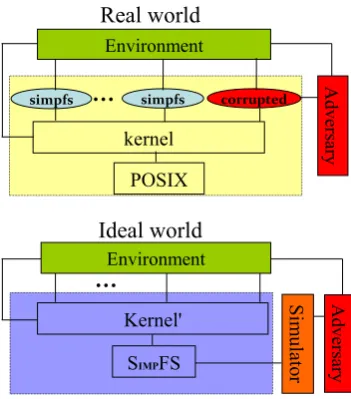
Fig. 2.The real and ideal worlds for a user-level implementation of simpfs. The kernel components that keep track of privileges are formally considered to be parts of the implementation and the ideal functionality.
Fig. 3.The real and ideal worlds for a kernel implementation ofsimpfs. In this setting, process privileges are handled by the environment.
Theorem 1. Oursimpfs implementation realizes the SimpFSfunctionality over the POSIX interface, pro-vided that the underlying POSIX system satisfies Assumptions 1 through 3.
To prove Theorem 1 we show that there exists an ideal-world simulator S such that for every real-world adversaryA, no environmentZ can distinguish the behavior of the real world withAfrom that of the ideal world with S and A. We first define a few concepts that will be important in the proof, then define the simulatorS, and finally prove the indistinguishability.
5.1 Useful Concepts
The simulated real world. As usual, our simulatorS interacts with the adversary A, and it needs to simulate a complete picture of the real world as would be seen by thisAand the environment Z. Note that
S knows all the calls made byAto the underlying POSIX system. Also, the simulator knows the details of all the calls made by the legitimate players to theSimpFSfunctionality (by virtue of theAdversaryAction calls made bySimpFS). Hence S can simulate the corresponding real-world implementation for these calls, keeping a complete picture of the real-world POSIX system as it would exist in the real world at any point in time. Below we call this POSIX system that the simulator keeps thesimulated real world.
Bad roles. Recall that the association between processes and roles (such as userid and groups) is not
one-to-one. This raises the possibility that some roles are held by both corrupted and uncorrupted processes at the same time, and similarly a process can have both “good” and “bad” roles.7 To handle these cases we introduce the following definition.
Definition 4 (Bad roles).At any point in a run of the system, the setBof bad roles contains all the roles that were held by a corrupt process since the start of this run. The other roles are called good roles.
Clearly, the set Bis monotonically growing throughout the run of the system. The simulator can make calls toSimpFSusing any role inB, as per our process corruption interface.
Protected names and files.Throughout the simulation, some of the names in the simulated real world also exist in the SimpFS functionality, while the others exist for the most part only “in the simulator’s head.” Intuitively, the former are the protected names while the latter are unprotected. The formal notions of protected names (and also files) are defined next.
Definition 5 (Protected Names). An absolute pathname fName that resolves to a regular file in the simulated real world at a given point in time is protected if no bad role in B is a manipulator for fName. Pathnames that resolve to regular files but are not protected are called unprotected.
Definition 6 (Protected Files). A file that exists in the simulated real world is protected if no bad role inB has permission to write in it. Otherwise it is unprotected.
Unprotected names and files can exist only after some processes were corrupted. Also, a system-safe pathname is protected if and only if noroot process was corrupted, and a pathname which is safe forU is protected if and only if noroot orU processes were corrupted.
Note also that protected names must be created by uncorrupted processes, since no corrupted process has the permission to create them. This means that protected names can only be either the names that were specified as arguments tocreateFile, or the temporary names with special prefix SimpFS ephemeral that are used inside the procedurecreateFile. Below we refer to the latter asephemeral:
Definition 7 (Ephemeral Names).A pathname in the simulated real world is called ephemeral if any of the pathname components begins with the prefix SimpFS ephemeral .
5.2 The Simulator
The simulator’s strategy is to keep in the SimpFS functionality only protected names, while it simulates the unprotected names internally. When a player tries to access such an unprotected name, the simulator temporarily creates a file with that name inSimpFSby making aCreateFilecall on behalf of a corrupted process. The simulator then allows the main operation to succeed and return an answer, and then deletes that temporary name using aDeleteNamecall on behalf of the same corrupted process.
In a few more details, when the simulator is informed bySimpFSthat some process invoked an operation (CreateFile,DeleteName,Read,Write), it simulates the corresponding procedure of thesimpfs implemen-tation (including any interleaving events). For DeleteName and Read it returns OKAY if the procedure succeeds, for CreateFile it returns the first OKAY once the temporary file is created and set with right permissions and then returns OKAY for each name for which thelinksystem call succeeded. For Writeit
7
returns the first OKAY when the procedureopen’s the file, and then again when the procedure successfully write’s to the file. In all cases, if the procedure in the simulated real world fails, the simulator returns the same error code.
For DeleteName, Read, and Write, before returning OKAY the simulator ensures that a file with the corresponding name exists in theSimpFS functionality. If this name is an unprotected, the simulator first creates a temporary file with this name inSimpFSand writes into it the content that it has in the simulated real world. The simulator also puts these temporary names in a list of names to-be-deleted, and deletes them from SimpFSas soon as it gets back the control. Similarly for CreateFile, if a successful createOneName creates an unprotected name then the simulator puts that name on its to-be-deleted list and deletes it from SimpFSonce it gets back the control.
When receiving a Done Write call from SimpFS, the simulator goes over all the protected file names, looking for names for which the content of the corresponding file in the simulated real world differs from that in theSimpFSfunctionality. If the file isunprotected (i.e., the simulator has permissions to write in it) then the simulator makes a Writecall to set the content of the file in the SimpFS functionality to match that of the simulated real world.
Process corruption.When the simulator learns from SimpFSthat a process is corrupted, it goes over all the file names that exist inSimpFS, and deletes each name that the newly corrupted process can delete fromSimpFS, using a call on behalf of that process. The simulator also remembers that this process is now corrupted.
Modifications of files with protected names.When a corrupted process modifies the content of a file that has a protected name in the simulated real world, the simulator makes aWritecall to theSimpFS functionality on behalf of the same process, setting the content of the corresponding file insideSimpFS to match that of the simulated real world.
5.3 Proof of correctness
We show that with the simulator defined above, the view of the environment in the ideal and real worlds is identical. As we noted above, it is sufficient to argue about the simulated real world vs. the SimpFS functionality. We now prove a sequence of lemmas relating the names that exist in the simulated real world to those that exist in theSimpFSfunctionality.
Lemma 5. Every protected name that exists in the simulated real world is either ephemeral or also exists in the SimpFS functionality.
Proof. Recall that protected names must be created by uncorrupted processes, since corrupted processes do not have permission to write in the directories containing them. As per our implementation, the only names of regular files that are created by uncorrupted processes are either the names that are specified as parameter increateFileor ephemeral names. As to the former, they are created via a successfullinksystem call in createOneName, at which point the simulator returns OKAY to the SimpFSfunctionality, which in turn then creates the name (if it does not already exist).
Below we say that the a particular link (hard or symbolic) that exists in the simulated real worldremains unchanged during some time interval if it is not removed or renamed in its containing directory, and its permissions and ownership remained the same. A pathname remains unchanged if all the directories, links and filenames that are accessed during resolution of this pathname remain unchanged.
Lemma 6. Every namefNamethat exists in the SimpFSfunctionality and no corrupted process has permis-sion to delete it, also exists in the simulated real world and is protected. Moreover,fNameremained unchanged since it was last created in the simulated real world.
Proof. Fix any file namefNamethat satisfies the premise of the lemma. This cannot be temporary a name on the to-be-deleted list, since those can be deleted by corrupted processes. Thus the last time when it was
created inSimpFSwas after a successful link system call increateOneName, during aCreateFile call by an uncorrupted process. (AlsofNameis not ephemeral, since our implementation ofcreateOneNamedoes not create ephemeral names for regular files.)
LetMbe the set of manipulators forfNamein theSimpFSfunctionality, so by the premise of the lemma M ∩ B = ∅. Also, M was the manipulator-set specified in the CreateFile call to SimpFS when fName was created. Recall now that the subroutine createOneName keeps track of all the owners/writers in all the directories that it visits, and only issues the final link system call if that set equals M. Denote the directories visited during name resolution (in order) bydir1,dir2,...,dirn and the final filename byfoo. Since M ∩ B =∅ then set of writers/owners in those directories at the time wherecreateOneName visited them was disjoint ofB. We next show that all these directories (and also the final file) remained unchanged sincecreateOneNamevisited them, thus completing the proof.
First, we claim that at the time of creation,fNamewas a simple pathname. ThatfNamedoes not include ‘.’ or ‘..’ or ‘//’ follows since createOneName does not create names that include any of them. Also, uncorrupted processes in our implementation never create symbolic links, so symbolic links can only be created in directories that are writable by some role in B. This means that none of the directories diri contained symbolic links when the name-resolution visited them during createOneName, so in particular all the pathname components visited (or created) bycreateOneName(except the finalfoo) were directories. Once these directories were visited, they were not moved (since only corrupted processes can move directories but none of them had permission to do so), hence by Lemma 4 they also not removed before the hard link foowas created. Hence also at the time thatfoowas created, the pathnamefNamewas simple.
Next, assume toward contradiction that one of the directoriesdiri(orfoo) was modified or erased since it was visited bycreateOneName, and consider the first of them that was modified or erased. By Assumption 2, the caller owned or had write permission in the parent directory at the time of the change. Since the set of owners/manipulators is disjoint ofB, it means that the process that first modified/erased that pathname component must have been uncorrupted.
In our implementation, system calls that modify permissions are used by uncorrupted processes only on ephemeral names, whichfName is not. Therefore the first modification had to be a removal of a pathname component (by an uncorrupted process). Invoking Lemma 4 again, we know that none of the directories can be removed, thus the first pathname element to be deleted has to be the hard linkfooitself. Note also that hard links to files are only deleted by uncorrupted processes during a successfulDeleteNamecall toSimpFS. Denote the pathname argument to the successfulDeleteName call that deleted fooby fName2, and we argue that fName2 must be the same as fName. Clearly, fName2 cannot include ‘.’ or ‘..’ or ‘//’ since safeDirOpen does not allow these. Also, recall that the deleteName procedure was run by a process that had permissions to delete the hard linkfoo, so it must have a different effective-uid from all the corrupted processes. Since only the adversary creates symlinks, then symlinks must reside in directories that are unsafe for the effective-uid of that process, hence safeDirOpenwill not follow them. Therefore safeDirOpen encountered only hard links (to directories) as it resolved the namefName2.
We now argue that these directories must have been the same dir1,dir2,...,dirn as in fName, and moreover at the time of deletion the hard-link must have been calledfoo(as in fName). For fooitself, we already established above that the first modification to it since it was created was the time it was removed. Hence at the time of deletion it must have been calledfoo and must have resided at deletion in the same directory in which is was created.
Summing up, we had an uncorrupted player who made a successful call DeleteName(fName) to the SimpFSfunctionality. But this means thatfName no longer exists inSimpFS, which is a contradiction. Lemma 7. At any point in time, two non-ephemeral protected names resolve to the same file in the simulated real world if and only if they belong to the same file in the SimpFS functionality.
Proof. Fix any two non-ephemeral protected names that exist at some point in time in the simulated real world. By Lemma 5 they also exist in theSimpFSfunctionality. For each name, we look at theCreateFile call when it was lastcreated in the SimpFS functionality, which was after the link system call returned successfully in the respective simulatedcreateOneName subroutine.
If both createOneName subroutines were part of the same createFile procedure then they were created pointing to the same ephemeral filename, and since they are protected then also the ephemeral name was protected, which means that it was not deleted between the twolinksystem calls. Hence they were created pointing to the same file. On the other hand, if the two subroutines were part of two different runs ofcreateFile then they were created pointing to different files. By Lemma 6, the two pathnames remained unchanged since they were created. Hence, they still resolve to the same file if they were created in the same CreateFile call to the SimpFS functionality (and hence belong to the same file inSimpFS), and they still resolve to different files if they were created in twoCreateFilecalls (and hence belong to different files inSimpFS). Lemma 8. Consider a callWrite(fName,...)from an uncorrupted process that returnsOKAY, and consider the state of the simulated real world at the time when the open system call in the implementation returns a handle to the final hard link. If at that timefName is unprotected, but there exists a protected name that resolves to the same file, then the file itself is unprotected (i.e., there is some role in B with permission to write in it).
Proof. If anyroot process is corrupted then all files and names are unprotected and we are done. Assume from now on that noroot process is corrupted. It follows that when the lastopensystem call returned, the namefNamewas not system-safe (else it would have been protected), so the Write procedure did not open fName in a system-safe mode. LetU denote the effective-uid of the calling process. The same argument as above shows that if noU process was corrupted (when theopensystem-call returned), theWriteprocedure could not have opened fNamein a safe-for-U mode. Hence the only two cases that we need to consider are that someU process was corrupted, or thatsafe-openopenedfNamein unsafe mode.
In the former case, recall thatfNamewas not opened in system-safe mode, so aWritecould only succeed when the file is either world-writable or owned by U (and writable by owner). Either way the file is not protected (since it can be written by the corruptedU process). It is left to show that the latter case (where the file was opened in unsafe mode and noU process is corrupted) cannot happen.
Since the file had a protected name it also had a simple protected name, which we denote fName2 = /dir1/.../dirn/foo. The hard linkfoomust also be the last hard link infName, as opening a file in unsafe mode would fail if the file has multiple hard links. Finally, the resolution offNamecould not have encountered directories unsafe for U before merging into the simple path fName2, else it would fail. But since no U or root process is corrupted, all these directories were still safe for U when the open system call returned, hencefNamewas protected, which is a contradiction.
Lemma 9. The view of the environment is identical in the real and ideal worlds.
Proof. We need to show that the answers that the environment sees when interacting withsimpfsover POSIX and the adversaryA are identical to what it sees from theSimpFSfunctionality with the simulatorS and the sameA. Below we will argue about the simulated real world, since it is an exact replica of the real world. From the description of the simulator, it is clear than whenever the implementation of some call returns an error code then the environment will see the same error code in the ideal world (since this is what the simulator returns toSimpFS). Also, it is clear that the results of all the calls that haveunprotected names
as arguments must be the same, since the simulator always creates the corresponding files inSimpFSon the fly to ensure this.