(will be inserted by the editor)
Practical Complexity Differential Cryptanalysis and Fault
Analysis of AES
Michael Tunstall
the date of receipt and acceptance should be inserted later
Abstract This paper presents a survey of practical complexity differential cryptanalysis of AES and com-pares this to attacks that have been proposed for differ-ential fault analysis. Naturally, the attacks in each vein of research are applicable in the other but use different models. In this paper we draw from both topics to im-prove attacks proposed in the literature. We re-evaluate the so-called Square attack and the use of impossible differentials in terms of differential fault analysis using a weaker model than previously considered in the liter-ature. Furthermore, we propose two new attacks appli-cable to both differential cryptanalysis and differential fault analysis. The first is a differential cryptanalysis of four-round AES based on a differential that occurs with a non-negligible probability. The second is an ap-plication of the Square attack to a five-round AES that requires 28 ciphertexts and a time complexity
equiva-lent to approximately 237.5 AES encryptions.
Keywords Differential Cryptanalysis · Advanced Encryption Standard·Differential Fault Analysis
1 Introduction
The Advanced Encryption Standard (AES) [14] was standardized in 2001 from a proposal by Daemen and Rijmen [9, 10]. It has since been analyzed with regard to numerous attacks ranging from purely theoretical cryptanalysis to attacks that require some extra infor-mation, from some side channel for example [19], to succeed. In this paper we present a survey of differ-ential cryptanalysis of AES and present improvements
Department of Computer Science, University of Bristol, Merchant Venturers Building, Woodland Road, Bristol BS8 1UB, United Kingdom.
E-mail: [email protected]
where possible, and contrast this with differential fault analysis.
Differential cryptanalysis analyses pairs of plaintexts and seeks to exploit how the difference between these plaintexts propagates through a block cipher. Typically, reduced round variants of block ciphers are analyzed, since analyzing an entire modern block cipher is typi-cally computationally infeasible. Differential fault anal-ysis uses similar techniques to analyze differences in-duced in an instance of a block cipher. These differ-ences are typically considered to be induced by a fault in the computation provoked by an attacker. The mech-anisms for inducing faults into a microprocessor range from light [24] to glitches in the signals supplied to a microprocessor [3].
In this paper we give a summary of key recovery at-tacks on reduced round variants of AES and how these apply to differential fault analysis. In our analysis we define an attack to be practical, rather than purely the-oretical, if it requires an effort equivalent to less than 256AES encryptions as proposed by Biryukov et al. [5].
To this end we describe attacks using the chosen plain-text model, and further define a chosen difference model that corresponds to faults being injected in the compu-tation of a block cipher a certain number of rounds before the end of a block cipher. We define a differen-tial cryptanalysis of a four-round variant of AES, that is valid in both models.
effort required to conduct an attack and provide a new version of the Square attack applied to a five-round AES.
We do not consider attacks that have been designed to attack more than five rounds, and thus have a high complexity, such as the meet-in-the-middle attacks [11] and impossible differential attacks [7, 17] that have been proposed to attack reduced round variants of AES.
The organization of this paper is as follows. In Sec-tion 2 we define the notaSec-tion and operaSec-tions that we will use in this paper to describe AES. In Section 3 we define a model for an attacker, and describe some ob-servations concerning AES that we will refer to later in Section 4. We describe attacks based on differential cryptanalysis and the square attack in Sections 5 and 6 respectively. These attacks are summarized in Section 7, and we conclude in Section 8.
2 Preliminaries
In this paper, multiplications are considered to be poly-nomial multiplications overF28 modulo the irreducible polynomialx8+x4+x3+x+ 1. It should be clear from
the context when a mathematical expression contains integer multiplication.
2.1 The Advanced Encryption Standard
Algorithm 1:The AES-128 encryption function.
Input: The 128-bit plaintext blockP and keyK.
Output: The 128-bit ciphertext blockC.
1 X←AddRoundKey(P, K)
2 fori←1to10do
3 X←SubBytes(X)
4 X←ShiftRows(X)
5 ifi6= 10then
6 X←MixColumns(X)
7 end
8 K←KeySchedule(K, i)
9 X←AddRoundKey(X, K)
10 end
11 C←X
12 returnC
The structure of the Advanced Encryption Standard (AES) , as used to perform encryption, is illustrated in Algorithm 1. Note that we restrict ourselves to con-sidering AES-128 and that in discussing the AES we consider that all variables are arranged in a 4×4 array of bytes, known as the state matrix. For example the
128-bit plaintext P = (p1, p2, . . . , p16)(256) is arranged
as follows:
p1p5 p9 p13
p2p6 p10p14
p3p7 p11p15
p4p8 p12p16
The encryption itself is conducted by the repeated use of a round function that comprises the following oper-ations executed in sequence:
The SubBytesoperation is the only nonlinear step of the block cipher, consisting of a substitution table ap-plied to each byte of the state. This replaces each byte of the state matrix by its multiplicative inverse, fol-lowed by an affine mapping. Thus the input bytex is related to the outputybyy=A x−1+B, whereAand
Bare constant matrices. In the remainder of this paper we will refer to the functionSas this substitution table andS−1 as its inverse.
TheShiftRowsoperation is a byte-wise permutation of the state that operates on each row.
TheKeySchedule operation generates the next round key from the previous one. The first round key is the input key with no changes, subsequent round keys are generated using the functionS, defined above, and XOR operations. The round counter is required as a differ-ent constant (RCON) is used each time the operation is instantiated.
The MixColumns operation operates on the state col-umn by colcol-umn. Each colcol-umn of the state matrix is considered as a vector where each of its four elements belong to F(28). A 4×4 matrixM whose elements are
also in F(28) is used to map this column into a new
vector. This operation is applied to the four columns of the state matrix. Here M and its inverse M−1 are
defined as
M =
2 3 1 1 1 2 3 1 1 1 2 3 3 1 1 2
and M−1=
14 11 13 9 9 14 11 13 13 9 14 11 11 13 9 14
.
All the elements inM andM−1 are elements ofF(28)
expressed in decimal.
TheAddRoundKeyoperation XORs each byte of the ar-ray with a byte from a corresponding subkey.
3 Attack Model and Complexity
3.1 Attack Model
In the remainder of this paper we detail some low com-plexity attacks on a reduced round AES. We use two models to describe our attacks:
1. Chosen Plaintext Model — This is one of the typical scenarios used in the differential cryptanaly-sis of a block cipher. An attacker is able to encipher arbitrary plaintexts under a fixed unknown key and obtain the ciphertext. The practicality of an attack is influenced by the number of chosen plaintexts re-quired to conduct a given attack. The time com-plexity of attacks in this model is considered to the number of enciphering operations, or equivalent, of the algorithm under attack.
2. Chosen Difference Model— In this case an at-tacker is able to encipher two related but unknown plaintexts. That is, an attacker is able to encipher two plaintexts with a chosen difference. Note that this does not mean that the exact difference can be chosen by an attacker, but that the number and po-sition of bytes that have a non-zero difference can be chosen. The practicality of the attack is influenced by the number of pairs of ciphertexts required that are produced by plaintexts produced with a differ-ence of a known size. The time complexity of at-tacks in this model is considered to the number of enciphering operations, or equivalent, of a full 10-round AES. We also assume that the attacker has access to an oracle that can be used to test whether a given key hypothesis is correct. A justification for this model is given below in Section 3.3.
In the following sections we consider how attacks can be mounted on a reduced round version of AES, and we as-sume that the last round does not contain aMixColumns function as in the full AES. This is important to note since it has been shown that the lack of a MixColumns function does have a negative impact on the security of AES [12]. Indeed, many of the attacks described in the paper would have a substantially higher complex-ity if theMixColumns function was included in the last round.
3.2 Attack Complexity
In the models defined above there are two things that dictate the complexity of the attack. The first is the number of observations (either plaintext-ciphertext pairs or ciphertext pairs) that need to be acquired by an at-tacker. In the chosen plaintext model this can be consid-ered to be straightforward. However, in the chosen
dif-ference model acquiring a ciphertext pair requires a cer-tain amount of effort. Typically, this involves obcer-taining one ciphertext by enciphering an arbitrary plaintext, and then obtaining a faulty ciphertext by enciphering the same plaintext while injecting a fault in the de-vice under attack. This typically takes a considerable amount of time when compared to a standard PC im-plementation, since fault attacks are usually considered to be limited to resource constrained devices such as smart cards. A more significant problem is that each fault injection will stress a device and will, with a cer-tain probability, render it inoperable. An attacker will therefore seek to minimize the number of fault injec-tions required to conduct an attack. We do not define a strict upper limit to the number of acquisitions since this will vary considerably for different fault injection mechanisms.
The second is computational complexity of the anal-ysis required to derive the secret key. Biryukov et al. define the upper bound of such an attack to be the ef-fort equivalent to computing 256 AES operations [5]. They cite the computation of 255 DES operations
sev-eral years ago and the unsuccessful collision finding ef-fort on SHA-1 that was expected to require 261 opera-tions.
3.3 On the Chosen Difference Model
In describing fault attacks one typically uses an attack model where an attacker is able to affect a single byte during the computation of AES. There are numerous examples in the literature of fault attacks where a byte has been modified allowing an implementation of AES to be broken. Typically, these are examples of an attack proposed by Piret and Quisquater [23] that is described in Section 5.2. An example of an attack that produces a modification on chosen bytes is only likely to be possible in certain circumstances. For example, Ali et al. [1] de-scribe a fault that affects a diagonal line across the state matrix (as required by one of the attacks described in Section 5.4). However, no details are given on why this could be produced are given, and one has to assume that the effect is implementation specific.
opcode on a given microprocessor that allows very spe-cific attacks to be defined [2]. The intention behind this model is to thoroughly evaluate the generic case rather than use a weak model requiring that attacks on specific effects are designed on anad hocbasis.
4 Observations
In this section we describe some observations on the structure of AES that we will refer to in later sections.
Observation 1:Given a differential between two val-uesx,y, wherex6=yand the non-zero XOR difference between these values isx⊕y=α. For a knownβ there will exist a certain number of values for xand y that will satisfyS(x)⊕S(y) =β. For a random differencesα, β there will be four solutions with a probability 1/256, two solutions with a probability 126/256 and zero solu-tions with a probability 129/256. This is a well-known result and the basis for all differential cryptanalysis of AES.
Observation 2:We considery=M xfor
y=
y1
y2
y3
y4
, x=
x1
x2
x3
x4
where eachxiandyj, fori, j∈ {1,2,3,4}, is an element in F28 and M is defined above in Section 2. Given any four bytes from
{y1, y2, y3, y4, x1, x2, x3, x4},
the remaining four can be computed. Trivially, we know this is also true if we consider the differentials, since, if y=M xandy0=M x0 theny⊕y0 =M(x⊕x0). This
is equivalent to the fact that the words (x, y) form an MDS code.
Observation 3:Again, we considery=M xfor
y=
y1
y2
y3
y4
, x=
x1
x2
x3
x4
where eachxiandyj, fori, j∈ {1,2,3,4}, is an element in F28 andM is defined above in Section 2. The num-ber of bytes in y that are zero given a certain number of bytes of xare equal to zero can be counted for all possible inputs. This gives a probability of observing the number of output bytes set to zero (n) given the number of input bytes that are set to zero (m), given n, m∈ {0,1,2,3,4}, and are tabulated in Table 1.
5 Differential Cryptanalysis
In this section we describe attacks based on differen-tial cryptanalysis. We describe attacks based on other properties of AES in the next section.
5.1 Analyzing One-Round AES
It has been demonstrated by Bouillaguet et al. [6] that one known plaintext-ciphertext pair can enable an at-tacker to mount an attack by inspection that requires an exhaustive search of 240. This attack functions by guessing 40 bits of one subkey and, combined with the knowledge of the plaintext and ciphertext, deducing a possible key. For brevity, we do not consider this form of attack since it is only applicable to very few rounds. Moreover, a straightforward attack is widely known where two plaintext-ciphertext pairs are avail-able, and is described here for completeness.
5.1.1 Chosen Difference
If an attacker is only able to determine the amount of bytes that are different between two plaintexts there is no information to exploit since the difference is un-known.
5.1.2 Chosen Plaintext
An attacker defines two plaintexts where the XOR dif-ference between the two plaintexts is not zero for any byte. One can then look at the which bytes of the last subkey can produce the observed difference in the two input plaintexts. This will give 216 hypotheses for the
last subkey. Bouillaguet et al. note that the number of hypotheses can be further reduced if bytes of the first subkey are generated independently and verified. This reduces the time complexity of an attack from 216
en-cryptions to 212 applications of theSubBytesfunction
to individual bytes [6].
5.2 Analyzing Two-Round AES
5.2.1 Chosen Difference
Table 1 Given a number of differentials in bytes on input to theMixColumnsfunction the probability of this affecting a given number of output bytes is shown.
No of Affected Bytes Out(0) Out(1) Out(2) Out(3) Out(4)
In(0) 1 0 0 0 0
In(1) 0 0 0 0 1
In(2) 0 0 0 4
255 ≈
1
26
251 255
In(3) 0 0 2
12675 ≈
1
213.4
1004
65025 ≈
1
26
12803 13005
In(4) 0 4
16581375≈
1
222
502
5527125 ≈
1
213.4
51212
3316275 ≈
1
26
3264761 3316275
Plaintext
θ1θ2θ3θ4
0 0 0 0 0 0 0 0 0 0 0 0
→
First Round
2α2β2γ2δ
3α3β3γ3δ
α β γ δ α β γ δ
→
Ciphertext
x1 x5 x9 x13
x2 x6x10 x14
x3 x7x11 x15
x4 x8x12 x16
Fig. 1 Propagation of a four-byte difference across two rounds of AES.
An attacker can verify key hypotheses on the last subkey in groups of four bytes by checking that hy-potheses will produce the differences caused by the (un-known) values{α, β, γ, δ}[23]. An attacker can conduct an exhaustive search on the last subkey in four groups of 28 hypotheses, and this will reduce the key
hypothe-ses for the last subkey to 232 for the reasons noted in
Observation 1.
5.2.2 Chosen Plaintext
Attacking a two round AES with chosen plaintexts has the same start as the attack under the chosen differ-ence model. However, an attacker has more information given that the plaintexts are known and some of the 232
hypotheses can be eliminated.
If we consider Figure 1, we knowθi, fori∈ {1,2,3,4}, and the corresponding plaintexts. Given Observation 1 we can note that α, β, γ, δ will each have 27 possible
values rather than 28considered in the previous attack.
This means that an attacker would be able to reduce the key hypotheses to 228[6].
In both cases the same analysis can be conducted if an attacker changes bytes at indexes {2,6,10,14}, {3,7,11,15} or {4,8,12,16}, i.e., one row of the state matrix.
5.3 Analyzing Three-Round AES
5.3.1 Chosen Difference
If an attacker sets a difference in one byte of the plain-texts it will propagate as shown in Figure 2. In this example an attacker has a difference in the plaintexts at index 1.
As with the attack on two rounds described above, an attacker can verify key hypotheses on the last subkey in groups of four bytes by checking that hypotheses will produce the differences caused by {α, β, γ, δ}. Again, this will reduce the key hypotheses for last subkey to 232 [23] for the reasons noted in Observation 1.
This analysis can be continued by verifying which key values also produce the differences {2θ,3θ, θ, θ} shown in Figure 2. This will reduce the number of key hypotheses for the last subkey to 28 [25]. This will
re-quire 232operations consisting of oneSubBytes
opera-tion and a quarter ofMixColumns operation. If we es-timate this to equate to the effort required to compute a third of a round of AES, the time complexity of the attack will be 232· 1
3· 1 10 ≈2
27.
5.3.2 Chosen Plaintext
Attacking a three round AES with chosen plaintexts has the same start as the attack described above for the chosen difference model. As for the attack on two round AES, an attacker has more information given that the plaintexts are known. Given Observation 1 we can note that θ will have 27 possible values rather than the 28
considered in the previous attack, reducing the number of key hypotheses from 28 to 27. As above, this will
require 232 one round deciphering operations that will have a time complexity of 232·1
3 · 1 3 ≈2
29.
5.4 Analyzing Four-Round AES
5.4.1 Chosen Difference
An attacker can create two plaintexts with a difference in four bytes along a diagonal line within the state matrix. In Figure 3 we show an example where the bytes at indexes{1,6,11,16}represented by ζi foriin
{1,2,3,4}. These four bytes will produce a difference in one column after the first round, shown as θi for i in
Plaintext
ζ0 0 0 0 0 0 0 0 0 0 0 0 0 0 0
→ First Round
2θ0 0 0
3θ0 0 0
θ 0 0 0
θ 0 0 0
→ Second Round
2α β γ 3δ
3α2β γ δ
α 3β2γ δ α β 3γ2δ
→ Ciphertext
x1x5 x9 x13
x2x6 x10x14
x3x7 x11x15
x4x8 x12x16
Fig. 2 Propagation of a one-byte difference across three rounds of AES.
Plaintext
ζ1 0 0 0
0 ζ2 0 0
0 0 ζ3 0
0 0 0 ζ4 → First Round
θ10 0 0
θ20 0 0
θ30 0 0
θ40 0 0 → Second Round
2γ1 γ2 γ3 3γ4
3γ12γ2 γ3 γ4
γ1 3γ22γ3 γ4
γ1 γ2 3γ3 2γ4 → Third Round
15 9 13
261014
371115
481216 → Ciphertext
x1x5 x9 x13
x2x6x10x14
x3x7x11x15
x4x8x12x16
Fig. 3 Propagation of a four-byte difference across four rounds of AES.
portions of a subkey. That is, there does not appear to be a method of deriving the secret key that would be significantly quicker than an exhaustive key search.
However, if we assume that θ2 = 0 an attack can
be constructed. The propagation of this difference is shown in Figure 4 where a structure is produced at the end of the third round that can be exploited. This attack proceeds in a similar manner to the attacks de-scribed in Section 5.3. For each column there are 224
possible differences (see Observation 2) that will allow 224 key hypotheses to be determined for a column of
the last subkey (see Observation 1), leading to 296key
hypotheses for the last subkey. Likewise, if for example θ1 = 0 and θ2 = 0 the same reasoning would lead to
264key hypotheses for the last subkey.
If we assume that an attacker is somehow able to determine that θ2 = 0, then four acquisitions would
be enough to reduce the number of key hypotheses to one. Furthermore, any remaining hypotheses could be verified by checking that the difference at the end of the second round has the structure shown in Figure 4 for each of the four pairs of ciphertexts.
The probability of one ofθi, fori∈ {1,2,3,4}, being equal to zero is 1/26 as described in Observation 3.
One would therefore expect to require 4×26 = 256
ciphertexts to have four ciphertexts where at least one ofθi is equal to zero. However, an attacker has no way of knowing how many, or which, different bytes of θi have been set to zero. An attacker is, therefore, obliged to test all the possibilities combinations in a set of 256 acquisitions to find them. This will contain 44 256
4
≈ 235combinations.
In a simulation of this attack we have found that evaluating a set of four pairs of ciphertexts corresponds to approximately 225 executions of a 10-round AES.
One can also note that the 44 possible combinations
where one of, θi for i in {1,2,3,4}, can be treated in parallel with negligible increase in the required compu-tational effort. The expected compucompu-tational effort
re-quired to conduct an attack therefore corresponds to
256 4
225≈252.
The same reasoning can be applied if an attacker can determine more than one ofθi, fori∈ {1,2,3,4}, is equal to zero. These attacks are summarized in Table 2. As one would expect, there is a trade-off between the number of pairs of ciphertexts and the computational effort required to achieve an attack.
5.4.2 Chosen Plaintext
The same differential cryptanalysis can be applied to chosen plaintexts in a straightforward manner, with the added advantage that an attacker can be sure that each plaintext is distinct. The attack can be further optimized by comparing every ciphertext with every other ciphertext. That is, 118
= 330 comparisons can be made from 11 chosen plaintext-ciphertext pairs re-ducing the number of acquisitions required where one assumes that one ofθi, for i ∈ {1,2,3,4}, is equal to zero. The modifications to the attack are summarized in Table 3.
re-Plaintext
ζ1 0 0 0
0 ζ2 0 0
0 0 ζ3 0
0 0 0 ζ4
→
First Round
θ1 0 0 0
0 0 0 0
θ3 0 0 0
θ4 0 0 0
→
Second Round
2γ1 γ2 γ3 0
3γ12γ2 γ3 0
γ1 3γ2 2γ30
γ1 γ2 3γ30
→
Third Round
2a1⊕3a2⊕a3 2b1⊕3b2⊕b3 2c1⊕c2⊕c3 3d1⊕d2⊕d3
a1⊕2a2⊕3a3 b1⊕2b2⊕b3 c1⊕3c2⊕c3 2d1⊕3d2⊕d3
a1⊕a2⊕2a3 b1⊕b2⊕3b3 c1⊕2c2⊕3c3 d1⊕2d2⊕3d3
3a1⊕a2⊕a3 3b1⊕b2⊕2b3 3c1⊕c2⊕2c3 d1⊕d2⊕2d3
→
Ciphertext
x1x5 x9 x13
x2x6x10 x14
x3x7x11 x15
x4x8x12 x16
Fig. 4 Propagation of a four-byte difference across four rounds of AES whereθ2= 0.
Table 2 A summary of the differential attacks applied to a four-round AES. The computational effort has been determined by simulation or through previous estimates (such as given in Section 5.3).
No. ofθi Probability Acquisitions Computational Overall
equal to zero Effort Time Complexity
1 1/26 256 225 256
4
225≈252
2 1/213.4 214.4 223 214.4
2
223≈251
3 1/222 222 227 222·227= 249
Table 3 A summary of the differential attacks applied to a four-round AES. The computational effort has been determined by simulation or through previous estimates (such as given in Section 5.3).
No. ofθi Probability Acquisitions Computational Overall
equal to zero Effort Time Complexity
1 1/26 12 228 256
4
228≈255
2 1/213.4 30 226 214.4
2
226≈254
3 1/222 211 230 222·230= 252
maining 232 key hypotheses, from a computation with
a time complexity of 10 240×2×4)/4
≈244 . We
note that this attack is not possible in the chosen dif-ference model.
6 Square Attack
The Square attack (so-called since it was first presented in the description of the block cipher Square [8]) was first presented in the original description of AES [9, 10]. The Square attack is based on a particular prop-erty arising from the structure of AES. For a set of 256 plaintexts where each byte at an arbitrary index is a distinct value and all the other bytes are equal, the XOR sum of the 256 state matrices at the end of the third round is a state matrix consisting of just zeros. This is because a given position in the state matrix will have all 256 possible values across the 256 state matri-ces before the lastMixColumnsoperation. This property is lost after theMixColumnsoperation but the result of the XOR sum remains the same. Attacks based on this
property in the context of our models are presented in this section.
6.1 Analyzing Four-Round AES
6.1.1 Chosen Difference
Kim notes that the number of hypotheses can be further reduced by analyzing the values of the bytes in the state matrix before theMixColumnsoperation in the penultimate round [15]. At each index the bytes will have a pairwise non-zero differential, i.e. across the 256 values at a given index there will be one of each possible value. This will determine the key value with an over-whelming probability, since the probability a random set of bytes at a given index will satisfy this condition is
255
Y
i=0
256−i
256 ≈
1 2364 .
Phan and Yen state that this attack would require 255 acquisitions [22] (one reference acquisition and 255 with a difference). However, this assumes that an at-tacker is able to determine the exact difference caused by the effect of a fault. In the chosen difference model used in this paper one would have to take enough ac-quisitions that all 256 ciphertexts have been seen. This is in an instance of the coupon collector’s text described by Knuth [16], and one would expect 1561≈211
acqui-sitions to be taken before all the possible ciphertexts have been collected.
A related attack is based on the use of impossible differentials by Biham and Keller [4]. Any two cipher-texts in the Square attack described above will have a non-zero differential at the same point one would expect a XOR sum of zero for all 256 ciphertexts. In order to derive information on the last subkey, hypotheses can be verified in sets of 32 bits by conducting a partial decryption and assuring that the difference before the MixColumns operation in the penultimate round con-tains no bytes equal to zero. Conducting this analysis 211times allows the last subkey to be determined [22].
The time complexity of this attack is 232 single round
decryptions per ciphertext, i.e. 211 232/10
≈239.5.
Biham and Keller [4] observed that an incomplete set of acquired ciphertexts that an attacker wishes to use to conduct a Square attack can be used to derive a secret key. This is possible since the a given num-ber of distinct ciphertexts will have the same numnum-ber of distinct values across the acquisitions for a given byte of the state matrix. Kim presents this as a vari-ant of the Square attack [15]. However, one can observe that this also corresponds to an instance of impossi-ble differential cryptanalysis since 57 distinct cipher-texts will allow a secret key to be determined since
57 2
≈ 1561≈ 211 comparisons where a non-zero
dif-ferential is present can be made (this another instance of the coupon-collectors problem). However, the time complexity is 57 232/10
≈234.5since one needs to
ver-ify that 57 values are distinct rather than having
pair-wise non-zero differentials. This is described in terms of fault analysis by Kim [15].
Givenm different ciphertexts the expected number of remaining key hypotheses N for a 32 bits of the last subkey (corresponding to one column before the MixColumnin the penultimate round) can be defined as
N = (232−1)·Pr(X =m)4+ 1
= (232−1)r(m) rm
4 + 1
= 1 + (232−1) 255
(m)
255m 4
,
wherer(m) =r(r−1). . .(r−m+ 1) and Pr(X =m)
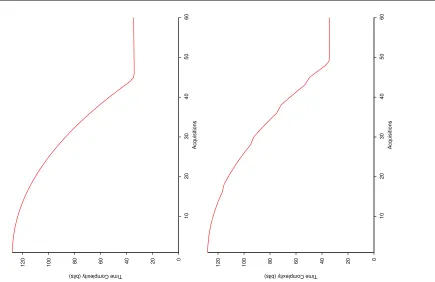
is the probability that the number of different values across m ciphertexts at a given position in the state matrix is equal tom. The time complexity of this vari-ant of impossible differential cryptanalysis is shown in Figure 5 (left) givenxacquired ciphertexts. The time complexity of the attack includes the effort required to produce the N ciphertexts. The time complexity falls below our practical bound to 253.4AES operations after
40 ciphertexts are acquired. The minimum time com-plexity is 234 after 46 ciphertexts have been acquired,
after which treating the ciphertext becomes more sig-nificant than the resulting exhaustive search.
Kim implicitly assumes that one can acquirem dif-ferent ciphertexts with m faults. In the chosen differ-ence model the amount of effort required to acquirem different ciphertexts is an instance of the classical occu-pancy problem. That is, how many distinct ciphertexts will one have after n faults have been injected. The probability of observing xdifferent balls from r possi-bilities givennfaults is
Pr(x=k) = r(k) n
i
rn ,
where we definen
i as a function that returns the Stir-ling numbers of the second kind. That is, the number of ways of partitioningn elements intoinon-empty sets. The expectation of xis simplyE(x) =Pri=1iPr(x=
i) . The resulting time complexity when an attacker has to collect a certain number of ciphertexts is only slightly different given so few ciphertexts are required, as shown in Figure 5. The practical bound of 253.4AES
operations occurs after 43 acquisitions, and the mini-mum time complexity of 234 occurs at 51 acquisitions.
6.1.2 Chosen Plaintext
0
20
40
60
80
100
120
10
20
30
40
50
60
Time Complexity (bits)
Acquisitions
0
20
40
60
80
100
120
10
20
30
40
50
60
Time Complexity (bits)
Acquisitions
Fig. 5 The time complexity of the cryptanalysis of a four-round AES using impossible differential, where distinct bytes (left) and random bytes (right) are inserted into a fixed plaintext.
and the key uniquely identified from the result that the XOR sum of the intermediate state at the end of the third round is equal to zero. As above, the expected number of key hypotheses generated by the attack is 216. This can be improved if one repeats the
analy-sis, i.e. one takes 29 chosen plaintexts and conducts
the above analysis twice. This was originally detailed by Daemen and Rijmen in their AES proposal [9, 10]. Kim’s observation will also apply in this case and allow the number of hypotheses to be reduced to one from a set of 256 chosen plaintext-ciphertext pairs [15].
Attacks based on impossible differentials [4] will also function in the same manner, including the version based on acquisitions that would otherwise be used to conduct a Square attack. However, an attacker would be able to ensure that each plaintext is distinct and would not need to conduct acquisitions until a certain number of distinct ciphertexts have been collected.
6.2 Analyzing Five-Round AES
6.2.1 Chosen Difference
Phan and Yen describe an extension to the Square at-tack [22], that was also first presented in the original description of AES [9, 10]. The Square attack can be
extended by an extra round with an increase in the time complexity. Rather than analyzing the final sub-key byte-by-byte one analyses the penultimate subsub-key. In order to analyze the penultimate subkey one is obliged to guess 32 bits of the final subkey to deter-mine one column of the state matrix before the XOR with the penultimate subkey. One can then compute the MixColumns operation on this column, and form hypotheses on a subkey equivalent to the penultimate subkey where one computes theMixColumns operation on the derived subkey to derive the penultimate sub-key. Each evaluation reduces the potential key space by 1/256, and would need to conduct this analysis five times to uniquely determine the subkey [9, 10].
If we define each of the 232 partial decryptions as
having a time complexity equivalent to 1/4 of a round the time complexity of the attack is
5 4·240/4
/10≈239 .
As in the Square attack described in Section 5.4, one cannot choose the values that are in the one-byte differ-ence required to conduct the Square attack. One would therefore expect 5×1561≈213acquisitions to be taken
last subkey can verified, in than they must be generated from corresponding hypotheses on the penultimate sub-key. One can start an analysis of 256 ciphertexts pro-duced by encrypting 256 plaintexts that are identical except for one byte where each plaintext is distinct.
One can analyze two columns of the penultimate subkey by guessing eight bytes of the last subkey (in two sets of four bytes). This will give two sets of 232
hypotheses with a time complexity 2·240/4 one round
decryptions. One can then eliminate hypotheses in each set that are inconsistent. Given that we have hypotheses on eight bytes of the penultimate key and eight bytes of the last subkey, we will have three bytes of the last subkey that are produced by bytes included in these hy-potheses. Given that the probability that all three bytes of a given hypotheses can be verified with a probability of 1/224 one would expect that the two sets of 232
hy-potheses can be reduced to one set of 240 hypotheses.
A third set of 232hypotheses can then be generated for
one of the remaining columns of the penultimate subkey and four bytes of the last subkey. There will be a further four bytes of the last subkey by that will be generated by bytes for which there are already hypotheses, and an element from the new set of of 232hypotheses will
vali-date a hypothesis from the known set of 240hypotheses with a probability of 1/232. One would therefore expect
to combine these two sets to produce a set of 240
hy-potheses for 96 bits of the penultimate and 96 bits of the last subkey. A set of 232hypotheses can then be
gen-erated for the final column of the penultimate subkey and four bytes of the final subkey. At this point one can verify whether an entire subkey can be generated from the penultimate subkey. For each of the 232hypotheses
generated there will be a 1/(28)9 = 1/272 (since there
will be nine bytes in the last subkey that will not have been verified before). One would, therefore, expect to generate two hypotheses from the two sets of hypothe-ses. One that is correct and one fulfills the criteria by chance. A similar strategy has been proposed by Lucks for variants of AES with 192 and 256-bit keys [18].
In order to clarify how this attack functions an ex-ample is described below, although other versions will be possible (i.e. where one chooses to examine the columns of the penultimate subkey in a different order).
We define the last two subkeys as
K9=
k9,1k9,5 k9,9 k9,13
k9,2k9,6 k9,10k9,14
k9,3k9,7 k9,11k9,15
k9,4k9,8 k9,12k9,16
and
K10=
k10,1k10,5 k10,9 k10,13
k10,2k10,6k10,10 k10,14
k10,3k10,7k10,11 k10,15
k10,4k10,8k10,12 k10,16
.
If an attacker has a set of plaintexts where all the bytes except one are equal, and the remaining byte takes all possible values across the set of 256 plain-texts. One can conduct an analysis as described at the beginning of this section. That is, one can guess, for ex-ample, the key bytes{k10,1, k10,14, k10,11,k10,8}which
will allow hypotheses to be formed on each element of {k9,1, k9,2, k9,3, k9,4}independently. Note that while the
attack derives information on a transformed version of {k9,1, k9,2, k9,3, k9,4}this can be easily inverted for each
hypothesis for the whole set. With a time complexity of 240/4 one round decryptions one would expect to
obtain 232hypotheses for
γ1={k10,1, k10,14, k10,11, k10,8, k9,1, k9,2, k9,3, k9,4} ,
which can be stored in a hash table.
One can then conduct the same analysis by making hypotheses on{k10,13, k10,10, k10,7, k10,4} which will
al-low hypotheses to be derived on the elements of{k9,13,
k9,14, k9,15, k9,16}. Likewise, this will provide 232
hy-potheses for
γ2={k10,13, k10,10, k10,7, k10,4, k9,13, k9,14, k9,15, k9,16} .
However, as each element inγ2is generated the
follow-ing relationships between the elements inγ2andγ1can
be verified:
k10,1=S(k9,14)⊕k9,1⊕RCON
k10,4=S(k9,13)⊕k9,13 k10,14=k10,11⊕k9,14
A given element ofγ2will therefore have 28elements in
γ1that will satisfy these constraints, given that a
incor-rect key value will fulfill these relationships with prob-ability 1/224. The resulting 240 hypotheses for{γ
1, γ2}
can also be stored in a hash table.
One can continue in a straightforward manner to derive 232 hypotheses for
γ3={k10,5, k10,2, k10,15, k10,12, k9,5, k9,6, k9,7, k9,8} .
For each element in γ3 an attacker can verify the
fol-lowing relationships with{γ1, γ2}:
k10,2=S(k9,15)⊕k9,2, k10,5=k10,1⊕k9,5
k10,8=k10,4⊕k9,8 and k10,14=k10,10⊕k9,14
Again the resulting 240 hypotheses for{γ
1, γ2, γ3}can
Lastly, one can perform the same analysis on
γ4={k10,9, k10,6, k10,3, k10,16, k9,9, k9,10, k9,11, k9,12} .
Each element fromγ4 can be used to see if a valid pair
{K9, K10} has been found by searching in {γ1, γ2, γ3}
for values that satisfy the remaining relationships be-tween the two subkeys.
k10,4=S(k9,13)⊕k9,4, k10,6=k10,2⊕k9,6,
k10,7=k10,3⊕k9,7, k10,9=k10,5⊕k9,9,
k10,10=k10,6⊕k9,10, k10,11=k10,7⊕k9,11,
k10,12=k10,8⊕k9,12, k10,13=k10,9⊕k9,13,
and k10,16=k10,12⊕k9,16
Given that an incorrect hypothesis for {K9, K10} will
validate these equations with a probability of 1/289 = 1/272, one would expect to have two hypotheses for
{K9, K10} (i.e. the correct key and one incorrect one
that fulfills the criteria by chance) and therefore two hypotheses for the AES key. The overall time complex-ity of this attack would therefore be expected to be
4·240 4
/10≈236.5 , and as with Phan and Yen’s
attack one would expect that 1561 acquisitions would need to be made to collect the 256 possible ciphertexts. Using a set of acquisitions to exploit impossible dif-ferentials to recover a secret key is not described in the chosen difference model, since the time complexity of such an attack would not be below the bound set for a practical attack [7].
6.2.2 Chosen Plaintext
As above, the Square attack can be used to attack a five-round instance of AES in the chosen plaintext model by the method described above [9, 10]. Naturally, this requires fewer plaintexts and has a slightly higher time complexity.
The new attack described above applies equally well to attacking an implementation to a five-round AES under the chosen plaintext model. One can choose 256 distinct plaintexts that differ in one byte. The resulting analysis will identical to that given above, but an at-tacker will be seeking to derive information on{K4, K5}
rather than{K9, K10}. The time complexity for this
at-tack would be 4·240/4
/5≈237.5 .
6.3 Analyzing More Rounds
There are attacks that conduct a differential crypt-analysis on an instance of AES that consist of up to
eight rounds. These are extensions of the Square at-tack [13], impossible differentials [17] and meet-in-the-middle attacks [11], since attacks based on a straight-forward differential spanning four rounds or more have been proven to be impossible [21]. However, these at-tacks typically require a large number of plaintexts and/or have a high time complexity, and are therefore beyond the scope of this paper.
7 Summary
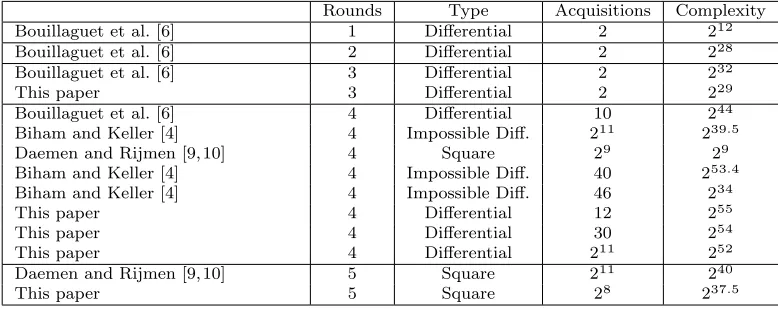
In order to clarify the contribution of this paper the attacks presented in this paper are described alongside some of the most efficient attacks from the literature in Tables 4 and 5. We note that the numbers correspond-ing to fault attacks based on the Square attacks de-scribed in the literature [22, 15] have been re-evaluated to fit our model. We assert that this represents a more accurate evaluation of these attacks since our model is intended to correspond to an attacker able to inject a fault at a given point in time during the computation of an AES.
We recall that the time complexity of Table 4 is defined in terms of a ten-round AES since it is intended to correspond to differential fault analysis, whereas the time complexity in Table 5 is defined in terms of the number of rounds in the variant under consideration.
8 Conclusion
In this paper we consider some low complexity differ-ential cryptanalyses of reduced round variants of AES. Specifically, we consider instances of AES that consist of one to five rounds of AES in two attack models. The first is the standard chosen plaintext model considered in differential cryptanalysis. The second is a chosen dif-ference model that is intended to correspond to faults being injected into an instance of AES a given number of rounds before the end of the block cipher.
We propose a new differential cryptanalysis of four rounds of AES under the chosen plaintext model that has a practical complexity. We further show that this attack can be readily applied to conduct a differential fault analysis. We also demonstrate that the Square at-tack has not been correctly evaluated as a fault atat-tack, and is not efficient as described in the literature [22, 15]. We also provide a novel attack on a five-round AES based on the Square attack. A summary is given in Sec-tion 7.
Table 4 Summary of attacks under the chosen difference model.
Rounds Type Acquisitions Complexity
Piret and Quisquater [23, 20] 2 Differential 1 232
Tunstall and Mukhopadhyay [25] 3 Differential 1 227
Phan and Yen [22] 4 Impossible Diff. 211 239.5
Phan and Yen [22] 4 Square 211 216
Biham and Keller [4, 15] 4 Impossible Diff. 43 253.4
Biham and Keller [4, 15] 4 Impossible Diff. 51 234
This paper 4 Differential 28 252
This paper 4 Differential 214.4 251
This paper 4 Differential 222 249
Phan and Yen [22] 5 Square 213 239
This paper 5 Square 28 236.5
Table 5 Summary of attacks under the chosen plaintext model.
Rounds Type Acquisitions Complexity
Bouillaguet et al. [6] 1 Differential 2 212
Bouillaguet et al. [6] 2 Differential 2 228
Bouillaguet et al. [6] 3 Differential 2 232
This paper 3 Differential 2 229
Bouillaguet et al. [6] 4 Differential 10 244
Biham and Keller [4] 4 Impossible Diff. 211 239.5
Daemen and Rijmen [9, 10] 4 Square 29 29
Biham and Keller [4] 4 Impossible Diff. 40 253.4
Biham and Keller [4] 4 Impossible Diff. 46 234
This paper 4 Differential 12 255
This paper 4 Differential 30 254
This paper 4 Differential 211 252
Daemen and Rijmen [9, 10] 5 Square 211 240
This paper 5 Square 28 237.5
model defined in Section 3.1. This model assumes a strong attacker who is able to affect a chosen number of bytes at a chosen set of positions in the state matrix. This allows for a broad range of attacks to be imple-mented, although not all attacks will be applicable to all methods of fault injection. Likewise, the effects pro-duced by some fault injection mechanisms are not con-sidered since they are likely to be specific to one family of microprocessor/FPGA.
Acknowledgements
The work described in this paper has also been sup-ported in part the European Commission through the ICT Programme under Contract ICT2007216676 ECRYPT II and EPSRC via grant EP/I005226/1.
References
1. S. Ali, D. Mukhopadhyay, and M. Tunstall. Differential fault analysis of AES using a single multiple-byte fault. Cryptology ePrint Archive, Report 2010/636, 2010.http:
//eprint.iacr.org/.
2. F. Amiel, C. Clavier, and M. Tunstall. Collision fault analysis of DPA-resistant algorithms. In L. Breveglieri, I. Koren, D. Naccache, and J.-P. Seifert, editors,FDTC 06, volume 4236 ofLNCS, pages 223–236. Springer, 2006. 3. H. Bar-El, H. Choukri, D. Naccache, M. Tunstall, and C. Whelan. The sorcerer’s apprentice guide to fault at-tacks.Proceedings the IEEE, 94(2):370–382, 2006. 4. E. Biham and N. Keller. Cryptanalysis of reduced
vari-ants of Rijndael. unpublished, 1999.http://www.madchat.
fr/crypto/codebreakers/35-ebiham.pdf.
5. A. Biryukov, O. Dunkelman, N. Keller, D. Khovratovich, and A. Shamir. Key recovery attacks of practical com-plexity on AES-256 variants with up to 10 rounds. In H. Gilbert, editor, EUROCRYPT 2010, volume 6110 of
LNCS, pages 299–319. Springer, 2010.
6. C. Bouillaguet, P. Derbez, O. Dunkelman, N. Keller, and P.-A. Fouque. Low data complexity attacks on AES. Cryptology ePrint Archive, Report 2010/633, 2010.
http://eprint.iacr.org/.
7. J. H. Cheon, M. Kim, K. Kim, J.-Y. Lee, and S. Kang. Improved impossible differential cryptanalysis of Rijndael and Crypton. In K. Kim, editor,ICISC 2001, volume 2288 ofLNCS, pages 39–49. Springer, 2002.
8. J. Daemen, L. Knudsen, and V. Rijmen. The block cipher Square. In E. Biham, editor,FSE ’97, volume 1267 of
LNCS, pages 149–165. Springer, 1997.
9. J. Daemen and V. Rijmen. AES proposal: Rijndael. In
AES Round 1 Technical Evaluation CD-1: Documentation.
NIST, August 1998. http://www.nist.gov/aes.
10. J. Daemen and V. Rijmen. The Design of Rijndael: AES
11. H. Demirci, I. Ta¸skin, M. C¸ oban, and A. Baysal. Im-proved meet-in-the-middle attacks on AES. In B. Roy and N. Sendrier, editors,INDOCRYPT 2009, volume 5922 ofLNCS, pages 144–156. Springer, 2009.
12. O. Dunkelman and N. Keller. The effects of the omis-sion of last round’s MixColumns on AES. Information
Processing Letters, 110(8–9):304–308, 2010.
13. N. Ferguson, J. Kelsey, S. Lucks, B. Schneier, M. Stay, D. Wagner, and D. Whiting. Improved cryptanalysis of Rijndael. In B. Schneier, editor,FSE 2000, volume 1978 ofLNCS, pages 213–230. Springer, 2001.
14. FIPS PUB 197. Advanced encryption standard (AES). Federal Information Processing Standards Publication 197, National Institute of Standards and Technology (NIST), Gaithersburg, MD, USA, November 2001. 15. C. H. Kim. Efficient methods for exploiting faults
in-duced at AES middle rounds. Cryptology ePrint Archive, Report 2011/349, 2011. http://eprint.iacr.org/. 16. D. E. Knuth. The Art of Computer Programming, volume
2 / Seminumerical Algorithms. Addison-Wesley, 2nd edi-tion, 1981.
17. J. Lu, O. Dunkelman, N. Keller, and J. Kim. New impos-sible differential attacks on AES. In D. R. Chowdhury, V. Rijmen, and A. Das, editors,INDOCRYPT 2008, vol-ume 5365 ofLNCS, pages 279–293. Springer, 2008. 18. S. Lucks. Attacking seven rounds of Rijndael under
196-bit and 256-bit keys. In AES Candidate
Confer-ence 2000, 2000. http://csrc.nist.gov/encryption/aes/
round2/conf3/aes3conf.htm.
19. S. Mangard, E. Oswald, and T. Popp. Power Analysis
Attacks: Revealing the Secrets of Smart Cards.
Springer-Verlag, 2007.
20. D. Mukhopadhyay. An improved fault based attack of the Advanced Encryption Standard. In B. Preneel, editor,
AFRICACRYPT 2009, volume 5580 ofLNCS, pages 421–
434. Springer, 2009.
21. S. Park, S. H. Sung, S. Chee, E.-J. Yoon, and J. Lim. On the security of Rijndael-like structures against dif-ferential and linear cryptanalysis. In Y. Zheng, editor,
ASIACRYPT 2002, volume 2501 ofLNCS, pages 176–191.
Springer, 2002.
22. R. C.-W. Phan and S.-M. Yen. Amplifying side-channel attacks with techniques from block cipher cryptanalysis. In J. Domingo-Ferrer, J. Posegga, and D. Shreckling, edi-tors,CARDIS 2006, volume 3928 ofLNCS, pages 135–150. Springer, 2006.
23. G. Piret and J.-J. Quisquater. A differential fault attack technique against SPN structure, with application to the AES and KHAZAD. In C. D. Walter, C¸ . K. Ko¸c, and C. Paar, editors,CHES 2003, volume 2779 ofLNCS, pages 77–88. Springer, 2003.
24. S. P. Skorobogatov. Semi-invasive attacks: A new ap-proach to hardware security analysis. Technical Report UCAM-CL-TR-630, Computer Laboratory, University of Cambridge, April 2005.