Based on
Table-Element Permutation
Hongbo Zou
Neijiang Local Tax Bureau, Sichuan, China [email protected]
Abstract. In this paper, a new stream ciphers design method (named TEP) is proposed to base on the table-element nonlinear permutation. A number of words are generated by n-LFSRs(linear feedback shift register) input to a table. In the table, every word is dealt with by the nonlinear transforms and the several words are combined with nonlinear function to produce keystream words. The algorithm is simplicity and the secret key is generated rapidly. The result of many simulation experiments show that the keystream by TEP method generating can meet DIEHARD and RABENZIX statistics tests. The approach is efficient to design stream ciphers.
Key words: stream cipher, combining function, LFSR, permutation
1
Introduction
Stream ciphers are an important manner of information encryption. One ap-proach of the conventional stream ciphers is to use n-LFSRs(Linear Feedback Shift Register) in parallel, their output combined using an n-input binary Boolean function . Various properties of such a combining function are critical for ensur-ing the security of the resultant scheme. It is very difficult for designer to design a function, which not only meet a variety of conditions for randomness, but also resists against all kinds of attack approach. How to design function is central topics to design of the kind of stream ciphers [3, 4].
The RC4 is a stream cipher widely deployed in software applications due to its simplicity and efficiency. 32-bit RC4 requiring 16 Gigabytes of memory, would be incredibly limiting need 4G memory. RC4 can’t directly generate 32, 64-bit word flow in PC platform. Furthermore, there are several weaknesses in RC4 which is found in [7]. A number of word-oriented stream ciphers such as Rabbit, Turing, HC-256 [8, 9, 11] etc have been presented in current, but their security had not been proved exhaustively.
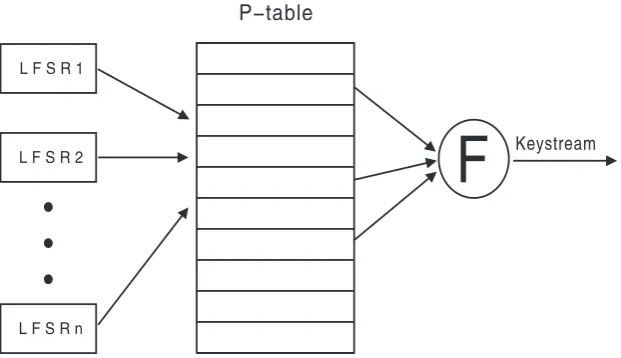
word mode to input to the table in turn, Every element of the table is transposed with various nonlinear transform and confused the original linear relationship between a word and others, the random counters choose several words to non-linear combine in order to generate unpredictable secret key. Principle of TEP see Fig. 1. The result of simulation experiments shows that random keystream is generated by TEP method to meet DIEHARD and RABENZIX statistics tests.
Fig. 1.Principle of TEP stream cipher design method
2
TEP Algorithm describe
TEP Algorithm consists of two steps. The first is initialize procedure, the second step is main program. They all use SP nonlinear transform to confuse internal states of the table-element to generate keystream for encryption. We discuss later. Transposition cryptosystem, an old strategy is adopted to in this paper for SP nonlinear transform design.
2.1 Organization and notation
This paper is organized as follows. We will describe the design method of TEP in detail in section two and the simple cryptanalysis of TEP in section three, and in section four the performance results are presented. We conclude and summarize in section five.
The following operations and functions are used in TEP:
bytes.
P : a table with 256*32 bit elements.Every element is denoted as
P[i], P[i] with 0≤i <256.
pi(j) :jth byte ofith element of P table is denoted as pi(j).pi(j)
with 0≤i <256,0≤j≤3.Every element split into four bytes.
+ : meansx+y mod 256, where 0≤x, y <256. ⊕: exclusive operator.
∥: concatenation operator. mm: random key word of output.
j : is random counter to select element operation and output.
f lag: two LFSR select mark.f lag= 0 select LFSR1,f lag= 1
select LFSR2
P[i]≫r: Table-elementP[i] right cyclical shiftrbit, means
((P[i]≫r)⊕(P[i]≪(32−r)) where 0≤i≤255,0≤r≤31.
Input(LF SRi) : LFSRi generate 32-bit word to input table.
2.2 SP Transform
The transform operator of TEP called SP transform (section permutation) to permute internal one byte (8-bit) between two words. Begin from the first ele-ment of the tableP, the random (or sequenence) counter select one elementP[i] in the table,P[i] right cyclical move 11 bits,P[i+ 213] right cyclical move 5 bits. Divide elementP[i],P[i+ 213] into four 8-bit quarters with hexadecimal digits of pi(0), pi(1), pi(2), pi(3) and pi+213(0), pi+213(1), pi+213(2), pi+213(3). The
content of pi+213(0), pi+213(1), pi+213(2), pi+213(3) is regarded as address
posi-tion of words to operate in the table, corresponding elements are P[pi+213(0)],
P[pi+213(1)], P[pi+213(2)], P[pi+213(3)]. The first byte of P[pi+213(0)] element
will permute pi(0) byte of P[i]. The second byte of P[pi+213(1)] element will
permutepi(1) byte ofP[i]. The third byte ofP[pi+213(2)] element will permute
pi(2) byte ofP[i]. The fourth byte of P[pi+213(3)] element will permute pi(3)
byte ofP[i]. Last,P[pi+213(0)],P[pi+213(1)],P[pi+213(2)],P[pi+213(3)] and new
P[i] right cyclical shift 3, 13, 19, 29, 17-bit respectively. SP transform explicit description is as follow:
P[i]≫11
P[i+ 213]≫5
P[i] = pi(0)||pi(1)||pi(2)||pi(3)
P[i+ 213] = pi+213(0)||pi+213(1)||pi+213(2)||pi+213(3)
P[pi+213(1)] = a1(0)||a1(1)||a1(2)||a1(3)
P[pi+213(2)] = a2(0)||a2(1)||a2(2)||a2(3)
P[pi+213(3)] = a3(0)||a3(1)||a3(2)||a3(3)
After exchanging, these elements are changed as follow:
P[i] =a0(0)||a1(1)||a2(2)||a3(3)
P[pi+213(0)] =pi(0)||a0(1)||a0(2)||a0(3)
P[pi+213(1)] =a1(1)||pi(1)||a1(2)||a1(3)
P[pi+213(2)] =a2(0)||a2(1)||pi(2)||a2(3)
P[pi+213(3)] =a3(0)||a3(1)||a3(2)||pi(3)
Next rotation right every elements.
P[i]≫17
P[pi+213(0)]≫3
P[pi+213(1)]≫13
P[pi+213(2)]≫21
P[pi+213(3)]≫29
Design illuminate: we firstly use rotation-right operator simple change two table-element internal linear relation and avoid same context for next SP operation choosing same table-element. The reason that we choose four bytes ofP[i+ 213] as address ofP[i] operation is we don’t want to use the context ofP[i] as address of itself operation. As fori adding 213 is stochastic, in fact, we think may add the other random number.
2.3 Initialization procedure
2.4 Main program
The main program will generate and output random sequence key. It also uses SP transform that is previously used at initialization program. Begin from first element, program uses SP transform at first, then select one element P[j] with one random counter to combine other four words withF function, the result of operation to output as keystream.P[j] is replaced with one 32-bit word by two LFSRs generating in turn. New the 32-bit element of input will be transposed with SP. It is not until main program to stop that producing enough number keystream.F function is described later.
2.5 F(i, j) function describe
F(i, j) function is nonlinear transform just as conventional stream ciphers. F function is bit-oriented in conventional stream ciphers, however, it is word-oriented in TEP. It is a key for this kind stream ciphers family to design F function for security. In the paper,F function is designed to use exclusion op-erator with five 32-bit words that are selected from among the tableP by the random counters. The random counters j are derived from internal states of the table. Explicit description is as follows. Divide every element P[i] into four 8-bit quarters with hexadecimal digits of pi(0), pi(1), pi(2),pi(3). The content
of pi(0), pi(1), pi(2), pi(3) is regarded as address the position of words,
corre-sponding elements are P[pi(0)], P[pi(1)], P[pi(2)], P[pi(3)], that right cyclical
shift 3, 9, 19, 23 bits respectively. P[j] right cyclical shift 29 bits.
P[i] =pi(0)||pi(1)||pi(2)||pi(3)
j=j+ (pi(0) +pi(1))⊕(pi(2) +pi(3))
F(i, j) =P[pi(0)]≫3⊕P[pi(1)]≫9⊕P[pi(2)]≫19
⊕P[pi(3)]≫23⊕P[j]≫29
wherej initial value is 0.
2.6 Pseudo code describe
Algorithm 1Initialization Procedure
fori= 0 to 127do
P[i]←Input(LF SR1)
end for
fori= 128 to 255do
P[i]←Input(LF SR2)
end for
fori= 0 to 255do
SP(P[i])
f lag←0 j←0
whiledon’t satisfy stop conditiondo fori= 0 to 255do
SP(P[i])
j←j+ ((pi(0) +pi(1))⊕(pi(2) +pi(3))
mm←F(i, j)
if f lag= 0then
P[j]←Input(LF SR1) f lag←1
else
P[j]←Input(LF SR2) f lag←0
end if
SP(P[j])
end for end while
The words sequence ofmmis the keystream that we need. The secret key is chosen to be the initial state of the LFSRs.
Design specification: Using the sequence counter ensures that each element of the table P can be updated with SP operator. A 32-bit word with the use of two LFSRs generating alternately input to the table. For each element of input, using SP operator mix up its byte sequence linear relation. The states of internal element of the table are confused with cyclically right shift operator. All elements of the table will be fragment with SP operator repeatedly.
2.7 Encryption and decryption
The key stream is XORed with the message for encryption. The decryption is to XOR the key stream with the cipher text.
3
Security of TEP discuss
3.1 Period property
3.2 Resistance
TEP algorithm is different from traditional combining function stream ciphers, it is word-oriented. It is also different from current proposed word-oriented stream cipher such as Rabbit, HC-256, Turing, and so on. It assimilates the merit of traditional combiner function stream ciphers that have well randomness. The table of TEP is to open and dynamical update. Output of n-LFSRs is merely resources to satisfy stochastic property, doesn’t directly output. It is thus im-possible almost all the techniques developed to attack stream ciphers based on LFSR fail on TEP. The output result can resist against linear attacks, differ-ential attacks and other common attack. It needs time for security of TEP to exhaustive analysis. For TEP, SP transform achieves to largely scale bytes per-mutation between four elements. The output word leaks very small amount of partial information at each step. The large number of elements of the table and a non-linear transforms ensures that the secret key could not be recovered from those that leaked partial information. We think it is impossible to recover the secret key faster than exhaustive key search. We hope that the cryptographic community prove its security or find the weakness, which helps us improve this method in the future.
3.3 Parameters and Experiment
The initial states of the LFSRs can’t be full 0. We note that although length of the tablePis almost universally specified in the literature as being a power of 2, and most often 256, this is not necessary, but more of a convenience. Choosing length of the table just depends on experience in order to TEP algorithm carry out easily and simply. It is too small to resist against cryptographically analysis, but too large will increase the cost of time and space. Generally, scale of the table is chosen from 256, 512, 1024, 2048 elements. Width of the table suit for computer platform 8, 16, 32, 64, 128-bit in order to algorithm run rapidly.
For TEP, we make many simulation tests with Turbo 2.0 for windows. It is difficult and slow for conventional LFSR to achieve with C language, Our ex-periments replace conventional LFSR with a Galos-LFSR configuration. Galois-LFSR is not cryptographically superior, when it’s compared with typical Galois-LFSR. They exhibit some of the same characteristics. If they constructed from primitive polynominals, they have maximal period 2n−1 iterations before repeating. In
software, Galois- LFSR exploits parallelism and easier achieves with C language, thus it can execute faster.
The primitive polynomialp1(x) andp2(x) of LFSR1 and LFSR2 are given
below [10]:
(0xAF838772) (0xABE14240) (0x1889A622) (0x14AF19A1) (0xCC2D8086)
(0XB64E4D3F) (0XA8E7331B) (0XD871FA30) (0XD46D4DBA)
The initial states of LFSR1 and LFSR2 or secret key are given below:
(0x56B3E642) (0xA23B5F78) (0x76F4D57) (0xABCDAE12) (0x467C7642)
(0x387C6543) (0xAECDC783) (0x343B3242) (0xC3F7C943)
Choosing the initial state of LFSR1 and LFSR2 is to stochastic, no spe-cial intention. Output results can pass DIEHARD and RABENZIX statistical tests [6, 13]. The ”exceptional Good ” result is given by RABENZIX test. The exhaustively test reports will be omitted due to length of the article.
4
Discuss and Conclusions
TEP compared with the conventional sequence ciphers algorithm, its mathe-matical description is more difficult. Randomness of the output of TEP has well mathematical foundation based on LFSR, which is confirmed by a lot of sta-tistical test. Nonlinear transformation functionF and SP transform are critical to ensure the algorithm security. Practically,TEP is highly flexible and trans-formable. A variety of nonlinear transform come into being many different al-gorithms. In this paper, we adopt a conservative method to design SP operator that merely modify 0, 1 position of elements, which doesn’t increase or decrease the number of 0 and 1 in the table in order to keep the table 0 and 1 dynamic balance.
References
1. A. Klimov, A. Shamir. A new class of invertible mappings. Workshop on Crypto-graphic Hardware and Embedded Systems-CHES’ 2002, LNCS 2523[C], pp.470 483. Springer, Heidelberg (2003)
2. A. Klimov, A. Shamir. Cryptographic applications of T-functions. Ninth workshop on Selected Areas in Cryptograph-SAC’ 2003, LNCS 3006[C], pp. 248 261. Springer, Heidelberg (2004)
3. A. Menezes, P. Van Oorschot, S. Vanstone. Handbook of Applied Cryptography CRC Press, 1996, Chapter 5, 7, 12, 13.
4. B. Schneier. Applied Cryptography Second Edition. J. Wiley Sons Inc, 1996, Chap-ter 16, 17.
5. B. Tsaban, U. Vishne. Efficient Linear Feedback Shift Rregisters With Maximal Period. Finite Fields Appl, 8(2), pp. 256-267 (2002)
6. G. Marsaglia. Diehard Statistical Tests,http://stat.fsu.edu/~geo/
7. I. Mantin, A. Shamir. A Practical Attack on Broadcast RC4. Fast Software En-cryption (FSE’01), LNCS 2355, pp.152-164, Springer, Heidelberg(2002)
8. M. Boesgaard, M. Vesterager, T. Pedersen. Rabbit: A New High-Performance Stream Cipher. Fast Software Encryption(FSE’03), LNCS 2887, pp.307-329. Springer, Heidelberg(2003)
9. G,R. Gregory, H. Philip. Turing: A Fast Stream Cipher. Fast Software Encryption 2003, LNCS 2887, pp.290 306. Springer, Heidelberg(2003)
10. J. Arndt.http://www.jjj.de/mathdata/rand-primpoly.txt
11. H. Wu. A New Stream Cipher HC-256. Fast Software Encryption(FSE’04), LNCS 3017, pp.226-244. Springer, Heidelberg(2004)