International Journal of COPD
Dove
press
O r I g I n a l r e s e a r C h
open access to scientific and medical research
Open access Full Text article
gender difference on the knowledge, attitude,
and practice of COPD diagnosis and treatment:
a national, multicenter, cross-sectional survey
in China
guohua Jia Ming lu rui Wu Yahong Chen Wanzhen Yao
Department of Pulmonary and Critical Care Medicine, Peking University Third hospital, Beijing, China
Purpose: To investigate the gender difference in knowledge, attitude, and practice of COPD
diagnosis and treatment in China.
Patients and methods: A nationwide, multicenter, cross-sectional questionnaire study was
carried out to investigate patients’ understanding and experience of COPD between September 2007 and December 2008.
Results: Two thousand and seventy-two patients were recruited from eleven centers. The final effective questionnaires were those of 1,698 cases, of which 32% were female. Women were younger, had higher body mass index, were more never smokers, and had lesser pack-years (all P0.01). More women had under elementary education level and monthly income 1,000 RMB (about 160 USD) (all P0.01). Women had higher ratio of FEV1/FVC (54.1±10.9 vs 50.2±11.5), FEV1% (50.0±19.1 vs 45.4±29.0), and lower short form-36 mental component summary (57.5±26.8 vs 61.3±25.0) (all P0.01). Fewer women reported severe exacerbation (defined as an acute worsening of respiratory symptoms that results in patient’s hospitalization) in the previous year (44.5% vs 51.6%, P0.05). More women reported that they never heard of COPD before (67.0% vs 59.0%, P0.01). Less women reported that physician had to tell them they had emphysema (50.5% vs 60.4%) or COPD (31.9% vs 37.9%). Less women had pulmonary function test (PFT) done before (65.2% vs 70.4%, P0.05). More women reported that they would not repeat PFT annually (91.7% vs 87.6%, P0.05) and did not know the PFT results (78.6% vs 73.1%, P0.05). More women reported not having had pulmonary rehabilitation before (87.8% vs 83.6%, P0.05). Fewer women reported knowing that COPD should be given combined therapy (38.3% vs 44.5%) and long-term treatment (46.1% vs 51.9%) (all P0.05).
Conclusion: Male and female patients had different experiences on COPD diagnosis and treatment. Physicians should pay more attention to patients’ education on COPD, especially of women.
Keywords: chronic obstructive pulmonary disease, sex, perception, experience, education, management
Introduction
COPD is a disease characterized by airflow limitation that is not fully reversible. As a major public health problem, COPD is the third leading cause of death in China.1
The overall prevalence of COPD was 8.2% in 2004 (men 12.4%; women 5.1%) and 8.6% in 2015 (men 11.9%; women 5.4%), accounting for 99.9 million people in China.2,3 It is notable that in our national epidemiology survey, prevalence of COPD
is increasing, but only 12.0% of people with COPD had a pulmonary function test Correspondence: rui Wu; Yahong Chen
Department of Pulmonary and Critical Care Medicine, Peking University Third hospital, no 49 north garden road 100191, Beijing, China
Tel +86 1 366 110 5506;
+86 1 561 190 8216 Fax +86 108 226 6699;
+86 108 226 6699
email [email protected]; [email protected]
Journal name: International Journal of COPD Article Designation: Original Research Year: 2018
Volume: 13
Running head verso: Jia et al
Running head recto: Gender difference on the knowledge, attitude, and practice of COPD DOI: 176173
International Journal of Chronic Obstructive Pulmonary Disease downloaded from https://www.dovepress.com/ by 118.70.13.36 on 22-Aug-2020
For personal use only.
Dovepress
Jia et al
(PFT) done before, in which only 9.4% were women, which is statistically less than men (13.2%).2 Patients have little
understanding on COPD compared with the knowledge of hypertension and diabetes mellitus, while the health care professionals have little information on patients’ experi-ence. The correct information exchange between patients and health care professionals can help in early detection of COPD. Patient education has been shown to be an effective method to improve patients’ understanding of the disease and treatment. There have been few studies examining patients’ understanding of COPD.
Traditionally, we regarded COPD as a male disease, which primarily affected men. However, epidemiology sur-vey showed us a different standpoint. COPD deaths in women firstly surpassed men in 2004 in the USA, and the prevalence of COPD in women was higher than men in the USA, Canada, the Netherlands, and Australia.4–7 Also, in our national
epi-demiology study, COPD in women increased from 5.1% in 2004 to 5.4% in 2015, which represents 31.2 million people in China.2,3 Women are at greater risk of smoking-induced
lung function impairment, more severe dyspnea, and poorer health status for the same level of tobacco exposure, and the number of women smokers is increasing.8–10 In addition,
women have more chances of exposure to biomass smoke, which causes nonsmokers with COPD also more likely to be female.11–14 The risk factors may justify the current
“preva-lence” (only 10% have spirometry) of COPD; nonetheless, the alleged increase (from 5% to 5.4%) from 2005 to 2014 seems insignificant. Despite this, research suggests that physicians are still “gender biased” in diagnosing COPD, as a general practitioner is more likely to diagnose men with COPD.15 The delayed diagnosis or misdiagnosis of
COPD in women may cause poor prognosis.16,17 The degree
to which these observations represent biologic, physiologic, or sociologic differences is not addressed. In addition, new evidence is emerging that men and women may be pheno-typically different in their response to tobacco smoke, with men being more prone to an emphysematous phenotype and women to an airway predominant phenotype.18 Although
information regarding differences in disease biology and clinical presentation between men and women is emerging, knowledge regarding gender difference in disease perception and experience is lacking.
Our research aim, therefore, was to explore the gender difference in understanding the disease from the perspectives of patients with COPD in a nationwide, multicenter study. The results will provide better education and management for patients, prevent disease progression, improve the quality
of life and adherence, and reduce social burden between genders.
Patients and methods
study design and patients
This study was a retrospective database analysis. Nationwide cross-sectional surveys of patients with COPD were con-ducted in China including eleven tertiary hospitals from September 2007 to December 2008. These eleven hospitals were chosen because they represented different parts of China. The study was approved by the ethical committee of Peking University Third Hospital, Beijing, China. All data in the database were de-identified.
Patients’ survey
Outpatients with COPD were recruited consecutively. COPD was diagnosed according to the criteria recommended by the Chinese Medical Society.19 Chronic airflow limitation
was defined as a post-bronchodilator ratio of FEV1/FVC being 70%. Bronchodilator reversibility test revealed an increase in FEV112% or 200 mL above the pre-broncho-dilator FEV1 after inhalation of 400 µg of salbutamol. Static lung volumes were measured in all patients using body plethysmography when appropriate. Patients were asked if they had comorbidities such as hypertension, coronary artery disease, diabetes, cerebrovascular disease, or other diseases. Patients with asthma, bronchiectasis, lung cancer, active lung tuberculosis, psychiatric diseases, cognitive dysfunction, or left heart failure were excluded from the study. Information on the use of drugs was also acquired by asking patients. The Chinese validated version of short form-36 (SF-36) was administered by trained researchers in each center.20 Each
patient was interviewed once.
Questionnaire items
The questionnaire was designed according to the literature with modification. A panel of COPD experts helped draft the questionnaires. The demographics, and patients’ knowl-edge, attitude, and practice of COPD were included in the questionnaire. Patients’ knowledge, attitude, and practice on COPD diagnosis and treatment were measured by a series of questions; the answer was dichotomic or ranked by patients. For most questions, the answers to be selected were yes, no, or do not know, and some questions had some items to be ranked (Supplementary material). Dyspnea severity was measured by the mMRC Dyspnea Index. Stages of COPD were defined according to the original GOLD criteria based on FEV1% predicted.21 The investigators in each center were
International Journal of Chronic Obstructive Pulmonary Disease downloaded from https://www.dovepress.com/ by 118.70.13.36 on 22-Aug-2020
Dovepress gender difference on the knowledge, attitude, and practice of COPD
trained before the study. Patients were interviewed face to face by the investigators.
statistical analyses
All statistical analyses were conducted with SPSS 21.0 (IBM Corporation, Armonk, NY, USA). Descriptive data were expressed as mean±SD or proportion (%). Differences between the two groups were tested using the Student’s t-test or the chi-squared test, when appropriate. The independent effects of gender on the knowledge, attitude, and practice of COPD were evaluated with logistic regression models. All
P-values were two-tailed, with P0.05 considered statisti-cally significant.
Results
Patients’ demographics
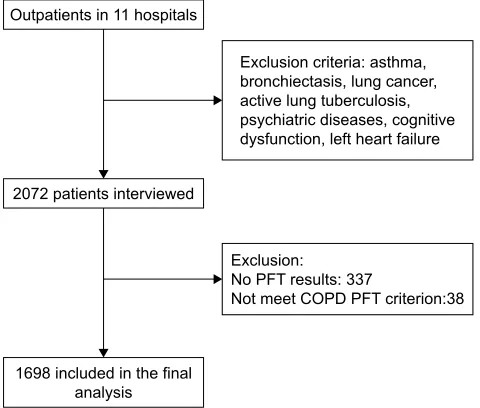
Two thousand and seventy-two patients were interviewed in the eleven centers. The final effective questionnaires were 1,698 after exclusion of 337 cases without PFT results and 38 cases who did not meet the COPD PFT criterion (Figure 1). The characteristics of the patients are shown in Table 1; 32% of the patients were female. Relative to male patients, women were younger (64.9±11.2 vs 67.6±10.9 years old), had higher body mass index (23.2±4.2 vs 22.2±3.7 kg/m2), were more
never smokers (63.6% vs 13.4%), and had lesser pack-years (26.0±23.2 vs 36.5±25.9) (all P0.01). More women were farmers (31.7% vs 17.5%), with under elementary education level (28.6% vs 9.5%) and a monthly income of 1,000 RMB (about 160$; 61.4% vs 30.4%), and without medical
insurance (45.5% vs 26.0%) or work (46.1% vs 20.1%) (all
P0.01; Table 1).
Disease severity, comorbidities,
exacerbation, and quality of life
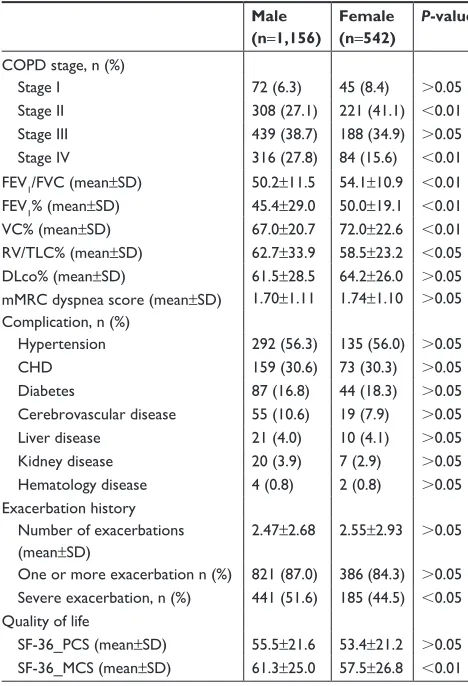
Relative to male patients, women had higher FEV1/FVC (54.1±10.9 vs 50.2±11.5), FEV1% (50.0±19.1 vs 45.4±29.0), vital capacity % (72.0±22.6 vs 67.0±20.7) (all P0.01) and lower residual volume/total lung capacity (58.5±23.2 vs 62.7±33.9, P0.05). However, women rated mMRC dyspnea score similar to men (1.74±1.10 vs 1.70±1.11, P0.05). They had similar comorbidities: hypertension (56.0% vs 56.3%), coronary artery disease (30.3% vs 30.6%), diabetes (18.3% vs 16.8%), and cerebrovascular disease (7.9% vs 10.6%) (all
P0.05). Less women reported severe exacerbation (defined as an acute worsening of respiratory symptoms that results in patients’ hospitalization) in the previous year (44.5% vs 51.6%, P0.05). The number of exacerbations in the past year (2.55±2.93 vs 2.47±2.68) and the percentage of one or more exacerbations (84.3% vs 87.0%) were similar between women and men. Regarding the quality of life, women had lower SF-36 mental component summary (57.5±26.8 vs 61.3±25.0, P0.01) and similar SF-36 physical component summary to men, as shown in Table 2.
Patients’ knowledge about
COPD diagnosis
Patients’ knowledge about COPD diagnosis was assessed by the items that were heard of COPD and the risk factors Figure 1 Flow of participants through the study.
Abbreviation: PFT, pulmonary function test. 2XWSDWLHQWVLQKRVSLWDOV
SDWLHQWVLQWHUYLHZHG
LQFOXGHGLQWKHILQDO DQDO\VLV
([FOXVLRQ
1R3)7UHVXOWV
1RWPHHW&23'3)7FULWHULRQ ([FOXVLRQFULWHULDDVWKPD EURQFKLHFWDVLVOXQJFDQFHU DFWLYHOXQJWXEHUFXORVLV SV\FKLDWULFGLVHDVHVFRJQLWLYH G\VIXQFWLRQOHIWKHDUWIDLOXUH
Table 1 Patient demographics
Male (n=1,156)
Female (n=542)
P-value
age, years (mean±sD) 67.6±10.9 64.9±11.2 0.01 BMI (kg/m2) (mean±sD) 22.2±3.7 23.2±4.2 0.01 smoking history, n (%)
Current smoker 298 (26.0%) 79 (14.6%) 0.01
never smoker 153 (13.4%) 344 (63.6%) 0.01
ex-smoker 693 (60.6%) 118 (21.8%) 0.01
Pack-years (mean±sD) 36.5±25.9 26.0±23.2 0.01 education under elementary,
n (%)
109 (9.5%) 155 (28.6%) 0.01
Occupation, n (%)
Farmer 202 (17.5%) 172 (31.7%) 0.01
no work 232 (20.1%) 250 (46.1%) 0.01
no insurance, n (%) 299 (26.0%) 246 (45.5%) 0.01 Monthly income 1,000
(rMB), n (%)
348 (30.4%) 333 (61.4%) 0.01
Abbreviation: BMI, body mass index.
International Journal of Chronic Obstructive Pulmonary Disease downloaded from https://www.dovepress.com/ by 118.70.13.36 on 22-Aug-2020
Dovepress
Jia et al
of COPD. Relative to male patients, more women reported having never heard of COPD before (67.0% vs 59.0%,
P0.01). More than half of the women did not know the risk factors of COPD (53.5% vs 37.5%, P0.01). Less women regarded active smoking, passive smoking, air pollution, biomass, respiratory infection, and occupational exposure as the risk factors of COPD (Table 3).
Patients’ attitude about COPD diagnosis
As for patients’ attitude about COPD diagnosis, similar percentage of female and male patients regarded themselves as having COPD (80.7% vs 83.1%, P0.05). There was no gender difference about whether they would ask physician about the severity of COPD (90.6% vs 92.6%, P0.05), as shown in Table 3.Patients’ and physicians’ practice
about COPD diagnosis
Relative to the practice on COPD diagnosis, less women had PFT done before (65.2% vs 70.4%, P0.05). More women reported not repeating PFT annually (91.7% vs 87.6%,
P0.05) and being unknown to the PFT results (78.6% vs 73.1%, P0.05). Less women reported that physician would tell them they have emphysema (50.5% vs 60.4%, P0.01) or COPD (31.9% vs 37.9%, P0.05). Similar percentage of female and male patients reported that physician would tell them they have chronic bronchitis (74.8% vs 77.6%, P0.05) and about the severity of COPD (28.2% vs 30.8%, P0.05), as shown in Table 3.
Patients’ knowledge about
COPD treatment
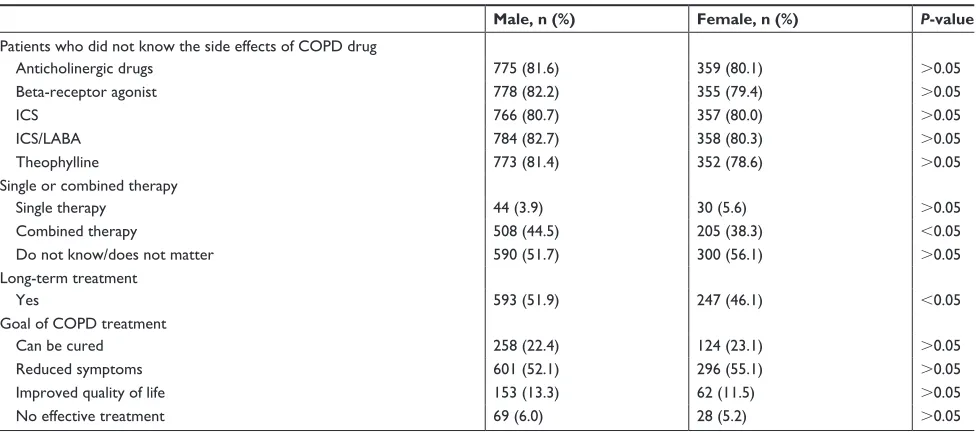
The knowledge on COPD treatment was evaluated by patients’ cognition of drugs’ side effects, treatment meth-ods, and goal of COPD treatment. Approximately 80% of female and male patients did not know the side effects of anticholinergic drugs (80.1% vs 81.6%), β-adrenergic ago-nists (79.4% vs 82.2%), inhaled corticosteroids (ICSs; 80.0% vs 80.7%), ICS/long-acting β2-agonist (80.3% vs 82.7%), and theophylline (78.6% vs 81.4%) (all P0.05). Lesser women than men reported COPD should be given combined therapy (38.3% vs 44.5%) and long-term treatment (46.1% vs 51.9%) (all P0.05). They did not differ in the goal of COPD treatment (Table 4).
Patients’ attitude on current
COPD treatment
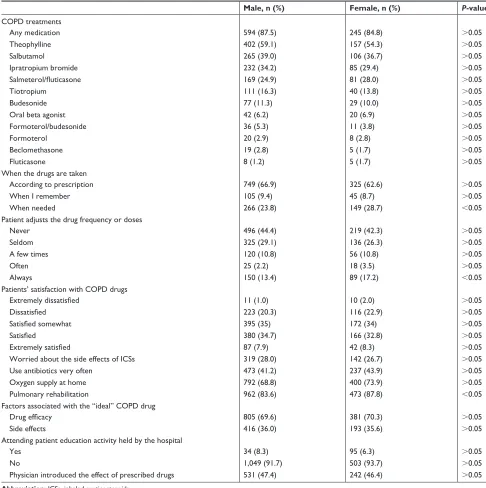
As to patients’ attitude on COPD treatment, 70% of the female and male patients were satisfied with COPD drugs (75.1% vs 77.6%, P0.05). Some patients worried about the side effects of ICSs (26.7% vs 28.0%). When asked about the factors associated with the “ideal” COPD drug, male and female patients ranked drug efficacy as No 1 (69.6% vs 70.3%) and side effects as No 2 (36.0% vs 35.6%), as shown in Table 5.
Patients’ and physicians’ practice
on COPD treatment
With regard to the practice on COPD treatment, 84.8% female and 87.5% male patients reported use of any respiratory medi-cation for COPD in recent 3 months. The most commonly used drug by women and men was theophylline (54.3% vs 59.1%), followed by salbutamol (36.7% vs 39.0%), ipratropium
Table 2 gender difference on disease severity, comorbidities, exacerbation, and quality of life
Male (n=1,156)
Female (n=542)
P-value
COPD stage, n (%)
stage I 72 (6.3) 45 (8.4) 0.05
stage II 308 (27.1) 221 (41.1) 0.01
stage III 439 (38.7) 188 (34.9) 0.05
stage IV 316 (27.8) 84 (15.6) 0.01
FeV1/FVC (mean±sD) 50.2±11.5 54.1±10.9 0.01 FeV1% (mean±sD) 45.4±29.0 50.0±19.1 0.01
VC% (mean±sD) 67.0±20.7 72.0±22.6 0.01
rV/TlC% (mean±sD) 62.7±33.9 58.5±23.2 0.05 Dlco% (mean±sD) 61.5±28.5 64.2±26.0 0.05 mMrC dyspnea score (mean±sD) 1.70±1.11 1.74±1.10 0.05 Complication, n (%)
hypertension 292 (56.3) 135 (56.0) 0.05
ChD 159 (30.6) 73 (30.3) 0.05
Diabetes 87 (16.8) 44 (18.3) 0.05
Cerebrovascular disease 55 (10.6) 19 (7.9) 0.05
liver disease 21 (4.0) 10 (4.1) 0.05
Kidney disease 20 (3.9) 7 (2.9) 0.05
hematology disease 4 (0.8) 2 (0.8) 0.05
exacerbation history number of exacerbations (mean±sD)
2.47±2.68 2.55±2.93 0.05
One or more exacerbation n (%) 821 (87.0) 386 (84.3) 0.05 severe exacerbation, n (%) 441 (51.6) 185 (44.5) 0.05 Quality of life
sF-36_PCs (mean±sD) 55.5±21.6 53.4±21.2 0.05 sF-36_MCs (mean±sD) 61.3±25.0 57.5±26.8 0.01
Abbreviations: ChD, coronary heart disease; Dlco, carbon monoxide diffusing capacity; rV, residual volume; sF-36_MCs, the short form-36 mental component summary; sF-36_PCs, the short form-36 physical component summary; TlC, total lung capacity; VC, vital capacity.
International Journal of Chronic Obstructive Pulmonary Disease downloaded from https://www.dovepress.com/ by 118.70.13.36 on 22-Aug-2020
Dovepress gender difference on the knowledge, attitude, and practice of COPD
antibiotics very often (43.9% vs 41.2%, P0.05). They did not have oxygen supply at home (73.9% vs 68.8%, P0.05). More women reported not having had pulmonary rehabilita-tion before (87.8% vs 83.6%, P0.05). They did not ever attend patient education activity held by the hospital (93.7% vs 91.7%, P0.05). Similar percentage of patients reported that physician would introduce the effect of prescribed drugs to them (46.4% vs 47.4%, P0.05), as shown in Table 5. bromide (29.4% vs 34.2%), and salmeterol/fluticasone (28.0%
vs 24.9%) (all P0.05). Female and male groups reported taking drugs according to the prescription (62.6% vs 66.9%), when they remember (8.7% vs 9.4%), or when needed (28.7% vs 23.8%). Most of them never adjusted (42.3% vs 44.4%,
P0.05), whereas a small percentage of the patients always adjusted the drug frequency or doses by themselves (17.2% vs 13.4%, P0.05). Similar percentage of patients reported using
Table 3 Patients’ knowledge, attitude, and practice on COPD diagnosis
Male, n (%) Female, n (%) P-value
never heard of COPD 682 (59.0) 363 (67.0) 0.01
risk factors of COPD
Unknown 431 (37.5) 288 (53.5) 0.01
active smoking 655 (57.0) 183 (34.0) 0.01
Passive smoking 378 (32.9) 150 (27.9) 0.05
air pollution 349 (30.3) 119 (22.1) 0.01
Biomass 176 (15.3) 64 (11.9) 0.05
respiratory infection 325 (28.3) 122 (22.7) 0.05
Occupational exposure 178 (15.5) 52 (9.7) 0.01
regard themselves have COPD 957 (83.1) 434 (80.7) 0.05
ask physician about the severity of COPD 1,066 (92.6) 489 (90.6) 0.05
Physician had to tell the patient that he/she has emphysema 694 (60.4) 272 (50.5) 0.01
Physician had to tell the patient that he/she has chronic bronchitis 892 (77.6) 404 (74.8) 0.05
Physician had to tell the patient that he/she has COPD 436 (37.9) 172 (31.9) 0.05
Physician had to say about the severity of COPD 354 (30.8) 153 (28.2) 0.05
have done PFT before 812 (70.4) 353 (65.2) 0.05
not repeating PFT yearly 1,011 (87.6) 497 (91.7) 0.05
not knowing PFT results 843 (73.1) 426 (78.6) 0.05
Abbreviation: PFT, pulmonary function test.
Table 4 Patients’ knowledge on the goal of COPD treatment
Male, n (%) Female, n (%) P-value
Patients who did not know the side effects of COPD drug
anticholinergic drugs 775 (81.6) 359 (80.1) 0.05
Beta-receptor agonist 778 (82.2) 355 (79.4) 0.05
ICs 766 (80.7) 357 (80.0) 0.05
ICs/laBa 784 (82.7) 358 (80.3) 0.05
Theophylline 773 (81.4) 352 (78.6) 0.05
single or combined therapy
single therapy 44 (3.9) 30 (5.6) 0.05
Combined therapy 508 (44.5) 205 (38.3) 0.05
Do not know/does not matter 590 (51.7) 300 (56.1) 0.05
long-term treatment
Yes 593 (51.9) 247 (46.1) 0.05
goal of COPD treatment
Can be cured 258 (22.4) 124 (23.1) 0.05
reduced symptoms 601 (52.1) 296 (55.1) 0.05
Improved quality of life 153 (13.3) 62 (11.5) 0.05
no effective treatment 69 (6.0) 28 (5.2) 0.05
Abbreviations: ICs, inhaled corticosteroid; laBa, long-acting β2-agonist.
International Journal of Chronic Obstructive Pulmonary Disease downloaded from https://www.dovepress.com/ by 118.70.13.36 on 22-Aug-2020
Dovepress
Jia et al
Factors associated with patients’
knowledge, attitude, and practice
on COPD
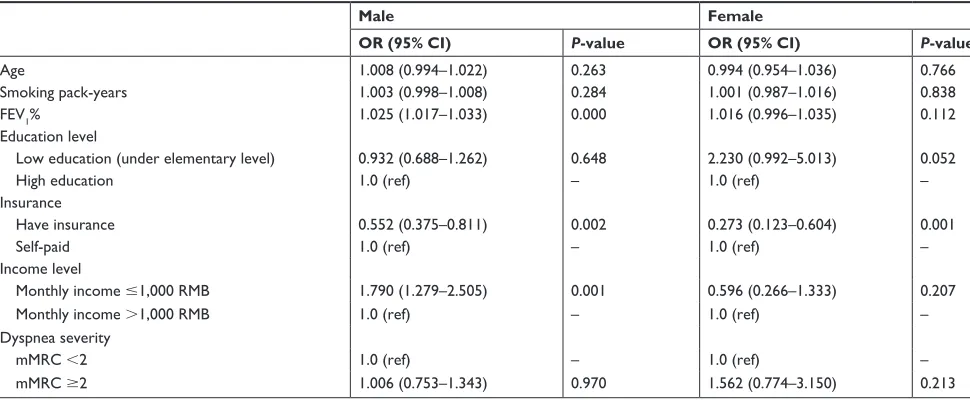
Using “never heard of COPD before” as the outcome vari-able about patients’ knowledge on COPD, we did logistic regression analysis and found that after adjustment of age, education, income, insurance, smoking pack-years, mMRC, FEV1%, lower income (1,000 RMB, OR 1.790, 95% CI 1.279–2.505), FEV1% (OR 1.025, 95% CI 1.017–1.033), and having insurance (OR 0.552, 95% CI 0.375–0.811)
among male patients and having insurance (OR 0.273, 95% CI 0.123–0.604) among female patients remained the independent variables associated with patients’ knowledge on COPD (Table 6).
Discussion
The surveys represented the first coordinated national surveys of gender difference on knowledge, attitude, and practice of COPD in China. It revealed that female and male patients had different experiences on COPD and its treatment. The
Table 5 Patients’ practice on current COPD treatment
Male, n (%) Female, n (%) P-value
COPD treatments
any medication 594 (87.5) 245 (84.8) 0.05
Theophylline 402 (59.1) 157 (54.3) 0.05
salbutamol 265 (39.0) 106 (36.7) 0.05
Ipratropium bromide 232 (34.2) 85 (29.4) 0.05
Salmeterol/fluticasone 169 (24.9) 81 (28.0) 0.05
Tiotropium 111 (16.3) 40 (13.8) 0.05
Budesonide 77 (11.3) 29 (10.0) 0.05
Oral beta agonist 42 (6.2) 20 (6.9) 0.05
Formoterol/budesonide 36 (5.3) 11 (3.8) 0.05
Formoterol 20 (2.9) 8 (2.8) 0.05
Beclomethasone 19 (2.8) 5 (1.7) 0.05
Fluticasone 8 (1.2) 5 (1.7) 0.05
When the drugs are taken
according to prescription 749 (66.9) 325 (62.6) 0.05
When I remember 105 (9.4) 45 (8.7) 0.05
When needed 266 (23.8) 149 (28.7) 0.05
Patient adjusts the drug frequency or doses
never 496 (44.4) 219 (42.3) 0.05
seldom 325 (29.1) 136 (26.3) 0.05
a few times 120 (10.8) 56 (10.8) 0.05
Often 25 (2.2) 18 (3.5) 0.05
always 150 (13.4) 89 (17.2) 0.05
Patients’ satisfaction with COPD drugs
Extremely dissatisfied 11 (1.0) 10 (2.0) 0.05
Dissatisfied 223 (20.3) 116 (22.9) 0.05
Satisfied somewhat 395 (35) 172 (34) 0.05
Satisfied 380 (34.7) 166 (32.8) 0.05
Extremely satisfied 87 (7.9) 42 (8.3) 0.05
Worried about the side effects of ICss 319 (28.0) 142 (26.7) 0.05
Use antibiotics very often 473 (41.2) 237 (43.9) 0.05
Oxygen supply at home 792 (68.8) 400 (73.9) 0.05
Pulmonary rehabilitation 962 (83.6) 473 (87.8) 0.05
Factors associated with the “ideal” COPD drug
Drug efficacy 805 (69.6) 381 (70.3) 0.05
side effects 416 (36.0) 193 (35.6) 0.05
attending patient education activity held by the hospital
Yes 34 (8.3) 95 (6.3) 0.05
no 1,049 (91.7) 503 (93.7) 0.05
Physician introduced the effect of prescribed drugs 531 (47.4) 242 (46.4) 0.05
Abbreviation: ICss, inhaled corticosteroids.
International Journal of Chronic Obstructive Pulmonary Disease downloaded from https://www.dovepress.com/ by 118.70.13.36 on 22-Aug-2020
Dovepress gender difference on the knowledge, attitude, and practice of COPD
prevalence (11.9%) than women (5.4%).2 Women had a
poorer understanding of their condition than men; less female patients had a PFT done before than male patients.2 These
two national surveys identified the prevalence of COPD in China and its risk factors, but did not focus on the gender difference of COPD, and our study made a further investi-gation on the gender difference of COPD. The confronting COPD international survey was performed in the USA, Canada, France, Italy, Germany, the Netherlands, Spain, and the UK in 2000 with 3,265 COPD participants. Forty-one percent of them were women. Women were younger and had lesser pack-years of smoking. They were more likely to report severe dyspnea than men, with similar cough and less sputum. There were no differences in the risk of hospitaliza-tion or emergency room visit.24 Also, there were significant
differences in the clinical expression of COPD between men and women, with women scoring lower on health sta-tus questionnaires, manifesting worse dyspnea scores, and experiencing more exacerbations than men.25 A study from
Spain showed that women COPD patients were significantly younger, had better PTF, smoked less, but had worse quality of life and higher anxiety and depression.26 Another probe
revealed that at the same age and FEV1% predicted, women were more likely to have dyspnea and worse quality of life (the St George’s respiratory questionnaire and SF-36 health survey questionnaire) and worse scores on the Morale Scale that measures subjective well-being, but less sputum.27
Evi-dence indicates that men and women may be phenotypically different in their response to tobacco smoke, with men being more prone to an emphysematous phenotype and women to an airway predominant phenotype.18 Also, women were more
knowledge on COPD was poor in COPD patients, more measures should be taken to improve patients’ knowledge on COPD, especially women. It is evident that gender dif-ferences in disease impact, expression, progression, and response to therapy were noted in COPD.22 However, studies
on gender difference in experience and management are lack-ing. Focused investigation in this area is clearly warranted. Studies suggested that COPD had different impacts on patient physiology and psychology between males and females. In the present study, relative to male patients, female patients were younger, had higher body mass index, were more never smokers, and had lesser pack-years. More female patients were farmers, with under elementary educa-tion level, a monthly income of 1,000 RMB, and without medical insurance or work. Although female patients had higher FEV1/FVC, FEV1%, vital capacity %, and lower residual volume/total lung capacity, they had similar mMRC dyspnea score, the number of exacerbations in the past year, and lower SF-36 mental component summary. The gender differences on COPD were also revealed in other surveys. Our large national survey conducted in 2014–2015 estimated that the prevalence of COPD in Chinese people aged 40 years and older was 13.6%.23 In the study, there were great
differences between men and women in the prevalence, the smoking status, and the severity of COPD. The prevalence of COPD in men was 19.0%, whereas it was 8.1% among women; as to the smoking status, almost all current smokers were men (58.2%), whereas only 4.0% were women, and men had a higher prevalence in COPD of GOLD stage II–IV than women.23 Another national prevalence study undertaken in
2012–2015 showed similar results, that men had a higher
Table 6 Multivariable adjusted Ors for patients’ knowledge on COPD
Male Female
OR (95% CI) P-value OR (95% CI) P-value
age 1.008 (0.994–1.022) 0.263 0.994 (0.954–1.036) 0.766
smoking pack-years 1.003 (0.998–1.008) 0.284 1.001 (0.987–1.016) 0.838
FeV1% 1.025 (1.017–1.033) 0.000 1.016 (0.996–1.035) 0.112
education level
low education (under elementary level) 0.932 (0.688–1.262) 0.648 2.230 (0.992–5.013) 0.052
high education 1.0 (ref) – 1.0 (ref) –
Insurance
have insurance 0.552 (0.375–0.811) 0.002 0.273 (0.123–0.604) 0.001
self-paid 1.0 (ref) – 1.0 (ref) –
Income level
Monthly income 1,000 rMB 1.790 (1.279–2.505) 0.001 0.596 (0.266–1.333) 0.207
Monthly income 1,000 rMB 1.0 (ref) – 1.0 (ref) –
Dyspnea severity
mMrC 2 1.0 (ref) – 1.0 (ref) –
mMrC 2 1.006 (0.753–1.343) 0.970 1.562 (0.774–3.150) 0.213
Abbreviation: ref, reference.
International Journal of Chronic Obstructive Pulmonary Disease downloaded from https://www.dovepress.com/ by 118.70.13.36 on 22-Aug-2020
Dovepress
Jia et al
likely to be undiagnosed by general practitioners.15 These
studies indicated that gender differences in COPD physiology and psychology existed in different studies. Female COPD patients should be given more attention.
In the study, we used knowledge, attitude, and practice (KAP) questionnaire to evaluate patients’ knowledge, atti-tude, and practice on COPD, instead of validated question-naires such as the Bristol COPD Knowledge Questionnaire (BCKQ) for some reasons. The BCKQ contains 13 topics and it is widely used to assess patients’ knowledge about COPD. It also works well in assessing the effectiveness of education and enables comparison of different teaching methods.28 Because it focuses on the education of COPD
knowledge, it has limitation in assessing COPD patients’ attitude and practice and it is not close enough to the clinic to some extent. The KAP questionnaire we used in the article is more comprehensive and closer to clinic than BCKQ, so we chose the KAP questionnaire instead of validated question-naires such as BCKQ.
Our results showed that COPD patients had a poor understanding of COPD assessed by the items they heard of COPD, the risk factors of COPD, knowledge of the side effects, and COPD treatment. Other studies also showed the same results. A study conducted in Guizhou and Chongqing, China, revealed patients’ knowledge on COPD measured by BCKQ and found that patients’ knowledge about COPD was poor, the mean BCKQ score was 30.36±5.59, and patients’ knowledge level was a risk factor of anxiety and depression.29
Another study recruited 100 patients in Hong Kong, China, to assess patients’ knowledge of COPD, the mean score of BCKQ was 41.01±10.64, and there was no gender differ-ence on the knowledge of COPD.30 The two Chinese surveys
had some limitations in evaluating patients’ knowledge on COPD, the number of participants was limited, and most par-ticipants were from a single center which could not represent national population. Another survey undertaken in the West Midlands, UK, investigated self-management behavior and support among COPD patients and explored the behavior associated with having a self-management plan. The results indicated that the knowledge on COPD was also poor with a mean BCKQ of 31.5±10.7.31 A study showed that COPD
education delivered in primary care increased patients’ knowledge on COPD; the participants’ BCKQ scores in the experimental group and the control group were 27.6±8.7 and 29.6±7.9, respectively, at baseline.32 In general, the
knowl-edge on COPD was limited worldwide, and our survey found that patients, especially women, had a poor knowledge of COPD in China. We should pay more attention to women’s education on COPD.
The current survey revealed the differences in male and female patients’ attitudes about COPD. Relative to male patients, more female patients reported having never heard of COPD before, not repeating PFT annually, and being unknown to the PFT results. Less female patients had done PFT before and reported that the physician would tell them they have emphysema or COPD. The results were consis-tent with our previous study in Yanqing District, China.33
We evaluated the patients’ comprehension, recognition, and burden of COPD in the rural area of Beijing. Of the 1,624 people aged 40 in five villages in Yanqing District of Beijing, 148 were diagnosed to have COPD. None of them had ever heard the term COPD and been diagnosed with COPD. Lung function tests and health education had never been performed for these patients.33 In our national
epidemiology survey, about 9.7% of adults had a PTF done before;2 but in our survey, we found a higher rate
of PFT done before than other national and international surveys,2,23,34 which may be attributed to the reason that
patients recruited were from clinics in tertiary hospitals and some of them may have visited physicians in primary care or secondary hospitals before. Despite this, over 70% of patients did not know their PFT results. Patients’ knowl-edge of COPD was limited. Patients considered themselves to be uninformed about COPD and obtained most of their information from physicians. A nationwide survey in the USA showed that about 45.6% of the COPD patients were aware of COPD guidelines, but men were better informed.35
Also, they had sufficient sources of COPD education, as along with physician, respiratory therapist, and nurse, they also got information about COPD on books, magazines, other patients, television or cable, patient organizations, online support groups, and other Internet resources.35 The
results showed that patients had a poor understanding of COPD in China and patients had a few sources, except from the physician, for learning about COPD. Health education should play an important role in the management of COPD in China, particularly among females.
Whether women received the same medical care for COPD as men is not known. We found that the most com-monly used drugs by female and male patients in the recent 3 months were theophylline, followed by albuterol, ipra-tropium bromide, and salmeterol/fluticasone. The results were equal to another survey conducted in Sweden, which showed that drug treatment depended on disease severity.36
More than 70% of the patients were satisfied with COPD drugs. Approximately 80% of the patients did not know the side effects of anticholinergic drugs, β-adrenergic agonists, ICSs, ICS/long-acting β2-agonist, and theophylline. Similar
International Journal of Chronic Obstructive Pulmonary Disease downloaded from https://www.dovepress.com/ by 118.70.13.36 on 22-Aug-2020
Dovepress gender difference on the knowledge, attitude, and practice of COPD
percentage of female and male patients reported using antibiotics very often. They did not have oxygen supply at home. Relative to male patients, more female patients reported not having had pulmonary rehabilitation before and lesser number of females reported COPD should be given combined therapy and long-term treatment. In our previous study in Yanqing District, only 4.1% of the patients in stable stage took theophylline irregularly.33 None of the stable
COPD patients took inhalers regularly or temporally. No oxygen therapy and pulmonary rehabilitation were done in those patients. During acute exacerbations, only 6.8% took theophylline and 6.8% had antibiotics, and the management of both stable and exacerbation of COPD was inadequate.33
The results indicated that patients, especially women, were unfamiliar with COPD guidelines.
In our study, more women were farmers, with under elementary education level, a monthly income 1,000 RMB, and without medical insurance or work. Using “never heard of COPD before” as the outcome variable about patients’ knowledge on COPD, we did logistic regression analysis and found that lower income and FEV1% in male patients had a negative effect on the knowledge of COPD, and self-paid insurance in female and male patients enhanced patients’ knowledge on COPD. Optimal care is impeded by subopti-mal knowledge of physicians and patients and by not having insurance coverage policies.
The current study had several limitations. The study design was not a population survey, and patients were selected from clinics in hospitals consecutively and not by random selection; therefore, it might have a selection bias. About 50%–60% of the patients were GOLD stage III and IV; they may have different perceptions of COPD and treat-ment, compared with stage I and II patients. Secondly, there is heterogeneity in drug availability in different centers. We did not compare the differences among centers.
Conclusion
In summary, our data indicate that male and female patients had different experiences on COPD and its treatment. Physician should pay more attention to patient education, especially of females, using various ways such as televi-sion, Internet, and lecture to improve their knowledge and management of COPD.
Acknowledgments
We acknowledge the substantial contributions to the con-ception and design and acquisition of data by Jian Kang, MD of The First Hospital Affiliated to the China Medical University; Baiqiang Cai, MD of Peking Union Hospital,
Beijing; Xin Zhou, MD of the First People’s Hospital in Shanghai; Zheng Liu, MD of China Oil and Gas Group Central Hospital; Ping Chen, MD of Shenyang Military General Hospital; Dejun Sun, MD of Inner Mongolia Autonomous Region People’s Hospital; Jinping Zheng, MD of the Institute of Respiratory Disease; Guoyang Wang of Jingmei Group General Hospital; Yulin Feng of West China Hospital; and Yongjian Xu of Tongji Hospital, affiliated to Huazhong Science and Technology University. The study is supported by the Research Special Fund for Public Welfare Industry of Health (201002008), Chinese Medical Associa-tion Chronic Respiratory Disease Fund (No 07010360044), 12th Five-Year National Science and Technology Support Program (2013BAI06B02), and National Key Research and Development Project (No 2016YFC1304301). The abstract of this paper was presented at the 17th Conference of the Asian Pacific Society of Respirology as a poster presentation with interim findings. The poster’s abstract was published in “Poster Abstracts” in Respirology.
Author contributions
Guohua Jia, Ming Lu, Rui Wu, Yahong Chen, and Wanzhen Yao were responsible for the conception and design, acqui-sition of data, analysis and interpretation of data, drafting the article or revising it critically for important intellectual content, and final approval of the version to be published, and all agree to be accountable for all aspects of the work in ensuring that questions related to the accuracy or integrity of any part of the work are appropriately investigated and resolved. All authors have read the manuscript and approve its submission.
Disclosure
The authors report no conflicts of interest in this work.
References
1. Zhou M, Wang H, Zhu J, et al. Cause-specific mortality for 240 causes in China during 1990–2013: a systematic subnational analysis for the Global Burden of Disease Study 2013. Lancet. 2016;387(10015):251–272. 2. Wang C, Xu J, Yang L, et al. Prevalence and risk factors of chronic
obstructive pulmonary disease in China (the China Pulmonary Health [CPH] study): a national cross-sectional study. Lancet. 2018;391(10131): 1706–1717.
3. Zhong N, Wang C, Yao W, et al. Prevalence of chronic obstructive pul-monary disease in China: a large, population-based survey. Am J Respir Crit Care Med. 2007;176(8):753–760.
4. Aryal S, Diaz-Guzman E, Mannino DM. COPD and gender differences: an update. Transl Res. 2013;162(4):208–218.
5. Akinbami LJ, Liu X. Chronic obstructive pulmonary disease among adults aged 18 and over in the United States, 1998–2009. NCHS Data Brief. 2011;63(63):1–8.
6. Bischoff EW, Schermer TR, Bor H, Brown P, van Weel C, van den Bosch WJ. Trends in COPD prevalence and exacerbation rates in Dutch
International Journal of Chronic Obstructive Pulmonary Disease downloaded from https://www.dovepress.com/ by 118.70.13.36 on 22-Aug-2020
Dovepress
Jia et al
7. Doucet M, Rochette L, Hamel D, Incidence HD. Incidence, prevalence, and mortality trends in chronic obstructive pulmonary disease over 2001 to 2011: a public health point of view of the burden. Can Respir J. 2016;2016:1–10.
8. Camp PG, Ramirez-Venegas A, Sansores RH, et al. COPD phenotypes in biomass smoke- versus tobacco smoke-exposed Mexican women. Eur Respir J. 2014;43(3):725–734.
9. Amaral AFS, Strachan DP, Burney PGJ, Jarvis DL. Female smokers are at greater risk of airflow obstruction than male smokers. UK Biobank. Am J Respir Crit Care Med. 2017;195(9):1226–1235.
10. Miller MR, Jordan RE, Adab P. Gender differences in COPD: are women more susceptible to smoking effects than men? Thorax. 2011;66(10):921–922.
11. Gordon SB, Bruce NG, Grigg J, et al. Respiratory risks from household air pollution in low and middle income countries. Lancet Respir Med. 2014;2(10):823–860.
12. Lou P, Zhu Y, Chen P, et al. Vulnerability of patients with chronic obstructive pulmonary disease according to gender in China. Int J Chron Obstruct Pulmon Dis. 2012;7:825–832.
13. Zhao D, Zhou Y, Jiang C, Zhao Z, He F, Ran P. Small airway disease: a different phenotype of early stage COPD associated with biomass smoke exposure. Respirology. 2018;23(2):198–205.
14. Lamprecht B, Mcburnie MA, Vollmer WM, et al. COPD in never smokers: results from the population-based burden of obstructive lung disease study. Chest. 2011;139(4):752–763.
15. Delgado A, Saletti-Cuesta L, Lopez-Fernandez LA, Gil-Garrido N, Luna del Castillo JD. Gender inequalities in COPD decision-making in primary care. Respir Med. 2016;114:91–96.
16. Zhou Y, Zhong NS, Li X, et al. Tiotropium in early-stage chronic obstruc-tive pulmonary disease. N Engl J Med. 2017;377(10):923–935. 17. Wilkinson TM, Donaldson GC, Hurst JR, Seemungal TA, Wedzicha JA.
Early therapy improves outcomes of exacerbations of chronic obstruc-tive pulmonary disease. Am J Respir Crit Care Med. 2004;169(12): 1298–1303.
18. Hong Y, Ji W, An S, Han SS, Lee SJ, Kim WJ. Sex differences of COPD phenotypes in nonsmoking patients. Int J Chron Obstruct Pulmon Dis. 2016;11:1657–1662.
19. Chronic Obstructive Pulmonary Disease Committee, Respiratory Society, Chinese Medical Association. Guidelines for the diagnosis and treatment of chronic obstructive pulmonary disease (2013 edition). Zhonghua Jie He He Hu Xi Za Zhi. 2013;36(4):67–80.
20. Li L, Wang H, Shen Y. Development and psychometric tests of a Chinese version of the SF-36 Health Survey Scales. Zhonghua Yu Fang Yi Xue Za Zhi. 2002;36(2):109–113.
21. Vogelmeier CF, Criner GJ, Martinez FJ, et al. Global strategy for the diagnosis, management, and prevention of chronic obstructive lung disease 2017 report. GOLD executive summary. Am J Respir Crit Care Med. 2017;195(5):557–582.
22. Kokturk N, Kilic H, Baha A, Lee SD, Jones PW. Sex difference in chronic obstructive lung disease. Does it matter? A concise review. COPD. 2016;13(6):799–806.
23. Fang L, Gao P, Bao H, et al. Chronic obstructive pulmonary disease in China: a nationwide prevalence study. Lancet Respir Med. 2018; 6(6):421–430.
24. Watson L, Vestbo J, Postma DS, et al. Gender differences in the man-agement and experience of chronic obstructive pulmonary disease. Respir Med. 2004;98(12):1207–1213.
25. Celli B, Vestbo J, Jenkins CR, et al. Sex differences in mortality and clinical expressions of patients with chronic obstructive pulmo-nary disease. The TORCH experience. Am J Respir Crit Care Med. 2011;183(3):317–322.
26. Naberan K, Azpeitia A, Cantoni J, Miravitlles M. Impairment of quality of life in women with chronic obstructive pulmonary disease. Respir Med. 2012;106(3):367–373.
27. Katsura H, Yamada K, Wakabayashi R, Kida K. Gender-associated differences in dyspnoea and health-related quality of life in patients with chronic obstructive pulmonary disease. Respirology. 2007; 12(3):427–432.
28. White R, Walker P, Roberts S, Kalisky S, White P. Bristol COPD Knowledge Questionnaire (BCKQ): testing what we teach patients about COPD. Chron Respir Dis. 2006;3(3):123–131.
29. Zhang Q, Liao J, Liao X, et al. Disease knowledge level is a noteworthy risk factor of anxiety and depression in patients with chronic obstructive pulmonary disease: a cross-sectional study. BMC Pulm Med. 2014;14(1): 92–97.
30. Wong CK, Yu WC. Correlates of disease-specific knowledge in Chinese patients with COPD. Int J Chron Obstruct Pulmon Dis. 2016; 11(1):2221–2227.
31. Khan A, Dickens AP, Adab P, Jordan RE. Self-management behav-iour and support among primary care COPD patients: cross-sectional analysis of data from the Birmingham Chronic Obstructive Pulmonary Disease Cohort. NPJ Prim Care Respir Med. 2017;27(1):46–56. 32. Hill K, Mangovski-Alzamora S, Blouin M, et al. Disease-specific
educa-tion in the primary care setting increases the knowledge of people with chronic obstructive pulmonary disease: a randomized controlled trial. Patient Educ Couns. 2010;81(1):14–18.
33. Shen N, Yao W, Zhu H. Patient’s perspective of chronic obstructive pulmonary disease in Yanqing County of Beijing. Zhonghua Jie He He Hu Xi Za Zh. 2008;31(3):206–208.
34. Lamprecht B, Soriano JB, Studnicka M, Bernd L, Joan BS, Michael S. Determinants of underdiagnosis of COPD in national and international surveys. Chest. 2015;148(4):971–985.
35. Martinez CH, Raparla S, Plauschinat CA, et al. Gender differences in symptoms and care delivery for chronic obstructive pulmonary disease. J Womens Health(Larchmt). 2012;21(12):1267–1274.
36. Henoch I, Strang S, Löfdahl CG, Ekberg-Jansson A. Management of COPD, equal treatment across age, gender, and social situation? A register study. Int J Chron Obstruct Pulmon Dis. 2016;11:2681–2690.
International Journal of Chronic Obstructive Pulmonary Disease downloaded from https://www.dovepress.com/ by 118.70.13.36 on 22-Aug-2020
Dovepress gender difference on the knowledge, attitude, and practice of COPD
Supplementary material
The KAP Questionnaire on COPDI. Patients’ knowledge of COPD diagnosis and treatment
1.Have you ever heard of COPD before? Yes No
2. Which disease is associated with COPD?
Chronic bronchitis or emphysema Yes No Don’t know
3. Which item is a risk factor of COPD?
Active smoking Yes No
Passive smoking Yes No
Air pollution Yes No
Biomass Yes No
Respiratory infection Yes No
Occupational exposure Yes No Don’t know
4. What’s the clinical feature of COPD?
Cough Yes No
Expectoration Yes No
Dyspnea Yes No Don’t know
5. What’s the clinical feature of COPD exacerbation?
Upper respiratory infection Yes No
Increased dyspnea Yes No
Increased sputum volume Yes No
Sputum purulence Yes No
Increased cough Yes No
Fever Yes No Don’t know
6. What’s the warning sign of coming COPD exacerbation?
Wheeze Yes No
Lacking of strength Yes No
Upper respiratory infection Yes No
Increased cough Yes No
Increased sputum Yes No
No warning signs or don’t know Yes No
7. What’s the side effect of most used COPD drugs? Please list the side effect if you choose yes.
Anticholinergic drug Yes No
Beta receptor agonist Yes No
Inhaled corticosteroids Yes No
ICS/LABA Yes No
Theophylline Yes No
8. Do you think COPD should use combined treatment or single treatment? Single treatment Combined treatment Don’t know
9. Does COPD need long-term therapy?
Yes No Don’t know
International Journal of Chronic Obstructive Pulmonary Disease downloaded from https://www.dovepress.com/ by 118.70.13.36 on 22-Aug-2020
International Journal of COPD
Publish your work in this journal
Submit your manuscript here: http://www.dovepress.com/international-journal-of-chronic-obstructive-pulmonary-disease-journal The International Journal of COPD is an international, peer-reviewed
journal of therapeutics and pharmacology focusing on concise rapid reporting of clinical studies and reviews in COPD. Special focus is given to the pathophysiological processes underlying the disease, intervention programs, patient focused education, and self management protocols.
This journal is indexed on PubMed Central, MedLine and CAS. The manuscript management system is completely online and includes a very quick and fair peer-review system, which is all easy to use. Visit http://www.dovepress.com/testimonials.php to read real quotes from published authors.
Dovepress
Dove
press
Jia et al
10. What’s the right description on goal of COPD treatment?
Can be cured Yes No
Alleviate symptoms Yes No
Improve quality of life Yes No
No effective treatment Yes No
II. Patients’ attitude of COPD diagnosis and treatment
1. Do you regard yourself have chronic bronchitis, emphysema or COPD? Yes No 2. Would you ask physician about the severity of COPD? Yes No 3. Which did you worry most in a COPD exacerbation?
Death The exacerbation of syndrome Hospitalization Decline of lung function 4. Which item best describes your satisfaction with COPD drugs?
Extremely dissatisfied Dissatisfied Satisfied somewhat Satisfied Extremely satisfied 5. These are factors associated with the “ideal” COPD drug, please rank them by importance?
A. Drug efficacy B. Type of dose C. Side effects D. The size and shape E. Price F. Frequency of dose 6. Do you worry about side effect of ICS? Yes No Don’t know
III. Patients’ practice of COPD diagnosis and treatment 1. What medicines do you take to treat your COPD?
Theophylline Salbutamol Ipratropium bromide Salmeterol/fluticasone Tiotropium Budesonide Oral beta agonist Formoterol/budesonide Formoterol Beclomethasone
2. Had Physician told you that you have emphysema? Yes No 3. Had Physician told you that you have chronic bronchitis? Yes No 4. Had Physician told you that you have COPD? Yes No 5. Had Physician told you the severity of your COPD? Yes No
6. Had you ever done PFT before? Yes No
7. Do you repeat PFT yearly? Yes No
8. Do you know your PFT results? Yes No
9. Had physician introduce the effect of prescribed drugs? Yes No 10. When did you take drugs?
According to prescription When remember When needed
11. How often do you adjust drug frequency or doses without doctors’ instructions? Never Seldom A few Often Always
12. Did you use antibiotics very often? Yes No
13. Do you have oxygen supply at home? If you have one, did you use it often or treat it as a standby? Use it often Standby Don’t have one
14. Had you attended a pulmonary rehabilitation program? Yes No 15. Did you attend patients’ education activity held by hospital? Yes No
International Journal of Chronic Obstructive Pulmonary Disease downloaded from https://www.dovepress.com/ by 118.70.13.36 on 22-Aug-2020