Article
1
Recognizing and Acknowledging Worldview
2
Diversity in the Inclusive Classroom
3
Janieta Bartz1 and Thomas Bartz1
4
1 TU Dortmund University, Germany; [email protected]
5
6
7
Abstract: In the context of the increasing migration into Germany that has taken place in recent
8
years and German efforts to establish an inclusive school system, which enables learners from
9
different religious, ethnic, language and social backgrounds with and without disabilities to
10
participate, religious education has become a key topic for interdisciplinary discourse between
11
theology, philosophy, and pedagogy in German schools. The following questions are of special
12
interest: How can we manage diversity in inclusive classroom settings in general, and specifically:
13
how can we do so with regard to worldview diversity? Does worldview diversity in schools exist,
14
and if so, how can we recognize it in its plurality and complexity? How can we acknowledge
15
different worldviews in the context of a changing inclusive school system? In this article, we would
16
like to present the theoretical foundation, the research setting and the first findings of our ongoing
17
pilot studies of worldview education at an inclusive German school. The experiments are part of a
18
larger project context that is also described. The case study presented in this article, in which
19
innovative language and machine learning technology was used for data analysis, illustrates the
20
potential of inclusive methods and didactic concepts such as Universal Design for Learning [1],
21
Learning in the Presence of the Other [2,3] and Reflexive Inclusion [4] for inclusive worldview
22
education in the context of a religiously pluralized and secularized society.
23
Keywords: inclusion; worldview education; universal design for learning; learning in the presence
24
of the other; reflexive inclusion
25
26
1. Introduction
27
These days, religious education in German schools is a key topic for interdisciplinary discourse
28
between theology, philosophy, and pedagogy. A greater religious and non-religious diversity can be
29
observed in German classrooms today than in the middle of the 20th century when many Germans
30
belonged to the Catholic or Protestant Church. In the context of secularism and syncretism, however,
31
young people’s religious and moral identities have become much more diverse [5]. There are various
32
reasons for this. Apart from the increasing global pluralization in moral issues and the rapid
33
secularization beginning in the 1960s[2,3], other important factors are the increasing migration of
34
refugees to Germany that has taken place in recent years and German efforts to establish an inclusive
35
school system. These developments result in a high degree of complexity including various levels of
36
diversity, which have a huge impact on encounters between teachers, learners, and parents at school
37
[6]. It may lead to conflicts and disagreements as well as to fruitful learning processes. Therefore, it
38
is important for teachers to be able to recognize, analyze and acknowledge this diversity and its
39
impact on teaching processes. However, especially in the context of inclusive schools, this is a
40
challenge for everyone involved: How to manage diversity in inclusive schools and classrooms? How
41
to acknowledge differences in the context of inclusive education? What methods are helpful for
42
establishing successful inclusive learning processes? These are important questions both in the field
43
of inclusive education as well as in the field of religious education in Germany.
44
At TU Dortmund University, these questions are being addressed within the scope of “DoProfil”
45
(Dortmunder Profil für inklusionsorientierte Lehrer/-innenbildung - Dortmund profile for
inclusion-46
oriented teacher education), an interdisciplinary project funded by the German Federal Ministry of
47
Education and Research. In a subproject, we focus specifically on the level of religious, cultural and
48
moral diversity, to which we will refer in the following as worldview diversity. In this article we
49
present the theoretical foundation, the research setting and first findings of the project. Starting with
50
an overview of the ongoing discussion on inclusion in Germany (1.1.), we then outline how we are
51
tackling the resulting challenges (1.3.). In doing so, we draw on the principles of Universal Design
52
for Learning [1] and Reflexive Inclusion [4] as well as on the didactics of Learning in the Presence of
53
the Other [2,3], which we introduce as important sources in the preceding chapter (1.2.). In the main
54
part, the article focuses on the methodology (2.) and the results (3.) of the case study, which we
55
present and discuss (4.).
56
1.1. Towards inclusive education in Germany
57
The discussion about inclusive education in German schools revolves around several aspects.
58
Many supporters of inclusive education focus on a moral perspective: For them, inclusive education
59
is an element of participation and educational justice [7,8]: All learners in Germany should have the
60
possibility to learn without having to bear disadvantages because of their social or personal
61
backgrounds. In the past, learners with special needs in terms of their learning and personal abilities
62
were sent to separate schools called Sonderschulen, i.e. schools providing special education. In these
63
schools, teachers with special knowledge about learning differences were responsible for teaching
64
learners in a particular way in order to meet their specific educational needs and help them to attend
65
a regular school one day. Ultimately, however, many of these learners were not integrated into
66
regular schools, with the result that they suffered from many disadvantages: longer journeys to
67
school, living with stigmatism, lower job perspectives etc. Therefore, advocates of inclusive education
68
ask for structures in schools in which every learner is welcome.
69
Inclusive education is a possibility to change your teaching perspective: it means that every
70
single learner has a need for support; there are no ‘special’ children or young people with ‘special’
71
needs. One can say that every learner has a special need. The planning and conduct of inclusive
72
lessons is characterized by diversity-sensitive diagnostics and support for all learners. This means,
73
goal-differentiated teaching is not to be regarded as an exception, but as a general rule of inclusive
74
education. The idea of collaborative classroom learning based on mutual recognition is enormously
75
important from a social point of view, too. The idea of inclusion pursues the goal that one day it will
76
no longer be necessary to speak of inclusion, since dealing with diversity has become a matter of
77
course.
78
Over the past years, regular German schools started to integrate learners with special needs into
79
their schools. As a consequence, teachers in German schools are now confronted with very different
80
learners. Some have learning or other disabilities; others have just arrived in Germany a few months
81
or years ago. Many German teachers have not been taught how to manage diverse levels of learning,
82
cultural and personal abilities. For that reason, German schools and universities need good didactic
83
concepts that help to manage diversity.
84
1.2. Managing and teaching (worldview) diversity: Theoretical sources
85
1.2.1. Universal Design for Learning
86
One of the most promising methods for managing diversity in the classroom is the Universal
87
Design for Learning. This concept from the U.S. can provide orientation in the planning and
88
implementation of inclusive teaching [1]. Based on the design concept of the same name [9], it
89
highlights key points of a learning environment with as few barriers as possible, an environment
90
which considers a variety of learning strategies and levels. The consideration of three basic principles
91
ensures that learners can acquire knowledge and skills according to their individual requirements:
92
2. Design of active learning and expression possibilities (action and expression),
94
3. Enabling motivated learning (commitment).
95
From a religious and worldview didactic perspective, these principles can be concretized as
96
follows: The principle of multiple forms of representation (1) corresponds to the complexity of many
97
theological topics – including every day, children's and youth theology – or to the polyphony of
98
biblical texts, which allows different emphases to be set. In addition, it makes sense to provide
99
different editions of the Bible (e.g. in plain language, the German Elberfeld Bible or the German
100
standard translation, etc.) or specialist information represented in various forms (text, video and/or
101
audio versions), so that learners can choose an easier or more difficult access, depending on what
102
suits them.
103
The principle of diverse forms of learning and expression (2) encourages the full exploitation of
104
the spectrum of didactic approaches in religious education that is spread between the poles of
105
cognition, performance and denomination. This principle allows learners to try themselves out and
106
find adequate learning paths and forms of expression: Bibliodrama, bibliology, photo stories, role
107
play, station or project work, creative writing etc.
108
Finally, the focus on commitment (3) recalls the serving – diaconal – function of religious
109
education: learners should find themselves in confrontation with the transcendent, i.e. develop a
110
(religious) identity. Without the willingness to really engage in the religious learning process, this
111
cannot succeed. This willingness is promoted by guided work and the conscious integration of the
112
individual personality of each learner in the teacher's counselling and reflection on learning
113
outcomes.
114
1.2.2. Reflective Inclusion
115
The idea of intervention in the context of worldview diversity is important for teacher education
116
at universities, too. Inclusive education succeeds above all through reflection by all those who are
117
involved in teaching processes. Starting from the concept of reflective inclusion, the project described
118
in this article addresses reflective and difference-sensitive teacher education. The professional
119
orientation of teachers is of special importance for the pedagogical implementation of inclusion. In
120
particular, this is underpinned by the approach of Reflective Inclusion [4], which understands
121
difference as a product of social interactions in which (dis)advantages are inscribed. Such an
122
understanding requires a specific mode of reflection that “comprises a permanent reflection on the
123
individual consequences and structural conditions of one's own actions” [10]. Being already generally
124
discussed as an important dimension of professionalism for teacher education, (self-)reflection is thus
125
of significant importance for inclusive teacher education as well. Such an approach involves the
126
challenge of reflecting on school practice with regard to the (re)production and processing of
127
differences concerning worldview diversity as well as illuminating processes of stereotyping and
128
maturation.
129
1.2.3. Worldview education: Learning in the Presence of the Other
130
Worldview education should help learners to become aware of their similarities and strengthen
131
their common values. At the same time, it is important that learners also recognize that there are
132
many special features that need to be understood with regard to the multitude of personal and
133
organized worldviews. This requires a special culture of encounter and learning [11]. Based on
134
theological and anthropological optimism [12,13] (on "Religious Pedagogy of Hope"), the concept of
135
Learning in the Presence of the Religious Other is based on the idea that a safe space can be created
136
in learning environments that are sensitive to worldview diversity, where learners meet in their
so-137
being, perceive their differences and use this perception to sharpen their own personal worldview
138
concepts.
139
Personal worldviews [14] are generally not systematically or consistently coherent but allow the
140
individual more or less certain answers to existential questions or a meaningful narration for his or
141
her own life. They are derived from various sources: from the broad traditional and organized
socio-142
(personal) worldviews of other individuals. Wherever superordinate action-guiding ideals, values or
144
principles (so-called “broad moralities”) are conveyed in organized or spontaneous learning
145
situations, they can influence or expand the personal worldviews of the participants – not only in
146
religious settings, but also in political or cultural teaching/learning contexts. Depending on the nature
147
of the religious or world-oriented teaching processes in relation to the mode (didactic dimension)
148
and possibility (pedagogical dimension) of personal engagement with the available worldviews as
149
well as the type of theological or ideological discourse initiated and the underlying relationship
150
(discursive dimension), different forms of interreligious or transcultural learning arise:
151
If worldviews emerge from the teaching discourse, e.g. as worldviews of the majority society or
152
a certain group, or if they are reported by an authority on the basis of their power of interpretation,
153
this encounter leads to a “learning about” [3], i.e. learning about a religion or a worldview concept.
154
Differences are imparted objectively and initially without starting points for a constructive
155
transformation. The communication of different worldviews at eye level allows a “learning from” [3],
156
i.e. learning from a religion or ideological concept. The learners become partners, who reflect on their
157
personal worldviews against the background of the differences that have come to light and who are
158
able to relate aspects of personal and foreign worldviews to one another. This contributes to an
159
internal differentiation of individual ideological concepts of norms and values. Finally, if teachers
160
dispose of their personal worldviews within the framework of an existential theological or ideological
161
discourse conducted in an atmosphere of mutual trust, this permits a mutual immersion in the worlds
162
of faith and narratives of the respective other, a “learning in/through” [3]. Such a discourse, which is
163
comparable to a trusting conversation among friends, has an effect going beyond the differentiation
164
and consolidation of so far fragmentary or inconsistent theological or ideological concepts. The
165
hypothesis is that anyone who entrusts himself/herself entirely to a friend in his/her vulnerability
166
also adopts the friend’s personal concept of norms and values without, however, giving up his/her
167
own. In a sincere encounter with the other, (post-)identitarian worldviews can thus emerge which
168
appear to be sustainable sources for norms and values that guide action (broad moralities) with a
169
view to a transcultural society.
170
What revision processes personal worldviews undergo in the presence of the other, how they
171
are composed in detail and how their composition changes during the revision processes is a largely
172
unanswered research question. It is to be expected, however, that the personal concepts will gain
173
coherence and consistency and, in particular, will be adjusted with regard to those aspects that have
174
been adopted unquestioningly as settings or commonplaces of a primary reference group or society,
175
as prejudices, as superstition, etc. and do not stand up to critical reasoning. In this manner, the
176
existential discourse in the presence of the other is an essential resource for synchronizing clashing
177
worldviews. Above all, everyone participating in this discourse can convincingly contribute those
178
aspects of his or her personal worldview that he or she has understood. In contrast, the influence of
179
religious, cultural, or political authorities and the organized worldviews transported by them will be
180
reduced.
181
1.3. What we do: Recognizing and acknowledging worldview diversity in the inclusive classroom
182
In our project, we closely cooperate with the inclusive Münsterlandschule in Tilbeck (near
183
Münster, NRW, Germany), in order to establish and evaluate religious resp. worldview education
184
(see 1.2.3.) in a learning environment with a universal design (see 1.2.1.). We accompany a
185
heterogeneous class of 26 learners, aged between 17 and 19 years with different ethnic and religious
186
backgrounds, who deal with different perspectives on the future within the framework of a class
187
project entitled “Our School of the Future”. The project was conducted over a period of 15 weeks and
188
lessons took place in several blocks on two to three afternoons each week. These were
189
interdisciplinary lessons in history, German, religion and art. At the beginning, the learners prepared
190
an interesting research question on a future topic, which they developed further on an empirical and
191
interdisciplinary basis. During their learning process they were advised and accompanied by their
192
teachers and a research assistant of TU Dortmund University. The learning opportunities were
193
active manner. At the end of the class project and research-based learning period, the learners
195
prepared a project report on their research findings and a reflection of their results.
196
In order to create reflection events in the sense of Reflective Inclusion (see 1.2.2.), the data
197
collected at the inclusive Münsterlandschule were evaluated and discussed in seminars at TU
198
Dortmund University. The results of these data-based discussions were then recommunicated to the
199
teachers and learners creating a meta-level of reflection about worldview diversity.
200
In the case study presented below, we followed up the question how personal worldviews and
201
their development can be identified and analyzed within the inclusive learning environment
202
described above in an efficient way. Which methodology is suitable for analyzing the complex textual
203
and conversational data of learners and students at a reasonable expenditure of time? These were the
204
questions that led us to the case study described below, which we conducted using an innovative
205
technology-based approach, focusing on the following subordinate research questions that
206
correspond to the overarching project goals:
207
1. What are the subjective narratives that learners use in order to understand and present
208
themselves and their individual personalized worldviews?
209
2. What are the socio-cultural and religious narratives of our societies (organized worldviews) that
210
they thereby refer to?
211
3. How can these narratives be analyzed and described efficiently?
212
2. Materials and Methods
213
The project reports of three 11th grade learners of the abovementioned Münsterlandschule – a
214
total of approx. 5000 words – provided the basis for the case study described in the following.
215
Moreover, we also analyzed a much larger database of reference texts as possible sources of
216
organized worldviews (see below). For the data analysis we have used an innovative approach based
217
on language technology and machine learning. We have automated the manual steps of topic analysis
218
that are normally required for a content analysis [15], which allows us to be more objective on the
219
one hand and, on the other, to analyze larger amounts of data. This, in turn, should enhance the
220
reliability and accuracy of the research results. However, the initial aim of the case study presented
221
in this article was to provide a proof-of-concept for the proposed approach of analyzing.
222
In order to uncover not only the learners’ individual personalized worldviews but also the
223
superordinate organized worldviews to which these refer (see 1.2.3.), we chose a two-stage
224
procedure. The automatic identification of topic expressions in the available data plays a central role
225
here. In the first step, we analyzed the personalized worldviews, which can be understood as
226
identity-forming narratives, using an automatic linguistic method for co-reference analysis [16]. This
227
method allows for the identification of narrative strands (thematic chains, so-called co-references)
228
established by thematic expressions, which help to linguistically create a scenic imaginary space and
229
an action taking place within it. In a second step, we selected potential reference texts on the dominant
230
topics identified in the previous analysis, which convey possible superordinate organized
231
worldviews that are connected with the learners’ narratives. This selection of texts reflects our
232
hypothesis according to which organized worldviews can be found in the learners’ narratives. In a
233
last step, we applied the Latent Dirichlet Allocation method [17] to the selected digital full texts and
234
the learners’ project reports. This method identifies and sorts the topics present in a text corpus and
235
clusters the texts according to thematic similarity. If the reference texts and project reports were
236
assigned to different thematic clusters, our hypothesis would be falsified. If common underlying
237
topics and thematic clusters emerged for reference texts and project reports, our hypothesis would
238
be verified. In the following, we will elaborate in more detail on the fundamentals of this procedure,
239
i.e. the concept of linguistic topics and narratives (2.1.) as well as the automatic procedures mentioned
240
above (2.2., 2.3.).
241
2.1. Linguistic topic and narrative concept
243
From a linguistic point of view, topics are the subjects (facts, processes, things, etc.) about which
244
something is said in a text or conversation [18]. To this end, they are repeatedly mentioned in the text
245
or conversation by nouns, pronouns and other reference expressions and thus remembered by
246
readers or listeners. Topics can be explicitly introduced, changed or further developed through
247
certain formulation patterns or constructions. The way in which topics are linked and further
248
developed in a text or conversation is specific to different text patterns. The text pattern of narration
249
is characterized, among other things, by the fact that new information is continuously delivered on a
250
chronological axis to constantly continued topics, whereby actions and developments as well as
251
surprising twists can be staged [19]. Example (1) shows the constant continuation of the topics
252
“Education” (T1, partly continued via the subtopics T1.1 and T1.2: “Knowledge”, T1.3: “Experience”
253
and T1.4: “Political and Ethical Ideas”), “School” (T2, partly continued via the subtopics T2.1:
254
“Primary School” and T2.2: “Grammar School”) and “Children” (T3).
255
BildungT1 gab es schon in der Steinzeit, als die ersten Menschen das WissenT1.1 an die nachfolgenden Generationen weitergegeben haben. Es gibt sieT1 also eigentlich schon seit ca. zweihunderttausend Jahren. SchulenT2, an denenT2 Lehrer KentnisseT1.2 und ErfahrungenT1.3 weitergegeben haben, sind aber viel später entstanden. Die ältesten SchulenT2 gab es vor viertausend Jahren in Ägypten. KinderT3 lernten dortT2 einen Bestand an WissenT1.1 und politische und ethische VorstellungenT1.4 kennen. Nach einer GrundschuleT2.1 konnten die KinderT3 auf die ersten GymnasienT2.2 gehen.
EducationT1 already existed in the Stone Age, when the first people passed on the knowledgeT1.1 to the following generations. ItT1 has actually existed for about two hundred thousand years. However, schoolsT2 whereT2 teachers have passed on their knowledgeT1.2 and experienceT1.3 came into being much later. The oldest schoolsT2 existed in Egypt four thousand years ago. ThereT2 childrenT3 got to know a stock of knowledgeT1.1 and political and ethical ideasT1.4. After a primary schoolT2.1, the childrenT3 could go to the first grammar schoolsT2.2.
(1)
2.2. Automatic co-reference analysis
256
Automatic co-reference analysis is a computational linguistic method that facilitates the
257
automatic detection of topics and their continuation in the course of a text as described in 2.1. This is
258
considered to be a major challenge, especially with regard to the resolution of pronoun references.
259
These references are often underspecified and can only be resolved by the semantics of the context.
260
The analysis method we have chosen takes these into account via word occurrences in the context of
261
pronouns that are typical for the respective reference expressions. The procedure is state-of-the-art.
262
It currently offers the highest possible accuracy [16].
263
2.3. Latent Dirichlet Allocation
264
Latent Dirichlet Allocation is a machine learning method used to classify texts by topics. The
265
procedure is based on the idea that the topics of a text result from the distribution of words in the
266
text. Accordingly, each word of a text can be assigned to a (latent) topic, which in turn is represented
267
by certain very frequent text words (e.g. “Development”, “Pedagogy”, “Education” vs. “School”,
268
“Education system” vs. “Skills”, “Maturity” etc.; see 3.2). The purpose of the procedure is to
269
automatically optimize the allocation (Dirichlet distribution) of the text words to the topics in such a
270
manner that the topics explain the text content in the best possible way [17].
271
3. Results
272
In this chapter, we present the results of our case study. First, we will take a look at the results
273
of the analysis of personalized worldviews in the learner data (3.1.). Then we explain the identified
274
interrelations to overarching organized worldviews (3.2.). Thirdly, we review the quality of the
275
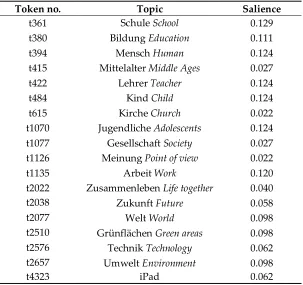
3.1. Personalized worldviews
277
The following table (table 1) shows the results of the co-reference analysis conducted on the
278
learners’ project reports. The topics listed are those that were mentioned in the reports with an
above-279
average frequency. The value specified in column 1 (“Token no.”) identifies the text passage where
280
the topic was first introduced (“t361” means the 361st text word). Low token numbers indicate an
281
early mention in the text, high token numbers indicate a late one. The value in column 3 (“Salience”)
282
indicates the relative frequency with which a topic is re-introduced in the text. High values in this
283
column indicate central topics, which are usually repeated over the entire course of the text.
284
Table 1. Results of the co-reference analysis on the learners’ project reports: main topics.
285
Token no. Topic Salience
t361 Schule School 0.129
t380 Bildung Education 0.111
t394 Mensch Human 0.124
t415 Mittelalter Middle Ages 0.027
t422 Lehrer Teacher 0.124
t484 Kind Child 0.124
t615 Kirche Church 0.022
t1070 Jugendliche Adolescents 0.124
t1077 Gesellschaft Society 0.027
t1126 Meinung Point of view 0.022
t1135 Arbeit Work 0.120
t2022 Zusammenleben Life together 0.040
t2038 Zukunft Future 0.058
t2077 Welt World 0.098
t2510 Grünflächen Green areas 0.098
t2576 Technik Technology 0.062
t2657 Umwelt Environment 0.098
t4323 iPad 0.062
The main topics identified make it easy to summarize the narratives contained in the learners’
286
project reports: Not surprisingly, the main topics are “School”, “Education”, “Teacher” and
287
“Children”/“Adolescents”, which are directly derived from the project theme (“Our School of the
288
Future”). What is interesting, however, is the early thematization of the humanistic ideal of education
289
(“Human”) and the role of the Church for the schools of the Middle Ages (“Middle Ages”), to which
290
the learners first refer. Only then a reference is made to the socializing function of schools (“Society”,
291
“Point of view”, “Life together”), but also to the purpose of education for the working world (in the
292
present). From the learners’ point of view, the school of the future is characterized not only by a
293
balanced relationship between humanistic education and training for a later employment, but also
294
by a balanced relationship between innovative technology (“Technology”, “iPad”) and ecology
295
(“Ecology”, “Green areas”) and by an increasing internationalization (“World”).
296
In the following, some excerpts from the learners’ project reports are presented as examples.
297
These excerpts illustrate the narratives outlined above. Among other topics, first two excerpts (2,3)
298
deal with the influence of the Christian Churches on the development of the education system:
299
Viel von der Bildung wurde auch von der Kirche übernommen. In Klöstern oder Pfarrschulen wurden auch Lehrer ausgebildet. Die Reformatoren wollten dann nach einigen Jahren durchsetzten, das es Bildung für alle gibt, für Jugend und Mädchen, Reiche und Arme. Dies wurde durch die Gründung von Städten und durch den Buchdruck begünstigt.
Much of the education was also taken over by the church. Teachers were also trained in monasteries or parish schools. After a few years, the Reformers wanted education for all, for boys and girls, rich and poor. This was fostered by the founding of cities and by book printing.
Noch heute sagt z.B. die evangelische Kirche in Deutschland, das die schulische Bildung und Erziehung von Kindern und Jugendlichen eine der wichtigsten Aufgaben in unserer Gesellschaft ist. Schulen müssen bereit sein, die Schüler auf eine Vielfalt von Lebenslagen vorzubereiten und den Schülern bei der Persönlichkeitsentwicklung und dem Prozess des Aufwachsens zu helfen. Sie muss sich auch auf Migration, Multikulturalität und mehrere Religionen einlassen. Schule soll nicht nur ein Ort des Lernens, sondern auch ein Ort des gemeinsamen Lebens sein. Man verbringt ja einen sehr großen Teil seines Lebens in der Schule, etwa zwei Drittel des Tages. Da sollte man sich auch wohlfühlen.
Even today, for example, the Protestant Church in Germany says that the education of children and young people at school is one of the most important tasks in our society. Schools must be ready to prepare students for a variety of situations and help them develop their personalities and grow up. They also have to engage with migration, multiculturalism and several religions. School should not only be a place of learning, but also a place of living together. You spend a very large part of your life at school, about two thirds of the day. You should feel comfortable there, too.
(3)
This feeling of well-being should be achieved in schools through innovative communication
300
technology on the one hand, and through a pleasant ecological learning environment on the other
301
(4,5):
302
Lernen ist in Zukunft stärker durch digitale Medien geprägt. Du hast keine Schultasche mehr, sondern dein Ipad und da sind alle Lernsachen drauf. Mann muss aber aufpassen, dass die Technik nur als Hilfsmittel genutzt wird und die Lehrkraft nicht vollständig ersetzt. Es gibt schon Kitas, in denen Ipads zur Dokumentation benutzt werden. Kinder können zwischendurch Fotos machen und sich diese später zusammen mit ihren Eltern anschauen oder besprechen.
In the future, learning will be more strongly influenced by digital media. You don't have a schoolbag anymore, you have your iPad and all your learning things are on it. But you have to be careful that the technique is only used as a tool and does not completely replace the teacher. There are already daycare centers in which iPads are used for documentation. Children can take photos in between and look at them later together with their parents or discuss them.
(4)
Es kann interessant sein, in und von der Natur zu lernen. Wir sollten vielmehr im Grün und mit dem Grün lernen. In meiner Traumvorstellung wären Grünflächen um die Schule herum mit Bächen und Bäumen. Die Schule wird zum Lebensraum auch durch eine einladende Architektur. Beispielsweise könnte man den Boden mit Teppich auslegen und die Wände farbenfroh gestalten.
It can be interesting to learn in and from nature. We should rather learn in the green and with the green. My dream would be green spaces around the school with streams and trees. The school also becomes a living space through its inviting architecture. For example, you could cover the floor with carpet and make the walls colorful.
(5)
The following excerpts (6,7) illustrate the relationship between the professional angle and the
303
personal orientation of education:
304
Beim Thema Arbeit ist auch die Frage wichtig: Warum arbeitet man überhaupt? Man kann arbeiten, um Geld zu verdienen, oder Arbeiten, weil damit ein bestimmter Sinn verbunden ist. Zum Beispiel backt der Bäcker einerseits, um sein Geld zu verdienen, andererseits aber auch, um andere Menschen satt zu machen. Wenn jeder nur arbeitet,
um Geld zu verdienen, entwickelt sich daraus eine egoistische Gesellschaft. Dann gibt es keine Liebe oder Wärme in der Gesellschaft mehr.
When it comes to work, the question is also important: Why work at all? You can work to earn money, or work because it has a certain meaning. For example, the baker bakes to earn money on the one hand, but also to feed other people. If everyone works just to make money, society becomes a selfish one. Then there will be no more love or warmth in society.
Ich bin zu dem Entschluss gekommen, dass in der Schule die Persönlichkeits-entwicklung in Zukunft deutlich in den Vordergrund rücken wird. Kinder sind durch den medialen Umschwung vielfach in einer seperaten Welt unterwegs. In Schulen muss deshalb das Kommunikative untereinander gefördert werden. Ich habe selbst kleine Kinder im Fußball trainiert. Früher saßen wir in der Halle und haben uns zwischen den Spielen unterhalten. Heute sitzen die Kinder da und machen mit Snapchatfiltern Fotos. Der Kontakt mit den Lehrpersonen ist vor allem deshalb wichtig für die Persönlichkeitsentwicklung, weil man sich andauernd in dieser separaten digitalen Welt bewegt.
I have come to the conclusion that personality development will become much more important at school in the future. Due to the changes in the media, children often live in a separate world. In schools, therefore, the communication with each other must be promoted. I trained small children in football myself. We used to sit in the hall and talk between games. Today the children sit there and take photos with Snapchat filters. Contact with teachers is particularly important for personal development because one is constantly living in this separate digital world.
(7)
3.2. Organized worldviews
305
We also investigated the potential sources of the personalized worldviews described above in
306
an automated manner. The procedure used for this essentially resulted in two clusters of thematically
307
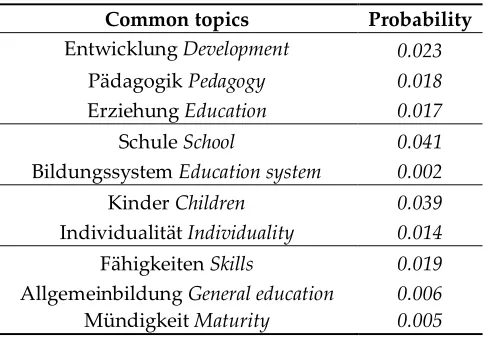
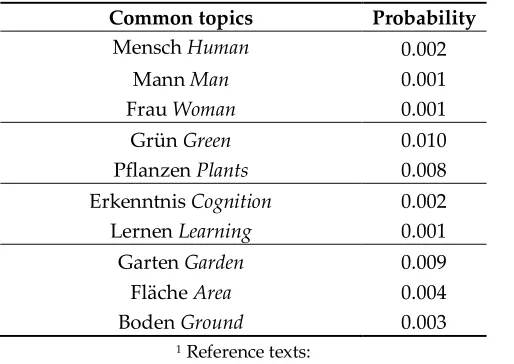
uniform reference texts, each of which also contains the learners’ project reports. The following two
308
tables (tables 2 and 3) show the topics that are common to all texts in one cluster. The value in the
309
second table column (“Probability”) indicates the prognostic relevance of a text topic for its
310
assignment to the corresponding cluster.
311
Table 2. Results of the Latent Dirichlet Allocation clustering on the learners’ project reports and a
312
choice of potential reference texts: cluster 1.1
313
Common topics Probability
Entwicklung Development 0.023
Pädagogik Pedagogy 0.018
Erziehung Education 0.017
Schule School 0.041
Bildungssystem Education system 0.002
Kinder Children 0.039
Individualität Individuality 0.014
Fähigkeiten Skills 0.019
Allgemeinbildung General education 0.006
Mündigkeit Maturity 0.005
1 Reference texts:
314
Wilhelm von Humboldt (1793): Theorie der Bildung des Menschen Theory of Human Education
315
Johann Heinrich Pestalozzi (1820): Wie Gertrud ihre Kinder lehrt How Gertrud Teaches her Children
316
Table 3. Results of the Latent Dirichlet Allocation clustering on the learners’ project reports and a
318
choice of potential reference texts: cluster 2.1
319
Common topics Probability
Mensch Human 0.002
Mann Man 0.001
Frau Woman 0.001
Grün Green 0.010
Pflanzen Plants 0.008
Erkenntnis Cognition 0.002
Lernen Learning 0.001
Garten Garden 0.009
Fläche Area 0.004
Boden Ground 0.003
1 Reference texts:
320
The Bible (standard translation): Gen 2,4b-25 (The Paradise)
321
The Quran (Bubenheim & Elyas 1980 translation): Suras 2; 7; 9; 13; 18; 23; 47; 52; 54; 56; 75
322
The topics of the first cluster (reference texts by Humboldt, Pestalozzi and Montessori; table 2)
323
all relate to the field of education theories (“Development”, “Pedagogy”, “Education”) resp. the
324
school and education system. The focus on children and their individuality (“Children”,
325
“Individuality”) as well as on their skills and important educational goals (“General education”,
326
“Maturity”) also fits in. Those reference texts (the Bible, the Quran; table 3) that we regard as sources
327
of religious ideas of paradise are significantly different. It is interesting that the paradise concepts
328
conveyed in the Bible and the Quran, which also occur in the learners’ project reports, do not differ
329
thematically to an extent that would justify an assignment to different clusters.
330
In other words, we can now assume that the learners in our experimental group derive their
331
individual personalized worldviews from organized worldviews that differ little in content, even
332
though the origin and sources of these worldviews differ. We see these results as a positive
333
confirmation of our approach of recognizing and acknowledging worldview diversity in the inclusive
334
classroom, where it is important to emphasize and strengthen the similarities in all apparent
335
differences.
336
3.3. Quality of the automatic procedures
337
Our choice of automatic linguistic and machine learning methods has enabled us to obtain
338
meaningful results regarding our research questions formulated above. According to their own
339
studies, the developers of these methods assume an accuracy of 80-85% for the co-reference analysis
340
method [16] and 85-95% for the Latent Dirichlet Allocation method [17], respectively. Although the
341
tools represent the current state of the art with these values, this is not sufficient for many linguistic
342
applications. However, with regard to cases such as ours, we consider the procedures to be adequate.
343
The automatic procedures have enabled us to evaluate a larger amount of text material in a structured
344
manner with justifiable time expenditure, even within the framework of a qualitative research design.
345
Once an automatic analysis procedure has been set up, it only takes a few minutes to complete. In
346
addition, the quantity of material to be evaluated can be scaled considerably without significant
347
additional effort. Another major advantage of automatic analysis is its reproducibility. Further
348
studies involving the same tools and data can be expected to produce the same results.
349
4. Discussion and conclusions
350
The results of the case study are instructive in four different ways with regard to the research
351
1. with regard to Universal Design for Learning as a framework that allows learners with different
353
learning requirements to work intensively on a common topic (see 1.2.1.).
354
2. in view of the emerging worldview diversity on a seemingly neutral topic (see 3.1.).
355
3. with regard to the possibility of exchanging worldview concepts in the presence of the other in
356
a safe space while learning about, from and with each other (see 1.2.3.).
357
4. in view of the importance of a Reflective Inclusion approach in teacher education (see 1.2.2.).
358
In the following, we finally will summarize and discuss these questions against the backdrop of the
359
study conducted.
360
4.1. The Universal Design for Learning as an activating methodological framework in inclusive (worldview)
361
education
362
In view of the relatively broad theme of the project described above, “Our School of the Future”,
363
the level of profundity with which the learners have worked on this theme is remarkable. The learners
364
not only developed a well thought-out plan for a good future school, including its architecture,
365
equipment, pedagogical approach and function in society, they also took into account the history of
366
the school system and the positions of important influential persons and institutions (see 3.1.). Even
367
though the effectiveness of the Universal Design for Learning framework in interaction with the
368
heterogeneous learning group under investigation was not examined in an experimental manner, it
369
can be ruled out that the learning success was spoiled by the inclusive learning environment. On the
370
contrary, the learners succeeded in bundling the diversity of perspectives into a dense working result.
371
4.2. Worldview diversity as a standard in (inculsive) education
372
At first glance, the topic "Our School of the Future" is not necessarily dependent on religious,
373
political or other worldviews. In this sense, it seems to leave room for – e.g. with regard to design
374
and equipment – seemingly neutral concepts that may be discussed controversially in questions of
375
taste, but not in questions of worldview. The results of the learning project show that learners can
376
hardly avoid worldview questions when topics are discussed genuinely. Be it the question of
general-377
, labor market- or personality-oriented education, the question of the roles of the state and the Church
378
in education, the question of the purpose of work in life, the question of benefits and burdens of new
379
technologies or even the question of how the ideal school building and its surroundings are to be
380
designed – none of these questions can be seen as naive (see 3.1.). The (automatic) intertextual
381
analysis showed that the learners’ school design concepts obviously incorporate ideas that refer to
382
religious paradise visions of Christianity and Islam (see 3.2.). These observations prove van der
383
Kooij’s thesis that education considering rules, values, morals or politics in the broadest sense cannot
384
be viewed in an ideologically neutral way [14]. In the context of a secularized society these values can
385
either lead to conflicts and exclusion or to peaceful and enriching encounters empowered by inclusive
386
worldview education.
387
The results indicate that worldview diversity certainly has an influence on teaching in inclusive
388
classrooms. A heterogeneous learning group brings heterogeneous personal worldviews with it,
389
referring to parts of larger overarching organized worldviews. Social, religious and cultural
390
backgrounds of both teachers and learners unconsciously influence the subterranean learning process
391
and must be taken into consideration when planning and conducting lessons.
392
4.3. Inclusive worldview education as a safe space for Learning in the Presence of the Other
393
If we, like van der Kooij [14], assume worldview diversity as the standard case, the question
394
arises what a discourse about worldview questions should look like in inclusive education and how
395
it can be ensured to be objective and to let each position come into its own. There is no doubt that
396
worldview diversity has an influence on teaching togetherness and that teachers should be aware of
397
This is where the concept of Learning in the Presence of the Other (see 1.2.3.) comes into play.
399
If a safe space can be created in learning environments that are sensitive to worldview diversity,
400
inclusive worldview education can help to resolve conflicts between students, parents or teachers. In
401
doing so, the three perspectives or intensities of worldview learning must be taken into account,
402
which we would like to address again at this point [3]: If there are no starting points for a constructive
403
transformation, differences can at least be imparted objectively in the mode of “learning about”. The
404
communication of the different worldviews at eye level allows a “learning from” process in the
405
course of which personal and foreign world views can be related to one another. Finally, in an
406
atmosphere of mutual trust, learners can dare to mutually immerse themselves in the worlds of faith
407
and identity of the respective other, a “learning in/through”. In a sincere encounter of this kind,
408
harmonized post-identitarian worldviews can emerge that facilitate togetherness as well as common
409
action-guiding beliefs and values [11].
410
As we have seen in the case study, learners were able to harmonize their worldviews in the
411
investigated environment, focusing on common values without giving up their own points of view.
412
In their common vision of the future they achieved a sustainable common position with regard to
413
seeming opposites such as technology vs. nature, labor market vs. personality orientation of
414
education, paradise concepts of the Bible vs. the Quran (see 3.2.). This can be a basis for good
415
encounters between different cultures and religions both in school and everyday life.
416
4.4. Reflective Inclusion as an desideratum for teacher education
417
Finally, the above perspectives (see 4.1. to 4.3.) make it apparent that dealing with worldview
418
diversity leads to complex teaching/learning situations for which teachers must be adequately
419
prepared. In particular, they should be trained to distinguish between personal and organized
420
worldviews. As we have seen, apparently incompatible worldviews such as those of Islam and
421
Christianity do not necessarily have to contradict each other at the level of the derived personalized
422
worldviews. For example, the ideas of paradise introduced by the different learners were not
423
controversial (see 3.2.).
424
In order to gain further insights in the field of Reflective Inclusion, the data collected at
425
Münsterlandschule (see 2.) were discussed as part of a university course on worldview diversity for
426
students of the teaching profession in the winter semester 2016/2017. Our aim was to immediately
427
implement the empirical findings of the abovementioned study (see 3.) in teacher education at
428
university. The students sifted through the material and discussed their expectations and
429
observations. On the basis of an initial evaluation of this group discussion, the following key points
430
for dealing with worldview diversity in the context of teacher education can be formulated:
431
Teachers should be able to understand which worldviews expressed by learners are actually
432
part of organized worldviews and which are individual readings of the learners. For example,
433
disruptions coming from a learner who observes fasting rules for religious reasons cannot be
434
generalized and attributed to all learners with the same religion. It is quite conceivable that different
435
learners interpret orthopraxy in varying degrees of rigor. In the sense of the concept of Reflective
436
Inclusion (see 1.2.2.) a positive knowledge of organized worldviews protects teachers from forming
437
prejudices against certain political or religious groups. In this sense, (self-)reflection is a crucial
438
dimension of the professional work of teachers, especially in the context of inclusive
diversity-439
sensitive education. To this end, embedding reflective inclusion in teacher education is an important
440
requirement, if we want the aforementioned methods and didactics to work.
441
Acknowledgments: This study was conducted as part of the project “Dortmunder Profil für inklusionorientierte
442
Lehrer/-innenbildung DoProfiL” (Dortmund Profile for Inclusion-Oriented Teacher Education). The Ministry of
443
Education and Research of the Federal Republic of Germany is supporting this project as part of the
444
“Qualitätsoffensive Lehrerbildung” (Quality Offensive for Teacher Education).
445
Author Contributions: Janieta Bartz and Thomas Bartz conceived and designed the experiments; Thomas Bartz
446
performed the experiments; Janieta Bartz and Thomas Bartz analyzed the data; Janieta Bartz contributed
447
Conflicts of Interest: The authors declare no conflict of interest. The founding sponsors had no role in the design
449
of the study; in the collection, analyses, or interpretation of data; in the writing of the manuscript, and in the
450
decision to publish the results.
451
References
452
453
1. Rose, D.H.; Meyer, A. Teaching every student in the Digital Age: Universal Design for Learning, Association for
454
Supervision and Curriculum Development: Alexandria, Virginia, 2002.
455
2. Roebben, B. „Einander in der Fremdheit begegnen“. Möglichkeiten und Grenzen einer Spiritual Learning
456
Community. In Anerkennung in religiösen Bildungsprozessen. Interdisziplinäre Perspektiven. Diskursschrift für
457
Martin Jäggle, Krobath, T., Lehner-Hartmann, A., Polak, R., Eds.; V&R unipress: Wien, Austria, 2013; pp.
458
149–164.
459
3. Roebben, B. Living and Learning in the Presence of the Other. Defining Religious Education Inclusively.
460
International Journal of Inclusive Education 2012, 16, pp. 1175–1187.
461
4. Budde, J.; Hummrich, M. Reflexive Inklusion. Zeitschrift Für Inklusion 2014, 4. Available online:
462
https://www.inklusion-online.net/index.php/inklusion-online/article/view/193 (accessed on 15th July 2018).
463
5. Bartz, J. Jugendpastoral auf neuen Wegen: Der XXVIII. Weltjugendtag in Rio de Janeiro und sein Beitrag für die
464
Kirche vor Ort, LIT Verlag: Münster, Germany, 2017.
465
6. Bakker, C.; Montessori, N.M. Complexity in Education. From Horror to Passion, Sense Publishers: Rotterdam,
466
The Netherlands, 2016.
467
7. Hinz, A. Von der Integration zur Inklusion – terminologisches Spiel oder konzeptionelle
Weiterent-468
wicklung? Zeitschrift für Heilpädagogik 2002, 53, pp. 354–361.
469
8. Grosche, M. Was ist Inklusion? Ein Diskussions- und Positionsartikel zur Definition von Inklusion aus Sicht
470
der empirischen Bildungsforschung, In Inklusion von Schülerinnen und Schülern mit sonderpädagogischem
471
Förderbedarf in Schulleistungserhebungen. Kuhl P., Stanat P., Lütje-Klose B., Gresch C., Pant H., Prenzel M.,
472
Eds; Springer VS: Wiesbaden, Germany, 2015, pp. 17–39.
473
9. Mace, G; Hardie, J.; Place, J.P. Accessible Environments: Toward Universal Design, The Center for Universal
474
Design: Raleigh, North Carolina, 1996.
475
10. Dannenbeck, C; Dorrance, C. Inklusion als Perspektive (sozial)pädagogischen Handelns – eine Kritik der
476
Entpolitisierung des Inklusionsgedankens, Zeitschrift für Inklusion 2009, 2. Available online:
477
http://bidok.uibk.ac.at/library/inkl-02-09-dannenbeck-inklusion.html (accessed on 15th July 2018).
478
11. Bartz, J.; Delucchi Danhier, R.; Mertins, B.; Schüppel, K.; Welzel, B.; Zimenkova, T. Auf dem Weg zur
479
Neuverortung: Sprache, Objektkultur und Religion im transkulturellen Deutschland. In Dortmunder Profil
480
für inklusionsorientierte Lehrerinnen- und Lehrerbildung. Hußmann, S, Welzel, B., Eds.; Waxmann: Münster,
481
Germany 2018, pp. 179–194.
482
12. Roebben, B. Schulen für das Leben. Eine kleine Didaktik der Hoffnung, Calwer Verlag: Stuttgart, Germany, 2016.
483
13. Roebben, B. Religionspädagogik der Hoffnung: Grundlinien religiöser Bildung in der Spätmoderne, LIT Verlag:
484
Münster, Germany, 2011.
485
14. Van der Kooij, J.C. Worldview and moral education: On conceptual clarity and consistency in use. PhD
486
Thesis, Vrije Universiteit Amsterdam, The Netherlands, 2016.
487
15. Meyring, P. Qualitative Inhaltsanalyse: Grundlagen und Techniken, Beltz: Weinheim, Germany, 2010.
488
16. Tuggener, D. Incremental Coreference Resolution for German. PhD Thesis, University of Zurich,
489
Switzerland, 2016.
490
17. Blei, D.M.; Ng, A.Y.; Jordan, M.I. Latent dirichlet allocation. Journal of Machine Learning Research, 2003, 3,
491
pp. 993–1022.
492
18. Hoffmann, L. Deutsche Grammatik. Grundlagen für Lehrerausbildung, Schule, Deutsch als Zweitsprache und
493
Deutsch als Fremdsprache, Erich Schmidt Verlag: Berlin, Germany, 2016.
494
19. Bubenhofer, N.; Müller, N.; Scharloth, J. Narrative Muster und Diskursanalyse: Ein datengeleiteter Ansatz.