
Article
Analysis of Optimal Sensor Positions for Activity
Classification and Application on a Different Data
Collection Scenario
Natthapon Pannurat 1, Surapa Thiemjarus 2,*, Ekawit Nantajeewarawat 1 and Isara Anantavraslip3 1 School of Information, Computer, and Communication Technology, Sirindhorn International Institute of
Technology, Thammasat University, Pathumthani, Thailand; [email protected] (N.P.); [email protected] (E.N.)
2 National Electronics and Computer Technology Center, Pathumthani 12120, Thailand; 3 International College, King Mongkut's Institute of Technology Ladkrabang, Thailand; [email protected] (I.A.)
* Correspondence: [email protected] (S.T.); Tel.: +66-2-5646-900 (ext. 2479)
Abstract: This paper focuses on optimal sensor positioning for monitoring activities of daily living and investigates different combinations of features and models on different sensor positions, i.e., the side of the waist, front of the waist, chest, thigh, head, upper arm, wrist, and ankle. Nineteen features are extracted and the feature importance is measured by using the Relief-F feature selection algorithm. Eight classification algorithms are evaluated on a dataset collected from young subjects and that collected from elderly subjects, with two different experimental settings. To deal with different sampling rates, signals with a high data rate are down-sampled and a transformation matrix is used for aligning signals to the same coordinate system. The thigh, chest, side of the waist, and front of the waist are the best four sensor positions for the first dataset (young subjects), with average accuracy values being greater than 96%. The best model obtained from the first dataset for the side of the waist is validated on the second dataset (elderly subjects). The most appropriate number of features for each sensor position is reported. The results provide a reference for building activity recognition models for different sensor positions, as well as for data acquired from different hardware platforms and subject groups.
Keywords: activity classification, activity monitoring, wearable sensors, sensor positions
1. Introduction
Body Sensor Network (BSN) has recently been an emerging technology that provides a platform for pervasive healthcare monitoring [1]. The technology is believed to play an important part in improving the quality of life for elderly people and patients. In healthcare monitoring, wearable sensors have been employed for several applications including energy expenditure estimation [2–4] and analysis [5,6], fall detection [7], fall risk assessment [8], activities of daily living (ADLs) classification [9,10], motor rehabilitation [11], and cardiac monitoring [12].
with the additional use of the gyroscope. Compared to a gyroscope, an accelerometer requires less power [16,17] and is thus a more suitable sensor as power constraint is one of the challenging issues in a BSN application. Other problems and requirements for effective development of a BSN application can be found in [18].
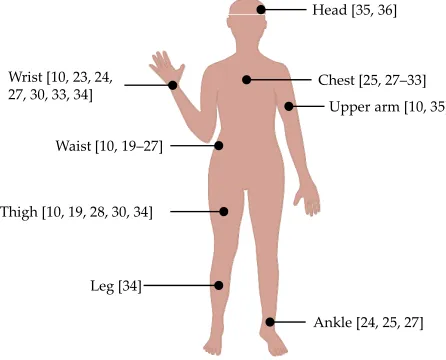
Chest [25, 27–33]
Thigh [10, 19, 28, 30, 34]
Ankle [24, 25, 27] Wrist [10, 23, 24,
27, 30, 33, 34]
Waist [10, 19–27]
Leg [34]
Head [35, 36]
Upper arm [10, 35]
Figure 1. Different positions for sensor placement.
In several studies [37–39], multiple sensors have been used either to improve detection accuracy and/or to find an optimal placement. Although higher classification accuracy has been reported with the use of multiple sensors [38], multi-sensor fusion will introduce several research challenges as discussed in [40]. Taking usability into consideration, a smaller number of sensors is preferable. As depicted in Figure 1, a large variety of sensor positions have been examined in previous studies. In order to find an optimal sensor position, Gjoreski et al. [37] placed tri-axial accelerometers on subject’s chest, waist, thigh, and ankle. Several types of ADLs (e.g., lying, sitting, standing, sitting on the ground, sitting/lying down, standing up, and all fours on the ground) and falls (e.g., tripping, falling slowly, falling from a chair slowly, and falling from a chair quickly) were classified using statistical features, e.g., mean, root mean square, and standard deviation. With only one sensor, the accuracy values of 75% and 77% were achieved at the chest and waist, respectively. Atallah et al. [39] investigated the optimal sensor positions by placing tri-axial accelerometers on different parts of subjects’ bodies. Three feature selection algorithms, i.e., Relief, Simba, and minimum redundancy maximum relevance (mRMR), were used for measuring feature importance. These algorithms gave the same four highest ranked features. With only four features, kNN yielded reasonable results for distinguishing five levels of activities, i.e., very low, low, medium, high, and transactional activities. In [38], an ADL classification experiment was conducted based on five tri-axial accelerometers placed on the chest, waist, thigh, lower back, and ankle. Eleven types of features were used for classifying seven types of ADLs, i.e., lying, sitting, standing, walking, walking upstairs, walking downstairs, and jogging. Four machine-learning algorithms, i.e., decision tree (J48), naïve Bayes (NB), neural network (NN), and support vector machine (SVM), were evaluated by using WEKA Experimenter. With a single sensor, J48 and NB yielded the best accuracy values when the sensor was placed on the ankle, while SVM appeared to be the best classifier for all other positions. Out of the four positions, the waist was reported as the best single position, with the accuracy value of 97.81%. In some studies [41–43], other criteria besides accuracy (e.g., computation cost, power consumption, and sensor redundancy) are also considered in the data analysis step. The experiments in these studies involved multiple sensor nodes and beyond the scope of this study.
for discovering appropriate models and features for classifying ADLs. The main objectives of this paper are twofold:
1. To investigate three different factors that affect ADL classification, i.e., sensor positions, features, and classification models.
2. To explore the possibility of applying a model trained from data collected in a different experimental setting (e.g., a subject group, a sampling rate, and hardware).
In this study, we focus on optimal sensor positioning for monitoring elderlies’ activities such as sleep postures, sitting, standing, and walking. Collecting data from elderlies (vulnerable subjects) has some limitations. They are uncomfortable to perform certain activities and/or are not able to perform certain activities for a long period of time. Walking upstairs/downstairs, for example, are not included in this study as many of the elderlies would require assistance to perform these activities and trading the classification accuracy of walking upstairs/downstairs for that of other activities would not benefit a monitoring system for elderlies as a whole. To address the above two objectives, two datasets are used. The first dataset is collected from young subjects using tri-axial accelerometers placed on different body parts. The second dataset is collected from elderly subjects using a different hardware platform and a different sampling rate. By using the data collected from young subjects, we first study various combinations of features and models on different sensor positions, and analyze how the three factors (i.e., sensor positions, features, and classification models) affect the ADL classification. The best obtained model is then applied on the dataset collected from elderly subjects.
The paper is organized as follows: Section 2 describes the datasets used in our experiments. Section 3 presents data analysis techniques. Section 4 reports the experimental results and Section 5 concludes this paper.
2. Data Descriptions
This study involves two datasets, i.e., DS1 for deriving appropriate combinations of features and activity classification models on different sensor positions and DS2 for assessing the performance of pre-trained models when applied on data obtained using another data collection scenario. Wireless ear-worn activity recognition (e-AR) sensors [44] and a BSN node [45], developed by Imperial College, were used for collecting DS1 and DS2, respectively. An e-AR sensor uses a Nordic nRF24LU1P processor, with an IEEE 802.15.4 (2.4GHz) integrated radio transceiver. A BSN node is based on a TI MSP430F1611 processor and equipped with a separate radio transceiver (Chipcon CC2420). Figure 2 shows an e-AR sensor and a BSN node, along with the coordinate systems of their embedded tri-axial accelerometers.
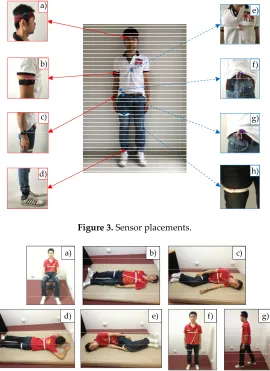
The dataset DS1 was collected (using e-AR sensors) from 12 subjects (6 male and 6 female), aged between 23–45 years. Acceleration signals were sampled at 15 Hz and transmitted to a computer through a receiver board. As shown in Figure 3, the e-AR sensors were placed on eight different body positions, i.e., a) the side of the head, b) the upper arm, c) the wrist, d) the ankle, e) the chest, f) the side of the waist, g) the front of the waist, and h) the thigh. The twelve subjects were asked to perform a sequence of seven activities, i.e., a) sitting on a chair, b) supine, c) lying on the left side, d) prone, e) lying on the right side, f) standing, and g) walking, as shown in Figure 4. Each subject performed each activity for approximately 15 seconds.
The dataset DS2 was collected (using a BSN node) from 48 healthy elderly subjects (20 males and 28 females), with an average age of 67.52 years. Acceleration signals were sampled at 50 Hz. The subjects were asked to perform a routine of six activities, i.e., a) sitting on a branch, b) standing, c) walking, d) supine, e) lying on the left side, and f) lying on the right side, which are shown in Figure 5, with a tri-axial accelerometer being attached only to the side of the waist. Compared to the activities considered in DS1, prone was excluded since it was uncomfortable for elderly subjects.
x z
a) b)
y
x y
z
Figure 2. An e-AR sensor (a) and a BSN node (b) along with their coordinate systems.
a)
b)
c)
d)
e)
f)
g)
h)
Figure 3. Sensor placements.
a) b)
d) e) f) g)
c)
Figure 4. A young subject performing a sequence of 7 activities.
a) b) c)
d) e) f)
3. Data Analysis
3.1. Feature Extraction
Prior to feature extraction, data preprocessing is required. For instance, to handle different sampling rates, acceleration signals with a high data rate were down-sampled. To cater for different
device coordinate systems, a transformation matrix was used for aligning signals to the same coordinate system. To deal with noises in acceleration signals, a median filter technique was employed. To cater for inter-subject and hardware variations, acceleration signals were normalized
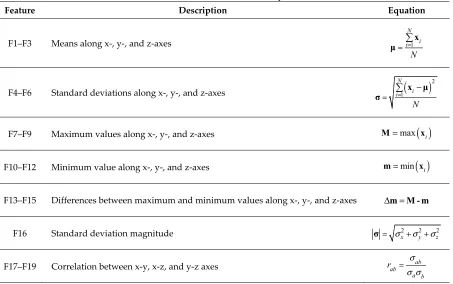
by subtracting the median values of signals acquired during standing. Table 1 describes the features used in this study along with the feature extraction functions. The functions are applied on
normalized data using a fix-sized window of 1 second, shifted by 0.5 second at each time step
.
Table 1.List of features and their equations.
Feature Description Equation
F1–F3 Means along x-, y-, and z-axes 1
N i i
N =
=
x μ
F4–F6 Standard deviations along x-, y-, and z-axes
(
)
2
1
N i i
N =
= x −μ
σ
F7–F9 Maximum values along x-, y-, and z-axes M=max
( )
xiF10–F12 Minimum value along x-, y-, and z-axes m=min
( )
xiF13–F15 Differences between maximum and minimum values along x-, y-, and z-axes Δ =m M - m
F16 Standard deviation magnitude σ = σx2+σ2y+σ2z
F17–F19 Correlation between x-y, x-z, and y-z axes ab ab a b
r σ
σ σ
=
N = number of data samples; i = data sample index; = observation vector at i; , , are standard deviation values along the x-, y-, and z-axes, respectively; σab is the covariance between axes a and b.
3.2. Feature Selection
Compared to other approaches to feature selection, a feature ranking approach, in general,
requires lower computation complexity and entails a lower risk of overfitting [46]. In [39], three feature selection algorithms were examined, i.e., Relief, Simba, and mRMR, and it was reported that
these algorithms yielded similar feature importance, especially for the first four highest ranked features. Relief-F [47], which is an extended version of Relief [48], was reported as the best feature
selection algorithm in [49] compared to Fast Correlation Based Filter and Correlation Based Feature Selection. It was one of the most widely used feature selection algorithms, with low computational time [50] and the ability to deal with incomplete and noisy data, and can be used for evaluating
In this study, Relief-F was used to determine the most appropriate feature sets. The algorithm
ranks individual features according to feature relevance scores. It randomly selects an instance R and finds the nearest sample H from the same class and the nearest sample M from a different class. Given a feature A and its feature relevance score W[A], instead of looking for the nearest sample M from only one different class, Relief-F searches one M for each different class C and averages their contributions for updating W[A] by
[ ]
[ ]
(
)
( )
( ) (
( ), ( ( )))
( ), ( )
,
C class R
P C A R A M C
A R A H
W A W A
n ≠ n
× Δ
Δ
= − +
where n is the number of instances used for approximating the probabilities; given a sample x,
Δ(A(R), A(x)) is the difference between the value of the feature A of the instance R and the value of that of x; class(R) denotes the class to which R belongs; and M(C) and P(C) denote the nearest sample
in the class C and the probability of the class C, respectively.
3.3. Classification Algorithms
The following classification algorithms are used in this study.
• Bayesian network (BN) [52]: BN is a directed acyclic graphical model describing relationships between features and classes. Each node in a graph corresponds to a feature and a directed edge between two nodes represents a causal relationship between them. By observing feature values and the class of each element in the set of data samples, one can construct such a network and use it to compute the probability of each class given an unseen sample. The class with the highest probability will be assigned to the sample. In our experiment, conditional probability tables are estimated by using a simple estimator and network structures are learned from the data distribution by using the K2 search algorithm along with Bayesian scores.
• Naïve Bayes (NB) [53]: NB is a simple Bayes’ theorem-based probabilistic classifier with independent assumptions among features.
• Pruned decision tree (J48) [54]: J48 is a Java implementation of the C4.5 decision tree algorithm. C4.5 determines “information gain” of each feature by comparing entropies of the data before and after considering the feature. C4.5 tries to construct a decision tree in which each node tests a feature value. Although the algorithm is proved to be very useful, features with many possible values could lead to overfitting. This problem could often be resolved by pruning some branches of the tree.
• Partial-tree rule learning (PART) [55]: PART uses the C4.5 decision algorithm to create a set of classification rules. However, unlike the ordinary C4.5, PART does not expand (or grow) a tree from the root to leaf nodes. It uses only a partially created tree that contains nodes with the lowest entropy to generate a set of rules. The instances covered by the created rules are then removed from the dataset. The process is repeated until all instances are covered.
• Instance-based learning [56]: Instead of building a classification model, an instance-based learning algorithm uses a set of given data as part of the classifier. The idea is built around an algorithm called k nearest neighbor (kNN). kNN treats each sample as a point in an M-dimensional space, where each dimension corresponds to one feature. It is assumed that elements of the same class should be close to each other (since they have similar properties, i.e., similar feature values). To classify an unseen sample, kNN finds k nearest data samples (or “neighbors”) and assigns the majority class of those samples to it.
output results to those in the next layer. Each perceptron in a subsequent layer produces an output by considering the results obtained from all perceptrons in its previous layer along with their corresponding weights. The process is repeated until the last layer is reached. A class is assigned to an unseen data sample based on the results of the last layer. The network can be trained to adapt itself to solve specific problems, by continually adjusting the weight of each input to each perceptron.
• Support vector machine (SVM) [58]: SVM is a supervised machine learning algorithm which can be used for both classification or regression analysis. Its basic principle is to define decision boundaries between a set of objects having different class memberships by constructing hyper planes in a multidimensional space. In our experiment, SVM is trained by applying a sequential minimal optimization algorithm with a polynomial kernel being used as a support vector.
In our experiments, we set the number k of neighbors for instance-based learning to 1 and 3. The performance of the eight algorithms, i.e., BN, NB, J48, PART, 1NN, 3NN, NN, and SVM, are compared. The classification models were developed in Java using WEKA API with their default parameters.
4. Results
4.1. Validation Using DS1 (Young Subjects)
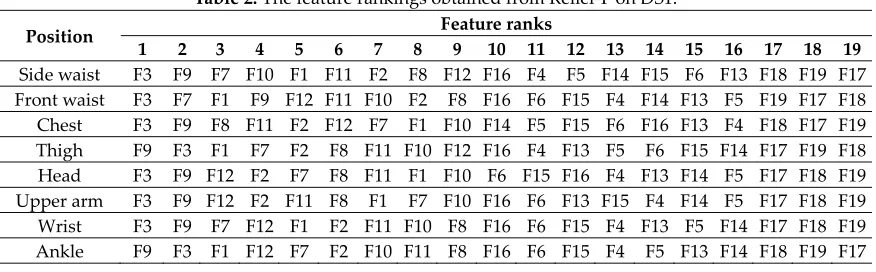
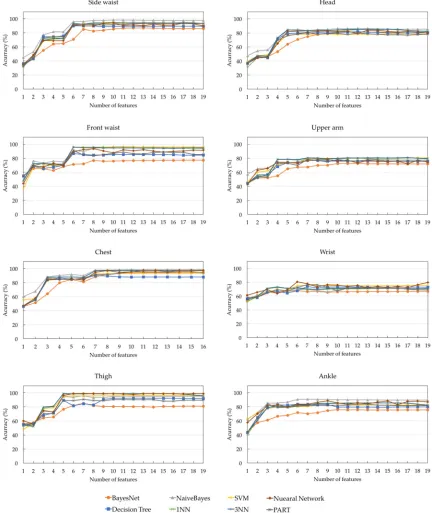
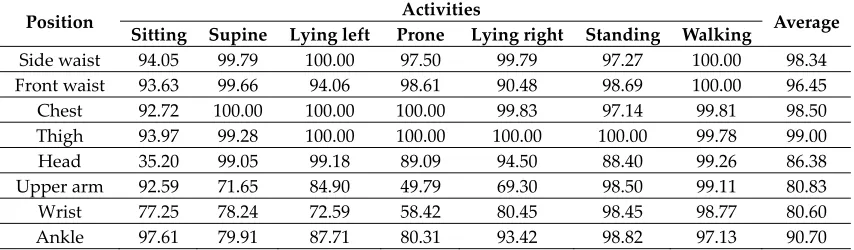
Table 2 shows the ranks of the 19 features obtained by applying the Relief-F feature selection algorithm to DS1. A smaller number indicates a better feature rank. The top two features used for all positions are the mean and the maximum values along the upward axis (F3 and F9). Considering the top four features, the maximum value along x-axis (F7) and the minimum values along the upward axis (F12) are the next most commonly used features, followed by the mean along the x-axis (F1). The correlation across the three axes (F17, F18, and F19) are the three lowest ranked features for all sensor positions. Since the number of subjects in DS1 is 12, six-fold cross validation was used to evaluate the eight classification algorithms. For each fold, the models were trained based on data acquired from ten subjects and evaluated on the data acquired from the two remaining unseen subjects. For each integer f such that 1 ≤ f ≤ 19, Figure 6 shows the average accuracy values of the eight classification algorithms across all sensor positions when the top f features for each sensor position were used. With only one feature, the accuracy values are relatively low for all sensor positions. The values can be improved by increasing the number of features. As there is no significant improvement on classification accuracy with further additional features, five to seven features are considered to be appropriate. The accuracy values of different classification algorithms across the eight sensor positions are shown in Figure 7. Table 3 summarizes the model settings with the best classification accuracy across different sensor positions. The thigh yields the highest accuracy value of 99%, using 1NN with five features. NB is the best model for the side of the waist, front of the waist, chest, head, and ankle, with accuracy values of 98.34%, 96.45%, 98.50%, 86.38%, and 90.70%, respectively. 3NN and NN are the best models for the upper arm and wrist, with the accuracy values of 80.83% and 80.60%, respectively.
Table 2. The feature rankings obtained from Relief-F on DS1.
Position Feature ranks
1 2 3 4 5 6 7 8 9 10 11 12 13 14 15 16 17 18 19
Figure 6. The average accuracy of the eight classification models across all sensor positions on DS1.
Table 3. Settings with highest accuracy for different sensor positions. Position Number of
features
Best algorithm
Accuracy
Side waist 10 NB 98.34
Front waist 11 NB 96.45
Chest 10 NB 98.50
Thigh 5 1NN 99.00
Head 12 NB 86.38
Upper arm 17 3NN 80.83
Wrist 6 NN 80.60
Ankle 7 NB 90.70
Table 4. Best algorithms for different number of features and sensor positions.
Position Feature ranks
1 2 3 4 5 6 7 8 9 10 11 12 13 14 15 16 17 18 19
Side waist NB NB NB NB NB NB NB NB NB NB NB NB NB NB NB NB NB NB NB
Front waist BN NB NB NB NN 3NN SVM SVM SVM NB NB NB SVM SVM SVM SVM SVM SVM SVM
Chest NB NB NB NB NB NB NB NB NB NB NB NB NB NB NB NB NB NB NB
Thigh BN BN 3NN 3NN NN NN 1NN NN NN 1NN 1NN 1NN 1NN 1NN 1NN 1NN NN NN NN
Head NB NB NB 3NN 1NN NB NB NB NN NB NB NB NB NB NB NB NB NB NB
Upper arm NB NB NB 3NN NN 3NN 3NN 3NN SVM 3NN 3NN 3NN 3NN 3NN 3NN 3NN 3NN SVM SVM
Wrist NN NN 3NN 3NN 3NN NN NN PART NN NN SVM NN SVM SVM SVM SVM SVM NN NN
Ankle NB NB NB NB NB NB NB NB NB NB NB NB NB NB NB NB NB NB NB
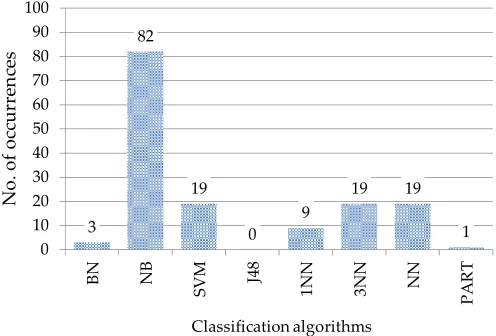
Table 4 shows the best algorithms versus different number of features and sensor positions. For all sensor positions except for the thigh, upper arm, and wrist, the best algorithms do not change when more than 12 features are used. It is well known that the best classification algorithm is data-dependent. The algorithm that occurs most often for a sensor position can be regarded as a generally suitable algorithm for that sensor position. From the results, NB is a generally suitable algorithm for the side of the waist, chest, head, and ankle, while 1NN, 3NN, and NN are generally suitable algorithms for the thigh, upper arm, and wrist, respectively. Apart from the front of the waist, the generally suitable algorithms are also the algorithms that yield best classification accuracy shown in Table 3. For the front of the waist, although SVM occurs most often as the best algorithm, it occurs only when more than the top six features are used. When a fewer number of features are used, NB is considered as a generally suitable algorithm for this position. Figure 8 summarizes the frequency that different algorithms appear as the best models across all experimental settings. In general, NB is considered as the best algorithm for this dataset, followed by SVM, 3NN, and NN.
3 82 19 0 9 19 19 1 0 10 20 30 40 50 60 70 80 90 100 BN NB SV M J48 1N N 3N N NN PA R T No . o f o ccur ren ces Classification algorithms
The class-specific accuracy values for the best models shown in Table 3 are detailed in Table 5. The limbs, i.e., the upper arm and wrist, are not suitable positions since they yield low accuracy for several activities (with the average accuracy being less than 85%). Average accuracy values greater than 96% are obtained from four sensor positions, i.e., the side of the waist, front of the waist, chest, and thigh. Lying postures are most difficult to classify when sensors are placed on the limbs, i.e., the upper arm, wrist, and ankle. When different subjects perform the same lying posture, their limb positions may be different.Sitting is most difficult to classify when a sensor is placed on the head; it is often misclassified as standing when a subject is sitting upright. Although the thigh appears to be the position that yields the highest average accuracy in this experiment, users may sit with different positions of their legs in realistic scenarios. In many other related works [10,39,59–61], a common suggestion is to place the sensor at the waist as this location is less affected by peripheral body motions than upper or lower limbs. In terms of usability, wearing a sensor at the waist is more comfortable compared to the thigh, particularly for elderlies.
Table 5. The ADL classification results obtained from the best models on DS1.
Position Activities Average
Sitting Supine Lying left Prone Lying right Standing Walking
Side waist 94.05 99.79 100.00 97.50 99.79 97.27 100.00 98.34 Front waist 93.63 99.66 94.06 98.61 90.48 98.69 100.00 96.45 Chest 92.72 100.00 100.00 100.00 99.83 97.14 99.81 98.50 Thigh 93.97 99.28 100.00 100.00 100.00 100.00 99.78 99.00 Head 35.20 99.05 99.18 89.09 94.50 88.40 99.26 86.38 Upper arm 92.59 71.65 84.90 49.79 69.30 98.50 99.11 80.83 Wrist 77.25 78.24 72.59 58.42 80.45 98.45 98.77 80.60 Ankle 97.61 79.91 87.71 80.31 93.42 98.82 97.13 90.70
4.2. Validation Using DS2 (Elderly Subjects)
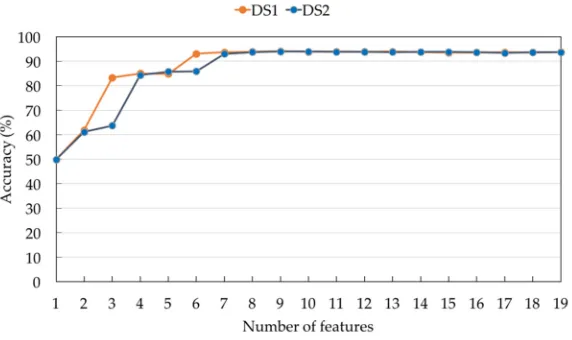
Feature ranking in the dataset DS2 and the possibility of applying a classifier trained from DS1 to DS2 were next investigated. Acceleration signals in DS2 were collected at a sampling rate of 50 Hz using a BSN node placed only on the side of the waist. The signals were down-sampled to approximately 15 Hz. A median filter technique was used to eliminate noise. To ensure that features extracted from the two devices are comparable, the coordinate system of the BSN node was aligned with that of an e-AR sensor. After the matrix transformation, the Relief-F feature selection algorithm was applied to DS2. Table 6 compares the ranks of the 19 features obtained from DS1 when a sensor was placed on the side of the waist (cf. the first row of Table 2) and those obtained from DS2. At the side of the waist, the most appropriate number of features is ten (cf. Table 3). According to Table 6, all the ten highest ranked features for DS1 also appear among the ten highest ranked features for DS2. Six ADL types are common to DS1 and DS2 (cf. Section 2), i.e., sitting, standing, walking, supine, lying on the left side, and lying on the right side. Figure 9 shows the average accuracy values of the eight classification models for these six common ADL types when the top f features were used for each integer f such that 1 ≤f ≤ 19. Except for the case when the top three and the top six features are used, the average accuracy values on DS1 and DS2 are almost the same. Based on Table 6 and Figure 9, it is expected that the top ten features used in the best model at the side of the waist for DS1 are also appropriate for DS2.
Table 6. The feature rankings obtained from Relief-F on DS1 and DS2 for the side of the waist.
Dataset Feature ranks
Figure 9. Comparison of average accuracy using feature ranking obtained from DS1 and DS2.
The best model at the side of the waist for DS1, i.e., NB, is validated on DS2 by using the top ten features derived from DS1 for the side of the waist. Table 7 shows the ADL classification results. The accuracy values of all ADL types are greater than 92%. The average accuracy is 95.77%, which is only slightly lower than the average accuracy obtained on DS1 using the same model and features (98.34%, cf. the first row of Table 3).
Table 7. The ADL classification results on DS2 using NB with the top ten features derived from DS1. Activities
Average Sitting Standing Walking Supine Ling left Lying right
96.03 96.78 100.00 94.32 92.04 95.43 95.77
4.3. Comparison with a Transfer Learning Method
A transfer learning was defined as the ability to extend what has been learned in one context to new contexts [62]. A summary of several existing works on activity recognition using transfer learning can be found in [63]. A recent work that is closely related to our study is presented in [64], in
which three different asynchronous data mapping (ADM) algorithms, i.e., brute force ADM (BFADM), clustering-based ADM (CADM), and motif-based ADM (MADM), were introduced for
supporting knowledge transfer in wearable systems. Tri-axial accelerometers (embedded in smartphones) with four different sampling rates, i.e., 50, 100, 150, and 200 Hz, were used for activity
recognition. Nine young subjects were asked to perform six types of ADLs, i.e., walking, sitting, standing, walking downstairs, walking upstairs, and biking, while wearing eight smartphones (two
phones for each sampling rate) on their waists. Three experiments were conducted, i.e., inter-subject, inter-device, and inter-model. The inter-subject experiment used data collected from eight subjects to train classification models and evaluated them with the remaining subject. The inter-device and
inter-model experiments used data collected from one phone to train models, which were then tested using signals from another phone with the same sampling rate and signals from that with a
different sampling rate, respectively. The classification models were trained and tested based on normalized cross-correlation with the resulting values lying between -1 and 1. Three classification
algorithms were used, i.e., kNN, decision tree, and random forest. Among the three mapping algorithms, BFADM yielded the highest accuracy using random forest. It was concluded in [64] that
the recognition accuracy of their approach could be affected by sampling frequency variation, device variation, and subject variation. In addition, cross-correlation is a poor measure to capture subject
when device orientations are different (since it relies on signal motifs, which are subsequences that
occur repeatedly in time series). In our study, we use signal resampling to handle the difference in sampling frequency, data normalization to handle inter-subject variation, and data transformation to
handle the difference in sensor orientations. Table 8 compares the experimental settings and classification accuracy in our study with those in [64].
Table 8. Comparison between our work and the work presented in [64]. Our study Saeedi et al.’s study
No. of subjects 12 young subjects 48 elderly subjects
9 young subjects
Sensor 3D accelerometers 3D accelerometers Sampling rate 15 and 50 Hz 50, 100, 150, and 200 Hz Features 19 features, with Relief-F feature
selection algorithm
Signal similarity
Window size 1 second (shifted by 0.5 second) 2 seconds (shifted by 0.5 second) Sensor
placements
Side waist, front waist, chest, thigh, head, upper arm, wrist, and ankle
Waist
Activities Sitting, supine, lying on the left side, prone, lying on the right side, standing, and walking
Walking, sitting, standing, walking downstairs, walking upstairs, and biking
Classifiers BN, NB, J48, PART, kNN, NN, and SVM
kNN, decision tree, and random forest
Accuracy 98.34% (side waist, using NB with 10 features)
~85% (with random forest)
5. Conclusions
This study presents ananalysis of optimal settings for activity classification in terms of sensor positions, features, and classifiers, and assesses the possibility of applying a trained model on data
acquired from a different experimental scenario. Focusing on monitoring basic activities performed by elderlies, only four lying postures, sitting, standing, and walking are considered.
In the first experiment, activity classification was performed on a dataset collected from young subjects using e-AR sensors attached to eight different parts of subjects’ bodies, i.e., the side of the
waist, front of the waist, chest, thigh, head, upper arm, wrist, and ankle. Nineteen features were extracted and their importance was measured by using the Relief-F feature selection algorithm.
Different combinations of features and eight classification algorithms on different sensor positions were investigated. For each sensor position, the best classification model and the most appropriate features were reported. The mean and the maximum values along the upward axis were the top
two common features used for all sensor positions. Among the eight positions, the side of the waist, front of the waist, chest, and thigh were the optimal sensor positions. NB outperforms other
classifiers for most feature combinations. The NB algorithm with ten to eleven features was the best model for the side of the waist, front of the waist, and chest, while the 1NN algorithm with five
In the second experiment, the dataset was collected from elderly subjects using a BSN node
placed on the side of the waist. To process the signals from different environment settings, signals with high sampling rate were down-sampled and coordinate systems were aligned to the same
direction. The experimental results show that the best model derived from the young-subject dataset can still perform with high classification accuracy when applied on the elderly-subject dataset. This demonstrates that data collection effort could be saved when a new hardware
platform is developed, i.e., classification models obtained from a previous data collection scenario could be applicable on a new hardware platform, provided that appropriate data preprocessing has
been performed.
Acknowledgments: This work was supported by the Thailand Research Fund (TRF), under Royal Golden Jubilee Ph.D. Program Grant No. PHD/0247/2552, the National Research University Project, funded by Thailand Office of Higher Education Commission, the Centre of Excellence in Intelligent Informatics, Speech and Language Technology and Service Innovation (CILS), Thammasat University, and the Anandamahidol Foundation.
Author Contributions: N.P. and S.T. conceived and designed the experiments; I.A. wrote software for data collection, N.P. performed the experiments; N.P., S.T., and E.N. analyzed the data; N.P., S.T., E.N., and I.A. wrote the paper.
Conflicts of Interest: The authors declare no conflict of interest.
Abbreviations
The following abbreviations are used in this manuscript:
BSN: Body sensor network ADL: Activity of daily living BN: Bayesian network NB: Naïve Bayes
PART : Partial-tree rule learning kNN: k nearest neighbors NN: Neural network
SVM: Support vector machine
References
1. Yang, G.-Z., Body sensor networks. Springer-Verlag: London, 2006.
2. Bouten, C.; Sauren, A.; Verduin, M.; Janssen, J., Effects of placement and orientation of body-fixed accelerometers on the assessment of energy expenditure during walking. Medical & Biological Engineering & Computing 1997, 35, 50–56.
3. Swartz, A.; Strath, S.; Bassett, D.J.; O’Brien, W.; King, G.; Ainsworth, B., Estimation of energy expenditure using csa accelerometers at hip and wrist sites. Medicine & Science in Sports & Exercise 2000, 32, S450–S456.
4. Crouter, S.E.; Clowers, K.G.; Bassett, D.R., A novel method for using accelerometer data to predict energy expenditure. Journal of Applied Physiology 2006, 100, 1324–1331.
5. Mayagoitia, R.E.; Lötters, J.C.; Veltink, P.H.; Hermens, H., Standing balance evaluation using a triaxial accelerometer. Gait & Posture 2002, 16, 55–59.
6. Moe-Nilssen, R.; Helbostad, J.L., Trunk accelerometry as a measure of balance control during quiet standing. Gait &
7. Pannurat, N.; Theekakul, P.; Thiemjarus, S.; Nantajeewarawat, E. Toward real-time accurate fall/fall recovery detection system by incorporating activity information, Proceedings of the IEEE-EMBS International Conference on Biomedical and Health Informatics, Hong Kong and Shenzhen, China, 5–7 January 2012; pp 196–199.
8. King, R.C.; Atallah, L.; Wong, C.; Miskelly, F.; Yang, G.Z. Elderly risk assessment of falls with bsn, Proceedings of the International Conference on Body Sensor Networks, Singapore, 7–9 June 2010; pp 30–35.
9. Ravi, N.; Dandekar, N.; Mysore, P.; Littman, M.L., Activity recognition from accelerometer data. In Proceedings of
the Seventh conference on Innovative applications of artificial intelligence - Volume 3, AAAI Press: Pittsburgh,
Pennsylvania, 2005; pp 1541–1546.
10. Bao, L.; Intille, S.S. Activity recognition from user-annotated acceleration data, Proceedings of the Second International Conference on Pervasive Computing, Vienna, Austria, 21–23 April 2004; pp 1–17.
11. Fortino, G.; Gravina, R., Rehab-aaservice: A cloud-based motor rehabilitation digital assistant. In Proceedings of the
Eighth International Conference on Pervasive Computing Technologies for Healthcare, Institute for Computer
Sciences, Social-Informatics and Telecommunications Engineering: Oldenburg, Germany, 2014; pp 305–308. 12. Covello, R.; Fortino, G.; Gravina, R.; Aguilar, A.; Breslin, J.G. Novel method and real-time system for detecting the
cardiac defense response based on the ecg, Proceedings of IEEE International Symposium on Medical Measurements and Applications, 4–5 May 2013; pp 53–57.
13. Nuksawn, L.; Nantajeewarawat, E.; Thiemjarus, S. Real-time sensor- and camera-based logging of sleep postures, Proceedings of International Computer Science and Engineering Conference, Chiang Mai, Thailand, 23–26 November 2015; pp 1–6.
14. Shoaib, M.; Bosch, S.; Incel, O.D.; Scholten, H.; Havinga, P.J.M., Fusion of smartphone motion sensors for physical activity recognition. Sensors 2014, 14, 10146–10176.
15. Shoaib, M.; Bosch, S.; Incel, O.D.; Scholten, H.; Havinga, P.J.M., Complex human activity recognition using smartphone and wrist-worn motion sensors. Sensors 2016, 16, 426.
16. Godfrey, A.; Bourke, A.K.; Ólaighin, G.M.; van de Ven, P.; Nelson, J., Activity classification using a single chest mounted tri-axial accelerometer. Medical Engineering & Physics 2011, 33, 1127–1135.
17. Casson, A.J.; Vazquez Galvez, A.; Jarchi, D., Gyroscope vs. Accelerometer measurements of motion from wrist ppg during physical exercise. ICT Express 2016, 2, 175–179.
18. Fortino, G.; Giannantonio, R.; Gravina, R.; Kuryloski, P.; Jafari, R., Enabling effective programming and flexible management of efficient body sensor network applications. IEEE Transactions on Human-Machine Systems 2013, 43, 115–133.
19. Yeoh, W.S.; Pek, I.; Yong, Y.H.; Chen, X.; Waluyo, A.B. Ambulatory monitoring of human posture and walking speed using wearable accelerometer sensors, Proceedings of the Thirtieth Annual International Conference of the IEEE Engineering in Medicine and Biology Society, Vancouver, British Columbia, Canada, 20–25 August 2008; pp 5184–5187.
21. Baek, J.; Lee, G.; Park, W.; Yun, B.-J., Accelerometer signal processing for user activity detection. In
Knowledge-based intelligent information and engineering systems, Negoita, M.; Howlett, R.; Jain, L., Eds. Springer
Berlin Heidelberg: 2004; Vol. 3215, pp 610–617.
22. Meijer, G.A.L.; Westerterp, K.R.; Verhoeven, F.M.H.; Koper, H.B.M.; Hoor, F.t., Methods to assess physical activity with special reference to motion sensors and accelerometers. IEEE Transactions on Biomedical Engineering 1991, 38, 221–229.
23. Maurer, U.; Smailagic, A.; Siewiorek, D.P.; Deisher, M. Activity recognition and monitoring using multiple sensors on different body positions, Proceedings of International Workshop on Wearable and Implantable Body Sensor Networks, 3-5 April 2006; pp 113–116.
24. Tamura, T.; Fujimoto, T.; Muramoto, H.; Huang, J.; Sakaki, H.; Togawa, T. The design of an ambulatory physical activity monitor and it application to the daily activity of the elderly, Proceedings of the Seventeenth IEEE Annual Conference on Engineering in Medicine and Biology Society, Montréal, Canada, 20–23 September 1995; pp 1591– 1592.
25. Amir Mehmood; Akhter Raza; Adnan Nadeem; Saeed, U., Study of multi-classification of advanced daily life activities on shimmer sensor dataset. International Journal of Communication Networks and Information Security
2016, 8, 86–92.
26. Gupta, P.; Dallas, T., Feature selection and activity recognition system using a single triaxial accelerometer. IEEE
Transactions on Biomedical Engineering 2014, 61, 1780–1786.
27. Leutheuser, H.; Schuldhaus, D.; Eskofier, B.M., Hierarchical, multi-sensor based classification of daily life activities: Comparison with state-of-the-art algorithms using a benchmark dataset. PLoS ONE 2013, 8, e75196.
28. Lyons, G.M.; Culhane, K.M.; Hiltob, D.; Grace, P.A.; Lyons, D., A description of an accelerometer-based mobility monitoring technique. Medical Engineering & Physics 2005, 27, 497–504.
29. Lara, Ó.D.; Pérez, A.J.; Labrador, M.A.; Posada, J.D., Centinela: A human activity recognition system based on acceleration and vital sign data. Pervasive and Mobile Computing 2012, 8, 717–729.
30. McGlynn, D.; Madden, M.G., An ensemble dynamic time warping classifier with application to activity recognition.
In Research and development in intelligent systems xxvii, Bramer, M.; Petridis, M.; Hopgood, A., Eds. Springer
London: London, 2011; pp 339–352.
31. Khan, A.M.; Lee, Y.K.; Lee, S.Y.; Kim, T.S., A triaxial accelerometer-based physical-activity recognition via augmented-signal features and a hierarchical recognizer. IEEE Transactions on Information Technology in
Biomedicine 2010, 14, 1166–1172.
32. Ermes, M.; Parkka, J.; Cluitmans, L. Advancing from offline to online activity recognition with wearable sensors, Proceedings of the Thirtieth Annual International Conference of the IEEE Engineering in Medicine and Biology Society, Vancouver, British Columbia, Canada, 20–25 August 2008; pp 4451–4454.
33. Parkka, J.; Ermes, M.; Korpipaa, P.; Mantyjarvi, J.; Peltola, J.; Korhonen, I., Activity classification using realistic data from wearable sensors. IEEE Transactions on Information Technology in Biomedicine 2006, 10, 119–128. 34. Ahmadi, A.; Mitchell, E.; Richter, C.; Destelle, F.; Gowing, M.; N. E, O.C.; Moran, K., Toward automatic activity
35. Min, J.K.; Cho, S.B. Activity recognition based on wearable sensors using selection/fusion hybrid ensemble, Proceedings of IEEE International Conference on Systems, Man, and Cybernetics, Anchorage, Alaska, USA, 9–12 October 2011; pp 1319–1324.
36. Menz, H.B.; Lord, S.R.; Fitzpatrick, C., Age-related differences in walking stability. Age Ageing 2003, 32, 137–142. 37. Gjoreski, H.; Lustrek, M.; Gams, M. Accelerometer placement for posture recognition and fall detection, Proceedings
of the Seventh International Conference on Intelligent Environments, Nottingham, UK, 25–28 July 2011; pp 47–54. 38. Cleland, I.; Kikhia, B.; Nugent, C.; Boytsov, A.; Hallberg, J.; Synnes, K.; McClean, S.; Finlay, D., Optimal placement
of accelerometers for the detection of everyday activities. Sensors 2013, 13, 9183–9200.
39. Atallah, L.; Lo, B.; King, R.; Guang-Zhong, Y., Sensor positioning for activity recognition using wearable accelerometers. IEEE Transactions on Biomedical Circuits and Systems 2011, 5, 320–329.
40. Gravina, R.; Alinia, P.; Ghasemzadeh, H.; Fortino, G., Multi-sensor fusion in body sensor networks: State-of-the-art and research challenges. Information Fusion 2017, 35, 68–80.
41. Ghasemzadeh, H.; Panuccio, P.; Trovato, S.; Fortino, G.; Jafari, R., Power-aware activity monitoring using distributed wearable sensors. IEEE Transactions on Human-Machine Systems 2014, 44, 537–544.
42. Thiemjarus, S.; Pansiot, J.; Mcllwraith, D.G.; Lo, B.P.L.; Yang, G.-Z. An integrated inferencing framework for context sensing, Proceedings of the Fifth International Conference on Information Technology and Applications in Biomedicine, Shenzhen, China, 30–31 May 2008; pp 270–274.
43. Thiemjarus, S.; James, A.; Yang, G.-Z., An eye hand data fusion framework for pervasive sensing of surgical activities Pattern Recognition 2012, 45, 2855–2867.
44. Gaglione, A.; Chen, S.; Lo, B.; Yang, G.Z. A low-power opportunistic communication protocol for wearable applications, Proceedings of the Twelfth International Conference on Wearable and Implantable Body Sensor Networks, Cambridge, MA 02139, USA, 9–12 June 2015; pp 1–6.
45. Bsn development kit v.3. http://vip.doc.ic.ac.uk/bsn/a1892.html
46. Yang, G.-Z., Body sensor networks. Second ed.; Springer-Verlag: London, 2014.
47. Kononenko, I. Estimating attributes: Analysis and extensions of relief, Proceedings of the European conference on machine learning on Machine Learning Catania, Italy, 6–8 April 1994; pp 171–182.
48. Kira, K.; Rendell, L.A., A practical approach to feature selection. In Proceedings of the Ninth International Workshop
on Machine Learning, Morgan Kaufmann Publishers Inc.: 1992; pp 249–256.
49. Howcroft, J. Evaluation of wearable sensors as an older adult fall risk assessment tool. UWSpace, 2016.
50. Zhang, M.; Sawchuk, A.A., A feature selection-based framework for human activity recognition using wearable multimodal sensors. In Proceedings of the Sixth International Conference on Body Area Networks, ICST (Institute for Computer Sciences, Social-Informatics and Telecommunications Engineering): Beijing, China, 2011; pp 92–98. 51. Huan Liu; Motoda, H., Computational methods of feature selection. CRC Press: 2007.
52. Cooper, G.F.; Herskovits, E., A bayesian method for the induction of probabilistic networks from data. Machine
Learning 1992, 9, 309–347.
53. George, H.J.; Langley, P. Estimating continuous distributions in bayesian classifiers, Proceedings of the Eleventh conference on Uncertainty in artificial intelligence, Montréal, Quebec, Canada, pp 338–345.
55. Frank, E.; Witten, I.H., Generating accurate rule sets without global optimization. In Proceedings of the Fifteenth
International Conference on Machine Learning, Morgan Kaufmann Publishers Inc.: 1998; pp 144–151.
56. Aha, D.; Kibler, D., Instance-based learning algorithms. Machine Learning 1991, 6, 37–66.
57. Haykin, S., Neural networks: A comprehensive foundation. Prentice Hall PTR: Upper Saddle River, NJ, USA, 1998. 58. Platt, J., Fast training of support vector machines using sequential minimal optimization. In Advances in kernel
methods - support vector learning, Schoelkopf, B.; Burges, C.; Smola, A., Eds. MIT Press: 1999.
59. Kangas, M.; Konttila, A.; Winblad, I.; Jamsa, T. Determination of simple thresholds for accelerometry-based parameters for fall detection, Proceedings of the Twenty-Ninth Annual International Conference of the IEEE Engineering in Medicine and Biology Society, Lyon, France, 22–26 August 2007; pp 1367–1370.
60. Kumahara, H.; Tanaka, H.; Schutz, Y., Daily physical activity assessment: What is the importance of upper limb movements vs whole body movements? International Journal of Obesity 2004, 28, 1105–1110.
61. Bianchi, F.; Redmond, S.J.; Narayanan, M.R.; Cerutti, S.; Lovell, N.H., Barometric pressure and triaxial accelerometry-based falls event detection. IEEE Transactions on Neural Systems and Rehabilitation Engineering
2010, 18, 619–627.
62. Byrnes, J.P., Cognitive development and learning in instructional contexts. Allyn and Bacon: Boston, 1996.
63. Cook, D.; Feuz, K.D.; Krishnan, N.C., Transfer learning for activity recognition: A survey. Knowledge and
Information Systems 2013, 36, 537–556.
64. Saeedi, R.; Ghasemzadeh, H.; Gebremedhin, A.H. Transfer learning algorithms for autonomous reconfiguration of wearable systems, Proceedings of IEEE International Conference on Big Data, Washington D.C., USA, 5–8 December 2016; pp 563–569.
![Table 8. Comparison between our work and the work presented in [64].](https://thumb-us.123doks.com/thumbv2/123dok_us/8079830.1348138/12.595.110.487.184.483/table-comparison-work-work-presented.webp)
