Scholarship@Western
Scholarship@Western
Electronic Thesis and Dissertation Repository
4-22-2013 12:00 AM
Governing Occupation Through Constructions of Risk: The Case
Governing Occupation Through Constructions of Risk: The Case
of the Aging Driver
of the Aging Driver
Silke Dennhardt
The University of Western Ontario
Supervisor
Dr. Debbie Laliberte Rudman The University of Western Ontario
Graduate Program in Health and Rehabilitation Sciences
A thesis submitted in partial fulfillment of the requirements for the degree in Doctor of Philosophy
© Silke Dennhardt 2013
Follow this and additional works at: https://ir.lib.uwo.ca/etd
Part of the Critical and Cultural Studies Commons, Geriatrics Commons, Health Communication Commons, Other Life Sciences Commons, and the Other Public Health Commons
Recommended Citation Recommended Citation
Dennhardt, Silke, "Governing Occupation Through Constructions of Risk: The Case of the Aging Driver" (2013). Electronic Thesis and Dissertation Repository. 1221.
https://ir.lib.uwo.ca/etd/1221
This Dissertation/Thesis is brought to you for free and open access by Scholarship@Western. It has been accepted for inclusion in Electronic Thesis and Dissertation Repository by an authorized administrator of
(Thesis format: Monograph)
by
Silke Dennhardt
Graduate Program in Health & Rehabilitation Sciences
A thesis submitted in partial fulfillment of the requirements for the degree of
Doctor of Philosophy
The School of Graduate and Postdoctoral Studies The University of Western Ontario
London, Ontario, Canada
ii
Abstract
Risk and risk-management have become increasingly pervasive features of modern society
and governmentality scholars have highlighted various ways risk discourses are taken up to
govern citizens and their everyday conduct. Thus, attending to risk is imperative to advance
an understanding of how everyday occupation is shaped and governed within contemporary
society. Within this study, the example of driving in later life is drawn upon to address two
objectives: 1. to advance the understanding of how risk is taken up to govern everyday
occupation, and 2. to explicate how risk is taken up in discourses to constitute particular
subjectivities and their occupational possibilities.
In North-America, alarmist discourses predict a ‘grey Tsunami’ that will have devastating
impacts on social and individual security if governments and individuals do not proactively
prepare. Within this context, driving in later life has been problematized as a risky
occupation. Consequently, the so-called ‘older driver problem’ provides an example to
examine how risk is discursively employed to govern a specific occupation (‘driving’) and to
shape a specific occupational subjectivity (‘the aging driver’). A critical discourse analysis
(CDA) of information brochures targeting aging drivers and their families in Canada was
conducted. Drawing upon governmentality as an analytical lens, the analysis focused on how
risk as a rationality and technology was employed to construct the occupation of driving in
later life and the subjectivities of aging drivers.
Brochures incorporated a particular rhetorical structure and risk logic that served to construct
the occupation of driving in later as a site of governing. The risks of driving in later life were
located in the aging body which is constructed as a mis-fit with safe driving, and three
knowledge assemblages were employed to forefront a particular ideal aging driver
subjectivity, that is a risk-averse ‘activated’ driver. The texts also promoted an array of
self-practices as a means to work towards this subjectivity and avoid becoming a risk to self and
others. The study raises concerns regarding how risk is employed in neoliberal modes of
governing in ways that individualize responsibility for occupation and obscure the social and
political shaping of occupation.
iii
Acknowledgments
Many say that the process of writing a Ph.D. dissertation can be very isolating and lonely.
Mine wasn’t. Without doubt, there were challenging times in this process and some were
very long. However, I never felt lonely during this process due to the support of a number of
great people. These people need to be acknowledged here, as they have made this dissertation
possible and have helped me to find the perseverance and courage to complete it.
First and foremost, I owe sincere gratitude to Dr. Debbie Laliberte Rudman, my doctoral
supervisor. Debbie’s immense knowledge, patience, constructive feedback, critical way of
thinking, excellent advice, and constant encouragement have been of great value for me and
have gone far beyond all duty.
I would like to extend a special thanks to the members of my thesis advisory committee, Dr.
Jessica Polzer and Dr. Michael Heine, as well as to Thelma Sumsion, who was part of my
comprehensive committee. I am very glad that I had two members on my advisory committee
who were in fields other than my own, as this challenged me to refine and better express my
thoughts. Along with Debbie, they contributed to this dissertation through their critical,
excellent and encouraging feedback on my work. I am grateful for inspiring and motivating
advisory committee meetings, engaging discussions, and their open doors, whenever I had
questions. They made me ‘think’, taught me how to think, and fostered my academic growth
in multiple ways.
I would also like to express my gratitude to my examining committee, which was comprised
of Dr. Clair Ballinger, Dr. Roma Harris, Dr. Jessica Polzer, and Dr. Kevin Wamsley. They
carefully read over this dissertation and engaged me in an inspiring and rewarding discussion
about my work in my doctoral defense.
I am also deeply thankful to Alison White, my landlady, who became over the last years an
incredibly supporting and encouraging friend, especially in the last phase of writing this
thesis. Alison has contributed many significant things to this thesis, she offered me a living
place that truly became a home, proofread many papers and helped me improve my English.
iv
Susanne Kohalmi, and Dina Ribbink. My German card game friends kept me sane during my
Ph.D. journey by providing awesome dinners, friendship, fun, beer, outdoor trips, and so
much more. It is no exaggeration to say that Friday evenings left me always feeling better
than before and, thus, contributed a lot to the writing process.
I am very grateful to my family in Germany, in particular to Gudrun and Achim Gaiser, my
mother and stepfather. They need to be acknowledged for their financial support, the
Lebkuchen parcels, their patience and for never asking me if I really wanted to follow this
through. There is also my ‘Canadian Family’ to thank, in particular, Douglas and Ann White,
for inviting me every holiday to be part of their family dinners, as well as Cohen White, for
seeing a great playmate in me and for unconditionally awaiting me with great excitement, no
matter how many words I had written that day.
Of all my doctoral colleagues in the Graduate Program for Health and Rehabilitation
Sciences and the friends I gained along the way, I want to express a special thanks to: Birgit
Prodinger, Marie-Eve Catsy, Shanon Phelan, Svetlana Knorr, Mary-Beth Bezzina, Anelize
Zen Salces, Laura Titus, and Briana Zur. I feel incredibly fortunate for having the chance to
meet and study with you.
I’d also like to acknowledge the support of faculty and staff from the Field of Occupational
Science, the School of Occupational Therapy, the Graduate Program in Health and
Rehabilitation Sciences at the University of Western Ontario, and the members of the Faculty
of Information and Media Studies’ journal club.
And last, but not least, I’d like to acknowledge the contribution of my friends in Germany to
this dissertation, in particular Kathrin Reichel, Eva Sievers, Claudia Morlock, Petra Reinecke
and Ulrich Kross. They, and all others that I cannot individually name here, made it easy to
keep our friendship despite the geographical distance. They contributed to this dissertation by
reconnecting with me during my visits as if I never had been away, which helped me in my
v
Table of Contents
Abstract ... ii
Acknowledgments... iii
Table of Contents ... v
List of Tables ... ix
List of Figures ... x
List of Appendices ... xii
Chapter 1 ... 1
1 Introduction ... 1
1.1 Linking risk and occupation... 3
1.2 Thesis organization ... 7
1.3 Mapping risk: An overview of epistemological perspectives on risk ... 8
1.3.1 Technico-scientific perspective ... 9
1.3.2 Risk society perspective ... 11
1.3.3 Cultural/symbolic perspective ... 13
1.3.4 Governmentality perspective ... 14
1.4 Summary ... 16
Chapter 2 ... 18
2 Mapping the study of risk in the occupation-based literature: A scoping review ... 18
2.1 Introduction ... 18
2.2 Scoping review... 18
2.2.1 Methods... 18
2.2.2 Findings... 20
2.2.3 Occupation as a risk ... 22
vi
2.2.6 Occupation at risk ... 34
2.2.7 Discussion ... 38
2.2.8 Moving forward in studying occupation and risk: Incorporating socio-cultural perspectives... 42
2.2.9 Conclusion ... 44
2.3 Scope and focus of the study: The case of the aging driver... 45
Chapter 3 ... 51
3 Methodology ... 51
3.1 Analytic perspective: Governmentality ... 53
3.1.1 Power ... 56
3.1.2 Subject... 59
3.1.3 Risk ... 61
3.1.4 Occupation ... 63
3.1.5 Conclusion ... 66
3.2 Research methodology: Critical discourse analysis ... 67
3.2.1 Positioning myself ... 72
3.3 Summary ... 74
Chapter 4 ... 75
4 Methods ... 75
4.1 Research questions ... 75
4.2 The research field in critical discourse analysis ... 75
4.2.1 Constructing the research field for this study ... 76
4.3 Data collection ... 80
4.3.1 Inclusion and exclusion criteria ... 80
vii
4.3.4 Body of texts ... 91
4.4 Data analysis ... 95
4.4.1 Key pillars underlying the analysis approach ... 96
4.4.2 Analytic strategies and devices ... 99
4.4.3 Process of Analysis ... 102
4.5 Quality considerations ... 108
4.5.1 Coherence ... 108
4.5.2 Systematic and careful research conduct ... 109
4.5.3 Convincing and relevant interpretation ... 110
4.5.4 Accounting for role of researchers ... 111
Chapter 5 ... 114
5 Findings 1: Rhetorical structure and main discursive techniques ... 114
5.1 Rhetorical organization ... 114
5.2 Main discursive techniques: Knowledge assemblages ... 116
5.2.1 The fact knowledge assemblage: ‘Know the facts’ ... 121
5.2.2 The evaluation knowledge assemblage: ‘Find out where you stand’ ... 137
5.2.3 The action knowledge assemblage: ‘Stay safe and plan ahead!’ ... 155
5.3 Rhetorical structure: Interconnections between knowledge assemblages ... 174
5.3.1 Rhetorical structure: Overall narrative... 179
Chapter 6 ... 182
6 Findings 2: Discursive effects - The ideal aging driver ... 182
6.1 Becoming an ‘activated driver’: Key characteristics of ideal drivers ... 183
6.1.1 Being self-aware: Knowing one’s driving self ... 184
viii
informed action ... 191
6.2 Becoming active: Ideal practices ... 196
6.2.1 Taking care of one’s aging and driving body: Ideal body practices ... 196
6.2.2 Taking care of one’s driving: Ideal driving practices ... 208
6.2.3 The ideal aging driver and risky ‘others’ ... 221
7 Discussion and Conclusion ... 226
7.1 Governing driving through risk ... 227
7.1.1 The problematization of driving in later life ... 228
7.1.2 Configuring the problem: The aging driver and driving ... 231
7.1.3 Constructing risk objects: Dividing practices and expertise ... 236
7.1.4 Main effects of the identified problematization ... 240
7.2 Governing through subjectivity: Shaping and idealizing the ‘activated driver’ . 241 7.2.1 The activated driver and good neoliberal citizen ... 241
7.2.2 The risky driver ... 244
7.2.3 Technologies of the self ... 246
7.3 Governing occupation through risk ... 247
7.3.1 Occupation as a site and technology of governing ... 248
7.3.2 Riskifying occupation ... 251
7.3.3 Occupation and subjectivity ... 254
7.3.4 Conclusion ... 255
ix
List of Tables
Table 1: Linking risk and occupation………..22
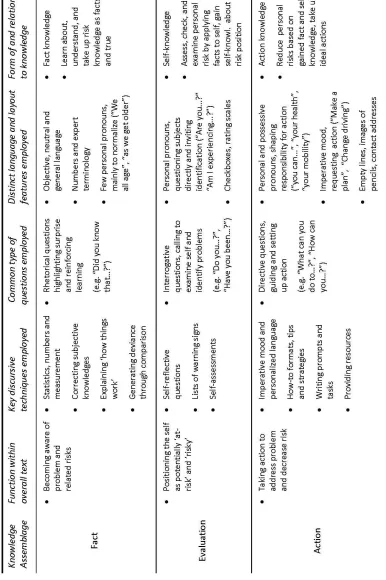
Table 2: Overview of identified knowledge assemblages……….118
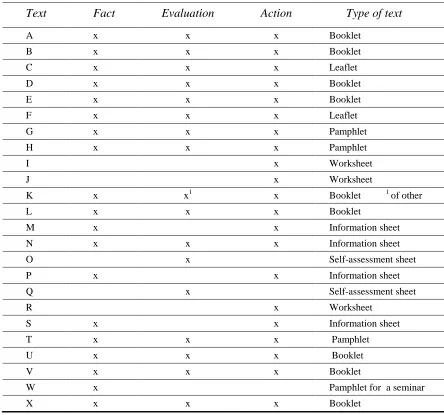
Table 3: Presence of knowledge assemblages in text………120
x
List of Figures
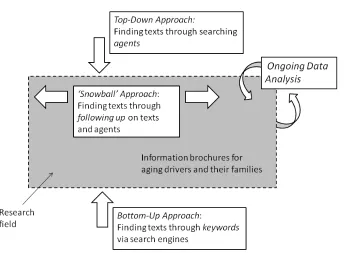
Figure 1: Constructing the research field……….83
Figure 2: Example snapshot of a webpage part………...90
Figure 3: Example images on a title page………92
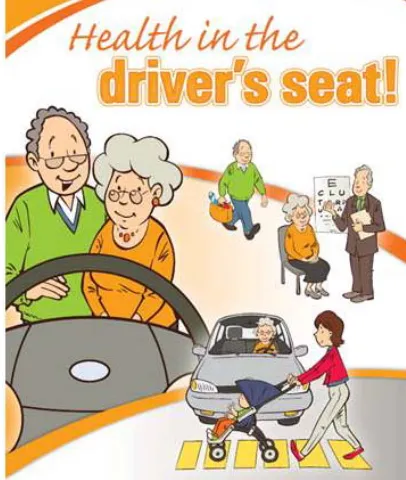
Figure 4: Fact knowledge assemblage, example use of statistics………..123
Figure 5: Fact knowledge assemblage, example use of research as authority………...126
Figure 6: Fact knowledge assemblage, example use of comparison……….134
Figure 7: Fact knowledge assemblage, example use of warning signs 1………...147
Figure 8: Fact knowledge assemblage, example use of warning signs 2………...148
Figure 9: Evaluation knowledge assemblage, example use of assessment instructions……151
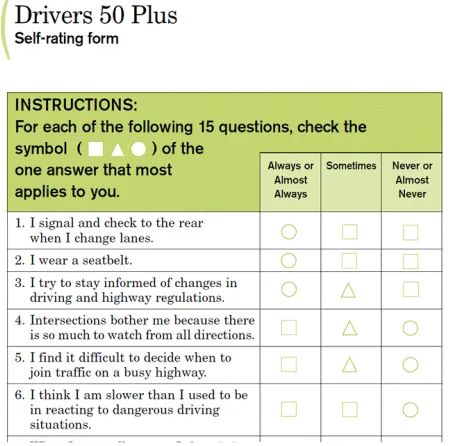
Figure 10: Evaluation knowledge assemblage, example use of rating the self……….152
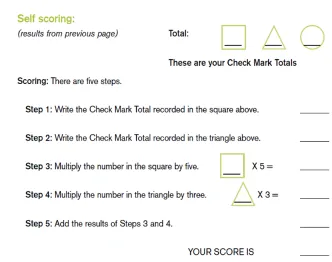
Figure 11: Evaluation knowledge assemblage, example use of calculating a score……….153
Figure 12: Evaluation knowledge assemblage, example use of understanding results…….154
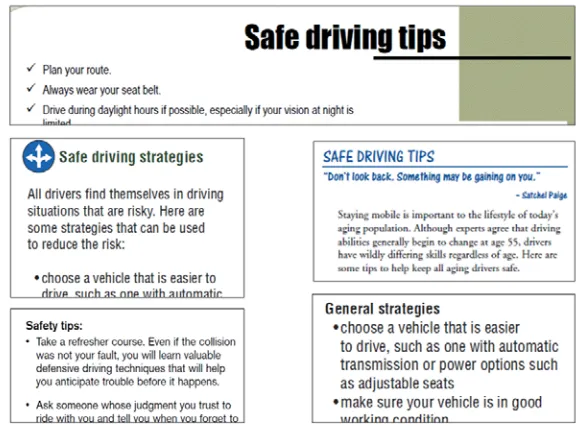
Figure 13: Action knowledge assemblage, example use of tips and strategies……….161
Figure 14: Action knowledge assemblage, example use of writing prompts………164
Figure 15: Action knowledge assemblage, example writing prompt………164
Figure 16: Action knowledge assemblage, example action task………...165
Figure 17: Action knowledge assemblage, example of calculation tasks………..166
Figure 18: Action knowledge assemblage, example use of personal planning……….167
xi
action………..169
Figure 21: Action knowledge assemblage, example use of resources………...170
Figure 22: Action knowledge assemblage, example action task of relationship between resources and reinforcing ideal practices………...173
Figure 23: Example chapter structure………176
Figure 24: Order of employed knowledge assemblages, first example……….178
Figure 25: Order of employed knowledge assemblages, second example………178
Figure 26: Rhetorical structure of texts……….180
Figure 27: Knowing oneself, example of promoting self-awareness………185
Figure 28: Example monitoring one's body………...198
Figure 29: Example optimizing one's body………...207
xii
List of Appendices
Appendix A: Publisher permission………277
Appendix B: Risk perspectives………..278
Appendix C: Included articles………...279
Appendix D: Body of texts………285
Chapter 1
11
Introduction
Risk has become a pervasive part of contemporary Western society. Every day, people
encounter many risk-related messages in their everyday doing; notions of risk have
become a taken-for-granted part of modern everyday life. For example, when making
breakfast, food labels bear reminders to not pursue this everyday activity thoughtlessly,
but rather to combat future health risks. Every breakfast can become a ‘smart start’ in the
quest for a long, healthy and disease-free life as it provides the chance to ‘make our heart
one bowl stronger’ (Kellogg's Smart Start®, 2011). Food products with names like
Praeventia (Praeventia Bars, 2011) or On Track Cereal (President's Choice On Track
Cereal, 2011) encourage people to include preventive thinking in their daily activities,
provide reassurance about being ‘on track’ in maximizing their lives and validate an
epidemiological mindset that “life is a process of selecting a cause of death” (Levin,
2005, p.1103).
As well, the broader socio-cultural contexts in which people carry out the activities of
daily life have also been re-shaped in relation to notions of risk. For instance, based on
concerns about children’s safety and wellbeing, today’s spaces for childhood activities
are increasingly narrowed and shielded by adults (Cobb, Danby, & Farrell, 2005; Jackson
& Scott, 1999; Parton, 2006). In contemporary North America, childhood activities occur
more and more in pre-planned, organized and surveilled ways (O'Brien & Smith, 2002;
Scott, Jackson, & Backett-Milburn, 1998).
Scholars have noted that in contemporary risk-averse or ‘risk society’ (Beck, 1986, 1992)
many things, such as obesity, genes, and illness, have come to be framed as ‘risks’ and, in
1
turn, as undesirable, predictable, and preventable (Lemke, 2004; Lupton, 1995;
McDermott, 2009). Considerations of risk and safety have become powerful features
within modern Western society (Beck, 1992; Furedi, 2002; Garland, 2003; Giddens,
1991; Kemshall, 2002), often drawn upon to emphasize individual responsibility in
following a ‘healthy’ lifestyle and enacting safety information (Bunton, Nettleton, &
Burrows, 1995; Rasmussen & Kroon Lundell, 2012; Webb, 2006). In particular contexts,
for instance, ‘accidents’ gradually disappear, intentionally replaced by the term
‘preventable injuries’. Individuals learn at their workplace that “there are really no
accidents” (Workplace Safety & Insurance Board Ontario, 2008, p.4), editors of a
scientific journal proudly announce that they have ‘banned’ the word accident from their
journal as accidents are not unpredictable ("BMJ bans 'accidents': Accidents are not
unpredictable" by Davis & Pless, 2001), and newspapers frame falls among seniors as a
preventable public health problem and ‘falling seniors’ as a risk and burden to society
(“Falling seniors: A preventable problem, a ‘huge health burden’”, The Globe and Mail,
May 29, 2011). Such examples raise questions about the social consequences of the
prevalence of risk in shaping realities of social life. For occupational scientists, these
examples raise questions regarding how risk is implicated in shaping everyday activity.
The meaning of ‘risk’ itself has also changed remarkably in Western society (Bernstein,
1996; Hacking, 1990; Luhmann, 1993; Lupton, 1999a; Stalker, 2003). Despite a few
exceptions in circumscribed contexts (e.g., business or extreme sports where a
‘risk-taking’ individual might be seen as having positive qualities), the term ‘risk’ is now
delimited to a negative meaning. Indeed, it seems as if the meaning of risk has lost its
potential to signal the possibility for a positive change. Risks are now negative outcomes
to be managed and avoided through informed and thoughtful decision-making. At least in
the last decade, risk in its negative meaning and its management have become popular
and increasingly pervasive features of modern everyday life. As Giddens (2002) states
“this apparently simple notion [of risk] unlocks some of the most basic characteristics of
1.1 Linking risk and occupation
As an occupational scientist, I view ‘occupation’ as one of the most basic characteristics
of people’s everyday life worlds. In occupational science, the term occupation is broadly
defined as “all the various everyday activities people do as individuals, in families and
with communities to occupy time and bring meaning and purpose to life. Occupations
include things people need to, want to and are expected to do” (International Society of
Occupational Scientists, ISOS, 2012). Recently, there has been increasing critique in
occupational science that research, up to this point, has privileged individualistic
perspectives (Cutchin, 2004; Dickie, Cutchin, & Humphry, 2006; Hocking, 2012), has
been dominantly informed by Western values and histories (Kantartzis & Molineaux,
2010), and has been not attended sufficiently to socio-economic and political contexts in
which occupation is constructed and occurs (Galvaan, 2012; Hocking, 2012; Laliberte
Rudman, 2012).Theoretical concepts related to occupation, such as ‘occupational
identity’ and ‘occupational choice’, have also been critiqued (Galvaan, 2012; Laliberte
Rudman, 2012; Phelan & Kinsella, 2009a) for failing to attend to the ways in which
individuals’ choices and possibilities for occupation and identity are shaped within
particular macro-level contexts.
More specifically in relation to risk, little attention has been paid to how some
occupations become constructed as ‘risky’ and others are promoted as ‘healthy’
(Kantartzis & Molineaux, 2010; Kiepek & Magalhães, 2011). Therefore, there has been a
recent call within the discipline for a critical occupational science that attends to power
relations and focuses on understanding how social differences and injustices are related to
occupation (Aldrich & Marterella, 2012; Angell, 2012; Townsend, 2012). A critical
perspective, which has been developed in and enriched other disciplines, such as
gerontology, health promotion, public health, and disability studies, is just emerging. For
example, Laliberte Rudman (2010) has suggested the concept of ‘occupational
possibilities’, a concept which emphasizes that occupation is intimately linked to power
relations. She defines occupational possibilities as:
available within that context. Occupational possibilities refer to what people take for granted as what they can and should do, and the occupations that are supported and promoted by various aspects of the broader systems and structures in which their lives are lived. (p.55)
Thus, as Townsend (2012) argued in a keynote to an academic audience of occupational
scientists, there is much “undeveloped critical potential to raise insights and questions
about the organization of occupation” (p.10).
In this dissertation, I argue that attending to how risk shapes people’s occupations within
their daily lives is imperative to understanding further how occupation is shaped within
contemporary society and how ideas about occupation produce and reinforce social and
occupational inequalities. By investigating risk not as an objective phenomenon, but
rather as a particular ‘thinking style’ that governs possibilities for occupation, I take up
the call for critically reflexive and contextualized knowledge generation in occupational
science. Using the ‘aging driver’ problem as a specific example, I aim to show how
taking a critical perspective on risk can open up new ways to think about how a problem
related to occupation is constructed, so that alternative solutions to such problems
become thinkable and, thus, possible.
There are two other reasons supporting the relevance of risk for occupational science.
First, and intriguingly for occupational science, while many risk definitions exist,
prevailing definitions are based on the idea that humans can (and should) control their
futures through their everyday activities (Zinn, 2008). Once a risk is outlined, individuals
are urged ‘to do something’ about it, such as, to avoid, decide for, alter, or engage in
particular activity to manage uncertainty and minimize a potential harm, danger or threat.
If the future would be considered as predetermined or independent of people’s doing, the
term ‘risk’ would make no sense at all (Renn, 1992). This frequent and strong link to
doing inherent in risk conceptualizations makes risk a vital focus for investigation in
occupational science.
Moreover, risk definitions are inherently connected to power. How risk is understood and
how it is related to occupation, by researchers, health care practitioners, policy makers,
proposed solutions. It informs actions, including the questions that are considered
important to ask, the knowledge practices that identify specific populations as at-risk, or
the activities proposed as the best ways to address risks. In this sense, as Slovic (1999)
points out, the conceptualization of risk is inherently connected to power,
If risk is defined one way, then one option will rise to the top as the most cost-effective or the safest or the best. If it is defined another way, perhaps
incorporating qualitative characteristics and other contextual factors, one will likely get a different ordering of action solutions. Defining risk is thus an exercise in power (p. 689).
The above quotation further highlights that risk conceptualizations are based on the
values of those who define risk, such as achieving cost-efficacy, increasing safety, or
calling for action framed by certain moral principles. Therefore, ‘risk’ is not a neutral and
objective concept, nor can it be taken for granted; it is rather a contested term, based on
the risk knowledges that are generated, compete or come to be viewed as ‘true’. Hansen
draws attention to the close relationship between knowledge generation, uncertainty and
risk, pointing out that “when there is a risk, there must be something that is unknown or
has an unknown outcome; hence there must be uncertainty. But for this uncertainty to
constitute a risk… something must be known about it” (Hansson, 2004, p. 10).
The connection between risk, power and knowledge raises two considerations for
occupational science. First, it raises questions regarding the ways in which the
occupations of individuals and collectives are governed through risk. In this dissertation,
I use the example of the occupation of driving in later life to further understanding of
how risk is taken up to govern occupation in everyday life. Second, the relationship
between risk and power points to the necessity of critical reflexivity regarding the ways
risk is understood and researched in occupational science. As one’s perspective on risk
necessarily shapes the questions that are asked - and not asked - and simultaneously
frames subsequent action, they can produce and reinforce inequalities and injustices in
relation to occupation. Therefore, in this dissertation, I investigate how risk has been
epistemologically attended to within the occupation-based literature and argue for, and
demonstrate the contributions that can flow from taking a critically-informed
My interest in risk, its connection to power, and how it shapes possibilities to engage in
occupation, is also motivated by personal experiences. Originally from Germany, my
experience of transitioning to Canada raised my awareness of how socio-political
contexts shape everyday doing. Transitioning also made me question many of my
taken-for-granted beliefs. For instance, I began to question my assumptions about ‘risk’ as an
objective, neutral, and impartial concept when I noticed that parents in one socio-cultural
context thought and talked about things as ‘risky’ and not ‘safe’ for their children that
parents in another context did not care about at all.
My enhanced self awareness of the socially-constructed nature of risk, led me also to
critically reflect on my previous work as a mental health care professional. In this work, I
had frequently experienced frustration regarding how increased concerns about ‘risk’ and
‘safety’ began to shape my immediate work practices, as well as how they limited some
clients’ possibilities to engage in occupation. Parallel to these experiences, I had also
noticed the increased emergence of particular words, which suddenly became fashionable
in the hospital’s everyday context. These words struck me for their sudden prominence,
but also for their apparent power; they were, for some reason, hard to argue against. Who
could be against ‘flexibility’, ‘consumer orientation’, or ‘safety’? They sounded nice at
first glance, but were often used in very specific contexts, and had practical
consequences, shaping my work practices. For instance, in the provision of our ‘services’,
my colleagues and I and were increasingly asked to be more ‘flexible’ and
‘consumer-orientated’, but the word ‘flexibility’ was primarily used by clinic managers when it came
to taking on a greater case-load in times of fewer resources. Particularly the last word,
‘safety’, drew my personal attention, as I experienced within the context of my work how
concerns about ‘safety’ were able to justify and legitimate almost any new practice, as
well as end related team discussions and potential critique quickly. Safety concerns also
seemed to significantly limit some clients’ everyday live worlds, as safety concerns and
fears of accountability were able to overrule individual needs and wishes, such as living
independently. Reflecting on these experiences from an occupational science perspective,
I became interested in how risk is constructed and how notions of risk inform what
people do, what they desire and find meaningful to do, and how risk frames their
1.2 Thesis organization
Given that numerous definitions of risk exist, it is important to address the critical
reflexivity regarding the definitions of risk, used to inform one’s research. I therefore end
this chapter by introducing four major epistemological approaches to risk, based on the
work of Deborah Lupton (Lupton, 1999a, 1999b). I use Lupton’s risk heuristic in chapter
two to analyze how risk is currently addressed in the occupation-based literature. I return
to this heuristic again in subsequent chapters when I interpret and discuss the findings of
my research.
In chapter two, I present a scoping review of the occupation-based literature that explores
the relationship between risk and occupation. Drawing upon the epistemological
perspectives outlined in the first chapter, I present an analysis of how risk has been
conceptualized and linked to occupation in peer-reviewed literature in occupational
science. Based on this analysis, I argue for the need to extend research beyond a
technico-scientific understanding of risk, and to address the types of questions and
understandings that could emerge from the application of socio-cultural risk perspectives.
I conclude chapter two by presenting the rationale for focusing on the occupation of
driving, as performed by aging drivers, as the example I used in studying how risk is
taken up to govern occupation.
In chapter three, I describe the particular analytic perspective and methodological
approach used within this thesis to further understanding of how everyday occupation is
shaped, or governed, through risk. Within this thesis, I take a governmentality perspective
and employ critical discourse analysis (CDA) to study how the occupation of driving in
later life is discursively shaped within information brochures addressed to aging drivers
and their families in Canada.
In chapter four, I present the specific research questions that guided this critical discourse
analysis and explicate the rationale for choosing information brochures targeting aging
drivers and their families. This chapter also provides details about how the research
strategies that were used to collect data, how the data was analyzed, and the quality
criteria that were used throughout the study.
The findings from the critical discourse analysis of these brochures are presented in
chapters five and six. Chapter five examines the rhetorical structure of the aging driver
discourse that was shaped and circulated within the brochures, and illustrates three
pervasive knowledge assemblages used within and across the brochures. Chapter six
shifts the focus to findings that pertain to the effects of the discourse identified. I describe
the ideal aging driver subjectivity that is constructed, as well as several ideal practices in
which aging drivers are encouraged to engage in order to as become successful
“activated” drivers. Throughout both of these chapters, I pay attention to the ways in
which risk discourses are taken up in the brochures as well as to the discursive
techniques used.
In chapter seven, I return to the study’s guiding objectives, and discuss how driving in
later life is governed through risk by constructing this occupation as a risk object. I
situate how both, the occupation of driving and the aging body are problematized through
a technico-scientific perspective on risk and how this problematization aligns well with
neoliberal rationalities and enables ‘governing at a distance’. I also discuss how driving
in later life is governed through the subjectivity of the activated driver, and outline the
technologies of the self promoted as the means to continually work towards this
subjectivity. I end this thesis by returning to my key objectives and discuss how my
research findings illustrate occupation as a site of governing and a technology of
government and consider the implications that arise from this for the study of occupation.
1.3 Mapping risk: An overview of epistemological
perspectives on risk
There have been various attempts to map the diversity of risk conceptualizations. For
instance, Fox (1999) investigates differences in the ontological risk-hazard relationship in
realist, constructionist, and postmodern perspectives on risk and Denney (2005)
highlighted differences in social practices that flow from six risk positions. In this chapter
differences in knowledge paradigms and illustrates the diversity of epistemological
perspectives on risk. Lupton (1999a) outlines four major perspectives along an
epistemological continuum: Technico-scientific, Risk society, Cultural/symbolic, and
Governmentality (see Appendix B: Risk definitions and theoretical perspectives). These
four risk positions are not discrete categories; they are located at different points on a
continuum of philosophical positions between a realist and strong constructionist position
(Lupton, 1999a; Strydom, 2002; Taylor-Gooby & Zinn, 2006). Placing the
technico-scientific perspective on a realist pole of the continuum as it focuses on risk as an
objective hazard, Lupton groups the other three perspectives as socio-cultural
perspectives, as they all focus on risk as relative and socially constructed in varying
ways. The following section introduces these four epistemological perspectives on risk
and leads into the next chapter in which I use Lupton’s risk heuristic to map how risk has
been conceptualized and linked to occupation in occupation-based literature.
1.3.1
Technico-scientific perspective
The technico-scientific perspective on risk has been predominant and taken-for-granted in
many disciplines (Denney, 2005; Lupton, 1995, 1999a), although studies which employ
this perspective rarely define risk or explicitly address epistemology. In line with a realist
position, its key ontological assumption is that risk ‘is’; that is, risk is understood as an
objective, neutral entity that pre-exists ‘out there’, independently from humans and their
perception of risk. In turn, generating knowledge about risk is viewed as a technical,
value-neutral matter achieved through empirical, scientific research. Such research aims
to identify and measure risk and its properties and determinants, in order to predict and
control risks and develop evidence-based interventions. Therefore, from a
technico-scientific perspective, risk is defined as a measure combining “the probability and
magnitude of an adverse effect” (Adams, 1995, p. 8). As risk is proposed to be objective
and separate from value systems, the existence of risk, as seen from this perspective is
generally beyond debate (O'Byrne & Holmes, 2007). However, the appropriate means to
measure, calculate and subsequently manage identified risks are debatable.
A key aim within the technico-scientific perspective is to optimize the accuracy and
engaging in a particular behavior. By doing so, technico-scientific researchers produce
‘webs of causality’ (Petersen & Lupton, 1996), which are translated into risk-reducing
recommendations. A technico-scientific perspective on risk works from a particular
hierarchy of knowledge in which subjective (lay) appraisals of risk are viewed as
subordinate to objective (expert) assessments and measurements of risk (Douglas, 1990;
Lupton, 1999a; Slovic, 1999). This knowledge hierarchy stems from an underlying
assumption that individuals do not possess sufficient or ‘true’ information as they are
easily biased by subjective perceptions, experiences, and values. This assumption creates
need for experts to develop value-free and valid means of understanding and intervening.
Consequently, this perspective emphasizes bringing scientific knowledge into people’s
everyday lives by informing and educating people, stressing ‘risk communication’ or
‘knowledge translation’. In such translation activities, human beings are often assumed to
be rational and calculating actors who value objective knowledge gained through
scientific methods and act accordingly (Lupton, 1999a). For instance, it is assumed that
rational subjects will strive to minimize health risks by pursuing occupations proposed by
experts as healthy (such as physical leisure activities) while avoiding occupations
associated with poor health (such as smoking). Thus, a technico-scientific perspective on
risk conceptualizes a linear relationship between risk, behavior, and risk reducing action:
once a risk is identified and truly ‘understood’, there is a universal rational way to act that
decreases risks. Since it is assumed that rational individuals are those who strive to adopt
practices that prevent risks, the epistemological imperative is to uncover existing
relationships between particular risks and specific activities, and to promote integration
of risk-reduction practices into everyday life.
The technico-scientific perspective has been critiqued for its underlying assumption of
risk as being ‘out there’, independent from human activity, perception and social and
political contexts (Adam & Van Loon, 2000, Beck, 1986, 1992; Giddens, 1990). Another
key critique is the perspective’s underlying assumption that individuals are independent,
rational actors who predominantly act (or should act) based on knowledge, independent
Next, I will introduce a perspective of risk that departs from technico-scientific risk
perspectives.
1.3.2
Risk society perspective
First introduced by the German sociologist Beck (1986, 1992), the risk society
perspective has also been elaborated to by the British sociologist Giddens (1990, 1991).
Both theorists conceptualize risk as fundamental to the development of late modernity
and its emergent social order (Jaeger, 2001). Beginning in the early 1990s Beck (1986,
1992) argues that contemporary Western societies entered a transitional period in which
industrial society is entering a ‘risk society’. While industrial modernity was
characterized by confidence in the possibility of safety, security, predictability, and the
stability of traditional social categories (for example, class or gender), risk society is
characterized by an all-embracing insecurity generated by uncontrollable risks,
manufactured uncertainties, and processes of de-traditionalization. Fuelled by an ongoing
drive for unlimited progress and rationalization, risks emerge as unanticipated,
‘side-effects’ of modernization processes. Therefore, risk, in this perspective, is understood as
“a systematic way of dealing with hazards and insecurities induced and introduced by
modernization itself” (Beck, 1992, p. 21, original emphasis).
Beck argues that the growing focus on risk in everyday life occurs not because the
quantity of risks has increased but, rather, because of the “de-bounding” of a new type
and quality of uncontrollable risks. While Beck’s early work was critiqued for being
inconsistent in its ontological position on risk, he articulated in later works that he adopts
both a realist and constructionist perspective on risk (Beck, 1999). Thus, while risks are
viewed as socially-constructed through specific measurement and assessment techniques,
socially-constructed risks have, at the same time, real and lasting effects on individuals
The risk society perspective proposes that modernization processes undermine the
ontological security2
In considering the potential contributions of the risk society perspective to the study of
occupation, its boundaries need to be considered (Alexander, 1996; Lupton, 1999a). One
relevant critique is that, in neglecting cultural diversity, Beck assumes universalizing
tendencies of a value consensus in risk society (Denney, 2005; Tulloch & Lupton, 2003).
A second critique highlights a lack of detail in historical analysis of how and why
macro-level societal transformations have occurred. It is argued that Beck’s lack of historical
grounding overlooks other aspects of the social world, since it regards current risk
consciousness as an inevitable result of an historical logic (Denney, 2005; O'Malley,
2000; Zinn, 2008). Both of these critiques point to the next two perspectives on risk; a
cultural/symbolic perspective that forefronts risk as a cultural and collective concept, and
a governmentality perspective that addresses risk as a technique of governing linked to
power.
of humans and enhancing uncertainty in two different, but
interlinked, ways. First, modernization has produced an essentially new type and quality
of risks - such as nuclear, chemical, ecological, and genetic risks - that transgress spatial,
temporal, and social boundaries (Beck, 2002). Second, modernization is associated with
individualization processes that produce insecurities and new risks related to the
configuration of individual biographies, life transitions, and formations of identity. Such
processes lead to a categorical shift between the individual and society; it is now the
individual, who becomes the “reproduction unit for the social in the lifeworld” (Beck,
1992, p. 130). An individual’s biography once understood as largely socially-prescribed,
becomes viewed as reflexively self-produced. It becomes a “do-it-yourself biography”
(Beck, 1992), a “planning project” (Beck-Gernsheim, 1996), in which potential risks
need to be pro-actively minimized. Within such individualization processes, unfortunate
events, such as unemployment or chronic illness, become transformed into personal
failures, rather than being considered as societal problems (Beck, 1992).
2
1.3.3
Cultural/symbolic perspective
From a cultural/symbolic perspective on risk, Mary Douglas (1985, 1990, 1992; Douglas
& Wildavsky, 1982) draws attention to risks as collective phenomena that are socially
selected and constructed. She argues that concerns about risk are a result of cultural
processes, and, thus, it is impossible to analyze risks without taking the uniqueness and
values of the community in which the risks are perceived into account (Denney, 2005).
Rejecting a technico-scientific risk perspective, but stressing the social, cultural, and
political dimensions of risk, Douglas states that risk is “not only the probability of an
event but also the probable magnitude of its outcome, and everything depends on the
value that is set on the outcome” (Douglas, 1990, p. 10). Thus, from this
cultural/symbolic perspective risk is understood as a social process in which “social principles that guide behaviour affect the judgment of what dangers should be most
feared, what risks are worth taking, and who should be allowed to take them” (Douglas &
Wildavsky, 1982, p. 6).
Consequently, risk is conceptualized not as independent from, but essentially about,
values, morals, and politics. Highlighting the social influences that select particular risks
for attention, Douglas attempts to explain why some dangers are identified as ‘risks’,
while others are not. She proposes that risk is a modern strategy to deal with danger and
otherness that serves to construct and maintain boundaries between individual and social
bodies (Lupton, 1999a). Referring to risk allows social groups, organizations, and
societies to deal with social deviance, maintain boundaries and achieve social order. As a
powerful resource within normalization processes, risk can be understood as a modern
blaming system (Douglas, 1992).
In emphasizing the cultural context of risks, Douglas rejects models of risk that explain
individual behavior as determined by rational choice. Rather, Douglas argues that
engaging in activities labeled as ‘risky’ by science and experts is not “a weakness of
understanding. It is a preference” (Douglas, 1985, p. 103). Taking cultural values and
belief systems into consideration, decisions regarding risk, and about occupation in
relation to risk, cannot be considered as ‘irrational’ (Vahabi & Gastaldo, 2003). For
aware of associated risks, but still engages in this occupation because of the social
meanings attached to smoking in particular sub-cultures.
A cultural/symbolic perspective on risk highlights how different worldviews, mediated
through value and belief systems and forms of social organization, generate different risk
cultures. In this perspective, differences in risk assessment and risk acceptance between
experts and lay people are not based on lacking or varying knowledge, but on
fundamental ‘culture-clashes’ (Lupton, 1999a). Since risk represents collective belief
systems, relative to culture and social position (Rosa, 1998), knowledge about risk is
viewed as a social product, situated in a circumscribed social context.
As shown, a cultural/symbolic perspective on risk enables occupational scientists to move
beyond a sole focus on individuals to consider risk as a socio-cultural concept. However,
it has been critiqued for an over-emphasis on culture and for subsequently not attending
adequately to the impact of social structures and personal traits on risk definitions and
responses (Denney, 2005; Tulloch, 2008). A governmentality perspective on risk takes
this critique of neglecting hidden relationships between power, social position, and
collective claims on risk further, in that it focuses on risk as a technique to govern the
conduct of individuals and groups.
1.3.4
Governmentality perspective
Because I take a governmentality perspective in this research, the subsequent section
attends primarily to how governmentality has been used to understand risk. How this
perspective further informed the critical discourse analysis study conducted for this thesis
is outlined in further detail in chapter three of this dissertation.
Governmentality perspectives on risk draw on the work of Michel Foucault and his
analysis of governmentality (see e.g., Foucault, 1977, 1991, 1994). Governmentality
points to questions of how government, the “conduct of the conduct” (Foucault, 1993),
occurs in everyday life. Government encompasses the various attempts that are made to
certain ends. Hence, a governmentality approach situates risk as a particular ‘thinking
style’ to govern individuals, as well as a type of technology of government.
From a governmentality perspective, risk is seen as part of the ways in which social
authorities govern the conduct of individuals and collectives, through prompting them to
consider the risk of their actions and to operate on the basis of a rational, responsible
approach to risk (Denney, 2005; Hunt, 2003; Lupton, 1999a). From this perspective, risks
are not produced through new technologies as Beck forefronts; rather they are seen as a
technology that produces and maintains power relationships, particular types of
subjectivites, and particular types of conduct. As Castel (1991) states,
risk does not arise from the presence of particular, precise danger embodied in a particular concrete individual or group. It is the effect of a combination of abstract factors which render more or less probable the occurrence of undesirable modes of behavior (p.287).
Thus, from a governmentality perspective, risk is a technology that is used to represent
events or actions in ways which construct particular ways of thinking and acting as ideal
and possible. Within this perspective, risk becomes a way of ordering reality so as to
shape action in ways that align with the values and aims of authorities. Therefore, risk is
seen as a calculative technology and political rationality intimately connected to power;
risk facilitates patterns of self-regulation that (re)produce power relations. Emphasizing
the notion of risk as shaping a particular reality for particular purposes, Dean (1999b)
states:
There is no such thing as risk in reality. Risk is a way – or rather a set of different ways – of ordering reality, of rendering it into a calculable form. It is a way of representing events so they might be governable in particular ways, with
particular techniques and for particular goals. It is a component of diverse forms of calculative rationality for governing the conduct of individuals, collectives and populations (p.131).
Governmentality scholars also pay attention to discourses, as discourses are
conceptualized as identifiable ways of giving a particular meaning to reality through
languages, ideas, and images, based within a bounded body of knowledge, tied to
particular political rationalities and associated social practices (Fairclough, 2001; N.
risks in late modernity, governmentality theorists draw attention to the contemporary
importance of the role of risk in promoting self-management through discursive means.
Governmentality theorists, such as Dean (1997), O'Malley (1996), and N. Rose (1999)
have linked shifts from socialized risk management to an increasing self-responsibility
for avoiding and managing risks to the political rationality of neo-liberalism. Neo-liberal
approaches to government highlight a recession of the welfare state and emphasize
individual responsibility, autonomy and self-reliance (Laliberte Rudman, 2012; Lupton,
1999a). Taking a governmentality perspective draws attention to processes in which the
rationality of risk is used to render particular conduct, behaviour, or subjects as ‘at-risk’ -
or as ‘risky’.
1.4 Summary
In this chapter, I have argued that considerations of risk have become pervasive features
of everyday life in contemporary Western society, often drawn upon to highlight
individual responsibility in choosing and pursuing one’s occupations so as to avoid risk. I
expound that attending to how risk shapes people’s occupations within their daily lives is
imperative to further understanding of how occupation is shaped within contemporary
society and how ideas about occupation produce and reinforce inequalities. Given that
numerous definitions of risk exist, it is relevant to reflect on the ways constructions of
risk are privileged, since risk definitions are inherently connected to power, which, in
turn, points to the necessity of critical reflexivity regarding the ways how risk is attended
to in occupational science. The previous section, based on the work of Lupton’s risk
heuristic (Lupton, 1999a), outlined four epistemological perspectives on risk and
demonstrates how these perspectives lead to different definitions of risk which inform
research and action differently. Indeed, when researching risk and occupation, it can
make
quite a difference whether we interpret risk as a result of new and recent types of risks we have to face, as a change in style of governance, as caused by an
increasingly differentiated society, as a response of alienating conditions of living, or as a problem of diverse cultural interpretations (Zinn, 2008, p. 2).
The next chapter presents a scoping review of occupation-based literature that addresses
of a technico-scientific perspective in this literature. In turn, the need for epistemological
expansion is attended to, and the case used to apply a governmentality perspective to the
Chapter 2
2
Mapping the study of risk in the occupation-based
literature: A scoping review
2.1
Introduction
In chapter one, an overview of four possible epistemological perspectives on ‘risk’ was
provided. This chapter two presents a scoping review of peer-reviewed occupation-based
literature in which these epistemological perspectives are drawn upon to understand how
‘risk’ is currently linked to occupation in occupational science. Based on my analysis, I
discuss implications that I see as vital for risk conceptualizations and the study of risk
and occupation in occupational science. The chapter ends by introducing the case of the
aging driver that is drawn upon within the remainder of this thesis.
2.2
Scoping review
Scoping reviews are “concerned with contextualizing knowledge in terms of identifying
the current state of understanding” (Anderson, Allen, Peckham, & Goodwin, 2008, p.
10). Within the subsequent review, my focus was on identifying the current state of
conceptualizing the links between occupation and risk within the occupation-based
literature, and to consider the epistemological perspectives on risk informing such work.
Two questions guided this review:
1. How is ‘risk’ conceptually linked to occupation in peer-reviewed literature on occupation?
2. Which epistemological perspectives on risk inform this peer-reviewed literature?
2.2.1
Methods
Drawing on Arksey and O’Malley’s (2005) methodological framework for scoping
reviews, the review included five stages: identifying the review’s research question,
identifying relevant literature, selecting literature, charting and analyzing the data, and
summarizing and reporting findings. To establish a clear and feasible scope (Levac,
Colquhoun, & O'Brien, 2010), I carried out a comprehensive search of relevant literature
journals. At this point in time, the discipline of occupational science has only one
discipline-specific journal, the Journal of Occupational Science. For that reason, the
scope of this review also included occupational therapy journals. This extension was
reasonable given that the discipline of occupational science and the profession of
occupational therapy share a common understanding of occupation. Hocking and
Wright-St. Clair (2011), for instance, state that:
occupation [in occupational science], is conceptualized in the same way
occupational therapists around the world understand it, whether framed as work, self-care, leisure, rest and play or more generically as ‘the ordinary and familiar things that people do every day’ (p.29).
Using two electronic databases, Scopus (inclusive of MEDLINE3
In total, the database search produced 177 references. The abstracts of all references were
read to select relevant articles. If relevance was unclear from the abstract, the article’s full
text was read. At this stage, only literature that linked risk to occupation was included for
further analysis. To be included in the review, an article needed to state a clear focus on
occupation, defined as ‘the ordinary and familiar things that people do every day’ in its
abstract. Given the lack of consistent use of terminology within occupational science and
therapy (Creek & Hughes, 2008), abstracts were also included if they used synonyms for
occupation, such as ‘activity’, ‘participation’, ‘activities of daily living’, or if they
pertained to an occupation but did not explicitly name it as such (for example, working,
caregiving, or bathing). Abstracts were excluded if they focused primarily on the conduct
of occupational therapy practice. For instance, excluded articles focused on the
development and psychometric properties of particular risk assessments scales, or on an ) and CINAHL
(Cumulative Index to Nursing and Allied Health Literature), 17 relevant peer-reviewed
journals were identified. Literature published in the English language in one of these
journals over a five year period (Jan. 2007 – Nov. 2012) that referred to ‘risk’ (in title,
abstract, or keyword) was retrieved. The search was limited to research articles,
theoretical papers and literature reviews. Editorials, position and opinion papers,
commentaries and critical appraisal papers were excluded.
3
occupational therapy intervention to prevent risks. Many articles referred to the risk of
falls for older adults. Here, an article was excluded, if it focused primarily on the
occurrence of a fall or on functional deficits leading to a fall. However, if the fall was
related to occupation, such as an occupation being a risk factor for falls, an article was
included. The decision of whether an article focused primarily on occupation or primarily
on something else, such as a type of event or a medical condition, was not always clear.
In such cases, I discussed the article with my doctoral supervisor to reflect on my
rationale for an article’s inclusion or exclusion. As common in scoping reviews, the
quality of the included literature was not assessed (Levac et al., 2010), as the purpose of
this scoping review was not to evaluate research evidence with regard to risk and
occupation. Rather, the purpose was to understand how risk and occupation were related
and how risk was conceptualized. The refined search left 76 articles. Full texts were
downloaded and entered into a reference management software package (EndNote,
Version X5), which allowed electronic searches across articles for specific words or
phrases. After a first reading of each full text, another 12 articles were excluded for not
meeting the inclusion criteria, three articles could not be accessed (Israel Journal of
Occupational Therapy), leaving a total of 61 articles for review. For a reference list of the
included articles, see Appendix C.
Analysis focused on how risk and occupation were related and how risk was
conceptualized. An analysis sheet containing categories, such as risk description and
causation, at-risk group, relation of risk and occupation, and suggested implications of
risk, was used to systematically extract data that referred to the review’s research
questions. Lupton’s risk heuristic (described in the previous chapter) was used to identify
a paper’s underlying epistemological position on risk. I also used qualitative data analysis
techniques (Maxwell, 2005), including content and thematic analysis, to collate,
summarize and thematically organize the data.
2.2.2
Findings
Within the literature of this review, the relationship between risk and occupation was
conceptualized in four major ways: ‘occupation as a risk’, ‘occupation as a marker for
categorized as employing at least one of these conceptualizations, with some articles
employing more than one. For instance, some articles emphasized driving as a ‘risky’
occupation for older adults, but also noted that their engagement in everyday activities is
‘at risk’ if driving is given up without ensuring community mobility; this then, in turn,
was seen as associated with increased risk for depression (Dickerson, Reistetter, Davis, &
Monahan, 2011; Vrkljan et al., 2010).
Although varying types of relationships between occupation and risk were identified, this
review found that a technico-scientific perspective on risk is dominant, regardless of the
implied type of relationship between risk and occupation. Informed by a
technico-scientific understanding of risk, the analyzed literature mostly conceptualizes the
relationship between risk and occupation essentially as a linear cause-effect relationship.
Everyday doing is viewed as generating, minimizing or preventing risks and as a
‘modifiable variable’ that can be shaped to work against potential negative effects of
one’s doing. Therefore, the literature promotes that acting upon one’s occupation can
reduce and control risks. In this body of occupation-based knowledge, risk is taken as
something objective and identifiable through scientific measurement and researchers aim
to generate new knowledge about occupation and risk that can inform practices to reduce
risk. In the majority of articles, the relationship between risk and occupation was solely
stated as a fact, but not further elucidated and elaborated. That is, authors commonly
demonstrated that previous research had found evidence for a relationship between the
two, or between occupation and health, but otherwise assumed that readers shared their
understanding of this relationship (e.g., “Evidence has suggested that drivers with
arthritis… have a higher risk for crashes and traffic violations… although not all studies
have found an association”, Vrkljan et al., 2010, p. 259). The following section outlines
the four most common relationships between risk and occupation that were found and
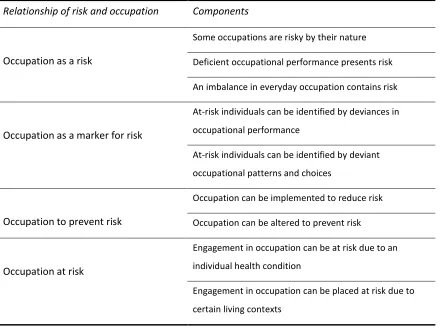
points to some key epistemological risk assumptions (see Table 1, Linking risk and
Table 1: Linking risk and occupation
Relationship of risk and occupation Components
Occupation as a risk
Some occupations are risky by their nature
Deficient occupational performance presents risk
An imbalance in everyday occupation contains risk
Occupation as a marker for risk
At-risk individuals can be identified by deviances in occupational performance
At-risk individuals can be identified by deviant occupational patterns and choices
Occupation to prevent risk
Occupation can be implemented to reduce risk
Occupation can be altered to prevent risk
Occupation at risk
Engagement in occupation can be at risk due to an individual health condition
Engagement in occupation can be placed at risk due to certain living contexts
2.2.3
Occupation as a risk
The first group of articles related risk and occupation by emphasizing occupation itself as
a risk, commonly as a risk to health. While occupation was generally assumed as being
beneficial to achieve health and wellbeing, authors, who draw upon the idea of
‘occupation as a risk’, underlined that engaging in particular occupations also contained
risks. Within this body of literature, there were three main ways in which occupation was
constructed as a risk.
Some occupations are risky by their nature
First, some occupations were assumed to be risky by their nature. In this group of
literature, the specific nature of the occupation, such as working (Dyrkacz, Mak, & Heck,
Baxter, 2010), or watching television (Dwyer, Baur, Higgs, & Hardy, 2009), placed
subjects at risk. Risk was located within an occupation’s specific characteristics,
demands, and tasks. For instance, some articles in this group identified ‘working’ in
health care as carrying risks for work-related injuries and disorders (Darragh,
Huddleston, & King, 2009; Dyrkacz et al., 2012; Rice, Dusseau, & Miller, 2011), with
occupational therapy and nursing framed as a “high-risk occupation” (Rice et al., 2011, p.
95). Other articles discussed certain types of play and leisure occupations as placing
children at risk for ill-health. Risky occupations for children included, for instance
“small-screen recreation, which includes television viewing, computer usage, and
handheld small-screen games” (Dwyer et al., 2009, p. 32) and “sedentary unstructured
pursuits” (Poulsen, Ziviani, & Cuskelly, 2008, p. 35). Such occupations were constructed
as exposing children to health risks, particularly obesity.
In this group of articles, individuals are usually healthy subjects. They become part of an
‘at risk’ group by performing the risky occupation regularly or by being ‘exposed’ to the
occupation’s inherent risks. Dyrkacz et al. (2012), for instance, list several risks related to
the nature of health care work: “each year in Canada, healthcare workers are exposed to
numerous work-related hazards. These range from needle-stick injuries, contraction of
infectious diseases, physical injuries associated with patient handling and transfers,
working alone, ever-increasing job demands, violence, and stress” (p.237). The
conceptualization of some occupations as risky by their nature, takes for granted that the
occupation, as well, as the at-risk subject, exist and perform in somehow universal and
usually predictable ways. The various factors making an occupation risky and an
individual vulnerable to risk pre-exist and can be discovered through scientific research
and measurement. Darragh et al. (2009), for instance, measured how time was a factor
affecting the relation between a risky occupation and vulnerability to injury; they found
that workers “with injuries worked approximately 4 hr more per week than those without
injuries” (p. 356). This example illustrates how a technico-scientific risk perspective,
although used to analyze the specific components that made an occupation risky (e.g.,
that it involved patient lifting), draws attention to the individual and how he or she carries
Deficient occupational performance presents risk
In another group of literature, the occupation itself was not inevitably risky, but became
risky when subjects performed it in ways which lacked certain qualities and failed to
meet established or safety standards. In this way of relating risk to occupation, a
particular group of individuals becomes vulnerable to risk due to deficits in their
occupational performance. The underlying key assumption is that ‘normal’ subjects -
often used as a control group - perform the occupation in normal and safe ways. Authors
in this group, for instance, found that older adults performed the occupation ‘driving’ in
an unsafe way; they were found to have a higher risk for crashes, made age-related
driving errors, or might have lost their driving fitness (Classen, Awadzi, & Mkanta, 2008;
Shaw, Polgar, Vrkljan, & Jacobson, 2010; Vrkljan et al., 2010). However, driving in
itself was implicitly constructed as an occupation that was usually safe; the assumed
normal driver drives faultlessly, and driving in itself thus does not create considerable
risks.
Reasons for a risky performance were mainly assumed to reside within the person, such
as having a medical condition (Poulsen et al., 2008), getting old (Classen, Winter, &
Lopez, 2009) or lacking information (Fisher, Brodzinski-Andreae, & Zook, 2009). For
instance, Cordier, Bundy, Hocking, and Einfeld (2010), investigating the play of children
with ADHD and their playmates, stated that their collective play lacked certain qualities,
such as “empathy (i.e., caring, sharing, cooperating, helping others, generosity,
compliance, and supporting others)”(p.197). The authors view the lack of particular
qualities within how the children were playing as a risk to maintaining (ADHD child) and
developing (playmate) negative behavior (“results suggest that both children with ADHD
and their playmates tend toward decreased prosocial behaviour - at least when they are playing together”, Cordier et al., 2010, p.197).
This literature commonly focused on subjects with a medical condition or disability, but
sometimes also on subjects, who did not have a medical condition. However, these
subjects were still ‘lacking’ something in their performance that was expected to be
ideally there. Thus, their lack made the described occupation risky. For instance, a lack of