End-to-End Coreference Resolution via Hypergraph Partitioning
Jie Cai and Michael Strube Natural Language Processing Group
Heidelberg Institute for Theoretical Studies gGmbH
(jie.cai|michael.strube)@h-its.org
Abstract
We describe a novel approach to coref-erence resolution which implements a global decision via hypergraph partition-ing. In constrast to almost all previ-ous approaches, we do not rely on sep-arate classification and clustering steps, but perform coreference resolution glob-ally in one step. Our hypergraph-based global model implemented within an end-to-end coreference resolution system out-performs two strong baselines (Soon et al., 2001; Bengtson & Roth, 2008) using sys-tem mentions only.
1 Introduction
Coreference resolution is the task of grouping mentions of entities into sets so that all mentions in one set refer to the same entity. Most recent approaches to coreference resolution divide this task into two steps: (1) a classification step which determines whether a pair of mentions is corefer-ent or which outputs a confidence value, and (2) a clustering step which groups mentions into enti-ties based on the output of step 1.
The classification steps of most approaches vary in the choice of the classifier (e.g. decision tree classifiers (Soon et al., 2001), maximum en-tropy classification (Luo et al., 2004), SVM clas-sifiers (Rahman & Ng, 2009)) and the number of features used (Soon et al. (2001) employ a set of twelve simple but effective features while e.g., Ng & Cardie (2002) and Bengtson & Roth (2008) de-vise much richer feature sets).
The clustering step exhibits much more varia-tion: Local variants utilize a closest-first decision
(Soon et al., 2001), where a mention is resolved to its closest possible antecedent, or a best-first deci-sion (Ng & Cardie, 2002), where a mention is re-solved to its most confident antecedent (based on the confidence value returned by step 1). Global variants attempt to consider all possible cluster-ing possibilites by creatcluster-ing and searchcluster-ing a Bell
tree (Luo et al., 2004), by learning the optimal
search strategy itself (Daum´e III & Marcu, 2005), by building a graph representation and applying graph clustering techniques (Nicolae & Nicolae, 2006), or by employing integer linear program-ming (Klenner, 2007; Denis & Baldridge, 2009). Since these methods base their global clustering step on a local pairwise model, some global infor-mation which could have guided step 2 is already lost. The twin-candidate model (Yang et al., 2008) replaces the pairwise model by learning prefer-ences between two antecedent candidates in step 1 and applies tournament schemes instead of the clustering in step 2.
There is little work which deviates from this two-step scheme. Culotta et al. (2007) introduce a first-order probabilistic model which implements features over sets of mentions and thus operates directly on entities.
out-performs two strong baselines, Soon et al. (2001) and Bengtson & Roth (2008).
Soon et al. (2001) developed an end-to-end coreference resolution system for the MUC data, i.e., a system which processes raw documents as input and produces annotated ones as output. However, with the advent of the ACE data, many systems either evaluated only true mentions, i.e. mentions which are included in the annotation, the so-called key, or even received true informa-tion for meninforma-tion boundaries, heads of meninforma-tions and mention type (Culotta et al., 2007, inter alia). While these papers report impressive results it has been concluded that this experimental setup sim-plifies the task and leads to an unrealistic surro-gate for the coreference resolution problem (Stoy-anov et al., 2009, p.657, p660). We argue that the field should move towards a realistic setting using system mentions, i.e. automatically deter-mined mention boundaries and types. In this pa-per we report results using our end-to-end coref-erence resolution system, COPA, without relying on unrealistic assumptions.
2 Related Work
Soon et al. (2001) transform the coreference res-olution problem straightforwardly into a pairwise classification task making it accessible to standard machine learning classifiers. They use a set of twelve powerful features. Their system is based solely on information of the mention pair anaphor and antecedent. It does not take any information of other mentions into account. However, it turned out that it is difficult to improve upon their re-sults just by applying a more sophisticated learn-ing method and without improvlearn-ing the features. We use a reimplementation of their system as first baseline. Bengtson & Roth (2008) push this ap-proach to the limit by devising a much more in-formative feature set. They report the best results to date on the ACE 2004 data using true mentions. We use their system combined with our prepro-cessing components as second baseline.
Luo et al. (2004) perform the clustering step within a Bell tree representation. Hence their system theoretically has access to all possible outcomes making it a potentially global system. However, the classification step is still based on
a pairwise model. Also since the search space in the Bell tree is too large they have to apply search heuristics. Hence, their approach loses much of the power of a truly global approach.
Culotta et al. (2007) introduce a first-order probabilistic model which implements features over sets of mentions. They use four features for their first-order model. The first is an enumeration over pairs of noun phrases. The second is the out-put of a pairwise model. The third is the cluster size. The fourth counts mention type, number and gender in each cluster. Still, their model is based mostly on information about pairs of mentions. They assume true mentions as input. It is not clear whether the improvement in results translates to system mentions.
Nicolae & Nicolae (2006) describe a graph-based approach which superficially resembles our approach. However, they still implement a two step coreference resolution approach and apply the global graph-based model only to step 2. They report considerable improvements over state-of-the-art systems including Luo et al. (2004). How-ever, since they not only change the clustering strategy but also the features for step 1, it is not clear whether the improvements are due to the graph-based clustering technique. We, instead, describe a graph-based approach which performs classification and clustering in one step. We com-pare our approach with two competitive systems using the same feature sets.
3 COPA: Coreference Partitioner
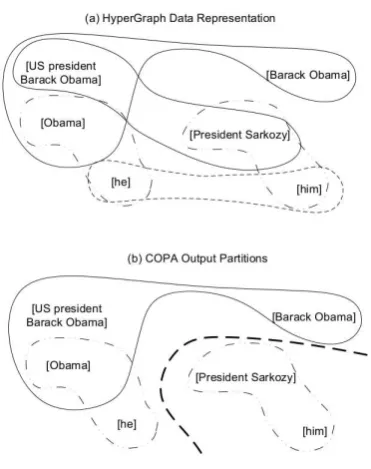
The COPA system consists of learning modules which learn hyperedge weights from the training data, and resolution modules which create a hy-pergraph representation for the testing data and perform partitioning to produce subhypergraphs, each of which represents an entity. An example analysis of a short document involving the two en-tities, BARACKOBAMAand NICOLASSARKOZY illustrates how COPA works.
[US President Barack Obama]came to Toronto today.
[Obama] discussed the financial crisis with [President Sarkozy].
[He]talked to him[him]about the recent downturn of the European markets.
A hypergraph (Figure (1a)) is built for this document based on three features. Two hyper-edges denote the feature partial string match, {US President Barack Obama, Barack Obama, Obama}and{US President Barack Obama, Pres-ident Sarkozy}. One hyperedge denotes the fea-ture pronoun match, {he, him}. Two hyperedges denote the feature all speak, {Obama, he} and {President Sarkozy, him}.
On this initial representation, a spectral clus-tering technique is applied to find two partitions which have the strongest within-cluster connec-tions and the weakest between-clusters relaconnec-tions. The cut found is called Normalized Cut, which avoids trivial partitions frequently output by the min-cut algorithm. The two output subhyper-graphs (Figure (1b)) correspond to two resolved entities shown on both sides of the bold dashed line. In real cases, recursive cutting is applied to all the subhypergraphs resulting from previous steps, until a stopping criterion is reached.
Figure 1: Hypergraph-based representation
3.1 HyperEdgeLearner
COPA needs training data only for computing the hyperedge weights. Hyperedges represent fea-tures. Each hyperedge corresponds to a feature instance modeling a simple relation between two or more mentions. This leads to initially overlap-ping sets of mentions. Hyperedges are assigned
weights which are calculated based on the train-ing data as the percentage of the initial edges (as illustrated in Figure (1a)) being in fact coreferent. The weights for some of Soon et al. (2001)’s fea-tures learned from the ACE 2004 training data are given in Table 1.
Edge Name Weight
Alias 0.777
StrMatch Pron 0.702 Appositive 0.568 StrMatch Npron 0.657 ContinuousDistAgree 0.403
Table 1: Hyperedge weights for ACE 2004 data
3.2 Coreference Resolution Modules
Unlike pairwise models, COPA processes a docu-ment globally in one step, taking care of the pref-erence information among all the mentions at the same time and clustering them into sets directly. A raw document is represented as a single hyper-graph with multiple edges. The hyperhyper-graph re-solver partitions the simple hypergraph into sev-eral subhypergraphs, each corresponding to one set of coreferent mentions (see e.g. Figure (1b) which contains two subhypergraphs).
3.2.1 HGModelBuilder
A single document is represented in a graph with basic relational features. Each hyper-edge in a graph corresponds to an instance of one of those features with the weight assigned by the
HyperEdgeLearner. Instead of connecting nodes
with the target relation as usually done in graph models, COPA builds the graph directly out of a set of low dimensional features without any as-sumptions for a distance metric.
3.2.2 HGResolver
Algorithm 1 R2 partitioner
Note:{L=I−Dv−
1
2HW De−1HTDv−12 }
Note:{N cut(S) :=vol∂S( 1
volS +
1
volSc)}
input: target hypergraphHG, predefinedα⋆
Given aHG, construct itsDv,H,WandDe
ComputeLforHG
Solve theLfor the second smallest eigenvectorV2 for each splitting point inV2do
calculateN cuti
end for
Choose the splitting point withmin
i (N cuti)
Generate two subHGs ifmin
i (N cuti)< α
∗then
for each subHGdo
Bi-partition the subHGwith the R2 partitioner end for
else
Output the current subHG
end if
output: partitionedHG
many applications, e.g. image segmentation (Shi & Malik, 2000).
We adopt two variants of spectral clustering,
recursive 2-way partitioning (R2 partitioner) and flat-K partitioning. Since flat-K partitioning did
not perform as well we focus here on recursive 2-way partitioning. In contrast to flat-K partitioning, this method does not need any information about the number of target sets. Instead a stopping cri-terion α⋆ has to be provided. α⋆ is adjusted on
development data (see Algorithm 1).
In order to apply spectral clustering to hyper-graphs we follow Agarwal et al. (2005). All ex-perimental results are obtained using symmetric Laplacians (Lsym) (von Luxburg, 2007).
Given a hypergraph HG, a set of matrices is generated. Dv andDedenote the diagonal
matri-ces containing the vertex and hyperedge degrees respectively. |V| × |E|matrix H represents the
HG with the entries h(v, e) = 1 ifv ∈ eand0
otherwise. HT is the transpose of H. W is the
diagonal matrix with the edge weights. S is one of the subhypergraphs generated from a cut in the
HG, whereN cut(S)is the cut’s value.
Using Normalized Cut does not generate sin-gleton clusters, hence a heuristic sinsin-gleton detec-tion strategy is used in COPA. We apply a thresh-oldβto each node in the graph. If a node’s degree is below the threshold, the node will be removed.
3.3 Complexity of HGResolver
Since edge weights are assigned using simple de-scriptive statistics, the time HGResolver needs for building the graph Laplacian matrix is insubstan-tial. For eigensolving, we use an open source li-brary provided by the Colt project1which imple-ments a Householder-QL algorithm to solve the eigenvalue decomposition. When applied to the symmetric graph Laplacian, the complexity of the eigensolving is given by O(n3), where n is the number of mentions in a hypergraph. Since there are only a few hundred mentions per document in our data, this complexity is not an issue (spectral clustering gets problematic when applied to mil-lions of data points).
4 Features
The HGModelBuilder allows hyperedges with a degree higher than two to grow throughout the building process. This type of edge is mergeable. Edges with a degree of two describe pairwise rela-tions. Thus these edges are non-mergeable. This way any kind of relational features can be incor-porated into the hypergraph model.
Features are represented as types of hyperedges (in Figure (1b) the two hyperedges marked by “– ··” are of the same type). Any realized edge is an instance of the corresponding edge type. All in-stances derived from the same type have the same weight, but they may get reweighted by the dis-tance feature (Section 4.4).
In the following Subsections we describe the features used in our experiments. We use the en-tire set for obtaining the final results. We restrict ourselves to Soon et al. (2001)’s features when we compare our system with theirs in order to assess the impact of our model regardless of features (we use features 1., 2., 3., 6., 7., 11., 13.).
4.1 Hyperedges With a Degree>2
High degree edges are the particular property of the hypergraph which allows to include all types of relational features into our model. The edges are built through pairwise relations and, if consis-tent, get incrementally merged into larger edges.
1
High degree edges are not sensitive to positional information from the documents.
(1) StrMatch Npron & (2) StrMatch Pron:
After discarding stop words, if the strings of men-tions completely match and are not pronouns, they are put into edges of the StrMatch Npron type. When the matched mentions are pronouns, they are put into the StrMatch Pron type edges.
(3) Alias: After discarding stop words, if
men-tions are aliases of each other (i.e. proper names with partial match, full names and acronyms of organizations, etc.), they are put into edges of the
Alias type.
(4) Synonym: If, according to WordNet,
men-tions are synonymous, they are put into an edge of the Synonym type.
(5) AllSpeak: Mentions which appear within a
window of two words of a verb meaning to say form an edge of the AllSpeak type.
(6) Agreement: If mentions agree in Gender,
Number and Semantic Class they are put in edges
of the Agreement type. Because Gender,
Num-ber and Semantic Class are strong negative
coref-erence indicators – in contrast to e.g. StrMatch – and hence weak positive features, they are com-bined into the one feature Agreement.
4.2 Hyperedges With a Degree=2
Features which have been used by pairwise mod-els are easily integrated into the hypergraph model by generating edges with only two vertices. Infor-mation sensitive to relative distance is represented by pairwise edges.
(7) Apposition & (8) RelativePronoun: If two
mentions are in a appositive structure, they are put in an edge of type Apposition. If the latter mention is a relative pronoun, the mentions are put in an edge of type RelativePronoun.
(9) HeadModMatch: If the syntactic heads of
two mentions match, and if their modifiers do not contradict each other, the mentions are put in an edge of type HeadModMatch.
(10) SubString: If a mention is the substring
of another one, they are put into an edge of type
SubString.
4.3 MentionType and EntityType
In our model (11) mention type can only reason-ably be used when it is conjoined with other fea-tures, since mention type itself describes an at-tribute of single mentions. In COPA, it is con-joined with other features to form hyperedges, e.g. the StrMatch Pron edge. We use the same strat-egy to represent (12) entity type.
4.4 Distance Weights
Our hypergraph model does not have any obvi-ous means to encode distance information. How-ever, the distance between two mentions plays an important role in coreference resolution, es-pecially for resolving pronouns. We do not en-code distance as feature, because this would intro-duce many two-degree-hyperedges which would be computationally very expensive without much gain in performance. Instead, we use distance to reweight two-degree-hyperedges, which are sen-sitive to positional information.
We experimented with two types of distance weights: One is (13) sentence distance as used in Soon et al. (2001)’s feature set, while the other is
(14) compatible mentions distance as introduced
by Bengtson & Roth (2008).
5 Experiments
We compare COPA’s performance with two im-plementations of pairwise models. The first base-line is the BART (Versley et al., 2008) reimple-mentation of Soon et al. (2001), with few but ef-fective features. Our second baseline is Bengtson & Roth (2008), which exploits a much larger fea-ture set while keeping the machine learning ap-proach simple. Bengtson & Roth (2008) show that their system outperforms much more sophis-ticated machine learning approaches such as Cu-lotta et al. (2007), who reported the best results on true mentions before Bengtson & Roth (2008). Hence, Bengtson & Roth (2008) seems to be a rea-sonable competitor for evaluating COPA.
5.1 Data
We use the MUC6 data (Chinchor & Sund-heim, 2003) with standard training/testing divi-sions (30/30) as well as the MUC7 data (Chin-chor, 2001) (30/20). Since we do not have ac-cess to the official ACE testing data (only avail-able to ACE participants), we follow Bengtson & Roth (2008) for dividing the ACE 2004 English training data (Mitchell et al., 2004) into training, development and testing partitions (268/76/107). We randomly split the 252 ACE 2003 training documents (Mitchell et al., 2003) using the same proportions into training, development and testing (151/38/63). The systems were tuned on develop-ment and run only once on testing data.
5.2 Mention Tagger
We implement a classification-based mention tag-ger, which tags each NP chunk as ACE mention or not, with neccessary post-processing for embed-ded mentions. For the ACE 2004 testing data, we cover75.8%of the heads with73.5%accuracy.
5.3 Evaluation Metrics
We evaluate COPA with three coreference resolu-tion evaluaresolu-tion metrics: theB3-algorithm (Bagga & Baldwin, 1998), the CEAF-algorithm (Luo, 2005), and, for the sake of completeness, the
MUC-score (Vilain et al., 1995).
Since the MUC-score does not evaluate single-ton entities, it only partially evaluates the perfor-mance for ACE data, which includes singleton entities in the keys. The B3-algorithm (Bagga & Baldwin, 1998) addresses this problem of the
MUC-score by conducting calculations based on
mentions instead of coreference relations. How-ever, another problematic issue emerges when system mentions have to be dealt with: B3
as-sumes the mentions in the key and in the response to be identical, which is unlikely when a men-tion tagger is used to create system menmen-tions. The CEAF-algorithm aligns entities in key and response by means of a similarity metric, which is motivated by B3’s shortcoming of using one entity multiple times (Luo, 2005). However, al-though CEAF theoretically does not require to have the same number of mentions in key and response, the algorithm still cannot be directly
applied to end-to-end coreference resolution sys-tems, because the similarity metric is influenced by the number of mentions in key and response.
Hence, both the B3- and CEAF-algorithms have to be extended to deal with system mentions which are not in the key and true mentions not extracted by the system, so called twinless
men-tions (Stoyanov et al., 2009). Two variants of theB3-algorithm are proposed by Stoyanov et al.
(2009), Ball3 and B03. Ball3 tries to assign intu-itive precision and recall to the twinless system mentions and twinless key mentions, while keep-ing the size of the system mention set and the key mention set unchanged (which are different from each other). For twinless mentions,B3
all discards
twinless key mentions for precision and twinless system mentions for recall. Discarding parts of the key mentions, however, makes the fair com-parison of precision values difficult.B3
0 produces
counter-intuitive precision by discarding all twin-less system mentions. Although it penalizes the recall of all twinless key mentions, so that the F-scores are balanced, it is still too lenient (for fur-ther analyses see Cai & Strube (2010)).
We devise two variants of the B3- and
CEAF-algorithms, namelyB3
sys and CEAFsys. For
com-puting precision, the algorithms put all twinless true mentions into the response even if they were not extracted. All twinless system mentions which were deemed not coreferent are discarded. Only twinless system mentions which were mistakenly resolved are put into the key. Hence, the system is penalized for resolving mentions not found in the key. For recall the algorithms only consider mentions from the original key by discarding all the twinless system mentions and putting twin-less true mentions into the response as singletons (algorithm details, simulations and comparison of different systems and metrics are provided in Cai & Strube (2010)). For CEAFsys,φ3 (Luo, 2005)
is used.B3
sysand CEAFsys report results for
end-to-end coreference resolution systems adequately.
5.4 Baselines
SOON COPA with R2 partitioner
R P F R P F α⋆ β
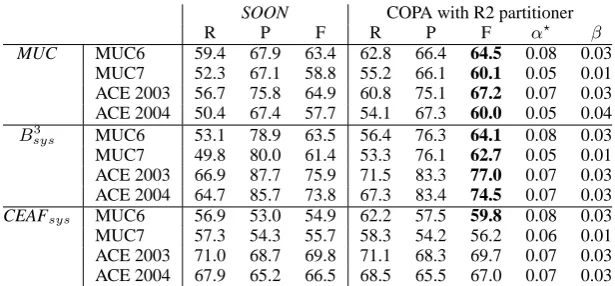
MUC MUC6 59.4 67.9 63.4 62.8 66.4 64.5 0.08 0.03
MUC7 52.3 67.1 58.8 55.2 66.1 60.1 0.05 0.01 ACE 2003 56.7 75.8 64.9 60.8 75.1 67.2 0.07 0.03 ACE 2004 50.4 67.4 57.7 54.1 67.3 60.0 0.05 0.04
B3
sys MUC6 53.1 78.9 63.5 56.4 76.3 64.1 0.08 0.03
MUC7 49.8 80.0 61.4 53.3 76.1 62.7 0.05 0.01 ACE 2003 66.9 87.7 75.9 71.5 83.3 77.0 0.07 0.03 ACE 2004 64.7 85.7 73.8 67.3 83.4 74.5 0.07 0.03
CEAFsys MUC6 56.9 53.0 54.9 62.2 57.5 59.8 0.08 0.03
MUC7 57.3 54.3 55.7 58.3 54.2 56.2 0.06 0.01 ACE 2003 71.0 68.7 69.8 71.1 68.3 69.7 0.07 0.03 ACE 2004 67.9 65.2 66.5 68.5 65.5 67.0 0.07 0.03
Table 3: SOON vs. COPA R2 (SOON features, system mentions, bold indicates significant improvement in F-score over SOON according to a paired-t test withp <0.05)
SOON B&R
R P F R P F
B3
sys 64.7 85.7 73.8 66.3 85.8 74.8
Table 2: Baselines on ACE 2004
B&R – Bengtson & Roth (2008)2. All systems share BART’s preprocessing components and our in-house ACE mention tagger.
In Table 2 we report the performance of SOON and B&R on the ACE 2004 testing data using the BART preprocessing components and our in-house ACE mention tagger. For evaluation we use
Bsys3 only, since Bengtson & Roth (2008)’s sys-tem does not allow to easily integrate CEAF.
B&R considerably outperforms SOON (we
can-not compute statistical significance, because we do not have access to results for single documents in B&R). The difference, however, is not as big as we expected. Bengtson & Roth (2008) re-ported very good results when using true men-tions. For evaluating on system mentions, how-ever, they were using a too lenient variant ofB3
(Stoyanov et al., 2009) which discards all twinless mentions. When replacing this withBsys3 the dif-ference between SOON and B&R shrinks.
5.5 Results
In both comparisons, COPA uses the same fea-tures as the corresponding baseline system.
2
http://l2r.cs.uiuc.edu/˜cogcomp/ asoftware.php?skey=FLBJCOREF
5.5.1 COPA vs. SOON
In Table 3 we compare the SOON-baseline with COPA using the R2 partitioner (parametersα⋆and
β optimized on development data). Even though COPA and SOON use the same features, COPA consistently outperforms SOON on all data sets using all evaluation metrics. With the exception of the MUC7, the ACE 2003 and the ACE 2004 data evaluated with CEAFsys, all of COPA’s
improve-ments are statistically significant. When evaluated using MUC and B3
sys, COPA with the R2
parti-tioner boosts recall in all datasets while losing in precision. This shows that global hypergraph par-titioning models the coreference resolution task more adequately than Soon et al. (2001)’s local model – even when using the very same features.
5.5.2 COPA vs. B&R
In Table 4 we compare the B&R system (using our preprocessing components and mention tagger), and COPA with the R2 partitioner using B&R fea-tures. COPA does not use the learned features from B&R, as this would have implied to embed a pairwise coreference resolution system in COPA. We report results for ACE 2003 and ACE 2004. The parameters are optimized on the ACE 2004 data. COPA with the R2 partitioner outperforms
B&R on both datasets (we cannot compute
B&R COPA with R2 partitioner
R P F R P F
Bsys3 ACE 2003 56.4 97.3 71.4 70.3 86.5 77.5
ACE 2004 66.3 85.8 74.8 68.4 84.4 75.6
Table 4: B&R vs. COPA R2 (B&R features, system mentions)
2004. Again, COPA gains in recall and loses in precision. This shows that COPA is a highly competetive system as it outperforms Bengtson & Roth (2008)’s system which has been claimed to have the best performance on the ACE 2004 data.
5.5.3 Running Time
On a machine with 2 AMD Opteron CPUs and 8 GB RAM, COPA finishes preprocessing, training and partitioning the ACE 2004 dataset in 15 min-utes, which is slightly faster than our duplicated
SOON baseline.
6 Discussion and Outlook
Most previous attempts to solve the coreference resolution task globally have been hampered by employing a local pairwise model in the classifi-cation step (step 1) while only the clustering step realizes a global approach, e.g. Luo et al. (2004), Nicolae & Nicolae (2006), Klenner (2007), De-nis & Baldridge (2009), lesser so Culotta et al. (2007). It has been also observed that improve-ments in performance on true mentions do not necessarily translate into performance improve-ments on system mentions (Ng, 2008).
In this paper we describe a coreference reso-lution system, COPA, which implements a global decision in one step via hypergraph partitioning. COPA looks at the whole graph at once which en-ables it to outperform two strong baselines (Soon et al., 2001; Bengtson & Roth, 2008). COPA’s hypergraph-based strategy can be taken as a gen-eral preference model, where the preference for one mention depends on information on all other mentions.
We follow Stoyanov et al. (2009) and argue that evaluating the performance of coreference resolution systems on true mentions is unrealis-tic. Hence we integrate an ACE mention tag-ger into our system, tune the system towards the real task, and evaluate only using system men-tions. While Ng (2008) could not show that
su-perior models achieved susu-perior results on sys-tem mentions, COPA was able to outperform Bengtson & Roth (2008)’s system which has been claimed to achieve the best performance on the ACE 2004 data (using true mentions, Bengtson & Roth (2008) did not report any comparison with other systems using system mentions).
An error analysis revealed that there were some cluster-level inconsistencies in the COPA output. Enforcing this consistency would require a global strategy to propagate constraints, so that con-straints can be included in the hypergraph parti-tioning properly. We are currently exploring con-strained clustering, a field which has been very active recently (Basu et al., 2009). Using con-strained clustering methods may allow us to in-tegrate negative information as constraints instead of combining several weak positive features to one which is still weak (e.g. our Agreement feature). For an application of constrained clustering to the related task of database record linkage, see Bhat-tacharya & Getoor (2009).
Graph models cannot deal well with positional information, such as distance between mentions or the sequential ordering of mentions in a doc-ument. We implemented distance as weights on hyperedges which resulted in decent performance. However, this is limited to pairwise relations and thus does not exploit the power of the high de-gree relations available in COPA. We expect fur-ther improvements, once we manage to include positional information directly.
References
Agarwal, Sameer, Jonwoo Lim, Lihi Zelnik-Manor, Pietro Perona, David Kriegman & Serge Belongie (2005). Be-yond pairwise clustering. In Proceedings of the IEEE
Computer Society Conference on Computer Vision and Pattern Recognition (CVPR’05), Vol. 2, pp. 838–845.
Bagga, Amit & Breck Baldwin (1998). Algorithms for scor-ing coreference chains. In Proceedscor-ings of the 1st
Inter-national Conference on Language Resources and Evalu-ation, Granada, Spain, 28–30 May 1998, pp. 563–566.
Basu, Sugato, Ian Davidson & Kiri L. Wagstaff (Eds.) (2009). Constrained Clustering: Advances in Algorithms,
Theory, and Applications. Boca Raton, Flo.: CRC Press.
Bengtson, Eric & Dan Roth (2008). Understanding the value of features for coreference resolution. In Proceedings of
the 2008 Conference on Empirical Methods in Natural Language Processing, Waikiki, Honolulu, Hawaii, 25-27
October 2008, pp. 294–303.
Bhattacharya, Indrajit & Lise Getoor (2009). Collective re-lational clustering. In S. Basu, I. Davidson & K. Wagstaff (Eds.), Constrained Clustering: Advances in Algorithms,
Theory, and Applications, pp. 221–244. Boca Raton, Flo.:
CRC Press.
Cai, Jie & Michael Strube (2010). Evaluation metrics for end-to-end coreference resolution systems. In
Proceed-ings of the SIGdial 2010 Conference: The 11th Annual Meeting of the Special Interest Group on Discourse and Dialogue, Tokyo, Japan, 24–25 September 2010. To
ap-pear.
Chinchor, Nancy (2001). Message Understanding
Confer-ence (MUC) 7. LDC2001T02, Philadelphia, Penn:
Lin-guistic Data Consortium.
Chinchor, Nancy & Beth Sundheim (2003). Message
Under-standing Conference (MUC) 6. LDC2003T13,
Philadel-phia, Penn: Linguistic Data Consortium.
Culotta, Aron, Michael Wick & Andrew McCallum (2007). First-order probabilistic models for coreference resolu-tion. In Proceedings of Human Language Technologies
2007: The Conference of the North American Chapter of the Association for Computational Linguistics, Rochester,
N.Y., 22–27 April 2007, pp. 81–88.
Daum´e III, Hal & Daniel Marcu (2005). A large-scale ex-ploration of effective global features for a joint entity de-tection and tracking model. In Proceedings of the Human
Language Technology Conference and the 2005 Confer-ence on Empirical Methods in Natural Language Process-ing, Vancouver, B.C., Canada, 6–8 October 2005, pp. 97–
104.
Denis, Pascal & Jason Baldridge (2009). Global joint models for coreference resolution and named entity classification.
Procesamiento del Lenguaje Natural, 42:87–96.
Klenner, Manfred (2007). Enforcing consistency on coref-erence sets. In Proceedings of the International
Confer-ence on Recent Advances in Natural Language Process-ing, Borovets, Bulgaria, 27–29 September 2007, pp. 323–
328.
Luo, Xiaoqiang (2005). On coreference resolution perfor-mance metrics. In Proceedings of the Human Language
Technology Conference and the 2005 Conference on Em-pirical Methods in Natural Language Processing,
Van-couver, B.C., Canada, 6–8 October 2005, pp. 25–32. Luo, Xiaoqiang, Abe Ittycheriah, Hongyan Jing, Nanda
Kambhatla & Salim Roukos (2004). A mention-synchronous coreference resolution algorithm based on
the Bell Tree. In Proceedings of the 42nd Annual
Meet-ing of the Association for Computational LMeet-inguistics,
Barcelona, Spain, 21–26 July 2004, pp. 136–143. Mitchell, Alexis, Stephanie Strassel, Shudong Huang &
Ramez Zakhary (2004). ACE 2004 Multilingual Training
Corpus. LDC2005T09, Philadelphia, Penn.: Linguistic
Data Consortium.
Mitchell, Alexis, Stephanie Strassel, Mark Przybocki, JK Davis, George Doddington, Ralph Grishman, Adam Meyers, Ada Brunstain, Lisa Ferro & Beth Sundheim (2003). TIDES Extraction (ACE) 2003 Multilingual Training Data. LDC2004T09, Philadelphia, Penn.:
Lin-guistic Data Consortium.
Ng, Vincent (2008). Unsupervised models for corefer-ence resolution. In Proceedings of the 2008 Confercorefer-ence
on Empirical Methods in Natural Language Processing,
Waikiki, Honolulu, Hawaii, 25-27 October 2008, pp. 640– 649.
Ng, Vincent & Claire Cardie (2002). Improving machine learning approaches to coreference resolution. In
Pro-ceedings of the 40th Annual Meeting of the Association for Computational Linguistics, Philadelphia, Penn., 7–12
July 2002, pp. 104–111.
Nicolae, Cristina & Gabriel Nicolae (2006). BestCut: A graph algorithm for coreference resolution. In
Proceed-ings of the 2006 Conference on Empirical Methods in Nat-ural Language Processing, Sydney, Australia, 22–23 July
2006, pp. 275–283.
Rahman, Altaf & Vincent Ng (2009). Supervised models for coreference resolution. In Proceedings of the 2009
Conference on Empirical Methods in Natural Language Processing, Singapore, 6-7 August 2009, pp. 968–977.
Shi, Jianbo & Jitendra Malik (2000). Normalized cuts and image segmentation. IEEE Transactions on Pattern
Anal-ysis and Machine Intelligence, 22(8):888–905.
Soon, Wee Meng, Hwee Tou Ng & Daniel Chung Yong Lim (2001). A machine learning approach to coreference resolution of noun phrases. Computational Linguistics, 27(4):521–544.
Stoyanov, Veselin, Nathan Gilbert, Claire Cardie & Ellen Riloff (2009). Conundrums in noun phrase coreference resolution: Making sense of the state-of-the-art. In
Pro-ceedings of the Joint Conference of the 47th Annual Meet-ing of the Association for Computational LMeet-inguistics and the 4th International Joint Conference on Natural Lan-guage Processing, Singapore, 2–7 August 2009, pp. 656–
664.
Versley, Yannick, Simone Paolo Ponzetto, Massimo Poesio, Vladimir Eidelman, Alan Jern, Jason Smith, Xiaofeng Yang & Alessandro Moschitti (2008). BART: A mod-ular toolkit for coreference resolution. In Companion
Volume to the Proceedings of the 46th Annual Meeting of the Association for Computational Linguistics,
Colum-bus, Ohio, 15–20 June 2008, pp. 9–12.
Vilain, Marc, John Burger, John Aberdeen, Dennis Connolly & Lynette Hirschman (1995). A model-theoretic corefer-ence scoring scheme. In Proceedings of the 6th Message
Understanding Conference (MUC-6), pp. 45–52. San
Ma-teo, Cal.: Morgan Kaufmann.
von Luxburg, Ulrike (2007). A tutorial on spectral clustering.
Statistics and Computing, 17(4):395–416.
Yang, Xiaofeng, Jian Su & Chew Lim Tan (2008). A twin-candidate model for learning-based anaphora resolution.