Multifractality of Deutschemark / US Dollar Exchange Rates
∗
Adlai Fisher and Laurent Calvet
†Department of Economics, Yale University
Benoit Mandelbrot
‡Department of Mathematics, Yale University
and
IBM T. J. Watson Research Center
Cowles Foundation Discussion Paper No. 1165
This Draft: September 15, 1997
First Draft: October 1996
THIS VERSION TEXT ONLY
Download figures at http://www.econ.yale.edu/
∼
fisher/papers.html
Abstract
This paper presents the first empirical investigation of the Multifractal Model of Asset
Returns (“MMAR”). The MMAR, developed in Mandelbrot, Fisher, and Calvet (1997),
is an alternative to ARCH-type representations for modelling temporal heterogeneity
in financial returns. Typically, researchers introduce temporal heterogeneity through
time-varying conditional second moments in a discrete time framework, or time-varying
volatility in a continuous time framework. Multifractality introduces a new source of
heterogeneity through time-varying local regularity in the price path. The concept of
local H¨older exponent describes local regularity. Multifractal processes bridge the gap
between locally Gaussian (Itˆo) diffusions and jump-diffusions by allowing a multiplicity
of H¨older exponents. This paper investigates multifractality in Deutschemark / US
Dollar currency exchange rates. After finding evidence of multifractal scaling, we show
how to estimate the multifractal spectrum via the Legendre transform. The scaling
laws found in the data are replicated in simulations. Further simulation experiments
test whether alternative representations, such as FIGARCH, are likely to replicate the
multifractal signature of the Deutschemark / US Dollar data. On the basis of this
evidence, the MMAR hypothesis appears more likely. Overall, the MMAR is quite
successful in uncovering a previously unseen empirical regularity. Additionally, the
model generates realistic sample paths, and opens the door to new theoretical and
applied approaches to asset pricing and risk valuation. We conclude by advocating
further empirical study of multifractality in financial data, along with more intensive
study of estimation techniques and inference procedures.
Keywords: Multifractal Model of Asset Returns, Multifractal Process, Compound
Stochas-tic Process, Trading Time, Time Deformation, Scaling Laws, Multiscaling, Self-Similarity,
1
Introduction
Multifractality is a promising new tool for economists. Recent theoretical research proposes the
Multifractal Model of Asset Returns (“MMAR”) as a method of modelling financial prices.
(Man-delbrot, Fisher and Calvet, 1997; Calvet, Fisher and Man(Man-delbrot, 1997; Man(Man-delbrot, 1997). The
MMAR is thus an alternative to ARCH and its variants. Multifractal processes incorporate
long-tailed asset returns and long memory in “volatility”. Additionally, the MMAR predicts a form of
scaling in the moments of returns that is new to both theoretical and empirical finance.
Current finance literature notes a discrepancy between financial theory, which is largely set
in continuous time, and empirical research that tends towards discrete formulations. (Rossi, 1997;
Drost and Werker, 1996; Melino, 1994) This discrepancy is sometimes viewed as a “gap” to be
reme-died by improvements in empirical models. Multifractality offers a different perspective, showing
that a large class of interesting stochastic processes are not covered by the Itˆo diffusion paradigm.1
Importantly, the MMAR contains a restriction, scaling, that is strong enough to generate
empiri-cal tests. “Sempiri-caling” describes a specific relationship between data samples of different time sempiri-cales,
e.g. daily, weekly, or monthly returns.2 We envision a growing set of econometric methods that
explicitly test or model the behavior of data at different time scales. Established research along
these lines includes the literature on decreasing sequences of ARCH representations (Nelson, 1990;
Nelson and Foster, 1994; Drost and Werker, 1996). This work assumes a decreasing sequence of
sampling frequencies, and therefore matches the natural continuous time framework of the MMAR.
The present paper conducts the first empirical investigation of the MMAR. The empirical work
uses an estimation technique that is new to economics, and is validated through simulation.
Simu-lations also are used to illuminate important differences in a core group of extant financial models.
Overall, the empirical results are quite promising for the MMAR, showing strong regularities in
an important data set that are consistent with restrictions imposed by multifractality. We hope
1Itˆo diffusions are locally quadratic, allowing arbitrage arguments and other mathematical conveniences that would
require distributional assumptions in discrete time. Theoretical results that depend critically upon Itˆo diffusions are generally understood to be idealized, and problematic because of the presence of discontinuities. The MMAR reinforces reservations about the “continuous hedge” by postulating a more generally diverse variety of local behavior. Even when price paths are continuous, they in general are not locally quadratic.
2A similar term that has been used in these papers is “scale-consistent”, which has the same meaning as “closed
to encourage further research by demonstrating the empirical content of the model, and to lay
groundwork that suggests which approaches will be most fruitful.
The structure of the paper is as follows: Section 2 presents the primary estimation methodology.
Multifractal processes are reviewed and their scaling properties are related to restrictions upon
moments of the data. This leads to an informal test of multifractality, and an estimation method
for the scaling function, which describes growth rates of moments as the time scale increases.
Section 3 applies these methods to Deutschemark / US Dollar exchange rate data. We find strong
evidence of scaling, consistent with the predictions of the MMAR.
Section 4 reviews the multifractal spectrum, which is a renormalized density of points in time
with different degrees of local regularity. We show that the multifractal spectrum can be estimated
by Legendre transform of the scaling function. Section 5 carries out the Legendre transform on the
estimated scaling function and discusses these results. The MMAR components are recovered from
the estimated multifractal spectrum. Finally, Monte Carlo simulations show a striking resemblance
to the DM/USD data, although consistent replication of scaling requires large simulated sample
sizes. This result is discussed in Section 5.
Section 6 simulates GARCH and FIGARCH processes, using parameters obtained from
pre-viously published research on exchange rates. Lack of long memory is made intuitively clear by
graphical representations of GARCH over long time intervals. Similar FIGARCH simulations show
long memory, but lack variability at high frequencies when compared to the data (or the MMAR).
Neither GARCH nor FIGARCH captures the scaling properties of the data with consistency, even
at large sample sizes. We discuss how to interpret these results.
Section 7 conducts a variety of robustness tests. We apply several seasonal adjustment filters to
the high frequency data, split the data to test for model stationarity, and perform similar tests with
the Japanese Yen/ US Dollar series. Scaling properties are robust to reasonable transformations of
the DM/USD data. Scaling behavior in the Yen/ Dollar series is more complicated, and is discussed
at the end of Section 7.
Section 8 concludes. Overall, we find that the MMAR captures a multitude of important features
of the data. These include long memory in volatility, long tails, scaling, and high variability in
returns at high frequencies. This line of research should therefore be extended in several directions,
comprehensive empirical work using different data sets. Finally, the most important applications
of this model will be in the valuation of risk.
2
Testing the MMAR: Methodology
Mandelbrot, Fisher, and Calvet (“MFC”, 1997) introduces multifractality to economics, focusing
upon scaling properties in moments. The main result is the Multifractal Model of Asset Returns
(“MMAR”), which shows that multifractal measures, when combined with the concept of trading
time, generate continuous-time stochastic processes that have long memory in volatility, long tails,
and are flexible enough to generate either martingale or long memory behavior in log prices.
Calvet, Fisher, and Mandelbrot (“CFM”, 1997) further develops the theory of multifractals,
focusing upon local scaling properties. This paper develops the concept of H¨older exponent, which
describes the local regularity of the price path, and the multifractal spectrum, which is a
renormal-ized density of local Holder exponents. These concepts are then related back to the MMAR.
This section and Section 4 review multifractality, emphasizing concepts necessary for empirical
work. Readers interested in further development of the theory should consult MFC, CFM, and the
literature cited therein.
2.1
Review of the MMAR and Multifractal Processes
LetX(t,4t) generically denote the increments of a stochastic process X(t), i.e.
X(t,4t)≡X(t+4t)−X(t), 0≤t≤T.
Also, let X(4t) stand for X(0,4t), which is distributionally invariant under translations when
stationarity in increments is assumed. MFC defines a multifractal process as a continuous time
process with stationary increments that satisfy
E[|X(t,4t)|
q] =c(q) (4t)τ(q)+1 (1)
for all t,4t on whichX is defined, and for allq such thatE[|X(t,4t)|
q]<∞.This expectation is
assumed finite over an interval [0, qmax)],which may be open or closed on the right.
Equation (1) is a scaling law in the moments of X(4t). It specifies a form for their change as
scaling function. Thus, τ(q) is a focal concept in the theory of multifractals. The prefactor, c(q),
is not considered in this paper, except for the fact that it does not vary over t or4t.
The MMAR posits a Fractional Brownian Motion,BH(t),compounded by a multifractal trading
time, θ(t). Trading time and the Fractional Brownian Motion are assumed independent. The
resulting multifractal price process is written3
logP(t)−logP(0) =BH[θ(t)]. (2)
The strategy followed in this paper will be first to test the scaling law in equation (1). We then
estimate τ(q), which is transformed into an estimate the multifractal spectrum. This, in turn,
allows us to recover the individual components of the MMAR and simulate the price process (2).
A review of the multifractal spectrum, which is not necessary to test the existence of a multifractal
scaling law, is deferred until Section 4.1.
2.2
A Simple Test of Multifractality
Consider a price series P(t) defined on all tbelonging to the fixed time interval [0, T]. Denote the
logarithm of price by X(t) ≡ logP(t)−logP(0). Dividing [0, T] into N intervals of length 4t,
define thesample sum (also called partition function4 from origins in thermodynamics),
Sq(T,4t)≡
NX−1 i=0
|X(i4t,4t)|q. (3)
By the stationary increments property of multifractal processes, the addends are identically
dis-tributed, although they may have arbitrary correlation. If X(t) is multifractal, the scaling law
yields
logE[Sq(T,4t)] =τ(q) log(4t) +c(q) logT (4)
when the qth moment exists.
The methodology employed in the remainder of the paper is straightforward. We plot logSq(4t)
against log4tfor various values ofqand various values of4t. The linearity of these plots for given 3All of the empirical work in this paper uses base 10 logarithms, except for the initial transformation of prices,
which is a natural logarithm. The companion theoretical papers work in natural logarithms exclusively, and use theln notation. This paper uses a single notation,log, which should be interpreted according to whether the use is empirical or theoretical. All of the theory converts easily (but tediously) to base 10 (or vice versa).
4The logarithm ofS
values ofq is proposed as a test of the MMAR. We check linearity by visual inspection. The slope
of the lines, estimated by OLS regression, gives an estimate of the scaling function τ(q). The
estimated scaling function is easily transformed into an estimated multifractal spectrum.
Despite the simplicity of these methods, theoretical justification beyond equation (4) is quite
difficult. Mandelbrot (1995, Section 6.4) has conjectured consistency of estimated slopes for a
large class of multifractals as 4t → 0. In general, a theoretical proof of this conjecture has
been elusive, except for a few simple cases such as the binomial and multinomial multiplicative
cascades. Consistency, along with inference methods, remains an open and interesting area for
future theoretical work.
Until additional theory is developed, we justify the above methodology on two counts. First,
while inversion of logarithms and expectations will produce small sample biases in estimation, these
need not prevent transmission of linearity in (4) to approximate linearity in the sample partition
function.5 Secondly, estimation biases for τ(q) can be studied and understood for particular cases
of interest.
Monte Carlo simulation validates the empirical methods used in this paper. After Section 3
shows linearity in DM/USD partition functions, Section 5 estimatesτ(q) and uses this information
to generate an estimated multifractal spectrum. Using results provided in MFC and CFM, we
then recover a generating mechanism with theoretical multifractal spectrum similar to the data.
Simulated partition functions of this process follow their predicted paths, with (approximately)
linear partition functions of (approximately) the same slope as the DM/USD data.
Finally, the partition function methodology has some power to discriminate against reasonable
alternatives. Section 5 simulates GARCH and FIGARCH processes with parameters from
pub-lished research on exchange rates. Although the simulated alternatives mimic scaling behavior in
individual samples, the MMAR replicates the scaling behavior found in the data more consistently.
All of the simulation results should be considered preliminary investigations, and should be studied
more thoroughly in future research.
5By Jensen’s inequality, rewriting equation (4) as a regression yields errors with negative expectation. The effect
2.3
Unifractal Examples: Brownian Motion and Fractional Brownian Motion
Consider a (Wiener) Brownian Motion (“WBM”, to distinguish from Fractional Brownian Motion,
“FBM”) with volatility σ. By self-affinity, E[|X(t,4t)|q] =σ(4t)q/2 for all t, and all q,4t >0.
Independent increments and the strong law of large numbers immediately yield
τ(q) = q 2 −1.
We simulate the increments at T = 105 uniform intervals, and calculate Sq(4t) for several
values of q between 1.5 and 5 and numerous values of 4t between 1 and 1000. Figure 2 shows
log4tplotted against logSq(4t) for each value of q. The plotted values fall very nearly on lines
of the predicted slope. The predicted values are shown as dotted lines in the figure.
We now repeat the example above for several Fractional Gaussian Noises (“FGN”), the discrete
time analogues of Fractional Brownian Motion. Understanding these processes is important, since
FBM is one of two main components in the MMAR. Mandelbrot and Wallis (1969) provides two
discrete approximations to the FBM. A third approximation, which reduces computational
com-plexity, appears in Mandelbrot (1971). These discrete FGN received widespread application in the
natural sciences and economics.
Granger (1980), Granger and Joyeux (1981), and Hosking (1980) provide a fourth discrete
approximation to the FBM,6 proposing the fractional differencing operator in discrete time as the
binomial expansion of (1−L)d. This gives the familiar ARFIMA(0, d,0) process,
(1−L)dxt=ut,
where{ut} is white noise and d=H−1/2. The Wold decomposition is
xt = ∞
X
k=0
ψkut−k
ψk = Γ(k+d) Γ(k+ 1)Γ(d) ∼
1 Γ(d)k
d−1 ask→ ∞, (5)
where Γ denotes the Gamma function. Asymptotically, the decay rate ofd−1 in the MA coefficients
is identical to the previous discrete approximations of 1968 and 1971. This gives an asymptotic
6This approximation is called Fractional White Noise by some authors. The perceived conceptual distinction is
decay rate in autocorrelations of 2d−1, which (alternatively expressed in terms of ACF or spectrum)
is the fundamental characteristic of FBM and discrete approximations to the FBM. Short-memory
components can be added to fit high-frequency features of the data as suggested by Mandelbrot
(1971), and formalized in the ARFIMA(p, d, q) process.
Figure 3 shows several simulations of Fractional Gaussian Noise, H ranging between .2 and
.8. In addition, we show a near-Fractional Gaussian Noise that is just non-stationary, and several
processes whose increments are FGN with 0 < H < 1. Beginning with d = .5, the span of the
vertical axis begins to increase dramatically as a consequence of non-stationarity.
These graphs are notably different from the data. The persistent values of .5 < H < 1 have
long-memory in their increments, which is usually diagnosed by a slow rate of decay in the sample
autocorrelation function. Long-memory can be detected visually whenH =.8, and somewhat when
H = .6, by apparent long-period trends in direction. More distinctive features of the DM/USD
data are low frequency shifts in the size, or absolute value, of price increments. When simulating
multifractal processes in Section 5, the distinction between memory in increments and
long-memory in the absolute value of increments will again become apparent.
Figure 4 shows, in solid lines, the estimated partition functions for four of the simulated FGN’s.
The dotted lines are reference lines showing the expected values for Wiener Brownian Motion, and
the dashed lines show theoretical expectations for FBM’s of the same H. All simulated partition
functions follow the prediction for FBM fairly closely.7 Even forH =.53, which is indistinguishable
from Wiener Brownian Motion by inspection of sample paths or increments, differences in slope
are apparent when using the partition function methodology.
3
Testing the MMAR: Empirical Results
3.1
The Data: Deutschemark / US Dollar Exchange Rates
The Deutschemark / US Dollar (“DM/USD”) currency market is the most thickly traded exchange
rate market in the world (three times the size of the Yen/Dollar market on the basis of quotes), and
high frequency (quote by quote) data is readily available. Olsen and Associates, a currency research
and trading firm located in Z¨urich, Switzerland, provided data for a one year period (October 31,
7As the distance betweenH and 1/2 increases, some biases appear. A likely explanation is approximation error in
1992 – September 1, 1993). The data set consists of all bid/ask quotes, with transmittal times,
collected by Olsen & Associates during that year. Quotes are collected from banks and other
trading institutions world-wide, creating a data set with round-the-clock observations. For the
DM/USD series, this amounts to 1,472,241 quotes. Previous researchers using the Olsen data have
noted that traders have strong incentives not to transmit spurious quotes, and Olsen provides a
filter for quotes which they believe to be erroneous.8
A second data source is a nearly twenty-four year series of daily DM/USD exchange rates. This
data set also was provided by Olsen and Associates, and spans from June 1973, shortly after the
permanent demise of the Bretton-Woods system of exchange rate pegs, to December 1996. The
reported price is the geometric mean of bid and ask quotes.9 The prices were recorded at 16:00
UK time as a linear interpolation of the two closest (in time) quotes. Data are provided for every
weekday except New Years and Christmas. Figure 1 shows the DM/USD daily series, along with
increments and log increments, over the length of this sample period.
Combining these two data sets allows calculation of the partition function over three orders of
magnitude of 4t. This permits investigation of scaling behavior over a broad range of sampling
frequencies.
3.2
Seasonality
Figure 5 shows weekly patterns in two measures of market activity. These are, respectively, average
number of quotes per fifteen minutes and average absolute returns per fifteen minutes. Trading
activity falls significantly during weekends, from the close of trading in the U.S. on Friday to the
opening of the Australian and Asian markets on Monday. Weekday market activity subsides from
approximately 3:00-4:30 AM GMT, when it is lunchtime in the major Asian economies and other
major markets are closed.
Seasonal components are non-scaling, and preclude that trading time is multifractal as defined
in MFC.10 While this claim may not be intuitively obvious, it depends upon viewing multifractal
8Olsen & Associates provide a flag for quotes they believe to be either erroneous or not representative of actual
willingness to trade. We eliminate the flagged observations, which comprise .36% of the dataset.
9The logarithm of the geometric mean is the logarithmic mid-point. This is a standard approximation to price
when only bid and ask quotes are available. We test sensitivity to this approximation in Section 7, which uses buying rates provided by the Federal Reserve.
10This set of papers has presented a fairly strict definition of multifractality, based upon the exact scaling equation
trading time as the cumulative distribution function (“c.d.f.”) of a statistically self-similar random
measure. For interested readers, this argument is presented in Appendix 9.1. Otherwise, seasonal
adjustment can be viewed simply as a stationarity requirement.
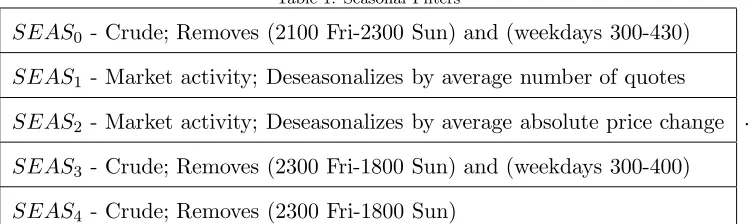
This complication is addressed by applying a seasonal adjustment filter11 that reduces the
seasonal component in the data. The seasonally modified version of the MMAR is written
lnP(t) =BH{θ[SEASn(t)]},
where SEASn denotes the nth seasonal adjustment filter among the several that we employ.12
The basic idea is that time is expanded during typically active periods of the week, and contracted
during typically slow periods. The expansions and contractions are restricted to maintain a constant
amount of total time, i.e. 604,800 seconds in a week.
Even for established time series models, seasonal adjustment is a delicate issue. (See the survey
by Ghysels, 1994.) Optimal procedures, in the sense of Grether and Nerlove (1970), are thus beyond
the scope of the present paper, and should be investigated separately. Instead, we choose a range
of imperfect, but reasonable, seasonal adjustment filters. Some have the merit of predictability in
whether they under-adjust or over-adjust for the seasonal component. This range allows us to test
robustness of results to reasonable variation in the seasonal adjustment method.
To simplify presentation, the results in Sections 3 and 5 use a single seasonal adjustment filter.
Section 6 separately investigates the issue of robustness, and presents results for the other four
filters. The filter used for the main results is SEAS2 which deforms time to smooth variation in
average absolute returns over fifteen minute intervals of the week.
A broader view of multifractality is simply the presence of multiple H¨older exponents, as in CFM. While we have not fully developed this viewpoint, one would proceed by presenting multifractality as an asymptotic, and thus less restrictive, requirement. This definition would permit seasonality, since seasonality can typically be viewed as a smooth transformation that affects prefactors, but not H¨older exponents. As long as prefactors are well behaved, the scaling properties as4t→0 are not affected. This idea may be further developed in the future, but does not seem to present significant advantages in empirical work at the present time.
11The term “filter” as used here simply means the data are “treated in a particular way before they are analyzed”
(Hamilton, 1990, p.63).
12Hereafter, we specify the seasonal filter in text and graphs, and drop this notation from future equations.
3.3
Plots of the Partition Function
Figure 6 shows renormalized graphs of logSq(4t) against log(4t) for values ofq around 2. 13 From
bottom to top on the graph, the values of q increase from 1.75 to 2.25. The values of 4t range
from 20 seconds to 180 days, and are spaced at intervals of approximately .0414 on a log10 scale,
or multiples of about 1.1 on a real scale. The renormalization for all q is logSq(20 seconds) = 0.
This renormalization is useful because the intercepts of the curves are not studied, and it allows
presentation of several curves on the same graph. Sample sums for the high frequency data and
the daily data are spliced together by the vertical displacement that provides the best linear fit,
using OLS, under the restriction that both lines have the same slope.14
Figure 7 plots higher moments (up to q = 5), which are generally more sensitive to deviations
from scaling. Format is the same as the Wiener Brownian Motion example from Figure 2. Dotted
lines are provided for reference, and show expectations for data generated by WBM. The horizontal
axis begins at log(2 hours) to focus attention on the region of principal interest. Each partition
function stops when the number of independent observations in the sample falls approximately
below 50. Thus, for the 365 day sample of high frequency data, the highest value of4trepresented
is 7 days, and 180 days is the approximate maximum for the daily data. The following section
explains what can be learned from inspection of these graphs.
3.4
Main Results
3.4.1 High Frequency Crossover
The most striking aspects of Figure 6 are the two clean breaks in the curves, highlighted by vertical
dotted lines. The first dotted line corresponds to five minutes of deseasonalized clock time. The
second dotted line corresponds to about two hours of deseasonalized clock time.15
The existence of lower and upper scale bounds for a model has been termed crossover in the
physics literature. This seems an appropriate term to extend to the phenomenon evident in Figure
13For the high frequency data, the price at timetis approximated by the geometric mean of bid and ask for the
most recently observed quote. This is consistent with the format the daily data was received in, explained in Section 3.1. Sensitivity to this approximation is addressed in Section 7.
14For canonical multifractal measures, vertical displacement is generally a random variable that depends only on
q. We expect this trait to be passed on to the price process byθ(t), and thus place no restrictions on the intercepts.
15During weekdays when a major market is open, these amounts would decrease by about 1/2 to 2/3 in units of
6 at about two hours. For the remainder of this paper, we consider primarily the long range of
sampling intervals greater than two hours. These sampling intervals still span nearly three orders
of magnitude of4t. The absence of a sharpuppercrossover in this region, at least up to 180 days,
is promising.
We conjecture that high-frequency crossover can be related to market frictions such as bid-ask
spreads, discreteness of trading units, and discontinuous trading. This topic will be investigated in
a forthcoming paper.
3.4.2 The Self-Affinity Index for BH(t)
A close up view of the slopes of the partition functions around the moments q = 2 is chosen in
Figure 6 for a particular purpose. The self-affinity index, H, of the Fractional Brownian Motion
BH(t) in the MMAR is identified by the condition that
τP(1/H) = 0, (6)
whereτP is the scaling function for the price process.16
From Figure 6, the value of qwith slope zero appears to be about 1.9, indicatingH≈.53. This
implies small persistence in DM/USD exchange rates. At the same time, the estimated H is very
close to 1/2. Previous studies, based on well understood estimation methods, find white spectra
(implyingH = 1/2) for log increments of typical financial data. Thus, the martingale hypothesis
for log prices seems to be a reasonable approximation. At the same time, Section 5 shows strong
evidence of multifractality in trading time, implying long memory in squared returns.
3.4.3 Linearity of the Partition Functions
Linearity of the partition functions in Figure 6 indicates a multifractal scaling law that holds, at a
minimum, for close to three orders of magnitude of4t. Scaling is even more striking in Figure 7
because the moments are higher, reaching to q = 5. Once again, the lines are relatively straight,
consistent with the MMAR. Variability of the lines around their apparent slopes increases as q
increases, as is to be expected.
16In a partition with fixed endpoints where all increments are restricted to have the same sign, the sum of increments
cannot depend on grid size. Intuitively, the total variation of an increasing process, estimated by finite increments, does not depend on how we cut it up. Therefore, since θ(t) is increasing (being the c.d.f. of a random measure),
Closer inspection of Figures 6 and 7 reveals that the lines are in fact composed of two distinct
segments, corresponding to the high frequency data and the daily data. At4t= 1 day, the daily
partition function overlaps the high frequency partition function with nearly the same slope, and
greater regularity because of a sample span nearly 24 times as large. Once again, as 4tincreases,
the variability around the apparent slope increases, until estimation ceases at 180 days.
The strong similarity in slopes between the high frequency data and the daily data suggests
model stationarity. At least for moments up to q = 5, the scaling law for 1992-1993 is similar to
the scaling law for 1973-1996. Returning to the daily price series of DM/USD returns presented
in Figure 1, note several long swings in price as the Dollar appreciates and depreciates against the
Mark. Working with the variety of GARCH, FIGARCH, ARFIMA, stochastic trend, and stochastic
volatility models that are currently available, few researchers would attempt to capture long term
behavior in the DM/USD series over the twenty-five year sample span with the same model that
explains relatively high frequency behavior in 1992-1993.
This highlights a major innovation in the MMAR approach. By modelling restrictions upon
the relationship between distributions or moments at different time scales, we can generate new
predictions and new econometric methods for testing these restrictions.
This section has shown evidence of a multifractal scaling law for DM/USD exchange rates. In
Figures 6 and 7 the eye is unable to discriminate differences inτb(q) (wherebτ indicates the estimated
scaling function) between the high frequency data set and the daily data set. Section 4 estimates
τ(q) separately for each data set, and employs Legendre transforms of bτ(q) to obtain estimates of
the multifractal spectrum.
4
Review of the Multifractal Spectrum
The scaling law in moments (1) is useful in generating testable restrictions, but not an intuitive
description of multifractality. Other intrinsic characteristics of multifractals might serve as
defini-tions, though with greater technical complications. For example, Mandelbrot (1972, 1974) begins
with the distributional scaling of statistically self-similar random measures and arrives at a scaling
law in moments as an implication.
The deepest, though probably most difficult, understanding of multifractals comes from studying
empirical work in Section 5. The concept of H¨older exponent is essential. The local H¨older exponent,
α(t), measures the local regularity of a process:
X(t,4t)∼(4t)α(t) for all t, and as4t→0. (7)
In a standard Itˆo diffusion, the local variation is always proportional to (4t)1/2. The most common
way to break this local scaling law is to introduce a jump component, which is akin to a local scaling
rule of the form (4t)0.
Multifractal processes generate variety in local regularity while filling the gaps between locally
(4t)1/2and (4t)0behavior. Multifractal processes contain a multiplicity of local H¨older exponents.
One might expect this diversity to result in unstructured behaviors. On the contrary, knitting
together sets of points with different H¨older exponents requires a particular kind of structure,
which is the topic of the two theoretical papers MFC and CFM.
The multifractal spectrum is the main tool for describing the distribution of H¨older exponents.
The following section reviews three subtly different interpretations. Section 4.2 provides a heuristic
for estimating the multifractal spectrum via a Legendre transform of the scaling function. Finally,
Section 4.3 reviews some basic facts about the multifractal spectrum that are useful in empirical
work.
4.1
Three Interpretations of the Multifractal Spectrum
The multifractal spectrum is a function f(α) ≤1, that may be defined on any subset of the real
line. The domain can be thought of as a space of H¨older exponents when α≥0. (This is the only
case considered in the present paper.)17 The goal of the multifractal spectrum is to describe the
distribution of local H¨older exponents in a multifractal process. The most natural place to begin
this investigation is with the standard frequency renormalization of probability theory. Partitioning
time into a grid with increments of size4t=b−k, we define the coarse H¨older exponents,
αk(t) =lnX[t,∆t] ln ∆t .
By increasingk we proceed to the limit 4t→0, and may expect that the frequency histogram of
coarse H¨older exponents will converge to the frequency distribution of Local H¨older exponents. This
17The caseα <0 cannot correspond to a Holder exponent for measures or bounded functions, but has gained an
intuition turns out to be correct, but misses a great deal of information. Mandelbrot (1989) shows
that an alternative renormalization is more informative. CFM neatly categorizes this interpretation
with two other common interpretations forf(α):
(D1) the limit of a renormalized histogram of coarse H¨older exponents,
(D2) the fractal dimension of the set of instants with H¨older exponentα,
(D3) the limit of k−1logbP{αk> α}+ 1 provided by Large Deviation Theory.
The second interpretation is a statement about fractal dimension, or Hausdorff-Besicovitch
dimension. In a partition of size 4t, the number of intervals characterized by αtakes the form
Nα(4t)∼(4t)−f(α).
This form justifies calling f(α) a fractal dimension.18 On the real line, fractal dimensions are
constrained to lie between zero and one. Fractal dimension and (unit renormalized) Lebesgue
measure coincide when both are either zero or one. On the other hand, all sets with positive
Lebesgue measure have a fractal dimension of one, and all sets with fractal dimension less than one
have zero Lebesgue measure. Thus, fractal dimension provides more information about some types
of sets. Standard continuous-time financial models have components with fractal dimension of one,
which applies to typical Itˆo diffusions, or zero, which applies to jump components. Thus, fractal
sets fill space in a manner that is midway between the standard cases of continuous time finance.
Definition (D3) is a statement about applying Large Deviation Theory (“LDT”) to multifractals
generated via multiplicative cascades. In the case of multifractals, the LDT provides far more
information about the generating mechanism than do the Strong Law of Large Numbers or Central
Limit Theorem.
These three definitions coincide when f(α) >0, but clearly (D1) precludes negative values of
f(α).19 Negative fractal dimensions are known as latent α’s, deriving from the fact that sets of 18Note that the quantity−logN
α(4t)/log(4t),which isf(α), does not depend on4t.
19Definition (D2) is compatible with negative values forf(α) since Mandelbrot (1988, 1995) introduced the concept
negative fractal dimension will typically not be found in a random sample. Estimating latent α’s
requiressupersampling, or obtaining many samples from the same higher dimensional space.20 This
paper focuses on manifestα’s, for whichf(α)≥0. The positive part of the multifractal spectrum
can be obtained from a single long sample, and describe the typical behavior of the process.
4.2
A H¨
older Exponent Heuristic for the Estimation of
f
(
α
)
This section provides a brief heuristic showing the relationship between the scaling law in moments,
which is the focus of our empirical work, and the multiple H¨older exponents property of multifractal
processes. We see through this heuristic that the multifractal scaling functionτ(q) and asymptotic
linearity of the partition function come from the fractal nature of sets of points in time with a given
H¨older exponent (D2). In addition, the heuristic shows how to obtain the estimated multifractal
spectrum of the process by applying a Legendre transform to the estimated scaling functionτb(q).21
Consider again a finite sample span [0, T]. Define
ˆ
For a given realization of a sample path and small 4t,
|X(t,4t)|q∼(∆t)qα(t),
where α(t) is the local H¨older exponent of the path att. At the scale ∆t, the distribution of αis
of the formc(α)(∆t)−f(α), wherec(α) is a constant. Thus,f(α) is the fractal dimension of the set of points having local H¨older exponent α. Rewriting the sum over price increments as a sum over
H¨older exponents yields
As ∆tgoes to zero, the main contribution to the integral comes from:
(∆t)Minα [qα−f(α)],
20Supersampling circumvents non-ergodicity in long memory processes. This is conceptually possible by obtaining
repeated long samples of the same generating mechanism, but probably has limited applicability economics. See the previous note.
21This heuristic is known as the Method of Steepest Descents in the thermodynamics literature, and dates at least
and thus
ˆ
τ(q)→M in
α [qα−f(α)] as4t→0.
We see thatτb(q) converges to the Legendre transform of f. Conversely, f(α) can be estimated by
Legendre transform ofτb(q) :
b
f(α) =M in
α [qα−bτ(q)]. (8)
This provides an estimation method forf(α).
4.3
Reference Points on the Multifractal Spectrum
The empirical work that follows estimates scaling functions and multifractal spectra for
multifrac-tal processes. Two essential results allow us to decompose the multifracmultifrac-tal process into the two
components postulated by the MMAR.
First, by Theorem 4.2 of MFC,
τP(q) =τθ(Hq), (9)
whereP denotes the price process,θdenotes trading time, and H denotes the self-affinity index of
the FBM. Since H is estimated by (6), both components are identified. The scaling functions of
prices and trading time are each deducible from the other by (9). Similarly, Theorem 5.1 of CFM
allows us to relate the multifractal spectra of the price process and trading time by the relation
fP(α) =fθ(α/H). (10)
Note that these two theorems imply one another by application of Legendre transforms.
An added benefit of these theorems is that simple results which have been derived for
multi-fractal measures can be immediately applied to multimulti-fractal processes. For example, concavity of
multiplicatively generated multifractal measures implies concavity offP(α). Also, the spectrum of
a multifractal measure always lies below the linef(α) =α, and has a tangent to this line at exactly
one point.22 Thus, fP(α)≤α/H, with equality at a single point. Additional notation and simple
facts about the multifractal spectrum follow:
22Violation of this would imply that total measure increases as we take finer and finer partitions of an interval. See
• α0 denotes the value ofαfor whichf(α0) = 1. This is the maximum value of the multifractal
spectrum. By strict concavity,α0 is unique. This is also the most frequently occurring value
of α, occupying a set of Lebesgue measure one (or T if the sample span is not renormalized
to a value of one.)
• α1 denotes the value of αthat carries most of the mass of a multifractal measure, or most
of the variation of a multifractal process. Multifractal measures satisfy f(α1) = α1. The
spectrum of a multifractal process generated by the MMAR thus satisfiesfP(α1) = 1/H.
• αmin denotes the smallest manifestα, i.e. αmin =
• αmax denotes the largest manifestα.
Each of these points is depicted in the multifractal diagram shown in Figure 8.
4.4
Unifractal Examples
While the Legendre transform (8) can be worked out mechanically, a graphical representation is
more instructive. This is obtained by plotting, for each q, a line of slope q and vertical intercept
−bτ(q). Placing all of these lines upon the same graph, the lower envelope gives the estimated
multifractal spectrum.
For each of the Fractional Gaussian Noises in Figure 4, the simulated partition functions follow
lines of approximate slopeτ(q) =Hq−1. Figure 9 shows Legendre transforms of scaling functions
for FGN’s with self–affinity indices .4, .53, .6, .8. Only the left side of each spectrum is shown.
The right side of the multifractal spectrum comes from negative moments of the partition function,
which are not used in the empirical work in this paper. Each of the lines drawn passes through the
same point at {α, f(α)}={H,1}.The lower envelope is thus degenerate:
By inspection of equation (8), this form derives from the linearity ofτ(q). The multifractal spectrum
is defined only for values ofαthat are tangency slopes for some value of the scaling function.
A single valued multifractal spectrum is an alternative way of saying that each of these processes
process, is the same asα1, which carries all of the variation of the process. These two values of α
are distinct for multifractal processes.
5
The Multifractal Spectrum of DM/USD Exchange Rates
5.1
Estimation of the Scaling Function
Section 3.3 claimed evidence of a multifractal scaling function for DM/USD exchange rates based
upon linearity of partition functions. Estimating slopes of the partition functions for many q
gives the estimated scaling function τb(q). Figures 6 and 7 indicated the relevant, approximately
linear, estimation region as 4t greater than two hours. With nearly linear partition functions,
the estimation method has little effect. We proceed by a combination of OLS and weighted least
squares.
Observations of Sq(4t) may be inversely weighted by some measure of their apparent
variabil-ity. We tried several reasonable weighting matrices, including no weighting at all, and found the
differences in estimated slopes to be very small. Likewise, dropping observations from the beginning
or the end of either sample, i.e., starting with a4tof four hours or using only values of 4t up to
90 days, had little effect. For all the results presented, observationsSq(4t) are unweighted.23 All
values ofSq(4t) with4t >2 hours are used.
Separate scaling functions were estimated for the daily data and the high frequency data. We
also considered regression with the slopes restricted to be identical between data sets. These results
are not reported since the separately estimated scaling functions contain more information.24
Figure 10 shows the estimated scaling functions. The solid line represents the high frequency
data and the dashed line represents the daily data. Values of the scaling function were estimated
at 99 values ofq between .01 and 30, with more concentration at low values ofqand values around
2. The scaling function is only estimated for positive values of q. Negative exponents greatly
amplify small fluctuations, and thus are unreliable with imprecisely measured data. Some degree of
measurement error is typical of financial data. For similar reasons, the estimated slopes for higher
23The variance of the partition function at each value of4tcan be directly estimated at the same time the partition
functions are calculated through the variance of the summands. We omitted this step, instead checking robustness to changes in weighting, which holds over a broad range of diagonal weighting matrices. Estimation of covariances probably requires bootstrapping.
24Any value between the two unrestricted estimates can be obtained by changing the relative weighting of
values ofq can be expected to be less robust.
The graphs show several characteristics that are typical of estimated scaling functions. First,
b
τ(0) =−1, which derives from the definition of the partition function. Secondly, the scaling function
is concave. This is a consequence of H¨older’s inequality, as shown in MFC. In addition, each of the
estimated scaling functions is non-decreasing.25.
Of particular interest in each graph is the value of q where bτ(q) = 0. This value ofq identifies
Hby (6).Finally, each of the scaling functions is asymptotically linear, with a slope approximately
equal to αmin. The minimum αcorresponds to the most irregular instants on the price path, and
thus the riskiest events for investors.
5.2
Estimation of the Multifractal Spectrum
The multifractal spectrum is obtained by applying the Legendre transform (8) to the estimated
scaling function bτ(q). Figures 11 and 12 show the estimated multifractal spectra, on the left
side of α0, for the high frequency data and the daily data respectively. The right side is not
estimated because this requires estimation of the scaling function for negative values of q. As
mentioned previously, calculation ofSq(4t) withq <0 is not appropriate for financial data. Small
measurement error amplify greatly when using negative moments, thus requiring a high degree of
precision from the data.
While the estimated spectra of high frequency and daily data are not exactly identical, strong
similarities indicate that the MMAR can be used to model both samples. Both figures show a strong
degree of multifractality. Whereas the unifractal examples of Section 4.2 converged to a spike at
α = 1/H, both estimated spectra of the DM/USD data are concave. From left to right on the
horizontal axis, values of α increase from zero, corresponding to discontinuities in the process, to
.6, corresponding to a greater degree of regularity than the Brownian Motion. The most commonly
occurring H¨older exponent, α0, is greater than 1/2 in both figures. Thus, on a set of Lebesgue
measure 1, the continuous-time process corresponding to either spectrum is more regular than
Brownian Motion. Nonetheless, both spectra have H¨older exponents less than 1/2, reaching down
to values of about 1/4. These are very irregular instants for the price process, and represent high 25Theoretical scaling functions are not restricted to be nondecreasing. This is a case ofvirtualα’s, mentioned in
risk for the investor.26
In terms of trading time, low values of α correspond to sets of points where the measure of
trading time per unit of clock time is very high. This translates into a low H¨older exponent for
the c.d.f. of trading time at these instants, i.e. very swift passage of trading time. The Fractional
Brownian Motion component of the MMAR has a constant H¨older exponent, so irregularity of the
price process at instants with low αis due solely to trading time.
Each of the two spectra can be decomposed into BH(t) and θ(t). Equation (10) is the key.
Having determinedH≈.53 by (6), the multifractal spectrum of trading time is derived by
expand-ing the price spectrum along the horizontal axis by a factor of 1/H. The next section discusses
recovery of the MMAR components more thoroughly.
Turning to some of the differences between the two figures, the high frequency spectrum is more
curved than the spectrum of the daily data, and its slope converges to∞approximately asα→αmin
from above. This type of behavior is typical of binomial and multinomial cascades. The spectrum
of daily data is more typical of a canonical trading time, which assumes that the multipliers in
a multiplicative cascade sum to one in expectation, instead of exactly.27 Canonical sample paths
typically have an abrupt transitions at approximately αmin. This can be seen in the spectrum
of daily data where all of the high moments pass through, or pivot at, a point approximated by
{αdmin,f(αdmin)}.28 Thus, at a single point the spectrum (approximately) has a finite slope to the
right but is undefined to the left.
Thatfb(α) has negative sample values for the daily data can be attributed to sample variability.
In general, the behavior of the spectrum around fb(α) = 0 is most variable since it is determined
by high moments of the data. Not surprisingly, this is where the differences in the two estimated
spectra appear most strong.
26Moreover, because of the particular structure of fractal sets, the set of instants with a particular value ofαtends
to be clumped together, simultaneously generating more risk and long memory in volatility. This is because uniform spacing, when viewed from a distance, becomes uniformly dense spacing and demands space-filling (or Lebesgue Measure of 1) behavior to maintain self-similarity. Only irregularly spaced sets on the real line, like the Cantor set, can maintain self-similarity without filling space.
27Amicrocanonicaltrading time shifts time locally, but preserves mass exactly at each step. Canonicalmeasures
allow random variations in mass that on average are conservative. This results in a random total mass of the measure. See MFC and CFM for further discussion.
28While a particular draw of the random measure is expected to pivot atf(α
Section 6 shows that SEAS2, used to generate Figure 11, overadjusts in removing seasonal
components from the high frequency data. This causes underestimation of the fractal dimension
for low values ofα. By employing other seasonal filters in Section 6, we can posit a range of possible
values for the “optimally seasonal adjusted” high-frequency spectrum. This range appears much
closer to the spectrum of the daily data, and thus the similarity in scaling laws is stronger than
suggested by Figures 11 and 12.
5.3
Recovering the MMAR Components
Each of the two spectra in Figures 11 and 12 can be compared to the shapes of known multifractal
measures (see CFM, Section 4.2). The spectrum of daily data is approximately quadratic,
suggest-ing the limit lognormal multifractal measure. The limit lognormal has a long history, and was in
fact the first multifractal developed by Mandelbrot (1972).29
The limit lognormal measure is a multiplicative cascade whose multipliers are lognormally
distributed. Following MFC and CFM, the generating process starts with a uniform mass on
[0,1] and divides intobequal sized intervals, each taking a proportion of the original mass equal to
M(η), where 0≤η < bindexes the interval, andM is distributed i.i.d. lognormal across intervals.
The multipliers need not sum exactly to one, but do have an expected sum of 1, which makes
the construction canonical. At the second stage, each interval is further subdivided in the same
manner. In the limit these iterations lead to the lognormal measure.
Following this construction, at thekth stage of subdivision all intervals are of the size b−k.We can denote an interval at the kth stage by the b-adic expansion of its starting time
t= 0.η1...ηk.
29Mandelbrot (1972) is a critique of theories put forward by Kolmogorov, Yaglom, and others concerning the
distribution of turbulent dissipation over cubic eddies. The contending theories held that dissipation is identically lognormally distributed over cubic eddies of the same size. This parallels arguments put forward by Clark (1973) which proposed modelling trading time with i.i.d. lognormally distributed increments. As argued by Mandelbrot in 1972, this creates an inconsistent model, since the sum of independent lognormals is not lognormal. Hence, Clark’s model could only hold at a single time scale.
The measure in an interval is the product
µ(η1...ηk) =M1(η1)...Mk(ηk)Ω(η1...ηk).
Mj denotes the multiplier at the jth level of the cascade. The r.v. Ω is called the high-frequency
component, and captures changes in total mass of the interval caused by stages beyondk. It can
be shown that Ω has the same distribution for all levels of the cascade, and thus has the same
distribution as the limiting mass in the interval [0,1].30
For convenience, denote
V =−logbM ∼N(λ, σ2).
CFM shows that the multifractal spectrum of a multiplicative cascade with lognormal multipliers
is given by
fθ(α) = 1−(α−λ)
2
2σ2logb. (11)
We can generate a further restriction by requiring average conservation of mass, so that
1
b =E(M) =E(e
−Vlogb),
leading to
logb= 2(λ−1)
σ2 .
Substituting this into (11) eliminates bothb and σ2, giving
fθ(α) = 1−(α−λ)
2
4(λ−1).
We now have a single parameter expression for the multifractal spectrum of trading time; however,
we directly estimate the price spectrum which is obtained by applying equation (10) :
fP(α) = 1− (α−Hλ)
2
4H2(λ−1)
Finally, using the substitution λ=α0/H allows us to write the spectrum in terms of α0 and H:
fP(α) = 1− (α−α0)
2
4H(α0−H).
30Convergence of mass to a random variable is guaranteed by the convergence of a positive martingale, or
H is estimated by equation (6), which gives
b
H= 1.88−1
for the daily data. This leaves us with only one parameter to fit.31 Using
c
α0 =.589
produces the parabola shown by circled stars in Figure 12. The fit with the actual data appears quite
remarkable. The next section uses Monte Carlo methods to asses the variability of the spectrum.
5.4
Monte Carlo Simulation
The methods used for simulation are quite simple. (See MFC for other simulation examples).
We approximate Fractional Brownian Motion with a Fractional Gaussian Noise, as in Section 2.3.
For trading time, a finite multiplicative cascade with lognormal multipliers approximates a limit
lognormal multifractal measure. The values of λ and σ2 are recovered from Hb and αc0 by the
equations above.
Several simulated processes, with corresponding log first differences, are shown in Figure 13.
The results are promising, with a variety of large asymmetric price changes, apparent trends, and
other characteristics typical of real data.
Another goal of simulation is to test the partition function methodology. We calculated partition
functions for twenty simulations with sample size identical to the data. Replication of the scaling
properties of the data constitutes a joint test of the partition function methodology and simulation
methods. About six or seven simulations followed a scaling law close to the data. Figure 14 shows
four of these graphs. The plots are relatively straight, and vary somewhat around their predicted
values. Some of the remaining simulations had nonlinear partition functions. The others had
straight partition functions, but with different slope than the data.
Rejection of the MMAR is thus difficult, in a problematic sense, because of apparent low
power. At the same time, the results are promising. Although variability is high, the simulated
partition functions tend to follow their predicted lines. Improvements in either partition function
31Joint estimation of parameters will generally improve fit, by whatever metric is chosen. This point is relatively
methodology or simulation methods should improve power.32 Incorporating information from all
moments of the data into a single statistic should have the same result.
At a more basic level, we may also consider that the data is better represented by an alternative
scaling model with less variability. This is a reversal of the usual situation in economics, where
data is typically much noisier than its first-approximation model. Strong empirical regularities of
the type seen in the DM/USD data are worthy of further theoretical attempts at description.
Longer simulated records improve ability to distinguish between scaling in the MMAR and
non-scaling in FIGARCH. A complete sample of twenty partition functions, each calculated from
simulations with 105increments, is shown in Figure 15.33 Figure 15ashows simulated high moments,
up toq= 5, and 15bshows moments aroundq = 2. The results are convincing. Most of the plots are
approximately linear at high moments, (although there are a few notable exceptions). The graphs
strongly tend to follow their predicted lines, perhaps with some inclination towards a downward
bias. For low moments, the simulations are even more consistent with expectations.
Figure 16 shows estimated multifractal spectra for all twenty simulations. Dotted lines represent
simulated data, and circles represent the theoretically prediction. The simulated spectra cluster
around the predicted value, with more variability at low values off(α), as expected.
From these experiments, we arrive at two conclusions. First, the MMAR theory, the
simula-tion methods, and the estimasimula-tion methods are all conceptually sound. Starting from the theory,
going through simulation, and comparing estimates from simulation to their predicted values gives
reasonable results. Secondly, there do appear to be convergence issues and possible biases, both of
which must be studied more carefully. Overall, the results are positive. Both model and estimation
method are in their infancy, and continued research should improve our ability to do inference.
Future research should attempt to systematically describe, for various specifications of the model,
convergence of the partition functions to their expected values as sample sizes increase.
32A detailed discussion of simulation methods for multifractal trading times is beyond the scope of the present
paper. In this work, we use a finite lognormal cascade, with a high frequency approximation to Ω. See MFC for further detail on this construction. Future work will treat simulation methods independently, and will explore alternative approximations to the limit lognormal measure. Better simulation methods may reduce variability.
33In simulation, the value of H was 1/2, rather than the value .53 from estimation. This allows us to forego
6
GARCH and FIGARCH Alternatives
This section simulates data from GARCH and FIGARCH representations. The parameter values
come from previously published research on foreign exchange data. We find that these processes
are distinct from the MMAR under simulation, and that the scaling properties of the DM/USD
data are more consistent with the MMAR.
6.1
GARCH
Weak memory in GARCH has recently become interesting to researchers. Taylor (1986), Dacorogna
et al. (1993), Baillie (1996), and others note that many financial time series display hyperbolically
declining sample autocorrelation functions. In contrast, the GARCH decay rate is exponential.
This finding is not a technicality or a matter of moment fitting, but has important qualitative
implications. For example, under certain regularity conditions rescaled weak memory processes
weakly converge to Brownian Motion.34 This can be depicted visually.
Four GARCH(1,1) simulations, with parameters from Baillie and Bollerslev (1989), appear in
Figure 17. The parameter values cover a typical range for GARCH(1,1) estimated on daily and
weekly data. The plots contain 40,000 observations in order to show low frequency effects clearly.
Convergence to Gaussian is apparent in 17a-c. The occasional spikes do not cluster except at high
frequencies, and thus their contribution is washed out over long intervals.
Figure 17dis different. The parameter values used in this simulation are{α1, β1}={.072, .923},
which very nearly sum to one. Thus, squared returns are nearly integrated, or IGARCH, explaining
noticeable low frequency effects. Still, the variations in volatility appear very unnatural, lacking
significant high frequency variation.35 Because weak-memory, even near integration, in volatility
appears inconsistent with the data, we predict that GARCH will not replicate scaling patterns
found in the data.
Expectations for the GARCH partition function are not easily calculated, so simulation is
our main tool.36 Partition functions of the previous simulations appear in Figure 18. None is
34This is a generalization of Donsker’s Theorem, which concerns the weak convergence of random walks. Intuitively,
the claim is also related to Central Limit Theorems for weakly dependent sequences.
35In this paper,“high frequency” should be interpreted relative to the scale of the graph or data. 36For general GARCH(q, p) processes,
E[Sq(4t)] is a complicated expression in combinatorial sums. As4t→ ∞,
particularly straight, and repeated simulation (not shown) shows a tendency towards the downward
bend observed in three examples. Moreover, the apparent slopes of the straighter plots are predicted
lines for Brownian Motion, rather than the slopes of the data.
The GARCH trend component is omitted from the simulations in Figure 18. Figure 18b repeats
the exercise, but includes the estimated trend. Clearly, the combination of trend and GARCH
component is nonscaling.
GARCH(1,1) fails to capture important aspects of financial data. Temporal dependence
be-comes negligible too quickly as the sampling interval increases. Also, neither simulated GARCH
nor sample partition functions of simulated GARCH replicate scaling features of the DM/USD
data.
6.2
FIGARCH
FIGARCH improves on previous processes by parsimoniously obtaining long memory in volatility.
It generates behavior in-between weak memory, typified by 17a-c, and unit root integration in
volatility, approximated by 17d.
Baillie, Bollerslev, and Mikkelsen (1996), which also studies DM/USD exchange rates, prefers
the FIGARCH(1, d,0) specification. We use parameter estimates from this paper to generate the
simulations in Figure 18. These improve upon Figure 17 in volatility correlations. On the other
hand, the simulations are more symmetric than the data, and too systematic in volatility at high
frequencies. Excessive regularity at high frequencies appears as thick clumps where increments of
like size group together. In contrast, the DM/USD data contains clustering, but within clusters,
subgroups of intervals cluster again into more or less variable groups. In turn, each subinterval can
be broken down again, ad infinitum. This characteristic typifies multifractality, and is not captured
by FIGARCH.
The FIGARCH(p, d, q) equations are
εt = σtut
φ(L)(1−L)dε2t = ω+ [1−β(L)]vt, (12)
their distribution is usually specified Student t rather than Gaussian. In simulation, we assume
independence for lack of an explicit alternative, and use the Gaussian for ut. These assumptions
should not qualitatively affect our conclusions.
For FIGARCH(1, d,0), (12) can be written more intuitively. Starting with
(1−L)dε2t =ω+ [1−β1L]vt,
The ARMA representation in volatility clarifies how simulation proceeds, and how long memory
arises. (Plotting ψk will help readers gain further intuition for the process.) Because the Gamma
function is smooth, the path of volatility is also smooth. This is the property that leads to clumping
of like-sized returns.
Like ARFIMA, FIGARCH is a hybrid from the scaling point of view. For ARFIMA, intuition
is clear since it is asymptotically equivalent in increments to Fractional Gaussian Noise. Short
memory components are non-scaling, but become negligible over long sampling increments. This
intuition disappears for FIGARCH since squared increments are asymptotically scaling, not
incre-ments themselves.
An alternative intuition is the literature on diffusion limits of ARCH sequences. The continuous
time limit of discrete GARCH sequences is an Itˆo diffusion or jump-diffusion in certain cases.
(Nelson, 1990; Drost and Nijman, 1996). Intuitively, GARCH is not scaling since Itˆo diffusions are
not scaling.37 Continuous time limits of FIGARCH, on the other hand, are not known.38
Twenty simulated partition functions, appearing in Figure 19, are used to investigate the scaling
properties of FIGARCH. Each simulat