Enhanced Symmetric Convergent Encryption Algorithm
for Data Deduplication
G. Uma
1, L. Jayasimman
21 Research Scholar, 2 Assistant Professor
Dept. of Computer Science, Bishop Heber College, Tiruchirappalli, Tamil Nadu, India. [email protected],
[email protected]
2Abstract- Data Deduplication is a process of maintaining the original copy of data in the cloud storage. Data Deduplication is a method of verify that whether the data are already stored in the cloud storage or not and maintain a single copy of data in the cloud. Data stored in the cloud is encrypted for maintaining the security but encrypting the same data with different user key has created different cipher text, this cause data deduplication is difficult in cloud storage. To avoid this problem,deduplication uses convergent encryption technique.This technique is used to generate convergent encryption key from the user data which is to be uploaded to the cloud and the user’s data are encrypted with this convergent encryption key. Existing convergent encryption techniques are vulnerable to different attacks and not suitable to cloud storage. To maintain secure deduplication with convergent encryption in cloud, this paper proposes enhanced symmetric convergent encryptiontechnique. The paper introduces new approach to get the key and encryption technique from the cloud as a service. Encryption is done in users’ side. The proposed technique is analyst for security vulnerability, and it is ensure the security and efficient deduplication by procedure used in the overall data deduplication process.
Keywords:- data deduplication, convergent encryption, security, cloud storage;
1.INTRODUCTION
Cloud storage is virtual environment which contains huge amount of computing resources which are ready to be available to users based on their necessity. The place of cloud is referred by the name of cloud data centre where high power computing servers and computers running for servicing consumers [1]. The physical computing resources in the cloud data centre are provisioned to user in virtualized manner [2]. The main objective of using cloud is to store data in the cloud storage [3]. Data storage and maintenance are crucial task in coming years. Because, based on the report of IDC, in recent year generation of data is increased and in the year of 2020 we are ready to store 40 trillion GB of data [4]. Obviously, cloud is the only option to maintain and store this huge amount data in future years. To support the cloud, and to maintain data efficiently, avoid storage of duplicate copies of data in the cloud. To avoid the duplicate copy of data, a well-known technique is used in cloud is called data deduplication [5].
Data deduplication eliminates the storage of redundant copy data in the cloud storage. It allows cloud to store unique copy of data in the cloud storage. Due the advancement of cloud, users are ready move their data to cloud, but the question is about security of data stored in the cloud. Data security is most ideal challenges in cloud to be addressed [6]. There are number research solutions for security of data in cloud [7][8][9], which are all addressed to use cryptography techniques. In cryptography technique, data are encrypted using an encryption algorithm and a secret key and stored it in the cloud. To avoid the insider
data to generate the same encrypted data. This paper introduced a Convergent Encryption as a Service (CEaaS), it is a cloud service from a trusted cloud service provider. They provide convergent encryption as a service.
2.RELATED WORK
Deduplication is an energetic research topic in cloud computing area of research. Different researchers carried out their research in data deduplication with secure data storage. The [12][13][14][15] are considered for review of literature, each research work, authors found their own problem and try address the problem by their defined procedures. But, still the problem is open to address. Maintaining security and efficient storage of cloud is to be addressed by novel approach.
More numbers researches are proposed different approach for deduplication with convergent encryption, but authors are concentrated on procedure of deduplication process. No researchers were tried to propose new convergent encryption key generation algorithm. Existing work describes the different ways of deduplication, and use existing algorithms for convergent key generation and encryption of user’s data. As said above, convergent key generation in existing approaches were not used any key; this is very vulnerable to brute force attack or confirmation of plaintext attack. To avoid the challenges in convergent key generation and deduplication, this paper proposes an enhanced convergent encryption key generation algorithm.
3.PROBLEM DEFINITION
Data deduplication is only right approach to maintain a unique copy of data in the cloud. Different deduplication techniques are proposed by many researchers. The main task of deduplication is convergent encryption, but it is vulnerable to brute force attack and dictionary attack [12]. In convergent encryption, there is a possibility to poison attack that includes duplicate faking attack and erasure attack, where the malicious adversary replaces the original file with the corrupted one. As a result, honest users lose their files and are subjected to download the faked ones [15]. Another problem against convergent encryption is that, it is open to a confirmation of a file attack in which an attacker can effectively confirm whether a target possesses a certain file by encrypting an unencrypted, or plain-text, version and then simply comparing the output with files possessed by the target [16]. This attack poses a problem for a user storing information that is non-unique, i.e. also either publicly available or already held by the adversary [17]. Traditional cryptography techniques are not suitable for deduplication, it makes deduplication impossible. Instead, Convergent encryption is used to derive a key
from the user data and encrypts the user data with the convergent key [18]. To protect the convergent encryption from the attacks and maintain the keys used for convergent encryption, this paper proposes an enhanced symmetric convergent encryption technique and also introduces convergent encryption cloud service which is provided as a service to the users.
4.OBJECTIVE OF THE PAPER
The paper addresses issue in cloud storage for maintaining the data. The optimum aim of our research work is to develop framework for secured data deduplication in cloud environment. To achieve this objective we have to develop a convergent encryption key generation key generation technique, symmetric convergent encryption technique and proof of data ownership. From the research work, we have proposed one convergent encryption key generation algorithm. To continue our work, this paper proposesan enhanced symmetric convergent encryption to support secured data deduplication in cloud. Here, the paper also introduced an independent trusted service provider for encryption service.
5.METHODOLOGY
Cloud provides fashionable environment to maintain users’ data. Users should ensure security of the data stored in the cloud. To maintain the secured data in the cloud, cryptography encryption technique is used. But for maintain efficient data storage, convergent encryption is used for maintaining secured cloud storage with unique data copy. Convergent encryption enables to generate same encrypted data for same data copy. The proposed approach generates convergent key from the users’ data. Users encrypts the data with convergent key and generates the encrypted data. In deduplication process, after the encryption, a tag is generated from the encrypted data and it is forwarded to the cloud for verify the data duplication. If tag is exist in the storage then, a new link the data stored in the cloud is generate and assigned to the user. Otherwise, users can upload the data to the cloud. Proposed approach has cloud services for key generation and encryption. Users should use this services to get the key and authenticate themselves to get the key and data.
6.PROPOSED SYSTEM ARCHITECTURE
service when they are ready to upload data to the cloud. Figure 1 shows the proposed system architecture with different cloud services.
. Fig 1. Proposed System Architecture with Cloud services
The proposed system architecture has three different cloud service for KGMaaS, CEaaS and Cloud Storage (CS). The work flow the proposed approach is explained in the following procedures.
1. Initially, users want upload a data (UD) to the cloud, they must generate token (TKN) from the user’s data using TKN= Tkn_Gen(UD) primitive function.
2. The token TKN is forwarded to the KGMaaS through a secure channel to get a key for generating convergent encryption key (CEK).
3. KGMaaS verify the metadata whether TKN already exist in the database or not, if it is already exist in the database, then, KGMaaS forward the corresponding key previously generated for same TKN to the user. If the TKN does not exist in the metadata then, KGMaaS generates a key (GCK) for TKN send to the user. KGMaaS maintain metadata for each user TKN and its corresponding key details.
4. KGMaaS forward the corresponding key GCK to the user for generating convergent encryption key CEK.
5. Users generate the convergent encryption key using the proposed algorithm CEK = CEkey_Gen(GCK) with the key GCK received from the KGMaaS.
6. After the key generation, UD is ready to encrypt, users requesting for convergent Encryption from the CEaaS.
7. CEaaS provides environment for convergent encryption techniques ED=CEnc_Alg().
8. Users encrypt the data using CEK. After encryption, a Tag (TG) is generated from the encrypted data (ED) using TG =
Tag_Gen(ED) for verifying the duplication of data.
9. Users forward the TG to cloud to check whether the data is already stored in the cloud or not.
10. Cloud CS verify the TG with TG’ which one derived from the cloud, if TG==TG’ then data is already in the cloud storage. Now a link is generated for this user for the same data. If TG != TG’ then cloud system asked user to forward the data ED. 11. Users forward the ED to CS, now
deduplication is verified and only one copy of data is stored in the CS.
7.PROPOSED ENHANCED SYMMETRIC
CONVERGENT ENCRYPTION ALGORITHM (ESCEA)
This section presents the pseudo code of proposed symmetric encryption algorithm. The proposed ESCEA processed the data at bit level. It uses CEK generated by user with the help of KGMaaS to encrypt the data. The key is 256 bit key. Users data are divided into 256 bits block and each block are XORed with the key. Before this one’s complement is calculated for the users’ data. After, the calculation the bits are divided into 8 bits and converted to ASCII character to produce the cipher text. This cipher text is uploaded to the cloud. Before uploading the cipher text, a tag is generated from the encrypted data. The tag and the encrypted data are uploaded to the cloud. Tag is stored for verifying the duplicate copy of data.
The following pseudo code represents the proposed enhanced symmetric convergent encryption algorithm.
Pseudo code for ESCEA
sub escea_enc(UD, CEK)
1. UD
2. D)
3. UD D)
4.
ASCUD D[i]) BinUD SCUD[i])
D[i]) next i
5. 6.
if c==1 then replace(buff,i,0) end if
next i
7. 8. 9.
KGMaa
S
CEaaS
Cloud
Storage
1
2
3
4
5
6
7
8
9
1
next i
10. CEK
11.
XORUD CEK
ORUD) next i
12. 13. 14.
DecUD next iENCUD
15. End sub
8.IMPLEMENTATION DETAILS
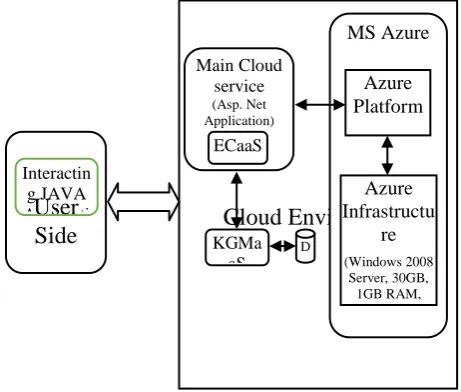
This section gives the details of implementation setup of the proposed research work; proposed work in this paper is one of the works of our research work. For our overall research work, we setup the simulation environment. Windows server 2008 micro instance with 30GB storage and 1GB RAM is rented from Microsoft Azure Cloud infrastructure which is the cloud server for storage. Proposed work for enhanced symmetric convergent encryption is developed using ASP.Net in Visual Studio 2012 and it is hosted in the platform provided by Microsoft Azure. There is main cloud service which contains all the process of the research work, where this encryption is provided as service from ECaaS. KGMaaS is developed as a separate web service which is connected to main cloud service. In the main cloud service, it has provisions for overall research work, which consists of generation of Token TKN from the user’s data, forward requisition for uploading data, received key GCK from KGMaaS, generation of convergent key CEK, encrypt the data ED using CEK, generation Tag TG, verify tag data for deduplication, uploading the data to cloud server, verify the user for proof of owner ship and for user data is download from the server. All these process are coded in the main cloud service which deployed in the Azure Platform as a Service from Microsoft. Figure 2 shows the diagrammatical representation of the simulation environment.
9.ANALYSIS PROPOSED WORK
Efficient deduplication enables the cloud to provide its storage in secured manner. This paper proposed a convergent encryption technique as a service from the cloud. As it is said early, convergent encryption is vulnerable to different attacks, like brute force and dictionary or poison attack. The proposed approach gets the key and algorithm from the cloud service. Users don’t want to maintain the key or algorithm in their custody. As per the methodology, a GCK is generated from the cloud and based on it, users should generate the CEK. Further, users get encryption from the cloud service ECaaS and using the CEK, data is
encrypted in user side. Hence, it avoids attacks like brute force, dictionary and poison attack by duplicate faking and erasure attack is impossible. The process deduplication is start from the user’s data UD KN K K D G, TG is finally forwarded to cloud server for deduplication checking, if it is duplicated TG, then, a new link is generated for the user, otherwise, encrypted ED is uploaded to the
cloud server. To retrieve the data, users are authenticated where they want proof of their owner
Fig 2. Implementation Setup for the our overall Research Work
ship of data. Hence, the deduplicated data are protected from unauthorized access. By the procedures for proposed approach, it ensures the security of deduplicated data with efficient storage.
10. CONCLUSION
Convergent encryption plays an important role in the process of data duplication for maintaining efficient cloud storage with secured data. This paper proposed an enhanced symmetric convergent encryption algorithm for secure the data in the cloud with deduplication. The proposed approach, it has cloud services for key generation and maintenance, encryption techniques and cloud storage. The idea behind this approach is to separate the each service in independent service providers. Hence, details of the data and users are kept in separate servers and it is not known the each other services providers. The proposed work is simulated using the Azure cloud platform. All the works are coded and developed as cloud service using ASP.Net Application. The proposed scheme efficiently secure the data and key
Cloud Environment
MS Azure
Azure Platform
Azure Infrastructu
re
(Windows 2008 Server, 30GB,
1GB RAM, Micro Instance
Data base) Main Cloud
service (Asp. Net Application)
KGMa aS
D B ECaaS
User
Side
Interactin g JAVA Applicati
and also reduce work burden to the users from generating and maintaining the key. Further, the proposed work will compared with existing convergent encryption techniques in near future.
REFERENCES
[1] Arockiam, L, Monikandan, S, & Parthasarathy G 2011 Cloud computing: a survey Int. J. Internet Comput1pp 26-33.
[2] Uma G, Jayasimman L 2018 Survey on Data Deduplication Techniques used for Efficient Management of Cloud Storage International Journal of Scientific Research in Computer Science Applications and Management Studies7 2018 pp 163-170
[3] Mather T, Kumaraswamy S and Shahed L 2009 Cloud security and privacy Chapter 4 O’Reilly Media Inc, pp 61-71.
[4] David Reinsel, John Gantz and John Rydning 2017 Data Age 2025: The Evolution of Data to Life-Critical Don’t Focus on Big Data; Focus on the Data That’s Big, https://www.seagate.com/www-content/our- story/trends/files/Seagate-WP-DataAge2025-March-2017.pdf pp 1-25.
[5] Mark W. Storer, Kevin Greenan, Darrell D. E. Long, Ethan L. Miller 2008 Secure Data Deduplication, ACM proceeding of Storage
pp1-10.
[6] Arockiam L, Monikandan S 2013 Data security and privacy in cloud storage using hybrid symmetric encryption algorithm International Journal of Advanced Research in Computer and Communication Engineering2 8 pp 3064-3070.
[7] Jin Li, Yan Kit Li, Xiaofeng Chen, Patrick P. C. Lee, Wenjing Lou 2014 A Hybrid Cloud Approach for Secure Authorized Deduplication, IEEE Transactions on Parallel and Distributed Systems pp 1-12.
[8] Monikandan S, Arockiam L 2015 Confidentiality technique to enhance security of data in public cloud storage using data obfuscation Indian Journal of Science and Technology8 24 pp 1-10.
[9] Megala D, S. Pothumani, C. Anuradha 2017 Secure and Efficient De-Duplication System in Cloud Computing, International Journal of Pure and Applied Mathematics, 116 20 pp 531-535.
[10] Arockiam L, Monikandan S 2014 Efficient cloud storage confidentiality to ensure data security. IEEE International conferernce prod.
in Computer Communication and Informatics
pp 1-5.
[11] J.R. Douceur, A. Adya, W.J. Bolosky, D. Simon, and M. Theimer 2002 Reclaiming Space from Duplicate Files in a Serverless Distributed File System in Proc. ICDCS pp 617-624.
[12] Taek-Young Youn, Ku-Young Chang, Kyung Hyune Rhee, and Sang Uk Shin2 2016 Authorized convergent encryption for client-side deduplication IT CoNvergence PRActice (INPRA)4 2 pp 9-17
[13] Jin Li, Xiaofeng Chen, Mingqiang Li, Jingwei Li, Patrick P.C. Lee, and Wenjing Lou 2014 Secure Deduplication with Efficient and Reliable Convergent Key Management IEEE Transactions on Parallel and Distributed Systems25 6 pp 1615-1625.
[14] Mihir Bellare, Sriram Keelveedhi, Thomas Ristenpart 2013 DupLESS: Server-Aided Encryption for Deduplicated Storage, Proc. of the 22th USENIX Security Symposium (SEC’13) pp 179–194.
[15] Ashish Agarwala, Priyanka Singh and Pradeep K. Atrey 2017 DICE: A Dual Integrity Convergent Encryption Protocol for Client Side Secure Data Deduplication, IEEE International Conference on Systems, Man, and Cybernetics (SMC) pp 2176-2181.
[16] Zooko Wilcox-O'Hearn, 2008 Drew Perttula and Attacks on Convergent Encryption, 2018 https://tahoelafs.org/hacktahoelafs/drew_perttul a.html , accessed on September 2018.
[17] Convergent encryption, 2018 https://en.wikipedia.org/wiki/Convergent_encr yption , accessed on April 2018.