An Underspecified Segmented Discourse Representation Theory (USDRT)
F r a n k S c h i l d e rC o m p u t e r Science D e p a r t m e n t H a m b u r g U n i v e r s i t y
Vogt-K611n-Str. 30 D - 2 2 5 2 7 H a m b u r g
G e r m a n y
s c h i l d e r @ i n f o r m a t i k , uni-hamburg, de
1 I n t r o d u c t i o n
A theory of discourse interpretation has to deal with a set of problems including anaphora resolution and the hierarchical ordering of discourse structure:
(1) Several students organised a dinner party for Peter. Some students wrote fancy invitation cards. Some other students bought exotic food. But Peter didn't like it.
There are two conceivable readings for (1). Either (a) it refers to the party or (b) Peter only disliked the food. Discourse grammars like Segmented Dis- course Representation Theory (SDRT) offer an ex- planation for this phenomenon. SDRT - - an exten- sion of DRT (Kamp and Reyle, 1993) - - d e s c r i b e s a complex propositional structure of Discourse Rep- resentation Structures (DRSs) connected via dis- course relations. The hierarchical ordering imposed by relations like narration or elaboration can be used to make predictions about possible attachment sites within the already processed discourse as well as suitable antecedents of anaphora.
The next section discusses the question of whether the SDRT formalisation used for discourse structure should also capture the ambiguities, as expressed in (1), for instance, via an underspec- ified representation. Section 3 introduces a tree logic proposed by Kallmeyer called TDG. Follow- ing Schilder (1997), this formalism is employed for the representation of the discourse structure. Sec- tion 4 presents the conjoined version of SDRT and TDG. This is a novel combination of the discourse grammar and a tree logic indicating the hierarchical discourse structure. Finally, a USDRT formalisation of the discourse example discussed is given.
2 F r o m D R T to S D R T
One obvious shortcoming DRT is that it lacks the rhetorical information that structures the text. This
rhetorical information, expressed by discourse rela- tions such as narration or background, has a crucial effect on anaphora resolution, lexical disambigua- tion, and spatial-temporal information. SDRT ex- tends DRT in order to amend this insufficiency.
Following Asher (1996) DRSs and SDRSs will be labelled ( { K 1 , . . . , K , } ) . Formally, an SDRS is recursively defined as a pair of sets containing la- belled DRSs or SDRSs, and the discourse relations holding between them.
Definition 1 (SDRS) Let K t : oq, . . . K n : Ctn be a labelled D R S s or S D R S s a n d R a .vet o f dis- course relations. The tuple (U, C o n ) is an S D R S i f ( a ) U is a labelled D R S a n d C o n : 0 or (b)
U = {K1 . . . , tfn} and C o n is a set o f S D R S con- ditions. A n S D R S condition is a discourse relation such as D ( K t , . . . , Kn), where D C R.
For the basic case (i.e. (K, 0)) K labels a DRS rep- resenting the semantic context of a sentence. A discourse relation introduces furthermore a hierar- chical ordering indicated by a graph representation. The nodes represent the labelled SDRSs and the edges are discourse relations. Apart from the dis- course relations, which impose a hierarchical or- dering, 'topic' relations add more structure to this graph. If a sentence c~ is the topic of another sen- tence/3, this is formalised as c~ 1~ /3.1 This sym- bol also occurs in the graph, indicating a further SDRS condition. The graph representation illus- trates the hierarchical structure of the discourse and in particular the open attachment site for newly pro- cessed sentences. Basically the constituents on the so-called 'right frontier' of the discourse structure are assumed to be available for further attachment (Webber, 1991).
Assuming a current label (i.e. the one added af- ter processing the last clause/sentence), a notion of
D-Subordination
is defined by Asher (1996, p. 24). Generally speaking, all constituents which domi- nate the current label are open. A further restric- tion is introduced by the termD-Freedom
which ap- plies to all labels which are directly dominated by a topic, unless the label assigns the current node. Formally speaking, this can be phrased as: a label K isD-free
in an S D R S / 3 iff current(//) = K or-~EK~(K ~ ~ K) E Con
(see figure 1). SDRT ex-K•:a•d-ffee
K l a : 7 K10:6g
K10a:e
Klo11:ff K'lOlO:~
Figure 1:
Openness
andD-Freedom
ploits discourse relations to establish a hierachical ordering of discourse segments. A constituent graph indicates the dependencies between the segment, es- pecially highlighting the open attachment points.
How the discourse relations such as
narration
orelaboration
are derived is left to an axiomatic the- ory called DICE (Discourse in Commonsense En- tailment) that uses a non-montonic logic. Taking the reader's world knowledge and Gricean-style prag- matic maxims into account, DICE provides a formal theory of discourse attachment. The main ingre- dients are defaults describing laws that encode the knowledge we have about the discourse relation and discourse processing. 2The following discourse which is similar to example (1) exemplifies how SDRT deals with anaphora resolution within a sequence of sentences (Asher, 1996):
(2) (kl) After thirty months, America is back in space. (k2) The shuttle Discovery roared off the pad from Cape Kennedy at 10:38 this morning. (k3) The craft and crew performed flawlessly. (k4) Later in the day the TDRS shuttle com- munication satellite was sucessfully deployed. (k5) This has given a much needed boost to NASA morale.
2Formally, this is expressed by means of the Comensense Entailment (CE) (Asher and Morreau, 1991).
Note that
this
in (k5) can refer back either to (a) the entire Shuttle voyage or (b) the launch of the TDRS satellite in (k4). It can also be shown thatthis
cannot be linked to the start of the shuttle described in (k2). The hierachical structure of the two first sentences is established by anelab-
oration
relation. As a consequence, the SDRS labelled by K1 is the topic of [(2 (i.e. ({1(1, K2},{elaboration(K1,
K2), K1 K 2 } ) ) . T h e next sentence (k3) is a comment to the situation described in the preceding sentence. However, a new constituent K{ has to be introduced into the discourse structure. This SDRS labelled by K{ subsumes the two DRSs in K2 and Ka. As a side effect, the label 1(2 within the discourse relationelaboration(K1,K2)
is changed to the newly introduced label K{ and a lhrther edge is introduced between this SDRS and K3. It has toK1
Elaboration
±q
~
i
Comment
Figure 2: The third sentence attached
be pointed out that this modification of the entire SDRS involves an overwriting of the structure derived so far. The SDRT update function has to be designed such that these changes are accordingly incorporated. Note furthermore that the introduc- tion of an additional edge from K[ to /r( 3 is not assigned with a discourse relation.
In order to proceed with the SDRS construction, we have to consider which constituents are available for further attachment. According to the definition of
D-Freedom
andD-Subordination,
the SDRS la- belled by K1, K2 and K3 are still available. 3We derive using DICE that the next sentence (k4) is connected to (k2) via
narration.
The resulting constituent graph is shown in figure 3. A com- mon topic as demanded by Asher (1996, p. 28) does not occur in the graph representation. Finally, only two attachment sites are left, namely K1 and K4. The discourse relationresult
can connect both [image:2.612.86.274.177.296.2] [image:2.612.327.500.290.395.2]K I
Elaboration
K{
Figure 3: Sentence (k4) processed
SDRSs with the SDRS derived for (k5). Conse- quently, two antecedents for the anaphora this can be resolved and the theory predicts two conceivable derivations: One SDRS contains the SDRS labelled by K5 attached to K1, whereas the second conceiv- able SDRS exhibits K5 connected to K4.
Summing up, the formalism includes the follow- ing shortcomings: (a) The representation of an un- derspecified discourse is not possible in SDRT. All readings have to be generated. (b) The formalism is not monotonic. Updates may overwrite preceed- ing constituents. As it can be seen from figure 2 a new SDRS K{ substituted K2. 4 (c) The con- stituent graph contains a set of different SDRS con- ditions (i.e. discourse relations, ~, and FBP). It is not clear how these different conditions interact and it seems difficult to predict their effect on the dis- course structure. Note that the update on narration requires a common topic which connects the two SDRSs according to the axioms stipulated within SDRT. However the ,~ relation is not shown in the constituent graph.
I will develop further ideas introduced by under- specified semantic formalisms which have been pro- posed in recent years (e.g. (Reyle, 1995)) in order to provide an underspecified representation for dis- course structure. I will employ a first order tree logic by Kallmeyer (1996) to define an underspeci- fled SDRT, in the following sections.
3 Tree Descriptions
Tree Description Grammars (TDGs) were inspired by so-called quasi-trees (Vijay-Shanker, 1992). The grammar formalism is described as a constraint- based TAG-like grammar by Kallmeyer (1996). The logic used for TDGs is a quantifier-free first order
4It may be possible that the topic relation is transitive to- gether with the d-subordination. However, this would contra- dict with the definition of D-Freedom (i.e. -~3K' (K' l~ K))
logic consisting of variables for the nodes, four bi- nary relations and the logical connectives -1, A, V. 5
Definition 2 (TDG) A Tree Description Grammar (TDG) is a tuple G = (N, T, <1, <1', -4, ~ , S), such that:
(a) N and T are disjoint finite sets f o r the nonter- minal and terminal symbols.
(b) <~ is the parent relation (i.e. immediate domi- nance) which is irreflexive, asymmetric and intran- sitive.
(c) <1" is the dominance relation which is the tran- sitive closure of <1.
(d) -< is the linear precedence relation which is ir- reflexive, asymmetric and transitive.
(e) ,,~ is the equivalence relation which is reflexive, symmetric and transitive.
(f) S is the start description.
[image:3.612.83.243.52.166.2]The tree descriptions are formulae in TDGs reflect- ing the dominance relations between subtrees. Such formulae have to be negation-free and at least one k E K must dominate all other k' C K . In order to combine two tree descriptions an adjunction op- eration is used which simply conjoins the two tree descriptions. Graphically, this operation can take place at the dotted lines indicating the dominance relation (i.e. <3*).The straight line describes the par- ent relation (<1). No adjunction can take place here. Figure 4 illustrates how the labels K ~ l and K~-, and s2 and K~2 are set to equal respectively.
KT
I
KRI
K'nl s l KT x
s2 ~
KIR2
S3
Figure 4: Two tree descriptions combined
We are now able to use this tree logic to describe the hierachical ordering within SDRT. This extends
5See Kalhneyer (1996) for a detailed description of how a sound and complete notion of syntactic consequence can be de-
[image:3.612.324.545.452.601.2]the original approach, as we are also able to describe ambiguous structures.
4 Underspecified SDRT (USDRT)
Similar to proposals on underspecified semantic for- malisms, the SDRSs are labelled and dominance re- lations hold between these labels. Note that also a precedence relation is used to specify the ordering between daughter nodes.
Definition 3 (USDRS)
Let S be a set of DRSs, L a set of labels, R a set of discourse relations. Then U is a USDRS confined to the tuple (S, L, R) where U is a finite set consisting of the following two kinds of conditions:1. structural information
(a) immediate dominance relation: KI <3 K2, where K t , K 2 E L
(b) dominance relation: I(1 <1" K2, where K1,K2 E L
(c) precedence relation: K1 -~ K2, where K1,K2 E L
(d) equivalence relation: K1 ,-~ 1(2, where K1, K2 E L
2. content information
(a) sentential: 81 : drs, where Sl E L, drs E S (b) segmental: K1 : P ( s l , . . . , s n ) , where P is an n-place discourse relation in R, and K l , s l , . . . , S n E L
Generally speaking, a discourse relation P provides the link between DRSs or SDRSs. Similar to the standard SDRT account, this relation has to be de- rived by considering world knowledge as well as ad- ditional discourse knowledge, and is derived within DICE. [ do not consider any changes of the stan- dard theory in this respect. The structural infor- mation, however, is encoded by the tree descrip- tions as introduced in section 3. The most gen- eral case describing two situations connected by a (not yet known) discourse relation is formalised as shown in figure 5. 6 The description formula for this tree is KT <3* K ~ t A KT1 <3 K m A K n t <3 K R I ' A KR1 <3 K~I A K i t <1" sl A K'~I <1" s2. Comparing this representation with the SDRT con- stituent graph, the following similarities and differ- ences can be observed. First of all, the question of where the open attachment sites are found is easily observable in the structural restriction given by the
~'The dashed line describes the underspecification with re- spect to the precedence relation (-<).
K T
K~I : topic(st, s2)
I
K R I : r e l a t i o n ( K ~ l , K ~ l )
K h . . .
J
81:0~ 82:/~
Figure 5: Underspecified discourse structure
tree description. Graphically, the open nodes are in- dicated by the dotted lines. Secondly, a topic node is introduced, immediately dominating the discourse segment. No distinction between D-Subordination and D-Freedom has to be made, because the topic is open for further attachment as well. This is the main change to the discourse structure proposed by Schilder (1997). This account encodes the topic information in an additional feature called PROMI. However, it gives no formal definition of this term. I stick therefore to the topic definition Asher gives. But instead a uniform treatment of the hierarchi- cal ordering can be given by the tree logic used. Thirdly, the discourse segment is dominated by the discourse relation that possesses two daughter nodes. The structure is flexible enough to allow fur- ther attachment here. No overwriting of a derived structure, as for the SDRT account, is necessary.
If a discourse relation is derived, further con- straints are imposed on the discourse structure. Ba- sically, two cases can be distinguished: (a) A subor- dinating structure is triggered by discourse relations like narration or result. Consequently, the second situation becomes the topic (i.e. I{~l : /3) and the precedence relation between K ~ t and K ~ I is intro- duced. In addition, the open attachment site on the right frontier gets closed (i.e. t£~1 ,,~ //2). (b) A subordinated structure which comes with discourse relations like elaboration or background contains the first situation as a topic (i.e. K ~ I : c0. For this structure a precedence relation between K ~ I and I ( ~ t also holds, but instead of the right fron- tier, the left frontier is closed (i.e. K ~ I ~ K1).
[image:4.612.320.521.55.172.2]Kx
I
8 1 : C e
KTRl:Ol
I
K m : elab(K~3,
Km)
".:'::....:::,.
/3.7.
K T
KTR4 : e
I
I(n4 : r e s ( K ~ 4 , K ~ 4 )
K~I
K'R4
K~4 ,'~ K5
i ...
[
KTn3 : 5 s5 : e
I
Kn3 :na,'( K'R3, K 3)
K4
I
S 4 : ~
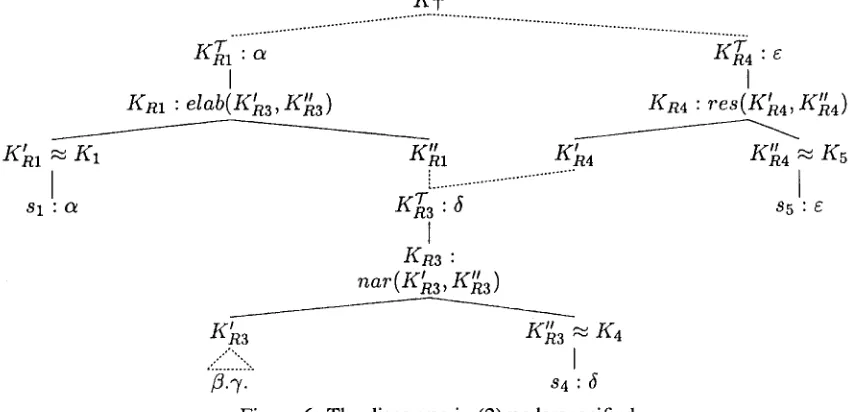
Figure 6: The discourse in (2) underspecified
(i.e. (kl) and (k2)), a copy of a ends up in KnT1. The resulting tree description contains two node pairs where the dominance relation holds, indicated by the dotted line in the graphical representation. Hence there are two possible attachment sites. 7
The construction of the discourse sequence con- tinues in the same way until sentence (k5). The am- biguity for this can be expressed as illustrated in fig- ure 6. Sentence (k5) (i.e. s5 : ¢) is connected via re- sult with either KRT1 : a (i.e. this refers to the entire voyage in (kl)) o r / ( ~ 3 (i.e. only the launch of the satellite is referred to by this). Note furthermore that the latter reading requires that (k5) is an elabora- tion of (kl). Thus the USDRT analysis provides an underspecified representation of the discourse struc- ture which covers the two possible readings of (2).
5 Conclusion
I have shown how the SDRT account can be ex- tended by tree descriptions to represent the dis- course structure. The formalism proposed has the following advantages over previous approaches: a uniform description of the hierarchical discourse structure, the ability to express ambiguities within this structure, and the dominance relation specify- ing the open nodes for further attachment.
References
N. Asher and M. Morreau. 1991. What some genetic sentences mean. In Hans Kamp, edi- tor, Default Logics for Linguistic Analysis, num-
7See figure 4 on page 3 which represents the first three sen- tences of this discourse.
ber R.2.5.B in DYANA Deliverable, pages 5-32. Centre for Cognitive Science, Edinburgh, Scot- land.
Nicholas Asher. 1996. Mathematical treatments of discourse contexts. In Paul Dekker and Martin Stokhof, editors, Proceedings of the Tenth Amsterdam Colloquium, pages 2 1 4 0 . ILLC/Department of Philosophy, University of Amsterdam.
Laura Kallmeyer. 1996. Underspecification in Tree Description Grammars. Arbeitspapiere des Sonderforschungsbereichs 340 81, University of Tfibingen, Tfibingen, December.
Hans Kamp and Uwe Reyle. 1993. From Discourse to Logic: Introduction to Modeltheoretic Seman- tics of Natural Language, volume 42 of Studies in Linguistics and Philosophy. Kluwer Academic Publishers, Dordrecht.
Uwe Reyle. 1995. On reasoning with ambigui- ties. In 7 th Conference of the European Chapter of the Association for Computational Linguistics, Dublin.
Frank Schilder. 1997. Temporal Relations in En- glish and German Narrative Discourse. Ph.D. thesis, University of Edinburgh, Centre for Cog- nitive Science.
K. Vijay-Shanker. 1992. Using descriptions of trees in a tree adjoining grammar. Computational Lin- guistics, 18(4):481-517.
[image:5.612.89.520.60.266.2]