© 2011, JDDT. All Rights Reserved ISSN: 2250-1177 CODEN (USA): JDDTAO Available online at http://jddtonline.info
REVIW ARTICLE
COCRYSTALIZATION: AN ALTERNATIVE APPROACH FOR SOLID MODIFICATION
Mundhe Akshay Vitthalrao*, Fuloria Neeraj Kumar, Biyani Kailash Radheshyam
Department of Pharmaceutics, Anuradha College of Pharmacy, Chikhli, Dist.Buldana. Maharashtra, India-443201
*Corresponding Author’s Email: [email protected]
INTRODUCTION
Initial R&D efforts were focused on finding new chemical entity with desired molecular structure and physical properties. The search for molecular structure of an API with optimized therapeutic efficacy and proper physical properties is quite difficult. Most of the active pharmaceutical ingredients exists in solid state, solid does not crystallize on its own it crystallizes several forms showing unpredictable crystal properties. There are number of approaches can be used to modify solids such as solvation, hydration, salting and polymorphism. Apart from available approaches of API modification cocrystallization is an emerging alternative approach enhancement of physical properties.
In this study the focus is given on cocrystallization as major alternative approaches for physical property enhancement. The mechanism of cocrystallization and various design strategies used along with the examples of cocrystals for optimization specific physical property. Co crystal screening, characterization and regulatory aspects are also covered.
Cocrystals are known as crystalline complexes of two or more neutral molecular constituents, bound together in crystal lattice through non covalent interaction. The
pharmaceutical co crystal are prepared by combination of API and coformer i.e. pharmaceutically acceptable molecule inside a crystal lattice. As a matter of fact cocrystals increase the diversity of API form. Cocrystallization is molecular association of similar or different molecules, the network of hydrogen bonds results in generation of families in the molecular network.
Designing of cocrystals
Crystal design involves the construction of solid crystals with acceptable physical properties with respect to supra molecular structure assemblies. The molecular interactions in the crystalline solids are a result of non covalent bonds such as hydrogen bonds between functional atoms. Due to interaction between compatible molecular assemblies changes in physicochemical properties occurs such as Solubility, dissolution rates stability and melting point.
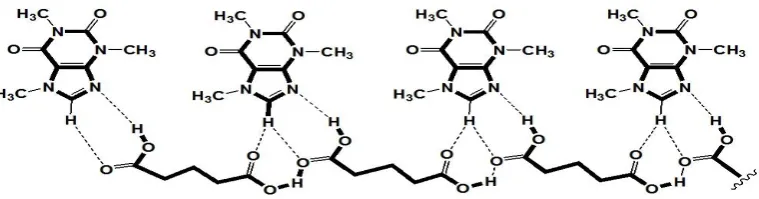
Cocrystals of caffeine were designed using di carboxylic acid as coformer the result found was that dicarboxylic acids acts as proton donor as a result heteromeric interaction that replaces homomeric interaction, Heteromeric interactions contains O-H—N and C-H—O bonding1.
Figure 1: Molecular interactions of caffeine- Glutaric acid cocrystals containing heteromeric interactions
ABSTRACT
To give detail view of cocrystal formation with their application in providing suitable approach for optimization of physical properties; Cocrystallization involves alteration in molecular assemblies and composition of pharmaceutical substance and which ultimately results in enhancing physical properties. Cocrystals contains API and pharmaceutically acceptable coformer. Cocrystals are molecular complex brings about changes in solubility, bioavailability and stability in pharmaceutical designin g without interacting with therapeutic utility. Cocrystals are compared with other solid modification techniques which are generally used in development of pharmaceutical compounds. Cocrystals can be prepared with several methods such as solution evaporation, solid grinding, and solvent drop grinding and sonocrystallization method. The major factor which affects cocrystal preparation is its thermodynamic stability. Screening of cocrystals gives the details about chemical structure and relation between API and coformer. As concern with the therapeutic utility, cocrystals will play major role in development of formulation. This review outlines cocrystallization as emerging process in modifying solids, mainly focused on methods applicable for preparation along with examples illustrating cocrystallization in enhancing specific properties of pharmaceutical solids. Final outlook is on future development and growth potential in this field.
COCRYSTALS IN COMPARISION WITH OTHER SOLID MODIFICATION TECHINQUES
Polymorphs
The phenomenon which indicates two or more different arrangement of same molecules showing different physicochemical properties is termed as polymorphism 2. It is not possible to predict number of polymorphs even for a simple molecule 3. Some compounds shows more than ten crystal forms4. As known the selection of solid modification technique is based on evaluation of solid and scope of screening method. In case of cocrystals the screening is fairly simple the main part is to identify suitable pharmaceutical acceptable coformer. The
detection of polymorphs is a major challenge for investigators it requires high through put screening method5.
Polymorphism is an essential approach for designing of cocrystals. Polymorphs can be converting from unstable polymorphs to stable polymorph at specific temperature and them posses different melting point and solubility results in difference in dissolution rate. A few examples of polymorphic cocrystals are nicotinamide-carbamazepine cocrystals and carbamazepine-saccharine cocrystals6. Cocrystals of piroxicam with carboxylic acid were prepared in that piroxicam and hydroxybenzoic acid cocrystals found to be polymorphs7.
Figure2:Classification of API solid form based on molecular structure8
Salts
Salting is one another approach for enhancement physical properties. Salting involves acid –base reaction between API and Acidic or basic substance.
Salt is used in the place of free acid and base in order of improved solubility, stability and crystalline property of pharmaceutical compound. Salt is formed by transfer of proton from acid to base. As proton is involved one can predict the formation by measurement of pKa value. Formation of salts depends upon the arrangement of hydrogen molecules in crystals. There are several marketed APIs which are result of solid modification by salt formation. Salts and cocrystals are two opposite aspects of multi component system.The difference between cocrystals and salts is that drug and coformer are solids at ambient temperature and that the intermolecular interactions are nonionic in nature 8-10.
Solvates and Hydrates
Solvates imparts toxicity so their use in development of API crystal is rare. Most of solvates are biologically toxic in nature. Basic difference between solvates and cocrystals is their physical form. If substance is liquid at room temperature considered as solvates11.
Hydrates are one of the better approaches to enhance properties moreover it has noted that 33% of molecules capable of forming hydrate12, 13. Due to temperature and pressure cycling some hydrates converts
into anhydrous crystalline form and as a result physical property changes.
PROPERTIES ALTERED BY CO CRYSTALIZATION
The alteration in molecular structure assemblies may lead to changes in physical properties. The expected changes in physicochemical properties would occur such as solubility, melting point, stability and other mechanical properties. There are some examples which demonstrate the changes in physicochemical properties.
Change in Solubility
© 2011, JDDT. All Rights Reserved ISSN: 2250-1177 CODEN (USA): JDDTAO
Change in Melting point
Melting point is an important property while studying the alteration of properties of cocrystallization. The lowering of melting point is useful process in consideration with pharmaceutical aspects. The solid having lower melting point in comparison with other solid shows lowered susceptibility to degradation.
Change in Stability
The cocrystallization in many cases improves the stability of the solid form. As the alteration in molecular assemblies changes the mechanical property of solid, the stability of polymorphic cocrystals is major concern for investigators. The example of polymorphic cocrystals is Carbamazepine with saccharin and nicotinamide as coformer. These cocrystals are more stable than original API17.
Miscellaneous properties changes
The changes in the crystalline structure the mechanical aspects also changes such as tensile strength and tabletability. For example Paracetamolcocrystals were evaluated for tabletability. The evaluation of four cocrystals was done in terms of tensile strength, breaking force and other elastic properties. These properties are beneficial in the designing of dosage form including compression phenomenon18. Cocrystallization can also alter hygroscopicity of API and avoid undesired molecular interaction in the crystal to form solvate or hydrates19.
Methods used for Cocrystal preparation
The most conventional method used for crystal formation the use of suitable solution with proper degree of super saturation. There are several methods through which solution is supersaturated such as evaporation, cooling and incorporation of solubility lowering solvent or substance. The most common technique used for preparation of cocrystals is the evaporation. Cocrystallization through solution evaporation based crystal growth technique did not offer optimal result.
Some of a few more some established techniques that currently used for co crystal formation such as mechanical co crystal synthesis and solvothermal co crystal synthesis. In mechanochemicalcocrystallization the suitable ratios of reactants are grinded to produce phase transformation in to crystalline form. Solvothermal method involves the dissolution of suitable ratios of reactants in solvent undergoing supersaturation20-22. There are several factors that involves to both of these processes such stability of reactants and condition selected for synthesis.
a) Solvent Evaporation:
This is most conventional technique of cocrystallization which includes super saturation of solution by evaporation, cooling and addition of solubility changing solvent or substance. The series of events that are follows in solvent evaporation are preparation of two or more suspensions by dissolution of stoichiometric amounts of materials in a solvent, mixing of suspensions and storage under suitable temperatures for co-crystallization. In evaporation process the solution of multiple molecules in suitable amounts are assumed to undergo hydrogen bonding. To have optimal result during evaporation the thermodynamic stability of molecules should always be
considered. The major drawback of evaporation process is its failure to comply in large scale preparations.
The intrinsic dissolution rate was increased of Fluoxetine hydrochloride by using multiple coformers like succinic acid, fumaric acid and benzoic acid. Norfloxacincocrystals were synthesized with Isonicotinamide, Malonic acid and maleic acid as coformers23.
b) Solid state grinding
Solid state grinding is alternative synthetic method for solution based cocrystallization process. Particle size reduction is carried out in mixture which increases the covalent reactivity. This method offers increase in selectivity and simplicity over solution crystallization technique.
The application of solid state grinding was studied using six cocrystals of sulfadimidine with anthranillic acid and salicylic acid, the co crystal of sulfadimidine –salicylic acid while grinding with anthranillic acid. The replacement of Salicylic acid with anthranillic acid occurs as a result of common pattern of hydrogen bonding of both of cocrystals24.
The hydration of caffeine is reported but the study of preparation by solid grinding in a ball mill is also proved25. The hydrogen bonding preferences was demonstrated in number of instances for modification in solid grinding technique26. The solid grinding generated cocrystals which were not possible by solutionevaporation. This method was used for generation of cocrystal phase with various coloristic properties27. The solid grinding approach is having drawback of polymorphic transition during the process which results in dangerous side effect that may includes permanent withdrawal from market.
c) Solvent drop grinding
Solvent drop grinding is emerging step in advancement of polymorphic selectivity in various models of cocrystals. Solvent drop grinding includes grinding of two materials together like solid state grinding with incorporation of small quantity of solvent. The solvent added act as catalyst. It is anticipated that this approach will open new opportunities in both the synthesis and characterization of co-crystals, regardless of the inabilities to characterize materials synthesized using this method by single-crystal X-ray diffraction28.
For determining efficacy of methods for synthesis the cocrystals the cyclohexane tricarboxyllic acid derivatives are used. Initially their synthesis is carried out by solution crystal growth method. Some crystals were readily prepared with solid grinding method but some did not successfully preceded further. For them solvent drop grinding technique found to be efficient29.
organic substances in case of carboxylic acids like succinic acid and anthranillic acid30. Solvent drop grinding is useful in synthesis of crystalline salt with pharmaceutical substances. Indomethacin cocrystals with saccharine were prepared by solvent drop grinding, the optimal result obtained with increased dissolution rate and physical stability31.
d) Slurry Crystallization
Slurry crystallization is simple process which includes the addition of crystallization solvent in the components i.e. API along with its acceptable former. The selection of this process is mainly depends upon the physical stability of the crystallization solution to co crystals and its solid former. The study on synthesis of cocrystals through Slurry crystallization was commenced in sixteen co crystal system with optimum result32
While preparation of cocrystals for Trimethoprim and sulfamethoxazole through slurry technique simple distilled water is used as solvent. Cocrystals of aspirin designed with 4, 4-Dipyridil as a coformer by using slurry crystallization method. However the yield obtained was not sufficient as compared with solvent drop grinding method33. The major disadvantage of this method is that it requires large amount of solvent.
e) Hot melt extrusion
Extrusion is useful method for synthesis of cocrystals, it involves highly efficient mixing and improved surface contacts, Co crystals are prepared without use of solvent. The selection of this method is primarily depends on thermodynamic stability of compound. This method was studied with the use of four models for cocrystal formation34.
Solvent drop extrusion technique used to optimize and make the process more flexible. Solvent drop extrusion technique gives an advantage to carry out process at lower temperature. Hot melt extrusion method was used in synthesis of Carbamazepine-nicotinamidecocrystals with polymer as former35. Continuous cocrystallization, API and coformer poured in the twin extruder. As a result of continuous addition of mixture the barrel temperature also increases.
f) Sonocrystallization Method
The development of sonochemical method for preparation of organic cocrystals of very finite size has been done. This method was primarily developed for preparation of nanocrystals. Caffeine- maleic acid cocrystal preparation commenced with use of ultrasound method36.
The comparative study of method of preparation of caffeine and theophylline as API and L-tartaric acid as coformer by Solvent drop grinding method and sonochemical method has been commenced37. The results of methods were consistent hence Sonocrystallization proves to be a significant approach.
MOLECULAR MECHANISM OF CO CRYSTAL FORMATION
The co crystal formation studies mainly aimed at understanding the design of cocrystal. In early study approach based on hydrogen bond rules includes certain assumption that all good proton donors are used in
hydrogen bonding and every good donor finds a suitable acceptor in crystalline structure38
The numerous studies based on method of preparation such as during the co grinding and storage the generation of amorphous phase led to co crystal formation39. There are several examples of co crystal formation by moisture uptake such as Caffeine, carbamazepine-nicotinamide, carboxylic acid. The mechanochemicalcocrystallization mechanism involves the competitive behavior of intermolecular halogen bonds. The further formation of finite molecular arrangement of competing strong halogen bonds which progresses to polymerization of infinite chain cross linking through strong intermolecular halogen bonds.
COCRYSTAL SCREENING
The purpose behind screening is to discover co crystal with enhanced physical properties. The cocrystallization involves interaction two molecules with compatible structural assemblies interact. The co crystal formation is mainly depend upon acceptability of coformer, ratio of solid and coformer and type of method used for synthesis. The cocrystals can be synthesized by several methods such as solvent evaporation, solid grinding, solvent- drop grinding technique and hot melt crystallization. The initial assessment of method of synthesis is done by yield of cocrystals obtained. In all these processes the most common and conventional method is solvent evaporation. The disadvantage of this method is inability to scale up. Solvent drop grinding was found to be efficient and effective in discovery of newer cocrystals but in the preparation of co crystal hydrates it was found to be less sensitive to reactant. The other methods such as slurry crystallization were found to be effective in case of stonolone and metastonolon with 11 acids as coformer the yield was good.
There are few methods which are used for screening of cocrystals such includes near infrared spectroscopy which was evaluated for co crystal screening in comparison with Raman spectroscopy. In this study Indomethacin was used as parent drug with L-aspartic acid and saccharin as coformer. The molar ratio of 1:1 with each coformer was selected. For the preparation cocrystals two methods are used, in case of saccharin the solvent drop technique is used. While for L-aspartic acid the method solvent evaporation was used. Raman spectroscopy showed straight peaks and shows satisfactory data but near infrared does not showed proper results. NIR shows good result in combination with multivariate modeling by principle component analysis40.
The development of thermal method for rapid co crystal screening was done. The compound sparing most efficient and highly automated differential scanning colorimetry method developed41.
© 2011, JDDT. All Rights Reserved ISSN: 2250-1177 CODEN (USA): JDDTAO Screening of cocrystals with similar structure was
carried out. Piracetam and Levitiracetam are structurally similar. The synthesis of Piracetamcocrystals with 10 different acids had been studied. For the experimental work these ten acids were used to form cocrystals of Levitiracetam. The profound result obtained with 40% success rate 43.
The co crystal hydrates were screened with solvent drop grinding method. The study on all the preparation method was carried out by considering variables along with combination of these techniques and its effect on co crystal formation44. Recently for co crystal of caffeine and adipic acid newer screening methods are used. The capability of co crystal formation for antiviral drugs like lamivudine and zidovudine were analyzed45. The application of newer synthetic approaches for designing of cocrystals was studied. Cocrystals of itroconazole-succinic acid characterization are done by single crystal x-ray. The comparative study on two structurally identical solids was carried out. Trimethoprim and pyrimethamine with carboxylic acid salts used as coformer. The cocrystals were prepared by various methods and evaluated by different techniques. Among all
these methods the solid grinding and solvent-drop grinding was found to be efficient screening tool46.
The cocrystals of caffeine and oxalic acid were evaluated for the stability in various different conditions. The different stoichiometric ratios of compound with submeric acid and nicotinamide as coformer were studied for stepwise assessment of co crystal formation. The Indomethacin-saccharin cocrystals were used as model for evaluation of supercritical solvent technique for screening47. The cocrystals of Norfloxacinsaccharinate-saccharin dehydrate cocrystals were prepared and evaluated for enhanced physical properties48. The study of polymorphic cocrystals of phloroglucinol and phenalzine were carried out. In that different stoichiometric ratios were taken and role of coformers as hydrogen bond additives for stability in crystallization process49.
COCRYSTAL CHARECTERIZATION
The co crystal characterization is involves structural assessment and properties evaluation. There are several analytical techniques which are used for characterization of crystal structures and properties evaluation.
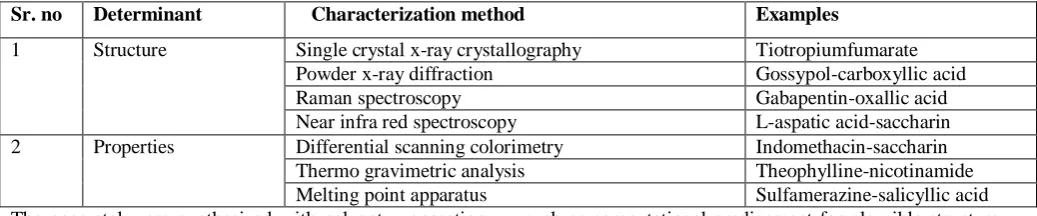
Table 2: shows various methods involving determination of structure & properties for several cocrystals50-52, 45, 47, 53
The cocrystal were synthesized with solvent evaporation method and solid grinding then characterized by DSC, IR, PXRD and single crystal X-ray diffraction54. Cocrystals are synthesized by grinding and slurring was characterized by single crystal x-ray diffraction. Solid state NMR has also generated recent interest in order to characterize cocrystals. The advantage of using solid state NMR spectroscopy is that it has the ability to differentiate chiral and racemic cocrystals of similar structure. The comparison of molecular salt and cocrystals solubility were carried out by mathematical model55. The formation of cocrystals can be predictable with the assessment of thermodynamic stability.
REGULATORY ASPECTS OF COCRYSTALS
Solid form can possess unwanted physical properties but with the proper efforts creative and useful thing could occur. For anything to be eligible for patentability criteria it should have three important things utility, novelty and non-obviousness. While considering patentability criteria for cocrystals always compared with pharmaceutical salts. The novelty of cocrystals for modification of API is far greater than salts56. The utility considered with therapeutic aspects can be suggested with cocrystallization. The physical properties such as solubility and dissolution rate enhancement will result in increased therapeutic utility.
The non-obviousness is inability to predict the crystal structure. The visual prediction of crystalline structure is not possible. The more advance techniques
such as computational predicament for plausible structure are being used by researcher57.
The main regulatory issue regarding cocrystals is that it is yet to be approved by generic regulatory department. The cocrystals applications are submitted in ANDA form. Pharmaceutical cocrystals are having commercial advantage with respect to market. In comparison with other solid modification approaches cocrystallization is having scientific and regulatory advantage.
CONCLUSION AND FUTURE SCOPE
Cocrystallization is significant type of process in the development and optimization of new therapeutic entity as well as existing one. The relation of cocrystallization process in the API formulation involves optimized physical properties such as solubility, stability, melting point and other properties. The major venture includes characterization, Identification and development of new and existing drug. Among the process of manufacturing of cocrystals solid grinding and solvent drop grinding tends to demonstrates higher selectivity than other solvent based process. Comparing with other solid modification techniques used in pharmaceutical industry, Cocrystallization appears to be alternative tool in drug discovery.
Cocrystallization is new process for pharmaceutical industry; more research needs to be done to scale up this process for application in manufacturing
Sr. no Determinant Characterization method Examples
1 Structure Single crystal x-ray crystallography Tiotropiumfumarate
Powder x-ray diffraction Gossypol-carboxyllic acid
Raman spectroscopy Gabapentin-oxallic acid
Near infra red spectroscopy L-aspatic acid-saccharin
2 Properties Differential scanning colorimetry Indomethacin-saccharin
Thermo gravimetric analysis Theophylline-nicotinamide
and development of new dosage form. The major concern for investigators is screening of cocrystals which includes high throughput assessment of molecular structure of API
and suitable coformer. There is need of development of proper screening methodology in order to ease cocrystallization and its regulatory criteria.
REFERENCES
1. Desiraju G.R. Crystal engineering: From molecules to materials, J. Mol. Structure, 2003,656,5-15
2. W.C. McCrone . Physics and Chemistry. 2nd ed. New York. Interscience, 1965.
3. Motherwell W.D.S, Ammon H.L, Dunitz J.D, Dzyabchenko A, Erk P, Gavezzotti A, Hofmann D.W.M, Leusen,F.J.J. Lommerse J.P.M, . Mooij W.T.M, Price S.L, Scheraga H, .Schweizer B, Schmidt M.U, van Eijck B P, Verwer P, . Williams D.E. Crystal structure prediction of small organic molecules: a second blind test. Acta Crystallographica.2002, B(58), 647-661
4. Rodrgueuez-sponge B, Price C.P,Jayasankar A,Matzger A.J, Rodriguez-Hornedo N, General principals of pharmaceutical solid polymorphism: Asupramolecular perspective, Adv. Drug delivery rev. 2004, 56, 241-274
5. Morissette SL, Almarsson O, Peterson ML, Remenar JF, Read MJ, Lemmo AV, Ellis S, Cima MJ, Gardner CR. High-throughput crystallization: polymorphs, salts, co-crystals and solvates of pharmaceutical solids. Adv Drug Deliver Rev 2004, 56, 275-300.
6. Porter W.W, Elie S.C, Matzeger A.S, Polymorphism in Carbamazepine co crystals. Crys. Growth Des 2008, 8, 14-16. 7. Childs S.L,Hardcastle K.I., Co crystals of piroxicam and
carboxylic acid. Cryst. Growth Des 2007, 7, 1291-1304. 8. Stahly G.P, Diversity in single and multiple component crystal:
The search for prevalence of polymorph and co crystals. Cryst. Growth Des 2007, 7, 1007-1026.
9. Childs S.L,Stahly G.P, Park A. Salts and cocrystals of Theophylline. Mol.Pharma 2007, 4, 323-338
10. Etter M.C. Hydrogen bonds as design elements in organic chemistry, J. PhysChem 1991, 95, 4601-4610.
11. Brahmankar DM, Jaiswal SB. Biopharmaceutics and
Pharmacokinetics. 2nd ed. .VallabhPrakashan, 2005, 33. 12. Vippagunta S.R, Britain H.G,Grant D.T.W, Crystalline solids.
Adv. Drug deliv. Rev. 2001, 48, 3
13. Gillon A, Feeder N, Davey R, Storey R. Hydration in molecular crystals - A Cambridge Structural Database analysis. Crystal Growth & Design. 2003, 3(5), 663-673.
14. Remnar J.F, Morissette S.L, Peterson ML, Moulton B, MacPhee JM, Guzman HR, Almarsson O. Crystal engineering of novel cocrystals of triazole drug with 1,4- dicarboxyllic acids, J am Chem SOC 2003, 125, 8456-8457.
15. Rodrguez-Hornedo N, Nehm SJ, Jayasankar A. Cocrystals: Design, Properties and Formilation mechanisms, In Encyclopedia of Pharmaceutical Technology 3rd ed. Informa Health care 2006, 615-635.
16. Nehm SJ, Rodriguez-Sponge B, Rodriguez-Hornedo N, Phase solubility diagram of cocrystalsare explained by solubility product and solution complexation. Cryst. Growth Des 2006, 6, 592-600
17. Karki S, Friscic T, Fabian L, Lalty PR, Day GM, Jones W, Improving mechanical properties of crystalline solids by cocrystal formation with mew compressible form of paracetamol, Advan Materials 2009, 21(38), 3905-3909.
18. Huang NC, Engineering of cocrystal solubility and stability via ionization and micellarsolublization. PhD theisis submitted to university of 2011 , 9-10.
19. Britain HG, Cocrystal systems of pharmaceutical interest, Cryst Growth Des 2012, 12(2), 1046-1054.
20. Aakeroy CB, Chopade PD, Cocrystals: Synthesis, structure and application in supramolecular chemistry from molecules of nanomaterials. John Wiley and sons ltd 2012 , 6, 2975-2992 21. Yadav Av, Shete As, Dabke AP, Kulkarni PV, Sakhre SS,
Cocrystal novel approach to modify physical properties of API. Ind J Pharm Sci 2009, 71(4), 359-370.
22. Childs SL, Chyall LJ, Dunlap JT, Crystal engineering approach for amine hydrochlorides with organic acids, Molecular complexes of fluxetine hydrochloride with benzoic , succinic and fumaric acid. J Am ChemSoc 2004, 126, 13335-13342. 23. Caira MR, Nassimbeni LR, Wildervanck AF. Selective
formation of hydrogen bonded co-crystals between a sulfonamide
and aromatic carboxylic acids in the solid state. J ChemSoc Perkin Trans 1995, 2, 2213–2216.
24. Trask AV, Motherwell WDS, Jones W. Pharmaceutical cocrystallization: Engineering a remedy for caffeine hydration Cryst Growth & Des 2005, 5, 1013-1021.
25. Trask AV, Jones W, Crystal Engineering of Organic Cocrystals by the Solid-State Grinding Approach. Top CurrChem 2005, 254 , 41-70.
26. Kurod R, Imai Y, Tajima N. Generation of cocrystal phase with novel coloristic properties via solid state grinding procedures. ChemComm 2002, , 2848-2849.
27. Jones W, Motherwell WDS, Trask AV. Pharmaceutical Cocrystals : An emerging approach for physical property enhancement. MRS Bulletin 2005, 31, 878.
28. Shan N, Toda F, Jones W. Mechanochemistry and co-crystal formation, effect of solvent on reaction kinetics. ChemCommun (Camb) 2002, 2372-2373.
29. Trask AV, Motherwell WD, Jones W. Solvent-drop grinding, green polymorph control of cocrystallization. ChemCommun (Camb) 2004, 126, 890-891.
30. Basavoju S, Borstrom D, Velaga SP. Indomethacin-Saccharin cocrystals, Design, synthesis and prelimnary pharmaceutical characterization. Pharm Res 2008, 25, 530-541.
31. Zhang GGZ, Henry RF, BorchardtTB, Lou X, Efficient cocrystal screening using solution mediated phase transformation. J Pharm Sci 2007, 96(6), 990-995.
32. Vishwashwar P, McMahon JA, Bis JA, Zaworotko MJ. Pharmaceutical co-crystals. J Pharm Sci 2006, 95, 499-516. 33. Daurio D, Medina C, Saw R, Nagapudi K, Alvarez-Núñez F.
Application of twin screw extrusion in the manufacture of cocrystals, Part I, Four case studies. Pharmaceutics 2011, 3, 582–600.
34. Dhumal RS, Kelly AL, York P, Coates PD, Para A. Cocrystalization and simultaneous agglomeration using hot melt extrusion. Pharm Res. 2010, 27(12), 2725–2733.
35. Ruecroft G, Hipkiss D, Ly T, Maxted N, Cains PW. Sonocrystallization, the use of ultrasound for improved industrial crystallization. Org Process Res Dev. 2005, 9, 923–932. 36. Bucar DK, MacGillivray LR. Preparation and reactivity of
nanocrystallinecocrystals formed via sonocrystallization. J Am Chem Soc. 2007, 129, 32–33
37. EtterMC.Encoding and Decoding Hydrogen-Bond Patterns of Organic Compounds. Acc. Chem. Res. 1990, 23, 120-126 38. Jayasankar A, Somwangthanaroj A, Shao ZJ, Rodrıguez-Hornedo
N. Co-crystal formation during cogrinding and storage is mediated by amorphous phase. Pharma Res 2006, 23, 2381-2392.
39. Alleso M, Velaga S, Alhalaweh A, Cornett C, Rasmussen MA, van den Berg F, Diego HLD, Rantanen J. Near-Infrared Spectroscopy for Cocrystal Screening. A Comparative Study with Raman Spectroscopy. Anal. Chem., 2008, 80 (20), 7755– 7764
40. Lu E, Rodríguez-Hornedo N, Suryanarayanan R. A rapid thermal method for cocrystal screening CrystEngComm 2008, 10, 665-668.
41. Berry DJ, Seaton CC, Clegg W Harrington RW, Coles SJ, Horton PN, Hursthouse MB , Storey R, Jones W, Friscic T, Blagden N. Applying Hot-Stage Microscopy to Co-Crystal Screening, A Study of Nicotinamide with Seven Active Pharmaceutical Ingredients. Cryst. Growth Des. 2008, 8 (5), 1697–1712.
42. Springuel G, NorbergB, Robeyns K, Wouters J, Leyssens T.Effective screening through structural resemblance. Institute of Condensed Matter and Nanosciences
© 2011, JDDT. All Rights Reserved ISSN: 2250-1177 CODEN (USA): JDDTAO 44. Bhatt PM, Azim Y, Thakur TS, Desiraju GR. Co-Crystals of the
anti-HIV drugs lamivudine and zidovudine. Cryst Growth Des 2009, 9, 951–957.
45. Karki S, Friscic T, Jones W. Control and interconversion of co-crystal stoichiometry in grinding, stepwise mechanism for the formation of a hydrogen-bonded cocrystal. CrystEngComm 2009, 11, 470–481
46. Padrela L, Rodrigues MA, Velaga SP, Matos HA, Azevedo EG. Formation of indomethacin-saccharin co-crystals using supercritical fluid technology. Eur J Pharm Sci 2009, online 27 May 2009.
47. Velaga SP, Basavoju S, Borstrom D. Norfloxacinsaccharinate– saccharin dihydratecocrystal –A new pharmaceutical co-crystal with an organic counter ion. J MolStruct 2008, 889, 150-153 48. Sarma B, Reddy LS, Nangia A. The Role of π-stacking in the
composition of phloroglucinol and phenazine co-crystals. Cryst Growth Des 2008, 8, 4546–4552.
49. Wenger M, Bernstein J. An alternate crystal form of gabapentin, Acocrystal with oxalic acid. Cryst Growth Des 2008, 8, 1595– 1598.
50. Basavoju S, Bostrom D, Velaga SP. Indomethacin-saccharin co-crystal, Design, synthesis and preliminary pharmaceutical characterization. Pharm Res 2008, 25, 530-541.
51. Lu J, Rohani S. Preparation and characterization of theophylline − nicotinamide co-crystal. Org Process Res Dev, Article ASAP DOI, 10.1021/op900047r Publication Date (Web), May 28, 2009
52. Pop M, Sieger P, Cains PW. Tiotropiumfumarate, an interesting pharmaceutical co-crystal. J Pharm Sci 2009, 98, 1820-1834. 53. Wang S, Chen J. Gossypol co-crystals and the use thereof. United
States Patent 7432300.
54. Cooke CL, Davey RJ, On Solubility of Saccharinate salts and cocrystals. Cryst. Growth Des 2008, 8, 3483-3485.
55. Friscic, T., Jones, W. Recent Advances in Understanding the Mechanism of Cocrystal Formation via Grinding. Cryst. Growth Des 2009, 9, 1621–1637.
56. Foraita, H.-G. Patent Aspects of Drug Salt Formation. In Handbook of Pharmaceutical Salts, Properties, Selection and Use, Stahl, P. H., Wermuth, C. G., Eds., Verlag Helvetica ChimicaActa, Zu¨rich, 2002, pp 221-235.