© 2017 IJSRSET | Volume 3 | Issue 6 | Print ISSN: 2395-1990 | Online ISSN : 2394-4099 Themed Section: Engineering and Technology
Improved Text Detection from Images using MSER Algorithm
Dr. Dilip Sharma, Amit Kumar Pandey
Ujjain Engineering College, Ujjain, Madhya Pradesh, IndiaABSTRACT
In this paper the text is detected from image using MSER based method along with the image enhancement which results in the improved performance in terms of text detection. In addition, we improve current MSERs by developing a contrast enhancement mechanism that enhances region stability of text patterns to remove the blurring caused during the capture of image Lucy Richardson de blurring Algorithm is used. Finally the accuracy and performance of detected image is improved due to the use of MSER and Lucy Richardson de blurring Algorithm.
Keywords : MSER, CC,Binary Image, De-blurring Image
I.
INTRODUCTION
A novel Connecting Character based content acknowledgment and extraction calculation is composed which utilizes Maximally Stable Extremely Regions (MSER) for test applicant acknowledgment and extraction from activity signs [1-3]. In spite of their favorable properties, MSER has been passed on to be fragile towards obscured Image [4-7]. To take into account recognizing little letters in pictures of restricted determination or obscured Image, the complimentary properties of Lucy-Richardson Algorithm and watchful edge Algorithm is utilized [8-13]. Further geometric separating and matching is connected to proficiently get more dependable results [13-15]. At long last, messages are bunched into lines and extra checks are performed to dispense with false positives.
II.
TEXT DETECTION
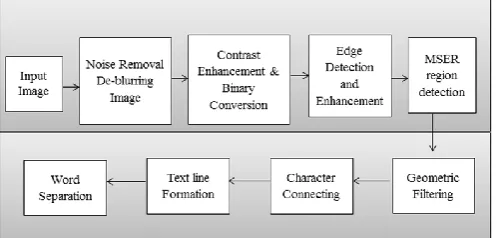
We propose a novel CC-based text detection algorithm as shown in Figure.1
Figure 1: Proposed model of Text Detection
2.1 Text Recognition Phase
It is consist of following steps as given below:
Step 1: Load Image
In this step firstly load the input image in which we have to detect text. Before preceding towards next step first of all the algorithm crop that portion of image that contains text, Further the text can be rotated in plane, if required.
Step 2: Noise Removal and De-blurring Image
Because of defects in the imaging and catching procedure, be that as it may, the recorded picture constantly speaks to a degraded adaptation of the first scene. The corruption results in picture blur, affecting identification and extraction of the helpful data in the pictures. It can be brought about by relative movement between the camera and the first scene, by an out of center of optical framework, environmental turbulences and deviations in the optical framework.
Step 3: Contrast Adjustment and Conversion RGB image to Binary Image
Further in this progression RGB Image is changed over into dim scale Image
Step 4: Edge Enhancement
In this progression, canny edge identification calculation is utilized for picture edge discovery. The calculation keeps running in 5 separate strides: Smoothing: Blurring of the picture to evacuate clamor. Discovering slopes: The edges ought to be checked where the inclinations of the picture has extensive extents.
Non-most extreme concealment: Only nearby maxima ought to be set apart as edges. Twofold thresholding: Potential edges are controlled by thresholding. Edge following by hysteresis: Final edges are dictated by smothering all edges that are not associated with an exceptionally certain (solid) edge.
To adapt to obscured pictures the propose calculation utilized the properties of Canny edges.
Step 5: MSER region detection
As the power complexity of content to its experience is regularly critical and a uniform force or shading inside each letter can be expected, MSER is a characteristic decision for content recognition. While MSER has been distinguished as one of the best area identifiers because of its vigor against perspective point, scale, and lighting transforms, it is delicate to picture obscure. Along these lines, little letters can't be recognized or recognized in the event of movement or defocus obscure by applying plain MSER to pictures of constrained determination[12].
2.2Text Extraction Phase
It is consist of following steps as given below:
Step 1 and 2: Geometric Filtering and Character Connecting
With the extraction of edge-improved MSER, we get a paired picture where the forefront CCs are considered as letter hopefuls. As in most best in class content identification frameworks, we play out an arrangement of basic and adaptable geometric minds every CC to sift through non- content items. As a matter of first importance, substantial and little protests are rejected.
At that point, subsequent to most letters have angle proportion being near 1, we dismiss CCs with extensive and little viewpoint proportion. A moderate limit on the angle proportion is chosen to ensure that some extended letters, for example, "i" and "l" are not disposed of.
Step 3 & 4: Text line formation and Word separation
Content lines are imperative signs for the presence of content, as content quite often show up as straight lines or slight bends. To detect these lines, we first pair wise bunch the letter competitors utilizing the accompanying principles. The following phase of the calculation finds lines of content inside the distinguished competitor districts. This permits the aggregate number of CCs to be lessened, evacuating non-character CCs and thus enhancing the odds for higher exactness.
III.
METHOD OF TEXT DETECTION
3.1. Lucy Richardson de blurring Algorithm
Because of the expansive utilization of handheld camera and savvy phone, image obscuring turns into a vital problem. There are two sorts of picture movement obscuring watched i.e. because of the movement of camera or because of the movement of item. The obscuring, or corruption, of a picture can be created by numerous variables[12].
Development amid the picture catch process, by the camera or, when long introduction times are utilized, by the subject, Out-of-center optics, utilization of a wide-point lens, air turbulence, or a short presentation time, which lessens the quantity of photons caught , Scattered light bending in confocal microscopy[17].
When all is said in done a Blurred picture can be displayed as
𝐼 = 𝐿 ⊗𝑘 + 𝑛 ..(1)
A more clearly deblurred image is generated for each time of iteration. After several iterations, a sharp and unblurred result image can be obtained. According to Baye’s theorem, (1) can be transform into
𝐿 = arg𝑚𝑎𝑥 P (𝐿/𝐼) 𝛼 (𝐼/𝐿) (𝐿) … (2)
Then the formulation of Richardson-Lucy algorithm can be defined as
𝐿t+1 = (𝑘 ∗𝐼/ 𝐿 ⊗ k )Lt …(3)
The above formula is used for the deblurring of the image in Richardson-Lucy Algorithm [13].
3.2. MSER Algorithm
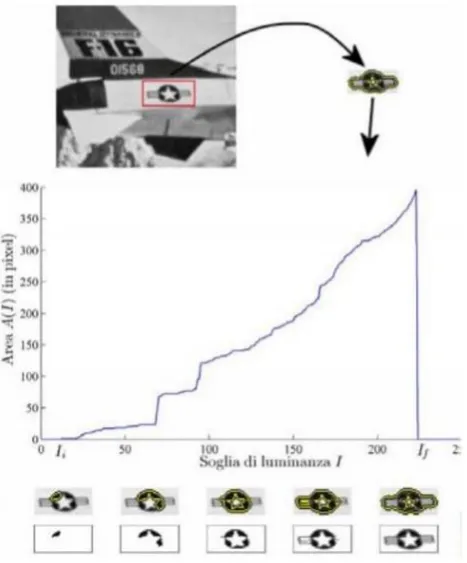
MSER is a technique for blob location in pictures. The MSER calculation separates from a picture various co-variation locales, called MSERs: a MSER is a stable associated part of some dark level arrangements of the picture . • MSER depends on taking areas which stay almost the same through an extensive variety of limits. – All the pixels underneath a given edge are white and every one of those above or equivalent is dark. – If we are demonstrated a grouping of threshold images with casing t relating to limit t, we would see initial a dark picture, then white spots comparing to nearby power minima will seem then become bigger[12-15]
Image I is a mapping :D Z2→S (4)
Extremal regions are well definedon images if:
1. S is totally ordered i.e. reflexive, antisymmetric and transitive binary relation exists .In this paper only S=(0,1,2……255) is considered ,but extremal regions can be defined on real valued images(S=R)
2. An adjacency (neighborhood) relation A D D is defined in this paper 4-neighborhood are used i.e p,q D are adjacent (p,Aq) if
∑ | | 1. (5)
Region Q is a contiguous subset of D i.e. for each p,q
Q there is a sequence p1,a1,a2,…..an, q and
pAa1,aiAai+1,anAq.
Region boundary dQ ={ },i.e, the
boundary dQ of Q is the set of pixels being adjacent to atleast one pixel of Q but not belonging to Q.
Extremal Region Q D is aregion such that for all p
Q, q dQ :I(p) I(q) (maximum intensity region) or I(p) I(q) (minimum intensity region)
Maximally Stable Extremal Region (MSER). Let
Q1 ,……Qi-1,Qi,… be a sequence of nested extremal
regions ,i.e.
Qi Qi+1..Extremal region Qi maximally stable if
q(i) = Qi+d / Qi-d/Qi
These white spots will in the long run converge, until the entire picture is white. – The arrangement of every associated segment in the succession is the arrangement of all extremal locales [18].Optionally; circular edges are appended to the MSERs by fitting ovals to the districts [20].Those areas descriptors are kept as elements .The word extremal alludes to the property that all pixels inside the MSER have either higher (brilliant extremal districts) or lower (dim extremal locales) power than every one of the pixels on its external limit [12]
Figure 2: Region detected for different threshold area
IV.
RESULT AND ANALYSIS
In the result part the performance of the algorithm used is assessed experimentally. Here we also check the accuracy of the method for different test images. Here we use 4 different pattern images and the performance of system when applied to that image.
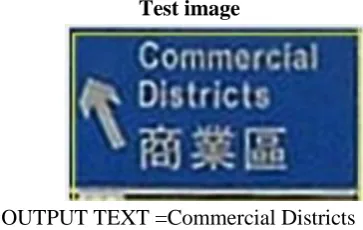
Let us consider the test image as shown in Figure 3:
Test image
Figure 3: Traffic Image for text detection
Now separate out the text portion from image for text detection as shown in Figure 4:
Figure 4: Portion of Image that contains text
Now apply Deblurring LR algorithm in image shown in Figure 4 and we get image which shown in Figure 5:
Figure 5: De-burring of Image using LR algorithm
Now apply Contrast Enhancement to image in Figure 5 and we get the enhanced image shown in Figure 6.
Figure 6: Contrast Enhancement
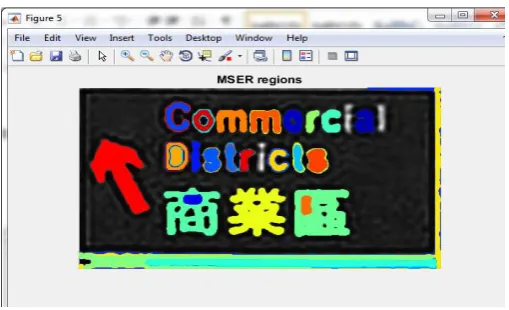
After that apply the MSER method to image shown in Figure 6 and we get image as shown in Figure 7.
Figure 7: MSER region detection
Figure 8: Bounding Box
Now after applying the bounding boz we get the detected text form image
Figure 9: Detected Output
OUTPUT
Figure 10: Detected Output
Figure 11: Output in command window
Above both images are the output or detected text from test images.
V.
PERFORMANCE
By applying the MSER method we get the highly accurate text and whose accuracy are shown below.
Test image
OUTPUT TEXT =Commercial Districts
ACCURACY = 19/19 = 100%
VI.
CONCLUSION
system also reduces still when you compare it with the previous algorithm it gives you far better results.
VII.
FUTURE WORK
As the algorithm is design for the recognition of text from the images and traffic signal it is needed that the accuracy of the system is maximum but apart from the many research still we are unable to design a system that can provide 100% accuracy. But for the text detection module a better performing labeling system is needed.
VIII.
REFERENCES
[1]. Gao, Jiang, and Yang, Jie. An adaptive algorithm for text detection from natural scenes. In Proceedings of the, "IEEE Conference on Computer Vision and Pattern Recognition" (December 2001)
[2]. Robust Text Detection in Natural Scene Images Xu-Cheng Yin, Member, IEEE, Xuwang Yin, Kaizhu Huang, and Hong-Wei Hao, "IEEE Transactions on Systems", june,(2008)
[3]. Gao, Jiang, Yang, Jie, Zhang, Ying, andWaibel, Alex. Text detection and translation from natural scenes.Tech. Rep. CMU-CS-01-139, "Carnegie Mellon University, School of Computer Science, Carnegie Mellon University, Pittsburgh", PA 15213, 2001.
[4]. Text-Attentional Convolutional Neural Network for Scene Text Detection Tong He, Weilin Huang, Member, "IEEE", Yu Qiao, Senior Member, IEEE, and Jian Yao, Senior Member, IEEE, (2007)
[5]. B. Shiva Kumar Reddy, Lakshmi Boppana and Ashok Agarwal. "BER Analysis of CVSD Vocoder for WiMAX using GNU Radio". IEEE Region 10 Symposium, 2014 IEEE.
[6]. Real-time text tracking in natural scenesbyCarlos Merino-Gracia1,2, Majid Mirmehdi2 Neurochemistry and Neuroimaging Laboratory, "University of La Laguna" , La Laguna, Spain, (2009)
[7]. Gao, Jiang, and Yang, Jie. An adaptive algorithm for text detection from natural scenes. In Proceedings of the , "IEEE Conference on Computer Vision and Pattern Recognition" (December2001)
[8]. Gao, Jiang, Yang, Jie, Zhang, Ying, andWaibel, Alex. Text detection and translation from natural scenes.Tech. Rep. CMU-CS-01-139, "Carnegie Mellon University, School of Computer Science, Carnegie Mellon University, Pittsburgh", PA15213,2001
[9]. Zhang, Dong-Qing, and Chang, Shih-Fu. Learning to detect scene text using a higher-order MRF with belief propagation.In IEEE Workshop on Learning in Computer Vision and Pattern Recognition vol. 06, pp. 101-108 (2004).
[10]. Y.-F. Pan, X. Hou, and C.-L.Liu.Text localization in natural scene images based on conditional random _eld. In ICDAR, pages 6-10, IEEE Computer Society, (2009).
[11]. Jain, A.K., and Bhattacharjee, S. Text segmentation using Gabor filters for automatic document processing. Machine Vision Applications 5 pages 169- 184, (1992). 12Wu, Victor, Manmatha, R., and Riseman, Edward M. Finding text in images. In "Proc. Intl. Conf. on Digital Libraries" (1997).
[12]. Wu, Victor, Manmatha, R., and Riseman, Edward M. Finding text in images. In "Proc. Intl. Conf. on Digital Libraries" (1997).
[13]. Thillou, C´eline, Ferreira, Silvio, and Gosselin, Bernard. An "embedded application for degraded text recognition.Eurasip Journal on Applied Signal Processing" 13 (2005).
[14]. Garcia, C., and Apostolidis, X. Text detection and segmentation in complex color images. In "Proc. Intl. Conf. on Acoustics, Speech, and Signal Processing" vol. 4, pp. 2326-2330, (June 2000). [15]. Sergei Azernikov. Sweeping solids on manifolds.
In "Symposium on Solid and Physical Modeling", pages 249-255,2008.
[16]. John Canny. A computational approach to edge detection.Pattern Analysis and Machine Intelligence, "IEEE Transactions on, PAMI"-8(6):679-698, Nov. (1986).
[17]. F. Mai, Y. Hung, H. Zhong, and W. Sze."A hierarchical approach for fast and robust ellipse extraction. Pattern Recognition", 41(8):2512-2524, August (2008).
[18]. David Ger´onimo, Antonio L´opez, and Angel D. Sappa Computer Vision Center, "University at Aut`onoma de Barcelona Edifici O, 08193 Bellaterra, Barcelona", Spain,june (2007)
[19]. Piotr Doll ´ ar, Christian Wojek, Bernt Schiele, and Pietro Perona, Submission to "IEEE Transaction on pattern analysis and machine intelligence", vol .1, page no. 1-19, (2012)