Original Research Article
Study of acute diarrhoea among preschool children from below poverty
line families of Lucknow district, North India
Khalid Mohammad, Pratibha Gupta*
INTRODUCTION
The pre-school age is a crucial and transitional period. A child deprived of health during these most impressionable years’ is deprived of the opportunity of growing into a normal human being, and the damage done in the first few years could be irreversible through one’s later life.1Diarrheal diseases are amongst the most frequent childhood illnesses and second leading cause of preventable death, especially among under five children in developing countries. Acute diarrheal diseases are one
of the main problems affecting children in the world, reducing their well-being and creating considerable demand for health services.2 In addition to increase mortality and morbidity, diarrhoea also predisposes children to malnutrition, which makes them highly susceptible to other infections, and this has been found to be a major contributor to illness and death, particularly among children in Sub-Saharan African countries.3,4 Globally, there are nearly 1.7 billion cases of childhood diarrhoeal disease and estimated 525000 deaths occur each year among children under five years of age.5 Most of these deaths occur in poor developing countries where
ABSTRACT
Background: Acute diarrheal illness remains one of the major causes of childhood morbidity and mortality especially among children under five in developing countries. Many of the risk factors for contracting diarrheal illnesses are associated with poverty, such as lacking access to safe water and sanitation, poor hygiene practices and unsafe human waste disposal. Objective of the study wasto know the prevalence of acute diarrhoea and find out certain associated risk factors among preschool children from below poverty line family of Lucknow district.
Methods: A community based cross sectional study was conducted using multistage sampling in rural and urban areas of Lucknow district from August, 2012 to July, 2013. Total 352 children aged 12-47 months from Below Poverty Line families were enrolled in this study. Mothers were interviewed after taking informed consent on pretested predesigned questionnaire.
Results: A total of 352 children were participated in this study, of which 75 were suffering from acute diarrhea, thus giving a two-week prevalence of 21.3%. The main risk factors for acute diarrheal illness were found to be Unimproved/no toilet facility, unsafe disposal of children stool, having piped water supply, storage of drinking water at household level, not received complimentary feeding within specified period and no vitamin A supplementation.
Conclusions: Approximately one-fifth of the children included in the study reported diarrheal disease. Building toilets and providing safe drinking water at the household level, interventions through effective health education of the community regarding appropriate complimentary feeding and immunization practices may reduce the burden of diarrhoea among these children.
Keywords: BPL families, Diarrhoea, Preschool children, Risk factors
Department of Community Medicine, Era’s Lucknow Medical College, Lucknow, Uttar Pradesh, India
Received: 10 June 2018
Revised: 12 July 2018
Accepted: 13 July 2018
*Correspondence:
Dr. Pratibha Gupta,
E-mail: [email protected]
Copyright: © the author(s), publisher and licensee Medip Academy. This is an open-access article distributed under the terms of the Creative Commons Attribution Non-Commercial License, which permits unrestricted non-commercial use, distribution, and reproduction in any medium, provided the original work is properly cited.
an estimated 25% of under-five mortality is directly attributed to diarrheal disease.6,7
In India, like other developing countries, diarrhoeal diseases are important child health problem. National Family Health Survey 2015-16 (NFHS-4) conducted using a two week recall period revealed that a diarrhoea prevalence among under five children 9.6% in rural and 8.2% in urban areas, with a average rate of 9.2%.8 Despite a significant progress has been made in reducing mortality in children under five years of age, the proportional mortality due to diarrheal illnesses still remains high. Diarrhea is the third most common cause of death in under-five children, responsible for an estimated 0.3 million children death in India every year.9
Many of the risk factors for contracting diarrheal illnesses are associated with poor socioeconomic conditions, such as lacking access to safe water and improved sanitation, poor hygiene practices and unsafe disposal of human waste.10-12 Low socioeconomic status can limit access to better health care and education, and can affect food safety, poor housing conditions and other related factors that increase likeliness of exposure to infectious organisms or decrease resistance to infectious diseases.13,14 Behavioral factors associated with acute childhood diarrhoea include lack of hand-washing, poor infant and young child feeding practices, and lack of child immunizations.15
This study has been conducted with the objective to know the prevalence of acute diarrhoea and find out certain associated risk factors among preschool children from below poverty line (BPL) families of Lucknow district, Utter Pradesh, India.
METHODS
Study area
This community based cross sectional study was conducted from August, 2012 to July, 2013 in rural and urban areas of Lucknow district. It is a centrally placed district of Uttar Pradesh, a state in northern India. Lucknow has population of 4,588,455 of which almost 66 percent are urban.16
Study subjects
Children aged 12-47 completed months from families who had permanent residence in the area (for at least 6 months) and having income less than 65 INR equivalent to 1.25 USD per capita per day at 2005 Purchasing Power Parity, World Bank, 2008 (criteria for Below Poverty Line) were included in this study.17,18
Sample size
Total 360 preschool children were planned to participate in this study. Using proportional allocation to the rural
and urban based on population; 120 (33%) samples from the rural area and 240 (66%) samples from the urban area was selected.19
Sampling design
A multistage sampling method was employed to select mohallas/villages. Total 16 mohallas from urban and 8 villages from rural areas were included in this study. Study households were selected by EPI random walk method. In households with more than one children of age between 12-47 months, one child was selected randomly.
Data collection procedure
The respondents were briefed about the survey in local language and after agreement reached upon. Interview was conducted with mothers of the children of BPL families to fill the pretested structured schedule. Mothers were asked if child had experienced diarrhoea in previous 2 weeks prior to interview. If the birth certificate was not available, age of the child was ascertained from the mother. Cultural and religious events were utilized to facilitate recall.
Immunization status of children was checked by observing immunization card and if it was not available mothers were asked to recall it. BCG vaccination was checked by observing scar on left deltoid. The immunization status was categorized as: Completed primary immunization: A child receiving all these vaccines-BCG, 3 doses of DPT, 3 doses of OPV (excluding Polio 0) and 1 dose of measles, Partially immunized: Not completely immunized but received one or more doses of the above vaccines, Not immunized: Did not receive any vaccine dose.
All the children covered for study were examined clinically for the presence of signs of nutritional deficiency and other morbidity at the time of interview. Children with diarroeal diseases were treated with ORS and/or antibiotics as appropriate.
Statistical analysis
Data entry and analysis was done using SPSS-17 version of software. Pearson’s Chi square test was used to test the significance. P values less than 0.05 were considered significant.
Ethical considerations
confidentiality of collected information was ensured throughout the process. If any child was found sick and malnourished, appropriate treatment and advice was given.
Operational definitions
Acute diarrhoea: Defined as change in consistency and character of stools 'or three or more watery stools per day or presence of blood in the stools in the last two weeks as perceived by the mother.
Type of sanitation: As defined by WHO/UNICEF Joint Monitoring Programme (JMP) for Water Supply and Sanitation.
(a) Improved sanitation: Flush toilet Piped sewer system, Septic tank, Flush/pour flush to pit latrine, Ventilated improved pit latrine (VIP), Pit latrine with slab Composting toilet
(b) Unimproved sanitation: Flush/pour flush to elsewhere Pit latrine without slab bucket, hanging toilet or hanging latrine, no facilities or bush or field.
Safe disposal of child faeces: A child’s using a toilet
directly or rinsing a child’s stools into a toilet or latrine is considered safe disposal.
RESULTS
A total of 360 BPL households with at least one preschool child were planned to participate in the study, out of which 352 children were enrolled making a response rate of 97.77 percent. Out of these 352 children, 234 and 118 were from urban and rural areas. Two-week prevalence of diarrhoea was 21.3%.
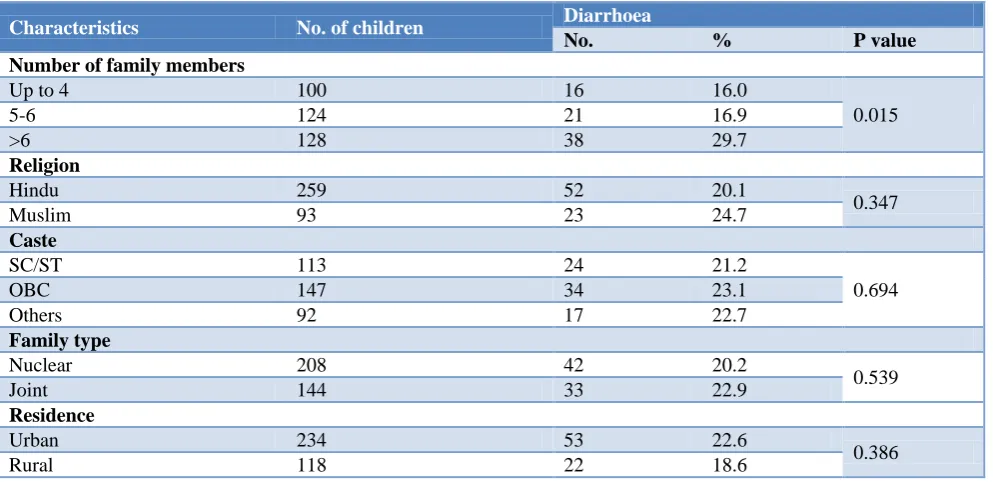
Diarrhoea was more prevalent among children from families had more than 6 family members than those from families had less than 6 members. This difference was statistically significant. No significant association was seen between diarrhoea and religion, caste, family type, place of residence (Table 1).
Table 1: Association between households characteristics and diarrhoea (n=352).
Characteristics No. of children Diarrhoea
No. % P value
Number of family members
Up to 4 100 16 16.0
0.015
5-6 124 21 16.9
>6 128 38 29.7
Religion
Hindu 259 52 20.1
0.347
Muslim 93 23 24.7
Caste
SC/ST 113 24 21.2
0.694
OBC 147 34 23.1
Others 92 17 22.7
Family type
Nuclear 208 42 20.2
0.539
Joint 144 33 22.9
Residence
Urban 234 53 22.6
0.386
Rural 118 22 18.6
Diarrhoea was more common (26.7%) among children from families used piped water for drinking than from families that used other sources (17.3%). Diarrhoea was also more common in children from families who stores drinking water (25.0%) as compared to those of taking directly from source (15.4%). Both factors were found to be significantly associated with diarrhoea in children (Table 2).
Statistically significant association was found between diarrhoea and type of toilet facility, manner of disposal of children stool. However, no significant association was
seen between mother’s hand washing practices before child feeding and diarrhoea (Table 3).
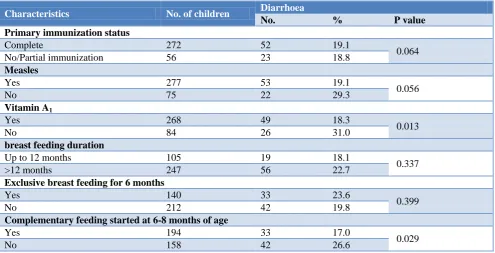
Children with no measles immunization and vitamin A supplementation suffered from more diarrheal diseases than those who had measles immunization and vitamin A supplementation. Diarrhoea was also more prevalent in children who had been given breast feeding for more than 12 months (22.7%) as compared to those who had breast feeding for less than 12 months (18.1%). A significant association was seen between diarrhoea and vitamin A
complementary feeding. However, no significant association was found between Duration of breast
feeding, children primary immunization status and diarrhoea (Table 4).
Table 2: Association between characteristics of drinking water and diarrhoea.
Characteristics No. of children Diarrhoea
No. % P value
Type of water source
Piped 150 40 26.7
0.034
Others 202 35 17.3
Storage of drinking water
Yes 216 54 25.0
0.033
None (taking direct from source) 136 21 15.4
Method used to draw water from storage container
Pouring 45 10 22.2
0.629
Dipping 175 45 25.7
Table 3: Association between excreta disposal, mother’s hand washing practices and diarrhoea.
Characteristics No. of children Diarrhoea
No. % P value
Type of toilet facility
Improved 192 31 16.1
0.010
Unimproved/no facility 160 44 27.5
Manner of disposal of children stool
Safe 169 20 11.8
0.000
Unsafe 183 55 30.1
Hand washing before feeding child
Water only 253 58 22.9
0.236
Water+soap 99 17 17.2
Table 4: Association between children immunization characteristics, feeding practices and diarrhoea.
Characteristics No. of children Diarrhoea
No. % P value
Primary immunization status
Complete 272 52 19.1
0.064
No/Partial immunization 56 23 18.8
Measles
Yes 277 53 19.1
0.056
No 75 22 29.3
Vitamin A1
Yes 268 49 18.3
0.013
No 84 26 31.0
breast feeding duration
Up to 12 months 105 19 18.1
0.337
>12 months 247 56 22.7
Exclusive breast feeding for 6 months
Yes 140 33 23.6
0.399
No 212 42 19.8
Complementary feeding started at 6-8 months of age
Yes 194 33 17.0
0.029
DISCUSSION
The results showed that the determinants of acute diarrhoea in this study were source of water supply, water storage at household, manner of child faeces disposal and availability of toilet, immunization and feeding practices.
Children from houses who used piped water for drinking had significantly higher risk for diarrheal disease than those from houses who used other sources. It is shown that broken pipes and interruptions of water supply are responsible for most of the water pollution. Also unhygienic water storage and handling at household level additionally increases water pollution. Despite millions spent on piped water supply in developing countries, water at point-of use is often polluted and causes increased levels of diarrhoea and child mortality.20 Opposite to this another study conducted in rural India showed that the prevalence and duration of diarrhoea among children under five are significantly less on average for families with piped water than for families without it. But health gains largely bypass children in poor families, particularly when the mother is poorly educated.21
Our study showed higher prevalence of diarrhoea in children from family members draw water by dipping method. A study in Ethiopia found obtaining water from storage containers by dipping had statistically significant association with diarrheal morbidity while type of water source, and latrine availability were not found to be significant risk factors.22
In our study prevalence of diarrhoea was higher in children from families with no improved toilet facility (26.9%) than those had improved toilet facility (19.3%). A study in Ethiopia showed the odds of having diarrhea in children who lived in households which had no latrine facility two times higher the odds than in children who lived in households which had latrine facility.23
Our study result also showed that prevalence of diarrhoea was significantly higher in children from families who practiced unsafe disposal than children from families who disposed child stool safely. A study conducted in Ethiopia showed Children from those households disposing refuse in pit/burnt are 69% less likely to have diarrhoea compared to children from the households who claimed disposing their refuse indiscriminately in open field.24
Diarrhoea was found to be more common in children of mothers who wash hands with water only. Similar observations have been found in a study done in Yavatmal by Khadse et al who have stated that hand washing with soap and water after defecation and before feeding had a protective value against diarrhoea.25 A study from Bangladesh showed that hand washing with water alone can significantly reduce childhood diarrhoea.26
In this study a significant association was seen between diarrhoea and vitamin A supplementation status. It lays emphasis on the concept that Vitamin A is protective of the intestinal epithelium. A study in South India showed those children who did not take any dose of vitamin A supplementation within preceding 6 months had 7.4 times higher risk for acute diarrhoea compared to those who had vitamin A Supplementation.27
This study result further showed that timing for introducing complementary feeding was significantly associated with diarrhoea. A study showed that the risk of diarrhoeal morbidity in poor population is 3 to 18 times higher if breastfed children not given complementary feeding in time.28
CONCLUSION
Childhood Diarrhoea continues to impose a considerable burden on this poor community. The main risk factors for occurrence of acute diarrheal illness were found to be Unimproved/no toilet facility, unsafe disposal of children stool, having piped water supply, storage of drinking water at household level. Complimentary feeding within specified period and vitamin A supplementation were protective. Building toilets and providing safe drinking water at the household level, interventions through effective health education of the community regarding appropriate complimentary feeding and immunization practices may reduce the burden of diarrhoea among these children.
ACKNOWLEDGEMENTS
We are grateful to our study supervisors from department of Community Medicine, KGMU, Lucknow. We are also sincerely thankful to the field workers of areas where in the study was undertaken, for their valuable help extended during the study.
Funding: No funding sources Conflict of interest: None declared
Ethical approval: The study was approved by the Institutional Ethics Committee,KGMU UP, Lucknow
REFERENCES
1. Bhansali KM, Mathur GM, Sharma R. A study of morbidity pattern in pre-school children. Indian J Paediatrics. 1979;46:13-9.
2. World Health Organization (WHO), Integrated Management of Childhood Illness, 2010.
3. Green S, Small J, Casman A. Determinants of National Diarrhoeal Disease Burden. Environ Sci Tech. 2009;43(4):123-31.
5. WHO, Diarroeal disease(fact sheet).May 2017.Available at: http ://www.who.int. Accessed 10 February 2018.
6. Victora CG, Bryce J, Fontaine O, Monasch R Reducing deaths from diarrhoea through oral rehydration therapy. Bull World Health Org. 2000;78:1246-55.
7. UNICEF/WHO, Diarrhoea: Why children are still dying and what can be done. The United Nations Children’s Fund/World Health Organization, Geneva, 2009.
8. International Institute for Population
Sciences.National Family Health Survey (NFHS-4): India. Mumbai: IIPS, 2015-2016.
9. Million Death Study Collaborators. Causes of neonatal and child mortality in India: A nationally
representative mortality survey. Lancet.
2010;376:1853–60.
10. Daniels DL, Cousens SN, Makoae LN, Feachem RG. A case-control study of the impact of improved sanitation on diarrhoea morbidity in Lesotho. Bull World Health Org. 1990;68(4):455.
11. Manunebo MN, Haggerty PA, Gaie MK, Ashworth
A, Kirkwood BR. Influence of demographic, socioeconomic and. J trop med hyg.1994;97:31-8. 12. Graf J, Meierhofer R, Wegelin M, Mosler HJ. Water
disinfection and hygiene behaviour in an urban slum in Kenya: impact on childhood diarrhoea and influence of beliefs. Int J Environ Health Res. 2008;18(5):335-55.
13. Forsberg BC, Gwatkin D, Tomson G, Allebeck P, Petzold MG. Socioeconomic inequalities in the prevalence and management of childhood diarrhoea: potential health gains to be achieved. Open Infect Dis J. 2009;3:44–9.
14. Ahs JW, Tao W, Löfgren J, Forsberg BC. Diarrheal diseases in low-and middle-income countries: incidence, prevention and management. Open Infect Dis J. 2010;4(4):113-24.
15. Wondwossen BA. Stepwise regression analysis on under-five diarrhael morbidity prevalence in Nekemte town, western Ethiopia: Maternal care giving and hygiene behavioral determinants. East Afr J Pub Health. 2008;5(3):193-8.
16. Govt. of India,Cencus 2011, Provisional population Report, Office of the Registrar general and Cencus Commissioner India, Ministry of home Affair, March 31st, 2011.
17. Ravallion M, Chen S, Sangaula P. Dollar a Day
Revisited. The World Bank Econ Rev.
2009;23(2):163-84.
18. PTI. India account for 33% of World poor: World Bank. PTI, April 19, 2013.
19. Khalid M, Kumari R, Mohan U, Manar MK, Singh
VK. Morbidity profile of preschool children below poverty line families of Lucknow District, North India. Int J Adv Res. 2014;2:627-34.
20. Lechtenfeld T. Why does piped water not reduce diarrhea for children? Evidence from urban Yemen. Available at: econpapers.repec.org/paper/gotgotcrc/ 119.htm. Accessed 10 February 2018.
21. Jalan J, Martin R. Does piped water reduce diarrhea
for children in rural India? J Econ.
2003;112(1):153–73.
22. Teklemariam S, Getaneh T, Bekele F.
Environmental determinants of diarrheal morbidity in under-five children, Keffa-Sheka zone, south west Ethiopia. Ethiop Med J. 2000;38:27-34. 23. Dessalegn M, Kumie A, Tefera W. Predictors of
under-five childhood diarrhea: Mecha District, West Gojam, Ethiopia. Ethiop J Health Dev. 2011;25(3):192-200.
24. Regassa G, Birke W, Deboch B, Belachew T. Environmental Determinants of Diarrhea among Under-Five Children in Nekemte town, Weat Ethopia. Ethiop J Health Sci. 2008;18(2):39-45. 25. Khadse SS, Dani VS, Kulkarni LR, Naik SV. Study
of behavioural risk factors for recurrent acute diarrhoea in children, Yavatmal in Conference Proceedings of the 9th Asian conference on diarrhoeal diseases and nutrition. Sep 28-30 2001, New Delhi.
26. Luby SP, Halder AK, Huda T, Unicomb L, Johnston RB. The effect of handwashing at recommended times with water alone and with soap on childdiarrhea in rural Bangladesh: an observational study. PLoS Med. 2011;8(6):e1001052.
27. Stanly AM, Sathiyasekaran BWC, Palani G. A population based stidy of acute diarrhoea among children under 5 years in a rural community in South India. SRJM. 2009;1(1):1–7.
28. Popkin BM, Adair L, Akin JS, Black R, Briscoe J, Flieger W. Breast feeding and diarrheal morbidity. Pediatrics. 1990;86(6):874-82.