Original Research Article
Screening of pre cancer and cancer cervix by Pap smear among women
in reproductive age group: a community based study
Suma R. K.
1, Keerthi S. Yalaburgi
2*
INTRODUCTION
Cervical cancer is the third most commonly diagnosed cancer and the fourth leading cause of cancer death in women worldwide. More than 85% of these cases and deaths occur in developing countries.1 Its mortality exemplifies health inequity, as its rates are higher in low and middle income countries (LMICs), and in low socio-economic groups within countries.2
India accounts for one-fifth of the world burden of cervical cancer. Data from population-based cancer registries in different regions indicate a slow, but steady, decline in the incidence of cervical cancer. However, the
rates are still too high and the absolute number of cases is on the increase due to population growth.3 Thus in India, based on six population-based registries, an average 1 in every 55 women is likely to develop cervical cancer in their lifetime.4
Unlike most other cancers, cervical cancer is readily preventable when effective programs are implemented to detect and treat its precursor lesions.5 In industrialized countries the incidence of cervical cancer is generally low and there has been a steady decline in morbidity and mortality caused by the disease largely due to comprehensive Pap smear programs and lifestyle changes.6 An important reason for higher cervical cancer incidence in developing countries is lack of effective ABSTRACT
Background: Cervical cancer is the third most commonly diagnosed cancer and the fourth leading cause of cancer death in females worldwide. The disproportionately high burden of cervical cancer in developing countries is largely due to a lack of screening that allows detection of precancerous and early stage cervical cancer. The objective of this study was to identify pre cancer, cancer of cervix by Pap smear test and the factors associated with cervical cancer. Methods: A cross sectional study was done among married women in the reproductive age group of 15-49 years in the urban field practice area of A.J. Institute of Medical Sciences, from Jan 2013 to March 2013. The study comprised of 357 women. A pretested semi structured questionnaire was used to collect data. Screening was done by Pap smear test. Statistical analysis was performed using SPSS software.
Results: 49.6% women were in the age group of 40-49 years. 62 (17.4%) were illiterates. 67.5 % belonged to low socioeconomic status. Pap smear test detected premalignant lesions among 2.1% women; no cancer cervix cases were detected. Association between premalignant lesion and educational status, early age at marriage, multi parity, erosion cervix was found to be statistically significant.
Conclusions: Regular cytological screening by Pap smear will help in early detection of precancerous lesions and thereby prevent cancer cervix.
Keywords: Screening, Pap smear test, Pre malignant lesions, Cancer cervix
Department of Community Medicine, 1Academy of Medical Sciences, Pariyaram, Kannur, Kerala; 2USM KLE International Medical Program, Belagavi, Karnataka, India
Received: 30 November 2018 Accepted: 18 December 2018
*Correspondence: Dr. Keerthi S. Yalaburgi, E-mail: [email protected]
Copyright: © the author(s), publisher and licensee Medip Academy. This is an open-access article distributed under the terms of the Creative Commons Attribution Non-Commercial License, which permits unrestricted non-commercial use, distribution, and reproduction in any medium, provided the original work is properly cited.
screening programs aimed at detecting precancerous conditions before they progress to invasive cancer.7
Cervical screening is acknowledged as currently the most effective approach for cervical cancer control.8 The accessibility of uterine cervix, propensity of cells to exfoliate from precancerous lesions, the evidence from pathological studies of existence of histological changes from mild atypia through pre malignancy to frank malignancy, the apparently prolonged natural history, the long premalignant phase, and the ability for detecting changes using cervical cytology provide perhaps the best potential for control of cervical cancer by population screening.9
There have been few public health measures in the history of medicine that have transformed human life as we know it. A number of these have been in the form of immunizations and therapies. The only screening test which has been universally accepted and has stood the test of time is the Pap smear test for the early detection of cervical cancer.10
Every woman has the right to cervical screening at least once in her lifetime.11 Once in a lifetime’ screening would result in reduction of 20-30% in the lifetime risk of cervical cancer. This approach could also be one of the options for the limited resource conditions.12
Very few studies have been conducted in the community in coastal area of Karnataka, India to screen for premalignant lesions of the cervix and cervical cancer. Thus the present study will help in reaching out to the community in detecting precancerous lesions of the cervix and cervical cancer.
METHODS
The study was carried out in the urban field practice area of A J Institute of Medical Sciences, Mangalore. 1035 families have been adopted in nine areas of Kavoor as urban field practice area with a total population of 4434.
Study period: January 2013 to March 2013.
Inclusion criteria: All married women in the reproductive age group of 15-49 years who consented to participate in the study.
Exclusion criteria: Pregnant women, women in reproductive age group who have undergone hysterectomy, women diagnosed with cervical cancer, on treatment or cured.
The study was approved by the Institutional Ethics Committee. Married women in the reproductive age group of 15-49 years present at the time of study were 667, obtained from a preliminary survey. There were 82 pregnant women and 64 women who had undergone hysterectomy, thus 146 were excluded from the study.
Thus it was planned to include 521 married women in the reproductive age group of 15-49 years.
In the study area defined, a house to house survey was done along with a female social worker. Married women in the reproductive age group were taken as subjects. The objectives of the study were explained to them. An assurance to the subject about confidentiality of the subject’s data was ensured. The women were also informed about the causes of cervical cancer, signs and symptoms, prevention, and stressed on the importance of early detection and treatment. Health education sessions were organized in the Anganwadi, during Sthree Shakti meetings to create more awareness about cervical cancer prevention. These women were asked to visit the health center for Pap smear test. At the health centre, pre-designed, semi structured questionnaire was administered and information collected regarding socio demographic profile, and gynecological complaints. Clinical examination and Pap smear test was done.
Statistical analysis
Data entry was done in excel sheet and analysis using SPSS 16.0 software. Descriptive statistics (means, percentages) and Fischer’s exact test were employed to analyze the data:
RESULTS
Of the 521 women who were eligible for the study, 357 (68.5%) agreed to undergo speculum examination and Pap smear test. 164 (31.5%) women did not consent to undergo Pap smear test. Majority (97.8%) of these women were screened for the first time. Also 70% of the women screened were in the age group of 35-49 years.
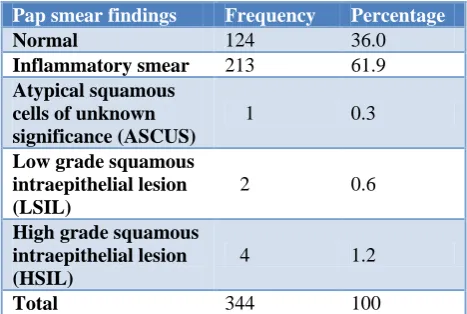
Table 1: Distribution of study subjects according to Pap smear findings (n=344)*.
Pap smear findings Frequency Percentage
Normal 124 36.0
Inflammatory smear 213 61.9 Atypical squamous
cells of unknown significance (ASCUS)
1 0.3
Low grade squamous intraepithelial lesion (LSIL)
2 0.6
High grade squamous intraepithelial lesion (HSIL)
4 1.2
Total 344 100
*Out of 357 smears, 13 samples were inadequate and excluded from analysis.
Socio demographic factors
(24.1%). Among the total number of cases, the proportion of Hindus was 63.3%, Muslim 27.5% and Christian 9.2%. Educational status of study subjects showed that 17.4% of the study subjects were illiterates and 82.6% of them were literates. Majority, 51.8% of the study subjects were Beedi workers and 32.2% were housewives. Marital status of study subjects showed 349 (97.7%) were married, 6 (1.7%) were widow and 2 (0.6%) were separated. 67.5% of the study subjects belonged to poor and lower middle socioeconomic status, according to Modified B G Prasad classification.
Reproductive tract infection symptoms
146 women (40.9%) had history of abnormal vaginal discharge, 132 (36.9%) had lower backache and 74 (20.7%) had lower abdominal pain, 36 (10.1%) had painful coitus and 20 (5.6%) had dysuria.
Marital status
Out of the 357 women, 79 (22.1%) were married before 18 years and 197 (55.2%) were married before the age of 22 years. All the respondents had single partner in the present study. Out of 357 women, 322 women had children of which 14% gave birth to their first child before the age of 18 years and 52.2% before the age of 22 years. 93 (26.1%) were having 3 children and 61 (17.1%) were having more than 3 children.
Per speculum findings
On per speculum examination, cervical erosion was found in 137 (38.4%) study subjects. Hypertrophy of the cervix was found in 48 (13.4%) of women. Discharge per vagina was seen in 146 (40.9%) of women.
Pap smear findings
Out of 357 smears which were examined, 124 (36.0%) were normal smears. 213 (61.9%) of women in the study group had inflammatory smear. 13 (3.6%) smears were reported as inadequate. Epithelial cell abnormality was seen in 7 (2.1%) of the smears which includes 1 (0.3%)
ASCUS, 2 (0.6%) LSIL, and 4 (1.2%) HSIL. No cases of cervical cancer were detected in the present study (Table 1).
Table 2: Distribution of Pap smear findings according to age group of study subjects (n=344).
Age group in years
Pap smear findings
Normal* (%) Abnormal** (%) Less than 30 65(100) 0 (0)
31-49 272 (97.5) 7 (2.5)
Total 337 (98) 7 (2)
*Normal (no pathological change) and inflammatory smears were considered as normal. **ASCUS, LSIL, HSIL was considered as abnormal.
ASCUS, LSIL, HSIL was considered as abnormal smear for study purpose. All the 7 (2.5%) abnormal Pap smear was found in women between the age group of 31-49 years, which is the most common age group in which precancerous lesions of cervix are reported (Table 2).
Relationship between associated factors and Pap smear findings
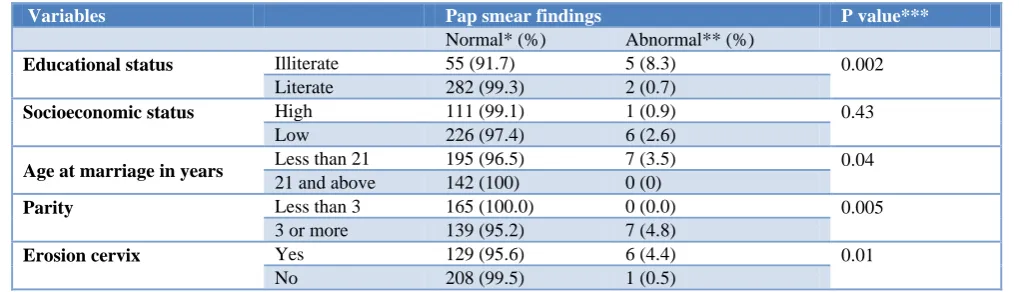
In this study 5 (8.3%) women with abnormal Pap smear were illiterates and 2 (0.7%) were literates and this difference was found to be statistically highly significant. 6 (2.6%) women with abnormal Pap smears belonged to low socioeconomic status and 1 (0.9%) woman belonged to high socio economic status and this difference was not statistically significant. All the women with abnormal Pap smear findings were married before the age of 21 years. Present study found 7 (4.8%) women with abnormal Pap smear findings had 3 or more children compared to no abnormal Pap smear in women with less than 3 children. This difference was found to be statistically significant. The frequency of abnormal Pap smear in women with cervical erosion was 6 (4.4%) compared to the frequency of abnormal Pap smear in women with healthy cervix which was 1 (0.5%). This association was found to be statistically significant. (Table 3).
Table 3: Relationship between associated factors and Pap smear findings.
Variables Pap smear findings P value***
Normal* (%) Abnormal** (%)
Educational status Illiterate 55 (91.7) 5 (8.3) 0.002
Literate 282 (99.3) 2 (0.7)
Socioeconomic status High 111 (99.1) 1 (0.9) 0.43
Low 226 (97.4) 6 (2.6)
Age at marriagein years Less than 21 195 (96.5) 7 (3.5) 0.04
21 and above 142 (100) 0 (0)
Parity Less than 3 165 (100.0) 0 (0.0) 0.005
3 or more 139 (95.2) 7 (4.8)
Erosioncervix Yes 129 (95.6) 6 (4.4) 0.01
No 208 (99.5) 1 (0.5)
DISCUSSION
Majority (97.8%) of these women were screened for the first time in their lives, reporting never having had a Pap test. Also 70% of the women screened were in the at risk age group of 35-49 years of age, which is the age group most often difficult to reach with screening services.
The present study revealed that the mean age of the study subjects was 38.2 years (standard deviation 7.2). Varghese C et al in their study observed mean age of their patients to be 39.5years.6 82.6% of women were literates. This is comparable to the Dakshina Kannada district 2011 census data which shows 84.04% female literacy rate.13
In this study, 197 (55.2%) were married before the age of 22 years and 79 (22.1%) were married before 18 years, before the legal age of marriage. Marriage at a tender age posed a very high risk for cervical cancer. Study done by Sreejata et al revealed 82% were married before the age of 18 years.14 Sharma et al in their study in Delhi reported 49.5% were married before the age of 18 years.15 Biswas et al, highlighted that cervical epithelium is more susceptible to carcinogenic agents during adolescence. Early age at marriage indicated an early exposure to sexual activities and early pregnancy which are well known etiological factors for cancer cervix.16
All the respondents had single partner in the present study. Study done by Yasmeen et al, suggested that absence of promiscuity in a population from Kashmir was the cause of absence of cervical cancer in that community.17
Out of 357 women, 322 women had children of which 14% gave birth to their first child before the age of 18 years and 52.2% between the age of 19 and 22 years. Study done by Dasgupta A et al in West Bengal showed that 49.5% women gave birth to their first child before the age of 18 years.18
It was observed among the study subjects that, 61(17.1%) were having more than 3 children. Study by Dasgupta A et al showed 33% with parity higher than 3.18 Study done by Sharma et al in Delhi reported 37.9% with parity more than 3.15
Cervical erosion was found in 137 (38.4%) of women on per speculum examination. Bang et al in their study reported cervical erosion to be 45.70%.19 Cervical erosion is a common finding during the fertile years. It is a true epithelial defect that can be produced by trauma, inflammation or, by carcinoma. The naked eye evaluation of such cases is deceptive and it is easy to dispose of the intraepithelial cancer precursors as simple cases of erosion or inflammation. Since chronic erosion is a predisposing condition for malignancy of the cervix, it is of paramount importance to detect these lesions early
enough and treat them adequately if cancer of the cervix is to be warded off.
Out of 357 smears which were examined, 213 (61.9%) had inflammatory smear. Persistent infections can lead to chronic inflammation and dysplastic changes, and consequently the evidence of inflammation in 61.9% of the smears is of particular concern. Study done by Varghese et al showed 70% of smears as inflammatory.6
Epithelial cell abnormality was seen in 7 (2.1%) of the smears which includes 1 (0.3%) atypical squamous cells of unknown significance (ASCUS), 2 (0.6%) Low grade Squamous Intraepithelial lesion (LSIL), and 4 (1.2%) high grade squamous intraepithelial lesion (HSIL). Study done by Mulay et al in Hyderabad reported a prevalence of 1.39% epithelial cell abnormality.20 A hospital based study done by Srivastava et al Found the frequency of SIL to be 7.2%.21 A few microlevel screening programs have been carried out on a sporadic basis throughout the country. Most of these studies are institution based and do not give a true picture of the magnitude of the problem in the community.22
No cases of cervical cancer were detected in the present study, which is similar to the community based study done by Yasmeen et al in Srinagar, where no cervical cancer cases were detected.17
All the 7 (2.5%) abnormal Pap smear was found in women between the age group of 31-49 years, which is the most common age group in which precancerous lesions of cervix are reported. Study done by Srivastava et al, reported a progressive rise in the frequency of cytological abnormalities with increasing age, and maximum frequency was observed in older women beyond 40 years of age 10.7% as compared to 4.7% in less than 20 years of age.21
In this study 5 (8.3%) women with abnormal Pap smear were illiterates and 2 (0.7%) were literates and this difference was found to be statistically highly significant. This indicates that women with low literacy level are at a higher risk of having pre malignant lesions of the cervix and thereby cervical cancer.
All the women with abnormal Pap smear findings were married before the age of 21 years. Early age at marriage indicates an early exposure to sexual activities and early pregnancy which are well known etiological factors for cervical dysplasia and cancer cervix. Dutta et al in their study found that estimated relative risk for developing cancer cervix among women getting married before 17 years of age was found to be 7.9 as compared to women who got married after the age of 17years.23
more pronounced with para3 and more (8.2%) compared to para1 (5.6%) and para 2 (5.8%).21 Thus women with high parity should be provided special attention for immediate mandatory cytological evaluation to rule out any abnormal cytological changes originating in the cervix.
Frequency of abnormal Pap smear in women with cervical erosion was 6 (4.4%) compared to the frequency of abnormal Pap smear in women with healthy cervix 1 (0.5%). This association was found to be statistically significant. Study done by Srivastava also showed the frequency of SIL was very high in women with clinical lesions of cervix (14.1%) compared to women with healthy cervix (3.4%).21 Study done by Kulkarni et al reported 4.45% of women with cervical erosion had dysplastic changes.2 Thus it is clear that clinical lesions of the cervix harbor a large number of premalignant lesions and cancer cervix and if such women are subjected to mandatory cytological evaluation, the burden of carcinoma cervix can be reduced significantly.
CONCLUSION
In conclusion it may be mentioned that various established risk factors for cancer cervix like early age of marriage, low literacy, multi parity are prevalent in the study population. Hence suitable programs to impart health education to these vulnerable groups for improving their awareness regarding cancer cervix should be organized. And screening services, diagnostic and/or treatment services should be provided.
ACKNOWLEDGEMENTS
I sincerely thank the women who participated, my teachers and colleagues who helped me in conducting this study.
Funding: No funding sources Conflict of interest: None declared
Ethical approval: The study was approved by the Institutional Ethics Committee
REFERENCES
1. Jemal A, Bray F, Melissa MC, Ferlay J, Ward E, Forman D. Global Cancer Statistics. Ca Cancer J Clin 2011; 61(2): 69–90
2. Cervical Cancer in India, South Asia Centre for chronic disease. Available at: URL: http://sancd. org/uploads/pdf/cervical_cancer. Pdf. Accessed on 10 October 2016.
3. Sankaranarayanan R, Budukh AM, Rajkumar R. Effective screening programmes for cervical cancer in low- and middle-income developing countries. Bulletin of the World Health Organization. 2001;79(10):954–62.
4. Asthana S, Satyanarayana L. Prevention and control of uterine cervical cancer: Current strategies. Indian J Community Med. 2007;32(3):233-4.
5. Sherris J, Agurto I, Arrossi S, Dzuba I, Gaffikin L, Herdman C, et al. Advocating for cervical cancer prevention. Int J Gynecol Obstet. 2005;89:46-54. 6. Varghese C, Amma NS, Chitrathara K, Dhakad N,
Rani P, Malathy L. Risk factors for cervical dysplasia in Kerala, India. Bull World Health Organization. 1999;77(3):281-3.
7. Juneja A, Sehgal A, Sharma S, Pandey A. Cervical cancer screening in India: Strategies revisited. Indian J Med Sci. 2007;61(1):34-47.
8. Cervical Cancer Screening in Developing Countries: Report of a WHO consultation; 2002
9. Kiran P, Ajay B. Cancer cervix – need for mass surveillance program specially in rural areas. J Obstet Gynecol India. 2005;55(5):436-9.
10. Adi DE, Tank PD. Milestones George Papanicolaou and the cervicovaginal smear. J Obstet Gynecol India. 2009;59(4):299-300
11. Alliance for Cervical Cancer Prevention (ACCP) Cervical Cancer Prevention Factsheet 2007. Available at: URL http://www.alliance-cxca.org/files/ACCP_recs_2007_factsheet_final.pd. Accessed on 10 May 2017.
12. Senapathy GJ, Umadevi P, Kannika PS. The Present Scenario of Cervical Cancer Control and HPV Epidemiology in India: an Outline. Asian Pacific J Cancer Prev. 2011;12:1107-15.
13. Dakshina Kannada District: Census 2011 data Available at: http://www.census2011.co.in/ census/district/252-dakshina-kannada.html.
Accessed on 10 May 2017.
14. Sreejata R, Sukanta M. Socio-Demographic and Behavioural Risk Factors for Cervical Cancer and Knowledge, Attitude and Practice in Rural and Urban Areas of North Bengal, India. Asian Pacific J Cancer Prev. 2012;13:1093-6.
15. Sharma P, Rahi M, Lal P. A community based cervical cancer screening program among women of Delhi using camp approach. Indian J Community Med. 2010;35(1):86-8.
16. Biswas L, Manna B, Maiti P, Sengupta S. Sexual risk factors for cervical cancer among rural Indian women: a case-control study. International J Epidemiol. 1997;26(3):491-5.
17. Yasmeen J, Qurieshi MA, Manzoor NA, Asiya W, Ahmad SZ. Community-based screening of cervical cancer in a low prevalence area of India: a cross sectional study. Asian Pac J Cancer Prev. 2010;11(1):231-4.
18. Dasgupta A, Naskar NN, Ram R, Deb S. A community based study on the prevalence of risk factors of cancer cervix in married women of a rural area of West Bengal. Indian J Community Med. 2002;27(1):35-8.
19. Bang RA, Baitule M, Sarmukaddam S, Bang AT, Choudhary Y, Tale O. High prevalence of gynecological diseases in rural Indian women. Lancet. 1989;333(8629):85–8.
Hospital in India and a population-based screening program in Mauritius. Indian J Pathol Microbiol. 2009;52(1):34-7.
21. Misra JS, Srivastava S, Singh U, Srivastava AN. Risk-factors and strategies for control of carcinoma cervix in India: Hospital based cytological screening experience of 35 years. Indian J Cancer. 2009;46(2):155-9.
22. Rao RSP, Kamath VG, Chandrashekhar S, Rao L, Pratap K. Downstaging for cervicacancer: a community-based study in the rural areas of Udupi district, Karnataka, India. Tropical doctor. 2007;37:73–5.
23. Dutta PK, Upadhyay A, Dutta M, Urmil AC, Thergaonkar MP, Ganguly SS. A case control study of cancer cervix patients attending Command Hospital, Pune. Ind J Cancer. 1990;27:101-8.