Small Schools in a Big World: Thinking
About a Wicked Problem
Michael Corbett
1, Jennifer Tinkham
21University of Tasmania, 2University of Saskatchewan
The position of small rural schools is precarious in much of rural Canada today. What is to be done about small schools in rural communities which are often experiencing population decline and aging, economic restructuring, and the loss of employment and services? We argue this issue is a classic "wicked" policy problem. Small schools activists have a worldview that is focused on maintaining infrastructure and even community survival, while school boards are mandated to focus on the efficient provision of educational services across wider geographies. Is it even possible to mitigate the predictable conflict and zero-sum games that arise with the decision to close small schools? That is the subject of this paper, which draws on poststructural and actor network theory. We suggest that wicked problems cannot be addressed satisfactorily through formulas and data-driven technical-rational processes. They can only be addressed through flexible, dialogical policy spaces that allow people who have radically different worldviews to create dynamic, bridging conversations. Fundamentally, we argue that what is required are new spaces and modes of governance that are sufficiently networked, open, and flexible to manage the complexity and the mutability of genuinely participatory democracy.
De nos jours, la situation des petites écoles rurales est précaire dans beaucoup de milieux ruraux au Canada. Que faire des petites écoles dans les milieux ruraux souvent aux prises avec une population vieillissante et en déclin, une restructuration économique, et une perte d’emplois et de services? Nous soutenons que cette situation est un problème classique de politique « pernicieuse ». Les activistes des petites écoles ont une vision du monde axée sur le maintien de l’infrastructure, voire la survie communautaire, alors que les conseils scolaires sont chargés de miser sur la prestation efficace de services éducationnels sur de plus grandes étendues. Est-il même possible de mitiger le conflit prévisible et les jeux à somme nulle qui découlent de la décision de fermer de petites écoles? Voilà le sujet de cet article, qui puise dans la théorie post-structurale et la théorie du réseau d’acteurs. Nous proposons que les problèmes pernicieux ne peuvent être abordés de façon satisfaisante par les formules et les processus technico-rationnels axés sur les données. Ils ne peuvent être résolus que par des politiques souples et dialogiques qui permettent aux gens avec des visions du monde radicalement différentes de créer des conversations dynamiques qui appuient le rapprochement. Dans le fond, nous militons en faveur de nouveaux espaces et de nouveaux modes de gouvernance qui sont suffisamment réseautés, ouverts et souples pour gérer la complexité et la mutabilité d’une démocratie authentiquement participative.
An Overview of Current Research on Small Schools
life is a messy configuration of multiple networks that mesh together, containing collaboration and institutional order but also tensions, conflict, and competing interests. If policy is understood in David Easton’s (1979) classic terms as an authoritative allocation of values, the case of the small rural school1 presents a situation where ordinary citizens are demanding to
have their values recognized. Rural community activists carry on established traditions of focused local resistance, establishing linkages across rural geographies, and developing what Michael Woods (2007) calls a vibrant and more broadly resistant politics of the rural. What results is a debate over the meaning of a school in a political system where different definitions of what constitutes quality education, educational efficiency, fairness equity, and other core values are at stake. The result is a necessarily complex political intersection of networks of discourse and practice and the seemingly incessant generation of what Rittell and Weber (1973) described as “wicked problems.”
It has long been understood that many Canadian rural communities are in decline both in terms of raw population numbers and in terms of political influence nationally and provincially. Nevertheless, the idea that rural decline in the Canadian context is inevitable is contested (Corbett, 2006; Markey, Halseth, & Manson, 2008). Meanwhile, there is a persistent, shifting, and evolving rural resilience that is scarcely visible on the national stage (Corbett 2014; Standing Senate Committee on Agriculture and Forestry, 2008; Wallin, 2007; Wallin & Reimer, 2008) but which, in particular Canadian provinces, remains a significant part of the social and political landscape. In Atlantic Canada for instance, between 45 and 65% of provincial populations are located in rural areas, depending on whose definition of “rural” and is evoked (Atlantic Health Promotion Research Centre, 2003). Political power in these provinces is primarily located in rural electoral districts; as such, school closure battles can become heated and decisive causing municipal and provincial politicians to fear for their “electoral lives” (Moreira, 2009; Corbett, 2014a).
Local struggles over small schools represent a global phenomenon, as rural issues touch on a number of crucial questions for nation states and indeed, for global geopolitics. It is becoming increasingly clear that healthy societies and indeed, a healthy planet depends on well-managed non-metropolitan regions which represent more than 95% of the North American landmass. These issues include climate change, energy and food security, emerging resource extraction technologies, mobilities and mobile work (Forsey, 2014; Haan, Walsh, & Neis, 2014), migration and other labour issues, and tourism to name a few. This has led to increased attention to rural development and education. For instance, in China (Lu, 2012; Wang & Zhao, 2011), in Great Britain (Bagley and Hillyard, 2011; Dowling, 2009; Hargreaves, 2009), in Australia (Anderson and White, 2011; Clarke and Wildy, 2011; Halsey, 2011) and in northern Europe and Scandinavia (Autti & Hyry-Beihammer, 2014; Egelund & Lausten, 2006; Kaloja & Pieterinen, 2009; Kilpimaa, Maatta, & Uusiautti, 2012; Kvaldsun, 2009; Meusburger, 2005), there has been significant interest in small schools in rural contexts. At the same time, there has recently been considerable attention paid to changes that may impact small rural schools. The possible impacts focus on four areas:
1. A renewed attention to rural economic development;
2. Questions of economic and cultural development (Corbett, 2015; Bell & Jayne, 2010; Shamah, 2011); and environmental sustainability/stewardship;
4. Social/spatial justice (Donehower, Hogg and Schell, 2007; Greenwood, 2009; Reid, Green, Cooper, Hastings, Lock, & White, 2010; Soja, 2010).
Most of these analyses argue for, and raise crucial questions about policy directions that support the sustainability and enhancement of economically and socially vibrant rural areas to support overall national and regional growth.
In recent years there has also been a literature that situates small schools as a structural remedy for the multiple ailments of large urban schools (Howley & Howley, 2010; Klonsky & Klonsky, 2010; Shiller, 2011). Interest in small schools was intensified when the Bill and Melinda Gates Foundation dedicated $350 million to the creation of small schools and “schools within schools” in disadvantaged urban neighbourhoods (Vander Ark, 2002). Since that time the Foundation has moved on to find other ways to “tame” the wicked problem of how to reform urban (i.e. inner city) schools. However, the particularity, the locatedness or thisness (Thomson, 2000, 2002) of schools continues to confound generic, top-down, “scalable” efforts to reform education. One example of the thisness of schools is Howley and Howley’s (2010) argument that the Gates Foundation initiative did not consider or support rural schools focussing exclusively on urban locations, thus recapitulating the metrocentric bias in educational policy and practice.
On one hand, rural revitalization questions relate to strengthening regions and the state. At the same time, as Epp (2001) suggests, the politics of rural schooling represent a symbolic last stand for many rural communities. Rural residents are well aware of the importance of a school to village and small town life, and they understand that once the school is gone that a significant part of the life and vitality of the community go with it (Aberg-Bengtsson, 2009; Adsit, 2009; Carr & Kefalas, 2009;). When rural Canadians fight to keep a school open they are fighting for community survival and to authorize a particular set of communitarian and equity values. To do so, they typically engage a multiplicity of networks to join in the struggle. At the same time, other networks are faced with difficult decisions. Provincial governments must also fund and operate schools as equitably as possible within financial constraints. In the case of provinces that have large rural populations like the Canadian Atlantic provinces, they must deliver educational services to a large segment of the population living in relatively isolated rural communities that have undergone significant economic and social transformation in past decades (Bennett, 2011; Corbett, 2007a; Riordan, 1996). These governments have tended to download their own fiscal challenges on to regional school boards, more localized governance bodies that are then forced to make difficult decisions about the allocation of scarce resources.
In Nova Scotia, for five of the seven regional school boards, population decline has been chronic for decades. In some cases, this population decline has been sharp, becoming what Ursula Kelly (2009a, 2009b) has called places of great loss. The result is that these rural school boards have faced drastic cuts to their funding, which is based primarily on student enrolment. One key strategy for reducing costs is to close schools considered to be “under-utilized” which means that the number of students in a building becomes the subject of a threshold calculus that can be used to settle emotional political arguments about whether or not to close a rural school. Declining rural populations and the provision of educational services is a wicked problem if ever there was one. The nature of wicked problems is that their very definition is problematic (Rittell and Webber, 1973) and there are many different ways to define what the problem actually is and whose problem it is in the first place.
year, a new group of schools is placed on the list for “review” which is an euphemism for a protracted and onerous process that effectively forces a community to justify the existence of its school. The terms of the review are set out by a provincially mandated process interpreted by the regional school board. In other words, ordinary people in already stressed rural communities are forced to generate data and rationale for the survival of a school in their community. They also receive data from school governance authorities, data that are often questionable to the point where one small school community facing closure took the provincial Department of Education to court. These communities typically do not possess the research capacity to be able to meet the requirements of this kind of review.
At the same time, provincial school boards rightly claim that they are not in the business of saving communities (Kearns, Lewis, McCreanor, and Whitten, 2011). Community activists counter that education is fundamentally about building and sustaining community. This tension is nothing new, either historically or geographically (Bell and Sigsworth, 1978; Edvardsen, 1988/2011; Nash, 1980; Corbett, 2001; 2014b). All over the world, rural communities have faced waves of school closure since the early decades of the 20th century (Corbett, 2001; Bennett, 2011;
Edvardsen, 1988/2011; Hargreaves, 2009; Kaloja & Pieterinen, 2009; Kvaldsun, 2009). While rurality has been a persistent problem for modernization and state formation (Corbett, 2001), in different national contexts the problem of small rural schools is handled differently. For example, in England since 2000 there has been even greater protection for small rural schools with federal legislation that has implemented a “presumption against closure,” which puts the onus on education authorities to justify to communities that a school should be closed (Hargreaves, 2009).
The “problem” of small rural schools is not one of historical inevitability, but rather a matter of (often metrocentric) policy decisions (Howley, 1997) that pit multiply stressed communities against economically stressed school boards forced to operate in neoliberal performativity regimes (see Harris in this issue) with diminished resources. Even in jurisdictions that are more financially secure, the problem of small school closures, consolidation, and amalgamation of schools can still be at issue. For instance, Clandfield and Martell’s (2010) work on small schools shows similar issues in populous urban locales. The same is the case in relatively remote areas like northern Norway or Newfoundland experiencing an economic boom associated with a resource development (Corbett & Baeck, forthcoming). In these diverse circumstances it can be very difficult to find common ground and space for dialogue. As such, this is a classic Habermasian question concerning how we might imagine, even in conditions of deep division, a public sphere that supports a dialogical process which in turn supports strong democracy?2
Methodology
groups and single-purpose “save our school” committees—school board officials and departmental/ministry personnel.
This is a multi-method study that uses semi-structured interviews, focus groups, an analysis of available statistical data.3 This paper outlines the contours of the study and presents the
analytic framework. Theoretically, the study is located generally in post-structural analysis of the rural that seeks to problematize a) essentialist, immobile/premodern, and productivist notions of rurality (Bell, 2007; Bell & Osti, 2010; Heley & Jones, 2012; Jackson, 2010; Woods, 2011; Heley & Jones, 2012; Bell, 2007; Bell & Osti, 2010; Corbett, 2006, 2007, 2013, Jackson, 2010) b) space and place theory; (Lefebvre, 1990; Soja, 1997, 2010) particularly as it applies to contemporary ruralities (Corbett, 2007b; Green & Letts, 2007; Reid, Green, Cooper, Hastings, Lock, and White, 2010; Somerville & Rennie, 2012); and c) Actor Network Theory (Fenwick & Edwards, 2011; Latour, 2005;Law, 2004). The project investigates the development, operation, and interaction of multiple networks that contest the importance of small, Nova Scotia rural schools.
This project uses qualitative analytical procedures drawing on grounded theory (Strauss & Corbin, 1990) for categorization and thematization of data. At the same time, our data are received as political value statements that are set within the matrix of the wicked problem of the closure of small rural schools. In our iterative coding and analytical process, we have come to see the importance of attending to the way that differently positioned actors understand and theorize the motives and orientations of those on the “other side.” Because of the methodological orientation, this project draws on an interpretive framework where we are intent in understanding how actors operating individually and collectively make sense of their social worlds. But we are also interested more broadly in their worldviews and the active theorization that these worldviews stimulate (Latour & Porter, 2013).
Preliminary Findings
The interviews we have done have sensitized us to the way that networks are formed and managed around school closure issues. In what follows we use some of the conceptual language of dynamic network formation and maintenance developed in Bruno Latour and Catherine Porter’s (2013) An Inquiry into Modes of Existence: An Anthropology of the Moderns. The ultimate aim of this project is to find ways to facilitate complex and inclusive policy deliberation that respect principles of deliberative democracy. The challenge of speaking across deep gaps in ontological positions or worldviews requires, we think, new forms of inclusive, dialogical discourse that focuses on building networks rather than maintaining boundaries.
Networks
discourse is produced and networks are enacted.
Governance bodies today seek ways to improve at least the notion that democratic process is respected and enacted in the method of closing small schools in rural communities. They wish to control impressions through managed consultation processes where they are able to define the terms of engagement. This is precisely the problem for many small school activists, who claim that democracy and transparency are largely absent. Ironically, many school officials make the same claim. The fundamental problem, it seems to us, is that each side is so immersed in its own definition of the situation, worldview, or what Latour and Porter (2013) call “mode of existence,” that democratic conversation becomes virtually impossible.
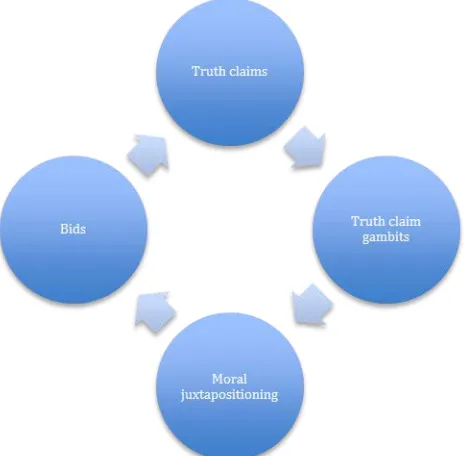
Mapping network formation is one way we might think about who is in, who is out, and what strategies each side employs to either reach out, or alternatively, to position the “Other” as unreasonable and irrational. It is quite clear from our analysis that small schools activists appear to be working very hard to establish networks and to be brought “inside” the often closed policy conversations about schools and communities. The same applies to local government bodies as well. They recognize schools as an important part of community development and sustainability, and seem to wish to forge additional links to school boards and sometimes to community activists. Of course, local governance bodies and small schools activists have no educational governance responsibility, and typically, they represent more strictly local interests. Thus, it can be easy for them to critique the job done by school boards from the outside. These groups make bids to join these official networks and these bids are accepted, rejected, and sometimes tabled for consideration. A bid is one aspect of negotiation identified by Latour and Porter (2013) in their analysis of the way that agents with differing worldviews attempt to communicate and influence the other. There are obvious power differentials in terms of which
groups are required to bid to be part of the process. When bids are accepted, the terms of engagement are still at stake.
An example of a successful bid is when the Nova Scotia Small Schools Initiative successfully argued in 2014, with the support of a school review commission, that the “community hub model” ought to be considered as a framework for protecting and maintaining small rural schools. The argument is that schools be made into multi-service community “hub” centres. This bid was accepted by the Department of Education when it accepted the school review commission’s recommendation that the province consider the hub model. The school boards were then charged with the task of setting up the criteria for the creation of hub schools. The criteria were established but have proven to be largely unworkable for most small rural community groups who see the process as yet another attempt on the part of school boards to quash the hub model. One community activist commented,
Yes they accepted the hub model. They had no idea what it is really, but they spent the summer up there in Halifax figuring out what we were talking about. They never got it. I don’t think they had any intention of creating a process that could work for these little places struggling to keep a school open. They created a policy and set the rules up so that anybody who wanted to get a hub going would have a process to follow. The thing is that the policy is so full of riders and “what ifs” that it is pretty much impossible in a small rural community to get a plan together to satisfy the criteria. But they say they have consulted us. Right.
This has led to calls for revised, and realistically workable, hub model criteria that involve the establishment of new network forms. The challenge going forward for both activists and school governance authorities is to develop these new forms in a way that supports both community development and educational improvement.
Pressing Truth Claims
What indeed is educational improvement and what is its relation to community development? We have become particularly sensitive to the way each of the players in the school closure drama use language to position the other in debates. In these debates each side speaks for other members of the network, particularly children and their interests. Each side makes what we might call truth claims, which are attempts to draw the other side into a singular “mode of existence.” This occurs through the invocation of the rules of process or through some incontrovertible standards of evidence about fundamentally contested questions concerning a number of possible areas, such as educational quality, building conditions and efficiency, reasonable bus rides, community development, education vs. training, efficient or “rational” use of resources, wasted space, equity, equality, optimum school size, etc.
So if our bureaucrats and our experts say, “we can’t afford this school anymore,” first of all we have to look at what’s good for the education of the children and what’s good for the community, to decide whether we can afford it. I saw a bumper sticker once that said, ‘if you think education is expensive try ignorance.” Right? So what is this “we can’t afford it”? I don’t understand it. We can afford a new trade and convention centre but we can’t afford education? We can’t afford to keep a small school open in a small community? We need to set priorities to decide what really is important.
One important strategy in this process is to position the other side as unreasonable, and thus, outside rationality. We refer to this as moral juxtapositioning; it is a strategy of setting up arguments and values as reasonable and rational, and characterizing the other side as incompetent, ideological, unreasonable, misguided, uninformed, partially informed, lazy, etc. The failure of the other side to understand the logic of the in-group’s claims has to do either with ignorance and/or some kind of self-interested, bad-faith position. For the school board representatives this is typically framed in terms of a community’s inability to see the big picture of school governance. School boards are charged with the responsibility of allocating resources in a fair way across the geography of governance. For local activists though, the problem is framed differently. Here, the view is that school boards dismiss or ignore the quality of the local school; they overlook its importance to the community and essentially cut off the potential for future growth on the strength of evidence that is either incorrect or irrelevant. This is considered by activists to be irresponsible governance and serves to inform their own truth claims.
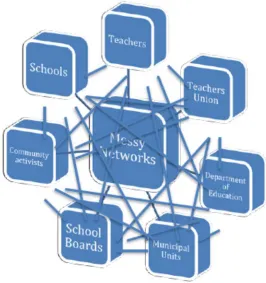
Each of the lines in Figure 1 and the complex of lines that make up a network or a potential network represent the possibility of connection in what we call the contact zone. The contact zone is a space of policy development and where governance mandates are enacted. While there has always been friction and tension in struggles over which values are promoted and authorized in policy (Easton, 1979), historically, the contact zone between nodes in the school governance network has been one where school boards have held authority. This authority is tenuous because—as the school board representatives were very quick to point out to us—the process is subject to political “interference.” As such, community activists can exercise influence on elected politicians, which has led to school board decisions about school closure being overturned. The contact zone we are imagining is a dialogical space in which truth claims might be debated and standards of evidence negotiated rather than imposed.
Terms of Engagement in the Contact Zone
clearly made by people whose work involves the technical aspects of running physical plants and transportation services. The terms of engagement here are constructed in technical terms and concern “wasted” or “excess” space/capacity, bussing routes, and pupil/teacher ratios (which often get framed in equality and sometimes in equity terms). These arguments buttress and support other arguments about the superior quality of education in larger schools.
On the side of the community activists, the assumption is that communities will be diminished if not destroyed by the removal of a school. This is the argument that schools can actually save communities by providing a key service that young families require close to home. Thus, young families will be more likely to think seriously about relocating to a community. Other arguments drawn on by activists concern their right to participatory democratic governance, the educational quality found in small schools, and equity arguments.
It is interesting to consider how the arguments around equity can also be framed in terms of offering additional support to rural communities in order to attract new people. Small class sizes and a cozy close-knit and/or specialized school with low pupil/teacher ratios could actually be used as part of a strategy for attracting in-migrants. What school boards do not wish to entertain are discussions of either school quality or the purpose of schools under the umbrella of broader concerns such as community, rural, and social development. Maintaining boundaries between educational questions (i.e. system questions) and these broader concerns is a way for school boards to protect their territory. It is also a way to legitimize their decision-making process through an agenda concerned with providing services to the individual child whose interests are drawn into system discourse. This focus on individual rights is the neoliberal strategy for lifting school and other public policy debates out of the messy processes of social development and political questions. Schooling here is defined in terms of “choice” rendering the discussion depoliticized and removed from a broader analysis of social questions. It becomes a more technical, quantifiable discussion of curriculum, assessment, provision of infrastructure, bussing, etc. The subsequent quotation illustrates the form of rationality that, in the view of this particular official, eventually cuts through the emotional content and opposition, co-opting
those who opposed “planning” on what is defined as reactionary grounds. The official comments,
…we didn’t have an agenda, other than the fact that we knew we would need to do planning, because we have continuing and declining enrolment and we would need to address it somehow. What we wanted was their input about how. We’ve learned from these experiences as we’ve gone along, but this was our first go. So, the first round of consultation was not all that fruitful. We did get some strong reactions like, “you’re going to close our school,” and we’re talking about a group of schools but you have people coming and saying, “you’re going to close my school.” And yes we did have to listen to that aspect when it wasn’t even there. So then what we did, the feedback we did get, we took it and put together a series of possibilities of what could happen, and in some cases there were quite a few and in some there were fewer. In one community it was really around consolidating the two big schools. The high school and the middle school because we had two big buildings and we only needed one. And interestingly enough, that one became not about a school closure but “which school gets closed?”
This is one vision of a rational process and school board representatives seem to have difficulty understanding how the process could be made much better. The process, they claim, is reasonable and rational and it allows both the board and community representatives to marshal evidence, make cases for various options, and discuss them in an open process. The process is made irrational according to them only where ideologically motivated or emotional individuals and arguments are allowed to derail things by presenting non-negotiable and zero-sum positions. From the perspective of community activists, the process is irrational because the evidence they are presented with by the boards tends, in their view, to be flawed and aimed at closing schools. They claim that the process is designed to allow boards to simply present their own case (or indeed present a flawed case) to support a pre-existing agenda or at best to support a process that makes their schools look underutilized, architecturally inappropriate and/or unsound, and inequitably resourced vis a vis larger schools with more students.
Each side makes different sorts of truth claims with distinct standards of evidence. This problem is taken up by Latour and Porter (2013) who use the concept of modes of existence to capture the coherent systems of logic which are employed by communities, or groups who share the same structure of thinking about a particular problem. When they encounter people who have a different way of approaching the problem then the conversation tends to get very sticky. Latour and Porter (2013) have an interest in looking at the ways that these various modes of existence come into contact with one another and interact: they frame these value interfaces as the key location of political struggle today using the climate change issue as their focal example. This contact zone is the new networked space of the social where people with very different world views confront one another and succeed or fail to find ways to bridge into one another’s worlds. It is by now inevitable that the contact zone broadens and becomes more salient to political debate because more people have access to information about the dealings of the other. In any event, the ability of expert and political groups to hide behind the authority of superior knowledge is significantly eroded in a networked world where information flows widely and relatively unchecked.
Power and Relationality
close schools and the responsibility to operate the ones they keep open. This is an important measure of power, and one that the recent commission on school review process recommended be left alone. But this power is troubled by the many voices that enter the arena to contest the authority of the school board to act on its mandate. The legitimation crisis represented by recent battles around school closure are not likely to go away, at least in part because it is now more difficult to abstract school questions out of broader discussion of rural social and economic development. Furthermore, nobody really has the power to impose final answers to questions about the role of the school in rural development. It is harder for any single group—including community activists—to remain aloof from the complex nest of questions that confront rural Nova Scotia. These include dysfunctional municipal governments, and a rural population that remains, in certain respects key respects, not fully integrated into the provincial economic and social mainstream.
A central purpose of this research is to think about how we might theorize space relationally rather than through sets of more or less distinct geographies. This theme has been featured prominently both in the school review process undertaken in Nova Scotia by Robert Fowler (Government of Nova Scotia, 2014a) and within the Ivany Commission’s (Government of Nova Scotia, 2014b) wider mandate, which was to investigate the Nova Scotia economy much more broadly. In both of these cases, the concept of relationality is at the heart of the deliberations. Both ask, in slightly different ways, how agencies, governance bodies, and ordinary Nova Scotians learn to discuss contentious questions productively.
Rittell and Webber (1973) pointed out more than four decades ago that there has been a shift in the way professionals and those who claim authority are increasingly beset by critical questions and resistance. The linear way of thinking about governance as though it were a simple technical-rational problem to be solved procedurally and not relationally is, they claimed, virtually impossible to sustain. The silent citizen-consumer of top-down governance mandates is one part of the problem. In the case of school closure debates, the usually docile rural citizenry gets engaged. This causes problems for authorities that are accustomed to operating without significant critique or scrutiny. Historically these governance bodies have not had to think systematically about how to network with activist groups because those groups were not generally able to organize, network, and communicate well with one another. Today that has changed as the rise of the Nova Scotia Small Schools Initiative illustrates. What is clear is that the traditional way of governing schools now is at least problematic, if not dysfunctional. One of the key points of disagreement between activists and governance people concerns whether or not the current system is workable, efficient, and democratic.
Conclusion: Latour and Porter’s Modes of Existence
contingency of action. This we believe is the kind of language we need to move toward if we are to have any hope of solving the wicked problem of what to do about schooling in small rural communities.
Latour and Porter (2013) begin by speaking to the switch from the relatively mechanistic and linear thinking associated with economy to the interconnected, messy, relational thinking associated with ecology as being emblematic of the kind of philosophical shift from structures to networks required today. How domains are connected is more important here than how they are separate. They argue that cartographic metaphors and organizational charts need to be replaced by those of network. Latour and Porter’s (2013) project is to develop an anthropology that takes seriously the pressing need to develop novel and complex ways of speaking across the many different modes of existence that are brought together via increasingly sophisticated scapes and flows. Regardless of what these emerging spaces of communication and negotiation are called, the emphasis on relationality and networks is crucial.
Mobile, networked modernity throws together people and systems that had, until quite recently (a few decades really), managed to exist in more or less self-referential nation states and regional territories. These have been shattered in many respects, although elements of their authority remain. What is different is that it is becoming increasingly difficult for people to exist without talking to one another and for power to be exercised behind a wall of legitimate authority. For instance, the geographic and social isolation of rural citizens is mitigated by the compression of space and the network potential of modern communication technologies. These changes have energized many rural citizens’ groups that demand involvement in the process of governance. This is what is illustrated in our interviews in this project so far. Ordinary citizens desire talk across boundaries, differences, and modes of existence to share governance. Furthermore, these citizens want assistance with the navigation of pressing collective wicked problems that range from how to exist in multicultural spaces, how to secure food and energy, how to develop cities and rural communities, and to how to interpret and respond to climate change. Here we are left in a more self-conscious post-structural universe which is one that takes the form of an agora where actors promote their ideas, debate them, and potentially take up the hard work of trying to talk seriously with one another across difference. Retreating into modernist, top-down, data-driven quantitative policy frameworks is not likely to lead to satisfactory governance.
If we have learned anything from the past couple of decades of struggle over small rural schools, it is that there is no single framework that can adequately address the concerns brought to the table by differently positioned players with diverse worldviews. Small schools activists do not have a partial understanding of the matters affecting small schools while the school board people have a fuller one. These ordinary rural citizens have a completely formed ontology, a mode of existence that is coherent, and worthy. Yet the process around school closure has tended to disrespect or dismiss these views as heart-felt but emotional and irrational. We conclude here that it does not serve democracy to define such views out of bounds. Latour and Porter (2013) refer to “passes” and “bridges” as the metaphors we need today to work on our wicked problems. What are the points where we can cross over into one another’s territory and think with the other?
The 19th century problems concerning what to do with the experience of the perceiving
accomplish this transcendence, and, as Latour (2007) has shown in his sociology of science, this is a messy enterprise. As Latour and Porter (2013) put it, we have “dreamed matter into existence” (p.124) as though it were separate from our experience of it. We have devised as well a set of other political practices and juridical modes of proof that lend the same kind of desire for the transcendence of experience to the distribution of power and justice. What we end up with here though, according to Latour and Porter (2013) is a “dangerous amalgam” of knowledge and politics where one mode (the rational/scientific) can claim hegemony and dismiss other modes as irrational, naïve, lying, misguided, partial, etc. In questions of governance, “the moderns are those who have kidnapped science to solve a problem of closure in public debate” (Latour & Porter, 2013, p.129). The question of the small rural school, at least at this point, has not been solved or silenced by any calculus. Complicated, messy and difficult conversation is a better hope.
Acknowledgments
The authors would like to acknowledge the support of the Social Sciences and Humanities Research Council of Canada for the funding of this research.
References
Adsit, T. (2011). Small schools, education and the importance of community: Pathways to improvement and a sustainable future. Lanham, MA: Rowman Littlefield.
Aberg-Bengtsson, L (2009). The smaller the better? A review of research on small rural schools in Sweden. International Journal of Educational Research, 48(2), 100-108.
Anderson, M., & White, S. (2011). Resourcing change in small schools. Australian Journal of Education, 55(1), 50–61.
Atlantic Health Promotion Research Centre. (2003). RCIP: Painting the Landscape of Rural Nova Scotia. Retrieved August 21, 2015, from http://www.ruralnovascotia.ca/RCIP/RuralReport.htm
Autti, O., & Hyry-Beihammer, E. K. (2014). School closures in rural Finnish communities. Journal of Research in Rural Education, 29(1), 1-17.
Bagley, C., & Hillyard, S. (2011). Village schools in England: At the heart of their community?, Australian Journal of Education, 55(1), 37–49.
Bell, A. B., & Sigsworth, A. (1987). The small rural primary school: a matter of quality. London, UK: Falmer.
Bell, D., & Jayne, M. (2010). The creative countryside: Policy and practice in the UK rural cultural economy, Journal of Rural Studies, 26(3), 209-218.
Bell, M. M. (2007). The two-ness of rural life and the ends of rural scholarship. Journal of Rural Studies, 23(4), 402-415.
Bennett, P. (2011). Vanishing schools, threatened communities. Black Point, NS: Fernwood Publishing. Bennett, P. (2013). The last stand: Schools, communities and the future of rural Nova Scotia. Halifax,
NS: Fernwood Publishing.
Boler, M. (Ed.). (2004). Democratic dialogue in education: Troubling speech, disturbing silence. New York, NY: Counterpoint.
Carr, P., & Kefalas, M. (2009). Hollowing out the middle: The rural brain drain and what it means for America. Boston, MA: Beacon.
Ching, B., & Creed, G. (1997). Knowing your place: Rural identity and cultural hierarchy. New York, NY: Routledge.
Toronto, ON: Canadian Centre for Policy Alternatives.
Clarke, S., & Wildy, H. (2011). Improving the small rural or remote school: The role of the district. Australian Journal of Education, 55(1), 24–36.
Coladarci, T. (2007). Improving the yield of rural education research: An editor’s swan song. Journal of Research in Rural Education, 22, 1–9.
Corbett, M. (2001). A protracted struggle: Rural resistance and normalization in Canadian educational history. Historical Studies in Education/Revue D’histoire de L’éducation, 13(1), 19-48.
Corbett, M. (2006). Educating the country out of the child and educating the child out of the country: An excursion in spectrology. Alberta Journal of Educational Research, 52(4), 289-301.
Corbett, M. (2007). Learning to leave: The irony of schooling in a coastal community. Black Point, NS: Fernwood Publishing.
Corbett, M. (2007). Travels in space and place: Identity and rural schooling. Canadian Journal of Education, 30(3), 771-792.
Corbett, M. (2009). Assimilation, resistance, rapprochement, and loss: Response to Woodrum, Faircloth, Greenwood, and Kelly. Journal of Research in Rural Education, 24(12), 1-7. Retrieved from
http://jrre.vmhost.psu.edu/wp-content/uploads/2014/02/24-12.pdf
Corbett, M. (2009). Rural Schooling in Mobile Modernity: Returning to the Places I’ve Been. Journal of Research in Rural Education, 24(7), 1-13.
Corbett, M. (2013). Improvisation as a curricular metaphor: Imagining education for a rural creative class. Journal of Research in Rural Education, 28(10), 1-11.
Corbett, M. (2014). Toward a geography of rural education in Canada. Canadian Journal of Education/Revue Canadienne de L’éducation, 37(3), 1-22.
Corbett, M. (2014). The ambivalence of community: A critical analysis of rural education’s oldest trope. Peabody Journal of Education, 89(5), 603-618. http://doi.org/10.1080/0161956X.2014.95653 Corbett, M. (2015). Towards a rural sociological imagination: ethnography and schooling in mobile
modernity. Ethnography and Education, 10(3), 1-15. http://doi.org/10.1080/17457823.2015.1050685
Dowling, J. (2009). Changes and challenges: Key issues for Scottish rural schools and communities, International Journal of Educational Research, 48(2), 129-139.
Easton, D. (1979). A Systems analysis of political life. Chicago, IL: University of Chicago Press.
Edvardsen, E. (1988/2011). Grassroots resistance: School and livelihood in a North Norwegian coastal community circa 1850-1900. Oslo, SE: Solum Forlag.
Egelund, N., & Lausten, H. (2006). School closure: What are the consequences for the local society? Scandinavian Journal of Educational Research, 50(4), 429-439.
Epp, R., & Whitson, D. (2001). Writing off the rural West: Globalization, governments and the transformation of rural communities. Edmonton, AB: University of Alberta Press.
Fenwick, T., & Edwards, R. (2010). Actor-Network Theory in education. New York, NY: Routledge. Forsey, M. (2014). Learning to stay: Mobile modernity and the sociology of choice, Mobilities, doi
10.080/17450101.2014.927202.
Green, B., & Letts, W. (2007). Space, equity and rural education: A trialectical account. In K. Gulson, & C. Symes (Eds.), Spatial theories of education: Policy and geography matters (pp. 57-76). New York, NY and London, UK: Routledge.
Green, B., Reid, J., Cooper, M., Hastings, W., Lock, G., & White, S. (2010). Regenerating rural social space: Teacher education for rural-regional sustainability. Australian Journal of Education, 54(3), 262-276.
Greenwood, D. (2009). Place, survivance, and White remembrance: A decolonizing challenge to rural education in mobile modernity. Journal of Research in Rural Education, 24(10), 1-6.
Haan, M., Walsh, D., & Neis, B. (2014). At the crossroads: Geography, gender, and the occupational sector in employment related geographic mobility. Canadian Population Studies, 41(3-4), 6-21.
Habermas, J. (1999). Between facts and norms: Contributions to a discourse theory of law and. democracy. Cambridge, MA: Massachusetts Institute of Technology Press.
Halsey, R. J. (2011). Small schools, big future. Australian Journal of Education, 55(1), 5–13. Hamilton, S. (2007). The little black school house. Maroon Films. Retrieved from
https://maroonfilmsinc.wordpress.com/2014/12/04/the-little-black-school-house/
Heley, J., & Jones, L. (2012), Relational rurals: Some thoughts on relating things and theory in rural studies. Journal of Rural Studies, 28(3), 208–217.
Howley, C. (1997). How to make rural education research rural: An essay at practical advice. Journal of Research in Rural Education, 13(2), 131-138.
Howley, A., Howley, M., Hendrickson, K., Belcher, J., & Howley, C (2012). Stretching to survive: District autonomy in an age of dwindling resources. Journal of Research in Rural Education, 27(3), 1-18. Howley, C., & Howley, A. (2006). Small schools and the pressure to consolidate. Educational Policy
Analysis Archives, 14(1), 1-28.
Howley, C. and Howley A. (2010). Disabusing small-schools reformism: An alternative outlook on scaling up and down. In P. Kocacks (Ed.), The Gates Foundation and the Future of US “Public” Schools (pp. 104-125). New York, NY and London, UK: Routledge.
Howley, C., & Eckman, J. (1997). Sustainable small schools: A handbook for rural communities. Washington, WA: ERIC Clearinghouse.
Huggins R., & Clifton N. (2011). Competitiveness, creativity, and place-based development. Environment and Planning A, 43(6), 1341-1362.
Jackson, A. (2010). Fields of discourse: A Foucauldian analysis of schooling in a rural, US southern town. In K. Schaaft, & A. Jackson (Eds.), Rural education in the 21st century (pp. 72-93). College Park, PA: Penn State University Press.
Kalaoja, E., & Pieterinen, J. (2009). Small rural primary schools in Finland: A pedagogically valuable part of the school network. International Journal of Educational Research, 48(2), 109-116.
Kearns, R., Lewis, N., McCreanor, T., & Whitten, K. (2009). “The status quo is not an option”: Community impacts of school closure in South Taranaki, New Zealand. Journal of Rural Studies, 25(1), 131-140. Kelly, U. (2009). Migration and education in a multicultural world: Culture, loss, and identity. New
York, NY: Palgrave.
Kelly, U. (2009). Learning to lose: Rurality, transience, and belonging (A companion to Michael Corbett). Journal of Research in Rural Education, 24(11), 1-4.
Kilpimaa, M., Maatta, K., & Uusiautti, S. (2012). What is the future of village schools? A case study on the life cycle of a school in northern Finland, Review of European Studies, 4(1), 125-137.
Kvalsund, R. (2009). Centralized decentralization or decentralized centralization? A review of newer Norwegian research on schools and their communities. International Journal of Educational Research, 48(2), 89-99.
Larsen, S., & Johnson, J. (2012). Toward an open sense of place: Phenomenology, affinity, and the question of being. Annals of the Association of American Geographers, 102(3), 632-646.
Law, J. (2004). After method: Mess in social science research. London, UK/New York, NY: Routledge. Latour, B. (2005). Reassembling the social: An introduction to Actor-Network-Theory. New York, NY:
Oxford University Press.
Latour, B., & Porter, C. (2013). An inquiry into modes of existence: An anthropology of the moderns. Cambridge, MA: Harvard University Press.
Lefebvre, H. (1990). The production of space. Malden, MA: Blackwell.
Levin, B. (2011). Steps to effective and sustainable public education in Nova Scotia: Report to Nova Scotia Department of Education. Halifax, NS: Nova Scotia Department of Education.
74(2), 328–341.
Markey, S., Halseth, G., & Manson, D. (2008). Challenging the inevitability of rural decline: Advancing the policy of place in northern British Columbia. Journal of Rural Studies, 24(4), 409–421. Massey, D. (2005). For space. London, UK: Sage.
Meusburger, P. (2005). The future of elementary schools in Alpine regions. Journal of Alpine Research, 93(2), 75-94.
Moreira, P. (2009). Backwater: Nova Scotia's economic decline. Fredericton, NB: Nimbus. Nash, R. (1986). Schooling in rural societies. London, UK & New York, NY: Routledge.
Onescu, J. (2014). The impact of a rural school’s closure on community resilience. Leisure/Loisir, 38(1), 35-52.
Pinar, W. (2004). What is curriculum theory? New York, NY: Routledge.
Portelli, J., & Menashy, F. (2010). Individual and community aims in education. In R. Bailey, R. Barrow, D. Carr, & C. McCarthy (Eds.), Sage handbook of the philosophy of education (pp, 415-434). London, UK/Thousand Oaks, CA: Sage.
Ranciere, J. (2007). On the shores of politics. London, UK: Verso. Ranciere, J. (2006). Hatred of democracy. London, UK: Verso.
Reid, J. A., Green, B., Cooper, M., Hastings, W., Lock, G., & White, S. (2010). Regenerating rural social space? Teacher education for rural–regional sustainability. Australian Journal of Education, 54(3), 262-276
Riordan, M. (1996). Out our way: Gay and lesbian life in the country. Toronto, ON: Between the Lines. Rittel, H. W. J., & Webber, M. M. (1973). Dilemmas in a general theory of planning. Policy Sciences, 4(2),
155-169.
Semke, C. & Sheridan, S. (2012). Family–school connections in rural educational settings: A systematic review of the empirical literature. School Community Journal, 22(1), 21-43.
Standing Senate Committee on Agriculture and Forestry. (2008). Beyond freefall: Halting rural Poverty. Ottawa, ON: Senate Reports – 39th Parliament.
Shamah, D. (2011). Supporting a strong sense of purpose: Lessons from a rural community. New Directions for Youth Development, 132, 45–58.
Shiller, J. (2011). Marketing small schools in New York City: A critique of neoliberal school reform. Educational Studies, 47(2), 160-173.
Smit, R. & Humpert, W. (2012). Differentiated instruction in small schools. Teaching and Teacher Education, 28(8), 1152-1162.
Strauss, A., & Corbin, J. (1990). Basics of qualitative research: Grounded theory procedures and techniques. Newbury Park, CA: Sage.
Soja, E. (1989). Postmodern geographies: The reassertion of space in critical social theory. London, UK: Verso.
Soja, E. (2010). Seeking spatial justice. Minneapolis, MN: University of Minnesota Press.
Somerville, M., & Rennie, J. (2012). Mobilising community? Place, identity formation and new teachers’ learning. Discourse, 33(2), 193-206.
Stevens, K. J. (2003). Open learning to sustain rural schools: The replication of a three-stage model. New Zealand Annual Review of Education, 12, 173-186.
Stevens, K. (2011). Organizational, pedagogical and conceptual changes in the provision of education in rural New Zealand and Atlantic Canadian communities. Journal of Rural and Community
Development, 6(2), 170-182.
Theobald, P. (1997). Teaching the commons: Place, pride, and the renewal of community. Boulder, CO: Westview Press.
Thomson, P. (2000). “Like schools,” educational “disadvantage” and “thisness.” The Australian Educational Researcher, 27(3), 157-172.
NSW: Allen & Unwin.
Tieken, M. (2015). Why rural schools matter. Chapel Hill, NC: University of North Carolina Press. Vander Ark, T. (2002). The case for small high schools, Educational Leadership, 59(5), 55-59.
Wagner, T. (1997). The new village commons-improving schools together. Educational Leadership, 54(5), 25-29.
Wallin, D. (2007). Policy window or hazy dream? Policy and practice innovations for creating effective learning environments in rural schools. Canadian Journal of Educational Administration and Policy, 63, 1-22. Accessed on 5 September 2015 at:
https://www.umanitoba.ca/publications/cjeap/pdf_files/wallin.pdf
Wallin, D., & Reimer, L. (2008). Educational priorities and capacity: A rural perspective. Canadian Journal of Education, 31(3), 591–613.
Wang, J., & Zhao, Z. (2011). Basic education curriculum reform in rural China: Achievements, problems, and solutions. Chinese Education and Society, 44(6), 36-46.
Notes
1 In this study we use the terms small school, rural school, and small rural school. By small school we refer to schools that enroll fewer than 100 students, which is the definition that has been used by the Nova Scotia Department of Education for supplementary funding. By rural schools, we refer to those schools serving students who live in communities that are defined as rural by Statistics Canada. Small rural schools are those schools meeting both criteria.
2 As one reviewer correctly points out this is one face of a larger problem that has been extensively discussed in political theory and it fundamentally concerns how in a democracy it is possible to see the world from the perspective of the other. There are diverse views on this question, some of which argue from a critical perspective that ultimately such encounters are fundamentally about power; thus, bridges that cross the gaps between world views are virtually impossible to achieve. While discourse across difference is unquestionably messy and difficult, we hold to the view that it is not impossible. Our argument is (and thanks again to this reviewer) that innovative and generous moves need to be made to even achieve a baseline level of agreement on the nature of wicked problem at hand.
3 In the Nova Scotian context, these administrative units include the provincial Department of Education, regional school boards, and local school councils, all of which have particular governance responsibilities. In recent years an increasingly coordinated and active group of small schools activists (the Nova Scotia Small Schools Initiative) has grown to prominence in the province (Bennett, 2013). These local activists who may or may not serve on school councils are networked into an organization of small school activist/promoters who have formed a provincial umbrella group. As Figure 1 below illustrates, complex networks of influence and interest have grown up around the small schools issue. At this point in the analysis we are not suggesting what form innovative spaces for better conversations might take, only that such spaces are at least imaginable and necessary.
Michael Corbett is Professor of Rural and Remote Education at the University of Tasmania. Corbett’s research investigates the way we think about rural space, and how this thinking influences education policy, teacher education, and literacies.