Experimental Study of Effect of Nanoparticles
Addition on Combustion Phasing In Diesel Engine
Abdulkhodor Kathum Nassir Haroun A. K. Shahad
[email protected] [email protected]Department of Mechanical Engineering Babylon University
Babylon-Iraq
Abstract-- This experimental work aims to examine the effect of
nanoparticles added to diesel fuel on combustion phasing. Nano fuels is prepared by adding Al2O3 or TiO2, both with particle size less 45nm to diesel fuel. Four doses for each one namely (25, 50, 100 and 150) ppm are prepared. These nanoparticles are blended with diesel fuel in varying volume fraction by the means of an electrical mixer and an ultrasonicator. Physicochemical properties of Nano fuels are measured and compared with neat diesel. Their stability characteristics were analyzed under static conditions. The Nano fuels are (DF+Al2O3) and (DF+TiO2). The study shows that the addition of nanoparticles to diesel fuel improves in physical properties such as cetane number where it increases from 51.6 to 54.3 for Al2O3 at 150ppm. Also Comparisons of fuel properties without and with nanoparticles additives (Al2O3 and TiO2) are presented. The influence of nanoparticles addition is very clear on the delay period and the heat release fractioning (premix and diffusion). The results show that the delay period decreased with increasing of nanoparticles addition. The maximum reduction is with 25ppm TiO2 is around (0.55CA) at full load. The reduction in the delay period means reducing the heat release in the premix stage of combustion and increasing the heat release in the diffusion stage combustion. The heat released decreased in premix combustion stage with both nanoparticles particularly in 25ppm as compared to pure diesel. Also the heat release decreased in diffusion combustion with both of them as compared to pure diesel. The reduction in premix fraction with Nano fuels(DF+Al2O3) and (DF+TiO2) is (0.3367%) and(4.125%) respectively for 25ppm at 25% load, while the increasing in diffusion fraction for Al2O3 and TiO2 for 25ppm and 25% load is(0.1422%) and(1.742%) respectively.
Index Term--Delay period, Premix, Diffusion, Nano fuel.
1.INTRODUCTION
The compression ignition engines are widely used due to its reliable operation and economy. As the petroleum reserves are depleting at a faster rate due to the growth of population and the subsequent energy utilization, engine performance, heat release pattern engine emission characteristic need to be improved. The increasing use of diesel combustion for powering automobiles has led to considerable activity in methods for the reduction of particulate emissions. Diesel engines are one of the major contributors to the emissions such a hydrocarbons, particulates, nitrogen oxides, and Sulphur oxides. These emissions are very harmful to human beings and also responsible for acid rain and photochemical contamination and hence subject to strict environmental legislation (12). Efforts were also made for the reformulation of diesel fuel to reduce these harmful emissions without changing the physicochemical properties of fuel such
as viscosity, flash and fire point, density and cetane number. Among these techniques available to reduce exhaust emissions, the use of fuel+nanoparticles catalyst is currently focused on due to the advantage of increase in fuel burning efficiency while reducing harmful greenhouse gas emissions and the health-threatening chemicals such as NOx, particulate matter, CO, UHC, smoke opacity and CO2 .The use of nanoparticles
as additives to diesel fuel is a promising method for improving the efficiency and improving the exhaust emissions of a CI engine. The Al2O3 and TiO2 acts as an oxygen donating
catalyst and provides oxygen for the oxidation of CO or absorbs oxygen for the reduction of NOx. The influence of Al2O3 additive on diesel particle emissions and oxidation
was studied by Salero (1). The size of nanoparticles added was 10nm. This addition led to enhancements of the combustion features and a reduction in the formation of carbon monoxide. Also improved combustion stability and thermal efficiency. Rolvin et.al (2), studied experimentally the influence of addition of titanium oxide (TiO2) nanoparticle to
diesel fuel in a compression ignition engine. The properties of neat diesel were improved 'with addition of nanoparticles such as viscosity, density, fire point. Brake thermal efficiency was improved while the brake specific fuel consumption was reduced by 22%. Emissions such as (UHC) and (CO) were decreased by8% and 25% respectively. Soner Gumus et.al (3), gave an experimental comparison between the addition of AlO3 and CuO to neat diesel on the performance and emission
of compression ignition engine. They found that Al2O3 and
CuO reduced the brake specific fuel consumption by 0.5% and 1.2% respectively. The reduction of emission of UHC and (NOx) with addition of Al2O3 and CuO was 13% and 6%
respectively. The reduction of emission of carbon monoxide (CO) with addition of Al2O3 and CuO was11% and 5% respectively. The reduction of emission of UHC and (NOx) with
addition of CuO was 8% and 2% respectively. Sajith et al [4] investigated the effect of cerium oxide nanoparticles on performance and emissions of diesel engine. Their results showed an increase in engine efficiency by 5% and a reduction of HC and NO𝑥 emissions by 45% and 30%, respectively. Arul et al (5), investigated the effect of CeO2 nanoparticles on the
emission and performance of compression ignition engine. The CeO2 nanoparticles(25ppm) acts as an oxygen donating catalyst
and supply O2 for the oxidation of carbon monoxide(CO) and
reduce of NOx. They also found that the addition of CeO2
0.358(kg/kW.hr). The heat release rate as 70J/CA for (DF+25ppm CeO2) and around 60J/CA for pure diesel. Babu
k.R. and Raja R.B. (6), studied theoretically and experimentally the effect of nanoparticles Al2O3 additive on the
performance and emission of compression ignition engine, with dosages 25ppm, 50ppm and 75ppmFlash point increased from 55C° (diesel) till 62C (diesel+75ppm Al2O3).Peak pressure
increased from 54 bar (diesel) to 58 bar for (DF+75ppm).Brake thermal efficiency increased to 39.6% at full load. The lowest smoke is observed as 80 ppm for the DF+75ppm Al. Carbon monoxide and UHC decreased. CO2 slightly increased but it decreased at full load.
Saraee et al. (7), reduced the emission and consumption in the diesel in C.I engine, the nanoparticle could help the fuel droplets furthers penetrate in the compressed air during the spraying. Nano particle which was used is cerium and aluminum with different dose. Decreasing in UHC, CO and NOx28%, 20.5% and 13% respectively. The brake specific fuel
consumption reduces to 6%.
Karthikeyan et al. (8) examined experimentally the effect of mixing of (ZnO) zine oxide with biodiesel fuel (canola oil methyl ester) on combustion, performance and emission characteristics. Three doses of ZnO were used namely 50, 80 & 100 ppm. The diesel fuel was mixed with 20% biodiesel. Brake thermal efficiency is increased, while BSFC is decrease. There was a reduction in concentration of UHC, CO and smoke, but NOx concentration. The maximum cylinder pressure is higher
with (ZnO). The highest heat release rate is observed as 95.93kJ/m3.deg for ZnO Nano additive (100ppm) blend.
Jeryajkumar et al (9), study for improving the performance on compression ignition diesel engine by the addition of nanoparticles such as cobalt oxide(Co3O4) and
titanium oxide(TiO2) with 50mg/l nanoparticles dosing to
calophyllurn iodophile biodiesel. Brake specific fuel consumption (BSFC) with the cobalt oxide (Co3O4) and the
titanium oxide (TiO2) resulted in 4%, 2% reduction
respectively. Also (Co3O4) blended with biodiesel shows 7%
increase in Brake thermal efficiency (BTE) as compared to pure biodiesel. By adding cobalt oxide (Co3O4) and (TiO2) there was
30% and 25% reduction in CO. There was a reduction in (UHC) with (Co3O4) and (TiO2) resulted in 80%, 70% respectively.
2. EXPERIMENTAL SETUP
Experiments were conducted to study the effect of nanoparticles addition on combustion phasing of a single cylinder 4-stroke water-cooled direct injection diesel engine with a displacement volume of (553 cm3), variable compression
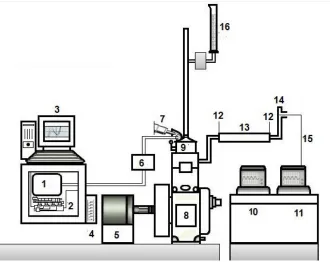
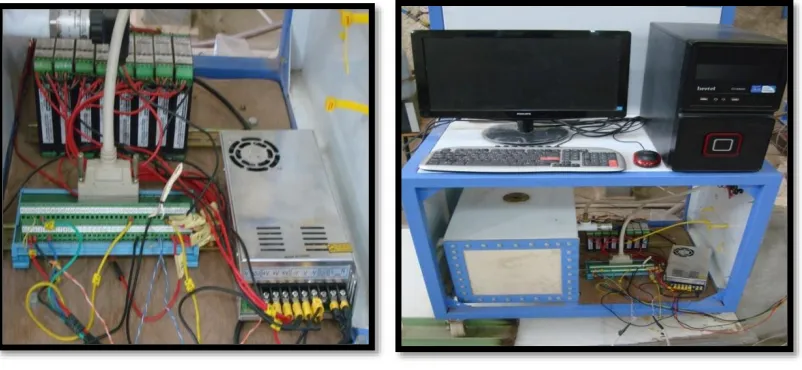
ratio, developing 3.7 kW at 1500 rpm with a dynamometer is used in the present research work. The engine is fitted with a conventional fuel injection system, which has a three hole nozzle of 0.2mm diameter separated at 120 degrees, inclined at an angle of 60 degrees to the cylinder axis. The injector opening pressure recommended by the manufacturer is 120 bar. As shown in plate (1-1).
Fig. 1-1. Schematic diagram of experimental set up.
Table 1-1
Definition of parts of the system of figure (1-1)
Data acquisition and engine control system. The engine control system based on a purpose built microprocessor controller and specially developed software which allowed variation of
Plate 1-2. Data Acquisition System 3.FUEL AND NANO FUEL PREPARATION
The fuel used in this study is gas oil (diesel) C12.3H22.2, density is 844.3 kg/m3, dynamic viscosity 2.778*10-3(kg/m.s).
Two types of nanoparticles are chosen namely Al2O3 and TiO2 with particle size less than 45nm. The nanoparticle dose was
chosen to be 25, 50, 100 and 150ppm.The mass of nanoparticles required for each dose is calculated using equation (1-1)
)
1
1
(
f f p p
p p
m
m
m
Where:
(ɸ) Solid volume fraction of nanoparticles mp: mass of nanoparticle
ρp: density of nanoparticle
mf: mass of fuel
ρf: density of fuel
The physical properties of the nanoparticles and pure diesel fuel used to prepare to Nano fuel are shown in table (1-2) (11).
Table 1-2
Shows the physical properties of nanoparticles and gas oil(11)
Thermal
conductivity(W/m.°C) Specific
heat(kJ/kg.K) Dynamic viscosity*103
(kg/m.s) Density (kg/m3)
Subject
40 765
--- 3970
Al2O3
9 710
--- 4230
TiO2
--- ---
2.778 844.3
Gas oil (Diesel)
Table (1-3) shown the mass of nanoparticles required for each dose of both types and the required mass is measured by digital balance.
The table (1-3)
Shows our result (for five liter of fuel)
Volume ratio by part per million(ppm)
%
ɸ Mass of particles(mp)
(g)(Al2O3)
Mass of particles(mp)
(g)(TiO2)
25 0.0025 0.4963 0.529
50 0.005 0.993 1.058
100 0.01 1.986 2.116
The measured quantity of nanoparticles is added to five litter (5L) of diesel fuel and mixed continuously for one hour by a mixer to ensure the spreading of nanoparticles within the diesel fuel to prevent aggregation of particles quickly. Plate (1-3).
Plate (1-3). Photograph of mixer.
An ultrasonic cleaner type (JTS-1018) is used to complete the mixing process. The mixing process continues of six hours. As shown in plate (1-4).
Table (1-4)
Specifications of ultrasonic cleaner bath.
4.RESULTS
4.1Effect of nanoparticles on physical properties:-
A-Viscosity:
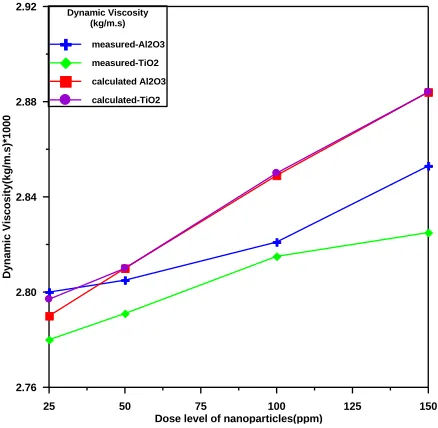
The effect of nanoparticles (Al2O3, TiO2) dose level on the viscosity of the diesel is shown in fig (1-2). The dynamic viscosity
of DF+Al2O3 is bigger than the dynamic viscosity of DF+TiO2.
Fig 1-2. Variation of the dynamic viscosity with nanoparticles dose.
25 50 75 100 125 150
Dose level of nanoparticles(ppm) 2.76
2.80 2.84 2.88 2.92
D
y
n
a
m
ic
V
is
c
o
s
it
y
(k
g
/m
.s
)*
1
0
0
0
Dynamic Viscosity (kg/m.s)
measured-Al2O3
measured-TiO2
calculated Al2O3
B- Density:-
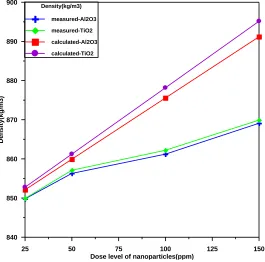
The effect of nanoparticles (Al2O3, TiO2) dose level on the density of the diesel is shown in
Fig. (1-3).
Fig. 1-3. Variation of the density with nanoparticles dose.
C- Cetane number
The cetane number is improved to DF+Al2O3 as compared to pure diesel.The cetane number for DF+Al2O3 and pure diesel is
51.6 and (54.3 at 150ppm) respectively. Also the cetane number is 53.3 at 150ppm for DF+TiO2 as shown in fig. (1-4).
Fig. 1-4. Variation of the cetane number with nanoparticles dose.
25 50 75 100 125 150
Dose level of nanoparticles(ppm) 840
850 860 870 880 890 900
D
e
n
s
it
y
(k
g
/m
3
)
Density(kg/m3)
measured-Al2O3
measured-TiO2 calculated-Al2O3 calculated-TiO2
25 50 75 100 125 150
Dose level of nanoparticles(ppm) 51.50
52.00 52.50 53.00 53.50 54.00 54.50
C
e
ta
n
e
n
u
m
b
e
r
Cetane number
diesel+Al2O3
D- Flash point and fire point
The effect of nanoparticles (Al2O3, TiO2) dose level on the flash point and fire point of the diesel is shown in fig (1-5). The
flash point of DF+Al2O3 is bigger than the flash point of DF+TiO2 and the same of fire point.
Fig. 1-5. Variation of flash point and fire point with nanoparticles dose.
4.2 Effect of nanoparticles addition on maximum pressure
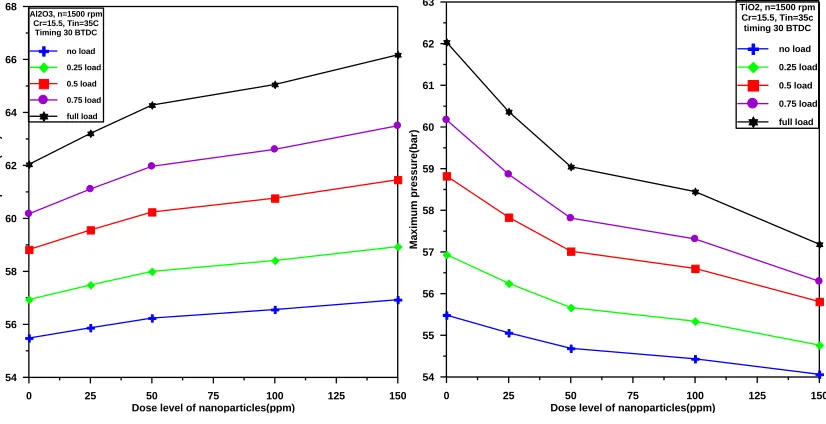
The maximum pressure is increased with Al2O3, but it is decreased with TiO2 due to the shorting in the premix stage and there is not enough heat release at the end of the premix stage. Figs 1-6 and 1-7 is shown variation the maximum pressure with the nanoparticles dose.
Fig. 1-6. Variation of Pmax with nanoparticles dose. Fig. 1-7. Variation of Pmax with nanoparticles dose.
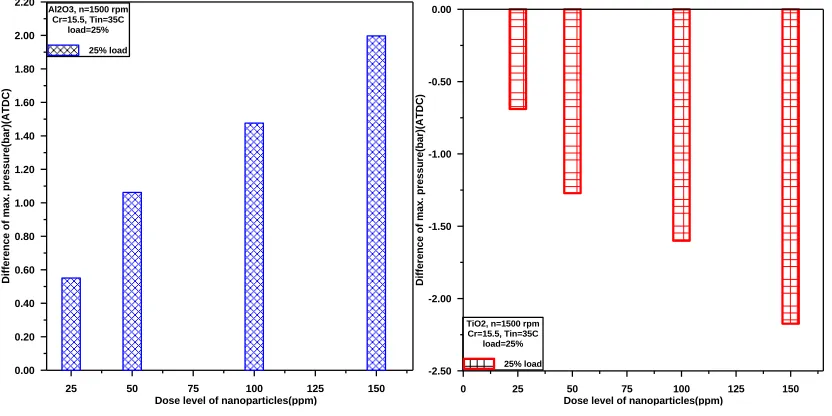
Figs (1-8) and (1-9) show the variation of the differences of maximum pressure with the timing ATDC with nanoparticles dose. It is clear the position of maximum pressure approaches of the ATDC with Al2O3, but with TiO2 be a bit faraway of ATDC
0 25 50 75 100 125 150
Dose level of nanoparticles(ppm) 54
56 58 60 62 64 66
T
e
m
p
e
ra
tu
re
(C
)
Flash point(C) and Fire point(C)
Flash Al2O3 Fire Al2O3 Flash TiO2 Fire TiO2
0 25 50 75 100 125 150
Dose level of nanoparticles(ppm) 54
56 58 60 62 64 66 68
M
a
x
im
u
m
p
re
s
u
re
(b
a
r)
Al2O3, n=1500 rpm Cr=15.5, Tin=35C
Timing 30 BTDC
no load
0.25 load
0.5 load
0.75 load
full load
0 25 50 75 100 125 150
Dose level of nanoparticles(ppm) 54
55 56 57 58 59 60 61 62 63
M
a
x
im
u
m
p
re
s
s
u
re
(b
a
r)
TiO2, n=1500 rpm Cr=15.5, Tin=35c timing 30 BTDC
no load
0.25 load
0.5 load
0.75 load
Fig. 1-8. Variation of ΔPmax with nanoparticles dose Fig. 1-9. Variation of ΔPmax with nanoparticles dose.
4.3 Effect of nanoparticles on the delay period
It is defined as the duration between start of injection and start of ignition, the value of delay period is around (10-15) CA. Generally the delay period decreases with increases of load, speed and compression ratio. It is clear the effect of nanoparticles additive on the delay period, with both nanoparticles (Al2O3 and TiO2), but the reduction with TiO2 is
bigger than the reduction with Al2O3, the reduction is 0.1CA
and 0.55CA at 25ppm and full load respectively. The main reason of that the viscosity of DF+Al2O3 is bigger than the
viscosity of DF+TiO2 [4]. In 25ppm of TiO2 is the biggest
effect, after that the delay period increased, but with the Al2O3
generally keep decreasing for all doses. Fig (1-10) and (1-11) shows the delay period with respect to nanoparticles dose level.
4.4 Effect of the nanoparticles on the heat release and combustion phasing
Experimentally, it is observed that the reduction in the heat release in premix combustion with the TiO2 more the reduction
with the Al2O3 due to reduce the delay period. The reduction
of heat release in premix forAl2O3 and TiO2 around 8.54% and
26.38% at full load and 25ppm respectively. The reduction of heat release in diffusion combustion for Al2O3 and TiO2 at
25 50 75 100 125 150
Dose level of nanoparticles(ppm) 0.00 0.20 0.40 0.60 0.80 1.00 1.20 1.40 1.60 1.80 2.00 2.20 D if fe re n c e o f m a x . p re s s u re (b a r) (A T D C )
Al2O3, n=1500 rpm Cr=15.5, Tin=35C
load=25%
25% load
0 25 50 75 100 125 150
Dose level of nanoparticles(ppm) -2.50 -2.00 -1.50 -1.00 -0.50 0.00 D if fe re n c e o f m a x . p re s s u re (b a r) (A T D C )
TiO2, n=1500 rpm Cr=15.5, Tin=35C
load=25%
25% load
0 25 50 75 100 125 150
Dose level of nanoparticles(ppm) 9 10 11 12 13 14 D e la y P e ri o d (C A )
Delay period, Al2O3 n=1500 rpm, Cr=15.5
Tin=35C no load 0.25 load 0.5 load 0.75 load full load
0 25 50 75 100 125 150
Dose level of nanoparticles(ppm) 9 10 11 12 13 14 D e la y P e ri o d (C A )
Delay period, TiO2 n=1500 rpm, Cr=15.5
Tin=35C no load 0.25 load 0.5 load 0.75 load full load
Fig. 1-11. Variation of the delay period with respect to nanoparticles dose level.
25ppm and full load is 7.31% and 20.68% respectively. Also the rate of heat release at full load and 25ppm for pure diesel, (DF+Al2O3) and (DF+TiO2) is 840, 755 and 636 J/CA
respectively.
Premix Fraction
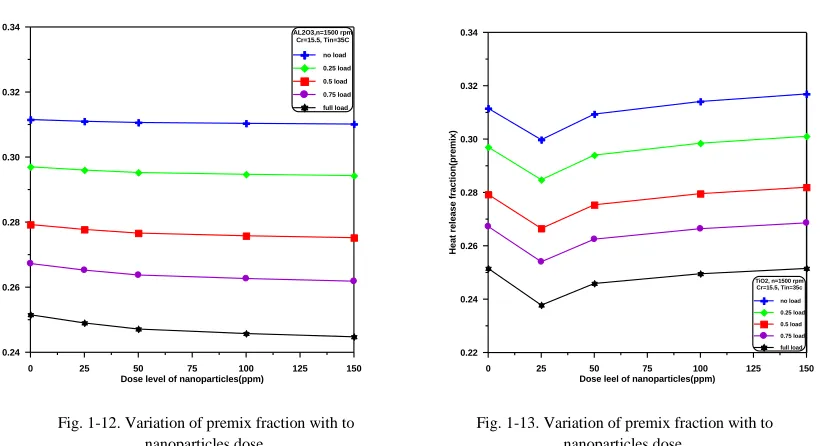
The premix heat released fraction for DF+Al2O3 decreased with
increased of the doses of nanoparticles and the reduction of the premix fraction of DF+Al2O3 and DF+TiO2 (at full load and
25ppm) is 0.99% and 5.47% respectively. Figs 12) and (1-13) show premix fraction with nanoparticles dose.
The diffusion heat released fraction for DF+Al2O3 increases with increasing of nanoparticles dose and the increasing of the
diffusion fraction of DF+Al2O3 and DF+TiO2 (at full load and 25ppm) is 0.33% and 1.84% respectively. Figs 14) and
(1-15) show diffusion fraction with nanoparticles dose.
0 25 50 75 100 125 150
Dose level of nanoparticles(ppm) 0.24 0.26 0.28 0.30 0.32 0.34 H e a t re le a s e f ra c ti o n (p re m ix ) AL2O3,n=1500 rpm Cr=15.5, Tin=35C no load 0.25 load 0.5 load 0.75 load full load
0 25 50 75 100 125 150
Dose level of nanoparticles(ppm) 0.68 0.70 0.72 0.74 0.76 0.78 H e a t re le a s e f ra c ti o n (d if fu s io n )
Al2O3w, n=1500 rpm Cr=15.5, Tin=35C no load 0.25 load 0.5 load 0.75 load full load
0 25 50 75 100 125 150
Dose level of nanoparticles(ppm) 0.68 0.70 0.72 0.74 0.76 0.78 H e a t re le a s e f ra c ti o n (d if fu s io n )
TiO2, n=1500 rpm Cr=15.5, Tin=35C no load 0.25 load 0.5 load 0.75 load full load
0 25 50 75 100 125 150
Dose leel of nanoparticles(ppm) 0.22 0.24 0.26 0.28 0.30 0.32 0.34 H e a t re le a s e f ra c ti o n (p re m ix )
TiO2, n=1500 rpm Cr=15.5, Tin=35c no load 0.25 load 0.5 load 0.75 load full load
Fig. 1-12. Variation of premix fraction with to nanoparticles dose.
Fig. 1-13. Variation of premix fraction with to nanoparticles dose.
Fig. 1-14. Variation of the diffusion fraction with nanoparticles dose.
5.CONCLUSIONS
1. The effect of Al2O3 is more noticeable than the
effect of TiO2 on viscosity, the biggest different is
clear in 150ppm.
2. The effect of Al2O3 is bigger than TiO2 on both
temperatures.
3. The cetane number:-The effect of nanoparticles (Al2O3) is bigger than the effect of TiO2.The
density of(diesel+Al2O3) is lower than the density
of (diesel+TiO2) in both cases(measured and
calculated)
4. The peak pressure for Al2O3, TiO2 and pure diesel
(at full and 150ppm) is 66.2, 57.2 and 62.034 bar respectively.
5. Delay period:-The reduction with TiO2 is bigger
than the reduction with Al2O3, the reduction is
0.1CA and 0.55CA at 25ppm and full load respectively.
6. The reduction of the premix fraction of DF+Al2O3
and DF+TiO2 (at full load and 25ppm) is 0.99%
and 5.47% respectively.
7. The increasing of the diffusion fraction of DF+Al2O3 and DF+TiO2 (at full load and 25ppm)
is 0.33% and 1.84% respectively.
REFERENCES
[1] Solero, G., “Experimental analysis of the influence of inert Nano-additives upon combustion of diesel sprays”. Nanoscience and Nanotechnology, [2012]. 2(4), pp. 129- 133. [2] Rolvin D'Silva, Binu K.O, Thirumaleshwara Bhat.,
“Performance and Emission characteristics of a C.l. Engine fuelled with diesel and Ti02 nanoparticles as fuel additive” [2015].
[3] Gumus, S., OL.C8n, H., Ozbey, M and Topaloglu, B., “Aluminum oxide and copper oxide Nano diesel fuel properties and usage in a compression ignition engine” [2016]. Fuel, 163, pp.80-87.
[4] Ajjin c. sajeevan and v.Sajith. “Engine emission Reduction using catalytic nanoparticles an experimental investigation”. Hindawi publishing corporation, Journal of Eng[2013]. Vol (1) page 9.
[5] Arul M.S. V,Anand R.B.,Udayakumar M. “Effects of cerium oxide nanoparticle addition in diesel and diesel-biodiesel-ethanol blends on the performance and emission characteristics of a ci engine”. ARPN Journal of Engineering Lind Applied Sciences, 2009, 4:1-6.
[6] Babu K.B. ”Theoretical and Experiment validation of performance and emission characteristics of Nano additive blended diesel engine”. Int. Jou. of Researching Aeronautical and Mech. Eng. [2015].Vol.3 Issue.5.pp. (3-8)
[7] Saraee, S., H., Jafarmadar, S., Taghavifor, H., Asharfi, S.J. “Reduction of emissions and fuel consumption in compression ignition engine using nanoparticles” Int. Joar. Of Environmental Sci. and Tech. july 2015, V12 pp, 2245-2262. [8] Karthikeyan, A. Elango and A. pathima Diesel engine performance and emission analysis using canola oil methyl ester with the Nano sized zinc oxide particles. Indian Journal of Eng. [2013] and materials science vol. 21, pp.83-87. [9] Jeryrajkumar, L, Anbarasu, G. and Elangovan, T., “Effects on
Nano Additives on Performance and Emission Characteristics of Calophyllim inophyllum Biodiesel”. [2016]. International Journal of Chem. Tech. Research, 9(4), pp.210-219.
[10] Aboud E. D.,” Theoretical and Experimental Analysis of Hydrogen-Diesel Blended Fuel Engine”, ph.d. thesis (mechanical engineering) in university of babylon 2016. [11] Al-Ali N. A. A. ”Heat transfer enhancement in a uniformly
heated tube using Nano fluids”, M.Sc. dissertation (Mechanical Engineering) in Babylon University 2014. [12] Mehta, R.N., Chakraborty, M. And Parikh, P.A., “Nano
fuels Combustion, engine performance and emissions”. Fuel 2014: 120, pp.91-97.
[13] Nasir A.K. "Experimental Study of Effect of Nano-Particles Addition to Diesel Fuel on Heat Release and Emission Characteristics of Diesel Engine" M.Sc. dissertation (Mechanical Engineering) in Babylon University 2018.