Handover Control for
Heterogeneous Wireless Access Systems
Farhan Qamar , Asim shahzad and Dr Adeel Akram
University of Engineering and Technology Taxila Pakistan
Abstract--
The convergence of various wireless access technologies has always been a difficult assignment because of the fact that they have emerged independently. Future vision of wireless world is an integrated network of different wireless access technologies with improved system resource s utilization anywhere, anytime. WLANs are expected to complement cellular networks such as 2G or 3G in near future. Cellular networks facilitate users with high mobility but less data rate (2 Mbps) as compared to WLAN systems having higher data rate (54Mbps) but less mobility (100m). From the users’ standpoint, the convergence of WLAN and cellular systems together will help to have combined benefits from both technologies. It pledges for a renewed aim beyond 3G, to support at least: 1Gbps bandwidth in low-mobility coverage area, and 100 Mbps peak bandwidth in full mobility mode. The seamless and capable handoff between different access technologies also known as vertical handoff is crucial and remains a testing problem. In this paper, vertical handoff procedure in location-aware heterogeneous wireless access network is being proposed. An outline for the examination of vertical handoff algorithm sensitive to various mobil ity parameters including velocity, FS L and RS S threshold is simulated. Moreover, it is targeted to estimate the performance of vertical handoff in terms of RS S (received signal strength) measurement in converged wireless network with appropriate propagation model and is validated by the results of the simulations.
Index Term
--
LAN, 2G, 3G, Vertical Handoff, Propagation model, RS S measurement.I. INTRODUCTION
Modern day revolution in Telecommunication is a result of the improvement and explosion of wireless and mobile technologies in recent past. However, as far as data services are concerned, „Ubiquitous connectivity‟ needs to be fulfilled yet. Future Convergent wireless networks envision different types of wireless networks having varying access bandwidth and coverage area. One of the most attractive approaches in Heterogeneous wireless access network is to exploit high bandwidths available in wireless local area network (WLAN) for movable users in „hotspots‟ and switch to cellular networks (CN) in low coverage WLAN area or conversely for WLAN having bad network conditions. This switching also known as inter-technology handoff, or Vertical Handoff (VHO), takes place when the mobile user moves among different access technologies. The main difference between vertical handoff and horizontal handoff (HHO) is symmetry. VHO is an asymmetric process in which the mobile user
moves between two different networks with different characteristics. Next Generation networks are intended to integrate vast coverage area provided by cellular systems and higher bandwidth offered by Wlan to provide maximum utilization of resources. „Seamless Vertical Handoff‟ stands as one of the key challenges for beyond 3rd generation (B3G) networks.
Requirement for Handoff arises either due to mobile user‟s movement or because of hostile individual or adjacent cell condition. [8,9]. Critical handoff metrics involved in handoff include RSS (Received Signal Strength), Bandwidth, Latency, Cost of bandwidth, Services at the network, Power consumption, Connection setup time, Load at the access point etc.[7] VHO constitutes 3-step: initiation; decision and execution procedure. VHO initiation mainly measures on of the handoff metrics . VHO decision engine examines the existing network connection, and based on the handover metric it selects the most suitable network to handover. VHO execution ensures that newer connections establishment. A suitable „Path loss propagation model‟ serves as Controlling Factor for System performance or coverage and is u seful in predicting signal attenuation or path loss to estimate better channel signal reception. [6]
This paper provides an analytical and a simulated model by implementation of a seamless vertical handoff procedure and algorithm for the handoff transition between WLAN, EDGE and W-CDMA data networks.
After introduction, the second section discusses propagation model for wireless access networks . Third Section provides performances of wireless networks using RSS as handover metric. Section 4 discusses the
VHO scheme for converged networks. In concluding Section 5 the performance of the heterogeneous wireless network is evaluated in light of the results of the simulated model.
II. PROPAGATION MODEL FOR WIRELESS ACCESS
NETWORKS
strength weakens as the mobile user moves farther from the serving node and conversely it gets stronger as the user moves near to the serving node. The moving-in – moving-out scenario introduced in this section is employed for the analysis of roaming between two networks with significant different data rates.
A. CELLULAR NETWORK
As far as cellular network is concerned, the propagation characteristics for Macro cells are quite intricate as it gets affected by reflection from ground, vegetation, high-rise buildings and moving vehicles.
The received signal strength for cellular network is expressed in dBm as:
Pcellular =PTrans + GTrans − PLoss−C [6] Where, Pcellular is CN Signal strength in dBm, PTrans is transmitted power in dBm, GTrans is Gain of transmitting antenna gain in dB, PLoss is total path loss in dB and C is connector and cable loss in dB.
Okumura-Hata model [6] takes urban areas as a reference and applies correction factors to calculate Path Loss values. For Urban Areas, Path loss value is given:
PLoss = K1 + K2 log10 R – K3 [6] K1 = 26 log10 fc + 69.5 – 13.82 log10 hb
K2 = 45 – 6 log10 hb
K3 = 3.2 (log10 (11.7554 hm)) 2 – 4.97 for large cities, fc ≥
300MHz
K3 = 8.29 (log10 (1.54 hm)) 2 – 1.1 for large cities, fc <
300MHz
Micro cells, on the other hand, span only up to a kilometer or so and are within a small confinement. Path loss in Micro cells can be calculated suing Dual slope empirical model based on signal strength measurement and is in fact quite similar to the Okumura-Hata model for a range of circumstances. The path loss in dB for cellular network in micro cell environment is given by:
PLoss = 10n1 log10 r + R1 [6]
Where R1 = reference path loss at r =1 m
B. WIRELESS LOCAL AREANETWORK
Owing to the prohibitive cost of building wired network infrastructures, WLAN technology has arisen on the worldwide market scale. Modern day WLAN is simpler and scalable. It exists with relative ease of integrating wireless access technology and is ability to roam within their existing network resources. Especially for Hotspots, Cellular networks could integrate WLAN as an additional service.
The received signal strength for WLAN is expressed in dBm as:
Pwlan = PTrans − PLoss [6]
Where, Pwlan is received signal strength of WLAN in dBm,
PTrans is the transmitted power, PLoss is total path loss in dB. Log-linear path loss propagation model incorporating shadow fading is given by:
PLoss = LC +10 nlog (dist) + Shadow [6]
where LC is constant power loss, n is path loss exponent with values varying between 2 to 4, dist represents the distance between the mobile user and WLAN access point (AP) and Shadow represents shadow fading which is modeled as Gaussian with mean μ=0 and standard deviation σ with values between 6-12 dB depending on the environment. Incase RSS is below a certain interface sensitivity level the mobile terminal is needs to get handed-over to the cell having better channel conditions.
C.
T
HE CONVERGENT HOT-SPOTThe convergence of WLAN and cellular data will facilitate users to have wireless higher bandwidth data access in localized hot-spots, and to enable users to have normal data rates using cellular networks in non-hotspot areas . The concept of a “Mobile” Hot- Spot would provide transitory hot-spot that is rapid to set-up and swift to flatten. Instead of a customary hot-spot which is coupled via a wired interface, a Convergent hot-spot is linked by a wireless interface. Such topology enables to provide swift high-bandwidth wireless data access anyplace, at anytime. However, one of the major bottlenecks is the fact that cellular interface such as GPRS, EDGE or UMTS is much time-consuming than the WLAN mode. It can be addressed by deploying inverse multiplexing as well as combining numerous voice channels together to achieve enhanced data rate. A trade-off decision of this will demand reduced number of voice trunks in cellular networks and will be made by service provider.
III. VERTICAL HANDOVER PROCESS
Vertical handoff from WLAN to cellular network such as GPRS, EDGE or UMTS, is mainly initiated when the user is not in coverage area. Received signal strength gets weakened as WLAN user moves away from Access Point. A Handoff initiation request to cellular network is made once the user detects the RSS is below a certain WLAN RSS Threshold value. The cellular network will accommodate to accept the request only if it has sufficient channels available to it else the user gets disconnected. Conversely, Cellular network to WLAN handoff occurs to exploit lesser costs or to have higher data rate services or to lessen network congestion. The user requesting vertical handoff from cellular network to WLAN is usually within cellular network coverage area as WLAN being smaller in coverage is located within a single cellular cell. If handoff request is acknowledged by WLAN, connection with cellular network gets broken and the user starts working within WLAN network. Provided WLAN for some reason do not accept the handoff request, the user will continue to operate in it original connection of cellular network as it had been operating in its footprint. Thereby, the user stays connected to the system and in essence, no blocking gets resulted once the user performs handover from cellular network to WLAN area.
thresholds for CN and WLAN access network respectively. Typical value for RSSCN in cellular network link is about -101 dBm subject of network conditions. Moreover, signal threshold level is about -80 dBm for the user moving from Cellular network to WLAN case. Conversely, for the user moving from WLAN to Cellular network has a typical signal threshold value of about -85dBm.The RSSwlan(x) and RSScn(x) are existing Received signal strengths for WLAN and cellular network at the position „x‟. Dwlan and DCN are the distance handover thresholds for WLAN and cellular network respectively. Dwlan(x) and DCN(x) are the current distances with respect to position „x‟.
Equation required for a handoff from cellular network to WLAN is given below:
RSSwlan(x) ≥ RSSwlan and Dwlan(x) ≤Dwlan
In above, RSS and distance threshold for cellular network is not considered once the user moves to WLAN; the reason being the higher priority of WLAN network: once above condition is satisfied, handoff will occur.
Equation required for a handoff from WLAN to cellular network is given below:
RSScn(x) ≥RSScn & DCN(x) ≤DCN & RSSwlan(x) ≤RSSwlan
In above case all the mentioned conditions are necessary to meet to trigger the handoff from WLAN to cellular network. Algorithm
Cycle:
Block Diagram: (For analysis model & result justification)
IV. PERFORM ANCE ANALYSIS and SIM ULATION
RESULTS
The simulation set-up comprises of using Convergent Hotspot to augment the performance of an existing cellular network and is applied for intense urban surroundings where bandwidth obligations are at their peak. The problem is quantified by having a simulated environment of a cellular network that may comprise of an EDGE or UMTS network along with WLAN hot spot nearby. Our analysis with small amendment is applicable to 802.11a network as well; owing to physical layer resemblance [10]. A deterministic propagation model uses demographic data to provide channel information predicting received power, frequency and spatial separation for the network. The performance of different convergent hotspot incorporating cellular network and WLAN is calculated using the set of input parameters as given in Table1: All the parameters are self-selectable.
TABLE I
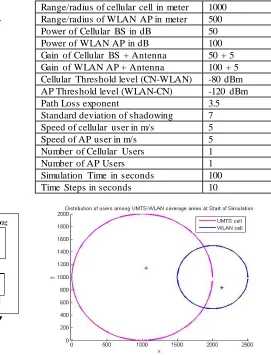
Simulation modeling offers the user to choose between any of the wireless access network between EDGE, UMTS and WLAN. For the Single User case in convergent WLAN-3G environment, Matlab Simulation results based on T able 1 are given as under. Initial position for the users is depicted as below:
Range/radius of cellular cell in meter 1000 Range/radius of WLAN AP in meter 500 Power of Cellular BS in dB 50
Power of WLAN AP in dB 100
Gain of Cellular BS + Antenna 50 + 5 Gain of WLAN AP + Antenna 100 + 5 Cellular Threshold level (CN-WLAN) -80 dBm AP Threshold level (WLAN-CN) -120 dBm
Path Loss exponent 3.5
Standard deviation of shadowing 7 Speed of cellular user in m/s 5
Speed of AP user in m/s 5
Number of Cellular Users 1
Number of AP Users 1
Simulation Time in seconds 100
Time Steps in seconds 10
During simulation user travels at random with respective velocity and having estimated environmental condition. Green highlighted is the handed-over
Final position of the users at the end of simulation is:
Measured Mean RSS for UMT S user during each time step is shown. T hresholds of both networks are also given.
T otal T ime Spent by both WLAN and UMT S user is given below:
T he exact time positioning of Handover of UMT S user is
Comparative analysis of WLAN user is depicted below:
T he exact location of the time positioning during handover is given below separately for each:
For the Multiple Users case in convergent WLAN-3G environment: Initial position for the 10 users in each network is given below:
Final position of the users at the end of simulation is:
Cellular handovers from UMT S to WLAN are given below:
Cellular handovers from WLAN to UMT S are given below
WLAN handovers from WLAN to UMT S are given below
CONCLUSIONS
This paper provides an analytical and a simulated model by implementation of a seamless VHO procedure and algorithm for the handoff transition between WLAN, EDGE and CDMA cellular networks; based on user input. In the handoff algorithm we use the number of uninterrupted beacon signals whose signal strength from the WLAN, EDGE or CDMA falls below the predefined threshold value. Moreover, for Each User in each network :: Number of HOs performed, Time Spent in each Network, Dropped Users Ratio and initial / final position are calculated. Future task is to simulate the Heterogeneous networking method architectures based on different aspects such as Bandwidth, Latency, cost of bandwidth, Services at the network, Power consumption, Connection setup time or Load at the access point. Moreover, Multimode Hosts Evolution and Multi-Services based on ABC are the new avenues to be explored further.
REFERENCES
[1] T . Al-Gizawi, R. Pin tenet , J.Gosteau, F.Lazarakis, K.Peppas and A.Alexiou, “Evaluation of interoperability mechanisms for coexisting HSDPA and WLAN enhanced with MT MR techniques”, IEEE 58th VehicularT echnology Conference, Vol.3, pp 1807 -1811, 2003. [2] Ahmed H.Zahram, Ben liang and Aladdin Dalch, “Signal threshold
adaptation for vertical handoff on heterogeneous wireless networks”, ACM/Springer Mobile Networks and Applications (MONET ) journal, Vol.11, No.4, pp 625-640, August 2006.
[3] Kaveh Pahlavan and Prashant Krishnamurthy, “Principles of Wireless Networks”, PHI, 2002.
[4] T .S. Rappaport, “Wireless Communications”, Pearson Education, 2003. [5] A. Doufexi, E. T ameh, A. Nix, S. Armour and A. Molina, “ Hotspot wireless LANs to Enhance the Performance of 3G and Beyond Cellular Networks”, IEEE Communication Magazine, Vol. 41, pp. 58 – 65, July 2003.
[6] Sylvain Ranvier, S-72.333 Physical layer methods in wireless communication systems
[7] Ken-Ichi, Itoh, Soichi Watanche, Jen-Shew Shih and T akuso safo, “Performance of handoff Algorithm Based on Distance and RSS measurements”, IEEE Transactions on vehicular T echnology, Vol. 57, No.6, pp 1460-1468, November 2002.
[8] T omar G.S and Verma. S, “ Analysis of handoff initiation using different path loss models in mobile communication system”, Proceedings of IEEE International Conference on Wireless and Optical Communications Networks, Bangalore, India, Vol. 4, May 2006. [9] Armoogum.V, Soyjaudah.K.M.S, Mohamudally.N and Fogarty.T ,
“Comparative Study of Path Loss using Existing Models for Digital T elevision Broadcasting for Summer Season in the North of Mauritius”, Proceedings of T hird Advanced IEEE International Conference on T elecommunication, Mauritius, Vol. 4, pp 34-38, May 2007. [10] A. Doufexi, S. Armour, P. Karlsson, M. Butler, A. Nix, D. Bull, J.