National Conference on Advances in Engineering and Applied Science (NCAEAS) 29th January 2018
Organized by : Anjuman College of Engineering and Technology (ACET) Nagpur, Maharashtra, India, In association with
International Journal of Scientific Research in Science and Technology
Ergonomic E- Bike
Aniket Rajeyya1, Dhanshri Dhoke1, Mangala Shende1, Najiya Sayyad1, Neha Satpute1, Prajwal Band1,
Saif Khan1, Prof. Mohd. Safique Memon2
1Student Anjuman College Of Engineering and Technology, Nagpur, Maharashtra, India 2Professor Anjuman College Of Engineering and Technology, Nagpur, Maharashtra, India
ABSTRACT
Bicycles have always a popular mode of transportation due to their low cost, ease of use, health benefits and mobility. Their drawbacks however include a low practical range, Increased effort compared to a car, and safety concerns in urban areas. A fully sustainable electric bike will be created which will not address a regular bicycle’s drawbacks but includes features to it to make it more appealing to people that normally would not consider commutating on e-bike. This relationship allows for more practical range of the bike while assisting the user with additional torque during all phases of acceleration rather than just using a throttle control located at the handle which is similar to the normal electrical bike. A normal throttle control however will be included for when the user decides not to use this feature and rely solely on the motor for torque. An Arduino board to communicate with an application device for displaying the battery charge status, temperature and speed. There will be solar panel connected to it to charge the battery. A USB charger will also will be included in addition to “wall outlet” so that the user may charge mobile devices while using the bicycle. To address safety concerns, head lamps, tail lights, a horn, LEDs and turn signal will be included. The bike will be made from lightweight aluminum with custom design brackets. When the bike is not in use the battery which is charged by using solar power and can be used to run household applications. It also consists of solar charge controller which will control and display the parameters of solar panel mounted on the top of the bike.
Keywords: Self Charging, motor controller, voltage regulator, Arduino (LCD display), Inverter, lead acid battery, DC gear head motor (Permanent Magnet DC Motor)
I.
INTRODUCTION
Now a day’s world’s market is full of motorcycles, mopeds and cars which are some or the other way are responsible for environmental pollution. Pollution is one of the major crises that world is facing today. Each fuel vehicle purchased has raised pollution to the dangerous level. We are also aware of the rapid increase in price of the petrol. Also, it is not possible for all the classes of the society to purchase vehicles such as mopeds, bikes, scooters
etc. Bicycle is an ecofriendly vehicle and can be an option but the efforts required is more. People get tired after riding a bicycle even at short distance. People all over the world are becoming increasingly aware of the environment impact of vehicles. This Ergonomic e bike is a solution to the planet.
is one of the best way to move from conventional method to renewable resource which will help to establish sustainable development. Further it is also a low-cost alternative to an automobile.
There are two sources of power in this bike .one is solar panel which will charge the battery. The power module is controlled by microprocessor (Arduino). Various parameters such as temperature, voltage, speed, battery percentage etc. will be displayed on small LCD. Which will help the rider to monitor the status of the bike. When bike will be on standby condition then the power in the battery can be used to run home appliances through inverter in emergency conditions.
E-BIKE
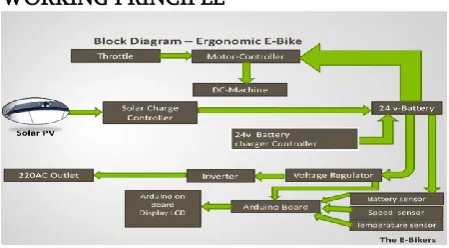
An electric bike also known as e-bike or booster bike with an integrated electric motor which can be used for electric propulsion. For the power source of electric motor certain country used different power because it depends on the laws of the country. It is not included in transportation law which require the certification and operation as on good motor vehicle. There is no need to have license to ride the e bike. Figure 1 shows the block diagram of ergonomic e –bike. It consists of following components (Figure 1) – DC motor, solar panel, lead acid battery, Arduino, solar charge controller, inverter, charger.
WORKING PRINCIPLE
Figure 1. Block diagram of E-Bike
The above block diagram gives an overview of the working of Ergonomic e bike. Solar power is the main source of energy. Solar energy is captured by solar panel and is converted into electrical energy. Solar charge controller will manage the power going into the battery form the solar array. The electrical energy thus formed is being fed to the batteries that get charged and is to run 24 V DC motor. There will be a motor controller which will control the variance of the voltage. The shaft of the motor is connected to the rear wheel of the vehicle through chain sprocket. A small LCD will display the parameters like battery percentage, speed temperature and voltage through Arduino. It also consists of inverter which can be used to run home appliances in emergency condition.
COMPONENTS OF ERGONOMIC E-BIKE
1.DC gear head motor (Permanent Magnet DC Motor)
In our project we are using dc motor which converts direct current electrical energy into mechanical energy. It works on the principle that “whenever current carrying conductor is placed in a magnetic field it experiences a mechanical force.” A dc motor’s motor speed can be controlled over a wide range by varying voltage. We are using motor controller to control the speed of the motor which works on the PWM method. Dc motor provide high efficiency and reliable performance. A gear assembly has been attached to the motor. The gear assembly help in increasing the torque. With proper combination of gears desirable speed can be obtained. E- bike has front gear with 28 teeth and back gear with 18 teeth.
Speed & Torque of the Driven shaft. Ratio of the teeth can be selected to increase or decrease speed or torque to the driven shaft
Figure 2. Chain Sprocket
Figure 3. Chain Drive
2. SOLAR PANEL
Solar panel absorb the sunlight as a source of energy to generate electricity. Photovoltaic modules use light energy from the sun to generate electricity through the photovoltaic effect. The majority of modules use wafer based crystalline silicon cell or thin film cells. The structural member of a module can either be the top layer or the back layer. Cells must also be protected from mechanical damage and moisture. Most modules are rigid, but semi flexible ones are available, based on thin film cells. Modules electrical connection are made in series to achieve
A desired output voltage and in parallel to provide a desired current capability.
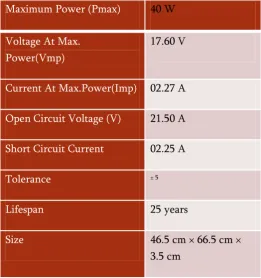
Table 1: Specifications of Solar Panel
Maximum Power (Pmax) 40 W
Voltage At Max. Power(Vmp)
17.60 V
Current At Max.Power(Imp) 02.27 A
Open Circuit Voltage (V) 21.50 A
Short Circuit Current 02.25 A
Tolerance ± 5
Lifespan 25 years
Size 46.5 cm × 66.5 cm ×
3.5 cm
Figure 4. Solar panel
3. BATTERY
as it withstands slow, fast and overcharging. Also, its life cycle is long all this combine and make it optimum choice for E- bike
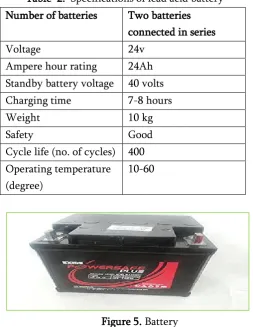
Table 2. Specifications of lead acid battery Number of batteries Two batteries
connected in series
Voltage 24v
Ampere hour rating 24Ah Standby battery voltage 40 volts Charging time 7-8 hours
Weight 10 kg
Safety Good
Cycle life (no. of cycles) 400 Operating temperature
(degree)
10-60
Figure 5. Battery
See the following equations to calculate the range from amperage and voltage:
Ah (Amp hours) × V (volts) = Wh (Watt hours)
26 Ah × 24 v = 624 Wh Motor Rating = 350 watt.
Operating Time =624Wh/350W = 1.78 Hour
4.ARDUINO MICROCONTROLLER
Arduino is an open source programmable circuit that can be integrated into a wide variety of maker space projects both simple and complex. This board contains a microcontroller which is able to be programmed to sense and control objects in the
physical world. By responding to sensors and input, the Arduino is able to interact with a large array of outputs such as LEDs, motors and displays. Specifically, we are using Arduino Uno in our project. The Arduino Uno board is a microcontroller based on the ATmega328. It has 14 digital input/output pins in which 6 can be used as PWM outputs, a 16MHz ceramic resonator, an ICSP header, a USB connection, 6 analog inputs, a power jack and a reset button. This contains all the required support needed for microcontroller. In order to get started, they are simply connected to a computer with a USB cable. The chip on the board plug straight into your USB board and support on your computer as virtual serial port. The benefit of the setup is that serial communication is an extremely easy protocol which is time-tested and USB makes connection with modern computers and makes it comfortable. It had a feature of built-in voltage regulator. Parameters like battery percentage, temperature, voltage and speed are displayed on small LCD screen for the convenience of the rider.
Figure 6. Arduino LCD
5. MOTOR CONTROLLER
Speed controllers of DC motor are very useful for controlling the robotic motion and automation systems in industry. When the DC motor is on, it takes certain time to reach at full speed. As soon as the power source is on, the DC motor starts gaining speed and if we switch off the power source before it reaches at rated speed, it starts to goes down. In quick succession of switching on and switching off are done, the motor rotates at a lower speed between zero and rated speed. So, we are using IC 555based PWM controller.
PWM have many of the characteristics of a control system. A simple method to control the speed of a DC motor is to control driving voltage, when the voltage is high the speed would be high. In many applications normal voltage control would cause lot of power loss on control system, so PWM method is mostly used in DC motor speed control application. This method work on low frequency so lower frequency is better than higher frequency. Figure 8 shows the circuit diagram of motor controller.
Figure 8. IC 555 based PWM controller
6. SOLAR CHARGE CONTROLLER
A solar charge controller manages the power going into the battery bank from the solar array. It ensures that the deep cycle batteries are not overcharged during the day, and that the power doesn’t run backwards to the solar panels overnight
and drain the batteries. Some charge controllers are available with additional capabilities, like lighting and load control, but managing the power is its primary job. A solar charge controller is available in two different technologies, PWM and MPPT.
Figure 9.Solar charge controller
7.INVERTER
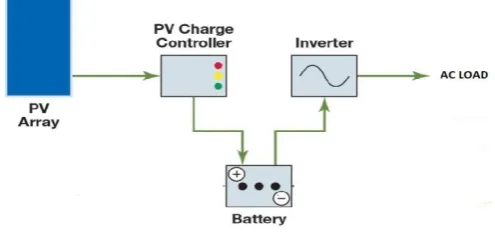
An inverter is an electrical power converter that changes direct current (DC) to alternating current (AC). Inverters are commonly used to supply AC power from DC sources such as batteries. They perform the opposite function of a rectifier. The electrical inverter is a high-power electronic oscillator. It is simply called DC to AC converters. The DC power source utilization will be used here in our e-bike because our battery will require 24V DC to 220V AC inverter.
Figure 10.Inverter connections
ADVANTAGES
3. Low maintenance cost. 4. Noise free.
5. Run on rechargeable batteries 6. Affordable price.
7. Require less human effort.
8. Leads towards the sustainable development. 9. Non-reliable on power supply.
10. The rider will be able to see the status of the bike on LCD.
DISADVANTAGES
1. solar power is not always available.
2. Components required varies with the variation in demand of the consumer.
3. There is frictional losses.
II.
RESULT and CONCLUSION
Table 3. Specifications of lead acid battery Parameter Ergonomic
e bike
Moped bicycle
Max. speed limit
35 45 10-15
Drivers pedaling requirement
nil No yes
Operating cost for 40 km.
travelling in rupees.
nil 45 Nil
Weight 70 90 15
Fuel used nil 2l nil
Type of energy used
Solar energy
Petrol Human effort
Noise level no Yes No
License required
no Yes No
Helmet required
no Yes No
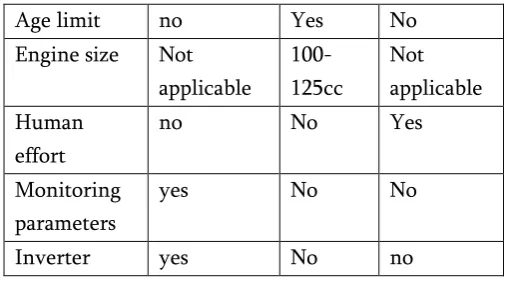
Age limit no Yes No
Engine size Not applicable 100-125cc Not applicable Human effort
no No Yes
Monitoring parameters
yes No No
Inverter yes No no
III.
CONCLUSION
Ergonomic e bike is designed considering comfort in the working environment and is driven by solar energy. It is suitable for all age groups from young to old people. It can be operated free of cost. No driving license is required to drive e-bike. It is affordable for all classes of society. Most important feature of this bike is that it does not consume fuel thereby saving money. It is ecofriendly as it does not produce any emissions. It can be recharged through adapter in case of cloudy conditions. It requires very less maintenance as compared to other vehicles. The rider is also able to check the status of the bike. Inverter is also provided so that the charged battery can be used to run the home appliances when the bike is not in use.
IV.
REFERENCES
[1]. Ajit B. Bachche, N. S. Hanamapure, Design and Development of Solar Assisted Bicycle, International Journal of Engineering and Innovative Technology (IJEIT) Volume 2, Issue 6, December 2012.
Oceanic hotel, Rio de Janeiro, Brazil, November 1-4-2016.
[3]. Jiyoung Lee, Jongmoo kiml, and Byungchul wool, Electric Motor Research Center, Korea Electro technology Research Institute (KERI), Changwon, Korea2Energy and Power Conversion Engineering, University of Science and Technology(UST), Optimal Design of In-wheel Motor for an E-Conference and Expo, Asia-Pacific(ITEC) June 1-4-2016, Busan, Korea.
[4]. Mr. Prashant Kadi Mr. Shrirang Kulkarni
Hybrid Powered Electric Bicycle IJSRD - International Journal for Scientific Research & Development| Vol. 4, Issue 05, 2016 | ISSN (online): 2321-0613.
[5]. Yogesh, jadhav, Gaurav Kale, Shekhar Manghare, Sager Patil Self Charging Electric Bicycle, International Journal on Recent and Innovation Trends in Computing and Communication ISSN: 2321-8169, Volume: 4, Issue: 4.
[6]. Ajinkya Parab, Ankit Kamath, Satwant Singh Raj purohit, Zeeshan Mulla, Urban Electric Bike International Journal for Scientific Research & Development (IJSRD), Vol.3, Issue 02,2015.
[7]. Jean-Marc Timmermans1, Julien Matheys, Philippe Latarire, Joeri van Mierlo, Jan Cappelle2 "A Comparative Study of 12 Electrically Assisted Bicycles" World Electric Vehicle Journal Vol.3- ISSN 2032-6653- © 2009 AVERE.
[8]. Ashfaq Hussain "Electrical Machine Second Edition" (Gangan kapur, Dhanpat Rai&co.2015).
[9]. Lesson 3, Understanding and Using DC Motor Specifications, gears education system.
[10]. Arduino Uno Data Sheet. Khan Masoom Raza1, Mohd. Kamil1, Pushpendra Kumar1